Class-based First-Fit Spectrum Allocation
with Fragmentation Avoidance
for Dynamic Flexgrid Optical Networks
Ramazan Yumera
, Nail Akara
, Ezhan Karasana
a
Electrical and Electronics Eng. Dept., Bilkent University, Bilkent 06800, Ankara, Turkey
Abstract
A novel Class-Based First Fit (CBFF) spectrum allocation policy is posed for dynamic flexgrid optical networks. The effectiveness of the pro-posed CBFF policy is compared against the First Fit (FF) policy for single-link and network scenarios. Throughput is shown to be consistently improved under the proposed CBFF policy with throughput gains of up to 15%, com-pared with the FF policy for the network scenarios we studied. The reduction in bandwidth blocking probability with CBFF with respect to FF increases as the link capacities increase. Throughput gains of CBFF compared with FF are more significant under alternate routing as opposed to fixed routing.
Keywords: Flexgrid optical networks, spectrum allocation, first fit,
connection blocking probability, bandwidth blocking probability
1. Introduction
Current state of the art optical transport networks employ Dense Wave-length Division Multiplexed (DWDM) transmission with per-waveWave-length ca-pacities of 10, 40, or 100 Gbps [1],[2]. Optical cross-connects (OXC) with or without wavelength conversion route the optical signal from one end point to another in DWDM networks, hence referred to as Wavelength Routed Net-works (WRN), and the path followed by the optical signal in WRNs is called an Optical Path (OP). The International Telecommunication Union (ITU) currently employs a fixed wavelength grid which divides the available opti-cal spectrum into fixed 50 GHz spectrum slots (or frequency slots). Fixed modulation formats and rigid and coarse wavelength level granularity have
been identified as the main drawbacks of current fixed grid DWDM networks [2],[3],[4],[5]. A recent paradigm, called Elastic Optical Networks or Flex-grid Optical Networks (FON), has recently emerged as a solution addressing the issues that DWDM-based WRNs raise. FONs rely on the flexgrid scheme where the available optical spectrum is divided into frequency slots that have finer spectral width compared to fixed grid; potential alternatives for the slot width are 6.25 GHz, 12.5 GHz, or 25 GHz [6]. The actual benefit of the flexgrid stems from the Liquid Crystal on Silicon (LCOS) devices by which adjacent slots can be joined together to form a multi-slot spectral block that can be dedicated to a single OP [7]. Moreover, different modulation formats, as opposed to a single standard one, can be used for different OPs in FONs. Realization of FONs using BV-Ts (Bandwidth Variable Transponder) and BV-OXCs has been demonstrated in the SLICE network using Orthogonal Frequency Division Multiplexing (OFDM) [3].
In WRNs, Routing and Wavelength Assignment (RWA) problem is in-volved in finding a route and assigning a wavelength for the OP. When the OXCs lack wavelength conversion capability, the so-called Wavelength Con-tinuity Constraint (WCC) ensures that the assigned wavelength needs to be the same on each link of the OP. The WCC constraint is replaced with the Spectrum Continuity and Contiguity Constraint (SCCC) for the Routing and Spectrum Allocation (RSA) problem in FONs. The SCCC dictates that the frequency slots dedicated to a particular OP need to be not only the same for all links along the OP (continuity constraint) but contiguous in spectrum as well (contiguity constraint). In the off-line RSA problem which is used in the design and planning stages of flexgrid networks, RSA applies to all connec-tion requests at the same time, i.e., static traffic scenario. The off-line RSA is known to be NP-complete [8],[9]. In [8], the authors propose a heuristic algorithm to find a sub-optimal solution to the RSA problem whereas al-ternative simulated annealing- and ant colony optimization-based methods are proposed in [5] and [10], respectively. The reference [6] proposes Integer Linear Programming (ILP) formulations for the RSA problem with reduced problem complexity.
In the on-line RSA problem, connection requests arrive at the system one at a time and RSA applies to one single connection request only, i.e., dynamic traffic scenario. In this on-line version of the problem, OPs are also allowed to be torn down occasionally. The on-line RSA problem applies to dynamic FONs where connections are added and terminated, but also a solution to on-line RSA can also be used as a heuristic for the off-line RSA problem.
Al-ternatively, a carrier may use off-line RSA in the network planning phase but until the next time the network will be re-planned, incremental changes are addressed by the on-line RSA algorithm. On-line RSA implementation can either be centralized or distributed [11]. In centralized control, the mech-anism we envision in this paper, a single controller maintains a detailed, global, and unique view of the network topology and the available spectrum on each link. When requests arrive, it is the responsibility of the controller to find routes and contiguous spectral blocks to meet the incoming request and provision the optical path [12]. For distributed control, Internet Engineer-ing Task Force (IETF) is currently workEngineer-ing on a distributed control plane for FONs and in particular the flexgrid extensions to existing signaling protocols [13],[14].
Fragmentation of optical spectral resources is a well-known consequence of on-line RSA algorithms. Similar to fragmentation in hard disk drives, once new connections are added and existing connections are terminated, the free spectrum eventually becomes interspersed (or scattered). Horizontal frag-mentation refers to a scenario where a spectral block may not be available on all links of a path for a request although individual links may have suffi-cient bandwidth [15],[16]. On the other hand, vertical fragmentation arises when the idle spectral resources on individual links turn out to be scat-tered making it hard to find large contiguous spectral blocks to be allocated to large demands [15]. It has been observed in the above-mentioned studies that the blocking probability (BP) of connection requests with larger number of slots are generally much higher than those with fewer-slot requests which stems from both types of fragmentation. Fragmentation is therefore not only detrimental to overall blocking performance but also to fairness among dif-ferent types of requests. There are two types of fragmentation avoidance algorithms: reactive and proactive. Reactive defragmentation policies are triggered once the spectrum becomes heavily fragmented [17],[18],[19]. On the other hand, proactive fragmentation avoidance has the advantage over reactive defragmentation schemes that it does not require reconfiguration of existing connections which may cause disruption for live connections [16]. The focus of this paper is on proactive fragmentation avoidance.
Some simulation examples demonstrating fragmentation are presented in [7]. For different quantification methods of fragmentation, we refer the reader to [17], [20],[21],[22]. A number of Spectrum Allocation (SA) policies have been discussed in [21] for dynamic flexgrid networks. The First-Fit (FF) policy, inspired from the FF algorithm devised for the wavelength assignment
problem in WRNs [23],[24], places the incoming request in the first available spectral block starting from the low end of the spectrum. The Exact-Fit (EF) algorithm of [21] places the incoming request in the first available spectral block that exactly matches the request. The EF algorithm is computationally more intensive than FF and results are given in [21] only for the single-link case. A spectrum-consecutiveness-based spectrum allocation policy with increased computational complexity is proposed in [22] which is shown to reduce blocking probabilities compared to FF. For other proposed spectrum allocation policies in the context of dynamic flexgrid optical networks, we refer the reader to [16],[17],[20].
Connection requests in flexgrid networks belong to different classes with different spectral requirements. For example, assuming 6.25 GHz slot width, a 10 Gbps connection requests a spectral block comprising 1 slot only and a 100 Gbps connection requires a contiguous spectral block of 8 slots, both con-nections using QPSK modulation [25]. This multi-class scenario resembles the multi-service circuit-switched network studied in [26], however it is also very different due to the SCCC. The multi-class nature of the spectrum allo-cation problem has already been addressed in various studies. The reference [27] proposes the FF-LF (First Fit or Last Fit) policy where high modula-tion format connecmodula-tions use FF for spectrum allocamodula-tion; otherwise LF policy is used allocating resources from the high end of the spectrum. A similar SA policy is proposed in [28] where individual classes are further classified using a threshold-based classifier into two super-classes, namely high data rate and low data rate super-classes, and FF (LF) is used for requests of low (high) data rate super-classes. In [29], again a number of super-classes are defined on the basis of the granularity of spectrum bandwidth required for different demands. For example, demands with bandwidth requirements of 2, 4, and 8 frequency slots are mapped to one super-class whereas those with 3, 6, and 9 slots may be mapped to the other super-class in [29]. Then, spectrum partitions are allocated for each super-class. When a demand ar-rives, resources will first be checked in the designated partition but the other subspaces will also be checked when needed. A similar idea is studied in [15] where classification is done on the basis of data rate only and the spectrum is sliced into K partitions. To cope with the unfairness problem, high data rate demands are allowed to access more partitions then relatively low rate demands. In particular, the lowest (highest) data rate demand is allowed to access one (all) partition(s). The spectrum allocation policy therefore em-ploys admission control for low rate demands and is non-work-conserving,
i.e., some demands are denied despite availability of bandwidth. In [15], proper partitioning of the spectrum is needed so as to ensure high spectral efficiency and/or fairness among super-classes.
In this paper, we propose a work-conserving Class-Based First-Fit (CBFF) spectrum allocation policy involving potentially more than two traffic classes. Moreover, hard partitioning of the spectrum is not required in CBFF. In-stead, the incoming request is placed by CBFF in the first available spectral block when the search starts from an outset assigned to the class the request belongs to. The search continues in a zig-zag fashion with alternating search direction. We also propose a load balancing-based heuristic for choosing per-class outsets which is practical to implement. The degree of freedom in using different outsets for each class for performance improvement is the basis of the proposed CBFF policy. Being as computationally simple as its ances-tor FF, and inheriting the horizontal fragmentation avoidance feature of FF, CBFF gives rise to notable performance gains in terms of bandwidth block-ing probability with respect to FF which are shown in several sblock-ingle-link and network scenarios using simulations.
The organization of the paper is as follows. The FF and CBFF policies are described in detail in Section 2. In Section 3, we present simulation results to demonstrate the effectiveness of the proposed SA policy CBFF using Poisson connection request arrivals and exponentially distributed con-nection holding times. The scenarios we consider are i) single-link scenario, ii) NSFNET topology, iii) Pan-European network topology. The policies un-der consiun-deration are i) FF policy, ii) CBFF policy. For routing purposes, we study i) fixed routing with one shortest path ii) alternate routing using two shortest paths. Finally, we conclude.
2. Class-Based First-Fit Spectrum Allocation
We envision a flexgrid optical network where nodes are interconnected by links comprising N contiguous frequency slots, numbered from 0 (the frequency slot at the left end of the spectrum) to N −1 (the frequency slot at the right end of the spectrum). The parameter N is representative of the link capacity. A spectral range or block [a, b], 0 ≤ a ≤ b ≤ N − 1 is a contiguous subset of the entire spectrum consisting of all the slots a, a + 1, . . . , b − 1, b. Clearly, the spectral range [0, N − 1] corresponds to the entire spectrum. A spectral block of size h with the lowest end slot being a is characterized with the spectral range [a, a + h − 1]. We have K classes of requests numbered
from k = 0 to K − 1. A class-k connection requests nk contiguous slots to be allocated to that connection. For the sake of convenience, we assume n0 < n1 < · · · < nK−1. Let n denote the vector of per-class requests, i.e., n = {n0, n1, . . . , nK−1}. If there exists a spectral block comprising nk contiguous frequency slots and which is available on all links along a path upon a new request, then the connection is accepted (i.e., work-conserving) and one of such free blocks is allocated to the connection. Otherwise, the connection is blocked leading to a non-zero connection blocking probability. If there are multiple free blocks that can satisfy the request, an SA policy chooses one from the existing alternatives so as to maximize a certain performance metric. In multi-hop scenarios, the situation is more challenging since a spectral block needs to be free on all the links of the OP that the connection is to use. Not only a desired spectrum allocation policy is to avoid fragmentation on individual links, but it should also give rise to spectral blocks that are free on all links.
In CBFF, each class k is associated with a search outset mk which is a real number satisfying 0 ≤ mk ≤ N − 1. The distance of a spectral block [a, b] to outset mk is defined to be |0.5(a + b) − mk|. For a new class-k request with outset mk and with request size nk, CBFF chooses a free spectral block closest in distance to the outset mk. If there are two such spectral blocks, any of the two can be chosen. Alternatively, the block that is closer to the lower end may be chosen, or one of the two blocks may be chosen at random with incremental impact on overall performance. The CBBF algorithm for a new class-k request for link capacity N, class outset mk, and class request size nk is formally given in Algorithm 1 for nk. In Algorithm 1, ¯mk is obtained by rounding mk to the nearest integer and ˜mkis the fractional part of mk. Note that, depending on whether nk is odd or even, the evolution of the algorithm is slightly different.
Note that the FF policy reduces to mk = 0 for all k since in FF, all connections use the same outset 0. The computational complexity of the general CBFF is similar to that of FF with the exception that the search is unidirectional over the entire spectrum in FF whereas for 0 < mk < N −1, the search direction alternates in CBFF as described in Algorithm 1. However, whenever a free spectral block is found during the search, both FF and CBFF allocate the first free spectral block without having to continue the search as would be the case in EF-type spectrum allocation.
The choice of the particular outset values for each class is key to the success of CBFF. We denote the outset vector of per-class outsets by m,
Algorithm 1 The pseudo-code for the CBFF spectrum allocation policy 1: procedure CBFF(N, nk, mk) 2: if nk is even then 3: mk ← mk+ 0.5 4: end if 5: m¯k ← round(mk) 6: m˜k ← fractional part of mk 7: if nk is odd then 8: ∆ ← (nk− 1)/2 9: else 10: ∆ ← nk/2 11: end if 12: a1 ← max(0, ¯mk− ∆) 13: if m˜k ≥ 0.5 then 14: a2 ← max(0, a1 − 1) 15: else 16: a2 ← a1+ 1 17: end if 18: if a1 ≥ 0 and a1+ nk− 1 ≤ N − 1 then
19: Check the availability of the spectral block [a1, a1 + nk− 1]. If available, allocate the spectral block and exit.
20: end if
21: if a2 ≥ 0 and a2+ nk− 1 ≤ N − 1 then
22: Check the availability of the spectral block [a2, a2 + nk− 1]. If available, allocate the spectral block and exit.
23: end if 24: if m˜k ≥ 0.5 then 25: a1 ← a1+ 1, a2 ← a2− 1 26: else 27: a1 ← a1− 1, a2 ← a2+ 1 28: end if 29: if (a1 < 0 or a1+ nk− 1 > N − 1) and (a2 < 0 or a2+ nk− 1 > N − 1) then
30: Block the request and exit
31: end if
32: Goto Step 18 33: end procedure
i.e., m = {m0, m1, . . . , mK−1}. As opposed to FF, the CBFF policy uses different outsets for each class mk6= ml if k 6= l. In particular, the proposed CBFF policy imposes the following. We propose m0 = 0 for class 0 and mK−1= N − 1 for class K − 1. In the latter case, for a connection belonging to class K − 1, we search for a free spectral block toward the low end of the spectrum but starting from the high end of the spectrum. For a class-k connection request 0 < k < K −1, the outset mkis such that 0 ≤ mk ≤ N −1 and moreover mk+1 ≥ mk.
Typically, the per-class outsets need to be positioned as far from each other as possible. In case we do not have a-priori knowledge on the input traffic distribution, one possibility is to uniformly place the remaining outsets other than 0 and N − 1 in the interval [0, N − 1]. In a three-class system, this policy reduces to positioning the class-1 outset m1 at the mid-point, i.e., m1 = (N − 1)/2. However, other choices are possible if we would know a-priori how the incoming traffic is distributed amongst the traffic classes. For this purpose, let us assume that connection requests arrive at the link with rate λk in units of requests/time unit (TU) and the mean holding time of the accepted connections is 1/µk. We do not strictly relate TU to any actual time unit in this study. Following the notation of [30], the intensity of traffic introduced by class-k connection requests in Erlangs is denoted by αk:
αk = λk µk
. (1)
The overall traffic intensity in units of slots is denoted by α: α =
K−1X k=0
nkαk. (2)
Assume that this traffic is offered to a single flexgrid optical link with capacity N. In this case, the link load ρ is the ratio of the overall traffic intensity to capacity:
ρ = α
N. (3)
The contribution of class-k traffic to the overall link load is denoted by ρk =
nkαk
N , 0 ≤ k ≤ K − 1. (4)
For K > 2, we propose the following heuristic based on the idea of balancing the load across the spectral blocks between successive per-class outsets. In
this case, the offered load between successive outsets mi and mi+1 equals to ρi
2 + ρi+1
2 if neither of the points is the left or right end of the spectrum. Mathematically, we have m1− m0 ρ0+ρ21 = mρ12− m1 2 + ρ2 2 = · · · = mρK−1K − mK−2 −2 2 + ρK−1 (5) Since m0 = 0 and mK−1 = N − 1, we have K − 2 unknowns with K − 2 linearly equations, the solution of which gives the remaining per-class outsets. Although this outset selection mechanism appears to provide relatively good results for the singe-link case, its extension to the network case involving multiple links is not straightforward. This difficulty stems from different ρk values for different links in the same network. In the current paper, we propose to use a single outset vector for all the links in the network based on the entire network demand distribution among multiple classes of connections. Other possibilities are left for future research.
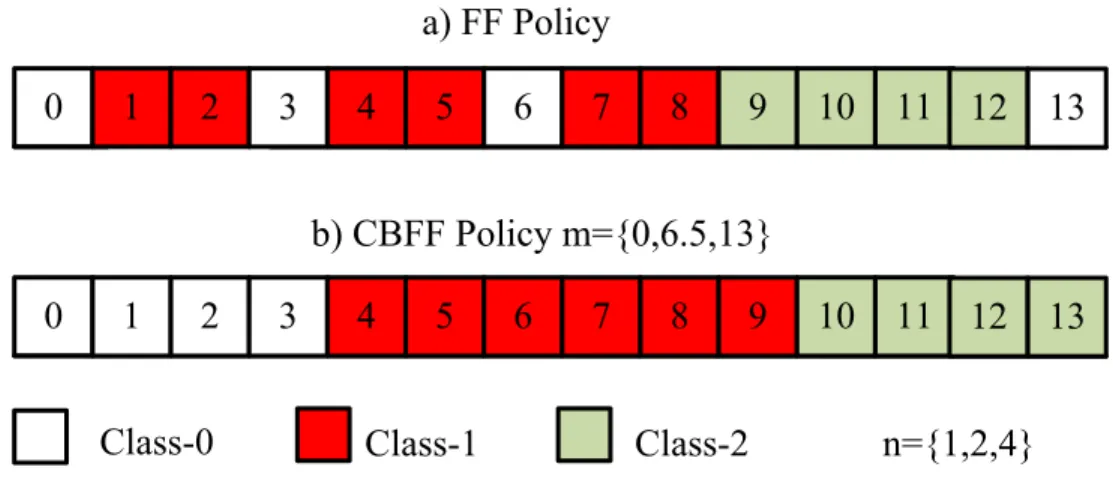
To motivate CBFF, we present the following 3-class example with N = 14 frequency slots in Fig. 1. We assume the request vector n = {1, 2, 4}. For CBFF, we use the outset vector m = {0, 6.5, 13}. We concentrate on a single flexgrid optical link that is offered with connection requests with the follow-ing order: class-0, class-1, class-0, class-1, class-0, class-1, class-2, class-0. The occupancy diagram for the optical link after all connection requests are accepted for both FF and CBFF spectrum allocation policies are presented in Fig. 1. The vertical fragmentation problem is evident for FF: when any two class-0 connection requests are to depart, no room will be freed for forth-coming class-1 connections. Similarly, if two class-1 connections decide to leave, there would not be any free spectral block for forthcoming class-2 con-nection requests. This problem is less problematic with CBFF. If any two successively-arrived class-0 requests decide to leave the link, a spectral block would be freed for a forthcoming class-1 request. Similarly, the departure of the first two successively-arrived class-1 connections would free room for a class-2 request. Therefore, CBFF favors classes with larger slot requirements in comparison with FF. While doing so, CBFF is work-conserving; if there is a free spectral block for an incoming request, then the request will always be admitted by choosing one of the free blocks. This is in contrast with non-work-conserving spectrum allocation policies which perform admission control to potentially increase the system throughput. However, it is clear that vertical fragmentation problem can only be mitigated, but not totally avoided, by CBFF. Assume now that the following sequence of events take
place: i) slots 6-7 released, ii) slot 6 occupied by a class-0 demand, iii) slots 4-5 released, iv) slots 8-9 released, v) a class-2 demand arrives and it is blocked because there is not a free spectral block of four contiguous slots out of the the five available slots. A detailed simulation study will be presented in the next section to quantify the benefits of CBFF relative to FF in terms of re-ducing the overall bandwidth blocking probability in more general single-link and network scenarios.
0
1
2
3
4
5
6
7
8
9
10
11
0
1
2
3
4
5
6
7
8
9
10
11
Class-0
Class-1
Class-2
a) FF Policy
b) CBFF Policy m={0,6.5,13}
n={1,2,4}
12
13
12
13
Figure 1: Illustration of the FF and CBFF spectrum allocation policies for a 3-class numerical example.
3. Numerical Results
For studying the performance of CBFF, we use the following three net-work topologies:
a) Single optical link,
b) NSF network topology [31],
c) Pan-European network topology [32]. For the routing problem, we use
i) Fixed Routing (FR) in which one minimum hop path only, called the primary path, is used to establish an OP using Dijkstra’s algorithm [33],
ii) Fixed Alternate Routing (FAR) is used in which a secondary minimum hop path is used as an alternative to the primary path using Yen’s algorithm [34]. A free spectral block is first searched for the primary path. If not found, the search procedure is repeated for the alternative path.
The spectrum allocation policy is either FF or CBFF. We also assume ex-ponentially distributed connection holding times with parameter µk = µ for all classes of connections. For the performance measures of interest, we need the following definitions. The total number of connection requests during a simulation run of duration D for class-k is denoted by Rk. The number of blocked connection requests out of Rk requests is Lk. The per-class connec-tion blocking probability is denoted by Pk:
Pk = Lk Rk
. (6)
The bandwidth blocking probability PBis defined as the ratio of total blocked bandwidth to the total requested bandwidth, both quantities in units of slots:
PB = PK−1 k=0 nkLk PK−1 k=0 nkRk . (7)
3.1. Single Optical Link
In the first numerical experiment, a single optical link is studied. We assume Poisson connection request arrival rates denoted by λk for class-k. We also denote by λ the vector of connection arrival rates, i.e., λ = {λ0, λ1, . . . , λK−1}. An Equal Intensity (EI) scenario refers to one where all arrival rates are identical, i.e., λj is fixed for all j, 0 ≤ j ≤ K − 1. On the other hand, an Equal Load (EL) scenario refers to one where the contribution of each class to the overall load is identical, i.e., λjnj is fixed for all j, 0 ≤ j ≤ K − 1. We set µk = 1 for all traffic classes in all examples pertaining to the single link case and we generate 107
overall requests for each simulation run.
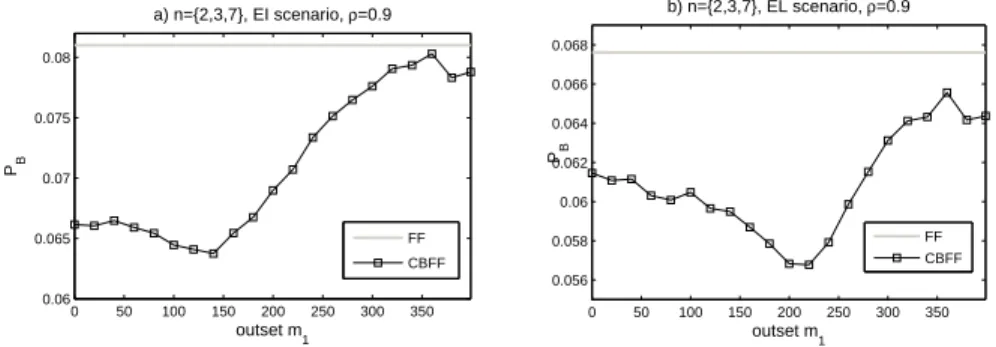
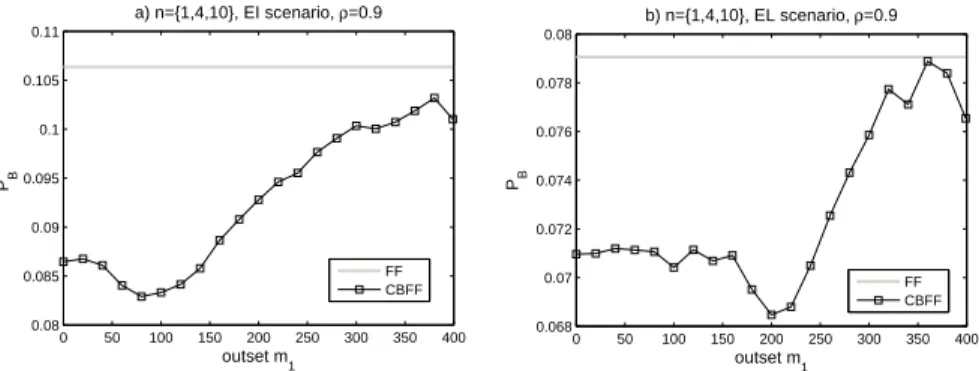
In the first numerical example, we fix N = 400, K = 3, n = {2, 3, 7} and ρ = 0.9. When CBFF is used, the two outsets m0 and m2 are set to zero and 399, respectively, but the outset for class 1 is allowed to vary in order to validate the effectiveness of the proposed heuristic for m1 given in Eqn. (5). For this purpose, we plot the bandwidth blocking probability
PB obtained with CBFF as a function of the outset m1 in Fig. 2 for the EI and EL scenarios. FF result is also provided as a reference for both scenarios. As conjectured, the choice of m1 is crucial for performance when CBFF is used and it is clear that there is an optimal value for m1 at which PB is minimized. The load balancing heuristic given in Eqn. (5) dictates the choices of m1 = 116.3750 and m1 = 199.5 for the EI and EL scenarios, respectively, which appear to be located very closely to the optimum values of m1 obtained with simulations. We repeat the same experiment this time with n = {1, 4, 10} in Fig. 3 while all other parameters are fixed for which we draw similar conclusions. The heuristic of Eqn. (5) leads us to the choices of m1 = 79.8 and m1 = 199.5 for the EI and EL scenarios, respectively, which again appear to be very close to the optimum values of m1 obtained via simulations. Note that for both examples of Figs. 2 and 3, the choice of m1 = 0 corresponds to a FF-LF spectrum allocation policy for which classes 0 and 1 use FF whereas class 2 uses LF. On the other hand, the choice of m1 = 399 corresponds to the other FF-LF policy for which classes 1 and 2 use LF whereas class 0 employs FF. Therefore, CBFF not only outperforms FF but also the only two possible FF-LF policies for a 3-class link.
0 50 100 150 200 250 300 350 0.06 0.065 0.07 0.075 0.08 outset m 1 PB a) n={2,3,7}, EI scenario, ρ=0.9 0 50 100 150 200 250 300 350 0.056 0.058 0.06 0.062 0.064 0.066 0.068 b) n={2,3,7}, EL scenario, ρ=0.9 outset m 1 PB FF CBFF FF CBFF
Figure 2: Bandwidth blocking probability PB for the single optical link with CBFF as a
function of m1 when N = 400, K = 3, n = {2, 3, 7} and ρ = 0.9: a) EI scenario, b) EL
scenario. PB obtained with FF spectrum allocation policy is also given as a reference for
both scenarios.
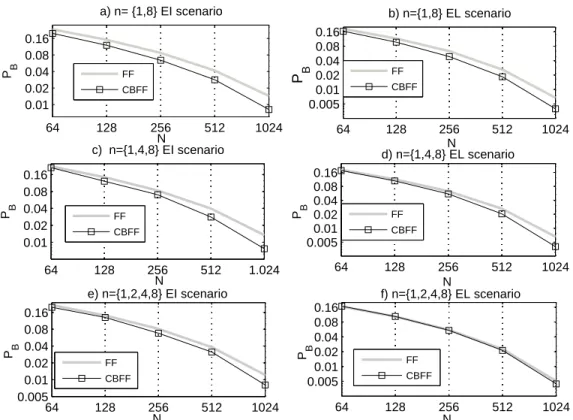
In the final numerical example concerning a single optical link, we study the impact of the number of classes K and the capacity N of the optical link on CBFF performance. We try the following three cases for both EI and EL scenarios for the case ρ = 0.85:
0 50 100 150 200 250 300 350 400 0.08 0.085 0.09 0.095 0.1 0.105 0.11 outset m 1 PB a) n={1,4,10}, EI scenario, ρ=0.9 0 50 100 150 200 250 300 350 400 0.068 0.07 0.072 0.074 0.076 0.078 0.08 outset m 1 PB b) n={1,4,10}, EL scenario, ρ=0.9 FF CBFF FF CBFF
Figure 3: Bandwidth blocking probability PB for the single optical link with CBFF as a
function of m1 when N = 400, K = 3, n = {1, 4, 10} and ρ = 0.9: a) EI scenario, b) EL
scenario. PB obtained with FF spectrum allocation policy is also given as a reference for
both scenarios.
ii) K = 3, n = {1, 4, 8}, iii) K = 4, n = {1, 2, 4, 8}.
We plot the bandwidth blocking probability as a function of N in Fig. 4 using CBFF and FF. We have the following observations:
• The performance advantage of CBFF over FF is more emphasized for lower number of classes. This advantage appears to reduce as K in-creases. However, CBFF always outperformed FF in all the studied cases.
• The reduction in bandwidth blocking probability using CBFF relative to FF increases when N increases. Therefore, CBFF is relatively more advantageous for relatively higher capacity optical links.
• Performance advantage of CBFF is more apparent in the equal intensity case for which the load introduced by classes with larger number of slots is more dominant relative to other classes with fewer slot requests.
3.2. NSF Network and Pan-European Network Topologies
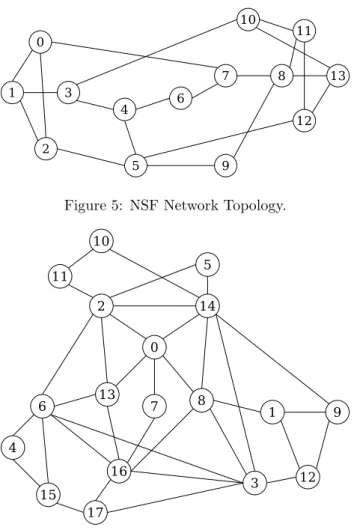
We now extend the simulation study for the performance evaluation of CBFF to multi-hop networks. We use two well-known network topologies given in Figures 5 and 6. The NSF topology has 14 nodes and 21 links [31] whereas the Pan-European network has 18 nodes and 35 links [32]. We fix N = 128 and K = 3 for all the examples in this section. We set µk = 0.01
64 128 256 512 1024 0.01 0.02 0.04 0.08 0.16 N P B a) n= {1,8} EI scenario 64 128 256 512 1024 0.005 0.01 0.02 0.04 0.08 0.16 N b) n={1,8} EL scenario P B 64 128 256 512 1.024 0.01 0.02 0.04 0.08 0.16 c) n={1,4,8} EI scenario N P B 64 128 256 512 1024 0.005 0.01 0.02 0.04 0.08 0.16 N P B d) n={1,4,8} EL scenario 64 128 256 512 1024 0.005 0.01 0.02 0.04 0.08 0.16 e) n={1,2,4,8} EI scenario N P B 64 128 256 512 1024 0.005 0.01 0.02 0.04 0.08 0.16 f) n={1,2,4,8} EL scenario N P B FF CBFF FF CBFF FF CBFF FF CBFF FF CBFF FF CBFF
Figure 4: Bandwidth blocking probability PB for the single link case as a function of N
for ρ = 0.85 under CBFF and FF for six different scenarios.
for all three classes. The connection request vector is set to n = {1, 4, 10} and we assume traffic between each pairs of nodes. For both topologies, the connection arrival rate vector λ is the same for all source-destination pairs of nodes and is characterized with a single traffic parameter σ which is varied in the range [0.001, 0.009]. We study five different traffic profiles for both topologies described in Table 1. The overall traffic rate (in units of slot requests/TU) offered to a source-destination pair is fixed at 15σ for all the five traffic profiles. When CBFF is used, the load balancing heuristic (5) is employed to find the class-1 outset m1 but we round this value of m1 to the nearest integer in which case it is possible that there may be two spectral blocks at the same distance from the outset m1 one of which is chosen at random for this example.
In order to provide more insight on the effectiveness of CBFF against the FF policy, we introduce the so-called throughput, denoted by T (PB) which
Figure 5: NSF Network Topology.
Figure 6: Pan-European Network Topology.
is the rate of traffic (in units of slots/TU) that is carried, averaged over all source-destination pairs, while not exceeding a certain desired bandwidth blocking probability PB. The percentage increase in throughput (∆T(PB)) defined below is indicative of the gain in using CBFF relative to FF when a desired bandwidth blocking probability of PB is realized:
∆T(PB) = 100 TCBF F(P B) − TF F(PB) TF F(P B) . (8)
The gain in throughput achieved by CBFF relative to FF under these five traffic profiles is given for both topologies in Table 2 when the desired band-width blocking probability PB is allowed to vary in the range 10−3− 10−1.
Table 1: Traffic profiles used for the NSF and Pan-European network topologies. Traffic Arrival Profile Vector λ TP-1 {σ, σ, σ} TP-2 {5σ, 5 4σ, 1 2σ} TP-3 {9 2σ, 9 8σ, 3 5σ} TP-4 {9 2σ, 3 2σ, 9 20σ} TP-5 {6σ, 9 8σ, 9 20σ}
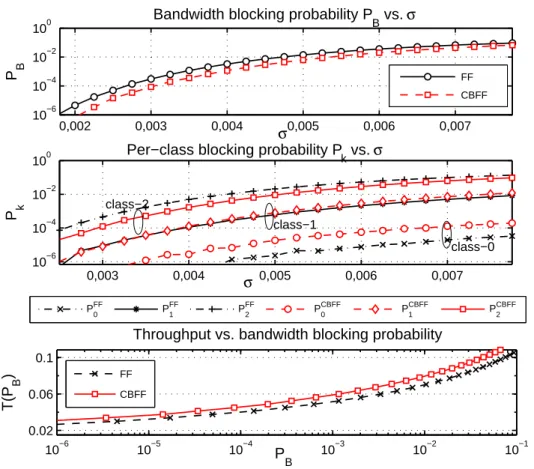
CBFF outperforms FF for all the traffic profiles with up to 15% gains in throughput. CBFF appears to be more effective with FAR than with FR. CBFF seems to benefit more from the flexibility provided by alternate routing when compared with FF. We also observe that the throughput gains with CBFF are higher for lower target bandwidth blocking probabilities. The performance improvement with CBFF is maximum for TP-1 in the Pan-European network scenario with FAR routing policy. We present detailed simulation results in Fig. 7 for this particular scenario.
Table 2: Gain in throughput by CBFF relative to FF under the five traffic profiles for the NSF and Pan-European network topologies for FR and FAR when PB is varied in the
range 10−3− 10−1.
Traffic Network Routing Throughput Profile Topology Policy Gain ∆T(PB)
TP-1 NSF FR 12.18 - 9.27 TP-2 NSF FR 6.03 - 3.98 TP-3 NSF FR 5.25 - 4.27 TP-4 NSF FR 6.31 - 4.07 TP-5 NSF FR 7.08 - 3.16 TP-1 NSF. FAR 12.59 - 10.47 TP-2 NSF FAR 6.31 - 4.35 TP-3 NSF FAR 5.13 - 4.47 TP-4 NSF FAR 5.25 - 4.17 TP-5 NSF FAR 6.76 - 3.31 TP-1 Pan-Eur. FR 12.30 - 10.23 TP-2 Pan-Eur. FR 11.75 - 2.00 TP-3 Pan-Eur. FR 6.47 - 3.55 TP-4 Pan-Eur. FR 6.31 - 2.00 TP-5 Pan-Eur. FR 5.01 - 2.00 TP-1 Pan-Eur. FAR 14.79 - 11.22 TP-2 Pan-Eur. FAR 7.59 - 3.55 TP-3 Pan-Eur. FAR 7.08 - 4.17 TP-4 Pan-Eur. FAR 6.17 - 3.55 TP-5 Pan-Eur FAR 6.31 - 2.40
We observe that the per-class blocking probability for class-2 is substan-tially reduced with CBFF allowing more class-2 connections to be accepted into the FON while being work-conserving. Consequently, the other two classes are affected slightly adversely in terms of increased per-class blocking probability. However, the overall bandwidth blocking probability is reduced when CBFF is employed. Since the gap among the per-class blocking prob-abilities gets to shrink with CBFF, we also conclude that CBFF improves fairness among traffic classes in terms of blocking probabilities.
0,002 0,003 0,004 0,005 0,006 0,007
10−6
10−4
10−2
100
Bandwidth blocking probability P
B vs. σ σ P B FF CBFF 0,003 0,004 0,005 0,006 0,007 10−6 10−4 10−2
100 Per−class blocking probability Pk vs. σ
σ P k PFF 0 P FF 1 P FF 2 P CBFF 0 P CBFF 1 P CBFF 2 10−6 10−5 10−4 10−3 10−2 10−1 0.02 0.06 0.1
Throughput vs. bandwidth blocking probability
P B T(P B ) FF CBFF class−1 class−0 class−2
Figure 7: Simulation results for the Pan-European network topology for TP-1 with CBFF and FF under FAR routing: a) Overall bandwidth blocking rate PB as a function of traffic
parameter σ b) Per-class blocking probability Pk as a function of σ c) Throughput T as a
function of PB.
4. Conclusion
A novel class-based first fit spectrum allocation is proposed for dynamic flexgrid optical networks. When compared with the conventional first fit algo-rithm, the proposed policy is shown by simulations to reduce the bandwidth blocking probability and increase the throughput in single- and multi-hop scenarios. The proposed policy is especially effective in network scenarios with relatively higher link capacities. The simplicity of the proposed spec-trum allocation scheme is another advantage.
References
[1] E. Pincemin, Challenges of 40/100 Gbps deployments in long-haul trans-port networks on existing fibre and system infrastructure, in: Optical Fiber Communication Conference (OFC), 2010, pp. 1–3.
[2] O. Gerstel, M. Jinno, A. Lord, S. J. B. Yoo, Elastic optical networking: a new dawn for the optical layer?, IEEE Communications Magazine 50 (2) (2012) 12–20.
[3] M. Jinno, H. Takara, B. Kozicki, Y. Tsukishima, Y. Sone, S. Matsuoka, Spectrum-efficient and scalable elastic optical path network: architec-ture, benefits, and enabling technologies, IEEE Communications Maga-zine 47 (11) (2009) 66–73.
[4] M. Jinno, B. Kozicki, H. Takara, A. Watanabe, Y. Sone, T. Tanaka, A. Hirano, Distance-adaptive spectrum resource allocation in spectrum-sliced elastic optical path network [topics in optical communications], IEEE Communications Magazine 48 (8) (2010) 138–145.
[5] K. Christodoulopoulos, I. Tomkos, E. Varvarigos, Routing and spectrum allocation in OFDM-based optical networks with elastic bandwidth al-location, in: Global Telecommunications Conference (GLOBECOM), 2010, pp. 1–6.
[6] L. Velasco, M. Klinkowski, M. Ruiz, J. Comellas, Modeling the routing and spectrum allocation problem for flexgrid optical networks, Photonic Network Communications 24 (3) (2012) 177–186.
[7] P. Wright, A. Lord, L. Velasco, The network capacity benefits of Flex-grid, in: 17th International Conference on Optical Network Design and Modeling (ONDM), 2013, pp. 7–12.
[8] K. Christodoulopoulos, I. Tomkos, E. A. Varvarigos, Elastic bandwidth allocation in flexible OFDM-based optical networks, IEEE/OSA Journal of Lightwave Technology 29 (9) (2011) 1354–1366.
[9] Y. Wang, X. Cao, Y. Pan, A study of the routing and spectrum alloca-tion in spectrum-sliced elastic optical path networks, in: IEEE INFO-COM, 2011, pp. 1503–1511.
[10] Y. Wang, J. Zhang, Y. Zhao, J. Wang, W. Gu, Routing and spectrum assignment by means of ant colony optimization in flexible bandwidth networks, in: Optical Fiber Communication Conference and Exposition (OFC/NFOEC), 2012, pp. 1–3.
[11] R. Munoz, R. Casellas, R. Mart´ınez, L. Liu, T. Tsuritani, I. Morita, Experimental evaluation of efficient routing and distributed spectrum allocation algorithms for GMPLS elastic networks, Opt. Express 20 (27) (2012) 28532–28537.
[12] J. Zhang, J. Zhang, Y. Zhao, H. Yang, X. Yu, L. Wang, X. Fu, Experi-mental demonstration of openflow-based control plane for elastic light-path provisioning in flexi-grid optical networks, Opt. Express 21 (2) (2013) 1364–1373.
[13] O. G. de Dios, R. Casellas, F. Zahang, X. Fu, D. C. amd I. Hus-sein, Framework and Requirements for GMPLS based control of Flexi-grid DWDM, Internet Engineering Task ForceInternet-Draft draft-ietf-ccamp-flexi-grid-fwk-00.
[14] F. Zhang, X. Zhang, A. Farrel, O. G. de Dios, D. Ceccarelli, RSVP-TE Signaling Extensions in support of Flexible Grid, Internet Engineer-ing Task Force Internet-Draft draft-zhang-ccamp-flexible-grid-rsvp-te-ext-03.txt.
[15] R. Wang, B. Mukherjee, Spectrum management in heterogeneous band-width optical networks, Optical Switching and Networking 11, Part A (2014) 83–91.
[16] S. Talebi, F. Alam, I. Katib, M. Khamis, R. Salama, G. N. Rouskas, Spectrum management techniques for elastic optical networks: A survey, Optical Switching and Networking 13 (2014) 34–48.
[17] X. Yu, J. Zhang, Y. Zhao, T. Peng, Y. Bai, D. Wang, X. Lin, Spec-trum compactness based defragmentation in flexible bandwidth optical networks, in: Optical Fiber Communication Conference and Exposition (OFC/NFOEC), 2012 and the National Fiber Optic Engineers Confer-ence, 2012, pp. 1–3.
[18] Y. Yin, K. Wen, D. J. Geisler, R. Liu, S. J. B. Yoo, Dynamic on-demand defragmentation in flexible bandwidth elastic optical networks, Optics Express 20 (2) (2012) 1798–1804.
[19] Y. Wang, J. Zhang, Y. Zhao, J. Zhang, J. Zhao, X. Wang, W. Gu, Path connectivity based spectral defragmentation in flexible bandwidth networks, Optics Express 21 (2) (2013) 1353–1363.
[20] X. Wang, Q. Zhang, I. Kim, P. Palacharla, M. Sekiya, Utilization en-tropy for assessing resource fragmentation in optical networks, in: Opti-cal Fiber Communication Conference and Exposition (OFC/NFOEC), 2012, pp. 1–3.
[21] A. Rosa, C. Cavdar, S. Carvalho, J. Costa, L. Wosinska, Spectrum allo-cation policy modeling for elastic optical networks, in: 9th International Conference on High Capacity Optical Networks and Enabling Technolo-gies (HONET), 2012, pp. 242–246.
[22] Y. Wang, J. Zhang, Y. Zhao, J. Liu, W. Gu, Spectrum consecutiveness based routing and spectrum allocation in flexible bandwidth networks, Chinese Optics Letters (2012) S10606 1–4.
[23] E. Karasan, E. Ayanoglu, Effects of wavelength routing and selection algorithms on wavelength conversion gain in WDM optical networks, IEEE/ACM Transactions on Networking 6 (2) (1998) 186–196.
[24] X. Sun, Y. Li, I. Lambadaris, Y. Zhao, Performance analysis of first-fit wavelength assignment algorithm in optical networks, in: 7th Interna-tional Conference on Telecommunications (ConTEL), Vol. 2, 2003, pp. 403–409.
[25] A. Castro, L. Velasco, M. Ruiz, M. Klinkowski, J. P. Fern´andez-Palacios, D. Careglio, Dynamic routing and spectrum (re) allocation in future flexgrid optical networks, Computer Networks 56 (12) (2012) 2869–2883. [26] K. W. Ross, Multiservice Loss Models for Broadband Telecommunica-tion Networks, Springer-Verlag New York, Inc., Secaucus, NJ, USA, 1995.
[27] N. Sambo, F. Cugini, G. Bottari, G. Bruno, P. Iovanna, P. Castoldi, Lightpath provisioning in wavelength switched optical networks with
flexible grid, in: Optical Communication (ECOC), 2011 37th European Conference and Exhibition on, 2011, pp. 1–3.
[28] K. Song, J. Zhang, Y. Zhao, X. Yu, Y. Yu, B. Chen, H. Yang, Service-oriented spectrum assignment algorithms in flexible bandwidth optical networks, in: Communications and Photonics Conference (ACP), 2012 Asia, 2012, pp. 1–3.
[29] J. Zhang, B. Chen, Y. Zhao, H. Chen, W. Zhang, X. Li, J. Jue, S. Huang, W. Gu, Minimized spectrum resource consumption with rescaled failure probability constraint in flexible bandwidth optical networks, Optical Communications and Networking, IEEE/OSA Journal of 5 (9) (2013) 980–993.
[30] T. Bonald, M. Feuillet, Network Performance Analysis, ISTE and Wiley, 2011.
[31] R. Hulsermann, A. Betker, M. Jager, S. Bodamer, M. Barry, J. Spath, C. Gauger, M. Kohn, A set of typical transport network scenarios for network modelling, in: Proc. of the 5. ITG Symposium on Photonic Networks, 2004, pp. 65–72.
[32] Y. S. Kavian, H. F. Rashvand, M. S. Leeson, W. Ren, E. L. Hines, M. Naderi, Network topology effect on QoS delivering in survivable DWDM optical networks, Journal of Telecommunications and Informa-tion Technology (2009) 68–71.
[33] E. Dijkstra, A note on two problems in connexion with graphs, Nu-merische Mathematik 1 (1) (1959) 269–271.
[34] J. Y. Yen, Finding the K shortest loopless paths in a network, Manage-ment Science 17 (1971) 712–716.