662
http://journals.tubitak.gov.tr/veterinary/ © TÜBİTAK
doi:10.3906/vet-1811-2
The effect of laying period on egg quality traits and chemical composition of Lindovskaya
(Linda) geese reared under breeder conditions*
Mehmet SARI1,**, Kadir Emre BUĞDAYCI2, Aykut Asım AKBAŞ3, Mustafa SAATCI4, Mustafa Numan OĞUZ2
1Department of Animal Science, Faculty of Agriculture, Kırşehir Ahi Evran University, Kırşehir, Turkey
2Department of Animal Nutrition and Nutritional Diseases, Faculty of Veterinary Medicine, Mehmet Akif Ersoy University, Burdur, Turkey 3Department of Animal Science, Faculty of Veterinary Medicine, Mehmet Akif Ersoy University, Burdur, Turkey
4Department of Animal Science, Fethiye Faculty of Agriculture, Muğla Sıtkı Koçman University, Muğla, Turkey
1. Introduction
Livestock support in recent years has enabled the introduction of various goose breeds into the Turkish poultry sector. These mainly include two broiler breeds, the Emden and Toulouse, alongside one laying breed, the Chinese goose. Random crossbreeding has been realized especially between Chinese geese and domestic geese; thus, various goose breeds and eggs other than these breeds have also been introduced to the Turkish poultry sector and they have even been reared a little. One of these breeds is the Lindovskaya.
The Lindovskaya breed constitutes the majority of the goose population in Russia and was obtained by crossbreeding the domestic breeds from the Nizhny Novgorod region of Russia and breeds from China, including the Adler, Solnechnogorsk, and Gorky. Their number accounts for more than 60% of the country’s geese. Lindovskaya was registered as a breed in 1994. They are heavy-bodied birds, and their feathers are generally white. They have a cone-like bump referred to as a knop
on their foreheads. This bump is larger in male adult geese than it is in females. A slight swelling or dewlap is seen on their necks. Their body is deep, wide, and long. The average live weight of an adult Lindovskaya goose is 6 to 7 kg; males tend to generally be heavier than females. Females are reported to lay 40 to 50 eggs per year[1] (https://yaroslavskaya.all.biz/en/lindovskiyes-geese).
Goose eggs are generally used to obtain goslings and they may be eaten as well, albeit rarely. Thus, identifying the quality traits of eggs of geese in the flock is necessary in order to use them for goslings as well as a food source. Traits such as egg weight, form index, shell weight, shell thickness, shell ratio, surface area of egg shell, shell weight per unit surface area, and shell density are used to identify the external quality traits of the eggs. Dawson and Clark [2] reported that egg weight affected the vitality of goslings as well as their walking/swimming and growth performances in the first 2 weeks. Vargare et al. [3] determined the egg weight of Landes and Hungarian geese as 153.9 and 154.2 g, respectively. The internal quality traits of eggs are identified
Abstract: The study was conducted to determine the effect of laying period on egg quality traits as well as the chemical composition of
Lindovskaya geese. The egg quality traits were examined by randomly taking a total of 90 eggs on the 45th ± 5, 60th ± 5, and 75th ± 5 days of the laying period from 3-year-old female Lindovskaya geese. It was determined that the effect of the laying period on external quality traits of eggs was statistically nonsignificant (P > 0.05). The effect of laying period on internal quality traits including height, diameter, and index of the yolk and albumen was statistically significant (P < 0.05). The eggs collected on the 45th ± 5 day had higher values compared to eggs obtained on the other days in terms of yolk height, diameter, and index, as well as albumen length and albumen width. The effect of laying period on dry matter, protein, and ash ratio of the egg yolk and albumen was statistically significant (P < 0.05). Dry matter and protein ratios of the yolk and albumen reached their peaks on the 75th ± 5 day of the laying period. These results are the first data for identification of egg quality traits in Turkish-reared Lindovskaya geese. It was concluded that the quality of eggs obtained on the 45th ± 5 day of the laying period was higher than those obtained on the other two control days in terms of internal traits.
Keywords: Lindovskaya geese, egg quality, laying period
Received: 01.11.2018 Accepted/Published Online: 25.09.2019 Final Version: 02.10.2019
Research Article
* Part of this research was presented at the 1st International GAP Agriculture and Livestock Congress, 25–27 April 2018, Şanlıurfa, Turkey. ** Correspondence: [email protected]
by using weight, height, diameter, index, ratio, and color of the yolk as well as weight, length, width, index, and ratio of albumen and also Haugh unit characteristics. Genetic and environmental factors also influence quality traits of eggs and include breed, origin, age, laying period, care and feeding, type of breeding, storage period, cleaning, shape of eggs, broodiness, and diseases. The effect of laying period on egg quality has been studied in geese [4,5] and other species of poultry [6,7].
Even though a limited number of studies have been conducted to identify quality traits of eggs in domestic geese reared in Turkey [8,9], none of them examined Lindovskaya. The present study was conducted to determine the effect of laying period on egg quality traits and chemical composition of Lindovskaya geese reared under breeder conditions.
2. Materials and methods
This study was approved by the Mehmet Akif University Local Ethics Committee of Animal Experiments (Decision no: MAKÜ-HADYEK/2017-331).
2.1. Birds, management, and diets
The eggs used in the study were supplied from a private farm located in the village of Kibritli in the district of Ağlasun, Burdur, which has been breeding Lindovskaya geese for 3 years. The research was conducted in the Department of Animal Science and Animal Nutrition of Mehmet Akif Ersoy University, Faculty of Veterinary Medicine. The distance between the laboratory and the farm is 35 km, which means that the eggs were transported in vials. No illumination or vaccination program was applied for geese. Only daylight was utilized. Eggs were collected from the geese when they reached 3 years of age. All of the geese were kept under the same conditions. The flocks were housed in sheds with a deep litter system and yard access. The geese were free to wander outside and come back to the sheds. They were housed in groups. In order to identify the quality of eggs, the eggs were taken from geese reaching a certain age according to hatching records. During the laying period, geese laid their eggs in pens bedded with barley straw. For the geese, an outdoor place was covered with barley straw. Eggs were randomly collected from the flock (females = 75) on the 45th ± 5,
60th ± 5, and 75th ± 5 days of the laying period. During this period (40th–80th days), 10 eggs were stored at 5-day intervals. This routine was repeated 9 times over the 40-day period. All of the eggs were analyzed 24 h after collection. All eggs were collected from different animals at the same time.
Eggs were obtained from geese reared under breeder conditions. During the laying period, the animals were fed ad libitum with a mixture of industrial residues consisting of yeast byproducts because they are cost effective. Under semiintensive conditions, they utilized the vegetation having feed value in their grazing area. They were also periodically fed with wheat, soybean peel, stale bread, potato, and fig, apricot, and carob scraps. A feed containing industrial residues was given to the geese during the laying period and its nutrient content was determined according to the method of the AOAC [10]. The metabolizable energy level of the feed was calculated using the equation reported by Titus and Fritz [11]. Table 1 shows the results of dry matter of feed alongside its chemical analysis on the basis of dry matter.
2.2. Egg quality measurements
In order to identify both the external and internal quality traits of eggs, the study was conducted on a total of 90 eggs, including 31 eggs on the 45th ± 5 day, 30 eggs on the 60th ± 5 day, and 29 eggs on the 75th ± 5 day of the laying period. The eggs were analyzed 24 h after the geese laid them.
The weight, shell, yolk, and albumen of the eggs were measured using a scale (Model CP224S - 14105100, 0.1 mg sensitivity, Sartorius AG, Gottingen, Germany). The width and length of the eggs were determined using a digital caliper with 0.01 mm precision. The shell thickness was measured via a digital micrometer (Mitutoyo, C/N 395-271-30, 0–25 mm; Japan) by averaging the egg’s blunt end, middle, and pointy end. The surface area, weight per unit area, and density of the shell were calculated using the following formulae:
i. Surface area of shell (cm2): (3.9782) × (egg weight0.7056)
[12].
ii. Shell weight per unit area (g): ((shell weight (g) × 100) / (surface area of shell (cm2) [13].
iii. Shell density (g/cm3): 1.945 × shell weight (g)0.014
[14].
Table 1. Nutrient composition of additional feed in dry matter basis.
Dry matter,
% Crude ash,% Ether extract,% Crude protein,% Crude fiber,% N-free extract,% Metabolic energy, MJ/kg
Goose feed 94.12 4.87 2.35 7.87 36.34 41.69 6.54
Titus and Fritz [12]: ME (MJ/g) = 133.06 (crude protein) + 232.91 (ether extract) – 4.68 (crude fiber) + 122.77 (nitrogen free extract).
All of the eggs were numbered in the study. The diameter and height of the yolk, as well as the albumen height and length and width of dense albumen, were measured using a digital caliper upon cracking the eggs on a glass-topped table. A tripod micrometer (Mitutoyo, No: 2050S-19, 0.01–20 mm; Kawasaki, Japan) was used to measure the height of dense albumen.
The following formulae were used to determine the internal and external quality traits of the eggs [15]:
i. Shape index (%) = [width (mm) / length (mm)] × 100.
ii. Shell ratio (%) = (shell weight (g) / egg weight (g)) × 100.
iii. Albumen weight (g) = egg weight – (shell weight + yolk weight).
iv. Yolk ratio (%) = (yolk weight (g) / egg weight (g)) × 100.
v. Albumen ratio (%) = (albumen weight (g) / egg weight (g)) × 100.
vi. Yolk index (%) = [yolk height (mm) / yolk diameter (mm)] × 100.
vii. Albumen index (%) = [albumen height (mm) / {(albumen length (mm) + albumen width (mm)) /2}] × 100.
viii. Haugh unit = 100 log [albumen height (mm) + 7.57 – 1.7 × egg weight (g)0.37].
The colors of the yolks of the treated eggs were scored by 3 investigators with a Roche yolk color fan [16].
2.3. Chemical composition of the eggs
The chemical composition of a total of 36 eggs, including 12 randomly taken from each of the 45th ± 5, 60th ± 5, and 75th ± 5 days of the laying period, was analyzed. For this purpose, yolks and albumens of the eggs cracked on a glass-topped table were carefully placed into petri dishes following the measurements, and some nutrient contents
of the eggs (dry matter, raw ash, raw fat) were examined using the method reported by the AOAC [10].
2.4. Statistical analyses
While one-way analysis of variance was used to compare the external and internal quality traits and the chemical compositions of the eggs, the Tukey test was employed to examine the difference among the groups. Minitab 16.0 software was employed for the analyses.
3. Results
3.1. External quality traits
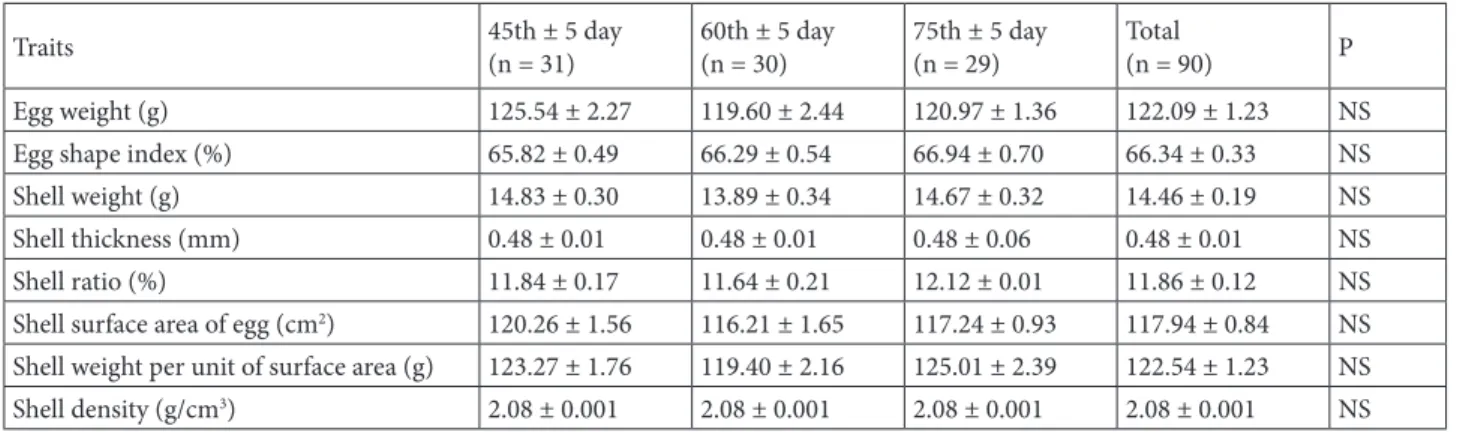
Table 2 shows the external quality traits of the eggs. The effect of the laying period on external quality traits of the eggs was found to be statistically nonsignificant (P > 0.05). The egg weight was 125.54, 119.60, 120.97, and 122.09 g; the egg shape index was 65.82%, 66.29%, 66.94%, and 66.34%; the shell weight was 14.83, 13.89, 14.67, and 14.46 g; the shell thickness was 0.48, 0.48, 0.48, and 0.48 mm; the shell ratio was 11.84%, 11.64%, 12.12%, and 11.86%; the shell surface area was 120.26, 116.21, 117.24, and 117.94 cm2; the shell weight per unit surface area was 123.27,
119.40, 125.01, and 122.54 g; and the shell density was 2.081, 2.080, 2.080, and 2.080 g/cm3 on the 45th ± 5, 60th
± 5, and 75th ± 5 days of the laying period and in general, respectively.
3.2. Internal quality traits
Table 3 shows the internal quality traits of the eggs. The laying period had a statistically significant effect on the height, diameter, and index of both yolk and albumen (P < 0.05). The eggs collected on the 45th ± 5 day had higher values in terms of yolk height, diameter, and index compared those obtained on the other days. Comparatively, the albumen index of the eggs was higher on the 45th ± 5 and 60th ± 5 days than the 75th ± 5 day.
Table 2. External quality traits of eggs in Lindovskaya geese (means, ±SEM1).
Traits 45th ± 5 day (n = 31) 60th ± 5 day (n = 30) 75th ± 5 day (n = 29) Total (n = 90) P
Egg weight (g) 125.54 ± 2.27 119.60 ± 2.44 120.97 ± 1.36 122.09 ± 1.23 NS
Egg shape index (%) 65.82 ± 0.49 66.29 ± 0.54 66.94 ± 0.70 66.34 ± 0.33 NS
Shell weight (g) 14.83 ± 0.30 13.89 ± 0.34 14.67 ± 0.32 14.46 ± 0.19 NS
Shell thickness (mm) 0.48 ± 0.01 0.48 ± 0.01 0.48 ± 0.06 0.48 ± 0.01 NS
Shell ratio (%) 11.84 ± 0.17 11.64 ± 0.21 12.12 ± 0.01 11.86 ± 0.12 NS
Shell surface area of egg (cm2) 120.26 ± 1.56 116.21 ± 1.65 117.24 ± 0.93 117.94 ± 0.84 NS
Shell weight per unit of surface area (g) 123.27 ± 1.76 119.40 ± 2.16 125.01 ± 2.39 122.54 ± 1.23 NS
Shell density (g/cm3) 2.08 ± 0.001 2.08 ± 0.001 2.08 ± 0.001 2.08 ± 0.001 NS
NS = Nonsignificant (P > 0.05).
3.3. Chemical composition
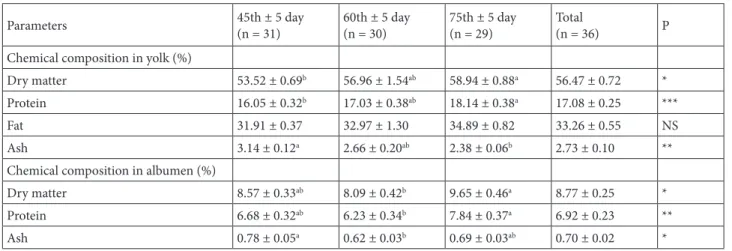
Table 4 shows chemical composition of eggs of Lindovskaya geese. The effect of laying period on dry matter, protein, and ash ratios of yolk and albumen was statistically significant (P < 0.05). The dry matter and protein ratios of yolk and albumen were determined to be at their peak on 75th ± 5 day.
4. Discussion
4.1. External quality traits
There are limited studies on the effects of laying period on the egg quality traits and composition of geese. Furthermore, there has been no study conducted on this matter in Turkey. The effect of laying period on egg weight was found to be statistically nonsignificant since
Table 3. Internal quality traits of eggs in Lindovskaya geese (means, ±SEM1).
Traits 45th ± 5 day(n = 31) 60th ± 5 day(n = 30) 75th ± 5 day(n = 29) Total(n = 90) P
Yolk weight (g) 45.80 ± 0.96 43.68 ± 0.97 45.38 ± 1.01 45.95 ± 0.57 NS
Yolk height (mm) 21.13 ± 0.33a 17.24 ± 0.41b 17.34 ± 0.42b 18.61 ± 0.29 ***
Yolk diameter (mm) 59.78 ± 0.49a 58.11 ± 0.48b 58.36 ± 0.43b 58.76 ± 0.28 *
Yolk index (%) 35.45 ± 0.68a 29.66 ± 0.65b 29.78 ± 0.77b 31.69 ± 0.49 ***
Yolk ratio (%) 36.62 ± 0.68 36.64 ± 0.70 37.50 ± 0.70 36.91 ± 0.40 NS
Yolk color by Roche scale 12.75 ± 0.15 12.57 ± 0.18 12.66 ± 0.17 12.66 ± 0.09 NS
Albumen weight (g) 64.92 ± 1.72 62.04 ± 1.80 60.93 ± 1.07 62.67 ± 0.92 NS Albumen length (mm) 114.90 ± 2.03a 109.14 ± 1.33b 114.09 ± 1.47a 112.72 ± 0.98 * Albumen width (mm) 73.11 ± 1.38a 69.82 ± 1.01b 74.00 ± 1.07a 72.30 ± 0.69 * Albumen height (mm) 9.48 ± 0.28 9.34 ± 0.26 8.82 ± 0.17 9.22 ± 0.14 NS Albumen index (%) 5.10 ± 0.19ab 5.24 ± 0.15a 4.71 ± 0.11b 5.02 ± 0.09 * Albumen ratio (%) 51.54 ± 0.66 51.73 ± 0.68 50.38 ± 0.72 51.23 ± 0.40 NS Haugh unit 82.57 ± 2.00 83.03 ± 1.93 79.95 ± 1.18 81.86 ± 1.02 NS
a, b Means within a row with no common letter differ significantly (P < 0.05).
NS = Nonsignificant (P > 0.05), * P < 0.05, *** P < 0.001.
1Standard error of the mean.
Table 4. Chemical composition of eggs in Lindovskaya geese (means, ± SEM1).
Parameters 45th ± 5 day(n = 31) 60th ± 5 day(n = 30) 75th ± 5 day(n = 29) Total(n = 36) P Chemical composition in yolk (%)
Dry matter 53.52 ± 0.69b 56.96 ± 1.54ab 58.94 ± 0.88a 56.47 ± 0.72 *
Protein 16.05 ± 0.32b 17.03 ± 0.38ab 18.14 ± 0.38a 17.08 ± 0.25 ***
Fat 31.91 ± 0.37 32.97 ± 1.30 34.89 ± 0.82 33.26 ± 0.55 NS
Ash 3.14 ± 0.12a 2.66 ± 0.20ab 2.38 ± 0.06b 2.73 ± 0.10 **
Chemical composition in albumen (%)
Dry matter 8.57 ± 0.33ab 8.09 ± 0.42b 9.65 ± 0.46a 8.77 ± 0.25 *
Protein 6.68 ± 0.32ab 6.23 ± 0.34b 7.84 ± 0.37a 6.92 ± 0.23 **
Ash 0.78 ± 0.05a 0.62 ± 0.03b 0.69 ± 0.03ab 0.70 ± 0.02 *
a, b Means within a row with no common letter differ significantly (P < 0.05).
NS = Nonsignificant (P > 0.05), * P < 0.05, ** P < 0.01, *** P < 0.001.
the laying periods were close to each other and the total duration of the experiment was short. Although there was no significant difference between laying periods, the egg weight decreased with increasing laying period. A similar situation was reported by Mazanowski and Adamski [4] and Biesiada-Drzazga et al. [17]. In the study by Biesiada-Drzazga et al. [17], it was determined that during successive weeks of the laying period, there was a continual decrease in the weight of eggs laid by 2-year-old White Koluda geese between the months of February and June (from 203 to 181 g). However, Mazanowski and Adamski [4] found that egg weight in 1-year-old White Italian-Cuban females increased significantly from the beginning to the peak of the laying period. Soloviev [18] reported greater egg weight (154.7, 157.1, and 158.4 g) in Lindovskaya geese. This difference may be due to the fact that the geese had different origins and also different conditions of breeding, care, and feeding were used.
The present study revealed that the effect of laying period on shape index was nonsignificant. Similarly, Mazanowski and Adamski [4] also reported that the effect of laying period on shape index was nonsignificant. On the other hand, Biesiada-Drzazga et al. [17] reported that the effect of laying period on shape index was significant. Shape index ratio determined in the present study was similar to the values (64.9% and 67.5%) reported by Mazanowski and Bernacki [19] for White Italian × Slovakian × Graylag geese and those (66.40% and 67.28%) stated by Arslan and Saatci [20] for geese native to the region of Kars. However, Zhang et al. [21] found that the shape index was 69% for 2-year-old geese, which was lower than the value found in the present study. This may be associated with breed, origin, and age of the geese and mainly the fact that geese used in the study were reared under breeder conditions.
In the present study, the laying period had a nonsignificant effect on the weight, thickness, ratio, surface area, weight per unit surface area, and density of the shell. This may be due to the fact that the laying periods were close to each other and the total duration of the experiment was short. The value of shell weight found in the present study was lower than the values (19.4, 21.6, 20.0, and 18.7 g, respectively) reported by Tilki and Inal [9] for one-year-old Armutlu, Tatlıcak, Başkuyu, and INRA geese and the value (20.37 g) reported by Saatci et al. [22] for geese of Kars Province. The values of egg shell thickness determined in the present study were lower than those (0.56 and 0.59 mm) noted by Juodka et al. [23] for Vishtines geese, similar to the value (0.51 mm) reported by Tilki and Inal [8] for 3-year-old INRA geese, and similar to the value (0.48–0.50 mm) reported by Bingöl et al. [24] for native Turkish geese. In another study, the shell thickness was 0.558 mm at the beginning of the laying period and 0.547 mm at the end of the laying period in
White Rhine Dutch geese [25]. Mazanowski and Adamski [4] and Biesiada-Drzazga et al. [17] reported that the shell thickness determined at the beginning of the laying period was higher than the value determined at the end of the laying period. This may be due to the fact that the laying periods were close to one another and the total duration of the experiment was short.
The shell ratio found in the present study was similar to the value (11.9%) reported by Tilki and Inal [8] for 3-year-old INRA geese and lower than those (13.7%, 14.8%, 13.8%, and 13.3%) reported by Tilki and Inal [9] for 1-year-old Armutlu, Tatlıcak, Başkuyu, and INRA geese and the value (14.68%) reported by Saatci et al. [22] for geese reared in the region of Kars. The differences between values obtained in the present study and the other studies were associated with the fact that the geese used in this study had different breed, age, origin, and egg weight and were reared under breeder conditions. The shell surface area of the present study was lower than the values (139.8, 141.5, and 134.6 cm2) reported by Mazanowski and Adamski [4] for White
Italian × Cuban geese in early, peak, and late periods and the value (140.60 cm2) declared by Rabsztyn et al. [26] for
Zatorska geese. Mazanowski and Adamski [4] reported that the laying period had no effect on shell density in White Italian × Cuban geese. The shell density determined in the present study was similar to the values reported by the same researchers (2.111, 2.095, and 2.104 g/cm3).
4.2. Internal quality traits
It was found that the laying period had a significant effect on height, diameter, and index of the yolk. These traits were the highest on the 45th ± 5 day of the laying period. The effect of the laying period on weight, ratio, and color of the yolk was nonsignificant. Yolk weight found in the present study was lower than the value (75.4 g) reported by Adamski et al. [27]for Biala Koludzka geese in the 3rd laying season and higher than the value (42.58 g) reported by Marzec et al. [28] for 61-week-old White Koluda W11 geese. Biesiada-Drzazga et al. [17] also reported that the effect of the laying period on yolk index was statistically nonsignificant. Total yolk index determined in the present study was similar to the value (32.1%) reported by Mazanowski and Adamski [4] for White Italian × Cuban geese. As laying period progressed, yolk index decreased in the present study; on the other hand, Mazanowski and Adamski [4] reported that yolk index increased from the beginning to the end of the laying period. This difference may be due to the breed, age, and laying period of the geese and the fact that they were reared under breeder conditions and their eggs were chosen via random sampling. Adamski et al. [27] evaluated morphological traits of eggs of geese fed ad libitum with feed containing 14.8% raw protein and 11.64 MJ/kg metabolizable energy in different laying seasons and revealed that while total albumen content was
higher in the first laying season, the yolk ratio was low. Raw protein content of the feed was 2 times greater than that of the mixture of industrial byproducts provided by the breeder. The biological value of protein is important in the formation of the egg but not the raw protein content of the feed. All of these essential amino acids need to be balanced and sufficient in mixed feed in order to obtain the expected production from the animals [29].
While the laying period had a nonsignificant effect on weight, height, and ratio of the albumen, it had a significant effect on length, width, and index of the albumen. Biesiada-Drzazga et al. [17] reported that the effect of laying period on weight and height of the albumen was statistically significant and decreased towards the end of the laying period. This situation was similar in the present study, even though it was not statistically different. The values of albumen weight determined in the present study were lower than those reported by Juodka et al. [23] for Vishtines geese (80.01 and 87.01 g) and by Adamski et al. [27]for Biala Koludzka geese (84.5–111.0 g). The albumen index in the present study was lower than the values (8.64%) found by Saatci et al. [22] for geese reared in the region of Kars, by Tilki and Inal (6.26%) [8] for 3-year-old INRA geese, and by Tilki and Inal (7.78%, 7.48%, 7.72%, and 7.32%, respectively) [9] for 1-year-old Armutlu, Tatlıcak, Başkuyu, and INRA geese. The albumen ratio in the present study was similar to the value (50.80%) stated by Razmaite et al. [5] for 3-year-old Lithuanian Vishtines geese for the entire laying period and higher than the value (47.64%) reported by Saatci et al. [22] for geese reared in the region of Kars.
In the present study, it was determined that the laying period had a nonsignificant effect on the Haugh unit, which is an important parameter to identify internal quality traits of eggs. A similar situation was reported by Mazanowski and Adamski [4]. The Haugh unit values determined in the present study were similar to those reported by Dodu [25] during the onset (33–34 weeks), peak (37–38 weeks), plateau (33–34 weeks), and ceasing (48–49 weeks) periods of the laying period for White Rhine Dutch geese. Haugh unit values found in all 3 laying periods in the present study were higher than the Haugh unit values (76.00, 66.10, 55.50, and 65.90) indicated by Adamski et al. [27] for Biala Koludzka geese in 4 laying seasons and those (59.2, 56.6, and 54.0) reported by Mazanowski and Adamski [4] for White Italian × Cuban geese during the beginning, middle, and end of laying period. However, the Haugh unit values determined in the present study were lower than the value (89.19) noted by Saatci et al. [22] for geese reared in the region of Kars. Albumen traits and Haugh unit values determined in the present study were different from results of the other studies due to the differences in the geese’s breed, age, care, and feeding as well as duration of laying period.
4.3. Chemical composition
In the study conducted by Mazanowski and Adamski [4] to examine egg traits of highly productive geese, each of the geese was given 250 g of feed containing 80% concentrated feed and 20% oats (17.6% raw protein and 2831 kcal metabolic energy) before the laying period, as well as feed containing 90% concentrated feed and 10% oats (18.4% raw protein, 2830 kcal ME) during the laying. The amount of feed given per animal was increased from 250 g to 350 g after the egg production exceeded 40%. In the present study, the geese, which were reared in a poorer quality pasture under semiintensive conditions during the laying period, were fed ad libitum with a feed containing raw protein of 7.87% and 1562.05 kcal/kg metabolic energy, and additional feeding was also provided periodically. The present study revealed that dry matter content of the yolk and albumen increased significantly from 53.52% to 58.94% during the laying period. Compared with the results of the present study, Mazanowski and Adamski [4] reported that dry matter content of yolk decreased from 53.80% to 51.00% as the laying period progressed. The most important reasons for this difference were differences in breed, age, care, feeding, and the duration of the laying period.
The egg, its composition, and its interior quality all play a crucially important role in embryonal development [30]. Razmaite et al. [5]indicated that weight and the components of geese eggs during the first year were lower than those of the third year. The ratios of yolk and albumen varied between the laying stages; while the albumen ratio was in favor for the first year, the yolk ratio was in favor for the last laying periods. Badzinski et al. [31] reported that the size of eggs was related to their nutrient ingredients in geese. Mazanowski et al. [32] stated that water, protein, and ash contents of egg yolk decreased during the beginning of laying; however, chemical analysis of yolk did not alter throughout the full laying period.
In conclusion, laying period was determined to have a nonsignificant effect on external quality traits of goose eggs. The internal quality traits of the eggs was higher on the 45th day of laying period compared to the other 2 days. The laying period had a significant effect on dry matter, protein, and ash ratios of egg yolk and albumen. Dry matter and protein contents of egg yolk and albumen were determined to be the highest on the 75th ± 5 day of the laying period. This research was the first study determining the effect of laying period on egg quality traits in Turkey. It can be recommended to conduct comprehensive studies in domestic and other geese reared under controlled conditions.
Acknowledgment
We thank İlyas Bilgili from the Kibritli village of the Ağlasun district in the province of Burdur.
References
1. Reuter YaS. State and the main directions of work with the Lindsovlike geese. In: XVII International Conference, WPSA, Innovative Developments and Their Development in Industrial Poultry Farming; Sergiev Posad, Russia; 2012. pp. 95-97 (in Russian).
2. Dawson RD, Clark RG. Effects of hatching date and egg size on growth, recruitment and adult size of lesser scaup. The Condor 2000; 102: 930-935.
3. Vargare SS, Varga S, Bodi L, Kozak J, Karsaine KM et al. Effect of genotype and reproduction traits of parents on early growth rate of geese. In: 12th European Symposium on Waterfowl; Adana, Turkey; 1999. pp. 27-32.
4. Mazanowski A, Adamski M. The structure, chemical composition and time trends of egg quality characteristics in high-producing geese. Archiv für Geflügelkunde 2006; 70: 127-133.
5. Razmaite V, Sveistiene R, Svirmickas GJ. Effect of laying stage on egg characteristics and yolk fatty acid profile from different-aged geese. Journal of Applied Animal Research 2014; 42: 127-132.
6. Okruszek A, Ksiazkiewicz J, Woloszyn J, Kisiel T, Orkusz A et al. Effect of laying period and duck origin on egg characteristics. Archiv fur Tierzucht 2006; 49: 400-410.
7. Kontecka H, Nowaczewski S, Sierszula MM, Witkiewicz K. Analysis of changes in egg quality of broiler breeders during the first reproduction period. Annals of Animal Science 2012; 12: 609-620.
8. Tilki M, Inal S. Quality traits of goose eggs: 1. Effects of goose age and storage time of eggs. Archiv für Geflügelkunde 2004; 68: 182-186.
9. Tilki M, Inal S. Quality traits of goose eggs: 2. Effects of goose origin and storage time of eggs. Archiv für Geflügelkunde 2004; 68: 230-234.
10. AOAC. Official Methods of Analysis of the Association of Official Analytical Chemists. 14th ed. Arlington, VA, USA: Association of Official Analytical Chemists; 1990.
11. Titus HW, Fritz JC. Percentage multipliers for computing metabolizable energy values, for chickens, of some feedstuffs used in the feeding of poultry. In: Titus HW (editor). The Scientific Feeding of Chickens. 5th ed. Danville, IL, USA: Interstate; 1971. pp. 295-298.
12. Hughes RJ. Estimation of shell surface area from measurements of length, breadth, and weight of hen eggs. Poultry Science 1984; 63: 2471-2474.
13. Mueller CD, Scott HM. The porosity of the egg shell in relation to hatchability. Poultry Science 1940; 19: 163-166.
14. Paganelli CV, Olszowka A, Ar A. The avian egg: surface area, volume, and density. The Condor 1974; 76: 319-325.
15. Yannakopoulos L, Tserveni-Gousi AS. Quality characteristics of quail eggs. British Poultry Science 1986; 27: 171-176.
16. Vuilleumier JP. The ‘Roche Colour Fan’-An instrument for measuring yolk colour. Poultry Science 1969; 48: 767-779. 17. Biesiada-Drzazga B, Banaszewska D, Koncerewicz A, Jozwik
A, Horbanczuk J. Examination of changes in selected external and internal egg traits during the geese laying season and their effect on gosling hatching results. European Poultry Science 2015; 79: 1-11.
18. Soloviev YuV. Evaluation and selection of geese on reproductive indicators. PhD, Timiryazev Agricultural Academy, Sergiyev Posad, Russia, 2014 (in Russian).
19. Mazanowski A, Bernacki Z. Characteristics of reproductive traits and egg traits in Graylag goose (Anser anser L.) crossbreds. Archiv für Geflügelkunde 2006; 70: 56–63. 20. Arslan C, Saatcı M. Egg yield and hatchability characteristics of
native geese in the Kars region. Turkish Journal of Veterinary and Animal Sciences 2003; 27: 1361-1365 (article in Turkish with an English abstract).
21. Zhang J, Peng W, Tang W, Wang M. Experimental study on the geometrical and mechanical properties of goose eggshells. Brazilian Journal of Poultry Science 2017; 19: 455-464. 22. Saatcı M, Yardımcı M, Kaya I, Poyraz O. Some egg properties
of geese in Kars city. Lalahan Hayvancılık Araştırma Enstitüsü Dergisi 2002; 42: 37-45 (article in Turkish with an English abstract).
23. Juodka R, Kiskiene A, Skurdeniene I, Ribikauskas V, Nainiene R. Lithuanian vishtines goose bred. World’s Poultry Science Journal 2012; 68: 51-62.
24. Bingöl S, Deprem T, Karadağ Sarı E, Koral Taşçı S, Aslan S. Comparison between goose (Anser anser) and chicken (Gallus
gallus domesticus) eggshells during embryonic development by
scanning electron microscopy. Kafkas Universitesi Veteriner Fakultesi Dergisi 2016; 22: 937-943.
25. Dodu M. Aspects of egg production and laying intensity for the goose population, (White Rhine Dutch geese), from Bihor county. Analele Universitatii din Oradea, Fascicula: Ecotoxicologie, Zootehnie si Tehnologii de Industrie Alimentara 2010; 9: 357-360.
26. Rabsztyn A, Andres K, Dudek M. Variability, heritability and correlations of egg shape in the Zatorska goose. Journal of Central European Agriculture 2010; 11: 433-436.
27. Adamski M, Kucharska-Gaca J, Kuzniacka J, Gornowicz E, Lewko L et al. Effect of goose age on morphological composition of eggs and on level and activity of lysozyme in thick albumen and amniotic fluid. European Poultry Science 2016; 80: 1-11.
28. Marzec A, Michalczuk M, Damaziak K, Mieszkowska A, Lenart A et al. Correlations between vitelline membrane strength and seleceted physical parameters of poultry eggs. Annals of Animal Science 2016; 16: 897-907.
29. Leeson S, Summers DJ. Scott’s Nutrition of the Chicken. Guelph, Canada: University Books Publications; 2001.
30. Moran ET. Nutrition of the developing embryo and hatchling. Poultry Science 2007; 86: 1043-1049.
31. Badzinski SS, Davison Ankney C, Leafloor JO, Abraham KF. Egg size as a predictor of nutrient composition of eggs and neonates of Canada geese (Branta canadensis interior) and Lesser snow geese (Chen caerulescens caerulescens). Canadian Journal of Zoology 2002; 80: 333-341.
32. Mazanowski A, Kisiel T, Adamski M. Evaluation of some regional varieties of geese for reproductive traits, egg structure and egg chemical composition. Annals of Animal Science 2005; 5: 67-83.