The effect of natural microbiota on colour, texture and sensory
properties of sucuk during the production
Yağmur Nil DEMİREL, Zeki GÜRLER
Afyon Kocatepe University, Faculty of Veterinary Medicine, Department of Food Hygiene and Technology, Afyonkarahisar, Turkey.
Summary: Fermentation occurs with the effect of starter cultures or microorganisms which origin from the raw material and environment during the sucuk (Turkish style fermented sausage) production named as ʽʽChance Inoculation’’. These microorganisms settle on sucuk dough better than commercial microorganisms because of their metabolic activities and properties of competition. This is one of the way for the development of desirable flavour and aroma in sucuks. In this study, Lactobacillus plantarum, Lactobacillus
sake, Lactobacillus curvatus and Staphylococcus xylosus were isolated and molecularly identified from the traditionally produced
sucuk doughs. Fermented sucuk was produced using various combinations of these microorganisms. It was aimed to determine the most desirable microorganism combination on colour, texture and sensory properties of sucuks. It was indicated that colour measurements were not affected by microorganisms (p>0.05). Hardness, cohesiveness and resilience values were significantly affected by microorganisms in texture profile analysis (p<0.05). One-way analysis of variance displayed that texture property was affected by microorganisms in raw sucuk groups at sensory evaluation (p<0.05). In cooked sucuk groups, colour of outer and inner surface (p<0.01), texture (p<0.01) and property of acceptability (p<0.05) were significantly different in intergroup analysis. As a result of the evaluation, it was detected that Lactobacillus sake, Lactobacillus curvatus and Staphylococcus xylosus were the most proper microorganism combination for consumer preference.
Keywords: Colour, natural microbiota, sensory evaluation, sucuk, texture.
Sucuk üretiminde doğal floranın renk, tekstür ve duyusal özellikler üzerine etkisi
Özet: Sucuk üretiminde fermentasyon aşaması starter kültürlerin katkısıyla veya “Chance Inoculation” olarak adlandırılan üretim sırasında ham maddeden ve çevreden kaynaklı mikroorganizmalarla bulaşma sonucu gerçekleşmektedir. Ham madde ve çevre kaynaklı bu mikroorganizmalar metabolik aktiviteleri ve yarışmacı özellikleri sayesinde bulundukları ortamda endüstriyel kültürlere göre daha iyi adapte olmakta ve arzu edilen duyusal özelliklerin oluşumunda etkin rol oynamaktadırlar. Çalışmada, geleneksel metotlarla üretimi yapılan sucuk hamurlarından izole ve moleküler olarak identifiye edilen Lactobacillus plantarum, Lactobacillus
sake, Lactobacillus curvatus ve Staphylococcus xylosus suş kombinasyonları kullanılarak yapılan sucuk üretiminde renk, tekstür ve
duyusal özellikler üzerinde tüketici damak zevkine en uygun mikroorganizma kombinasyonunun belirlenmesi amaçlandı. Renk analiz sonuçlarına göre gruplar arası farkın önemli olmadığı sonucuna varıldı (p>0.05). Tekstür profil analizinde sertlik, iç yapışkanlık ve elastikiyet özellikleri istatistiksel fark gösterdi (p<0.05). Duyusal değerlendirmede ise çiğ sucuklar için sadece tekstür özelliği açısından istatistiksel fark belirlenirken (p<0.05); pişmiş sucuk değerlendirmesinde kesit yüzey rengi (p<0.01), dış yüzey rengi (p<0.01), tekstür (p<0.01) ve genel kabul edilebilirlik özellikleri (p<0.05) bakımından gruplar arası fark önemli bulundu. Değerlendirmeler sonucu, tüketici damak zevkine en uygun mikroorganizma kombinasyonunun Lactobacillus sake, Lactobacillus curvatus ve Staphylococcus
xylosus olduğu sonucuna ulaşıldı.
Anahtar sözcükler: Doğal mikrobiyota, duyusal değerlendirme, renk, sucuk, tekstür.
Introduction
The first stage of sucuk production is fermentation. It occurs with the contribution of starter cultures or microbial contamination from raw material and environment called ‘Chance Inoculation’. The next stage is drying which is under control of environmental conditions in traditional sucuk production. However, it is under the control of atmospheric conditions in commercial sucuk production. The ripening period mostly consists of these two stages. Physical quality properties like texture,
colour, flavour and odor (7, 38, 41) peculiar to sucuk consist of natural microbiota activity (31). Microorganisms that derived from meat and environment, are called as ‘house microbiota’ (36). These microorganisms are also known as a wild type microorganism. Moreover, they can easily adapt to sucuk dough better than commercial cultures because of their metabolic and competitor activity (26, 40). In Europe, house microbiota can easily be colonized to sucuk dough than commercial culture, as commercial culture does not
have a sufficient effect on desired sensory properties (35). Therefore, traditional sucuks have better desired properties than commercial sucuks which are fermented under the controlled and processed with starter culture (28). Small business operators still produce traditional sucuks without using starter culture via natural fermentation to get desired flavour and aroma (36). In this study, it has been aimed to investigate how natural microbiota affect sucuk’s physical and sensory properties.
Materials and Methods
Lactobacillus plantarum ATCC 8014, Lactobacillus sake ATCC 15521, Lactobacillus curvatus ATCC 25601
and Staphylococcus xylosus ATCC 29971 were used as reference strains. L. plantarum, L. sake and L. curvatus were isolated (27, 34, 39) from traditional sucuk doughs and they were evaluated in terms of gas production from glucose (15), growth at different temperature (20), growth at different salt concentrations (20), growth ability at 3.9 pH (20), the Voges-Proskauer test, metil red test (23), arginine test (9) and carbonhydrate fermantation test (API CHL 50, Biomerieux). Then L. plantarum, L. sake and L.
curvatus were molecularly identified according to
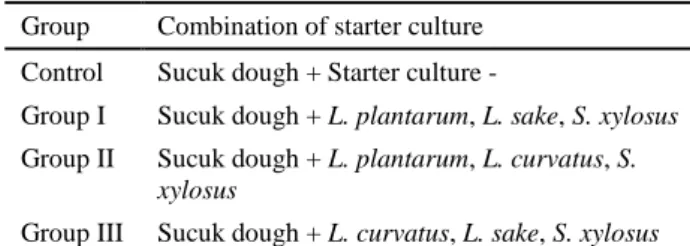
Berthier and Ehrlich (5), Aymerich et al. (4). S. xylosus was isolated from pure cultures (39), evaluated according to oxidase test (3), sensitivity of furazolidone and lysostaphin (41), gelatine hydrolysis test (3) and growth ability on Cimmon Citrat Agar (3) and identified as molecularly (17, 29, 30). After verification, these microorganisms were compared with 1:1 and were used for sucuk producing three different ways. Each sucuk group was produced in the form of 10 kg and it was replicated three times and named as control, group I (GI), group II (GII), group III (GIII). Sucuk groups are listed in Table 1.
Table 1. Combination of starter culture. Tablo 1. Starter kültür kombinasyonları.
Group Combination of starter culture Control Sucuk dough + Starter culture -
Group I Sucuk dough + L. plantarum, L. sake, S. xylosus Group II Sucuk dough + L. plantarum, L. curvatus, S.
xylosus
Group III Sucuk dough + L. curvatus, L. sake, S. xylosus
Control group had no starter culture. Other groups were inoculated with starter culture, and ratios of starter culture were 107 cfu/g for L. plantarum, L. sake and L.
curvatus; 106 cfu/g for S. xylosus. Dilutions were prepared
by physiological brine. Each dilution was inoculated to media to get 106-107 cfu/g level and enumerated. After
obtaining the 106-107 cfu/g level, it was determined which
McFarland turbidity gave 106-107 cfu/g level (33).
Sucuk production was made at Afyonkarahisar İkbal Gıda Inc. Production was made using formulation and method which were announced by Gökalp et al. (19). For this purpose, 1 kg sucuk doughs including 800 g beef and 200 g fat were prepared. It was applied basing on ripening conditions of Kaban and Kaya (25).
Colour analyses of the samples were calculated by Minolta (CR-A70, Japan) colorimetry at the final product. It was based on criteria of Commission Internationale de l'Eclairage (CIE). Lightness (L*), redness (a*) and yellowness (b*) were measured. Measuring was made twice on both inner and outer surfaces for each sample. The results were evaluated by five different measurements (2).
Texture profile analysis was made on final product with the instrument (Stable Micro Systems TA.XT2, Texture Technologies Corp., Robbinsville, NJ). After getting away from sucuk’s casing, they were sliced in 1 cm. This analysis was made considering the method of Bourne (6).
Sensory evaluation of samples was made with a total of 25 uneducated academics, administrative and other staff who work at the Veterinary Medicine Faculty of Afyon Kocatepe University. Evaluation was made using the hedonic scala. According to this scala, point 9 symbolizes ‘’very good’’ and point 1 symbolizes ‘’bad’’(1, 37).
Statistical analyses: Sucuks used in this study were
produced three times for each group. Testing of normal distribution for datasets was evaluated by the Kolmogorov-Smirnov and Shapiro-Wilk tests. According to these tests, it was seen that datasets did not fit normal distribution except for sensorial evaluation datasets. The sensorial evaluation datasets were analysed by one-way ANOVA. Multiple comparison test was applied by Duncan test related with sensorial evaluation datasets. The other datasets were analysed by Kruskal-Wallis test.
Results
According to CIE, statistical results of L*, a* and b* values are shown in Table 2. There were no statistical differences between the groups (p>0.05).
The results of texture profile analysis are summarized in Table 3. Hardness values of the groups were detected between 2519.19-3391.25 g. In terms of hardness, cohesiveness and resilience, there were statistical differences between control (3391.75 g) and GI (2521.04 g)-GII (2519.19 g) groups; GIII (0.74) and GI (0.70); GIII (0.28) and GI (0.25), respectively (p<0.05).There were no statistical differences detected between groups with regard to adhesiveness (29.70-10.28 g.sec), springiness (0.70-0.78) and chewiness (1263.43-1742.17 g) (p>0.05).
Table 2. Results of outer and inner surface colour values. Tablo 2. Dış yüzey ve kesit yüzey renk değerleri analiz sonuçları.
Colour values Group N q2 a q1a q2b q1b L* values C 3 41.56 38.58 51.79 51.16 GI 3 41.01 38.51 52.45 51.54 GII 3 41.19 38.54 52.56 51.39 GIII 3 42.33 37.31 51.59 51.35 a* values C 3 13.93 13.60 17.43 16.85 GI 3 10.16 9.99 17.35 17.00 GII 3 10.45 10.06 17.11 16.56 GIII 3 11.04 10.69 17.63 17.63 b* values C 3 12.26 12.01 17.75 17.09 GI 3 10.87 10.75 18.44 17.42 GII 3 11.39 10.74 18.36 17.28 GIII 3 10.69 10.53 18.02 17.57
N: number of analysis; q2: median; q1: quarter of %25; a: outer surface; b: inner surface; p of La* value: 0.863; p of aa* value: 0.063; p of ba* value: 0.075; p of Lb* value: 0.935; p of ab* value: 0.204; p of bb* value: 0.963.
N: analiz sayısı; q2: medyan; q1:%25’lik çeyreklik; a: dış yüzey; b: kesit yüzey; La* değeri p: 0.863; aa* değeri p: 0.063; ba* değeri p: 0.075; Lb* değeri p: 0.935; ab* değeri p: 0.204; bb* değeri p: 0.963.
Table 3. Results of texture profile analysis of control and other sucuk groups. Tablo 3. Kontrol ve deneme gruplarının tekstür analiz sonuçları.
Texture Values Group N q 2 q1 q3 Hardness (g) C 9 3391.75a 2677.64 3725.54 GI 9 2521.04b 2158.50 2855.66 GII 9 2519.19b 2214.69 2839.43 GIII 9 2779.47ab 2669.93 3155.62 Adhesiveness (g.sn) C 9 29.70 61.93 9.17 GI 9 20.09 92.14 13.58 GII 9 12.49 23.30 7.95 GIII 9 10.28 19.56 7.48 Springiness K 9 0.78 0.74 0.83 GI 9 0.76 0.71 0.79 GII 9 0.75 0.65 0.81 GIII 9 0.70 0.61 0.74 Cohesiveness C 9 0.71ab 0.68 0.74 GI 9 0.70a 0.66 0.70 GII 9 0.73ab 0.69 0.78 G III 9 0.74b 0.72 0.77 Chewiness (g) C 9 1742.17 1410.93 2252.39 GI 9 1263.43 1066.27 1453.74 GII 9 1448.97 974.92 1652.89 GIII 9 1462.71 1302.41 1589.79 Resilience C 9 0.25ab 0.24 0.29 GI 9 0.25a 0.23 0.26 GII 9 0.26ab 0.23 0.29 GIII 9 0.28b 0.27 0.30
N:number of analysis; *p<0.05; **p≤0.01; q2: median; q1: quarter of %25; q3: quarter of %75; a-b: letters on the same column compare values of texture profile analysis for each property; different letters represent a statistical difference intergroup (p˂0.05; p≤0.01); same letters do not represent a statistical difference (p˃0.05); p of hardness: 0.011**; p of adhesiveness: 0.184: p of springiness: 0.100; p of cohesiveness: 0.023*; p of chewiness: 0.052; p of resilience: 0.018**.
N: analiz sayısı; *p<0.05; **p≤0.01; q2: medyan; q1:%25’lik çeyreklik; q3: %75’lik çeyreklik;a-b: Her bir özellik için ayrı ayrı, aynı sutundaki harfler tektür profil analiz değerleri karşılaştırılmasıdır. Farklı harfler örnekler arasında istatistiksel fark (p˂0.05; p≤0.01) olduğunu gösterirken; aynı harflerle gösterilenler örnekler arasında istatistiksel fark bulunmadığını göstermektedir (p˃0.05); sertlik p: 0.011**; dış yapışkanlık p: 0.184: esneklik p: 0.100; iç yapışkanlık p: 0.023*; çiğnenebilirlik p: 0.052; elastiklik p: 0.018*
Table 4. Results of the sensory evaluation in raw sucuk. Tablo 4. Çiğ sucuk duyusal analiz sonuçları.
Results of the Sensory Evaluation Group N Average± Standard Deviation F P
Colour of inner surface
C 25 5.56±1.60
1.236 0.301
GI 25 5.24 ±1.56
GII 25 5.76±1.78
GIII 25 6.12±1.66
Colour of outer surface
C 25 6.36±1.46
0.650 0.585
GI 25 6.08±1.35
GII 25 6.12±1.69
GIII 25 6.60±1.44
Typical sucuk odor
C 25 6.76±1.80 0.917 0.436 GI 25 5.92±1.95 GII 25 6.52±2.08 GIII 25 6.60±1.80 Texture C 25 7.24a±1.26 2.970 0.036* GI 25 6.24b±1.47 GII 25 6.40ab±1.52 GIII 25 7.08ab±1.44 Acceptability C 25 7.32±1.28 1.696 0.173 GI 25 6.48±1.89 GII 25 6.92±1.60 GIII 25 7.32±1.28
N: number of panellist; *p<0.05; a-b: Letters on the same column compare values of the sensory evaluation in raw sucuk; different letters represent statistical difference intergroup (p˂0.05); same letters do not represent a statistical difference (p˃0.05).
N: panelist sayısı;*p<0.05;a-b: Aynı sütundaki harfler çiğ sucuk duyusal analiz değerleri karşılaştırılmasıdır. Farklı harfler, örnekler arasında istatistiksel fark (p˂0.05) olduğunu gösterirken; aynı harflerle gösterilenler örnekler arasında istatistiksel fark bulunmadığını göstermektedir (p˃0.05).
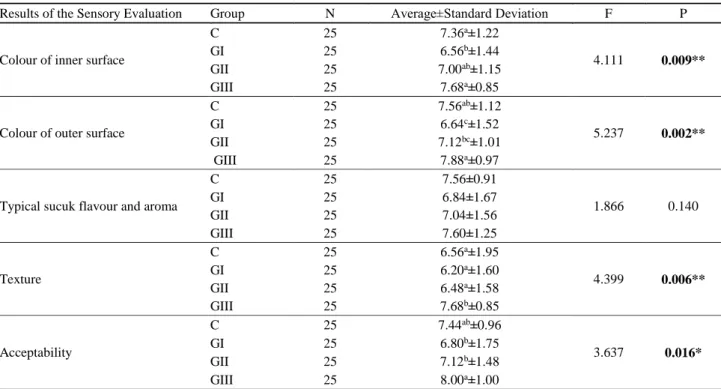
Table 5. Results of the sensory evaluation in cooked sucuk. Tablo 5. Pişmiş sucuk duyusal analiz sonuçları.
Results of the Sensory Evaluation Group N Average±Standard Deviation F P
Colour of inner surface
C 25 7.36a±1.22
4.111 0.009**
GI 25 6.56b±1.44
GII 25 7.00ab±1.15
GIII 25 7.68a±0.85
Colour of outer surface
C 25 7.56ab±1.12
5.237 0.002**
GI 25 6.64c±1.52
GII 25 7.12bc±1.01
GIII 25 7.88a±0.97
Typical sucuk flavour and aroma
C 25 7.56±0.91 1.866 0.140 GI 25 6.84±1.67 GII 25 7.04±1.56 GIII 25 7.60±1.25 Texture C 25 6.56a±1.95 4.399 0.006** GI 25 6.20a±1.60 GII 25 6.48a±1.58 GIII 25 7.68b±0.85 Acceptability C 25 7.44ab±0.96 3.637 0.016* GI 25 6.80b±1.75 GII 25 7.12b±1.48 GIII 25 8.00a±1.00
N: number of panelist; *p<0.05; **p<0.01; a-b: Letters on the same column compare values of the sensory evaluation in cooked sucuk; different letters represent statistical difference intergroup (p˂0.05; p˂0.01); same letters do not represent a statistical difference (p˃0.05). N: panelist sayısı; *p<0.05; **p<0.01; a-b: Aynı sutundaki harfler, pişmiş sucuk duyusal analiz değerleri karşılaştırılmasıdır. Farklı harfler, örnekler arasında istatistiksel fark (p˂0.05; p˂0.01) olduğunu gösterirken, aynı harflerle gösterilenler örnekler arasında istatistiksel fark bulunmadığını göstermektedir (p˃0.05).
Results of sensory evaluation are indicated in Table 4 for raw sucuk and in Table 5 for cooked sucuk. For raw sucuks, there were no statistical differences in terms of properties for colour of inner and outer surface, typical sucuk odor, acceptability except for texture property (p<0.05). If groups were sorted from smooth to rough texture, there would be control, GIII, GII and GI groups, respectively.
In cooked sucuk, there were statistical differences in inner and outer surface colour, texture (p<0.01) and acceptability (p<0.05). GI (6.56) and control group (7.36); GIII (7.68) and GI were statistically different from each other in inner surface colour. Control (7.56) and GI (6.64); GIII (7.88) and GI-GII (7.12) groups were statistically different in regard to outer surface colour. GIII was statistically different from other groups with regard to property of texture (p<0.01). GIII (8.0) was statistically different from GI (6.80) -GII (7.12) in property of acceptability (p<0.05).
Discussion and Conclusion
In this study, values of L*, a* and b* were similar to the findings of previous studies (40, 18, 24, 11, 14, 33). Moreover, it was observed that using starter culture could not affect colour parameters as stated by the earlier findings of Essid and Hassouna (14), Bozkurt and Bayram (7) and Casaburi et al. (8) found that as observed in this study.
In texture profile analysis, hardness values of groups with starter culture were lower than the control group which had no starter culture. This difference between the control group and GI-GII groups was related with the starter culture. For the cohesiveness property, L. sake, L.
curvatus and S. xylosus which present in GIII were more
effective when compare to other microorganism combinations. During the production, cohesiveness change in accordance with sucuk formulation and it is not preferable property in sucuks (12). L. sake, L. curvatus and
S. xylosus could be effective in resilience property.
According to panelist evaluations, microorganism combination of GIII was more desirable than the others as for the resilience property.
At sensory analyses, the control group had a more smooth texture than the other groups in raw sucuk groups. While GIII was more preferable in texture profile analysis, it was second line in sensory evaluation. Related with this result, subjective evaluation was not confirmed instrumental results for raw sucuk groups. Conversely, subjective evaluation was confirmed instrumental results for cooked sucuk groups. The values of texture profile analysis in this study were similar with the findings of the earlier studies considering hardness (7, 14), adhesiveness (7, 12, 33), chewiness (7) and resilience (33). The results
of texture profile analysis differ due to raw material, starter culture, processing method and environment in fermented meat products (7). Therefore, it is hard to find similar studies. However, scientific studies investigating texture profile analysis have increased day by day. Sense of texture is related with age, food culture and nutritional habit of consumers (13).
In cooked sucuk sensory analysis, GIII had the smoothest texture. So, it was verified with instrumental analysis. Panellists commented that GI had more sour flavour than the others had. Nevertheless, all of the groups had the same formulation. The reason of sour flavour was presence of L. plantarum in GI. This could be the reason why GI is less accepted by the panellists. This study was similar with the studies of Öztürk (33) (texture, typical sucuk odor and acceptability) and Kaban (24) (typical sucuk odor).
Hammes and Hertel (21) reported that L. sake and L.
curvatus were the best microorganisms at meat
fermantation. Hugas and Monfort (22) pointed that L. sake and L. curvatus inhibited unwanted microbiota because of the best adaptation feature to meat environment. By this way, microorganisms prevent undesirable odor and aroma. Garriga et al. (16) suggested that L. plantarum and
L. curvatus were more effective than L. sake on odor
improvement. L. plantarum is more attractive than L. sake and L. curvatus on rancid aroma development (16). Özdemir (32) claimed that L. sake and L. curvatus were dominant microbiotas in fermented sucuks, and the amount of L. sake was directly proportional to organoleptic quality. Dinçer et al. (10) reported that sensorial quality of fermented sucuks were the best way when using as a culture of L. sake, L. curvatus and S.
xylosus. In this study, the most proper microorganism
combination was mixture of L. sake, L. curvatus and S.
xylosus for the sensory quality.
Fermented sucuk is special for Turkey. Natural microbiota of sucuks are different according to the area where sucuk is produced. Natural microbiota of sucuk should be investigated and its safety for public health should be evaluated and determined technologically for using as a starter culture. In order to achieve this aim, researchers can benefit from microbiota which is isolated traditional sucuks and environment. This microbiota is better adaptable to sucuk than commercial microorganisms. These microorganisms called starter culture can speed up production, have less additives and have a proper palate for consumer. Following that, starter cultures having these properties should be offered to the market. To this purpose, except for pathogen microorganisms, we should contribute to the development of starter cultures special to Turkey.
Acknowledgement
This study is a part of doctorate thesis named as ‘’Investigation of use as a starter culture of Lactobacillus
plantarum, Lactobacillus sake, Lactobacillus curvatus
isolated from fermented Turkish sucuk’’ and is supported by Afyon Kocatepe University, Scientific Projects Research Coordination Centre as 14. Sağ. Bil. 04 project number.
References
1. Altuğ T (1993): Duyusal test teknikleri. E.Ü. Mühendislik Fakültesi Ders Kitapları Yayın No. 28, 56 s., İzmir. 2. Anon (1971): CIE international commission on
illumination, recommendations on uniform color spaces, color-difference equations, psychometric color terms.
Supplement No. 2 to CIE Publication No. 15, Colorimetry, 1971 and 1978.
3. Anon (2015): Simmon sitrat agarda üreme yetenekleri,
oksidaz testi, jelatin testi. http://www.mikrobiyoloji.org.
(Erişim tarihi: 03.04.2015).
4. Aymerich T, Martin B, Garriga M, et al. (2003):
Microbial quality and direct PCR identification of lactic acid bacteria and nonpathogenic staphylococci from artisanal low-acid sausages. Appl Environ Microbiol, 69,
4583-4594.
5. Berthier F, Ehrlich SD (1998): Rapid species
identification within two groups of closely related lactobacilli using PCR primers that target the 16S/23S rRNA spacer region. FEMS Microbiol Lett, 161, 97-106.
6. Bourne MC (1978): Texture profile analysis. Food Technol, 32, 62-66.
7. Bozkurt H, Bayram M (2006): Colour and textural
attributes of sucuk during ripening. Meat Sci, 73, 344-350.
8. Casaburi A, Aristoyb MC, Cavellaa S, et al. (2007):
Biochemical and sensory characteristics of traditional fermented sausages of Vallo di Diano (Southern Italy) as affected by the use of starter cultures. Meat Sci, 76,
295-307.
9. Coppola R, Giagnacovo B, Iorizzo M, et al. (1998):
Characterization of lactobacilli involved in the ripening of soppressata molisana, a typical southern Italy fermented sausage. Food Microbiol, 15, 347-353.
10. Dinçer B, Mutluer B, Erol I, et al. (1995): Türk fermente
sucuğuna özgü starter kültür bakterilerinin izolasyon, identifikasyon ve üretimleri. Ankara Univ Vet Fak Derg, 42,
285-293.
11. Ekşi H (2011): Sucuk üretiminde kaşar peyniri kullanımı. Ankara Üniversitesi, Fen Bilimleri Enstitüsü, Yüksek Lisans Tezi.
12. Ergönül B (2009): Farklı probiyotik kültürler kullanarak
hindi sucuğu üretimi ve kalite üzerine etkileri. Doktora Tezi,
Celal Bayar Üniversitesi, Fen Bilimleri Enstitüsü, Gıda Mühendisliği A.B.D., Manisa.
13. Ertaş N, Doğruer Y (2010): Besinlerde tekstür. Erciyes Üniv Vet Fak Derg, 7, 35-42.
14. Essid I, Hassouna M (2013): Effect of inoculation of
selected Staphylococcus xylosus and Lactobacillus plantarum strains on biochemical, microbiological and
textural characteristics of a Tunisian dry fermented sausage. Food Control, 32, 707-714.
15. Facklam RR, Carvalho MGS, et al. (2002): History,
Taxonomy, Biochemical Characteristics, and Antibiotic Susceptibility Testing of Enterococci. 1-54. In: MS Gilmore,
DB Clewell, P Courvalin, GM Dunny, BE Murray, LB Rice (Ed), The Enterococci: Pathogenesis, Molecular Biology, and Antibiotic Resistance. ASM Press, Washington, D.C. 16. Garriga M, Hugas M, Gou P, et al. (1996): Technological
and sensorial evaluation of Lactobacillus strains as starter cultures in fermented sausages. Int J Food Microbiol, 32,
173-183.
17. Gezgen C, Şeker E (2016): Investigation of methicillin
resistance and Panton-Valentine leukocidin in Staphylococci isolated from bovine mastitis. Acta Sci Vet,
44, 1373.
18. Gimeno O, Ansorena D, Astiasaran I, et al. (2000):
Characterization of chorizo de Pamplona: Instrumental measurements of colour and texture. Food Chem, 69,
195-200.
19. Gökalp HY, Kaya M, Zorba Ö (2004): Et ürünleri işleme
mühendisliği. Atatürk Üniversitesi, Yayın No:786, Ziraat
Fak. Yayın No: 320, Erzurum.
20. Gürakan GC, Bozoğlu TF, et al. (1995): Identification of
Lactobacillus strains from Turkish-style dry fermented sausages. Lebensm Wissu-Technol, 28, 139-144.
21. Hammes WP, Hertel C (1998): New developments in meat
starter cultures. Meat Sci, 49, 125-138.
22. Hugas M, Monfort JM (1997): Bacterial starter cultures
for meat fermentation. Food Chem, 59, 547-554.
23. Iversen C, Waddington M, Farmer JJ, et al. (2006): The
biochemical differentiation of Enterobacter sakazakii genotypes. BMC Microbiol, 6, 94.
24. Kaban G (2007): Geleneksel olarak üretilen sucuklardan
laktik asit bakterileri ile katalaz pozitif kokların izolasyonu-identifikasyonu, üretimde kullanılabilme imkânları ve uçucu bileşikler üzerine etkileri. Doktora Tezi. Atatürk
Üniversitesi Fen Bilimleri Enstitüsü, Gıda Mühendisliği Anabilim Dalı Erzurum.
25. Kaban G, Kaya M (2007): Staphylococcus xylosus ve
Lactobacillus plantarum suşlarının sucuğun duyusal özellikleri ve renk değerleri üzerine etkileri. Atatürk Üniv
Ziraat Fak Derg, 38, 83-89.
26. Leroy F, Verluyten J, De Vuyst L (2006): Functional meat
starters cultures for improved sausages fermentation. Int J
Food Microbiol, 106, 270-285.
27. Montel MC, Mason, F, et al. (1998): Bacterial role in
flavour development. Meat Sci, 49, 111-123.
28. Moretti VA, Madonia G, Diaferia C, et al. (2004):
Chemical and microbiological parameters and sensory attributes of a typical Sicilian salami ripened in different conditions. Meat Sci, 66, 845-854.
29. Morot-Bizot S, Talon R, Leroy-Setrin S (2003):
Development of specific PCR primers for a rapid and accurate identification of Staphylococcus xylosus, a species used in food fermentation. J Microbiol Methods, 55,
279-286.
30. Morot-Bizot SC, Talon R, Leroy S (2004): Development
of a multiplex PCR for the identification of Staphylococcus genus and four Staphylococcal species isolated from food. J
31. Ordonez JA, Hierro EM, Bruna JM, et al. (1999):
Changes in the components of dry-fermented sausages during ripening. Crc Cr Rev Food Sci, 39, 329-367.
32. Özdemir H, Çelik TH, Erol İ, et al. (1996): Yüksek sıcaklık
derecesinde olgunlaştırılan Türk fermente sucuklarında laktobasillerin seyir, izolasyon ve identifikasyonu. Gıda
Derg, 21, 465-470.
33. Öztürk İ (2013): Geleneksel fermente sucuklardan izole
edilen mayaların tanımlanması, teknolojik ve fonksiyonel özelliklerinin belirlenmesive sucuk üretimine uygun izolatların seçilmesi. Doktora Tezi, Erciyes Üniversitesi
Fen Bilimleri Enstitüsü, Kayseri.
34. Papamanoli E, Tzanetakis N, Litopoulou-Tzanetaki E, et al. (2003): Characterization of lactic acid bacteria
isolated from a Greek dry-fermented sausage in respect of their technological and probiotic properties. Meat Sci, 65,
859-867.
35. Samelis J, Metaxopoulos J, Vlassi M, et al. (1998):
Stability and safety of traditional Greek salami-a microbiological ecology study. Int J Food Microbiol, 44,
69-82.
36. Santos EM, Gonzalez-Fernandez C, Jaime I, et al. (1998): Comparative study of lactic acid bacteria house
flora isolated in different varieties of chorizo. Int J Food
Microbiol, 39, 123-128.
37. Stahnke LH (1995): Dried sausages fermented with
Staphylococcus xylosus at different temperatures and with different ingredient levels-Part I. Chemical and bacteriological data. Meat Sci, 41, 179-191.
38. Talon R, Leroy S, Lebert I (2007): Microbial ecosystems
of traditional fermented meat products: The importance of indigenous starters. Meat Sci, 77, 55-62.
39. Urso R, Rantsiou K, Cantoni C, et al. (2006):
Technological characterization of a bacteriocin-producing Lactobacillus sakei and its use in fermented sausages production. Int J Food Microbiol, 110, 232-239.
40. Üren A, Babayiğit D (1997): Colour parameters of
Turkish-type fermented sausage during fermentation and ripening. Meat Sci, 45, 539-549.
41. Winn W, Allen S, Janda W, et al. (2006): Color Atlas and
Textbook of Diagnostic Microbiology. 6th ed. Lippincott,
Williams and Wilkins, Philadelphia.
Geliş tarihi: 27.10.2016 / Kabul tarihi: 05.03.2017
Address for correspondence:
Dr. Yağmur Nil DEMİREL Afyon Kocatepe University, Faculty of Veterinary Medicine,
Department of Food Hygiene and Technology, Afyonkarahisar, Turkey.