Influence of eggshell colour on egg yolk antibody level, incubation results,
and growth in broiler breeders
Mikail Baylan1, Ladine Baykal Celik1, Gulsen Copur Akpinar2*, Sema Alasahan3, Altug Kucukgul4, Sibel Canogullari Dogan5
1 Cukurova University, Agriculture Faculty, Department of Animal Science, Adana, Turkey. 2 Mustafa Kemal University, Agriculture Faculty, Department of Animal Science, Hatay, Turkey. 3 Mustafa Kemal University, Veterinary Medicine Faculty, Department of Animal Science, Hatay, Turkey. 4 Mustafa Kemal University, Veterinary Medicine Faculty, Department of Biochemistry, Hatay, Turkey.
5 Ömer Halisdemir University, Agricultural Sciences and Technologies Faculty, Department of Animal Production and Technologies, Nigde, Turkey.
ABSTRACT - This study was performed to determine the effect of shell colour in eggs acquired from Ross-308 broiler breeders on the interior and exterior quality of the egg, the antibody content of the egg yolk, and growth performance. The shell colours of a total of 1350 eggs were classified, using a colorimeter, into three groups: dark (E<64), medium (E:64.00-67.00), and light (E>67). The difference between groups with respect to egg weight, shape index, shell weight, and Haugh unit value was significant. Egg yolk antibody content (IgY) was 6.658 mg/mL in the dark colour group, 5.130 mg/mL in the medium colour group, and 5.242 mg/mL in the light colour group. Among incubation characteristics, the fertility rate as, in order, 94.66%, 92.14%, and 87.92% in dark, medium, and light shell colour eggs, and the hatchability was 87.00%, 84.28%, and 80.57%, in the same order. No significant difference was observed between groups with respect to hatchability of fertile eggs and embryonic mortality rates. No significant difference was observed between groups for live weight, feed intake, and feed conversion ratio either. The eggshell colour has an effect on yolk antibody content and on the hatchability, but it has no influence on hatchability of fertile eggs, Haugh unit and growth performance.
Key Words: embryonic mortality, hatchability, growth performance © 2017 Sociedade Brasileira de Zootecnia
ISSN 1806-9290 www.sbz.org.br
R. Bras. Zootec., 46(2):105-112, 2017
Introduction
Eggshell colour is determined at the end of the ovarian channel, in the uterus. From the moment the eggshell starts to form, the epithelial cells at the surface of the shell gland (uterus) start synthesizing colour pigments (Butcher and Miles, 1995). The pigments that create the shell colour are called biliverdin-IX, zinc chelate, and protoporphyrin-IX. In eggs with blue or green shells, biliverdin and biliverdin zinc chelates are more prominent, while in brown-shelled eggs, the amount of protoporphyrin is higher (Zhao et al., 2006). While the biliverdin pigment has an antioxidant effect, protoporphyrin increases the resistance of the
eggshell against breaking (Liu and Cheng, 2010; Ishikawa et al., 2010; Soler et al., 2005). Biliverdin and its reduction product bilirubin are powerful antioxidants (Liu and Cheng, 2010) and are essential for early embryogenesis (Falchuk et al., 2002). A study performed on blue tit (Cyanistes
caeruleus) eggs reported that, according to the structural
function hypothesis, the protoporphyrins responsible for the reddish dots on the eggshell are stored in the shell areas where calcium accumulation is lower (Garcia-Navas et al., 2011).
There are many methods for determining eggshell colour differences (Sezer et al., 2007; Ingram et al., 2008; Mertens et al., 2010; Sekeroglu and Duman, 2011; Taha, 2011; Wegrzyn and Leniowski, 2011; Caglayan et al., 2014; Lukanov et al., 2015). One of these methods is based on determining the eggshell colour (E) value that shows the shell pigment density. The eggshell colour value is calculated using the formula E = (L2 + a2 + b2)1/2. Eggshell
colour is based on three basic indices: L, a, and b. These indices are defined as follows: L - blackness-whiteness degree; a - greenness-redness degree; and b - blueness-yellowness degree. A lower E value represents a darker egg colour (Ingram et al., 2008; Sekeroglu and Duman, 2011).
Egg external quality characteristics are established based on egg weight, egg density, and shell characteristics. Received: April 30, 2016
Accepted: May 16, 2016
*Corresponding author: [email protected] http://dx.doi.org/10.1590/S1806-92902017000200004
How to cite: Baylan, M.; Baykal Celik, L.; Copur Akpinar, G.; Alasahan, S.;
Kucukgul, A. and Canogullari Dogan, S. 2017. Influence of eggshell colour on egg yolk antibody level, incubation results, and growth in broiler breeders. Revista Brasileira de Zootecnia 46(2):105-112.
Copyright © 2017 Sociedade Brasileira de Zootecnia. This is an Open Access article distributed under the terms of the Creative Commons Attribution License (http://creativecommons.org/licenses/by/4.0/), which permits unrestricted use, distribution, and reproduction in any medium, provided the original work is properly cited.
Shell quality can be determined by shell thickness, shell breaking resistance, visible shell defects, density, shell weight, shell ratio, and shell colour (Liu and Cheng, 2010). In studies that examine the relationship between shell colour and shell quality, Godfrey (1949) and Jopesh et al. (1999) found that eggs with darker shells have a higher density. Ingram et al. (2008) reported that the eggshell colour is significantly related to the shell quality, but this was not a feature that determined shell quality as definitively as egg density and shell thickness. While Briggs and Teulings (1974) reported a positive (0.08) relationship between eggshell colour and breaking resistance, Yang et al. (2009) found a negative relationship between shell colour and breaking resistance (−0.262), shell weight (−0.255), and shell thickness (−0.443). On the other hand, Liu and Cheng (2010) reported that the eggshell colour on its own cannot be a sufficient indicator for determining eggshell quality.
The shape, structure, and pigmentation of the eggshell affect the hatchling weight, body structure, and incubation results of day-old chicks (Shanawany, 1987). Determining the eggshell colour provides information for determining the disease or stress status of the animals providing eggs with dark-coloured shells. This information can be used for early detection of stress states or oncoming diseases before serious quality and health problems arise (Mertens et al., 2010). Ishikawa et al. (2010) reported that the bacteria development on the shell surface is lower in eggs with darker shells. In studies performed on chicken eggs, Sekeroglu and Duman (2011) found that the live weight of chicks hatched from eggs with dark shells is higher than that of chicks hatched from eggs with light-coloured shells. Eggshell colour does not only indicate the female value, but also the quality of the egg and the chicks hatched. According to Morales et al. (2006), the intensity of the blue-green colour in Ficedula hypoleuca eggs reflects the antibody amounts
in the yolk and the amount of antibodies in the yolk affects the chick performance. The development of the chick immune system is dependent on the antioxidant capacity that is inherited or that comes from maternal transfer (Saino et al., 2003). These antibodies (IgY) provide first hormonal immunity for the newly hatched chicks and improve the growth and survival of the chicks (Apanius, 1998). Moreno et al. (2004) stated that the eggshell colour can reflect the egg IgY level and chick quality as well as serve as an indicator of maternal immune sufficiency. It was reported that the fertility, hatchability of fertile eggs, hatchability, and hatchling weight are higher in eggs with dark-coloured shells than in eggs with light-coloured shells (Sekeroglu and Duman, 2011), but eggshell colour had no effect on
embryonic mortality and egg weight loss (Sekeroglu and Duman, 2011).
This study was performed to determine the effect of shell colour differences in eggs acquired from breeders with genotype Ross-308 on the interior and exterior quality of the egg, the antibody content of the egg yolk, and growth performance.
Material and Methods
The trial materials consist of hatching eggs acquired from 35-week-old Ross-308 broiler breeders. During the trial, the hatching eggs acquired from the breeders over one week were grouped into three groups based on their eggshell colours (E values). To establish the eggshell colours, a colorimeter (Konica Minolta Colorimeter CR-300) was used to establish the L*, a*, and b* (L: brightness, a: redness, and b: yellowness) values. Using the L*, a*, and b* values taken from the blunt, sharp, and center areas of the egg, the local E values were calculated by the formula E = (L2 + a2 + b2)1/2. Using the arithmetic mean of local E
values, the E value of the entire shell colour was found as follows:
Whole shell colour E value = (ESharp end + EEquatorial + EBlunt end) / 3
After the shell colours of the collected eggs were established, the eggs were classified into three groups according to the calculated E values: dark (E<64), medium (E: 64-67.00), and light (E>67). During the trial, 400 eggs from each shell colour group and 1200 eggs in total were taken for hatching and 150 eggs (50 × 3) were taken to determine the internal and external quality criteria, thus using a total of 1350 eggs for the trial. In each eggshell colour group, the internal and external quality characteristics of the eggs were established using eggs collected daily during the first two days.
After the eggs were separated into three groups, according to E values, they were individually numbered. Individual egg weight, length, and width were measured for each egg in each group. To find out egg weight, an electronic scale sensitive to 0.01 g was used and the egg length and width were established using a digital caliper. Eggshell thickness was calculated by taking the arithmetic mean of thickness measurements from dried eggshells at sharp, blunt ends, and the equatorial area of the egg. Shell breaking resistance was measured using a tool that measures breaking resistance in kg/cm2.
Before determining the internal quality characteristics, eggs from each group were left at room temperature for 24 h. After the waiting period, the eggs were cracked onto a flat surface and the long radius and short radius of the thick
albumen and the yolk radius were measured using a digital caliper. A three-step micrometer was used to determine the albumen and yolk height.
The formulae below were used to calculate the internal and external quality values of the eggs:
Shape index (%) = (Egg width (mm) / Egg length (mm)) × 100
Albumen index (%) = (Egg albumen height (mm) / Average of albumen length and width (mm)) × 100
Yolk index (%) = (Yolk height (mm) / Yolk diameter (mm)) × 100
Haugh unit = 100 Log (H + 7.57 – 1.7 W0.37), in which
H = albumen height (mm) and W = egg weight (g).
Egg yolk L, a, and b values were measured using a colorimeter (Konica Minolta Colorimeter CR-300) and the E value was calculated using these measurements. Before measurements were taken, the spectrocolorimeter was calibrated according to L: 97.10, a: −4.88, and b: 7.04 values (Francis, 1998).
To determine the egg yolk antibody content, 15 samples were taken from each group and with two parallel samplings from each sample, 30 egg yolk antibody content (IgY) measurements were taken from each group.
The isolation of polyclonal chicken immunoglobulins acquired from egg yolks was performed using the modification of the two-stage protocol applied by Polson (1990). The egg yolk was separated from the albumen, washed with deionized water and placed inside a funnel. The external layer of the yolk was separated using forceps and the samples were transferred to 50-mL tubes. Each egg yolk sample was treated and mixed with 25 mL sodium phosphate buffer (100 mM, pH 7.6). Afterwards, 20 mL chloroform was added and the sample was shaken until a half-transparent phase was reached. After 30 min of 1200g
centrifuge treatment, the supernatant was poured into a centrifuge tube and (Fluka St. Louis, Mo) solidpolyethylene 6000% 12 (w/v) was added to the final concentration. Finally, after 10 min of centrifuge at 15.700 g, the pallets formed were unseated using 2 mL sodium phosphate buffer and the samples were stored at −20ºC.
The analysis of antibody bonding to egg yolk lysates was performed with indirect enzyme-linked immunosorbent assay (ELISA). As a shortcut, commercial anti-chicken IgG reaction kit (Cloud-Clone Corp., USA) was used. Afterwards, using an ELISA reader (Biotek µQuant), the IgGFClevels in the samples were recorded by calibrating the 450 nm light wavelength absorbance values according to the formulation given on the kit.
The eggs to be hatched were disinfected for 20 min at 20 oC room temperature using two doses of 28 cc formalin
and 14 g potassium permanganate solution before placement in the setter. Afterwards, 1200 eggs (400 × 3) were placed in incubators, with 80 eggs in each (80 × 5 = 400). During the development period (0-18 days), the temperature was fixed at 37.7oC and relative humidity at 55-60%. On day
18 of incubation, eggs belonging to each group were placed on separate trays and were transferred to the hatchery. The hatching conditions in the hatching machine were set as 37.4 oC temperature and 65-70% relative humidity.
At the end of the incubation period, the eggs that did not undergo a chick hatch were broken and fertility and embryonic mortality rates were determined macroscopically. Eggs were categorized as unfertilised, early (0-6 days), middle (7-17 days), and late and under shell embryonic mortality (18-21 days). Incubation results were calculated according to these formulae:
Fertility rate (%) = (number of fertilised eggs / total number of eggs placed into the machine) × 100
Hatchability of fertile eggs (%) = (Number of hatched chicks / Number of fertilised eggs placed into the machine) × 100
Hatchability (%) = (Number of hatched chicks / Number of total eggs placed into the machine) × 100
At the end of the hatching period, the chicks that hatched were taken out of the incubator after they were dried. To establish hatchling weight, the chicks were weighed individually and were given wing numbers. From each trial group, 200 chicks were taken and separated into five groups of 40 chicks. When placing chicks into groups, 20 male and 20 female chicks were selected for each.
During the study, the animals were fed broiler chick starter feed (23% raw protein, 3100 kcal/kg metabolizable energy; ME) on days 0-10 and broiler grower feed (22% raw protein, 3200 kcal/kg ME) ad libitum on days 11-35. Chicks were given water ad libitum as well and 24 h lighting was used.
For the study, animals in all groups were weighed individually every week and their weekly live weights were recorded. The feed conversion ratio of the groups was calculated using their weekly feed intake and live weights.
Groups were checked every day to determine animals that had died and at the end of 35 days, based on the mortality rate recorded, the survival strength (%) was known.
The SPSS (SPSS for Windows, release 17.0) package program was used for the analysis of the data obtained during the study. Variance analysis was applied for the statistical assessment of the data. To work out differences among the groups, Duncan’s multiple comparison test was applied.
Results
The effect of egg shell colour on egg weight, shape index, shell weight, Haugh unit value, and egg yolk IgY level was significant (P<0.05) (Table 1). The highest egg weight, shape index, and shell weight were achieved in the light shell colour group and the highest Haugh unit was achieved in the medium shell colour group. No significant difference was observed in shell colour groups with respect to albumen index, yolk index, shell thickness, breaking resistance, or yolk L, a, and b values (P>0.05).
The relationship between shell colour and yolk antibody content (IgY) was significant (P<0.05) and the yolk IgY content was 6.658 mg/mL in dark-coloured eggs, 5.130 mg/mL in medium-coloured eggs, and 5.242 mg/mL in light-coloured eggs (Figure 1).
The rates of fertility, hatchability, and hatchability of fertile eggs were the highest in the dark shell colour group. While the difference of the fertility and hatchability rates were significant among groups (P<0.05), the hatchability of fertile eggs among groups was not significant (P>0.05). With lighter shell colours, lower values were observed in these categories (Table 2).
The difference among shell colour groups was significant with respect to embryonic mortality (P<0.05). While early embryonic mortalities were more frequent in
the dark shell colour group, middle and late embryonic mortalities were rarer in the dark shell colour group (P<0.05).
The hatchling weights of dark, medium, and light groups were 46.45, 46.57, and 47.72 g respectively (Table 3), and the difference among the groups was significant (P<0.05). In regard to live weight, no significant difference was found among the groups in the other weeks (P>0.05). At the end of day 35, the average live weights were 2416.94, 2429.20, and 2403.96 g in dark, medium, and light shell colour groups, respectively. While the light shell colour group had
Parameter Eggshell colour P-value
Dark Medium Light
Egg weight (g) 62.75±0.649ab 62.09±0.453b 63.91±0.457a 0.045
Albumen index (%) 8.09±0.247 8.72±0.259 7.98±0.278 0.094
Yolk index (%) 42.71±0.616 43.37±0.407 43.91±0.453 0.246
Shape index (%) 78.69±0.389ab 78.28±0.451b 79.83±0.454a 0.036
Shell weight (g) 6.02±0.083b 6.24±0.087ab 6.31±0.91a 0.053
Shell thickness (μ) 323.18±2.862 326.43±4.762 325.73±4.358 0.831
Haugh unit 79.56±0.984b 82.70±0.913a 79.01±1.014b 0.015
Breaking strength (kg/cm2) 3.749±0.125 3.88±0.094 3.695±0.146 0.513
Eggshell colour (E) 61.95±0.380c 65.49±0.129b 69.20±0.280a 0.000
Yolk E value 90.54±0.621 90.83±0.621 91.17±0.620 0.779
Igγ level (mg/mL) in yolk 6.658±0.398a 5.130±0.374b 5.242±0.297b 0.013
a,b,c - differences between means indicated by different letters in the same row are significant (P<0.05).
Table 1 - Effects of eggshell colour on egg quality characteristics
Characteristic Eggshell colour P-value
Dark Medium Light
Initial egg weight (g) 62.815c 63.510b 64.126a 0.000
Fertility rate (%) 94.66a 92.14b 87.92c 0.033
Hatchability (%) 87.00a 84.28b 80.57c 0.037
Hatchability of fertile eggs (%) 91.90 91.47 91.64 0.058
Early embryonic mortality (%) 5.28a 2.84c 2.98b 0.028
Middle embryonic mortality (%) 1.03a 0.89b 0.012
Late embryonic mortality (%) 2.81c 4.39a 4.17b 0.022
a,b,c - differences between means indicated by different letters in the same row are significant (P<0.05).
Table 2 - Effect of eggshell colour on hatching results
Week Sex Eggshell colour P-value
Dark Medium Light
Female 46.15±0.313b 46.09±0.349b 47.83±0.324a 0.000 Male 46.75±0.315 47.05±0.374 47.61±0.300 0.181 Overall 46.45±0.222b 46.57±0.257b 47.72±0.220a 0.000 Female 206.51±2.288 206.40±2.088 207.88±2.088 0.862 1 Male 206.70±2.122 206.72±2.091 207.88±2.088 0.902 Overall 206.49±1.529 205.67±1.436 206.92±1.560 0.837 Female 527.53±5.184 530.49±4.445 532.91±5.346 0.749 2 Male 544.18±5.372 549.00±5.208 555.39±5.248 0.325 Overall 535.73±3.770 540.16±3.470 544.20±3.821 0.269 Female 1005.86±9.421 1005.66±7.651 1008.21±8.833 0.973 3 Male 1099.11±10.460 1105.70±9.591 1107.63±9.945 0.820 Overall 1052.24±7.789 1055.16±7.087 1058.42±7.527 0.843 Female 1654.76±16.036 1641.20±12.095 1635.51±12.966 0.599 4 Male 1913.01±17.479 1892.15±14.601 1890.13±13.947 0.514 Overall 1781.13±15.119 1768.62±13.112 1767.39±13.199 0.741 Female 2202.09±21.192 2213.33±12.983 2202.24±19.091 0.885 5 Male 2650.88±21.482 2627.97±18.093 2609.89±17.880 0.328 Overall 2416.94±22.257 2429.20±18.685 2403.96±19.637 0.675
a,b - differences between means indicated by different letters in the same row are significant (P<0.05).
Table 3 - Effect of eggshell colour on weekly live weight (g)
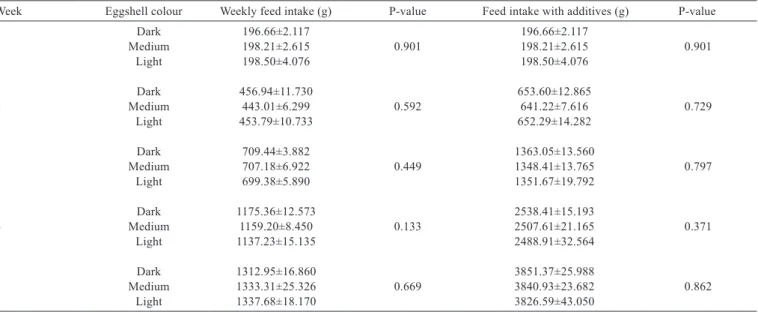
Week Eggshell colour Weekly feed intake (g) P-value Feed intake with additives (g) P-value
Dark 196.66±2.117 196.66±2.117 1 Medium 198.21±2.615 0.901 198.21±2.615 0.901 Light 198.50±4.076 198.50±4.076 Dark 456.94±11.730 653.60±12.865 2 Medium 443.01±6.299 0.592 641.22±7.616 0.729 Light 453.79±10.733 652.29±14.282 Dark 709.44±3.882 1363.05±13.560 3 Medium 707.18±6.922 0.449 1348.41±13.765 0.797 Light 699.38±5.890 1351.67±19.792 Dark 1175.36±12.573 2538.41±15.193 4 Medium 1159.20±8.450 0.133 2507.61±21.165 0.371 Light 1137.23±15.135 2488.91±32.564 Dark 1312.95±16.860 3851.37±25.988 5 Medium 1333.31±25.326 0.669 3840.93±23.682 0.862 Light 1337.68±18.170 3826.59±43.050
Table 4 - Effect of eggshell colour on weekly feed intake by the groups
Week Eggshell colour P-value
Dark Medium Light
0-7 days 1.229±0.012 1.245±0.012 1.247±0.010 0.513 8-14 days 1.390±0.048 1.324±0.014 1.346±0.029 0.400 15-21 days 1.373±0.011 1.373±0.021 1.360±0.012 0.807 22-28 days 1.613±0.021 1.625±0.031 1.604±0.024 0.851 29-35 days 2.062±0.094 2.031±0.055 2.114±0.046 0.697 Table 5 - Effect of eggshell colour on weekly feed conversion
ratio in the groups
Week Eggshell colour P-value
Dark Medium Light
0-7 days 1.229±0.012 1.245±0.012 1.247±0.010 0.513 0-14 days 1.337±0.035 1.299±0.012 1.314±0.022 0.574 0-21 days 1.355±0.013 1.336±0.010 1.337±0.012 0.483 0-28 days 1.463±0.006 1.455±0.006 1.447±0.009 0.378 0-35 days 1.622±0.021 1.612±0.006 1.625±0.009 0.774 Table 6 - Effect of eggshell colour on feed conversion ratio with
the highest hatchling weight, at the end of growth, its live weight was the lowest for this group.
No difference with respect to weekly and additive feed intake was observed among groups (P>0.05) (Table 4). The feed intake with additives in dark, medium, and light shell colour groups at week 1 was, in order, 196.66, 198.21, and 198.50 g, and this value was calculated, in the same order, as 3851.37, 3840.93, and 3826.59 g at the end of week 5.
Feed conversion ratio was given weekly and with additives (Tables 5 and 6), with no difference (P>0.05) among groups (without or with additives). At week 1, the feed conversion ratio for the dark, medium, and light groups were, respectively, 1.229, 1.245, and 1.247, while at the end of week 5, the rates were, in the same order, 2.062, 2.031, and 2.114.
Average feed conversion ratio during the grower period was 1.622, 1.612, and 1.625 for dark, medium, and light shell colours respectively (P>0.05).
Discussion
In this study, it was found that the egg and shell weights are higher in light shell colour eggs than in dark shell colour eggs. The study performed by Soria et al. (2013) on commercial white and brown chicken eggs reported that the egg weight and shell weight are higher in eggs with dark-coloured shells than in eggs with light-dark-coloured shells. Shafey et al. (2005) reported that egg weight and shell percentage were not affected by the brown pigment ratio of the eggshell. Tumova and Ledvinka (2009) reported that in Hisex-Brown genotype (38-42 weeks old), the eggs with the highest shell color rate (48%) were low for egg weight and shell weight.
In studies on the external and internal quality of pheasant eggs and the relationship of these with hatching results (Kirikci et al., 2005; Kozuszek et al., 2009), it was found that the shell weight and shape index were higher in dark-brown and olive-green eggs than in light brown- and blue-coloured eggs. In this study, shell weight and shape index were higher in light-coloured eggs. These differences in results might be related to working on different species and this study focuses on the pigment density of eggs acquired from the same genotype. Higher shell weight in the light shell colour group being higher than the other groups might be related to the egg weight in this group being higher than that of the other groups. Other studies also found a relationship between eggshell colour and breaking resistance, shell thickness, and weight (P<0.05), but determined that shell colour had no influence on egg
weight, Haugh unit, or yolk colour (Bennett, 1992; Roque and Soraes, 1995; Yang et al., 2009).
In this study, Haugh unit value was 79.56 in the dark shell colour group, 79.01 in the light shell colour group, and 82.70 in the medium shell colour group (P<0.05). In our study, the Haugh unit value for the medium shell colour group (82.70) was close to the values reported for this characteristic by Sarıca et al. (2012) (ATAK, ATAK-S ve SUPER-BROWN) and Zita et al. (2009) (ISA Brown) (in order, 82.14, 80.17, 84.69, and 81.34). Similarly, the Haugh unit values for the dark and light shell colour groups are close to the 79.48 value for eggs with brown shell colour (Alsobayel and Albadry, 2011). The Haugh unit values found in other studies by Olawumi and Ogunlade (2008) (93.21) (ISA Brown) in ISA Brown, Hisex Brown ve Moravia BSL genotypes by Tumova et al. (2011) (86.5, 88.4, and 86.9) and Ledvinka et al. (2012) (86.5, 88.9, and 87.8) are higher than the values found in this study.
In this study, the egg yolk antibody content was found higher in dark shell colour eggs (6.658 mg/mL) than in medium (5.130 mg/mL) and light (5.242 mg/mL) shell colour eggs. According to Sun et al. (2013), the yolk antibody (IgY) content is high in eggs with dark shells, and shell colour affects the IgY level in the egg directly. In our study, the yolk IgY level in all shell colour groups was lower than the 10-20 mg/mL level established by Szabo (2013). However, in this study, the yolk IgY level was higher than the yolk IgY levels measured by Carlander et al. (2003) in different genotypes (White leghorn, SLU-1392 and Rhode Island Red) as, in order, 2.21, 1.95, and 1.68 mg/mL. Again, in a study by Hamal et al. (2006) on the transfer of maternal antibody levels to albumen and yolk in two broiler lines, the yolk antibody levels were found, for line 1 and line 2, respectively, as 1.15 and 2.26 mg/mL.
The fertility, hatchability, and hatchability of fertile eggs with dark-coloured shells being higher than the other shell colour groups might be related to the higher yolk IgY content in this group. The results achieved support Sekeroglu and Duman (2011), leading to the conclusion that the fertility and hatchability in dark-coloured eggs of the Ross-308 genotype are higher than light-coloured eggs. Similarly, Kumar et al. (2012) reported that the hatchability is higher in brown and light-brown eggs than in light-coloured eggs. In a study performed on pheasant eggs (Kozuszek et al., 2009), the fertility and hatchability of eggs with dark brown shells were reported as higher than those of eggs with light brown-, olive-, and blue-coloured shells. Again, Ristic et al. (2013) reported that the fertility rate (92.1%) and hatchability (77.99%) in pheasant eggs
with brown shell colours are higher than in eggs with green, dark-spotted, and blue-green shells.
Embryo mortalities varied among eggshell colour groups, with the lowest early embryonic mortality in the light shell colour group and the lowest late embryonic mortality in the dark shell colour group. These results differ from the results of Shafey et al. (2005), who reported that the lowest early embryonic mortalities were observed in eggs with dark shell colours and the lowest late embryonic mortalities in eggs with light shell colours. Again, according to Sekeroglu and Duman (2011), early and late embryonic mortalities were lower in dark shell colour eggs than in medium light and light shell colour eggs.
The shell colour in hatching eggs had no effect on live weight, feed intake, and feed conversion ratio. This result differs from the results of the study of Sekeroglu and Duman (2011), in which the effect of shell colour on live weight was significant. The lack of effect of shell colour on feed conversion ratio matches with the conclusion reached by Sekeroglu and Duman (2011). The difference in hatchling weight was significant and these findings differ from the findings of Shafey et al. (2005). The differences among groups with respect to hatchling weights can be associated with the differences among starting egg weights.
Conclusions
The eggshell colour has an effect on egg yolk antibody content and the hatching results might be affected by this. The hatching characteristics of eggs with darker shell colours might be better than lighter-coloured ones.
Acknowledgments
The present study was supported by the Scientific Research Project Unit of Cukurova University, Turkey (Project Number: ZF2013BAP22).
References
Alsobayel, A. A. and Albadry, M. A. 2011. Effect of storage period and strain of layer on internal and external quality characteristics of eggs marketed in Riyadh area. Journal of the Saudi Society of Agricultural Sciences 10:41-45.
Apanius, V. 1998. Ontogeny of immune function. p.203-221. In: Avian growth and development: evolution within the altricial-precocial spectrum. Matthias, J. and Ricklefs, R. E., eds. Oxford University Press, New York.
Bennett, C. D. 1992. The influence of shell thickness on hatchability in commercial broiler breeder flocks. The Journal of Applied Poultry Research 1:61-65.
Briggs, D. M. and Teulings E. 1974. Correlation and repeatability between chicken eggshell color and breaking strength. Poultry Science 53:1904.
Butcher, G. D. and Miles, R. D. 1995. Factors causing poor pigmentation of brown-shelled eggs. Cooperative Extension Service Fact Sheet VM94. Inst. Food and Agric. Sci., Univ. Florida, Gainesville.
Caglayan, T.; Kirikci, K. and Aygun, A. 2014. Comparison of hatchability and some egg quality characteristics in spotted and unspotted partridge (Alectoris chukar) eggs. The Journal of Applied Poultry Research 23:1-8.
Carlander, D.; Wilhelmson, M. and Larsson, A. 2003. Immunoglobulin Y levels in egg yolk from three chicken genotypes. Food and Agricultural Immunology 15:35-40.
Falchuk, K. H.; Contin, J. M.; Dziedzic, T. S.; Feng, Z.; French, T. C.; Heffron, G. J. and Montorzi, M. 2002. A role for biliverdin IXá in dorsal axis development of xenopus laevis embryos. Proceedings of The National Academy of Science 99:251-256.
Francis, F. J. 1998. Colour analysis. p.601-611. In: Food analysis. Nielsen, S. S., ed. Aspen Publishers, Gaithersburg, MD. Garcia-Navas, V.; Sanz, J. J. and Merino, S. 2011. Experimental
evidence for the role of calcium in eggshell pigmentation pattern and breeding performance in Blue Tits Cyanistes caeruleus. Journal of Ornithology 152:71-82.
Godfrey, G. F. 1949. Shell color as a measure of eggshell quality. Poultry Science 28:150-151.
Hamal, K. R.; Burgess, S. C.; Pevzner, I. Y.; Erf, G. F. 2006. Maternal antibody transfer from dams to their egg yolks, egg whites, and chicks in meat lines of chickens. Poultry Science 85:1364-1372. Ingram, D. R.; Hatten, L. F. and Homan, K. D. 2008. A study on
the relationship between eggshell color and eggshell quality in commercial broiler breeders. International Journal of Poultry Science 7:700-703.
Ishikawa, S.; Suzuki, K.; Fukuda, E.; Arihara, K.; Yamamoto, Y.; Mukai, T. and Itoh, M. 2010. Photodynamic antimicrobial activity of avian eggshell pigments. Federation of European Biochemical Societies 584:770-774.
Joseph, N. S.; Robinson, N. A.; Renema, R. A. and Robinson, F. E. 1999. Shell quality and color variation in broiler breeder eggs. The Journal of Applied Poultry Research 8:70-74.
Kirikci, K.; Aytekin, G. and Garip, M. 2005. Some quality characteristics of pheasant (Phasianus colchicus) eggs with different shell colors. Turkish Journal of Veterinary and Animal Sciences 29:315-318.
Kozuszek, R.; Kontecka, H.; Nowaczewski, S.; Lesnierowski, G.; Kijowski, J. and Rosinski, A. 2009. Quality of pheasant (Phasianus colchicus L.) eggs with different shell colour. Archiv für Geflügelkunde 73:201-207.
Kumar, A.; Das, K.; Mukherjee, K.; Bharti, A. and Singh, A. K. 2012. Frequency of different shell color and its effect on the fertility and hatchability in Black rock, Gramapriya and Vanaraja breeds of chicken. Veterinary World 5:594-598.
Ledvinka, Z.; Tumova, E.; Englmairova, M. and Podsednicek, M. 2012. Egg quality of three laying hen genotypes kept in conventional cages and on litter. Archiv Geflügelkunde 76:38-43.
Liu, H. C. and Cheng,W. T. K. 2010. Eggshell pigmentation: a review. Journal of Chinese Society of Animal Science 39:75-89.
Lukanov, H.; Genchev, A. and Pavlov, A. 2015. Colour traits of chicken eggs with different eggshell pigmentation. Trakia Journal of Sciences 2:149-158.
Mertens, K.; Vaesen, I.; Loffel, J.; Kemps, B.; Kamers, B.; Perianu, C.; Zoons, J.; Darius, P.; Decuypere, E.; De Baerdemaeker, J. and De Ketelaere, B. 2010. The transmission color value: a novel egg quality measure for recording shell color used for monitoring the
stress end health status of a brown layer flock. Poultry Science 89:609-617.
Morales, J.; Sanz, J. J. and Moreno, J. 2006. Egg colour reflects the amount of yolk maternal antibodies and fledging success in a songbird. Biology Letters 2:334-336.
Moreno, J.; Osorno, J. L.; Morelas, J.; Merino, S. and Tomás, G. 2004. Egg colouration and male parental effort in the pied flycatcher Ficedula hypoleuca. Journal of Avian Biology 35:300-304. Olawumi, S. O. and Ogunlade, J. T. 2008. Phenotypic correlations
between some external and internal egg quality traits in the exotic Isa Brown layer breeders. Asian Journal of Poultry Science 2:30-35. Polson, A. 1990. Isolation of IgY from the yolks of eggs by a chloroform
polyethylene glycol procedure. Immunological Investigation 19:253-258.
Ristic, Z. A.; Markovic, V.; Kovacevic, M.; Nad, I.; Matejevic, M. and Jovanovic, T. 2013. The significance of egg shell color on the pheasant hatching production results. Pakistan Journal of Zoology 45:1549-1553.
Roque, L. and Soares, M. C. 1995. Effects of eggshell quality and broiler breeder age on hatchability. Poultry Science 73:1838-1845. Saino, N.; Ferrari, R.; Romano, M.; Martinelli, R. and Møller, A.
P. 2003. Experimental manipulation of egg carotenoids affects immunity of barn swallow nestlings. Proceedings of the Royal Society B 270:2485-2489.
Sarıca, M.; Onder H. and Yamak, U. S. 2012. Determining the most effective variables for egg quality traits of five hen genotypes. International Journal of Agriculture and Biology 14:235-240. Sekeroglu, A. and Duman, M. 2011. Effect of egg shell colour of
broiler parent stocks on hatching results, chickens performance, carcass characteristics, internal organ weights and some stress indicators. Journal of The Faculty of Veterinary Medicine, Kafkas University 17:837-842.
Sezer, M.; Tekelioglu, O.; Yavuz, M. and Yasar, E. 2007. Japon bıldırcınlarında yumurta kabuk renginin görüntü işleme tekniği ile ölçümü, 5. Ulusal Zootekni Bilim Kongresi, 61, Van (Sözlü sunu, Abstract).
Shafey, T. M.; Al-Batshan, H. A.; Ghannam, M. M. and Al-Ayed, M. S. 2005. Effect of intensity of eggshell pigment and illuminated incubation on hatchability of brown eggs. British Poultry Science 46:190-198.
Shanawany, M. M. 1987. Hatching weight in relation to egg weight in domestic birds. World’s Poultry Science Journal 43:107-115. Soler, J. J.; Moreno, J.; Aviles, J. M. and Moller, M. P. 2005. Blue
and green egg-color intensity is associated with parental effort and mating system in passerines: support for the sexual selection hypothesis. Evolution 59:636-644.
Soria, M. A.; Bueno, D. J. and Bernigaud, I. I. C. 2013. Comparison of quality parameters in hen’s eggs according to egg shell color. International Journal of Poultry Science 12:224-234.
Sun, H.; Chen, S.; Cai, X.; Xu, G. and Qu, L. 2013. Correlation analysis of the total IgY level in hen serum, egg yolk and offspring serum. Journal of Animal Science and Biotechnology 4:10. Szabo, C. 2013. Transport of IgY from egg-yolk to the chicken
embryo. Journal of Microbiology Biotechnology and Food Sciences 2:612-620.
Taha, A. E. 2011. Analyzing of quail eggs hatchability, quality, embryonic mortality and malpositions in relation to their shell colors. Egytpian Poultry Science Journal 31:807-815.
Tumova, E.; Englmaierova, M.; Ledvinka, Z. and Charvatova, V. 2011. Interaction between housing system and genotype in relation to internal and external egg quality parameters. Czech Journal of Animal Science 56:490-498.
Tumova, E. and Ledvinka, Z. 2009. The effect of time of oviposition and age on egg weight, egg components weight and eggshell quality. Archiv für Geflügelkunde 73:110-115.
Wegrzyn, E. and Leniowski, K. 2011. Pros and cons different methods of measuring egg coloratin-photocolorimetry vs. spectromety. Avian Ecology Behaviour 19:3-12.
Yang, H. M.; Wang, Z. Y. and Lu, J. 2009. Study on the relationship between eggshell colors and egg quality as well as shell ultrastructure in Yangzhou chicken. African Journal of Biotechnology 8:2898-2902.
Zhao, R.; Xu, G. Y.; Liu, Z. Z.; Li, J. Y. and Yang, N. 2006. Study on eggshell pigmentation: biliverdin in blue-shelled chickens
.
Poultry Science 85:546-549.Zita, L.; Tumova, E. and Stolc, L. 2009. Effects of genotype, age and their interaction on egg quality in brown-egg laying hens. Acta Veterinaria Brno. 78:85-91.