
INVESTIGATION OF MECHANICAL AND
METALLURGICAL PROPERTIES OF SHAPE
MEMORY NITINOL BASED WIRES
Abubaker J. Amir IRHAYIM
2021
MASTER THESIS
MECHANICAL ENGINEERING
Thesis Advisor
INVESTIGATION OF MECHANICAL AND METALLURGICAL PROPERTIES OF SHAPE MEMORY NITINOL BASED WIRES
Abubaker J. Amir IRHAYIM
T.C.
Karabuk University Institute of Graduate Programs Department of Mechanical Engineering
Prepared as Master Thesis
Thesis Advisor
Assoc. Prof. Dr. İsmail ESEN
KARABUK March 2021
I certify that in my opinion the thesis submitted by Abubaker J. Amir IRHAYIM titled “INVESTIGATION OF MECHANICAL AND METALLURGICAL PROPERTIES OF SHAPE MEMORY NITINOL BASED WIRES” is fully adequate in scope and in quality as a thesis for the degree of Master of Science.
Assoc. Prof. Dr. İsmail ESEN ... Thesis Advisor, Department of Mechanical Engineering
APPROVAL
This thesis is accepted by the examining committee with a unanimous vote in the Department of Mechanical Engineering as a Master of Science thesis. March 26, 2021
Examining Committee Members (Institutions) Signature
Chairman : Assoc. Prof. Dr. İsmail ESEN (KBU) ...
Member : Assoc. Prof. Dr. Selami SAGIROGLU (KBU) ...
Member : Assist. Prof. Dr. Mehmet Akif KOÇ (SUBU) ...
The degree of Master of Science by the thesis submitted is approved by the Administrative Board of the Institute of Graduate Programs, Karabuk University.
Prof. Dr. Hasan SOLMAZ ...
“I declare that all the information within this thesis has been gathered and presented in accordance with academic regulations and ethical principles and I have according to the requirements of these regulations and principles cited all those which do not originate in this work as well.”
ABSTRACT
M. Sc. Thesis
INVESTIGATION OF MECHANICAL AND METALLURGICAL PROPERTIES OF SHAPE MEMORY NITINOL BASED WIRES
Abubaker J. Amir IRHAYIM
Karabük University Institute of Graduate Programs The Department of Mechanical Engineering
Thesis Advisor:
Assist. Prof. Dr. İsmail ESEN March 2021, 69 pages
Shape memory materials are "smart" materials and have the ability to absorb energy in the charge and discharge cycle. The most commonly used alloys today are based on those based on copper and nickel titanium (Ni-Ti), such as Be or Cu-Al-Zn. Nitinol (nickel-titanium alloy) is a shape memory alloy that can be used for applications in many medical devices due to its good mechanical properties, good heat and corrosion resistance, and high energy dissipation capacity. Also, being recyclable makes it a good material for many engineering applications. The ability of nickel-titanium alloys to regain their initial state after stretching depends on the deformation and temperature of the material. If the material undergoes deformation at low temperatures, it can return to its original shape by increasing its temperature above a certain level called Af (end of the austenitic phase), and if it deforms at high temperatures, the material takes its shape instantly. In the second case, it is called superelastic material.
Generally, this shape is memorized after being shaped at a high temperature. This temperature is called memory temperature. If it is then deformed at the application temperature, usually room temperature or a certain low temperature, it returns to the previously memorized shape. Shape memory alloys are relatively new for medical applications, so there is little experience in using these materials. In this study, the mechanical behavior of a 1.5 mm diameter Nitinol wire was experimentally investigated.
Keywords : Nitinol wire, smart materials, characterization. Science Code : 91421
ÖZET Yüksek Lisans Tezi
ŞEKİL HAFIZALI NİTİNOL ESASLI TELLERİN MEKANİK VE METALURJİK ÖZELLİKLERİNİN İNCELENMESİ
Abubaker J. Amir IRHAYIM
Karabük Üniversitesi Lisansüstü Eğitim Enstitüsü Makina Mühendisliği Anabilim Dalı
Tez Danışmanı: Doç. Dr. İsmail ESEN
Mart 2021, 69 sayfa
Şekil hafızalı malzemeler "akıllı" malzemeler olup, şarj ve deşarj döngüsünde enerjiyi emme özelliğine sahiptirler. Günümüzde en yaygın olarak kullanılan alaşımlar, Cu-Al-Be veya Cu-Al-Zn gibi bakır ve nikel titanyum (Ni-Ti) esaslı olanlara dayanmaktadır. Nitinol (nikel-titanyum alaşımı), iyi mekanik özelliklere sahip olması, iyi ısı ve korozyon direncine sahip olması ve yüksek nerji yayılma kapasitesine sahip olması nedeniyle birçok tıbbi cihazında kullanılabilen uygulamalar için kullanılabilen bir şekil hafızalı alaşımdır. Ayrıca geri dönüştürülebilir olması, onu pek çok mühendislik uygulaması için iyi bir malzeme yapar. Nikel-titanyum alaşımlarının gerilmeden sonra ilk durumlarını geri kazanma yeteneği, malzemenin deformasyonuna ve sıcaklığına bağlıdır. Malzeme düşük sıcaklıklarda deformasyona uğrarsa, Af denilen belirli bir seviyenin üzerine çıkarak (östenitik fazın sonu) sıcaklığını artırarak orijinal şekline dönebilir ve yüksek
sıcaklıklarda deformasyona uğrar ise malzeme anında şeklini alır. İkinci durumda, süper elastik malzeme olarak adlandırılır.
Genellikle yüksek bir sıcaklıkta şekillendirildikten sonra bu şekil hafızaya alınır bu sıcaklığa hafıza sıcaklığı denir. Daha sonra uygulama sıcaklığında genellikle oda sıcaklığı veya belirli düşük bir sıcaklıkta deforme edilirse, daha önceden hafızaya alınan şekle geri döner. Şekil hafızalı alaşımlar, tıbbi uygulamalar için nispeten yenidir, bu nedenle bu malzemeleri kullanma konusunda çok az deneyim vardır. Bu çalışmada, 1.5 mm çapında Nitonol bir telin mekanik davranışı deneysel olarak incelenmiştir.
Anahtar Kelimeler : Nitinol tel, akıllı malzemeler, karekterizasyon. Bilim Kodu : 91421
ACKNOWLEDGMENT
I would like to thank my advisor, Assoc. Prof. Dr. İsmail ESEN, for his great interest as well as assistance in preparation of this thesis.
CONTENTS Page APPROVAL ... ii ABSTRACT ... iv ÖZET... vi ACKNOWLEDGMENT ... viii CONTENTS ... ix
LIST OF FIGURES ... xii
LIST OF TABLES ... xiv
PART 1 ... 1
INTRODUCTION ... 1
1.1. SHAPE MEMORY ALLOYS HISTORY ... 1
1.2. THERMOMECHANICAL BEHAVIOR OF MARTENSITIC TRANSFORMATIONS ... 4
1.2.1. Thermal Behavior ... 4
1.3. SHAPE MEMORY EFFECT ... 7
1.4. NITINOL ... 9
1.5. NICKEL-TITANIUM SHAPE MEMORY ALLOYS ... 10
1.6. PROBLEM STATEMENT ... 10
1.7. AIM OR GOAL OF THIS WORK ... 11
1.8. THESIS ORGANIZATION ... 11
PART 2 ... 12
LITERATURE REVIEW... 12
2.1. METALLURGY OF NITINOL ... 12
2.2. NITINOL BINARY PHASE DIAGRAM AND PRECIPITATION ... 12
2.3. DIFFUSIONAL TRANSFORMATION OF NITINOL-B2 ... 13
Page 2.5. EFFECT OF ALLOY COMPOSITION ON THE MARTENSITIC
TRANSFORMATIONS OF NITINOL ... 18
2.6. THERMOMECHANICAL TREATMENT OF NITINOL ... 19
2.7. COLD WORKING OF NEAR EQUIATOMIC NITINOL ... 20
2.8. EFFECT OF ANNEALING ON TRANSFORMATION BEHAVIOR OF NITINOL ... 20
2.9. EFFECT OF ANNEALING ON MECHANICAL BEHAVIOR OF NITINOL ... 21
2.10. AGEING OF NI-RICH NITINOL ... 22
2.11. OXIDATION ... 25
2.12. NEW DEVELOPMENTS OF NITINOL SMA ... 27
2.13. FUNCTIONALLY GRADED NITINOL ... 27
2.14. COMPOSITIONAL GRADIENT ... 28
2.15. MICROSTRUCTURAL GRADIENT ... 29
2.16. GEOMETRICAL GRADIENT ... 30
2.17. ARCHITECTURED SMAS ... 31
2.18. DEVELOPMENT OF THEORETICAL UNDERSTANDING OF NITINOL ... 33
2.19. THERMAL STABILITY OF THE B2 PHASE IN EQUIATOMIC NITINOL ... 33
2.20. THE GROUND STATE OF EQUIATOMIC NITINOL PREDICTED BY DFT CALCULATIONS ... 34
PART 3 ... 36
THEORETICAL ANALYSIS ... 36
3.1. EXPERIMENTAL METHOD ... 36
3.1.1. Tensile Tests ... 36
3.1.2. Leg Movement Control... 37
3.1.3. Temperature Measurement ... 38 3.1.4. Tests Procedures ... 38 3.1.4.1. Tensile Test ... 39 PART 4 ... 45 EXPERIMENTAL INVESTIGATIONS ... 45 4.1. NITINOL MATERIAL ... 45
Page
4.1.1. Mechanical Properties of Nitinol ... 45
4.1.2. Material Composition ... 47
4.1.3. Corrosion Behavior ... 47
4.1.3.1. How Corrosion Resistant Is Nitinol ... 47
4.1.3.2. How do Dissimilar Materials Affect the Corrosion Resistance and Biocompatibility of Niti? ... 48
4.1.3.3. Is Niti Biocompatible and Can it Be Used as an Implant Material?48 4.2. MECHANICAL TESTS ... 49
4.2.1. Tensile To Break Test ... 49
4.2.2. Temperature Change ... 50
4.2.3. Representative Numerical Values... 51
4.3. DISCUSSION OF THE TESTS ... 54
PART 5 ... 55
CONCLUSION AND RECOMMENDATIONS ... 55
5.1. CONCLUSION ... 55
5.2. RECOMMENDATIONS ... 59
REFERENCES ... 61
LIST OF FIGURES
Page Figure 1.1. The above figure is (a) Shape memory and its effect, (b) Shape memory
alloys and the amount of elasticity ... 2 Figure 1.2. Super elasticity process... 2 Figure 1.3. Schematic diagram of two typical basic accommodation mechanisms .. 3 Figure 1.4. The self-accommodation of martensite variants ... 4 Figure 1.5. Temperature induced martensitic transformation near equiatomic
Nitinol ... 5 Figure 1.6. Thermomechanical behavior of a near equiatomic Nitinol ... 6 Figure 1.7. Temperature-strain hysteresis during phase transformation of memory . 7 Figure 1.8. Influence of applied stress upon phase transformation temperatures ... 8 Figure 1.9. Austenite and martensite crystal structures for a Nitinol ... 10 Figure 2.1. Phase diagram of Nitinol system ... 13 Figure 2.2. Time-temperature-transformation (TTT) diagram of aging behavior
for Ti- 52 at% Ni alloy ... 14 Figure 2.3. Metastable precipitation phase diagram in Ni-rich Ti alloy systems .... 15 Figure 2.4. Ti3Ni4 precipitates in a Ti-51 at% Ni alloy. (a) Transmission electron
microscopy image of lenticular shaped Ti3Ni4 precipitates; (b)
Calculated strain field around a Ti3Ni4 precipitate ... 15 Figure 2.5. Possible experimentally observed martensitic phase transformation
paths in Nitinol-X shape memory alloys. ... 16 Figure 2.6. Typical phases in NiTi based shape memory alloys: (a) The B2
austenite, which can also be represented by a BCT unit cell; (b)
Orthorhombic B19 martensite ... 17 Figure 2.7. Experimental data on the effect of composition variation on the
transformation start temperature (Ms) ... 19 Figure 2.8. Transformation temperatures of annealed near equiatomic Nitinol at
different temperatures for 30 min measured by DSC ... 21 Figure 2.9. Strength dependence of NiTi upon different annealing temperatures.
(a) Typical stress-strain behaviour of a Ti-Ni 50.2 at.% sample annealed at 776 K and tested at different temperatures; (b) Strength vs annealing temperature for a Ti-Ni 50.2 at.% sample. ... 22
Page Figure 2.10. Ni4Ti3 precipitation in a Ni-rich Ti sample. (a) TEM image of
formation of precipitates near the grain boundary after aging of Ni 50.7 at%-Ti alloy for 1 hour at 500⁰ C; (b) Schematic of coherency
between Ni4Ti3 and the B2 phase of the matrix in age ... 23
Figure 2.11. Stress-strain response of a Ti–50.9 at.% Ni alloy aged at different temperatures for 3.6 ks ... 25
Figure 2.12. Actual behavior of NiTi vs desired behavior of NiTi shape memory alloys. (a) Stress induced phase transformation in superelasticity; (b) Thermally induced phase transformation under constrained condition ... 28
Figure 2.13. Compositionally graded NiTi plate created by diffusion annealing concept. A compositionally graded NiTi plate created by diffusion annealing concept. (a) schematic of the technique; (b) effect of diffusion time variation on Ni concentration variation measured by EDS technique (the inset is a SEM micrograph of the deposited Ni thin film on top of the NiTi substrate); (c) the tensile stress–strain curves of deformation of the two samples annealed at different timing and a solution- treated sample; (d) Transformation behavior of near equiatomic substrate (i) solution treated at 1123 K for 3.6 ks, and diffusion annealed at 1223 K after deposition of Ni for (ii) 1.5 3.6 ks (sample I) and (iii) 3 3.6 ks (sample II), respectively ... 29
Figure 2.14. A heat treatment method for the creation of functionally graded microstructure ... 30
Figure 2.15. Typical microstructural based functionally graded designs. (a) Series configuration; (b) Non-series configuration ... 31
Figure 3.1. MTS machine... 36
Figure 3.2. MTS machine diagram of the system ... 37
Figure 3.3. Assembly diagram prepared by the researcher. ... 38
Figure 3.4. Stress deformation curve ... 41
Figure 3.5. Transformation effort... 41
Figure 3.6. Areas calculated by integration. ... 43
Figure 3.7. Representative parameter values. ... 44
Figure 4.1. The stress versus deformation for monotone fracture tests. ... 49
Figure 4.2. Stress vs. deformation and temperature vs. distortion.. ... 50
Figure 4.3. Stress vs. deformation and temperature vs. distortion. ... 51
Figure 4.4. Fatigue curves of a nanostructural nitinol before treatment (1) and after annealing at 450°C, 15 min ... 51
Figure 4.5. Nitinol structure data: (a) X‐ ray diffraction patterns and (b) Microstructure analysis. ... 52
Page Figure 4.6. Wire configuration for Auger surface wire before immersion: (a)
Prior to treatment; after rinsing; (b) After polishing; and (c) Polishing and rinsing (dark and light spots in Figures 3a and b). ... 53 Figure 4.7. Monotonic tensile test findings results... 54 Figure 4.8. Stress versus NNff data with and without training samples. ... 54
LIST OF TABLES
Page
Table 4.1. Transformation properties ... 45
Table 4.2. Nitinol physical properties ... 46
Table 4.3. Electrical and magnetic properties ... 46
Table 4.4. Nitinol mechanical properties ... 47
Table 4.5. Details of samples with a diameter of 25 mm tested under tension. ... 49
PART 1
INTRODUCTION
1.1. SHAPE MEMORY ALLOYS HISTORY
Ah. Olander found the discovery of shape memory alloys in 1930 when was working on the Au-47.5at% Cd alloy and discover its pseudo elastic behavior. In 1938, Mooradian and Greninger discovered the formation phenomenon and disappearance in Cu-Zn alloy; martensitic phase by varying the temperature. Because, it was discovered in in Naval Ordnance Laboratory, So Nitinol they called it (Nickel- Titanium Naval Ordnance Laboratory) [1]. Only some of alloy are present in the market because most of them are expensive and not compatible unless in crystal form but Nitinol and CuZnAl are also present commercially. Because they are inexpensive and safer than other shape memory alloys. In 1932, A. Olander first discovered the phenomenon of form memory in gold-cadmium alloys. In 1940, he investigated pseudoelasticity and in Cu-Zn and indium thallium alloys the same effect was found. Khandros and Kurdumov discovered the source of this effect; the reversible martensitic phase transformations are dependent on temperature.
In the following years, the study on Nitinol and metallurgical testing established the thermomechanical properties of this alloy [2]. By characterizing the properties and the basic phenomenon of martensitic phase transformation the Nitinol alloy was considerably used in various high potential applications. Nitinol alloy was firstly used in Cryofit coupling ring and also used for Gumman F-14 Tomcat aircraft as a hydraulic pipelines by the Rayehem. Nitinol gets hug attention due to its unexpected properties and developing trend in aerospace, biomedical and robotic applications.
Figure 1.1. The above figure is (a) Shape memory and its effect, (b) Shape memory alloys and the amount of elasticity [2].
Step Transition in Shape Memory Alloy it is clear from the above the group of SMAs spans due to applications in vast area of metallic elements and their structures (crystal structure). (A) Plays the high temperature and low-temperature transition process martensite. Martensite is usually a lower degree of crystal-structural symmetry such as orthorhombic, tetragonal, monoclinical or hexagonal but has a high degree of crystal-structural symmetry which includes the cubic. Predictably the phase transformation occurred due to heating is Martensite to austenite (M-A) and phase transformation present due to cooling is called austenite to martensite (A-M) also known as forward transformation but the M-A transformation is called as reverse transformation [3].
The martensitic phase transformation is diffusion less phenomenon by which crystal structure of austenite concerted into the martensite crystal structure. The atomic movement and lattice distortions are responsible for this. Because of the diffusion of the unit cell, the conversion of a crystal form is formed. From this the martensitic phase transformation is change in crystalline transformation in structure and mechanical deformation in crystal [5]. By giving the mechanical limitations to transforming body, these shapes change behavior housed in the body to allow the phase transformation to proceed. In the martensitic phase transformation, there are two basic procedures: 1st with plastic deformation as shown in Figure 1.2 forming martensitic plates in various dimensions as shown in Figure 1.2. Clearly, the process is irreversible and so non-thermoelastic and latter it is reversible, and it becomes thermoelastic and it is called as the shape memory alloy has thermoelastic martensitic phase transformation. Different dimensions of martensite plates but same crystal structure is called as variants.
Figure 1.3. Schematic diagram of the two typical basic accommodation mechanisms (a) Internally slipped; (b) Internally twinned [5].
By considering the austenite structure, different martensitic variants are formed in various orientations according to the primary austenite. It gives the possibility of self-housing in their lattice distortions which is 3D configurations for martensite to form structure of specific group by mechanical shape conversion to the phase
transforming matrix, the whole scenario is called the self-accommodation Figure 1.3. There are 24 martensite variants for austenite cubic symmetry which are observed in dual Nitinol. Fig. 1.4 represents the self-accommodation structure for martensite variants which are in Nitinol; (a) Surface relief optical micrograph exposing the self-adjusted martensite of the B19 in an almost equiatomic nitronite [6].
Figure 1.4. The self-accommodation of martensite variants [7].
1.2. THERMOMECHANICAL BEHAVIOR OF MARTENSITIC
TRANSFORMATIONS
1.2.1. Thermal Behavior
According to the previous explanation, why it can be tempted for both potential applications of temperature variations and a stress. The tempted temperature for martensitic phase transformation happened at zero load. The martensitic process transition happened due to the shift in the physical and mechanical character. By various detected techniques like electrical resistance measurement, scanning calorimetry, mechanical dilation measurement which is known as thermomechanical analysis and internal friction measurement is also known as dynamic mechanical analysis are used for phase transformation [8].
Figure 1.5. Temperature induced martensitic transformation in near equiatomic Nitinol [9].
Figure 1.5 shows the different scanning calorimetry measurements for the Ti-50.2 at% Ni alloys which is martensitic transformation. When cooling happened austenite to martensitic transformation occurred which is forward transformation having limit to a finite temperature time, ∆Tfwd. One can easily observe during the temperature interval the volume of the martensitic increase by more cooling the temperature and when further cooling it then the increase in volume fraction ceased which is just like elastic spring pulling [9]. Reverse transformation is the phase shift from martensite to austenite but similar to a forward transformation happens when the sample is heated. These phenomenon and characteristics of two features 1st is when cooling and heating continue then transformation or changes continue, and 2nd is heating transformation and cooling phase transformation are vice versa and it is called thermoelastic transformation. Lattice deformation of variants cancelled internally, and no shape change globally occurred due to self-accommodation in the martensite variants. The temperatures that are at the end are used to calculate the phenomenon of thermoelastic martensitic phase transformation which is as and Mf. which show in Figure 1.5. From the DSC measurement, the following transformation parameters are conventionally defined:
ηAM: Thermal martensite − austenite transformation. Thermal hysteresis of martensite. os Tfwd: forward transition temperature interval.
Bear in mind: reverse transition temperature interval.
i.e.: heat shift as determined by the region covered under the spectral thermal peak during transformation.Mechanical behavior.
A phase shift show various mechanical effects which are depend on ambient temperature. Figure 1.6 elaborates the different distortion effects of near equiatomic of Nitinol at various temperatures. The red lattice represents austenite, the blue square-shaped lattice represents the self-accommodated martensite and the blue parallelogram-shaped lattice represents the oriented martensite. A different scanning calorimetry measurements curves facilitate to depiction of stress-strain effect at various temperature [10]. The distortion effect divided into three types depending upon testing temperature, which includes shape memory effect, pseudo elastic behavior and martensite reorientation [11].
1.3. SHAPE MEMORY EFFECT
It is known like “smart material” due the change mechanical stress with temperature. They show the SME which is the phenomenon of restoring the shape or deformed sample; deformed by heating to critical temperature. It is from the thermoelastic martensitic phase transformation. Martensite is happened at lower temperature and can be change its shape easily by de-twinning. And when the phase transformation temperature above the critical temperature then it converts into austenite and restore its original shape [12].
This rotation repeated several times as the crystalline structure is safe. Fig Demonstrates the SME of shape memory alloy wire. The SMA with higher performances can bear up to 8% distortion. Due to the SME these alloys are called as shape memory alloy. It occurs as a result of phase transformation which is described in earlier part. Detwinning arises in the martensite state and seems like a plastic distortion within macroscopic scale due the material stress. And when heating the martensite phase converted into austenite, which is the original phase of the material. And when cooling occurred the austenite phase transforms into martensite phase which is original geometry.
Figure 1.7. Temperature-strain hysteresis during phase transformation of shape memory [13].
Fraction of original phase is determined with temperature and mechanical stress during the phase transformation. Stain depends on temperature applied stress because strain is a function of martensite section. Due to the mechanical stress the critical temperature holds the phase transformation process; ends and start. But the transformation process of reverse and forward phase transform (martensite to austenite and austenite to martensite) is different as its phase transformation temperature is different [14]. Due to this hysteretic behavior appears in Nitinol, it is due to the observation of relationship and properties of martensite section, electrical resistance and strain. Figure 1.7 depicted the temperature and applied strain curve for Nitinol wire within the tensile load. The wire is extended start of the curve due the applied stress. When heating the wire, the temperature rises at critical temperature where the martensite phase transforms into austenite phase transformation this critical temperature is some time known as austenite critical temperature. The phase transformation only occurred when the temperature gradually rises. Af is the austenite phase transformation at finish critical temperature.
Figure 1.8. Influence of applied stress upon phase transformation temperatures [13].
When the wire or sheet’s cooling start then phase transforms when it reaches the critical temperature of martensite phase transformation which is Ms; from austenite to martensite this temperature. As the temperature decreases the austenite to
martensite phase transformation reaches at martensite finish critical temperature Mf. if we did not apply any bias load then then wire attain its original geometry. If the bias load applied, then the wire distorts its state and it allows the material to be used an actuator [15]. By cooling or at low temperature the martensite state detwinned under the bias load and at high temperature the phase transform is recovered. Force and displacement produce by following the stress during the boundary constraints. By increasing the applied stress, the critical transformation achieved, and it is linear relation. As the stress increased the temperature goes to increase and phase transformation occurred. And phase transformation changes by constant temperature but stress varies. When the temperature is high, but stress is constant the material is austenite and the martensite phase achieved by constant temperature and varying the applied stress. This effect is known as super elasticity.
1.4. NITINOL
Nickel-titanium alloys knows as Nitinol has high strength and durability properties due to its behavior it is favorable for SMA, but it is difficult for processing. Nitinol also shows excellent fatigue and protect corrosion. It is also compatible and useful for many biomedical applications. Nitinol is composed of 55% of titanium by changing the weight composite the result can be altered. But the temperature and phase transformation can be changed by selecting the heat action and tertiary alloying as additional elements like chromium, iron and cobalt [16]. The additional copper increases the fatigue life and also decreases the hysteresis effect. But we need to remove the oxygen and carbon because these elements decrease the properties of alloy. While alloy can be formed in many shapes normally sheet or strip and wires fabrication. Austenite and martensite crystal structures for a Nitinol as shown in fig. 1.9. By sputtering micro and Nano elements can form for various applications. Nitinol alloy in the form of wire has many advantages and high surface to volume ration allows wire cool down quickly which is demanding material. Nitinol wire is flexible and use to gain mechanical advantages. Moreover, modeling thermodynamically and mechanically of wire may be a 1D problem and complexity decrease of the model [17].
Figure 1.9. Austenite and martensite crystal structures for a Nitinol [18].
1.5. NICKEL-TITANIUM SHAPE MEMORY ALLOYS
The Nitinol is very famous due to its excellent performance and low cost for different applications. Mostly pure stoichiometric Nitinol is composed of 1:1 atomic ratio having 50-50% Nitinol it also presents in 55-45% ration of nickel and titanium with weight percentage. After the discovery of USA, it is known as 55-Nitinol alloy. Otsuka and Ren proposed that 50-50% of Nitinol is the most preferable composition for Nitinol fabrication [19]. To preset the original shape of the alloy temperature used for sintering is about 750-1110℉. Moreover, the deformation of alloy and ability to change phase transformation to its original geometry is depending on sintering temperature. However, the exact sintering temperature is not currently available for fabrication of alloy but varying the temperature Nitinol known as Nitinol is fabricated by using various methods [20].
1.6. PROBLEM STATEMENT
Although Nitinol shape memory alloys have a wide application area, studies on these are limited in our country. This study investigates the application areas, mechanical and metallurgical properties of general sheet metal plates and wires. With this study defining of some material constants will be done such as tensile strength, elasticity modulus, tangent modules and strain hardening index.
1.7. AIM OR GOAL OF THIS WORK
The mechanical and metallurgical properties of nitinol sheet, plates and wires, tensile testing, examination of mechanical properties, internal structure and other memory giving issues are investigated in this work.
1.8. THESIS ORGANIZATION
This work is organized in the six chapters. The aspects covered by each chapter are shown below:
Part 1: Introduction. Part 2: Literature Review. Part 3: Theoretical Analysis.
Part 4: Methodology (Experimental Setup). Part 5: Results and Discussion.
PART 2
LITERATURE REVIEW
2.1. METALLURGY OF NITINOL
In 1963 Buehler discovered the Nitinol based shape memory alloy during the study of heat shielding after the discovery it gains main attention towards shape memory alloy. The main purpose of these alloys is stability and workability which was not seen before the discovery on Nitinol. By melting and casting of materials in a very controlled environment Nitinol based alloys are fabricated in the presence of oxygen which is minimum requirement because Ti reacts with O. The exact and desirable shape of Nitinol samples achieved with rolling, forging, wire drawing, tube extrusion according to the industrial demand and applications. For specific requirements cold working is the only technique to alter the alloy property. To enhance the shape memory properties and applications usage sufficient aging and annealing applied to Ni-rich alloy and Nitinol alloys respectively [21].
2.2. NITINOL BINARY PHASE DIAGRAM AND PRECIPITATION
Below figure depicts Nitinol binary phase diagram. These kind of shape memory alloy are B2 crystal structure and equiatomic composition and we can see in phase diagram. The vertical boundary indicates the B2 phase of Ti side, solubility is not implying of Ti 50% in Nitinol-B2 phase diagram, excess of titanium in the Nitinol alloy. But if Ni can be replaced with Ti in Nitinol-B2 phase about 57% at sintering temperature 1118⁰C. Nickel solubility decreases in B2 as the temperature decreases normally about 50% at 630⁰C. However, the excess of Ni into Nitinol compound which is shown in binary diagram [22].
Figure 2.1. Phase diagram of Nitinol system [23].
2.3. DIFFUSIONAL TRANSFORMATION OF NITINOL-B2
At high temperature the Ni-B2 decreases the solubility and implies Nitinol possible precipitation system. These types of diffusional precipitation are confirmed by experiment for both sides as Ti-rich and Ni-rich sides. Ni-rich system of precipitation can be formed in various forms which include TiNi3, Ti2Ni3 and Ti3Ni4. GP zones can be observed on the Ti-rich side and also Ti2Ni precipitation also observed [24]. These are shown in Figure 2.1. Above figure depicts phase transformation diagram of Ti-52% Ni alloy. At shorter ageing and lower temperature, it can be seen that Ti3Ni4 form. TiNi3 phase form only at longer aging and higher temperature and suddenly time and temperature Ti2Ni3 phases originated. Ti2Ni3 concerts to TiNi3 and Ti3Ni4 conversion into Ti2Ni3 during the phase stability of precipitates of Ni-rich with previous Ti3Ni4 and Ti2Ni3. This experiment confirmed that both Ti2Ni3 and Ti3Ni4 phases are in-between phases, the equilibrium phase is TiNi3 and they follow evolution order to increase temperature and increase time as below equation
The different Ni-rich precipitates imply different solubilities of Ni in the B2 phase, according to thermodynamic principles. Figure 2.3 shows the experimentally measured solvus for Ti3Ni4, and the indicative solvus for Ti2Ni3.
Figure 2.2. Time-temperature-transformation (TTT) diagram of aging behavior for Ti- 52 at% Ni alloy [25].
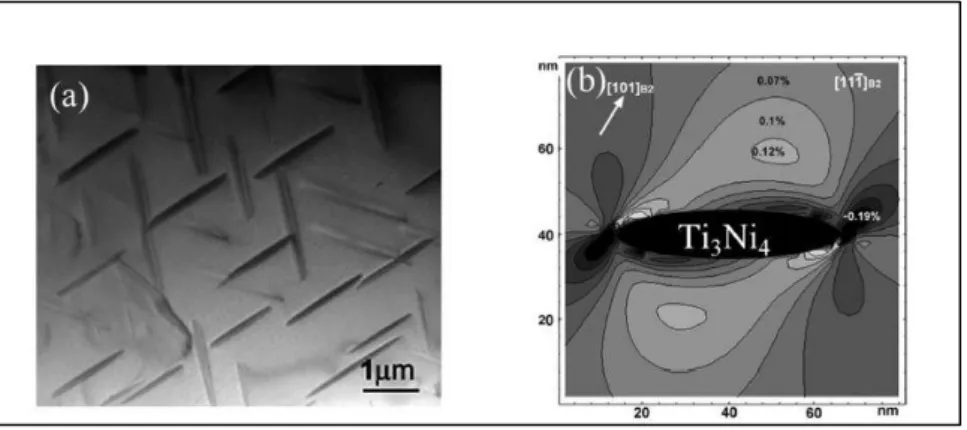
Among the three Ni-rich precipitates, Ti3Ni4 has the strongest influence on phase transformation behavior and properties of alloy due to its crystallographic coherency with the matrix, its small sizes and its dispersed distribution in the matrix. Fig. 2.4(a) shows the microstructure of a Ti-51 at% Ni alloy containing Ti3Ni4 precipitate particles. The Ti3Ni4 particles are lenticular in shape and are oriented in three variant directions in this case, along the {110} planes of the B2 matrix. Ti3Ni4 has a trigonal crystal structure composed of six layers with one additional Ni atom occupying a Ti atom position on every second layer, thus containing 18 Ti atoms and 24 Ni atoms [25]. As a result of the slight lattice gap between matrix and precipitate, there is a strain field within matrix around the precipitate.
Figure 2.3. Metastable precipitation phase diagram in Ni-rich Ti alloy systems [26].
Figure 2.4 reveals the calculated strain field surrounding a coherent Ti3Ni4 precipitate in an austenitic Ni51Ti49 matrix. It is clear that there are compressive strains at the edges of the lenticular shaped precipitate particle and tensile strains along the two side surfaces of the precipitate particle. The presence of the stain field is also confirmed in transmission electron microscopy. On the other hand, consequently interface dislocations form to partially relax the strain fields [26,27]. These strain fields play a role in behavior altering the transformation, developing the two ways SME, and inducing B2→R transformation.
Figure 2.4. Ti3Ni4 precipitates in a Ti-51 at% Ni alloy. (a) Transmission electron microscopy image of lenticular shaped Ti3Ni4 precipitates; (b) Calculated strain field around a Ti3Ni4 precipitate [28,29].
2.4. MARTENSITIC TRANSFORMATIONS OF NITINOL-B2
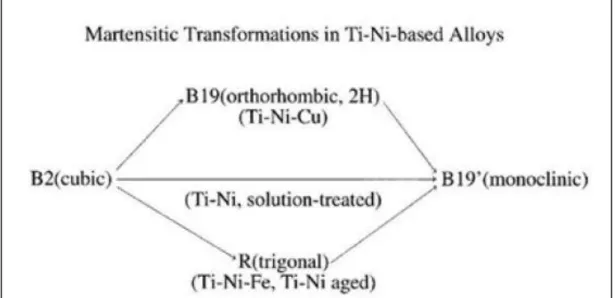
In addition to the diffusional transformations that occur generally at elevated temperatures, the B2 phase exhibits multiple reversible martensitic transformations upon cooling Figure 2.5 summarizes the possible martensitic transformation routes experimentally observe in Nitinol-X alloys. In case of binary Nitinol, crystal structures observed are three in experiment, consists of a trigonal R phase, a B19′ monoclinic martensite, B2 austenite, which may appear in between the B2 and B19′ phases under certain conditions [3,28].
Figure 2.5. Possible experimentally observed martensitic phase transformation paths in Nitinol-X shape memory alloys.
Among the three phases, there are three possible martensitic phase transformations, i.e., B2 to B19′, R to B19, and B2 to R, where B2 is always a paternal phase to R and B19′, and R is parental to B19′. The R phase has been observed in ternary alloy systems, such as NiTiFe, NiTiAl, and NiTiCo. For binary Nitinol, the R phase may appear under certain conditions, such as aged Ni-rich alloys, after thermal transformation cycling [30], or partially annealed after cold working [31]. Figure 2.6 shows the crystal structures of the martensitic phases and the B2 austenite of near equiatomic Nitinol. Also shown for each phase are their [110] projections. Figure 2.6 shows the B2 structure. The B2 phase may also be represented as its equivalent body centered tetragonal (BCT) structure to be comparable to the martensitic phases, as
indicated by the unit cell defined by the red lines. The lattice constant of the B2 structure is 3.015 Å [29,32], which gives the lattice parameters of a = 3.015 Å, b = c = 4.26 Å for the equivalent BCT structure. The BCT unit cell contains 4 atoms, including 2 Ti and 2 Ni atoms.
Figure 2.6. Typical phases in NiTi based shape memory alloys: (a) The B2 austenite, which can also be represented by a BCT unit cell; (b) Orthorhombic B19 martensite [33].
The B19 structure is shown in Figure 2.6 (b). It has an orthorhombic structure. It can be formed from the BCT phase by shuffle of the interior Ti and Ni atoms along the [001] B19 direction. This transformation has been reported to be associated with a volumetric contraction [34]. Parameters are a = 2.81 Å, b =4.19 Å, and c = 4.71 Å [35].
The B19′ structure is shown in Fig. 2.6(c). It is a monoclinic structure with a monoclinic angle of 97.8°. The lattice parameters experience a slight change from B19 to B19′. Parameters are a = 2.9 Å, b =4.11 Å, and c = 4.65 Å [36]. The experimentally observed transformation in near-equiatomic Nitinol is the B2↔B19′ transformation. This transformation is hypothesized to follow phenomenologically in two different steps. 1st step is B2 to B19. This phase transformation occurs via lattice volumetric distortion (contraction) and shuffling of the Ni and Ti atoms along the [1] B19 direction, as indicated in Figure 2.6(b).
2.5. EFFECT OF ALLOY COMPOSITION ON THE MARTENSITIC TRANSFORMATIONS OF NITINOL
The transformation behavior and the shape memory properties of phase martensitic transformation near-equiatomic Nitinol are found to be highly sensitive to small variations in its chemical composition. Figure 2.7 indicates the effect of Ni content on the Ms temperature of the B2 → B19′ (A→M) transformation (denoted TA-M) [31]. The TA-M temperature remains unchanged on the Ti- rich side. This is due to the fact that the B2 phase cannot accommodate more Ti above 50.0 at% and the excess of Ti forms into Ti2Ni, as shown in the Ni-Ti binary phase diagram (Figure 2.1). Consequently, the B2 matrix remains practically equiatomic. On the Ni-rich side, TA-M decreases with increasing Ni content at about 10 K per 0.1 at.% increase of Ni [37]. Also expressed in the figure are the indicative trends of critical temperatures for the A→R transformation (TA-R) and R→M transformation (TR-M).
Figure 2.7. Experimental data on the effect of composition variation on the transformation start temperature (Ms) [38].
Addition of some ternary elements has been found to impact on the thermal hysteresis and the transformation temperatures of Nitinol-based shape memory alloys significantly. Generally, adding elements right below Ni or Ti in the Periodic Table increases MS. On the other hand, addition of elements appearing between Ni and Ti in the Periodic Table decreases MS. Cu is found to slightly decrease MS but significantly reduces the thermal hysteresis of the B2-B19′ martensitic transformation [39], [40].Summarizes the effect of ternary alloy addition on the phase transformation temperatures of SMA [41]. Table 1. Effect of ternary alloy addition on the transformation temperatures of shape memory alloys at different conditions [42].
2.6. THERMOMECHANICAL TREATMENT OF NITINOL
The behavior of thermoelastic martensitic phase transformations, thus the properties of Nitinol SMA, can be strongly exaggerated by thermomechanical treatment and also change in the composition of the matrix. Therefore, along with the change of the alloy’s composition, different thermal and mechanical treatments have been utilized to alter the shape memory properties of SMAs. In the case of the binary Nitinol, the effective treatments can be separated for near equiatomic Nitinol and Ni-rich alloys (Ni>50.5 at%). The near-equiatomic alloys respond directly to cold working and
annealing. The Ni-rich alloys, due to the B2 phase’s solubility for excess of Ni and the change of the solubility with temperature, aging is the most effective way to influence their properties.
2.7. COLD WORKING OF NEAR EQUIATOMIC NITINOL
The cold working decline the B2↔B19′ martensitic phase transformation temperature of near equiatomic Nitinol and persuades the B2↔R transformation, thus changing the transformation sequence from B2↔B19′ to B2↔R↔B19′ (more often B2↔R↔B19′ on cooling and B19′↔B2 on heating) [43]. Meanwhile, the latent temperature of the B2-B19′ martensitic transformations is also reduced. The main reason for these effects is the increased dislocation density and grain refinements. This is generally attributed to the resistive effect of dislocations and to the lattice shape change of the martensitic transformation. Therefore, the B2↔B19′ transformation is much more affected (retarded) by the increase of dislocation density in the matrix than is the B2↔R transformation, because of the much larger lattice distortion of the former. Following the same argument, thermal transformation cycling has also been observed to have the similar effect, because it can be considered a very mild repeated process of gentle plastic deformation of the matrix [44]. Severe plastic deformation, however, will destroy all the martensitic transformation in the alloy. Such cold deformation is most commonly applied as a material working process than a transformation behavior control process and is often used in conjunction with post deformation annealing.
2.8. EFFECT OF ANNEALING ON TRANSFORMATION BEHAVIOR OF NITINOL
Annealing of near equiatomic Nitinol after severe plastic deformation restores the transformation behavior of the alloy. Fig. 2.8 shows the consequence of annealing on the phase transformation temperatures of a Ti-50.2 at. % Ni alloy. The transformation behavior can be divided into three regions. For region I at below 700 K, the B↔R transformation is restored, apparently due to its small lattice distortion and thus the least mechanical resistance in a heavily defected matrix. Rf increased
with increasing the annealing temperatures leading to lower transformation intervals in region I. In region II, R↔B19′ transformation became evident. The Mf and Ms Temperatures enlarged quickly with increasing the annealing. Finally, for the high annealing region, the transformation sequence was B2↔ B19′ and independent of annealing.
Figure 2.8. Transformation temperatures of annealed near equiatomic Nitinol at different temperatures for 30 min measured by DSC [45].
2.9. EFFECT OF ANNEALING ON MECHANICAL BEHAVIOR OF NITINOL
Annealing after cold working has been found to progressively restore the mechanical behavior of near-equiatomic Nitinol, including the stress-induced martensitic transformation and pseudo elasticity. Fig 2.9 shows the strength dependence of Nitinol upon different annealing temperatures. Figure 2.9 indicates distinctive tensile stress and strain curves of a Ti-Ni 50.2 at% sample at three temperatures after annealing at 776 K. It is seen that the sample has recovered its mechanical behavior after severe plastic deformation. A summary of the effect of annealing after cooling on the yield
strength and stress for persuading the phase transformation in a Ti - 50.2at%Ni alloy is shown in Figure 2.9(b) [46]. The alloy is found to exhibit super elasticity after annealing at 660 K for 1.8 ks. At above the recrystallization temperature, the alloy exhibits shape memory behavior. It is also seen that the yield strength, stresses for stress- induced phase transformation at a given testing temperature and for martensite reorientation increase gradually with growing annealing in this range. The increase of those parameters is not explained explicitly in the literature, but is supposed to be connected to surface oxidation of the alloy when annealed in air.
Figure 2.9. Strength dependence of NiTi upon different annealing temperatures. (a) Typical stress-strain behaviour of a Ti-Ni 50.2 at.% sample annealed at 776 K and tested at different temperatures; (b) Strength vs annealing temperature for a Ti-Ni 50.2 at.% sampl.
2.10. AGEING OF NI-RICH NITINOL
In comparison to the near-equiatomic (typically Ni > 50.2 at %) alloys, the Ni-rich (typically with Ni > 50.5 at %) alloys have much more complex response to heat treatment. In addition to annealing, they also exhibit sensitive response to ageing. Aging treatment can be applied to Ni-rich alloys to promote the nucleation and growth of Ni-rich precipitates [48]. Alloys with lower Ni contents have also been found to precipitate Ni4Ti3, but it generally requires longer aging times. The temperature range for aging is generally 450-750 K [49]. Ti3Ni4 is the first precipitate to form upon ageing. Figure 2.10 shows Ni4Ti3 precipitation in a Ni-rich Ti sample [50].
Figure 2.10. Ni4Ti3 precipitation in a Ni-rich Ti sample. (a) TEM image of formation of precipitates near the grain boundary after aging of Ni 50.7 at%-Ti alloy for 1 hour at 500⁰C; (b) Schematic of coherency between Ni4Ti3 and the B2 phase of the matrix in age [51].
Figure 2.10 indicates a TEM image of formation of precipitates near the grain boundary after aging of Ni 50.7 at%-Ti alloy for 1 hour at 500⁰C [33]. Ti3Ni4 precipitates are found to nucleate preferentially at grain boundaries. Figure 2.10 shows the schematic of coherency between Ni4Ti3 and the B2 phase of the matrix in aged Ni-rich Ti alloys. The coherency between the phases leads to formation of Ni4Ti3 in three specific orientations within the matrix. The presence of coherent Ni4Ti3 precipitates in the matrix has significant influence on the phase transformation mechanical properties behavior of Nitinol. The transformation sequence shows different transformation sequences of a Ti–50.9 at.% Ni alloy after different heat treatments. Curve (a) is the solution treatment condition achieved by annealing treatment. This heat treatment condition results in a simple A↔M transformation. Curve (b) proves the transformation behavior of a sample aged at 748 K for 36 ks. On cooling, it exhibits a phase transformation sequence of A→R→M and on heating from M, M→A. Dashed line is the anticipated direct A→M phase transformation, which is forbidden in this case by the occurrence of the A→R transformation. A phase transformation arrangement of A↔R→M can be seen in curve (c), where the sample has been aged treated at 573 K for 3600 ks.
The transformation behavior of Ni-rich alloys has also found to be more complex under certain sample processing conditions. Such behavior is usually observed in samples after aging at low temperatures and shorter times for Ni-rich alloys with less
than ~51at%Ni [52]. An example is for a Ni50.8Ti49.2 alloy later aging at 450 °C. It can be predicted that the 1st peak on cooling is A→R phase transformation, and the following peaks represent the creation of B19′, thus R→ B19′. After the third cooling peak, the majority of the R phase has been transformed to B19′, and with further cooling to -100 ⁰C the amount of the R phase becomes negligible. On heating from a low temperature, the transformation sequence is B19′→R followed by R→ B2. At 80 ⁰C, the matrix becomes fully B2.
Allafi et al. suggested an explanation about the multistage phase transformation detected in old Ni-rich alloys [38], on the basis of long range heterogeneous distribution of Ti3Ni4 precipitates within the matrix. In the initial stages of aging, Ti3Ni4 hastens are distributed more specially along with boundaries and much less in the inner of grains, effectively division the matrix in two districts of different phase transformation characteristics, thus the multiple-stage transformation behavior. The 5 stages may be identified for the morphology evolution of Ni4Ti3 precipitates during aging, including (I) suppression of B2↔B19′ due to the atomic arrangement heterogeneity; (II) B2↔R transformation; (III) B2↔R↔B19′ transformation sequence after well distribution of the coherent precipitates; (IV) multi stage phase transformation as a result of over-growth of coherent precipitates; (V) B2↔B19′ phase transformation in the presence of non-influential incoherent precipitates. The other influence of the coherent precipitation is the change of mechanical behavior of Ni-rich alloys. Precipitation hardening is a known effect that the yield strength [52]. An example for precipitation hardening in the case of a Ti–50.9 at.% Ni alloy aged at different temperatures for 3.6 Ks is presented in Figure 2.11.
Figure 2.11. Stress-strain response of a Ti–50.9 at.% Ni alloy aged at different temperatures for 3.6 ks [53].
Figure 2.11 reveals the temperature effect on the stress-strain response of the alloy, measured at 295 K [52]. The first obvious result is the starting structure of the samples at stage I as indicated in the figure. The second conclusion is the samples with lower critical stresses showed higher yield stresses and the highest yield stress was for the lowest aged temperature. The solution preserved sample had the last return stress.
2.11. OXIDATION
Oxidation of Nitinol system is usually not a major concern in manufacturing of these alloys for general purposes. However, for miniaturized applications and MEMS devices, where shape memory alloys are used to fabricate components of very small dimensions, surface oxidation can have significant impact to the transformation behavior and mechanical properties of the martensitic transformations [38,54]. The cross section of the annealed sample revealing the Ti oxide and Ni-rich Ti layers. It is known that Ti has a very high affinity to oxygen to form into TiO2. A surface
oxidation layer can influence the SMP in two apparent details: (i) The surface TiO2 layer is brittle and functions as a mechanical resistance to shape memory distortion and recovery; (ii) the Ni-rich layers (including TiNi3 and a Ti-depleted zone inside the matrix) underneath the surface oxide are unable to exhibit martensitic transformation, thus hindering the shape memory properties.
Despite the undesirable effects of oxidation on the shape memory properties, in biomedical applications, formation of a thin layer of TiO2 has been proposed as a technique to shield the Ni leach into bio-systems [55]. It is known that lower Ni interaction with bio-systems at the alloy surface due to formation of TiO2, reduces thrombogenicity [42]. However, several studies have reported that significant concentrations of Ni, ranging from 3 at% to 20 at%, can still be released at through the oxide layer, challenging the technique [54]. Undisz et al. [56] reported that the history of annealing determines the final Ni concentration at the oxide surface and that high heating rates reduce Ni release through the oxide. Another challenge is the surface roughness of the oxidation treated samples for biocompatibility. The SEM results reveal the consequence of annealing on the surface characteristics. The surface is smooth and includes two distinctive components: (1) dark islands with a structure near to TiO (Ti0.55O0.45), and (2) a grey oxide layer that has a composition of Ni0.46O0.23Ti0.31 [50]. Fig. indicates the surface of a sample annealed at 600 C. Increase the annealing at 600C changed the topography of the surface and made it rougher and grainier. The surface is found to contain mainly Ti and O, and a low concentration of Ni. At 800°C the surface has a dominant porous structure and the composition was measured to be TiO2 stoichiometry [50].
Natural oxidation of the surface can also change the phase transformation temperatures of Nitinol alloys and essentials to be occupied into account in the design of Nitinol based micro-electro- mechanical systems (MEMS) devices [29]. Li et al. [38] used an in situ TEM setup to investigate the natural oxidation of TEM samples with different thicknesses. They confirmed the oxygen content in the samples and found that the thickness of the TEM sample is a key factor on the thermally induced martensitic phase transformation. They reported that there are critical values 0f ~22 nm and ~50 nm for B2→R and R→B19′ thermally induced
phase transformation, respectively. They attributed the observed size effect to the natural oxidation of Nitinol.
2.12. NEW DEVELOPMENTS OF NITINOL SMA
With the establishment of the knowledge framework for Nitinol SMA, including the fundamental science of thermoelastic martensitic transformations [45], the physical metallurgy of the system [6], the thermomechanical behavior of the alloys [6,32], and the industrial production and processing techniques of these alloys [6,47], new effort has been made in recent years to develop more advanced Nitinol based materials in non-conventional forms and structures to further expand their property capabilities to meet the demands and challenges of more and new innovative applications, such as in microelectromechanical systems (MEMS), bionic and robotic technologies, space science, and mining and resource exploration.
2.13. FUNCTIONALLY GRADED NITINOL
Functionally graded Nitinol alloys allow them to display their functional properties in a progressive and gradient manner. These materials often exhibit progressively varying transformation stresses and transformation temperatures within the body of the material. The widened stress and temperature windows render the alloys better controllability in sensing and actuation applications. The sequential occurrence of the transformation across the body of a material often triggers complex and new mechanical behavior of the materials. Nitinol alloys are known to exhibit Lüders-type deformation behavior upon loading [57,58] A Lüders-type deformation is a mechanical instability with a nil stress window, which gives very poor controllability of the alloy in actuating applications [51]. Thermally induced phase transformations in Nitinol typically have transformation temperature window of about 10 K, which is also narrow and difficult for easy and reliable actuation control. For better actuation controllability, wider transformation stress and temperature windows are desired. Figure 2.12 shows the comparison between the actual and desired behaviors of Nitinol SMA, as in the case of stress-induced transformation in pseudo elasticity (Figure 2.12(a)) and thermally induced transformation (Figure 2.12(b)). One possible
way to achieve such desired thermomechanical behaviors is to design functionally classified alloys.
Figure 2.12. Actual behavior of NiTi vs desired behavior of NiTi shape memory alloys. (a) Stress induced phase transformation in superelasticity; (b) Thermally induced phase transformation under constrained condition [59,60].
Nitinol SMA with graded properties can be designed in three different ways: compositional incline, microstructural grade and geometrical gradient. In addition, the property gradient may also be perpendicular or parallel to the loading direction, referred to as the parallel and series configurations, respectively [61,62].
2.14. COMPOSITIONAL GRADIENT
The properties of Nitinol alloys are sensitive to their compositions, e.g., with the addition of a third element [26,63,64] or variation from the Ti-Ni equiatomic stoichiometry [29]. Several different ways are possible to create the compositional gradients in Nitinol, and these gradients may be along the length, such as wires, or through the width, such as thin films and sheets [53,65]. Figure 2.13 shows a compositionally graded Nitinol plate prepared by diffusion annealing. Figure 2.13 indicates the stress –strain tensile distortion samples annealed at different timing and a solution-treated sample. From the figure it can be seen that, the diffusion annealing of Ni into the substrate altered the stress-strain response of the sample. Figure 2.13(d) shows the phase transformation behavior of the similar samples as Figure 2.13(c). The phase change behavior of the annealed samples was changed, and the
second sample shows a continuous forward and reverse transformation (not a sharp peak) probably due to the created compositional variation in the Nitinol substrate.
Figure 2.13. Compositionally graded NiTi plate created by diffusion annealing concept. A compositionally graded NiTi plate created by diffusion annealing concept. (a) schematic of the technique; (b) effect of diffusion time variation on Ni concentration variation measured by EDS technique (the inset is a SEM micrograph of the deposited Ni thin film on top of the NiTi substrate); (c) the tensile stress–strain curves of deformation of the two samples annealed at different timing and a solution- treated sample; (d) Transformation behavior of near equiatomic substrate (i) solution treated at 1123 K for 3.6 ks, and diffusion annealed at 1223 K after deposition of Ni for (ii) 1.5 3.6 ks (sample I) and (iii) 3 3.6 ks (sample II), respectively [66].
2.15. MICROSTRUCTURAL GRADIENT
It is known that the phase transformation behavior and the shape memory properties of Nitinol alloys are sensitive to microstructural conditions [67,68], thus concept gradient of functional properties can be attained by creating a micro-structural gradient. The microstructural gradient can be of a cold worked microstructure, annealed microstructure or aged microstructure. Figure 2.14 shows a technique using heat treatment temperature variation to create microstructural functionally graded
near-equiatomic Nitinol SMA [69]. Figure 2.14(a) shows the schematic of the technique. The wire can be subjected to an annealing temperature variation (1) and also differential aging condition (2) created by the non-uniform furnace temperature profile. Figure 2.14(b) shows the stress-strain behavior of a Ti-50.2at%Ni Nitinol sample uniformly galvanized at 773K and then tested at 318K. The curve shows a typical Lüders like tensile deformation. Figure 2.14(c) shows the actual furnace profile used to create the microstructural gradient and the position of the annealed wire in the furnace. Figure 2.14(d) indicates the stress-strain retort of the non-uniform annealed sample. The gradient anneal is measured to be in the range of 550K to 760K. The curve reveals that by non-uniform annealing of the sample, different mechanical properties relative to the uniformly annealed sample can be achieved.
Figure 2.14. A heat treatment method for the creation of functionally graded microstructure [70].
2.16. GEOMETRICAL GRADIENT
The variation of the cross-section area in the direction of the applied load is the key for achieving the geometrical gradient designs. When the loading is applied, the martensitic transformation starts from the lowest cross-section area (i.e. highest stress concentration) and propagates to the highest cross-section area that creates a non-uniform transformation response in the sample. This effect generates an unmatched stress-strain response from the sample with uniform design that can be managed to
create a positive slope can tackle the mechanical instability of SMAs created by lüders bands [71]. Figure 2.15 shows the series and non-series examples.
Figure 2.15. Typical microstructural based functionally graded designs. (a) Series configuration; (b) Non-series configuration [59].
2.17. ARCHITECTURED SMAS
The functional properties of Nitinol SMAs can also be combined with the materials geometrical characteristics to offer new and enhanced application performances. Design of the materials to enhance their functionality is not a new concept. For example, I-beams and the tubular framework of bicycles are a well-known examples for enhanced bending stiffness and reduced weight. Another example is helical springs, which trades material stiffness for flexibility and recoverable deflections. Considering these already established concepts, various attempts have been made to create Architectured Nitinol materials for new and better performances, such as springs, cellular designs, network structures and porous design.
A simple architectured design of Nitinol is Nitinol springs. Spring design allows enlarging the recoverable elastic deformation by 1~2 orders of magnitude at the expense of strength. Thus, Nitinol springs are designed when excessively large displacement is required. They are used mainly for storing elastic energy, delivering constant force, and damping vibration [72]. Figure 2.15 shows the application of Nitinol springs in dentistry for space closure, tooth retraction and distal movement [73]. SMA cellular structures can be designed to achieve both low stiffness and high stiffness to mass ratio. The low stiffness designs can be considered as 3D springs and offer the advantage of adjustable stiffness for different application demands. One example is in biomedical applications as bone replacement with matching stiffness (typically 20 GPa) to avoid stress shielding effect [74]. Figure 2.15 shows cellular design of spot-welded Nitinol tubes and its deformation behavior under uniaxial compression [75]. The maximum 12% global compressive strain at three different testing temperatures without damage to the welding could be achieved. The structure exhibited an effective structure elastic modulus of ~25 GPa, which is very close to the reported modulus for bone.
Figure 2.15 shows another example of Nitinol cellular structure in honeycomb design and its deformation behavior under uniaxial compression [76]. The structure exhibited 60% pseudoelastic deformation and an apparent effective elastic modulus of 19.1 MPa. Another architectured design is network structures. They can be fabricated by weaving, braiding, knitting and stitching Nitinol wires and strips in 2D or 3D designs [77,78]. The designed geometrical network can be controlled to reduce the stiffness and produce a large recoverable deformations unmatched with the monolithic binary Nitinol. A typical example of network designs is woven Nitinol stents. Nitinol stents are capable of being compressed into a catheter in much reduced size and self-expanding against the vessel’s wall once deployed inside the body owing to its shape memory super elasticity. It illustrates a self-expanding Nitinol stent released from a catheter and an endoscopic view inside a self-expanded stent after insertion.
2.18. DEVELOPMENT OF THEORETICAL UNDERSTANDING OF NITINOL
However, with the development of density functional theories and computation tools in the past decade, many studies have been conducted on Nitinol system to discover some new phases that have never been observed experimentally and challenge the experimentally reported B2 phase. The DFT method has also allowed identification of transformation pathways between different phases, determination of the ground state, and investigation of stabilities of various phases. One worth mentioning discovery using the DFT method is instability of the B2 austenite phase, while the B2 phase is observed frequently in experiments. The other such findings is the discovery of the B19″ phase and a base centered orthogonal (BCO) phase in the binary near- equiatomic Ni-Ti system, which demonstrate a clear discrepancy with experimental observations.
2.19. THERMAL STABILITY OF THE B2 PHASE IN EQUIATOMIC NITINOL
The equiatomic Nitinol exhibits a B2 austenite phase of CsCl-type structure in 𝑃𝑚3¯ 𝑚 space group (no. 260) with a lattice constant of a=3.015 Å [30]. The dynamic stability of the phase may be examined using the frozen phonon technique. It displays the phonon dispersion of the B2 phase at 0 K based on the forces extracted from DFT calculations and used in the frozen phonon approach. For further comprehension about the entropic effects on B2 phase, researchers have attempted to combine the DFT calculations at 0 K, where there is no entropic effect, with other methods such as the self-consistent ab initio lattice dynamical (SCAILD) calculations and the ab initio molecular dynamics (AIMD). Zarkevich and Johnson used AIMD method to add the entropic effect to the B2 phase. They used a 3×3×3 supercell with 54 atoms [79]. They found that the B2 structure is thermodynamically unstable at all temperatures up to its melting temperature, 1586 K. This conclusion clearly contradicts the reality and could be attributed to the size of the supercell used. They proposed a new crystal structure for the B2 phase to solve this puzzle [80]. In contrast, Souvatzis et al. by using first principles SCAILD calculations method
confirmed that the B2 phase in equiatomic Nitinol is stabilized by phonon-phonon interactions [81]. Recently, Haskins et al. revealed the importance of the size effect of the supercell when AIMD method is used. They also reported that the imaginary (negative) frequencies of phonon dispersion become positive (stable structure) at 300 K, which is very close to the experimentally reported temperature for the B2↔B19′ transformation. Figure 2.34 shows phonon dispersions at 600 K for 3 different supercell sizes as calculated by Haskins et al. [59].
2.20. THE GROUND STATE OF EQUIATOMIC NITINOL PREDICTED BY DFT CALCULATIONS
In ternary Nitinol based shape memory alloys, such as NiTiFe, NiTiAl, and NiTiCo, the B2↔R transformation is known to occur spontaneously [66]. B19 is another experimentally observed phase in NiTiCu alloys with an orthorhombic crystal structure. It occurs in Ni50- xTi50Cux alloys when the Cu content exceeds 7.5 at.% [82,83]. Table 2.2 presents the lattice parameters, monoclinic angles, and the energy differences of the theoretically predicted phases with respect to the B2 parent phase. The BCO phase was first reported by Huang et al. [3]. In their DFT calculation, the monoclinic angle of the martensite corresponding to the minimum energy distortion is found to be 107°, and not the experimentally reported 98° for B19'. They identified this as a new phase with BCO structure and confirmed that it is effectively also a monoclinic phase similar to B19′.
To gain more insight about the BCO phase, Huang et al. constructed a minimum energy pathway (MEP) against monoclinic angle within the range from 90⁰ to 112⁰ [3]. They also considered PdTi and PtTi, which are known to also have monoclinic martensite, for comparisons with NiTi. Fig. 2.35 shows the MEPs as a result of the monoclinic angle change for NiTi, PdTi and PtTi alloy systems. The calculations revealed that there is a local minimum representing the B19′ martensite at ~93⁰ angle in the PdTi and PtTi systems, whereas for the Nitinol system a local minimum occurs at around 107 representing the BCO phase. There is no local minimum at the experimentally observed monoclinic angle of 97.8′ for B19′ phase. This analysis confirms their early calculation that BCO is the ground based on the structure
![Figure 1.1. The above figure is (a) Shape memory and its effect, (b) Shape memory alloys and the amount of elasticity [2]](https://thumb-eu.123doks.com/thumbv2/9libnet/5408774.102292/18.892.184.773.127.368/figure-figure-shape-memory-effect-shape-memory-elasticity.webp)
![Figure 1.3. Schematic diagram of the two typical basic accommodation mechanisms (a) Internally slipped; (b) Internally twinned [5]](https://thumb-eu.123doks.com/thumbv2/9libnet/5408774.102292/19.892.220.737.591.928/figure-schematic-diagram-typical-accommodation-mechanisms-internally-internally.webp)
![Figure 1.4. The self-accommodation of martensite variants [7].](https://thumb-eu.123doks.com/thumbv2/9libnet/5408774.102292/20.892.187.772.315.544/figure-self-accommodation-martensite-variants.webp)
![Figure 1.5. Temperature induced martensitic transformation in near equiatomic Nitinol [9]](https://thumb-eu.123doks.com/thumbv2/9libnet/5408774.102292/21.892.240.716.125.489/figure-temperature-induced-martensitic-transformation-near-equiatomic-nitinol.webp)
![Figure 1.6. Thermomechanical behavior of a near equiatomic Nitinol [11].](https://thumb-eu.123doks.com/thumbv2/9libnet/5408774.102292/22.892.193.763.690.1091/figure-thermomechanical-behavior-near-equiatomic-nitinol.webp)
![Figure 1.7. Temperature-strain hysteresis during phase transformation of shape memory [13]](https://thumb-eu.123doks.com/thumbv2/9libnet/5408774.102292/23.892.209.750.750.1076/figure-temperature-strain-hysteresis-phase-transformation-shape-memory.webp)
![Figure 2.1. Phase diagram of Nitinol system [23].](https://thumb-eu.123doks.com/thumbv2/9libnet/5408774.102292/29.892.227.733.127.539/figure-phase-diagram-of-nitinol-system.webp)
![Figure 2.6. Typical phases in NiTi based shape memory alloys: (a) The B2 austenite, which can also be represented by a BCT unit cell; (b) Orthorhombic B19 martensite [33]](https://thumb-eu.123doks.com/thumbv2/9libnet/5408774.102292/33.892.237.709.301.821/figure-typical-memory-alloys-austenite-represented-orthorhombic-martensite.webp)
