UC Davis
Dermatology Online Journal
Title
Early diagnosis of subungual squamous cell carcinoma of the hallux
Permalink
https://escholarship.org/uc/item/428217hj
Journal
Dermatology Online Journal, 21(7)
Authors
Kaksi, Sumeyye Altintas Ozdemir, Mustafa Balevi, Ali et al.
Publication Date
2015License
https://creativecommons.org/licenses/by-nc-nd/4.0/ 4.0eScholarship.org Powered by the California Digital Library University of California
Figure 1. Clinical picture of left hallux nail
Volume 21 Number 7
July 2015
Letter
Early diagnosis of subungual squamous cell carcinoma of the hallux
Sümeyye Altıntaş Kakşi
1, Mustafa Özdemir
1, Ali Balevi
1, Aslı Çakır
2, Yeliz Tavlı
1Dermatology Online Journal 21 (7): 18
1
Medipol University Hospital Depatment of Dermatology
2
Medipol University Hospital Depatment of Pathology
Correspondence:
Sümeyye Altıntaş Kakşi
TEL: 0 505 2481940
0212 4607777
E-
MAİL: [email protected]
[email protected]
Abstract
Primary subungual squamous cell carcinoma (SCC) of the toe is rare in the literature and frequently late or misdiagnosed. Lack of awareness among physicians of the specific clinical findings, the indolent course of the disease, and the high
prevalence of benign conditions of the nail unit may account for delays in diagnosis. In addition to difficulties in identifying the true incidence of this tumor, a standardized therapeutic approach does not currently exist. We present a case of subungual SCC of the first toe without bone invasion. The tumor was diagnosed early, treated with conservative surgical excision, and showed no recurrence or metastasis after 2 years of follow-up.
Keywords: sqaumous cell carsinoma , subungual SCC, nail SCC, nail tumors
Case synopsis
A 50-year-old man was seen in our clinic with the chief complaint of a nail abnormality in his left first toe during the past year. History revealed unsuccessful topical and systemic antibiotic therapy. Over time, median onycholysis, discoloration, and dystrophy of the nail had developed. Further, no response was
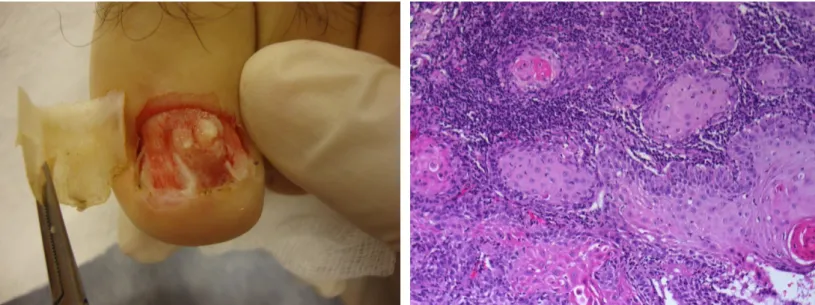
seen to systemic and topical antifungal therapies prescribed by another physician and administered for 6 months. Orthopedic consultation and treatment yielded no results either. There was no history of trauma, verruca, immune suppression, or radiation or chemical exposure. Upon examination, the nail plate of the left first toe was elevated and angled along the median plane with a visible subungual mass and onycholysis (Figure 1). There were no palpable lymph nodes. Laboratory findings were within normal limits. Microbiology cultures from the lesion remained negative. Radiologic exam showed no bone erosion or resorption in the distal phalanx. Punch biopsy from the subungual lesion was indicated and performed (Figure 2). Histopathologic
examination revealed well-differantiated SCC (Figure 3). Owing to absence of bone invasion, wide local tumor excision was performed by a plastic surgeon. There was no tumor infiltration along surgical boundaries. At the end of a 2-year follow-up after surgical resection, no local recurrence nor regional or systemic
metastases were seen.
Figure 2. Macroscopic view of subungual squamous cell carcinoma after nail avulsion Figure 3. Microscopic view of subungual
squamous cell carcinoma after nail avulsion
Discussion
Even though subungual SCC is a rare entity, SCC is the most common malignancy associated with the nail unit [1]. Besides the low incidence of subungual SCC, involvement of the toes is even less frequent. In a series of 35 subungual SCC patients reported by Dalle et al, 28 had finger involvement whereas only 8 patients had toe involvement [2]. In a literature review conducted by Valero et al, only 36 cases of subungual SCC cases were found over the 18 year period screened [3]. Subungual SCC usually affects men, commonly between the ages of 50 and 59. The majority of the reported cases involve a single digit, most often the thumb or the first toe [3]. Subungual SCC may originate from the nail bed, nail matrix, nail groove, or the lateral nail folds [4]. Etiologic factors associated with the disease are: chronic infections, chemical or physical microtrauma, genetic disorders such as congenital ectodermal dysplasia, radiation, tar, arsenic or mineral exposure, sunlight,
immunosuppression, and prior history of human papilloma virus (HPV) infection [6,7,8]. Several studies suggest that mucosal HPV (HPV 16, 31, 54, 58, 61, 62 and 73) may play a role in the development of malignancies in the nail unit [6]. In 60-90% of subungual SCC cases HPV DNA. More than 60% of the HPV positive specimens were associated with HPV 16 [9]. In our case, potential causative factors were eliminated via clinical history and physical exam. Further, neither history nor physical exam revealed genital warts in our patient. In the literature review by Valero et al, no specific cause has been identified in 50% of subungual SCC cases [3].
Clinical findings of subungual SCC may vary and include chronic pain, swelling, onycholysis, and dyschromia of the nail plate. The most common form of presentation is a verrucous appearance of the nail bed and periungual area and nail
dystrophy. In our case, 6-month treatment for onychomycosis in another center had not provided any improvement. When the nail plate was lifted for biopsy, the mass showed a verrucous appearance.
Other findings suggestive of subungual SCC are nodularity, bleeding, and ulceration [6,10]. Diagnosis may be difficult owing to a resemblence to several benign conditions such as verruca, onychomycosis, paronychia, glomus tumor, ingrown nail, pyogenic granuloma, subungual exocytosis, chronic osteomyelitis, and traumatic dyschromia [5,11,12]. In addition, diagnosis may be delayed by 4-40 years because of other factors such as the masking of the tumor by the nail plate, low awareness among physicians, and secondary infections [6,13]. Bone invasion is seen in 16-66% of the cases of late diagnosis of subungual SCC [2,13]. Even though cutaneous SCC generally has a low metastasis risk, subungual SCC is associated with a higher risk of local invasion and metastasis owing to the rich arteriovenous network located in the subungual bed. In chronic nail disorders unresponsive to conventional treatments, the nail plate should be lifted and a biopsy done to enable early diagnosis of subungual SCC.
Owing to its rarity, a standardized therapeutic approach has not been fully defined for subungual SCC. Therapy is planned based on tumor infiltration, ranging from wide local excision to distal phalanx amputation with lymph node dissection when metastasis is suspected. In the absence of bone invasion, wide local excision is preferred over simple excision owing to low risk of recurrence. If bone invasion is present, distal phalanx amputation is recommended. Our case was diagnosed relatively early within 1 year. Because of the absence of bone invasion it was treated by wide local excision. No local recurrence or metastasis was seen after 2 years of follow-up.
SCC must be considered in cases of subungual deformity and discoloration that has been unresponsive to treatments for other possible diagnoses. An early biopsy should enhance therapeutic success and prevent metastases as was the case in our patient.
References
1. Carrol RE. Squamous cell carsinoma of nail bed. J Hand Surg Am 1976; 1:92-7.
2. Dalle S, Depape L, Phan A, Balme B, Ronger –Savle S, Thomas L. Squamous cell carcinoma of the nail apparatus: clinicopathological study of 35 cases. Br J Dermatol 2007;156:871-874.
3. Valero J1, Gallart J, Gonzalez D, Deus J, Lahoz M. Subungual squamous cell carcinoma and exostosis in third toe--case report and literature review. J Eur Acad Dermatol Venereol. 2014 Oct;28(10):1292-7.
4. Yip KM, Lam SL, Shee BW, Shun CT, Yang RS. Subungual squamous carsinoma: report of 2 cases. J Formos Med Assoc 2000;99:646-9.
5. Lai CS, Lin SD, Tsai CW, Chou CK. Squamous cell carsinoma of the nail bed. Cutis 1996; 57: 341-345.
6. Meesiri S. Subungual squamous cell karsinoma masquerading as chronic common infection. J Med Assoc Thai 2010;93: 248-51.
7. Patel PP, Hoppe IC, Bell WR,Lamber WC, Fleegler EJ. Perils of diagnosis and detection of subungual squamous cell carcinoma. Ann Dermatol 2011;23 Suppl 3: S285-7.
8. Nasca MR, Innocenzi D, Micali G. Subungual squamous cell karsinoma of the toe: report on three cases. Dermatol Surg 2004; 30(2 Pt 2):345-8.
9. Moy RL, Eliezri YD, Nuovo GJ, Zitelli JA, Bennett RG, Silverstein S. Human papillomatous type 16 DNA in periungual squamous cell carcinomas. JAMA 1989; 261: 2669-73.
10. Ruiz Santiago H, Morales- Burgos A. Cryosurgery as adjuvant to Mohs micrographic surgery in the management of subungual squamous cell carsinoma . Dermatol Surg 2011; 37: 256-8.
11. Patel DU, Rolfes R. Squamous cell carsinoma of the nail bed. J Am Podiatr Med Assoc 1995;85:547-549.
12. Gomez Vazquez M, Navarra Amayuelas R, Martin –Urda MT, Abellaneda Fernandez C, Tapia G. Subungual squamous cell karsinoma. Presentation of two cases. Actas Dermosifiliogr. 2010;101(7):654-6.
13. Kelly KJ, Kalani AD, Storrs S, Montenegro G, Fan C, L ee MH, et all. Subungual squamous cell carsinoma of the toe: Working toward a standardized therapeutic approach. J Surg Educ 2008;65:297-301.