http://journals.tubitak.gov.tr/medical/ © TÜBİTAK
doi:10.3906/sag-1311-57
The long-term changes in pain-related symptomatology of inguinal hernia
following 2 different herniorrhaphy techniques
Salih Erpulat ÖZİŞ1, Işın ÜNAL ÇEVİK2, Hatim Yahya USLU3, Süleyman ÖZDEMİR1, Kamil GÜLPINAR1, Hasan Turgut AYDIN1
1Department of General Surgery, Faculty of Medicine, Ufuk University, Ankara, Turkey 2Department of Neurology, Faculty of Medicine, Hacettepe University, Ankara, Turkey
3Department of Surgery, Ankara TOBB ETÜ Hospital, Ankara, Turkey
1. Introduction
Pain is the second most common presenting symptom in inguinal hernia patients, following bulge in the groin. Even though any kind of surgical intervention for inguinal hernia is usually enough to correct the bulge, it sometimes cannot alleviate the pain related to the hernia. Apart from mild pain lasting for a few days postoperatively, a great proportion of the patients suffer from moderate to severe long-lasting pain after surgical correction. Any kind of pain following a surgical procedure lasting more than 2 months with no apparent cause is considered to be persisting or chronic postsurgical pain (1). The incidence of persisting postsurgical pain of any severity following inguinal hernia mesh repairs was reported to be up to 63% (2). This pain is probably the most serious adverse outcome following surgery and can be either neuropathic or nonneuropathic. The prevalence of neuropathic components in persistent postsurgical pain due to either
nerve damage or entrapment or patient-related factors was reported to be 31% (3).
The Lichtenstein tension-free hernioplasty is considered to be the gold-standard surgical therapy for inguinal hernia repair. As it is safe, easy, and effective, it is widely used to repair primary or recurrent inguinal hernias of any size with a low recurrence rate (4,5). In this technique, the hernia sac is reduced and a piece of prosthetic mesh of different materials is used to strengthen the inguinal canal. Self-gripping polypropylene mesh with absorbable microhooks (Parietene Progrip, Tyco/ Healthcare, France) is a novel mesh material that has been demonstrated to be safe and efficient when compared to others, with lower fibrosis rates and less required suture fixation.
In this study we aimed to compare the changes in pain-related symptoms of inguinal hernias from initial admission to postoperative month 6 following 2 different herniorrhaphy techniques.
Background/aim: To compare the changes in pain-related symptoms of inguinal hernias from initial admission to postoperative month
6 following 2 herniorrhaphy techniques.
Materials and methods: Patients with unilateral inguinal hernias were scheduled for either Lichtenstein or self-gripping polypropylene
mesh repair. Patients were preoperatively evaluated with a visual analog scale (VAS) and a Turkish version of the Douleur Neuropathique 4 (DN4) questionnaire and the complaints related to pain were noted. After surgery, patients were discharged without early complications. Patients were reassessed at postoperative month 6. The late-term complaints of pain as well as neurological findings were evaluated using the VAS and the Turkish version of the DN4 questionnaire. Quality of life was also assessed with the Nottingham Health Profile (NHP).
Results: Thirty-four patients underwent conventional Lichtenstein repair and 19 patients underwent self-gripping polypropylene mesh
repair. Even though decreases in VAS intensity scores for both hernia repair techniques were noted at postoperative month 6 when compared to the preoperative period, no significant changes were found in pain, VAS, total DN4, or NHP scores between groups.
Conclusion: Despite its ease of application and short time duration, self-gripping polypropylene mesh repair was not found to be
superior to conventional Lichtenstein hernia repair in terms of reducing pain related to inguinal hernia.
Key words: Inguinal hernia, pain, self-gripping mesh
Received: 14.11.2013 Accepted: 28.01.2014 Published Online: 12.01.2015 Printed: 09.02.2015
2. Materials and methods
This prospective study was carried out at Ufuk University, Faculty of Medicine, Department of General Surgery, between January 2012 and October 2012. The study was approved by the institutional ethics committee. Written informed consent was obtained from the patients. Patients who were admitted with the complaint of a one-sided inguinal bulge and diagnosed with a unilateral inguinal hernia upon physical examination were included in the study. Patients with a history of previous surgical interventions in the inguinal region, body mass index of greater than 30, diabetes mellitus, hepatic and renal failure, or congestive heart failure were excluded.
Demographic characteristics of the patients, type of inguinal hernia, pain at rest, pain with movement (walking, breathing, and gastrointestinal movements), genital and ejaculatory pain, contralateral pain, and sensory changes (hypoesthesia, paresthesia, allodynia, hyperalgesia) along the ilioinguinal, iliohypogastric, genital, and genitofemoral nerves were recorded. Pain intensity was assessed by a visual analog scale (VAS) on a scale of 0–10, in which “0” is no pain and “10” is the worst pain imaginable. All patients were evaluated preoperatively with routine blood tests including complete blood count, liver and kidney function tests, electrocardiograms, and chest radiography. The patients were assigned for either conventional Lichtenstein or self-gripping polypropylene mesh repair. All patients were operated on by the same surgeon (SEÖ) under spinal anesthesia. The mean operative time for hernia repair and the timing of the first oral intake postoperatively were recorded. Patients were hospitalized for at least 24 h after the operation. Early postoperative follow-up assessments were made at postoperative day 7 for early postoperative complications. All patients were reassessed at postoperative month 6. Late-term complaints of pain as well as neurological findings were recorded. Postoperative spontaneous pain and pain while walking, coughing, or sitting were documented. In order to screen for neuropathic pain, a Turkish version of the Douleur Neuropathique 4 (DN4) questionnaire was applied (6).
The DN4 questionnaire is a quick and easy screening tool that consists of 10 items, each item being worth 1 point (7). Seven items are descriptive (burning, painful cold, electric shocks, tingling, pins and needles, numbness, and itching) and 3 items are related to bedside examinations (hypoesthesia to touch, hypoesthesia to pinprick, and brush allodynia). A total score of ≥4 is considered to be neuropathic pain (7). All neurological examinations, including assessment of neuropathic pain, were evaluated by a neurologist and pain specialist (IÜÇ). The quality of life was assessed by the Nottingham Health Profile (NHP) (8). The NHP has 39 questions and scores 6 domains of perceived health: energy level/vitality, pain, emotional
reactions/mental health, sleep, social isolation/social functioning, and physical mobility/physical functioning (8).
2.1. Statistics
Data analysis was performed using SPSS 11.5 for Windows (SPSS Inc., USA). The Shapiro–Wilk test was used to determine whether the continuous or metric discrete variables were normally distributed. Continuous or metric discrete variables were shown as mean ± standard deviation. The mean differences between groups were compared by Student’s t-test or the Mann–Whitney U test. Nominal data were analyzed by likelihood ratio or Fisher’s exact test where appropriate. The differences between preoperative and postoperative month 6 incidences were compared by Bonferroni adjusted Wilcoxon signed-rank test or Bonferroni adjusted McNemar test. A P-value of less than 0.05 was considered statistically significant. The Bonferroni correction was applied to correct for type I errors.
3. Results
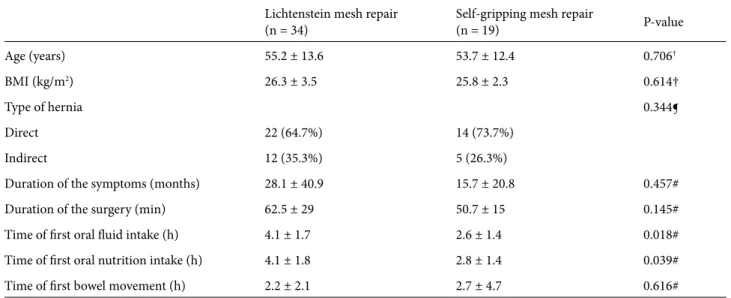
A total of 34 patients underwent conventional Lichtenstein hernia repair, whereas 19 patients underwent self-gripping polypropylene mesh repair. The groups did not differ statistically in terms of demographics or clinical characteristics (Table 1). In the Lichtenstein mesh repair group, 64.7% of the patients reported pain as an initial symptom, compared to 57.9% of patients in the self-gripping mesh repair group. No difference was observed for preoperative VAS intensity in either group. Neuropathic pain characteristics assessed by the DN4 questionnaire disclosed a total score of less than 4 in all patients preoperatively. The patients did not exhibit any signs of neurological deficit or nerve damage in the preoperative period. Although none of the patients had a total DN4 score of greater than 4, some of the patients described burning pain, painful sensations of cold, electric shocks, tingling, pins and needles, numbness, itching, or pain provoked or increased by brushing (Table 2). No difference in any DN4 questions (except question 3) was observed between the groups. Preoperative NHP evaluation revealed no statistically significant difference between groups.
The mean operative time was shorter for self-gripping polypropylene mesh repair but the difference was statistically insignificant. The first fluid intake as well as food intake was earlier for self-gripping mesh repair (4.1 ± 1.7 h versus 2.6 ± 1.4 h, P = 0.018; 4.1 ± 1.8 h versus 2.8 ± 1.4 h, P = 0.039, respectively). No early postsurgical complications were encountered for either group.
The patients were reassessed at postoperative month 6 for the presence of pain, neuropathic symptoms, and presence of sensory changes. In the Lichtenstein mesh
repair group, 17.6% of the patients reported ongoing pain, compared to 15.4% of the patients in the self-gripping mesh repair group. No difference in VAS intensity was found between the 2 groups in the postoperative period. However, compared to the preoperative period,
spontaneous pain and VAS intensity while walking, sitting, and coughing were found to be lower in both groups (all P < 0.05; Table 3). Neuropathic pain characteristics as assessed by the DN4 questionnaire gave higher total scores for all patients; this score was found to be less than 4 for
Table 1. Demographic and clinical characteristics of the inguinal hernia repair patients.
Lichtenstein mesh repair
(n = 34) Self-gripping mesh repair(n = 19) P-value
Age (years) 55.2 ± 13.6 53.7 ± 12.4 0.706†
BMI (kg/m2) 26.3 ± 3.5 25.8 ± 2.3 0.614†
Type of hernia 0.344¶
Direct 22 (64.7%) 14 (73.7%)
Indirect 12 (35.3%) 5 (26.3%)
Duration of the symptoms (months) 28.1 ± 40.9 15.7 ± 20.8 0.457#
Duration of the surgery (min) 62.5 ± 29 50.7 ± 15 0.145#
Time of first oral fluid intake (h) 4.1 ± 1.7 2.6 ± 1.4 0.018#
Time of first oral nutrition intake (h) 4.1 ± 1.8 2.8 ± 1.4 0.039#
Time of first bowel movement (h) 2.2 ± 2.1 2.7 ± 4.7 0.616#
†: Student’s t-test, ‡: likelihood ratio test, ¶: Fisher’s exact test, #: Mann–Whitney U test.
Table 2. Preoperative answers to DN4 questions of the patients.
DN4 questions Lichtenstein mesh repair (n = 34) Self-gripping mesh repair(n = 19) P-value†
• Q1 (Burning) 7 (20.6%) 5 (27.8%) 0.731‡
• Q2 (Painful cold) 4 (11.8%) - 0.285‡
• Q3 (Electric shocks) 1 (2.9%) 4 (22.2%) 0.043‡
• Q4 (Tingling) 4 (11.8%) 5 (27.8%) 0.247‡
• Q5 (Pins and needles) 6 (17.6%) 4 (22.2%) 0.723‡
• Q6 (Numbness) - 2 (11.1%) 0.115‡ • Q7 (Itching) 3 (8.8%) 1 (5.6%) 1.000‡ • Q8 (Hypoesthesia to touch) - - -• Q9 (Hypoesthesia to prick) - - -• Q10 (Brush allodynia) 1 (2.9%) - 1.000‡ • Total 0.5 0.5 0.602¶
†: According to the Bonferroni correction, a P-value of less than 0.025 was considered statistically significant. ‡: Fisher’s exact test, ¶: Mann–Whitney U test.
all patients and no statistically significant differences were found between groups from initial evaluation to late-term assessment (Table 4). Compared to the baseline NHP scores, a statistically considerable decline was noted in pain and physical mobility/physical functioning in postoperative month 6 in both groups (P = 0.000 versus P = 0.000, P = 0.000 versus P = 0.002, respectively), with no apparent difference between groups (Table 3).
4. Discussion
In this study we aimed to compare the changes in pain-related symptoms of inguinal hernias from initial admission to postoperative month 6 following 2 different herniorrhaphy techniques and we found that although both techniques resulted in decreases in late-term pain-related symptoms, neither was superior.
Inguinal hernia repair is the most common operation in general surgery worldwide. Pain is the second most common presenting symptom in inguinal hernia patients and up to 64% of patients report pain (9). In our study, a
total of 53 patients were enrolled and 62.2% of the patients reported pain as one of the presenting symptoms. Some of our patients also reported neuropathic pain symptoms such as burning pain, tingling, and pins and needles within their inguinal hernia area preoperatively. In the literature, some of these symptoms have not yet been reported. These symptoms may be related to chronic irritation of the inguinal nerves by the hernia itself. Nine patients in the Lichtenstein mesh repair group (26.4%) and 6 patients in the self-gripping mesh repair group (31.8%) exhibited an ongoing bulge in the groin for more than 1 year. It is probable that as the time from recognizing the bulge in the groin to surgical intervention increases, the damage amplifies.
Persistent postsurgical pain is expected to appear after a surgical procedure and last for more than 2 months with no apparent causes, and could be neuropathic or nonneuropathic (1). It is probably the most serious adverse outcome after inguinal hernia repair. In our study, 17.6% of the patients in the Lichtenstein mesh repair group reported ongoing pain compared to 15.4% of the patients
Table 3. Baseline data compared to the data at 6 months after surgery for each surgical method.
Variables Lichtenstein mesh repair (n = 34) Self-gripping meshrepair (n = 19) P-value†
VAS at rest –1.0 ± 2.3 –0.7 ± 2.0 0.618
VAS with walking –3.4 ± 3.1 –2.6 ± 2.9 0.542
VAS with sitting –1.6 ± 2.8 –0.4 ± 1.0 0.258
VAS with coughing –1.5 ± 2.6 –1.3 ± 3.1 0.617
VAS with gastrointestinal movement –0.9 ± 2.4 –1.7 ± 2.9 0.427
Genital pain –0.1 ± 0.5 –0.7 ± 2.2 0.811
Ejaculatory pain 0.0 ± 0.3 –0.8 ± 2.3 0.699
Contralateral pain –0.3 ± 1.3 –1.5 ± 2.7 0.449
DN4 total scores 0.0 ± 1.4 –0.5 ± 1.9 0.584
Nottingham Health Profile
ES 5.6 ± 31.0 –5.3 ± 24.7 0.365 AA –20.4 ± 21.6 –16.4 ± 19.3 0.518 ER –3.1 ± 15.1 –5.0 ± 11.8 0.726 U –7.2 ± 20.8 1.5 ± 11.7 0.365 SE 0.1 ± 6.5 –3.3 ± 19.4 0.985 FA –12.9 ± 23.6 –8.3 ± 11.9 0.868 Total –37.9 ± 66.9 –36.7 ± 75.7 0.985
†: Mann–Whitney U test. VAS: Visual analog scale, DN4: Douleur Neuropathique 4 questions, ES: energy level/vitality, AA: pain, ER: emotional reactions/mental health, U: sleep, SE: social isolation/social functioning, and FA: physical mobility/physical functioning.
in the self-gripping mesh repair group. Even though the prevalence of a neuropathic component in persistent postsurgical pain is reported to be 31% after groin hernia repair, we did not come across any patients whose pain fulfilled neuropathic pain criteria. All of our patients had a total DN4 score less than 4, but we found higher DN4 scores when compared to the baseline DN4 scores. This persistent nonneuropathic postsurgical pain is probably due to the mesh-related excess fibrosis and the nature of the fixative sutures.
The prosthetic mesh induces an acute inflammatory reaction followed by a chronic foreign-body fibroblastic response that creates scar tissue. This fibrotic reaction appears to reinforce the abdominal wall and leads to fewer recurrences. Although polypropylene mesh has significant advantages, it has been reported that this type of mesh stimulates inflammatory reactions, and this causes mesh shrinkage and postoperative chronic groin pain. Self-adhesive mesh provides another alternative for inguinal hernia repair. This type of mesh is lightweight and does not require sutures for fixation because of its absorbable microhooks. It causes less inflammatory reaction and, therefore, it has greater elasticity and flexibility. Reduced surgical time and decreased pain without increasing the number of complications or recurrences are other advantages of self-adhesive meshes (10–13). During the set-up of this study, we expected better results for the self-gripping mesh repair group due to its light weight
and absorbable microhooks. However, our results demonstrated that both surgical meshes reduced late-term pain-related symptoms, with neither technique being superior to the other. This finding is compatible with many other studies evaluating the efficacy of self-gripping mesh repair over Lichtenstein mesh repair (14–16).
Apart from similar studies evaluating postoperative pain following Lichtenstein mesh repair versus self-gripping mesh repair, we also investigated neuropathic pain symptomatology. To screen for neuropathic pain in patients, scales and questionnaires are recommended (17). Among these various neuropathic pain scales, we used the DN4 questionnaire, as it was previously shown to be a very quick, sensitive, and specific test (6). In a recent study, Aveline et al. compared 2 different regional anesthesia methods in inguinal hernia repair patients and assessed neuropathic pain at 6 months by DN4 questionnaire, for which no difference was found between the groups (18). In our study, some of our patients reported neuropathic pain symptoms such as burning pain, tingling, and pins and needles within the inguinal hernia area. We objectively documented baseline (preoperative) and late (postoperative month 6) assessments for the presence of nerve damage by neurological examinations, such as hypoesthesia to touch, hypoesthesia to prick, and pain provoked or increased by brushing (allodynia) or prick (hyperalgesia) in our patients. Despite the fact that a total DN4 score of less than 4 was found for all patients postoperatively, an increase from
Table 4. Postoperative month 6 answers to DN4 questions.
DN4 questions Lichtenstein mesh repair (n = 34) Self-gripping mesh repair(n = 19) P-value†
• Q1 (Burning) 1 (4.8%) -
-• Q2 (Painful cold) - -
-• Q3 (Electric shocks) 1 (4.8%) -
-• Q4 (Tingling) 6 (28.6%) 4 (33.3%) 1.000‡
• Q5 (Pins and needles) 2 (9.5%) 2 (16.7) 0.610‡
• Q6 (Numbness) 1 (4.8%) 1 (8.3%) 1.000‡ • Q7 (Itching) 2 (9.5%) - 0.523‡ • Q8 (Hypoesthesia to touch) 1 (4.8%) - -• Q9 (Hypoesthesia to prick) 1 (4.8%) - -• Q10 (Brush allodynia) - - -• Total 0.7 ± 1 0.6 ± 0.8 0.927¶
†: According to the Bonferroni correction, a P-value of less than 0.025 was considered statistically significant. ‡: Fisher’s exact test, ¶: Mann–Whitney U test.
the baseline values was noted. Persistent postsurgical pain may interfere with quality of life and general well-being. Quality of life domains are reported to be affected by pain in inguinal hernia patients, as well (19). In our patients, we assessed health profile by NHP. Preoperatively, the patients exhibited an impaired level of quality of life and there was no difference between the groups. At postoperative month 6, general well-being was reestablished in our patients.
As mentioned previously, self-gripping meshes have the benefits of being lightweight and not requiring fixative sutures. Their absorbable microhooks provide gripping properties for 12 months and their absorption begins thereafter. Not waiting for the microhooks’ absorption and reassessing the patients at postoperative month 6 could be one limitation of this study. However, during the study set-up, we focused mainly on mesh-related excess
fibrosis and the existence of fixative sutures in the hernia repair and underestimated the minor tissue changes due to microhooks.
Another finding of this study was the earlier fluid and food intake in the self-gripping mesh group. During the design of this study, as all patients underwent surgery under spinal anesthesia, we did not foresee such a difference. In the postoperative period the patients were allowed to take oral nutrition whenever they wished to. Though the time difference between the groups is an interesting finding, it is difficult to interpret as there are no data in the literature about this time difference.
To conclude, despite its ease of application and short operative time, self-gripping mesh repair was not found to be superior to conventional Lichtenstein mesh repair in terms of reducing pain related to inguinal hernias.
References
1. Macrae WA. Chronic post-surgical pain: 10 years on. Br J Anaesth 2008; 101: 77–86.
2. Hakeem A, Shanmugam V. Inguinodynia following Lichtenstein tension-free hernia repair: a review. World J Gastroenterol 2011; 17: 1791–1796.
3. Haroutiunian S, Nikolajsen L, Finnerup NB, Jensen TS. The neuropathic component in persistent postsurgical pain: a systematic literature review. Pain 2013; 154: 95–102.
4. Butters M, Redecke J, Köninger J. Long-term results of a randomized clinical trial of Shouldice, Lichtenstein and transabdominal preperitoneal hernia repairs. Br J Surg 2007; 94: 562–565.
5. Pokorny H, Klinger A, Schmid T, Fortelny R, Hollinsky C, Kawji R, Steiner E, Pernthaler H, Függer R, Scheyer M. Recurrence and complications after laparoscopic versus open inguinal hernia repair: results of a prospective randomized multicenter trial. Hernia 2008; 12: 385–389.
6. Unal-Cevik I, Sarioglu-Ay S, Evcik D. A comparison of the DN4 and LANSS questionnaires in the assessment of neuropathic pain: validity and reliability of the Turkish version of DN4. J Pain 2010; 11: 1129–1135.
7. Bouhassira D, Attal N, Alchaar H, Boureau F, Brochet B, Bruxelle J, Cunin G, Fermanian J, Ginies P, Grun-Overdyking A et al. Comparison of pain syndromes associated with nervous or somatic lesions and development of a new neuropathic pain diagnostic questionnaire (DN4). Pain 2005; 114: 29–36. 8. Hunt SM, McKenna SP, McEwen J, Williams J, Papp E. The
Nottingham Health Profile: subjective health status and medical consultations. Soc Sci Med 1981; 15: 221–229. 9. Magnusson J, Videhult P, Gustafsson U, Nygren J, Thorell
A. Relationship between preoperative symptoms and improvement of quality of life in patients undergoing elective inguinal herniorrhaphy. Surgery 2014; 155: 106–113.
10. Lichtenstein IL, Shulman AG, Amid PK. Use of mesh to prevent recurrence of hernias. Postgrad Med 1990; 87: 155–158, 160. 11. Silvestre AC, de Mathia GB, Fagundes DJ, Medeiros LR, Rosa
MI. Shrinkage evaluation of heavyweight and lightweight polypropylene meshes in inguinal hernia repair: a randomized controlled trial. Hernia 2011; 15: 629–634.
12. Miller JP, Acar F, Kaimaktchiev VB, Gultekin SH, Burchiel KJ. Pathology of ilioinguinal neuropathy produced by mesh entrapment: case report and literature review. Hernia 2008; 12: 213–216.
13. Kim-Fuchs C, Angst E, Vorburger S, Helbling C, Candinas D, Schlumpf R. Prospective randomized trial comparing sutured with sutureless mesh fixation for Lichtenstein hernia repair: long-term results. Hernia 2012; 16: 21–27.
14. Kapischke M, Schulze H, Caliebe A. Self-fixating mesh for the Lichtenstein procedure--a prestudy. Langenbecks Arch Surg 2010; 395: 317–322.
15. Pedano N, Pastor C, Arredondo J, Poveda I, Ruiz J, Montón S, Molina M, Hernández-Lizoain JL. Open tension-free hernioplasty using a novel lightweight self-gripping mesh: medium-term experience from two institutions. Langenbecks Arch Surg 2012; 397: 291–295.
16. Anadol AZ, Akin M, Kurukahvecioglu O, Tezel E, Ersoy E. A prospective comparative study of the efficacy of conventional Lichtenstein versus self-adhesive mesh repair for inguinal hernia. Surg Today 2011; 41: 1498–1503.
17. Haanpää M, Attal N, Backonja M, Baron R, Bennett M, Bouhassira D, Cruccu G, Hansson P, Haythornthwaite JA, Iannetti GD et al. NeuPSIG guidelines on neuropathic pain assessment. Pain 2011; 152: 14–27.
18. Aveline C, Le Hetet H, Le Roux A, Vautier P, Cognet F, Vinet E, Tison C, Bonnet F. Comparison between ultrasound-guided transversus abdominis plane and conventional ilioinguinal/ iliohypogastric nerve blocks for day-case open inguinal hernia repair. Br J Anaesth 2011; 106: 380–386.
19. van Hanswijck de Jonge P, Lloyd A, Horsfall L, Tan R, O’Dwyer PJ. The measurement of chronic pain and health-related quality of life following inguinal hernia repair: a review of the literature. Hernia 2008; 12: 561–569.