Numerical
implementation
of
absorbing
and injecting boundary
conditions
for
the
time-dependent
Schrodinger
equation
M. Cemal Yalabzk and M.Ihsan Ecemiq
Department ofPhysics, Bilkent University, 06688 Ankara, Turkey (Received
?
September 1994)A method is described that enables the absorption and injection ofwave functions at the bound-aries of aregion in a numerical solution to the time-dependent Schrodinger equation. A number ofresults corresponding to one- and two-dimensional simulations are presented. Such boundary conditions enable the use oftime-dependent simulations ofgeometries connected to contacts that correspond to sources and sinks of particles in thermal equilibrium. The approach presented has a number ofattractive features from anumerical-implementation point ofview.
Numerical solution
of
the Schrodinger equation for the analysis ofquantum transport propertiesof
small geome-tries (where the effectsof
energy dissipation mechanisms may beneglected) isapowerful method that has been uti-lized extensively.If
the analyzed system is "open,"
i.
e.
,if
it has contacts that may inject and absorb particles, then one has a number
of
approaches available for the solu-tion of the wave equation. One method isto
consider the time-independent Schrodinger equation, on which the im-plementationof
the contact boundary conditions is well known (see, for example, Ref.1).
The particle may be assumedto
be incident &om a contact with agiven wave vector, further assumedto
be absorbed completely by any contact ifincident onit.
The transport properties of the geometry may then be determined &om a superposi-tion of the associated propertiesof
these single particle solutions, weighed by the appropriate magnitudes of the injected waves dictated by the thermal properties of the contacts. A disadvantageof
this method is its inabilityto
describe the time-dependent dynamicsof
the system. One may also integrate the time-dependent Schro-dinger equation with open boundaries numerically, however, implementation of the contact boundary con-ditions is not straightforward. Main difhculty is due to the inHuence of the wave function values well outside the boundary (that have left the simulation regionat
some earlier times) on the wave function within the bound-ary. This then suggests a non-Markovian process, and a boundary condition based on the values of the wave functionat
previous times may be constructed. 'Sim-ulations have been performed in which the problem of the boundary conditions may be bypassed completely by injecting wave packets
of
finite extent into a structure, and their time development have been analyzed until a large portionof
the wave function reaches some extremal partsof
the geometry. The utility of this approach is limitedto
systems in which the time associated with this development isnot prohibitive.The Wigner function approach is an elegant method ' in which absorbing and injecting boundary
conditions can be applied naturally. How~ver, the algo-rithm is not straightforward, and the method is feasible at present for application
to
one-dimensional systems, asit
requires a2d dimensional mesh for ad-dimensionalsys-tern. The availability ofabsorbing and injecting bound-ary conditions puts the Schrodinger equation on a par with Wigner function approaches in the numerical study of time-dependent quantum phenomena, and it further has the advantage that it is feasible for application to problems with higher dimensionality.
The method
to
be described in this work is Markovian (in the sense that the boundary condition does not re-quire any knowledge of the system at previous times), and is applicableto
systems in which one can compute the time developmentof
the wave function precisely at some region of space near the contacts. This may be ac-complished, for example, by assuming a constant poten-tial at this region. As in other Markovian boundary con-ditions, the method employs an extrapolation of the wave function outside the simulation region as an estimateof
the wave that has already left the boundaryat
earlier times. An important difFerence between our method and the previous Markovian approaches is the construction ofan estimate based on the values of the wave function in arelatively large region near the boundary. The time developmentof
the wave function, therefore, isbased on the progress of the function in this region, and does not require excessively small time steps for stability. The ex-trapolation further does not require a knowledgeof
the time derivativeof
the wave function near the boundary. An appealing point about the approach is the utiliza-tion of the eKcient fast Fourier transform procedure in conjunction with open boundary conditions, which is nor-mally used for perfectly reHecting or periodic boundaries. We next describe the method, present a number of ex-amples of the applicationof
the approach, and present the conclusions.The principle idea of the method is
to
calculate the development of the wave function during a time step twice, once with reHecting or periodic boundary condi-tions throughout the full simulation space, second near the contact region, using an extrapolation of the wave function outside the contact region consistent with the absorption-injection condition. The full wave function is then updated using a mixture of the two time develop-ments. A number ofresults correspondingto
the appli-cationof
this methodto
some simple systems is given.The time-dependent Schrodinger equation may be
NUMERICAL IMPLEMENTATION OFABSORBING
AND.
.
.
20830
)
ap(
—
kl)le=—vx+1
Here, cl, are the 2n Fourier coefficients (with
n+
—
1 & k &n),
which are nonzero only for nonpositive values ofk.
These coefficients may be determined through the solution of the n simultaneous linear equations inEq. (5)
corresponding
to
the values of the n "known" valuesof
Pat
the boundary. However,it
is also possibleto
note thatEq.
(5)is a polynomial equationn—1
Ql
=
)
C lczl (6)2n
where zl
=
exp(—
zzrl/n). Hence, the right hand sideof
Eq.
(5)may be interpreted asa
polynomial which is spec-ifiedto
take the values Plat
the points zl with 1&l(
n.
Since this polynomial is unique, it may be determined through the Lagrange formula,
J[z]
=).
4l (7)I,=1 Ical
The polynomial
p(z)
then is the polynomial inEq.
(6) and may be usedto
obtain all 2n valuesof Pl.
Pl
=
p{exp[—
z(2zr/2n)l]) . (8) cretized on a set of lattice pointsa
distanceLx
apartas
z(8z/ll/87 )
=
[K+
v(l,7)]pl,
(1) where @lrepresents the time-dependent value ofthe wave functionat
the lth lattice point, visthe unitless potential function [scaled by the energy eo ——h2/2m(Ax)2, withh, the Planck constant and m the particle mass], and w
is the unitless time variable (scaled by 5/eo).
K
is the kinetic energy operator which may be defined through the relation,Kz/ll
=
2@l Ql—1 pl+1 (2)for
a
one dimensional system, generalization for higher dimensions is straightforward.If
4' represents the vectorof
valuesof
(@),
its time de-velopment can be formally expressed through the equa-tion4(7
+
A7)=
exp[—
zb.v(K+
v)]4(7)
. (3)The integration procedure used in this work for the time development
(i.
e.
, "updating") of the wave function isto
break up the exponential inEq. (3)
such that exp[—
zAz(K
+
v)]The difFiculties associated with the numerical stability in the determination
of
coefIicients in polynomialsof
a
high degree are well known.It
will only be pointed out here that the evaluationof
the extrapolated values through the Lagrange formula isto
be preferred overa
direct in-versionof Eq. (5),
and that the method has been appliedto
polynomialsof
order upto
16with no difIiculty, using single precision arithmetic.As discussed earlier, the above choice of the momen-tum components
to
bespecified isnot unique. Our choice was mainly dueto
its simplicity, and guarantees a "nu-mericallyexact"
representationof
outgoing wave func-tions nominally ofa
single wavelength and commensurate with the extended boundary region. Hence, the accuracyof
the method would be expectedto
increaseif
the sizeof
this boundary region could be increased, as this would allow longer and longer wavelengthsto
be commensurate with this region. However, as it stands, the method en-ables the absorptionof
wavelengths much longer than the boundary region size, although its accuracy decreases for very long wavelengths. In applications where the dynam-icsof
very long wavelengths dominate, one could modify the extrapolation procedure toinclude these wavelengthsat
the expense of others. On the other hand, fora
nu-merically efFicient implementation, the mesh lengthLx
should be chosen such that these large wavelengths are not generated,i.
e.
,a
smooth wave function should notbe represented by
a
needlessly large numberof
points. Theboundary wave function composed of the 2n values may then be updated for the next time step(at
the con-stant potential of the boundary), using periodic bound-ary conditions. Although this type ofboundary condi-tion would not be appropriate for points near l n, it is quite accurate near the boundary (l1).
The full wave function is also updated, using perfectly reflecting or pe-riodic boundary conditions. Again, this typeof
update is obviously not appropriate near the boundary, but isac-=
exp(—
zvEw/2) exp(—
zA+K) exp(—
zvAv/2), (4) which is correct to order(A~)2,
and preserves the nor-malization and the time reversal symmetry of the wave function. This uncoupling permits the updating of the wave function in the momentum space for the kinetic energy term (where the kinetic energy operator is diag-onal), and in the position space for the potential energy term. The availabilityof
fast Fourier transform algo-rithms make the transformation and inverse transforma-tionof
the wave functionat
each time step feasible. The discrete Fourier transformation implies periodic bound-ary conditions, however, perfectly reflecting boundary conditions may also be implemented by antisymmetrizing the wave function (througha
doubling of the periodicity length).As mentioned above, in order
to
implement an absorb-ing boundary condition, we consider a number (say n) points near the boundary where the potential may be assumedto
be constant. We then extrapolate the wave functionto
another n points outside the boundary con-sistent with absorption. This is in efI'ect, an estimate of the wave function which has left the boundaryat
earlier times. Admittedly, this estimate cannot be unique.If
one assumes that only outgoing waves exist inthis bound-ary region, an estimate consistent with this assumption may be constructed. The wave function in this extended boundary region may be assumedto
have only outgo-ing momentum components. The optimal choiceof
these momentum values depends upon the form of the wave function leaving the boundary.In our work, we have chosen these momentum compo-nents such that the discrete Fourier transform of the wave function composed
of
these 2n points correspondsto
no incoming (therefore only outgoing) momentum compo-nents. For example,if
the n valuesof
the wave function near the"left" (i.e.
,—
z)
boundaryof
the system are givenby Pl (with 1
(
l(
n),
the valuesof P
are extrapolatedfor values ofloutside the boundary (with
n+1
&l &0)—
such that for all l,a &om the boundary. Hence, the curate sufBciently away om e
in &om one type of update
to
anot er zn e ore '
bt
the solution for an absorbing~ ~
The use ofan extrapolation ase on a
r ' h b dary allows the use of time steps re ion near
t
e oun arI g
l all. We have used atame step which are not excessive y sma
d
of
Lw=
0.
1 in all of the examples that are presente zncould introduce intolerable errors in the break up o e ssm
=
0.067m,
corresponding to an electron in a s,massm
=
.
m,
47.
=
0.
1 correspondsto
a and amesh spacingof
1 nm, 7=
.
coof a roximately
0.
1fs.)ted &omthe same boundary
If
the particle isbeing injecte om eh one then expects
t
e with a particular wave vector q,wave function
to
have the formP~
=
A exp(tql)+
g
cl,exp tk= —(«+1
ere A is the coeKcient of the Inciden
t
wave. In thisA —+A exp(
—
xE~Dv.))w&incident wave]. The sum o e wo
of
the incite u date of the wave function then make up the complete up
a
eo~ ~
e ion. The full wave function cs a so u dated using perfectly reHecting or perio sc oun
e end' on the type ofproblem, near the boundaries. Depen mg
nt otential, or more typica y,
n
oe
',
.
l a c anne p)
thf
t
ott
1 11pendxcular
to
ththe boundary ws ni ef
of the solutions for which analytic orm o emay be used, for
ma be constructe d
.
Thee formor of the near the boundary m yr will then be of the solution near the absorbing boundary wj. en
10
0
~00gpO
Q I-j c(go A@6 oao
o ~ g OK++
+++
~ 10 -Qg~& NW0 +++++
y++
+++
+ + + 0n=2 an=4 4n=8 +n=16 10 10 « 20 Position {I) 30 form(li(l,
l„,
l )=
Au(l„,
l )exp(tql )0 2K «(I„,
(.
) p—
k()
+~
lE s«$ 2n 1 A:—n+with a particle injec
t
ed withwi wave vector q in the+z
23
mmmmmmmmmmr ~ 2 1 mmm~immmr im 0 N/U/ U/~
4/~~
23-Iyl t=10 ( I 0 4 00223
Iyl 0.00 16 32 1 mmmmr rxmmmm~m Qi.="--.-"
( (=20~(«
( 4 002 23-lyl 0.00 mmmmmmm/ 0r in the wave functIon at
t—
15 ofFIG.
2. Trious values ofthe size n o e o Fi . 1,displayed for various
region. The relative erro —l~, where Q( and
simulation mesh ofsizes 4~ aretheva ues ofthewave function onasimu
32 and 128,respectively. Q) CD C E L (5 U CO t=15 t=20 0 0 10 20 30 40 position (I) G. . '
f wave packet (correspond(ng to
Q(
=
exp[(8»(16+
x0.982/ In& Ia y uat the left, and aperfectly absorbing onin one
y g
of=' at the ind' t dv l esofthe
unitless time varIa le.
23-lyI 0 24 32 16 position (l) ve with aGaussianpy
l f=
0 198 d v rtical iin h d th k ( th o d o h 1the method descri e in
the p uses corres ~ ~ ~
496
't d 'th d
n amesh with 40 poin s
t ' l th diff b t
NUMERICAL IMPLEMENTATION OFABSORBING
AND.
.
.
2085t=60
FIG.
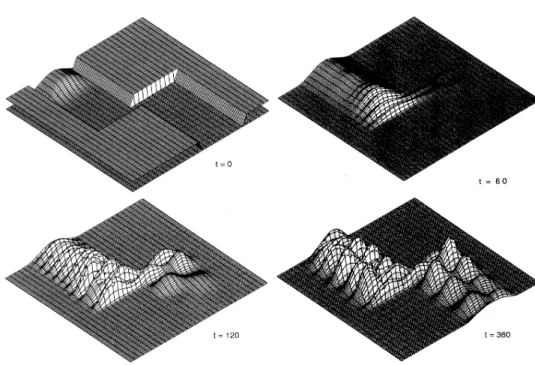
4. The development of the wave function in an electron waveguide with akink. Thefigure shows the square magnitude ofthewave function on a32x 128 sim-ulation mesh. The boundary re-gion has alength ofn
=
8,and the wavelength ofthe injected wave is approximately 14mesh units. The scaled value oftime isindicated on the figure. The potential profile issuperimposed onthe wave func-tion for t=
0. The oscillations inthe outgoing channel are due to the interference between the com-ponents ofthe electron wave func-tion in the first and the second subbands.direction and in the eigenstate
u(l„,
l,
) near the bound-ary. The integersl,
I,„,
/ label the position coordinateson the three-dimensional mesh, and the expansion coeffi-cients
cy(l„,
l,
) may be determined as before for fixedl„
and I.
Three applications of the boundary conditions are dis-played in Figs. 1—
4.
(All computations have been carried out using single precision arithmetic. ) Figure 1 displays the motion of an initially Gaussian wave packet with a momentum in the+x
direction, in the presence ofa per-fectly reflecting boundaryat
l=
1,
and a perfectly ab-sorbing boundaryat
l=
33.
The accuracy of the wave packet leaving the boundaryat
the scaled time value of 15 has been checked againsta
simulationof
the same wave packet on a mesh which extendsto
128 points. At this valueof
the scaled time, one expects no errors on this larger mesh due to the boundary condition, as the wave packet isa
safe distance away from the boundary. The"error"
in the wave packet on the smaller mesh in comparisonto
that on the larger mesh is displayed inFig. 2.
As apparent in this figure, there is a dramatic improvement in the approximation as the size n of the boundary region is increased, in fact at the scale ofFig. 1,
the wave function generated with n=
8 and 16 are indis-tinguishable from the one generated on the larger mesh. A boundary size correspondingto
n=
8 seems to be op-timal fora
large class of problems in terms of accuracy-computational resource tradeoffFigure 3shows the progress
of
awave injected into an initially empty space containing a tunneling barrier. A Gaussian wave front has been imposed onthe wave. The results of the simulation implementing the method de-scribed above have been compared with the results of a simulation carried out on a periodic meshof
size4096.
Again, this large mesh avoids the problems associated with boundary conditions for the values of the time vari-able indicated in the figure. The difference between the
results
of
the two simulations is not visible in the scaleof
the figure, two insets are providedto
display this dif-ferenceat
an expanded scale.The method has been tested for
a
large class of prob-lems correspondingto
various potential functions and ini-tial conditions.It
was foundto
be robust in these appli-cations.The boundary condition described in this work has also been applied
to
two-dimensional systems in which the wave function is incident (and absorbed) through chan-nel like potentials.By
carrying out an ensemble ofsingle particle simulations (each corresponding to a different incident wave) in parallel,it
is possible to study quan-tum transport through two-dimensional structures in the presence of time-dependent boundary conditions. Fig-ure 4 displays the progress of the wave function througha
kink (or "double-bend") shaped channel at different times. This structure isexpectedto
have interesting non-linear transport properties. The results of this study will be reported elsewhere.An implementation ofabsorbing and injecting bound-ary conditions for numerical simulations
of
the time-dependent Schrodinger equation has been described. The method is Markovian and isstable under alarge range of conditions. The basic idea is probably applicableto
other types ofwave equations (such as the Maxwell Equations) although we have not tested this.An important practical point is the application
of
the fast Fourier transformto
the solution of the wave equa-tion for systems with open boundaries, which results in improved numerical efficiency. There may bepossibilities for improvement in the method, for example through a difIerent choice ofmomentum components that are spec-ified in the extrapolation procedure, or indeed possibly through the adaptationof
a totally diferent extrapo-lation procedure. The removal of the sharp cutofFs in space and momentum are areasof
possible improvement.The method described above is presently being used in
a
more demanding studyof
atwo-dimensional system in the presenceof
aselfconsistent potential. This work will be reported separately.The authors would like
to
thank Erkan Tekman for many &uitful discussions and a critical reading of the manuscript.C. S. Lent and D.
J.
Kirkner,J.
Appl. Phys. O'7, 6357(1990).
R.
Landauer, IBMJ.
Res. Dev.1,
223(1957).
B.
Engquist and A. Majda, Math. Comput.Sl,
629(1977).R.
K. Mains and G.I.
Haddad,J.
Appl. Phys. O4, 3564 (1988).R. K.
Mains and G.I.
Haddad,J.
Appl. Phys. OF, 591(1990).
T.
Shibata, Phys. Rev.B
48, 6760(1991).
J.
-P.Kuska, Phys. Rev.B
46, 5000(1992).
L.
F.
Register, U.Ravaioli, andK.
Hess,J.
Appl. Phys.69,
7153
(1991);71,
1555(E)(1992).See Appendix D of Ref. 10 for a discussion of difBcul-ties involving boundary conditions on the time-dependent Schrodinger equation.
W. R.Frensley, Rev. Mod. Phys. 62, 645
(1990).
J.
R.
Hellums and W. R.Frensley, Phys. Rev.B 49'
2904(1994).
K.
Stratfort andJ.
L.Beeby,J.
Phys. Condens. Matter 5, L289(1993).
P.Carruthers and
F.
Zachariasen, Rev. Mod. Phys.55,
245 (1983).Although the procedure to be described here in relation to the boundary condition is probably applicable to other
widely used updating methods, this point was not verifj.ed. See, for example, G.Dahlquist and A. Bjorck, Numerical Methods (Prentice Hall, Englewood Cliffs, NJ, 1974), p. 284.
G. Dahlquist and A. Bjorck, in Numerical Methods (Ref. 15), p. 102.