Nonlinear fourterminal microstructures: A hotspot transistor?
I. O. Kulik
Citation: J. Appl. Phys. 76, 1920 (1994); doi: 10.1063/1.357675 View online: http://dx.doi.org/10.1063/1.357675
View Table of Contents: http://jap.aip.org/resource/1/JAPIAU/v76/i3 Published by the American Institute of Physics.
Additional information on J. Appl. Phys.
Journal Homepage: http://jap.aip.org/Journal Information: http://jap.aip.org/about/about_the_journal Top downloads: http://jap.aip.org/features/most_downloaded Information for Authors: http://jap.aip.org/authors
Nonlinear four-terminal
microstructures:
A hot-spot transistor?
I. 0. Kulik’)
Department
of
Physics, Bilkent University, 06.533 Bilkent, Ankara, Turkey (Received 12 October 1993; accepted for publication 22 April 1994)Four-terminal microcontacts between metallic electrodes develop nonlinear current-voltage dependencies both in the source and control channels as well as between the channels. Theory is presented of the nonlinearity caused by the reabsorption of nonequilibrium phonons emitted in the contact by injected electrons. Temperature of the lattice due to heating by the current is of the order T--V/4, which results in substantial increase of the resistance both in the bias direction and in the direction perpendicular to the bias. Performance characteristics of such a device at low temperature compared to the Debye temperature are quite promising for frequencies below 109 Hz.
1. INTRODUCTION
Point contacts between metals, and between semicon- ductors and semimetals, develop a number of nonlinear ef- fects associated with the interaction between electrons and Bose-type elementary excitations Iphonons, magnons, etc.). The degree of nonlinearity is generally not large (of the order d/l) in the ballistic regime in which the contact diameter (d) is much smaller than the electron and phonon mean free paths (I, ,1,,); however, the nonlinear part of a current is related in a very direct way to the characteristic electron- boson interaction function g(o) = a2(w)F(w), where F(o) is the density of the boson excitation and CY(W) the energy- dependent matrix element of the electron-boson (e.g., electron-phonon) interaction. This dependence serves as a basis of point-contact spectroscopy of elementary excitations in metals.le3
The opposite regime of small electron and phonon mean free paths is less informative in that respect. However, the degree of nonlinearity in the I-V dependence increases sub- stantially because nonequilibrium phonons emitted by “hot” electrons with the excess energy equal to the bias energy eV spend most part of their lifetime in the vicinity of constric- tion and therefore increase the contact resistance. The re- sponse time r,, for such a nonlinear conductance is quite small because of the smallness of the contact area, r.
= max(d2/D,rph-e), where D is the electron.diffusion coeffi- cient D = &vuFl, and ?-$,-e - { &h[ T3 + (eV)3]} the phonon- electron relaxation time. For contact diameter d- 1 ,um, T- 100 K, and eVCl0 mV this gives ~0-10-9-10-‘o s, i.e., the operation speed of such a device may be quite large. This is supported by the observation of nonlinear behavior in me- tallic point contacts above this frequency range.4
Up-to-date technology provides a possibility of making point contacts in various configurations including multiter- minal structures of micrometer and submicrometer sizes.
In this paper we present a theory of nonlinear current- voltage response of “diffusive” and/or of “thermal” point contacts (according to the definition made in Ref. 3) due to nonequilibrium phonons produced by a current. The four-
a’On leave of absence from B. I. Verkin Institute for Low Temperature Phys- ics and Engineering, Acad. Sci. of Ukraine, 47 Lenin Ave., 310164 Kharkh, Ukraine.
terminal constricted structure allows a bias voltage in one direction, and the control of the conductance in this direction by a current in the perpendicular direction. The strong non- linearity in both directions (channels) develops as a result of a hot spot formation at the intersection of conducting paths between the channels. The temperature of the spot is of the order of T-eV/4 and can greatly exceed the Debye tempera- ture of a metal, and its actual temperature. In spite of the fact that the metal away from a contact remains cold, the contact resistance changes substantially and is voltage dependent.
II. THEORETICAL FORMULATION
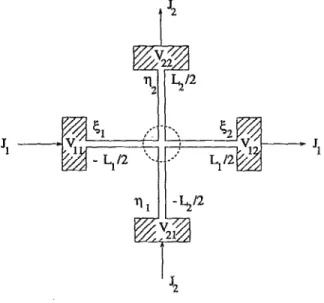
The four-terminal structure under consideration is shown in Fig. 1. A narrow strip of metal with length L, and cross section S, carrying a current J1 due to the connection to bulk reservoirs held at voltages V,, and VI2 is in thermal and electrical contact with another strip of length L, and cross section S2 connected to control reservoirs taken at voltages V,, and Vz2 and carrying the current J2. We assume that the narrowest part of the four-terminal structure is thermally iso- lated from the substrate, i.e., its heating and cooling are solely due to electron transport and electron-phonon interac- tion in metal electrodes.
The equation of thermal balance is
-div q+jE=Q, (1)
where Q is the heat transferred between the strips. q and j are thermal flow density and electric current density, respec- tively, related to thermal gradient and to electric field as
q=-KVT, j=aE=-d+. @I
We assume that thermal conductivity K and electrical
conductivity (+ are related to each other according to the Wiedemann-Franz law
K/UT=& (3)
where L = ( r?/3)(k,/e>2 IS the Lorentz number (later we : ’ adopt units in which kg= e= 1). For the strips that are long compared with their diameters (L 1,2S-d1,2), the temperature and electrostatic potential distributions are one dimensional:
T,(x),~I(x), -L,/2<x<L,/2
Tz.(Y),~~TY), -L,D<y<L,/2, (4)
FIG. 1. Schematics of a four-terminal microstructure. The dotted line shows a hot-spot region. V, = VI,- VI, , V2= Vz,- Vzl are voltages in the source channel (1) and in the control channel (2), respectively.
whereas heat transfer between 1 and 2 can be considered as a delta function giving
S1(-div q+jE)1-Q126(x)=0
&(-div
q+jE~z-QzlO)=O,
(5)
where Q is proportional to the temperature difference be- tween the points x = 0 and y = 0
Qn=
-Q21=42V1-T2)07 (6)and the subscript “0” means T,(x= 0) and T2(y = 0). An estimate of heat transfer coefficient is k12-dld2(T1 +T&JF/EF, where n is the electron concentration, and EF, vF the Fermi energy and the Fermi velocity, respectively.
Let us introduce the new variables 5, 7 in the x and y directions, respectively, according to
d d d d
“l&=-p uzdy=dp, (7)
where @ I = cr[ T,(x)], a2= cr[T,(y)]. o(T) is the tempera- ture dependent conductivity of a metal. Equation (7) implies that
o%$= at3, 4y)= av), which reduces Eqs. (5) to
v,-T2)877)=0.
The continuity equations Jjl/&= 0, aj,lay = 0 give
d”h d2h -@ =o> -@- =o.
The solution to Eqs. (10) is
(9)
00)
In the geometry of four-terminal constriction, two films are strongly coupled and temperatures of both strips coincide at x = 0, y = 0. This case is achieved formally by taking the limit k12--+m in Eqs. (9). (The accuracy of this approxima- tion is dl,2/Ll,2.) Taking for simplicity Tb= 0 and introduc- ing a parameter
X=W&)(Tt-T2)o 07)
J. Appt. Phys., Vol. 76, No. 3, 1 August 1994 I. 0. Kulik
(8)
~ =Vzdv- 7/72~+v22(771-17) (11)
2 ,
771- 772
where &, 6 and 771, rlz are values of the variables 5, 77 at bulk electrodes, i.e., at x = FL 1/2 and y = T L2/2. Potentials +,, & should match at points t=O, 7’0 at which strips 1 and 2 are crossing each other.
The solution to Eq. (9) gives
T;=z kl+a,t2+A5+rl
where (12) V2 1 ff1=-- Lt / (51-52j2, I ( Bl- 772j21 (13) c,,2= t--s”;:, lIT,(O~-T~(0)1.
The quantities VI = VI 1 - V12 and V,= V,, - V,, are volt- ages at source (1, in the x direction) and control (2, in the y direction) channels. Variables &, t2, ql, 72 and coefficients ,L+, p2, n, x are to be determined from the boundary con- dition
(14
where Tb is the bath temperature. Then, according to the definition of variables 6, ~(7) we have
62 d&
f- 0 PI(t)
(1%
where p(T) = l/a(T), thus giving another four equations for the above coefficients.
At k12=0, the equations for T,, T2 are decoupled, and the solution reduces to the one found by Holm and by others.6*7 If bath temperature Tb= 0, the temperature in the middle of a contact is related to bias voltage V according to
eV= yT, y=$ =3.62. (16)
(Compare this with the ballistic strong phonon-trapping re- gime in which e V- 4 T.8)
in Eqs. (12) and (13), consider a situation in which h remains fixed when k12-+~ and (Tr-T&+0. For a symmetric configuration shown in Fig. 1, it appears that the temperature distribution is symmetric T,( - 6) = T,(o), T2( - v) = Ta,( q) with
-51=52=50> -771=v2=770. (18)
We thus obtain
where To is the temperature in the center of a contact. The latter is subject to a self-consistency relation
TZ s1
(
J,v, +!c)=y
(5p +!g),
(20)whereas currents in the Iongitudinal (Jt) and transverse (Jz) channels are determined as
dz dT2(z)l ’
(21) For temperature-independent resistivity, p=const, Eq. (20) gives
w
which is an interpolation between the values corresponding to Eq. (16) for two constrictions at voltages VI, V, .3
III. NONLINEAR RESPONSE OF A CONTACT
In case of weak temperature dependence of resistivity,
P=Po+PpdT),
with pph4p0, the correction to the ohmic current at T, = 0 is expressed according to Eq. (21) as
AJ1= -g$
1
x j-olpPh[; I,/( “;:;p’ + viz) (l-zj]dz
V2 hJ2= -- L2Po x ,-ol,,p,,[ + J( VT;::?’ + v+) (l--s?>
I dz,
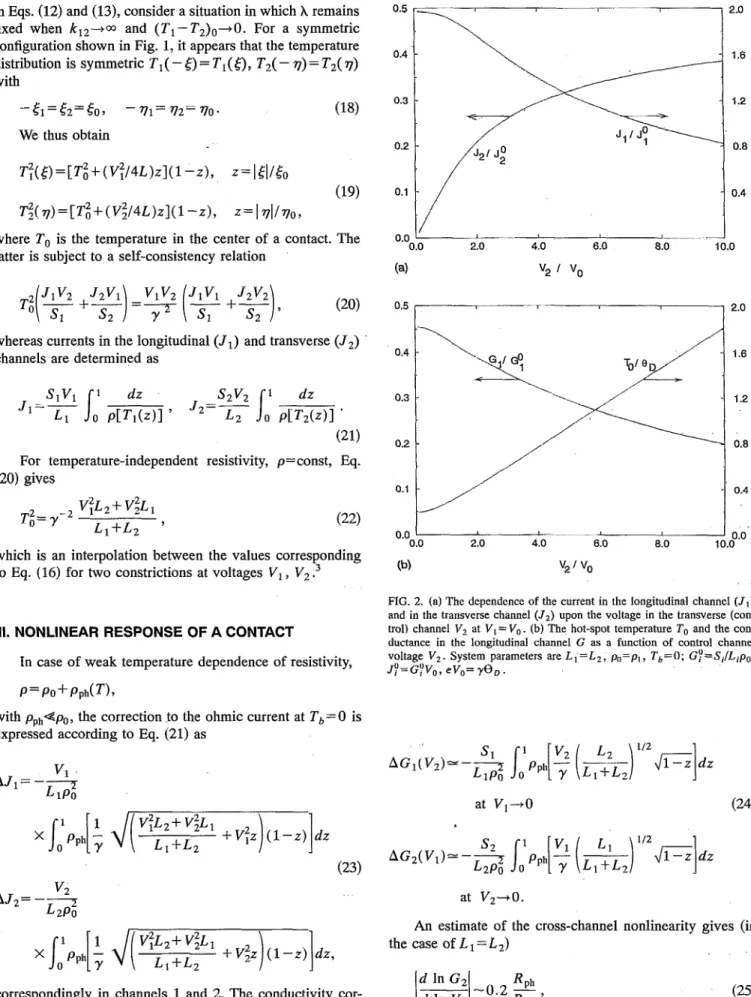
(23)correspondingly in channels 1 and 2. The conductivity cor- rections in the channels, with GIqz=dJI,2/dVl,a, are there- fore (a) 0.5 2.0 0.4 0.3 0.2 0.1 1.6 1.2 0.8 0.4 0.0 I L ._...,...-. - 0.0 2.0 4.0 6.0 8,0 10.0 0.0.. (b) "2'"o
FIG. 2. (aj The dependence of the current in the longitudinal channel (J,) and in the transverse channel (J,) upon the voltage in the transverse (con- trol) channel V, at V,=V,. (b) The hot-spot temperature TO and the con- ductance in the longitudinal channel G as a function of control channel voltage V,. System parameters are L,=L,, po=p,, T,=O; GY=Si/Lipo, J:=GYV,,, e-V,= ~8,.
AG,(V+-S’ Llpo I:Pph[T (&)l’zG]dz
at V,--+O (24)
“G,‘V”=ES%:
,:Pph[
9 ($$-j li2Gldz
at V,-+O.
An estimate of the cross-channel nonlinearity gives (in the case of LI=L,j
C=)
where R,,, is the residual resistivity and R,, the resistivity
due to phonons. This implies that nonlinearity is of the order ture as the lattice does. These two systems are in equilibrium of 1 when the residual resistivity ratio (RRR) of a metal is of but their common temperature quite exceeds the bath tem- the order of or larger than 1. perature.
Strong nonlinear regime (RRRS 1) requires numerical solution of Eqs. (20) and (21). Doing this iteratively, weob- tain the temperature of the hot-spot To as a function of V, , V2, and the dependencies Jr (V, , V,), J2( VI , V,) for cur- rents in the corresponding channels. Typical current-voltage characteristics are shown in Fig. 2 where we have adopted the p(T) dependence
r
I T \ 511/5Simple nonlinear relations (21) with the universal tem- perature distribution (19) and maximal temperature. in the middle of a contact determined self-consistently by Eq. (20) provide effective analysis of a self-induced and a cross- channel nonlinearity. The analysis*carried out above is not restricted to the electron-phonon mechanism and applies to any kind of p(T) dependence. In particular even stronger ..? nonlinearity is expected if the p(T) dependence is due to the temperature driven transition between insulating and con- ducting states of a material, or due- to- a magnetic ordering. The “giant anomaly” observed in the Ni-based alloyed point contacts” tells us that this may be actually the case in 3D point contacts. Nevertheless, similar experiments in planar structures are lacking. Heat conductivity and thermoelectric effects in metallic point contacts have been investigated in Refs. 9 and 10. An important problem, potentially, is a heat leak from a contact to the substrate reducing the hot-spot temperature. This should be taken into consideration in the fabrication of planar four-terminal structures.
PVJ=PO+PI[‘+(&--~ ;- (26)
interpolating between the Bloch-Gruneisen law pPh( T) - T5 at low temperature. T4 8 D and the dependence @, = const T at W-8,.
If the resistivity increases indefinitely with temperature, Jl and J2 saturate when V, , V,--+m (at a constant bias in the perpendicular direction). The To(VI ,Vz) behavior is in all cases similar to that given by Eq. (22). Note that in the case of an extremely asymmetric structure, L ,/L2-+0 or ~0, heat- ing is determined primarily by the voltage in the longer strip.
IV. CONCLUDING REMARKS
The four-terminal structure provides a possibility of non- linear coupling between two channels at a very small scale. Because of this, the- time response is also small since the fundamental phonon-electron coupling time (at energies and temperatures of the order @,) is of the order r$,+ - lo-‘OS.
Nonlinear coupling appears because nonequilibrium phonons are reabsorbed in the contact, thus increasing its temperature and resistivity. The heating temperature is gen- erally proportional to the bias voltage, Eq. (16). As at the Debye temperature, the phonon-electron mean free path is
$h-e - 10m5 cm, and the requirement of the small $h-e to d
ratio is met at the contact diameter d-l ,UL Since the electron-phonon mean free path is of the same order at T-OD , the electron system heats up to the same tempera-
i
ACKNOWLEDGMENTS I am very grateful to R. Ellialtioglu for fruitful
Professor C. Ciraci and Professor discussions.
‘I. K. Yanson, Sov. J. Low Temp. Phys. 9, 343 (1983).
‘A. M. Duif, A. G. M. Jansen, and P. Wyder, J. Phys. C 1, 3157 (1989). “I. 0. Kulik, Sov. J. Low Temp. Phys. 18, 302 (1992).
41. K. Yanson, 0. P. Balkashin, and Yu. A. Pilipenko, JETP Lett. 41, 372 (1985).
‘R. Helm, Electrical Contacts Handbook (Berlin, 1958).
‘B. I. Verkin, I. K. Yanson, I. 0. Kulik, 0. I. Shkliarevskii, A A. Lysykh, and Yu. G. Naydyuk, Solid State Commun. 30, 215 (1979).
71. 0. Kulik, Phys. Lett. 106A, 187 (1984).
“I. 0. Kulik, Sov. J. Low Temp. Phys. 11, 516 (1985).
“0. I. Shklyarevskii, A. G. M. Jansen, J. G. H. Hermsen, and P Wyder, Phys. Rev. Lett. 57, 1734 (1986).
“U. Gerlach-Meyer and H. J. Queisser, Phys. Rev. Lett. 51, 19M (1983). ‘I R. Trzcinski; E. Gmelin, and H. J. Queisser, Phys. Rev. 35, 6373 (1987).