A COMPARATIVE ANALYSIS OF NATIONAL AND
INTERNATIONAL ENGLISH LANGUAGE CURRICULA FOR
HIGH SCHOOLS IN TURKEY
The Graduate School of Education of
Bilkent University
by
Nermin Kondakçı
In Partial Fulfilment of the Requirements for the Degree of Master of Arts
in
The Program of Curriculum and Instruction Bilkent University
Ankara
BILKENT UNIVERSITY
GRADUATE SCHOOL OF EDUCATION
A COMPARATIVE ANALYSIS OF NATIONAL AND INTERNATIONAL ENGLISH LANGUAGE CURRICULA FOR HIGH SCHOOLS IN TURKEY
NERMİN KONDAKÇI June 2014
I certify that I have read this thesis and have found that it is fully adequate, in scope and in quality, as a thesis for the degree of Master of Arts in Curriculum and
Instruction.
--- Supervisor Title and Name
I certify that I have read this thesis and have found that it is fully adequate, in scope and in quality, as a thesis for the degree of Master of Arts in Curriculum and
Instruction.
---
Examining Committee Member Title and Name
I certify that I have read this thesis and have found that it is fully adequate, in scope and in quality, as a thesis for the degree of Master of Arts in Curriculum and
Instruction.
---
Examining Committee Member Title and Name
Approval of the Graduate School of Education
--- Director Title and Name
iii ABSTRACT
A COMPARATIVE ANALYSIS OF NATIONAL AND INTERNATIONAL ENGLISH LANGUAGE CURRICULA FOR HIGH SCHOOLS IN TURKEY
Nermin Kondakçı
M.A., Program of Curriculum and Instruction Supervisor: Asst. Prof. Dr. Necmi Akşit
June 2014
This research study comparatively analyses five national and international high school English language curricula implemented in Turkey. These curricula are the Turkish Ministry of National Education (MONE) High School English Language curriculum, International Baccalaureate Diploma Programme (IBDP) Language A: Language and Literature curriculum, International Baccalaureate Diploma
Programme (IBDP) Language B curriculum, Advanced Placement (AP) English Language and Composition curriculum, and Advanced Placement (AP) English Literature and Composition curriculum. The study uses content analysis to explore how the Turkish MONE English language curriculum for high schools compare and contrast with the English language curriculum in the two international programs, namely International Baccalaureate Diploma Programme (IBDP), and Advanced Placement (AP), in terms of educational philosophies, intent, content, approaches to design, approaches to implementation, approaches to assessment, and approaches to evaluation.
Key words: English language curriculum, high school, International Baccalaureate Diploma Programme, Advanced Placement
iv ÖZET
TÜRKİYE’DEKİ LİSELER İÇİN ULUSAL VE ULUSLARARASI İNGİLİZ DİLİ MÜFREDATLARININ KARŞILAŞTIRILMASI
Nermin Kondakçı
Yüksek Lisans, Eğitim Programları ve Öğretim Tez Yöneticisi: Yrd. Doç. Dr. Necmi Akşit
Haziran 2014
Bu araştırma Türkiye’de uygulan ulusal ve uluslararası toplam beş lise İnglizce müfredatını çeşitli boyutlarda karşılaştırmalı olarak analiz etmektedir. Bu müfredatlar Türk Milli Eğitim (MEB) Lise İngilizce müfredatı, Uluslararası
Bakalorya Diploma Programı (IBDP) Dil A: Dil ve Edebiyat müfredatı, Uluslararası Bakalorya Diploma Programı (IBDP) Dil B müfredatı, İleri Düzey Yerleştirme Programı (AP) İngiliz Dili ve Kompozisyon müfredatı ve İleri Düzey Yerleştirme Programı (AP) İngiliz Edebiyatı ve Kompozisyon müfredatıdır. Bu araştırma Türk Milli Eğitim Lise İngilizce müfredatının, Türkiye’de uygulanan uluslararası programların İngilizce müfredatları ile nasıl benzeştiğini ve farklılaştığını
araştırmak için içerik analizi yöntemini kullanmaktadır. Kıyaslama boyutları olarak müfredatların eğitim felsefeleri, amaçları, içerikleri, tasarım yaklaşımları, öğretim yaklaşımları, öğrenci değerlendirme yaklaşımları ve müfredat değerlendirme yaklaşımları belirlenmiştir..
Anahtar Kelimeler: İngilizce müfredat, lise, Uluslararası Bakalorya Diploma Programı, İleri Düzey Yerleştirme Programı
v
ACKNOWLEDGEMENTS
It is a pleasure to thank the people who made this thesis possible.
In the first place I would like to record my gratitude to Assist. Prof. Dr. Necmi Akşit for his supervision, advice, and guidance from the very early stage of this research. Collective and individual acknowledgments are also owed to my professors at Bilkent University. My sincere thanks also go to my thesis committee who spend their precious time and energy on the completion of this thesis. My parents and dear sister deserve special mention for their inseparable support as well.
Lastly, I offer my regards and blessings to all of those who supported me in any respect during the completion of this thesis.
vi TABLE OF CONTENTS ABSTRACT ... iii ÖZET... iii ACKNOWLEDGEMENTS ... v TABLE OF CONTENTS ... vi LIST OF TABLES ... xi
LIST OF FIGURES ... xiv
CHAPTER 1: INTRODUCTION ... 1
Introduction ... 1
Background ... 2
International Baccalaureate Diploma Programme-English ... 2
Advanced Placement-English ... 4
Ministry of National Education-English ... 5
Problem ... 6
Purpose ... 6
Research question ... 7
Significance ... 7
Definition of key terms ... 8
CHAPTER 2: REVIEW OF RELATED LITERATURE ... 10
Introduction ... 10
vii
Perennialism... 11
Essentialism ... 14
Progressivism ... 16
Reconstructionism ... 20
Overview of selected English language curricula ... 23
Overview of Turkish Ministry of National Education English language curriculum ... 23
Overview of International Baccalaureate Diploma English language curriculum ... 26
Overview of Advanced Placement English language curriculum ... 28
CHAPTER 3: METHOD ... 30
Introduction ... 30
Research design ... 30
Context ... 31
Method of data collection and analysis ... 31
CHAPTER 4: THE RESULTS ... 36
Introduction ... 36
Programmes at a glance ... 36
International Baccalaureate Diploma Programme... 38
IBDP overview: Philosophies ... 38
IBDP overview: Evaluation ... 41
viii
Language A: Language and literature: Philosophy... 42
Language A: Language and literature: Intent ... 45
Language A: Language and literature: Assessment ... 48
Language A: Language and literature: Content ... 52
Language A: Language and literature: Design ... 56
Language A: Language and literature: Implementation ... 58
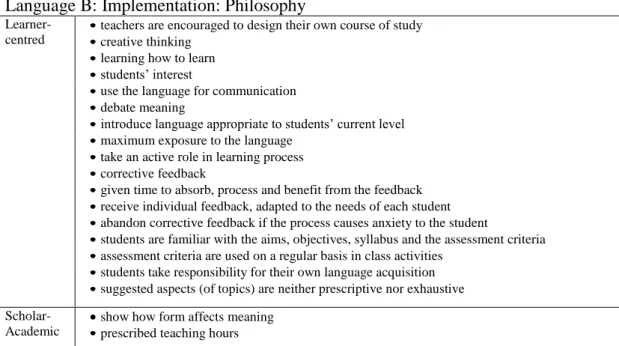
IBDP: Language B ... 61 Language B: Philosophy ... 61 Language B: Intent... 63 Language B: Assessment ... 65 Language B: Content ... 68 Language B: Design... 72 Language B: Implementation... 72
Advanced Placement Program ... 75
AP overview ... 75
AP overview: Evaluation ... 78
AP English ... 78
AP: English language and composition ... 80
AP English language and composition: Philosophy ... 80
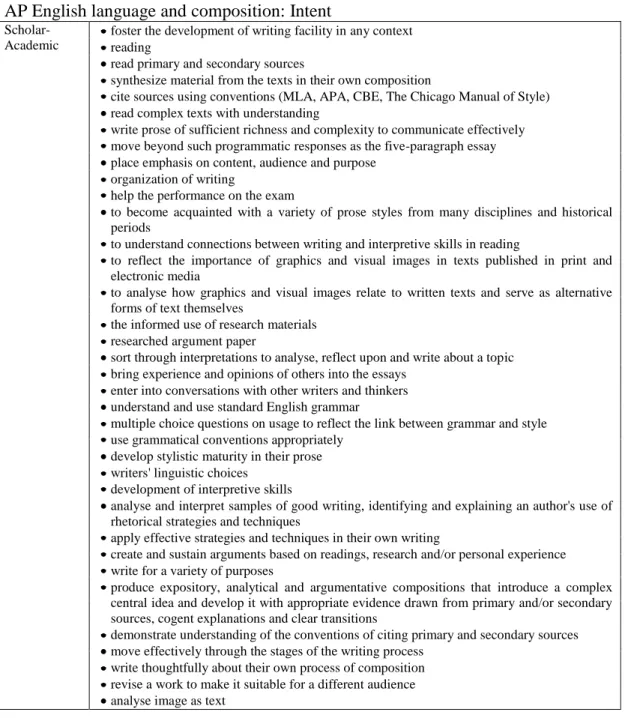
AP English language and composition: Intent ... 81
AP English language and composition: Implementation ... 83
ix
AP English language and composition: Content ... 84
AP English language and composition: Assessment ... 85
AP: English literature and composition ... 86
AP English literature and composition: Philosophy ... 87
AP English literature and composition: Intent ... 88
AP English literature and composition: Implementation ... 88
AP English literature and composition: Design ... 89
AP English literature and composition: Content ... 89
AP English literature and composition: Assessment ... 92
Turkish Ministry of National Education secondary education English language curriculum ... 93
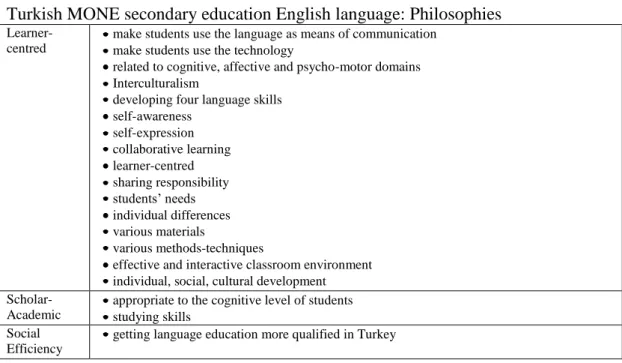
Turkish MONE secondary education English language: Philosophy ... 93
Turkish MONE secondary education English language: Intent ... 95
Turkish MONE secondary education English language: Implementation ... 96
Turkish MONE secondary education English language: Design ... 99
Turkish MONE secondary education English language: Content ... 100
Turkish MONE secondary education English language: Assessment ... 104
Turkish MONE secondary education English language: Evaluation ... 107
CHAPTER 5: DISCUSSION ... 108
Introduction ... 108
Overview of the study ... 108
x Educational philosophies ... 109 Intent ... 112 Content ... 112 Approaches to design ... 116 Approaches to implementation ... 117 Approaches to assessment ... 119 Approaches to evaluation... 121
Implications for practice ... 122
Implications for further research ... 123
Limitations ... 124
xi
LIST OF TABLES
Table Page
1 Weekly language lesson hours for different kinds of high schools ... 23
2 Language levels that are studied at different kinds of high schools ... 24
3 The number of themes and topics that are taught in each level ... 26
4 Sample Microsoft Word table related to implementation ... 33
5 IBDP overview: Philosophies ... 39
6 IBDP overview: Philosophies regarding assessment ... 40
7 IBDP overview: Evaluation ... 41
8 Language A: Language and literature: Philosophy ... 43
9 Language A: Language and literature: Intent... 45
10 Language A: Language and literature: Intent part focusing on assessment ... 47
11 Language A: Language and literature: Internal and external assessment ... 49
12 Language A: Language and literature: Assessment ... 50
13 Language A: Language and literature: Content Overview: Philosophy ... 54
14 Language A: Language and literature: Design... 57
15 Language A: Language and literature: Implementation: Philosophy ... 58
16 Language A: Language and literature: Approach to Implementation ... 60
17 Language B: Philosophy ... 62
18 Language B: Intent ... 63
19 Language B: Intent part focusing on assessment ... 64
20 Language B: Assessment based on internal and external assessment ... 66
21 Language B: Assessment ... 67
22 Language B: Content overview: Philosophy... 71
xii
Table Page
24 Language B: Implementation: Philosophy ... 73
25 Language B: Approach to implementation ... 74
26 AP overview: Philosophies ... 75
27 AP overview regarding assessment: Philosophies ... 76
28 AP overview regarding design: Philosophies ... 77
29 AP overview regarding implementation ... 77
30 AP overview: Evaluation ... 78
31 AP English overview: Philosophies ... 79
32 AP English language and composition: Philosophies ... 81
33 AP English language and composition: Intent ... 81
34 AP English language and composition: Approach to implementation ... 83
35 AP English language and composition: Design ... 84
36 AP English language and composition: Assessment ... 86
37 AP English literature and composition: Philosophies ... 87
38 AP English literature and composition: Intent ... 88
39 AP English literature and composition: Approach to implementation ... 88
40 AP English literature and composition: Design ... 89
41 AP English literature and composition: Assessment ... 92
42 Turkish MONE secondary education English language: Philosophies... 94
43 Turkish MONE secondary education English language: Intent ... 95
44 Turkish MONE secondary education English language: Implementation: Philosophy ... 97
45 Turkish MONE secondary education English language: Approach to implementation ... 98
xiii
Table Page 46 Turkish MONE secondary education English language: Language proficiency
levels and the number of themes and topics ... 100
47 Turkish MONE secondary education English language: Themes and suggested topics ... 100
48 Turkish MONE secondary education English language: Language content . 102 49 Topics about Kemal Atatürk, the founder of the Turkish Republic ... 104
50 Turkish MONE secondary education English language: Assessment overview: Philosophies ... 105
51 Turkish MONE secondary education English language: Assessment ... 106
52 Turkish MONE secondary education English language: Evaluation ... 107
xiv
LIST OF FIGURES
Figure Page 1 Sample Microsoft Excel analysis worksheet... 33
1
CHAPTER 1: INTRODUCTION Introduction
A number of international educational organizations offer international curricula, allowing schools to use external benchmarks to measure their performance. Included in these international educational programmes are International Baccalaureate Diploma Programme (IBDP), International Baccalaureate Middle Years Programme (IBMYP), International Baccalaureate Primary Years Programme (IB PYP) and Advanced Placement (AP). International Baccalaureate (IB) programmes are
implemented in 50 schools (June, 2014) in Turkey, and AP Programs are used in 11 schools (June, 2014). In most cases, these programmes are administered along with the national educational programme. The focus of this research is to compare and contrast the English language curricula in the Turkish Ministry of National Education (MONE), IBDP, and AP.
This chapter provides information about the International Baccalaureate Diploma Programme (IBDP), Advanced Placement (AP) and the national curriculum of the Turkish Ministry of National Education (MONE). The chapter proceeds with the problem, the purpose of the research, the research question and the significance of the research. The chapter ends with the definitions of some key terms.
The international educational programmes provide learners with an internationally recognized diploma or exam score. For instance, “more than 90 percent of four-year colleges and universities in the United States grant students credit, placement or both
2
on the basis of successful AP exam scores” (College Board, 2010, p. 1). As for IB, there are IB schools in 145 countries (IBO, 2013). The graduates of IBDP schools have internationally recognized high school diplomas. For this reason, some schools in Turkey offer these international educational programmes as well.
Background
There are a number of international educational programmes that are implemented in some high schools along with the curriculum of the Ministry of National Education (MONE) in Turkey. Some of these programmes are International Baccalaureate Diploma Programme (IBDP), and Advanced Placement (AP).
International Baccalaureate Diploma Programme-English
The International Baccalaureate Organization is a non-profit educational foundation founded in 1968 (IBO, 2014). It offers programmes at primary, middle and high school levels to 3848 schools in 148 countries. The programmes are Primary Years Programme (PYP), Middle Years Programme (MYP), and Diploma Programme (DP). There are 50 (June, 2014) IB schools in Turkey. Thirty five of these schools offer IBDP. All of these schools offer the DP together with the curriculum of Turkish MONE with the exception of two schools. These two schools are Bilkent
International Laboratory School (BLIS) and Bilkent Erzurum Laboratory High School (BELS). These laboratory schools are allowed to implement the IBDP only.
The IBDP is a two-year pre-university course for learners at the ages of 16-19 (IBO, 2011b). The programme aims to prepare learners for their higher education. “The aim of all IB programmes is to develop internationally minded people who,
3
recognizing their common humanity and shared guardianship of the planet, help to create a better and more peaceful world” (IBO, 2011b). The IBO has defined a learner profile to reach this aim. According to this learner profile, the IB programmes aim to raise people who are inquirers, knowledgeable, thinkers, communicators, principled, open-minded, caring, risk-takers, balanced, and reflective.
The curriculum of the programme includes six academic areas with a central core. The academic areas are: group one-studies in language and literature, group two- language acquisition, group three- individuals and societies, group four- sciences, and group five- mathematics, and group six- the arts. Learners are required to select one subject from each academic area. They can select a second subject from groups one to five instead of a sixth group subject. Learners are also required to complete the core subjects of the curriculum to get the diploma. The core subjects are theory of knowledge (TOK); extended essay (EE); and creativity, action, service (CAS).
Group one subjects are: Language A- literature, Language A- language and
literature, and Literature and performance (IBO, 2011a).
All three courses are designed for students who have experience of using the language of the course in an academic context…Group 1 courses are designed to support future academic study by developing a high social, aesthetic and cultural literacy, as well as effective communication skills. (IBO, 2011a, p. 4)
Group two subjects are two modern languages and a classical languages course (IBO, 2011b). The modern languages courses are Language ab initio and Language
B. These courses are provided in a variety of languages.
Language ab initio and language B are language acquisition courses designed to provide students with the necessary skills and intercultural understanding to enable them to communicate successfully in an environment where the language studied is spoken…The classical languages course focuses on the study of the language, literature and culture of the classical world. (IBO, 2011b, p. 4)
4 Advanced Placement-English
The Advanced Placement (AP) Program is designed by the College Board. The College Board was founded in 1900 (College Board, 2013). It is a non-profit educational organization. It aims to provide high school learners an equal chance to be academically prepared for their college level studies. There are 11 schools (June, 2014) in Turkey which implement the AP along with the curriculum of Turkish MONE.
The AP Program offers more than 30 courses in a wide variety of subject areas (College Board, 2010). The AP teachers are required to develop their own course syllabus. The AP Program provides AP teachers with a set of expectations that must be fulfilled while preparing the course syllabus. AP exams are an essential part of the AP Program if learners want to demonstrate their mastery of college-level work. The placement and credit policies to attend colleges are decided by each college
separately. There is not a certain set of criteria that is prescribed by the College Board. Therefore, learners are expected to read the placement and credit policies of the colleges that they want to attend to decide which AP courses and exams to take.
The AP Program offers two parallel exams in English. One of them is in Language
and Composition and the other one is in Literature and Composition. Consequently,
two courses are designed for these exams. “The purpose of the AP English Language and Composition course is to enable students to read complex texts with
understanding and to write prose of sufficient richness and complexity to
communicate effectively with mature readers” (College Board, 2010, p.7). The aim of the AP Literature and Composition course is to study “representative works from
5
various genres and periods concentrating on works of recognized literary merit…” (College Board, 2010, p. 49).
Ministry of National Education-English
The MONE English language curriculum is implemented in different kinds of high schools in Turkey (TTKB, 2011). These high schools are categorized as Anatolian high schools, non-Anatolian high schools, and high schools with preparatory classes in terms of their weekly language lesson hours. The language proficiency levels are based on the Common European Framework of Reference (CEFR). They are defined as A1, A2, B1, B2, C1, and C2. The objectives are defined for each language level in terms of four language skills. The curriculum also defines 22 themes with their suggested topics. The number of themes and topics that should be studied at each language level is also stated in the curriculum guide.
This research focuses on how the English language curriculum of Turkish MONE compares and contrasts with the English language curricula of international
programmes implemented in Turkey. The comparison is based on their educational philosophies. There are four major educational approaches described by Ornstein and Behar-Ornstein (1999). These are Perennialism, Essentialism, Progressivism, and
Reconstructionism. Perennialism and Essentialism are regarded as traditional
philosophies while Progressivism and Reconstructionism are regarded as
contemporary ones. Schiro (2008, p.1) further conceptualizes these “four visions” under the following four curriculum ideologies, or philosophies: Scholar-Academic,
Social Efficiency, Learner-Centered and Social Reconstruction. “An ideology is a
6
worldview that embodies the way a person or a group of people believes the world should [be] organized and function” (p.8). Each of these visions, philosophies, or ideologies has its own distinctive belief system concerning intent, content, design, implementation, assessment and evaluation.
Problem
There are a number of international programmes that are offered at some high schools along with the MONE curriculum in Turkey. Few studies have compared and/or contrasted such international curricula with the national curricula in Turkey. Saglam (2012) made a comparative analysis of quadratics in mathematics textbooks in Turkey, Singapore, and the IBDP. Yilmaz (2005) focused on comparing MONE high school one to three Biology curricula and IB Biology curriculum. Cam-Aktas (2013) made a comparison of mother tongue teaching courses in the IBDP and Turkish MONE program in terms of critical thinking skills. Nevertheless, there is not any research comparing the language acquisition curriculum of IB with the English language curriculum of Turkish MONE. While there is a limited number of research on IB, there is no research conducted on AP in Turkey. Therefore, there is a need in Turkey to conduct a comparative analysis with reference to the curricula of IB and AP and the curriculum of MONE.
Purpose
There are a number of international educational programmes that are implemented in high schools in Turkey such as IBDP and AP. These programmes are implemented along with the curriculum of Turkish MONE except for two laboratory schools in Ankara and Erzurum. There is a growing interest in these programs in Turkey, and
7
there is a need to know more about them, and how they compare and contrast with the MONE curriculum.
The purpose of this research is to use Schiro’s four curriculum ideologies as lenses for exploring the similarities and differences between the MONE English language curriculum, and the English language curricula of AP and IBDP. It is also the intention of this study to compare and contrast the English language curricula with regard to the following aspects of curriculum embedded in each ideology: intent, content, design, implementation, assessment and evaluation embedded.
Research question
How does the Turkish MONE English language curriculum for high schools compare and contrast with the English language curriculum in the International Baccalaureate Diploma Programme (IBDP), and Advanced Placement (AP)?
Significance
This study provides an insight into the similarities and differences between the English language curriculum of Turkish MONE and the English language curricula of IBDP and AP, which are implemented in some high schools in Turkey. This research is beneficial for researchers in their future studies in terms of producing a framework to compare and contrast the language curricula of different educational programmes. It is also beneficial for teachers who implement any of the international curricula and the national curriculum in Turkey in terms of identifying and
understanding the educational philosophies of these educational programmes. The research is most beneficial for curriculum developers of MONE, IBDP, and AP. They may find the research useful when they want to revise their curricula in
8
comparison with the other educational programmes that are implemented in the same context.
Definition of key terms
International Baccalaureate: The International Baccalaureate Organization is a non-profit educational foundation founded in 1968 (IBO, 2014). It offers programmes at primary, middle and high school levels to 3612 schools in 145 countries.
Diploma Programme: The International Baccalaureate Organization offers programmes at primary, middle, and high school levels (IBO, 2014). These programmes are Primary Years Programme (PYP), Middle Years Programme (MYP), and Diploma Programme (DP). The Diploma Programme is offered at high school level.
Advanced Placement: The Advanced Placement Program is designed by the College Board (College Board, 2013). It aims to provide high school learners an equal chance to be academically prepared for their college level studies. The programme offers more than 30 courses in a wide variety of subject areas (College Board, 2010).
Language A: The International Baccalaureate Diploma Programme has a curriculum composed of six academic areas (IBO, 2011a). The first one of these areas is
language and literature. Language A is the common name of the courses in this area. Language A refers to the language that learners have experienced in an academic context.
9
Language B: The International Baccalaureate Diploma Programme has a curriculum composed of six academic areas (IBO, 2011b). The second one of these areas is language acquisition. Language B is the common name of the courses in this area. Language B refers to the language that learners learn as a second or foreign language.
Common European Framework of Reference (CEFR): It is a framework of reference of language levels designed by the Council of Europe (Council of Europe, 2013). It was designed to provide a transparent system of teaching and assessing a foreign language. It describes foreign language proficiency in six levels: A1, A2, B1, B2, C1, and C2. It is mostly used in Europe, but it is also available in other continents.
10
CHAPTER 2: REVIEW OF RELATED LITERATURE Introduction
The aim of the study is to analyse English language curricula of three educational programmes comparatively. The curricula selected to analyse are the English language curriculum of the Ministry of National Education (MONE) in Turkey, IBDP English language curriculum, and AP English language curriculum. This chapter provides brief information about major educational philosophies, Schiro’s corresponding curriculum ideologies, and an overview of the three selected curricula.
Major educational philosophies
Ornstein and Behar-Ornstein (1999) categorized educational philosophies into two main types: traditional philosophies and contemporary philosophies. Traditional philosophies include Perennialism and Essentialism while contemporary
philosophies mainly focus on Progressivism and Reconstructionism.
According to Ornstein and Behar-Ornstein (1999), traditional philosophies:
are concerned with past and cultural heritage, and fixed and absolute values. emphasize the subject matter.
regard learners as minds and wish to fill them with knowledge. give more importance to some subject matters.
view the teachers as the authority figure that puts the rules and lectures. view education as a means of maintaining the current social pattern.
Contemporary philosophies, on the other hand: focus on the present and the future.
regard facts and events as relative. There are not fixed and absolute values. emphasize problem solving abilities.
11
give equal importance to most of the subject matters. They consider subject matters as a medium to teach skills and attitudes.
view the teacher as a facilitator who guides learners.
believe in individual modifying and even social reconstruction.
Perennialism
Perennialism is called as Scholar Academic Ideology by Schiro (2008). According to
the ScholarAcademic Ideology formal education is a process through which children become good citizens. It is a way of acculturating children into society. Curriculum is created according to the academic disciplines in this educational approach. The claim is that curriculum must both convey the knowledge of academic disciplines and the way of thinking of the academicians. According to this approach academic discipline knowledge is of primary importance while society, learner, and learning processes are of secondary importance.
Schiro (2008) stated that the intent of the Scholar Academics is to extend the
academic disciplines by transmitting their essence to students. Accordingly academic disciplines are of first importance, whereas society, learner, and learning processes come later in the ScholarAcademic Ideology. Child is regarded as a mind and the aim of education is to cultivate the mind. Education should transmit the academic
discipline knowledge to learners in such a way that knowledge ends up in their minds.
Schiro (2008) claimed that the content of education in the Scholar Academic
Ideology is the knowledge that academic disciplines contain. Education is seen as an
extension of academic disciplines. School subjects are defined as academic disciplines in the Scholar Academic Ideology. That kind of classification of school
12
subjects makes it easy to claim that the Scholar Academic Ideology has subject-centred curriculum designs. As cited in Ornstein and Hunkins, a subject-subject-centred curriculum includes: “(1) language and its uses (reading, writing, grammar,
literature); (2) mathematics; (3) sciences; (4) history; (5) foreign languages” (p. 247). That kind of organization also assumes that the teacher has an active role and lecture, recitation, and large group discussions are major instructional techniques.
Curriculum creation consists of four steps in the Scholar Academic Ideology (Schiro, 2008). The first one is that the knowledge exists in the objective reality. Then
academicians discover it. Curriculum developers decide to include it in the curriculum and thus it is transmitted into students’ minds through instruction. Therefore, the teacher is expected to obey strictly to the curriculum guide in instruction period. This kind of approach in implementation of curricula is called fidelity approach (Colin & Willis, 2007). Fidelity approach in implementation “treats teachers as passive recipients of the wisdom of the curriculum developers” (p. 223).
Gronlund and Waugh (1998) defined two major types of assessment methods. Those were testing and performance assessments. Testing referred to traditional paper -and- pencil tests. Linn and Gronlund (2000) stated that performance assessments were also called as authentic assessment or alternative assessment although there is a difference between the usages of these terms. Linn and Gronlund (2000) disclose the difference as “Alternative assessment highlights the contrast to traditional paper-and-pencil tests; authentic assessment emphasizes the practical application of the tasks in real world setting” (p. 260). Therefore, they declared that preferred to use the term
13
performance assessment to be more descriptive and less pretentious. Thus,
performance assessment is used to refer to non-traditional assessment in this research
as well.
Gronlund and Waugh (1998) state that an objective test is used to measure
knowledge of how to drive while performance assessment is used to measure driving skills in practice. While contrasting traditional and contemporary educational
philosophies, one may claim that traditional philosophies put emphasis on acquiring knowledge, whereas contemporary philosophies put emphasis on skills and attitudes. Traditional philosophies mostly favour paper-and-pencil tests while contemporary philosophies prefer performance assessment. Traditional tests include multiple choice, true-false, matching items, and short answer questions. The Scholar
Academic Ideology generally uses those assessment types.
The scientific-positivistic curriculum evaluation model which was developed between 1933 and 1941 are organized in seven sequential steps (Ornstein &
Hunkins, 2004): “focusing on the goals and objectives of the programme, classifying objectives, defining objectives in behavioural terms, finding situations in which achievements can be shown, developing or selecting measurement techniques,
collecting student performance data, and comparing data against objectives” (p. 340). The statement presents that the objectives are defined in behavioural terms to
evaluate curricula with scientific-positivistic evaluation model. Ornstein and Behar-Ornstein (1999) claim that changing behaviour is important in traditional educational philosophies since learning conforming behaviours are important for the good of society. Therefore, the objectives of traditional philosophies are written in terms of
14
acquired behaviours, which means the Scholar Academic Ideology is appropriate to be evaluated by scientific-positivistic evaluation model.
Essentialism
According to Ornstein and Behar-Ornstein (1999), Essentialism is based on Idealism and Realism. It aims to teach skills which are needed in adult life. It focuses on academic subjects and explicit teaching. Schiro (2008) regarded Essentialism as
Social Efficiency Ideology. Schiro also noted that according to this educational
philosophy, education prepares children for adult life. Education is a process of changing behaviour of learners so that they can confirm society. Education is a means of social progress. The philosophy adopts behaviourism as its main learning theory. Therefore, the objectives are described as observable skills and behaviour. These objectives are mainly performances that are needed in the adulthood. Learning takes place through active participation and experience, so learners have to carry actions themselves in their learning processes.
Bobbitt, as cited in Schiro, made an analogy between the Social Efficiency Ideology and a factory, which reflected the working of schools according to the Social
Efficiency Ideology.
The school is a factory. The child is the raw material. The adult is the finished product. The teacher is an operative, or factory worker. The curriculum is
whatever processing the raw material…The curriculum developer is a member of the research department who investigates what the consumer market
(society) wants in terms of a finished product and finds the most efficient way of producing that finished product. (2008, p. 59)
The intent of the Social Efficiency Ideology is to prepare people to operate productively in adult life (Schiro, 2008). According to this philosophy, education
15
has two basic functions in society: (1) continuing the functioning of society, (2) preparing individuals to lead a meaningful and productive adult life in society. The primary aim of the Social Efficiency Ideology is to form a future society superior to the existing one. As it was quoted in Schiro, Gagne stated that:
It is this social organization that must transform the highly dependent young children into the adult who, in his own individual manner, lives a life that is
satisfying to himself largely because it contributes to the goals of his society. (2008, p.63)
Knowledge is behaviour and skills in the Social Efficiency Ideology (Schiro, 2008). These skills should be observable. For this reason, the focus is on the possession of observable behaviour. In this respect, only active learners are thought to be
successful learners.
The Social Efficiency Ideology is appropriate for adaptation of fidelity approach or mutual adaptation approach in implementation. In mutual adaptation “adjustments are made to both the innovative curriculum and the institutional setting” (Colin & Willis, 2007, p. 225). Since 1970s, some researchers have argued that mutual
adaptation is the most effective way to implement a new curriculum. It represents an agreement between the curriculum developers and the users. As the Social Efficiency
Ideology does not have strict rules of following the contents of an academic subject
like the Scholar Academic Ideology does, it is appropriate to adopt either fidelity approach or mutual adaptation approach.
The Social Efficiency Ideology defines two key concepts in assessment which are accountability and standards (Schiro, 2008). Standardized tests are used as evidence of success or failure. These tests certify if students are qualified enough to graduate
16
from school or to enter another school. Gagne, as it is quoted in Schiro, asserts that the purpose of assessment according to the Social Efficiency Ideology is compare students’ performance with an external standard which represent the defined objectives of the curriculum. In other words, the Social Efficiency Ideology reveals an approach in favour of traditional paper-and- pencil tests.
Standardized tests are used to evaluate the success of the curriculum in the Social
Efficiency Ideology (Schiro, 2008). The standardized test scores determine the
educational success of students, which is an indication of the success of the
curriculum. The standardized tests determine if the defined objectives are reached. The scientific- positivistic curriculum evaluation model also focuses on the
objectives of the educational programme, defines them in behavioural terms, and compares the data about student achievement against the defined objectives (Ornstein & Hunkins, 2004). On that account, one can claim that the Social
Efficiency Ideology adopts the scientific- positivistic curriculum evaluation model.
Progressivism
According to Walker and Soltis (2004), Progressive education, which meant the opposite of traditional education, began to take shape between 1875 and 1950s in the United States. They claim that although progressive education movement is seen as a single entity, there are varied views about it. Some regard it as a more scientific approach to education while some others regard it as a way of social reforms. Furthermore, some others believe in the importance considering the child’s feelings in education. Ellis (2004) also treats Progressivism as an umbrella term which means the opposite of traditional as well. Schiro (2008) prefer to use Learner-Centred
17
Ideology to refer to the ideology which considers the needs of learners as of first
importance. Learner-Centred Ideology is used in this study in order not to allow for any conceptual confusion by using the umbrella term of Progressivism.
According to Ornstein and Behar-Ornstein (1999) the Learner-Centred Ideology is based on Pragmatism. It aims to improve social life. It focuses on development and life-long learning. There is a focus on active learning as well. According to the
Learner- Centred Ideology, the needs and interests of learners are of primary
importance, rather than those of others like teachers, parents, principals, and school subjects (Schiro, 2008). The approach adopts constructivism as the main learning theory. On that account, it claims that learning is a result of meaning making process that a child has. Accordingly, experience is the medium that a child can learn. The role of the teacher is not teaching, but diagnosing and facilitating learning and growth. Teaching consists of three steps: (1) observation of students’ needs and interests, (2) creating physical, social, emotional, intellectual learning environment, (3) facilitating growth. As learning is a meaning making process, knowledge is unique to individuals. For that reason, learning objectives are not expressed in terms of knowledge, but in terms of experiences that learners will have.
The intent of the Learner-Centred Ideology is to help learners to create meaning for themselves (Schiro, 2008). The ideology has a holistic view of education. It regards learners as whole people with their intellectual, social, psychological, and physical needs. Therefore, the aim of education is to develop learners in all these aspects. Children are regarded as different than adults and they are treated differently.
18
There is not a certain set of knowledge that must be learnt according to the
Learner-Centred Ideology (Schiro, 2008). Individuals construct meaning in their unique ways
through their personal interaction with their environment; therefore, interaction with peers and adults is important in learning. There is an interdisciplinary approach to knowledge. Separate school subjects are rejected. Experience is the medium of learning in this ideology. Accordingly, an ideal school is a school full of activity. Many different activities go on simultaneously in these schools.
Learner-centred curriculum design is employed in the Learner-Centred Ideology. In this ideology, students are independent, and are trusted and treated as responsible people (Schiro, 2008). Curriculum developers, therefore, create curriculum in such a way that learner autonomy is preserved, and also learner growth is achieved. Their curriculum has also an interdisciplinary approach. Ornstein and Hunkins (2004) state that advocates of learner-centred design believe in optimum learning when learners are active in the learning environment. They claim that a curriculum should be based on learners’ needs and interests. According to Ornstein and Hunkins, this view also puts this approach in the constructivist camp, which advocates learners’ active participation and constructing their own meaning.
As regards to implementation, curriculum enactment approach is adopted in the
Learner-Centred Ideology. Synder, Bolin, and Zumwalt (as cited in Pinar, Reynolds
& Slattery, 1996) define curriculum enactment as:
Externally created curricular materials and programmed instructional strategies at the heart of the fidelity and mutual adaptation perspectives are seen as tools for students and teacher to use as they construct the enacted experience of the classroom. (p. 701)
19
As the Learner-Centred Ideology gives importance to learners’ needs and interests, it requires implementing the curriculum by making an agreement with learners. As a consequence, the Learner-Centred Ideology adopts the curriculum enactment approach in implementation. As the mutual adaptation approach allows making an agreement with the curriculum developers and the users, it is also an appropriate implementation approach for the Learner-Centred Ideology.
The Learner-centred Ideology suggests that teachers continually assess students’ development (Schiro, 2008). It is a way to define students’ needs and facilitate learning. The ideology is opposed to standardized testing for it includes questions whose answers are either right or wrong. It mostly measures students’ ability to recall things like when Columbus discovered America. However, the
Learner-centred Ideology is not interested in memorizing knowledge, but in constructing
knowledge in one’s unique context. For this reason, the Learner-centred Ideology describes students’ performance through performance assessment. Portfolio assessment, teacher observation notes, teacher diaries, developmental checklists, learning logs and journals, student self- assessment and student peer assessment play an important role in the assessment approach of the Learner-centred Ideology.
Humanistic and naturalistic curriculum evaluation models developers believe that “evaluators [of the scientific- positivistic evaluation model]have become too much concerned with observing or measuring specific behavioural objectives” (Ornstein & Hunkins, 2004, p. 345). This new approach to evaluation supports the idea that evaluators personally involve in arguing the values of the new programmes and cases with colleagues. Contemporary educational philosophies do not define the objectives
20
of curricula in terms of behaviours. In these philosophies, there is a shift from behaviourism to constructivism. On that account, the Learner-Centred ideology is more appropriate for humanistic and naturalistic evaluation models.
Reconstructionism
According to Ornstein and Behar-Ornstein (1999) Reconstructionism is based on
Pragmatism as well. It aims to reconstruct society. There is a focus on skills and
subjects needed to solve problems of society. Schiro (2008) called Reconstructionism as Social Reconstruction. According to Schiro, the Social Reconstruction Ideology has two basic assumptions: society is unhealthy and education can save society from destroying. The Social Reconstruction Ideology deems education is a means of reconstructing society and schools as places that an action can be initiated the
reconstruction. Although society is of primary importance, individuals are not totally ignored. Individual is also important since individuals create society and society creates individuals. It is seen as a cyclical process. For that reason, individuals must reconstruct themselves to reconstruct society. Learners are members of society and the role of education is to guide them in a way that they can contribute to the functioning of good society. This philosophy adopts constructivism as its main learning theory like the Learner-centred Ideology does. Learning is a process of meaning making and learners learn through experience. Discussions are the other main instructional methods.
The intent of the Social Reconstruction Ideology is to eliminate the undesirable aspects from the culture and to substitute them with the desirable ones (Schiro, 2008). Children are regarded as products of society. If children are reshaped, society
21
can be reshaped. Thus, schools are places to initiate social reconstruction. Learners are viewed as meaning-makers and active learners. As a result, experience and interaction with the environment are considered to be important in learning.
The Social Reconstruction Ideology questions the categories of academic disciplines that are studied at schools (Schiro, 2008). According to this ideology, knowledge is interdisciplinary in nature. As the main aim of the philosophy is to solve problems the society faces, knowledge of various academic disciplines is respected to be useful to solve the problems. Therefore, the Social Efficiency Ideology asserts that the objective of the learning process is to reach a consensus upon which the group can act to reconstruct society.
The Social Reconstruction Ideology mainly adopts problem-centred curriculum designs. According to this ideology, the society is threatened by many problems such as political corruption, sexism, poverty, pollution, and worker exploitation (Schiro, 2008). The intent is to educate people to reconstruct the current society superior to the existing one. For this reason, problem-solving skills of individuals should be developed to overcome the existing problems in the society.
The Social Reconstruction Ideology aims to reconstruct culture so that the material, social, cultural and spiritual needs of the members of the society are met (Schiro, 2008). As the needs of the members of the society are considered in the Social
Reconstruction Ideology, curriculum enactment seems an appropriate approach for
implementation. Curriculum enactment permits students and teachers to utilize educational tools to construct their own enacted experience. On that account,
22
curriculum enactment allows forming the curricula in accordance with the need of the society.
The primary concern of the Social Reconstruction Ideology in terms of assessment is “How does curriculum z or student y measure up to standard in a particular
circumstance?” (Schiro, 2008, p. 172). It is because of the fact that the circumstances in which social crises are faced are continually in change. As a consequence, the
Social Reconstruction Ideology believes in the validity of assessment made in
real-life situations. Therefore, student assessment is taken outside of school. Accordingly, it can be inferred that the Social Reconstruction Ideology mostly favours
performance assessment.
As the Social Reconstruction Ideology adopts constructivism as its main educational approach, it does not define the objectives of curricula in behavioural terms (Schiro, 2008). As a result, it discards the scientific-positivistic evaluation model which compares data obtained from students’ performance against pre-defined behavioural objectives. In this respect, the humanistic and naturalistic curriculum evaluation model seems to be more appropriate for the Social Reconstruction Ideology. This respectively new evaluation model advocates that evaluators discuss the values and experiences of an educational programme with their colleagues (Ornstein &
23
Overview of selected English language curricula Overview of Turkish Ministry of National Education English language curriculum
The Ministry of National Education (MONE) high school English language curriculum is implemented in different kinds of high schools in Turkey (TTKB, 2011). These high schools are Anatolian High Schools, Non-Anatolian High Schools, Anatolian High Schools with prep classes, Science High Schools, Social Sciences High Schools, Arts and Sports High Schools, Religion High Schools, Religion High Schools with prep classes, Anatolian Teacher Education High Schools, Medical Vocational High Schools, Anatolian Medical Vocational High Schools, Technical High Schools, and Anatolian Technical High Schools. These high schools are classified according to their language learning hours into 3 categories: (1) Non-Anatolian High Schools, (2) Anatolian High Schools, (3) high schools having prep classes. Table 1 shows the weekly foreign language lesson hours for different kinds of high schools (TTKB, 2013).
Table 1
Weekly language lesson hours for different kinds of high schools
Grades Non-Anatolian Anatolian With prep classes
Prep: 20 hours
Grade 9: 3 hours 6 hours 6 hours
Grade 10: 2 hours 4 hours 4 hours
Grade 11: 2 hours 4 hours 4 hours
Grade 12: 2 hours 4 hours 4 hours
The table shows that Non-Anatolian high schools have 2-3 lesson hours for English language education while Anatolian high schools have twice as many lesson hours in their weekly schedules. High schools with prep classes have the same amount of
24
language lesson hours with Anatolian high schools. They have, however, one year of preparatory language education with 20 lesson hours per week.
The curriculum is based on the language levels of Common European Framework Reference (CEFR), which are defined as A1, A2, B1, B2, C1, and C2 (TTKB, 2011). The objectives for each level are given in tables in terms of four language skills. The language levels of A1, A2, B1, B2, C1, and C2 are divided into smaller units as A1.1.1 and A1.1.2 in the curriculum guide to be able to identify the objectives more precisely for each level. If schools have enough classrooms and teachers, they give a pre-test to students starting grade 9 to understand students’ level of readiness for language learning at the beginning of each school year. The test is based on the objectives of levels A1 and A2. Students having 60 out of 100 for each language level can continue with the higher level. So, students can, at most, begin with level B1. Table 2 shows language levels that are studied at different kinds of high schools.
Table 2
Language levels that are studied at different kinds of high schools
Grades Non-Anatolian Anatolian With prep classes
Starts with: A1
Prep: A1-B1.1.2
Grade 9: A1.1.1-A1.1.2 A1.1.1-A1.2.3 B1.1.3-B1.1.8 Grade 10: A1.2.1-A1.2.2 A2.1.1-A2.1.4 B1.2.1-B1.2.4 Grade 11: A1.2.3-A2.1.1 A2.2.1-A2.2.4 B1.2.5-B1.2.8 Grade 12: A2.1.2-A2.1.3 A2.3.1-A2.3.4 B2.1.1-B2.1.4
Total lesson hours 324 648 720+648
Starts with: A2
Prep: A2-B1.1.8
Grade 9: A2.1.1-A2.1.3 A2.1.1-A2.2.2 B1.2.1-B1.2.6 Grade 10: A2.1.4-A2.2.1 A2.2.3-A2.3.2 B1.2.7-B2.1.2 Grade 11: A2.2.2-A2.2.3 A2.3.3-B1.1.2 B2.1.3-B2.1.6 Grade 12: A2.2.4-A2.3.1 B1.1.3-B1.1.6 B2.1.7-B2.1.10
Total lesson hours 324 648 720+648
Starts with: B1
25 Table 2 (cont’d)
Language levels that are studied at different kinds of high schools
Grade 9: B1.1.1-B1.1.3 B1.1.1-B1.1.6 B2.1.5-B2.1.10 kncdjnc tabbGrade 10: B1.1.4-B1.1.5 B1.1.7-B1.2.2 B2.2.1-B2.2.4 Grade 11: B1.1.6-B1.1.7 B1.2.3-B1.2.6 B2.2.5-B2.2.8 Grade 12: B1.1.8-B1.2.1 B1.2.7-B2.1.2 B2.2.9-C1.1.2
Total lesson hours 324 648 720+648
The table shows that learners who study at Non-Anatolian high schools have 324 total number of lesson hours of English language, while learners at Anatolian high schools have 648 total number of lesson hours. High schools with prep classes have even a higher number of lesson hours. They study English language for 720 lesson hours at prep level. Then, they have 648 lesson hours of English language lesson for the rest of their high school studies. The table also shows that a learner studying at a Non-Anatolian high school can at most study English at B1.2.1 level. A learner studying at an Anatolian high school can at most study English at B2.1.2 level. A learner studying at a high school with prep class can at most study English at C1.1.2 level. This means none of the high school students in Turkey can study English at C2 level.
The curriculum contains a table (Table 3) which shows 22 themes and suggested topics for each theme. Any theme from that table can be chosen according to the objectives of each language level (TTKB, 2011). Suggested topics are not
compulsory to use. The themes are: Individual and Society, Values, Education, Jobs, Dreams and Plans, Youth, Sports, Personality, Health and Nutrition, Environment and Nature, Communication, History, Tourism, Our Country, Our World, Feelings, Art, Science and Technology, Economics, Design, Success and Failure, Security. The table below shows the number of themes and topics that are taught at each level.
26 Table 3
The number of themes and topics that are taught in each level
Language Level Number of Themes Number of Topics
A.1.1 6 themes 18 topics
A.1.2 6 themes 18 topics
A.2.1 8 themes 24 topics
A.2.2 8 themes 24 topics
A.2.3 8 themes 24 topics
B.1.1 8 themes 24 topics
B.1.2 8 themes 24 topics
B.2.1 10 themes 30 topics
B.2.2 10 themes 30 topics
C.1.1 --- ---
The learners studying English at A.1.1 and A.1.2 levels are expected to cover six themes and 18 topics. Learners studying English at A.2.1, A.2.2, A.2.3, B.1.1, B.1.2 levels are expected to cover eight themes and 24 topics. Learners studying English at B.2.1and B.2.2 levels are expected to cover 10 themes and 30 topics. The curriculum guide does not include any explanation about the number of themes and topics that are expected to be covered at the level of C.1.1.
Overview of International Baccalaureate Diploma English language curriculum The International Baccalaureate Organization was founded in 1968 (IBO, 2013). It is a non-profit educational foundation. It offers programmes at primary, middle, and high school levels to 3612 schools in 145 countries. There are 50 (June, 2014) schools in total in Turkey which implement the curricula of the IB at primary years, middle years, and high schools. Thirty five of those schools implement International Baccalaureate Diploma Programme (IBDP).
The IBDP is a pre-university course offered by the IB for learners at the ages of 16 to 19 (IBO, 2011b). It is a two-year programme which prepares learners for higher education. The curriculum of the programme includes six academic areas with a
27
central core. The academic areas are called by group names: Group one is called studies in language and literature, group two - language acquisition, group three - individuals and societies, group four - experimental sciences, group five -
mathematics and computer science, and group six - the arts. Learners are expected to choose one subject from each of those academic areas. They can choose a second subject from groups one to five instead of a group six subject. Courses can be taken at higher level (HL) or standard level (SL). Learners are required to study at least three, at most four subjects at HL. The other subjects are taken at SL. The higher level courses require 240 hours while standard level courses require 150 hours of study. In the core of the curriculum, there are three compulsory subjects. They are theory of knowledge; extended essay; and creativity, action, service (CAS).
Group one subjects are Language A: Literature, Language A: Language and
Literature, and Literature and Performance (IBO, 2011a). The courses of Language A: Literature, and Language A: Language and Literature are available at both SL
and HL while the course of Literature and Performance is available at SL only. The courses are designed for learners who have experienced the language in an academic context. The aim of the courses is to support future academic study of learners through developing a social, aesthetic and cultural literacy along with effective communication skills.
Group two subjects are two modern languages courses and a classical languages course (IBO, 2011b). The modern languages courses are Language ab initio and
28
to enable learners to communicate successfully in the target culture. They also aim at developing intercultural understanding of learners.
Language ab initio course is for learners with no or little previous learning of the
target language (IBO, 2011b). The course is available at SL only. It is organized into three themes: individual and society, leisure and work, urban and rural environment. Each of those themes has a list of prescribed topics as well.
Language B course is designed for learners with some prior knowledge of the target
language (IBO, 2011b). It is available at SL and HL. The core topics of the course are communication and media, global issues, and social relationships. Those are studied at both SL and HL. In addition to those core topics, teachers select from five options at both SL and HL. The options are cultural diversity, customs and traditions, health, leisure, science and technology. Besides, HL learners study two works of literature.
The aim of Classical languages course is to introduce learners to the languages and cultures of ancient Rome and Greece (IBO, 2011b). The course is available at SL and HL. The course is comprised of three parts: study of the language, genre study, and individual study. The courses are designed for learners with some previous learning of the target language and culture.
Overview of Advanced Placement English language curriculum
The Advanced Placement (AP) Program is designed by the College Board, which was formed in 1900 by 12 colleges and universities coming together (College Board,
29
2013). The aim of the board is to prepare all learners for their college years equally. The program is an international one that is offered in 180 countries and territories. There are 11 schools (June, 2014) in Turkey which implement the AP.
The AP Program supports that each individual school develops its own curriculum instead of mandating any curriculum (College Board, 2010). So it provides each AP teacher with a set of expectations that must be fulfilled while preparing the course syllabus. AP teachers are expected to develop their own curriculum and these courses are authorized by the AP Program.
The AP English Development Committee offers two exams in English: one in
Language and Composition and the other one in Literature and Composition
(College Board, 2010). Thus, two courses are designed for these exams. The
Language and Composition course aims at enabling learners “to read complex texts
with understanding and to write prose of sufficient richness and complexity to communicate effectively with mature readers” (p. 7). The aim of the Literature and
Composition course is to study “representative works from various genres and
30
CHAPTER 3: METHOD Introduction
The purpose of this study is to explore how the Turkish MONE English language curriculum for high schools contrasts and compares with the English language curricula in the international programs implemented in Turkey using Schiro’s curriculum ideologies, and the following aspects of curriculum embedded in each ideology: intent, content, design, implementation, assessment and evaluation. This chapter provides information about the research design, and the method of data collection and analysis.
Research design
This study uses content analysis to compare and contrast the Turkish MONE High School English Language Curriculum with the AP English Language curriculum and the IBDP English Language curriculum.
According to Fraenkel and Wallen (2009), content analysis is a technique by means of which researchers gain an insight into human behaviour through an analysis of their communication. It is an indirect way of researching human behaviour. The research is conducted through developing appropriate categories to use for subsequent comparison so that the researcher can illuminate what he or she is investigating. Content analysis is widely applicable in educational research. Some applications of content analysis in educational research involve describing trends in schooling, gaining an insight in how teachers feel about their job, and understanding
31
organizational patterns of a school. The aim of this study is to provide an insight into the English language curricula of IBDP and AP in comparison with the English language curriculum of Turkish MONE. Therefore, content analysis method is preferred for this study to analyse the written English language curricula of these programmes.
Context
There are 35 IBDP schools in Turkey (June, 2014). All of these schools are private schools except for Istanbul Prof. Dr. Mümtaz Turhan Social Sciences High School. These schools implement the IBDP curriculum together with the curriculum of the Turkish MONE. Only two schools are allowed to implement the IBDP curriculum without having to implement the national curriculum alongside. These two schools are Bilkent International Laboratory School (BLIS) and Bilkent Erzurum Laboratory School (BELS). The AP curriculum is implemented in some private high schools including Robert College, TED Istanbul College, Irmak Schools and Hisar Schools. These schools implement the AP curriculum together with the national curriculum as well.
Method of data collection and analysis
Information about each of the following curriculum was collected from the web-sites of the institutions whose curriculum the study explores.
Turkish MONE High School English Language Curriculum IBDP Language A Curriculum
IBDP Language B Curriculum
32
AP English Literature and Composition Curriculum
The researcher used Schiro’s curriculum ideologies (2008) as lenses to analyse the philosophies of the selected curricula, and to describe the following aspects of curriculum embedded in each ideology: intent, content, design, implementation, assessment and evaluation.
To this end, the researcher carefully analysed each curriculum, paying special attention to statements, phrases, words used, within the framework of Schiro’s curriculum ideologies, and the characteristics of the following aspects of curriculum embedded in each ideology: intent, content, design, implementation, assessment, and evaluation.
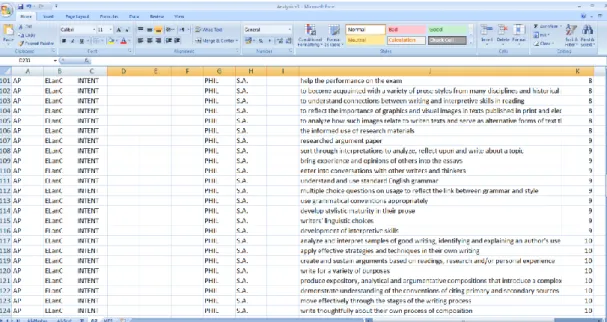
The researcher arranged Microsoft Excel sheets to identify, sift and sort statements, phrases and words with reference to corresponding ideologies, and characteristics of each aspect of curriculum. Figure 1 exemplifies how the researcher arranged the columns of an Excel sheet to analyse data related to the AP Program.
33
Figure 1. Sample Microsoft Excel sheet
To ensure consistency, the researcher checked and verified her choices with her supervisor on a regular basis, making adjustments as necessary. When she finalised the arrangement of spread-sheets, she turned them into tables (Table 4).
Table 4
Sample Microsoft Word table related to implementation
Fidelity teachers will find that certain assessment deadlines will affect the decisions regarding the sequence
teachers should consider the learning outcomes teachers should consider the type and range of texts
teachers should consider the time required for each part of the course …
Mutual Adaptation
teachers are strongly encouraged to design their own course of study by taking into account needs and interests of students and school
should be flexible enough to accommodate students differing linguistic profiles should be flexible enough to accommodate students differing interests should be flexible enough to accommodate students differing talents learning through cross-curricular links to other subjects, especially TOK does not require four parts of the course to be taught in a particular order
a broad range of texts and text types should be included in the study of topics chosen by the teacher
…
Phrases and words identified in relation to Learner-centred Ideology included learner choice; learner needs; learner interests; social, emotional, and spiritual development;
34
learner autonomy; active learning; meaning making; self-evaluation, peer-evaluation; interdisciplinary approach; assessment to facilitate learning; and teacher as a
facilitator.
Phrases and words identified with respect to the Scholar Academic Ideology included intellectual development; academic disciplines; academic needs; academic success; acquiring knowledge; teacher as a transmitter of knowledge; testing to assess academic performance; high-stakes testing; and testing to rank learners.
Phrases and words identified in relation Social Efficiency Ideology included social progress; perpetuating existing social system; learners as members of society; changing behaviour; assessment to determine behaviour change; observable skills; teacher as a supervisor; learning experience; child as a future adult; prepare children for productive adult life; compare learner performance with external standards; and assessment in pass/ fail boundaries.
Phrases and words identified considering Social Reconstruction Ideology included reconstructing society; keep society from destroying; problem-solving; learners as members of society; reconstruct individuals; meaning-making; performance
assessment outside of school; feedback for improvement; and teacher as a colleague.
As for content, the focus was on themes, topics, language content and suggested reading lists.
35
Approaches to design took into consideration the subcategories of three major design types which are subject-centred, learner-centred, and problem-centred designs
(Ornstein & Hunkins, 2004), the subcategories of which are subject design, discipline design, broad fields design, correlation design, process design, child-centred design, experience-child-centred design, romantic (radical) design, humanistic design, life-situations design, and social problems and Reconstructionist design.
Implementation was analysed according to three major implementation approaches:
fidelity approach, mutual adaptation approach and curriculum enactment approach (Pinar, Reynolds, Slattery, & Taubman, 1996).
As regards approaches to assessment, the focus was on performance assessment and traditional assessment (Gronlund &Waugh, 1998).
Finally, approaches to evaluation primarily considered two major evaluation models which are humanistic and naturalistic evaluation models and scientific-positivistic evaluation models (Ornstein & Hunkins, 2004).
36
CHAPTER 4: THE RESULTS Introduction
This study explores the similarities and differences of three educational programmes implemented in Turkey- the Ministry of National Education (MONE) high school English language curriculum, Advanced Placement (AP) English Language curriculum and International Baccalaureate Diploma Programme (IBDP) English language curriculum within the framework of Schiro’s curriculum ideologies, and the following aspects of curriculum embedded in each ideology: intent, content, approach to design, approach to implementation, approach to assessment, and approach to evaluation. This chapter begins with the overview of the IBDP and continues with the IBDP Language A: Language and Literature curriculum, which is followed by the analysis of the IBDP Language B curriculum. Afterwards, the overview of the AP is presented, which is followed by the analysis of AP English
Language and Composition curriculum, and AP English Literature and Composition
curriculum. Finally, the chapter presents the analysis of the Turkish MONE high school English language curriculum.
Programmes at a glance
This study analyses three curricula implemented in Turkey: International
Baccalaureate Diploma Program (IBDP) English language curriculum, Advancement Placement (AP) English language curriculum, and Turkish Ministry of Education (MONE) High School English language curriculum.