IC
ON
A
Volume 4, Issue 1, pp: 34 - 48
DOI: 10.15320/ICONARP.2016120307
ISSN: 2147-9380
available online at: http://iconarp.selcuk.edu.t r/iconarp
na l of A rc hite cture a nd Pl an ni ng
Abstract
According to World Health Organization (WHO), 10% of the population in developed countries and 12% of the population in developing countries are disabled people. And also researches by TUİK, in 2003, 12% of the population in our country are disabled. The problems that are faced in daily life, do not only affect disabled people but also their family. Therefore, it is said to be that half of our population have a disabled life.
According to Scherrer, “Anyone, who has handicaps, is not a disabled person in an accessible place. But healthy person will become disabled in a place without accessibility.” (Scherrer 2001). Accessibility can be provided through the continuity of interrelated daily activities without any interruption. When the connection between the activities breaks off, we cannot mention about accessibility.
Examination of
accessibility for disabled
people at metro stations
Evren Burak Enginöz,
Hilal Şavlı
Keywords:Architecture, Accessibility, disabled, metro
Evren Burak Enginöz, Assoc.Prof.Dr.,
Faculty of Architecture, Istanbul Kultur University
Hilal Şavlı, Architect-graduate student
Institute of Science and Technology, Istanbul Kultur University
35
na l of A rc hite cture a nd Pl an ni ngAccessibility is not only plays an important role on disabled people by providing daily activities and physical requirements without any interruption but also by sustaining to live as independent individuals in society. Therefore, we have to re-design our urban accessibility to achieve uninterruptible and independent daily life in cities.
In our country, disabled people also have difficulties to access indoors and outdoors and also have to face significant problems to be included in daily life despite the current regulations and laws. However, disabled people are entitled to have all social and cultural benefits independently as healthy people do. Realization of this act can be possible, if we re-design our buildings, transportation systems and the city life to achieve the accessibility requirements of disabled people. All around the world and also in our country, various laws, design rules and standards are tried to level the playing field on accessibility for public transportation systems with their service stations. However, despite of ensuring laws, regulations and standards on accessibility, lack of reglementation and enforcements, as well as insufficient user’s knowledge cause our cities inaccessible.
Therefore, we have to increase the awareness of our community on accessible city life and transportation systems rather than make laws and hope for recovery. In this context, a case study is intended to examine the approaches on barrier-free design and level of accessibility at metro stations in Turkey.
With the scope of this case study, current informative, stimulating and guiding regulations, vertical and horizontal implementations on circulation areas at metro stations are examined by an accessible design control list
Accessible design control list consists of 28 questions that have been selected from Turkish Ministry of Family and Social Policies-People with Disabilities and Elderly General Service Accessibility check Lists and Turkish World Handicapped Foundation- Outdoors and Indoors Accessibility Check Lists. With the help of question we can examine the passengers’ expectations on the quality of informative, stimulating and guiding signboards at entrance, circulations and surroundings of metro stations; except the legislations related to the product sizes and constraints that designers or professionals have to obey
The questions are answered by disabled passengers who use Kadıkoy Ayrılık Cesme main transmission metro station. Disabled passengers are divided into two subject groups. First subject group consist of 5 visually impaired and partially impaired people. The second subject group consist of 7 wheelchair users.
Experimentally, asked all the subject groups to make a journey beginning from the entrance of metro station to the train platforms without getting any help. After they completed their journey, they were
na l of A rc hite cture a nd Pl an ni ng
36
requested to answer the questions of control list and describe the positive and negative situations from their experiences.
According to the result of examining the approaches on barrier-free design and the level of accessibility at Ayrılıkcesme main transmission metro station, there are distinctive data detected which are inacceptable accessible solutions for wheelchair users and/or visually impaired people.
In this context, to realize an accessible city life in our country, we have to take some significant decisions on training well-informed professionals, constituting the common shares on standardization of buildings, increasing the community awareness on accessibility and innovating technologies for all disabled groups
INTRODUCTION
According to World Health Organization (WHO), 10% of the population in developed countries and 12% of the population in developing countries are disabled people. And also a research by TUİK, in 2003, 12% of the population in our country is disabled. The problems that are faced in daily life, do not only affect disabled people but also their family. Therefore, it is said to be that half of our population have a disabled life.
Accessibility plays an important role on disabled people by providing physical requirements for daily activities, and also pursuing their independent individual life without being obstructed in society.
Rather than other disabled groups, people with visual disabilities must make an extra effort to insert themselves into society and to participate as citizens in the World around them (Engelbrektsson, 2004) They also have problems acquiring descriptions from relief maps and associating these with their actual positions in real environments (Kulyukin, Gharpure, Nicholson, & Pavithran, 2004).
In everyday life, people who are blind have a series of problems with moving around in both familiar and unknown environments. Specifically, people with visual disabilities have problems using public transportation independently (Baudoin, 2005; Engelbrektsson, 2004).
Too often inclusive transport is not fully considered in transport planning, design, construction and implementation in developing countries. Mobility and access requirements of people with disabilities should be considered by planning and designing barrier- free transport systems. This implies an understanding and identification of the circumstances that
37
na l of A rc hite cture a nd Pl an ni ngcreate barriers for people with disabilities (Meriläinen and Helaakoski, 2001).
In our country, disabled people have difficulties to access indoors and outdoors and also have to face significant problems to be included in daily life despite the current regulations and laws. However, disabled people are entitled to have all social and cultural benefits independently as healthy people do. Realization of this act can be possible, if we re-design our buildings, transportation systems and the city life to achieve the accessibility requirements of disabled people.
The scope of this study, with the help of a design check list considering the accessibility and the architectural barrier-free design criteria, try to find out the acceptability of informative, stimulating and guiding regulations at metro stations for all disabled groups. Data from the case study will not only help us to understand the accessibility problems at our metro stations but also give us a chance to open discussion on accessible design and also increase the public awareness.
ACCESSIBLE URBAN TRANSPORTATION AND LEGISLATIONS
In a globalized world, communication, accessibility and transferring become the most important requirements for metropolitan life in our age. Especially, accessibility emerges as an important term which is required by all citizens whether you are healthy or disabled. Disability is directly proportional to the limitations on daily activities.
According to Scherrer, “Anyone, who has handicaps, is not a disabled person in an accessible place. But healthy person will become disabled in a place without accessibility.” (Scherrer, 2001). Accessibility can be provided through the continuity of interrelated daily activities without any interruption. When the connection between the activities breaks off, we cannot mention about accessibility.
Accessibility is not only plays an important role on disabled people by providing daily activities and physical requirements without any interruption but also by sustaining to live as independent individuals in society. Therefore, we have to re- design our urban accessibility to achieve uninterruptible and independent daily urban life
In the world and our country, various laws, design rules and standards are tried to level the playing field on
na l of A rc hite cture a nd Pl an ni ng
38
accessibility for public transportation systems with their service stations.
In United States of America, The American National Standards Institute (ANSI) was the first national standard describing design for access in 1961. (ANSI) is a professional non-partisan accrediting body with no governmental status which sets voluntary design standards in a variety of areas. ANSI A117.1 (1961) was six pages in length and described some very minimal design criteria which had been field tested at the University of Illinois at Champaign/Urbana. Afterward, The Architectural Barriers Act (ABA) enacted August 12, 1968. ABA marks one of the first efforts to ensure that certain federally funded buildings and facilities are designed and constructed to be accessible to people with disabilities.
In 1984, Uniform standards for the design, construction and alteration of buildings so that physically handicapped persons will have ready access to and use of them. These Uniform Federal Accessibility Standards (UFAS) are developed and maintained by an Access Board and serve as the basis for the standards used to enforce the law. The Board enforces the ABA by investigating complaints concerning particular facilities. Four Federal agencies are responsible for the setting the standards: the Department of Defence, the Department of Housing and Urban Development, the General Services Administration, and the U.S. Postal Service. These federal agencies are responsible for ensuring compliance with UFAS when funding the design, construction, alteration, or leasing of facilities. Some departments have, as a matter of policy, also required compliance with the Americans with Disabilities Act accessibility guidelines in addition to UFAS.
With the scope of Convention on the Rights of Persons with Disabilities, prepared by United Nations, The idea for a design manual for disabled people first came to surface in early 1994 during meetings that were held with a number of government officials and representatives of organizations concerned with disability in Lebanon. This design guidebook “Accessibility for the Disabled A Design Manual for a Barrier Free Environment” is made for the purpose of providing architects and designers with the basic information and data necessary for a barrier- free environment.
The first regulation on accessibility for disabled people in our country is development plan law 3194. With Law 3194, in order to make the physical environment, accessible and habitable for disabled people, urban development plans, social
39
na l of A rc hite cture a nd Pl an ni ngand technical infrastructure areas and buildings must be standardized according to rules of Institute of Turkish Standards. The regulations mentioned in the Institute of Turkish Standards, parts of which directly related to the accessibility of disabled people are;
“TS 9111: Rules of Regulation in Buildings That Disabled People Live”, “TS 12576: Roads of inner city- Rules of Structural Precautions design about street for disabled and Elder people, Avenue, Square and roads”, “TS 12460: Roads of inner city- Rail Transportation Systems Part 5: Design of public service areas for disabled and Elder people.”, “TS 12527: Roads of inner city- Rail Transportation Systems Part 14: Seating Elements of Station Platform.”, “TS 12694: Railway Vehicles: Passenger Wagons- Regulations on wagons for wheelchair users.”
We can summarize the design rules for disabled and Elder people at Rail Transportation Systems (TS 12460: Roads of inner city- Rail Transportation Systems) as follows;
1. Architectural Design at Metro Stations must prevent short walk and barrier free circulations for disabled passengers.
2. Between Rail System and highway traffic, metal handrails must be used along the side of the road to ensure the safety of disabled people.
3. Service areas (ticket sales, information desk, etc.) at stations should be constructed according to disabled people.
4. Platforms should be designed for making wheelchair users easily to move and manoeuvre. Safe line on platform ground must have proper colour, texture and pattern which can be easily seen by visually impaired
5. In emergency, warning alarms and lights must be working together. Warning alarms should be heard and the flashes should be higher than the current lighting.
6. Guide dogs of visually impaired should be allowed to train stations.
na l of A rc hite cture a nd Pl an ni ng
40
However, despite of ensuring laws, regulations and standards on accessibility, as we mentioned above, lack of reglementation and enforcements, as well as insufficient user’s knowledge cause our cities inaccessible.
Rights of disabled people monitoring report which was prepared in 2014 by Association of Toplumsal Haklar ve Araştırmalar, noteworthy outcomes have been obtained. The case study, conducted within the framework of accessibility at public transportation systems in Turkey, asking a question “Have municipalities been ensuring their new accessible public transportation vehicles which were equipped and prescribed by the law 5378 for disabled people since 2005?
According to case study; it is identified that only 52,36% of public transportation vehicles were bought after 2005. And 41.02% it have ramps or elevators, 26,02% only have audible warning system and 29,60% have visual warning system. And 52,36% of vehicles. (Akbulut, 2015) If we consider the results of this case study, we may say that municipalities in Turkey don’t take the law of accessibility on public transportation vehicles into account.
Similar to that case; informative, stimulating and guiding regulations, horizontal and vertical circulations at buildings, public spaces and transportation systems don’t display the same sensitivity for all disabled groups.
Another subject that needs to be addressed on this paper is; due to insufficient periodical maintenance of current regulation and implementation. Deterioration can be seen in process of time, become unusable or subsequent additions cause damages on building, unsafe for disabled people.
Therefore, we have to increase the awareness of our community on accessible city life and transportation systems rather than make laws and hope for recovery. In this context, a case study is intended to examine the approaches on barrier-free design and level of accessibility at metro stations in Turkey.
CASE STUDY: METHOD, SCOPING AND LOCATION
With the scope of this case study, current informative, stimulating and guiding regulations, vertical and horizontal implementations on circulation areas at metro stations are examined by an accessible design control list.
41
na l of A rc hite cture a nd Pl an ni ngThis accessible design control list was created by Comparative analysis on manuals, design guides, and catalogues of institutions, NGO’s, or national control boards of different countries which are played important roll on the realization of accessible, barrier-free architecture design. Thus, Turkish Ministry of Family and Social Policies-People with Disabilities and Elderly General Service Accessibility check Lists, European Conference of Ministers of Transport- Improving Transport Accessibility for All Guide to Good Practice, Americans with Disabilities Act Standards, U.S. Architectural and Transportation Barriers Compliance Board (ATBCB)- The Uniform Federal Accessibility Standards (UFAS)-Retrofit Manual and Turkish World Handicapped Foundation- Outdoors and Indoors Accessibility Check Lists were discussed.
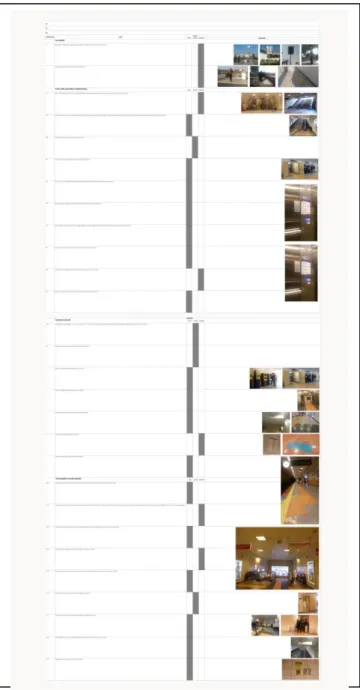
Figure 1. Accessible design control list consists of 28 questions on four subjects; building surroundings, entrance to building, circulation areas and stimulating and guiding signs.
na l of A rc hite cture a nd Pl an ni ng
42
But only the questions from Turkish Ministry of Family and Social Policies-People with Disabilities and Elderly General Service Accessibility check Lists and Turkish World Handicapped Foundation- Outdoors and Indoors Accessibility Check Lists have been selected to detect the accessibility problems at Istanbul metro stations.
Accessible design control list consists of 28 questions on four subjects; building surroundings, entrance to building, circulation areas and stimulating and guiding signs, to examine the passengers’ expectations on the quality of informative, stimulating and guiding signboards at entrance, circulations and surroundings of metro stations; except the legislations related to the product sizes and constraints that designers or professionals have to obey.
The questions are answered as YES-NO-PARTIALLY by disabled passengers (as subject group), not by professionals. There are two subject groups. First subject group consist of 5 visually impaired and partially impaired people. The second subject group consist of 7 wheelchair users.
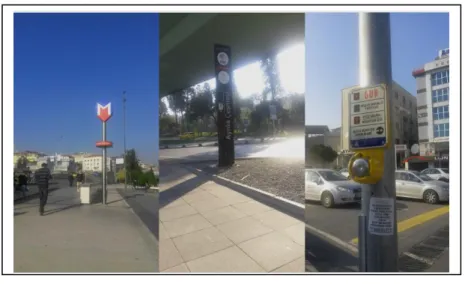
Kadıkoy Ayrılıkcesme main transmission metro station in which Marmaray and Istanbul Metro lines join was chosen for the case study. To arrive Marmaray train platforms or Istanbul Metro lines, passengers firstly have to go downstairs from one of two entrances to toll bar floor. Then go upstairs to Marmaray train platforms or go downstairs to Istanbul Metro lines. And also train platforms, ground and toll bar floors are all linked with elevators.
Figure 2. Entrances of Kadıkoy
Ayrılıkcesme main transmission metro station.
43
na l of A rc hite cture a nd Pl an ni ngExperimentally, asked all the subject groups to make a journey beginning from the entrance of metro station to the train platforms without getting any help. And let participants to decide their own routes and stops inside of metro station.
So that each of them has lived different spatial experiences at main hall, toilets, box-office, toll bars, elevators and escalators. After they completed their routes, they were requested to answer the questions of control list and describe the positive and negative situations from their experiences. And also all descriptions were photographed.
RESULTS AND DISCUSSIONS
According to the result of examining the approaches on barrier-free design and the level of accessibility at Ayrılıkcesme main transmission metro station, there are distinctive data detected which are inacceptable accessible solutions for wheelchair users and/or visually impaired people.
Figure 3. Informative, stimulating
and guiding signboards, traffic signals.
Figure 4. Unequipped or unfixed
na l of A rc hite cture a nd Pl an ni ng
44
Arrive to entrance of metro station: Signboards used by
wheelchair users, are available. They can easily find the entrance and elevators. But informative, stimulating and guiding signboards are insufficient for visually impaired people. There is no braille signboard and also guiding paths for visually impaired people are mostly unequipped or unfixed. The distance from parking area to entrances is not quite acceptable.
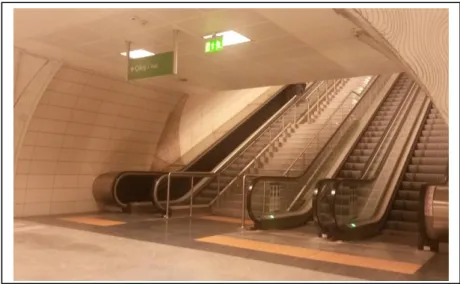
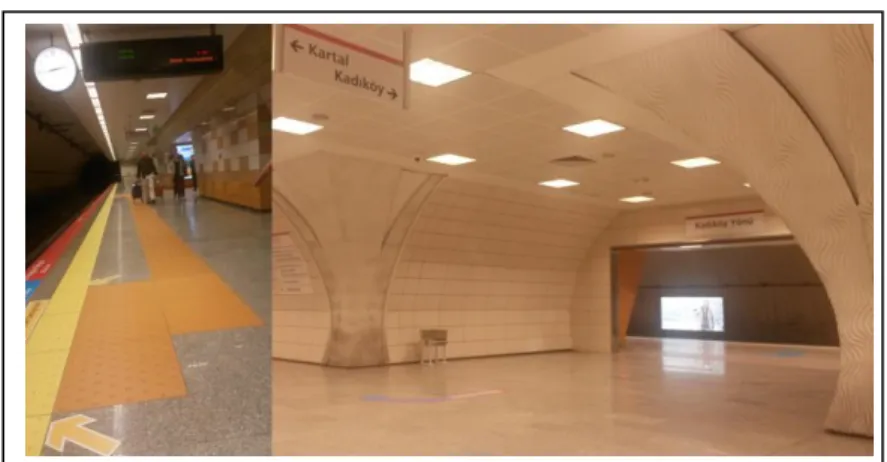
Stairs, escalators and elevators: Colored tactile paving as
detectable warning surfaces are used at initial and final steps of stairs and escalators. But along the side walls the handrails with contrasting colour are not considered.
Numbers and letters in embossed and Braille alphabet are used at buttons and signboards of elevators. Audible and visual warning systems, warning buttons and symbols are all in contrasting colour with surface of the cage and the floor. But elevator users can’t go to the train platforms directly. They have to stop at toll bar floor and get on another elevator to reach the platforms. This is not acceptable for the rule of TS 12460: Roads of inner city- Rail Transportation Systems “Architectural Design at Metro Stations must prevent short walk and barrier free circulations for disabled passengers.”
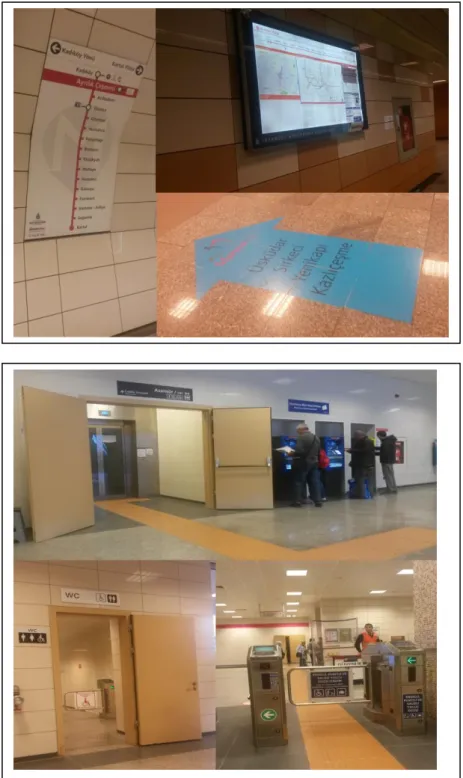
Main hall and circulation areas: Passengers can easily percept
the emergency exits. Warning and informative signboards with contrasting color are all setting up minimum height 220 cm from floor. But for visually impaired people, there is no braille and embossed warning and informative signboards at the height of 120-160 cm. And also door frames don’t have contrast colors with their walls.
Figure 5. Detectable warning
surfaces are used at initial and final
45
na l of A rc hite cture a nd Pl an ni ngToilets, box-office, toll bars: Guiding paths for visually
impaired people are partially fixed at metro station. Not only for visually impaired people but also for wheelchair users, there is no signboard to guide to the accessible toilets.
Arrive to train platforms: Coloured tactile paving surfaces for
warning are used in border of platforms. But because of partially fixed guiding paths, visually impaired people cannot easily find the way of platforms without getting help from other people.
Figure 6.Warning and informative
signboards.
Figure 7.Guiding paths on the toll
na l of A rc hite cture a nd Pl an ni ng
46
As a result of examining on the level of accessibility at Ayrılıkcesme Station, it can be said that there is a positive act for barrier free design and accessibility. But as it stated at the determinations, accessibility of metro stations do not reach to the desirable level that visually impaired people are being able to move individually as wheelchair users do.
CONCLUSIONS AND RECOMMENDATIONS
Currently, Istanbul metro system rapidly becomes a primary public transportation against increasing density of traffic. The efforts of making the metro system accessible will also help in connecting all the parts of Istanbul for disabled people in the near future.
But generally in our county; laws, legislations and regulations for accessibility and barrier-free design in public space and public transportation are not enough to realize our hopes. It is seen that care, expectations and awareness on accessibility become more important to emerge these difficulties. In this context, we have to take some significant decisions on training well-informed professionals, constituting the common shares on standardization of construction and production industry, increasing the community awareness on accessibility and barrier free city life, innovating technologies and alternative solutions for all disabled groups as follows;
Accessibility in Architectural Education: To increase the number of well-informed professionals, accessibility, universal and barrier free design must be practiced in theoretical lectures and studio works in architectural education. Universities must organize seminaries and workshops in order to educate architects, designers or staffs working at public services or municipalities.
Figure 8. There are partially
47
na l of A rc hite cture a nd Pl an ni ngAvoid faults or shortcomings in constructions by ensuring collaboration between universities, NGO’s, local governments, municipalities and public services: We have to
make laws to legislate local governments or municipalities to consult with universities and/or NGO’s in applications that require special knowledge and experience on accessible and barrier-free design.
Increasing awareness of architects, designers, professionals and all members of our community on accessibility by making workshops and activities: Enable the community to
understand the idea that disabled people are not different from others, just have special cases. We can generate informative projects to show the technologies, innovations and spatial solution for all disabled groups. And also we can encourage making researches on experiencing the accessible life and architecture.
We will increase the awareness of next generations by participating to workshops and activities where they can experience the disabled life.
Innovative technologies and alternative solutions on accessibility: According to data from case study, we may say
that there is an extremely need of alternative and innovative technologies for accessible transportation systems instead of conventional solutions. Accessibility, for visually impaired passengers and for all passengers, at underground closed spaces will be solved by using smart mobile technologies with audial or/and visual perception technologies.
As a result, we can say that, accessibility depends on supplying the physical and social requirements of disabled people as the healthy people do. And also opportunities to live independently in a community are up to people to know and care the accessibility and remember that everyone has equal rights.
REFERENCES
Akbulut, S., Özgün, H., Ak, İ. And Uslu, E. (2015). Mevzuattan Uygulamaya Engelli Hakları İzleme Raporu 2014, Toplumsal Haklar ve Araştırmalar Derneği (TOHAD) Yayınları, Ankara
Baudoin, G., Venard, O., Uzan, G., Rousseau, A., Benabou, Y., Paumier A. (2005). How can blinds get information in public transports using PDA? The RAMPE auditive man machine interface. In: Proc. 8th AAATE 2005, Lille, Sept.
na l of A rc hite cture a nd Pl an ni ng
48
Engelbrektsson, P., Karlsson, M., Gallagher, B., Hunter, H., Petrie, H., and O’Neill, A. (2004). Developing a navigation aid for the frail and visually impaired. Universal Access in the Information Society, 3(3), 194–201
Enginöz, E.B. (2015). Erişilebilir Mimarlık, Mimarlık Dergisi, 381, pp.48-52, TMMOB Mimarlar Odası, Ankara.
Kulyukin, V., Gharpure, C., Nicholson, J., and Pavithran, S. (2004). RFID in Robot-Assisted Indoor Navigation for the Visually Impaired. Intelligent Robots and Systems. Proceedings. of IEEE/RSJ international conference, Vol. 228 Sept.-2 Oct. 2004, pp. 1979–1984, Japan.
Meriläinen, A. and R. Helaakoski. (2001). Transport, Poverty and Disability inDeveloping Countries. Technical note prepared for the Poverty Reduction Sourcebook. Washington, DC, U.S.A.
Scherrer, V. (2001). Neden Ulaşılabilirlik Hakkında Düşünmeliyiz, Herkes için Ulaşılabilirlik Seminer Notları, Cem Ofset, pp.38-42, Istanbul.