World Journal of Social Sciences and Humanities, 2016, Vol. 2, No. 2, 42-45 Available online at http://pubs.sciepub.com/wjssh/2/2/3
©Science and Education Publishing DOI:10.12691/wjssh-2-2-3
Assessing the Personality Characteristics of Personal and
Team Sportsmen According to Some Variables
Kubilay ÇİMEN*, Aydın PEKEL*, Ecem AKGÜL, Sinan ÇETİNKAYA
High School of Physical Education and Sport, İstanbul Gelişim University, Turkey *Corresponding author: [email protected], [email protected]
Abstract
The objective of this study is to examine the personality characteristics of personal and team sportsmen according to some variables. According to this objective, the study included 43 participants from Galatasaray (male), Trabzonspor (male), Abdullah Gül University (female) and Edirnespor (female) basketball teams and 48 voluntary tennis players from ITF. The voluntary participants were asked to apply socio-demographic information form and Personality Scale. The acquired data were statistically analyzed via the IBMM SPSS20.0package software. Personal information about the applicants, as well as the total scores of inventory and factor scores were given by determining thefre quency (f) and percentage (%) values. Relationship between the scores obtained from the scales was presented by using the statistics of Mann-Whitney U test in comparisons according to their gender, sport backgrounds and sport branches. On the other hand, the statistics of Kruskal Wallis test was used in comparisons according to their age. As a consequence, a personality characteristic was associated with age, gender, sport background and branch. This condition is thought to be caused by the fact that sportsmen are trained result-oriented in both their infrastructure and in their lives, are social due to the undeniable contributions of sport, establish a rapid communication, and have the required self-confidence and self-efficacy.Keywords: personality, tennis, basketball
Cite This Article:
Kubilay ÇİMEN, Aydın PEKEL, Ecem AKGÜL, and Sinan ÇETİNKAYA, “Assessing the Personality Characteristics of Personal and Team Sportsmen According to Some Variables.” World Journal ofSocial Sciences and Humanities, vol. 2, no. 2 (2016): 42-45. doi: 10.12691/wjssh-2-2-3.
1. Introduction
Sport involves intense efforts of improving the physical and mental health of individuals, struggling within competition scales according to certain rules, feeling excitement, competing, surpassing, increasing the power of success in real terms and maximizing it personally [1]. Sport plays an important role in human life in terms of positively improving the personality of individuals and enabling them to socialize [2]. Literature involves more than one definitions and theories of personality. In general terms, personality contains everything from a to z that concerns individuals. Being a long and uninterrupted process; personality is formed as from conception and continues till the end of life [3]. Sport is generally defined as personal or team competitions that are organized according to certain rules or pleasure-oriented social activities [4]. Today, on the other hand, sport contains individuals’ social adaptation, mental and physical health, ability of winning competitions and it is defined as a discipline recommended by trainers for the formation and development of personality, a process that is liked very much by masses, a method used by administrators for shaping the energy and raising a balanced and combative sense and an expression of game motivation pleasing and satisfying individuals according to advanced rules [5]. Personality is a term that contains the interests, attitudes,
abilities, speaking styles, appearance and environmental adaptation of individuals. All these features that generate personality form a distinctive and harmonized wholeness in individuals and separate them from others [6,7]. Personality is the sum of consistent behaviors that are displayed by individuals as higly or lowly stable internal factors in the course of time and these behaviors show an explicit difference from other people in comparable conditions [8]. The effects of sportive activities upon personality could be generalized as follows: sport shapes character, team sports teach how to cooperate, personal sports develop personal discipline and teach how to discharge the aggression impulses naturally in accordance with social rules [9].
The objective of this study is to examine the personality characteristics of personal and team sportsmen according to some variables.
2. Material-Method
2.1. Formation of the Voluntary Group
While the target population of the study consists of the sportsmen in the Basketball League and ITF Tennis; the sample consists of 91 voluntary participants that were competing in different clubs and were selected via random sampling method.
World Journal of Social Sciences and Humanities 43
2.2. Data Collection Tools
Socio-Demographic Information Form: Being
developed by the researcher; this form consists of 5 questions about age, gender, sport background, branch and national sportsmanship.
2.3. Eysenck Personality Questionnaire –
Reviewed and Shortened Form
It was adapted into Turkish by Karancı, Dirikand Yorulmaz in 2007. The questionnaire contains 24 items and assesses the personality in three main factors: extroversion, neuroticism, psychoticism. It also aims to prevent mistakes made during the application and control the validity with the help of the subscale of lying. In this questionnaire where each factor is assessed with 6 items, participants are asked to answer 24 questions as Yes (1)-No (0). The scores to be obtained for each personality characteristic vary between 0 and 6. As a result of the internal reliability analysis that was conducted for the dimensions of extroversion, neuroticism, psychoticism and lying, the Kuder-Richardson correlation coefficients were determined respectively as .78, .65, .42, and .64. The test-retest reliabilities of the scales were determined respectively as .84, .82, .69 and .69 [10]. In the scale, items numbered 1, 9, 11,14, 18,21 constitute the lower dimension of neuroticism; items numbered 2, 4, 13, 15, 20, 23 extroversion; items numbered 3, 6, 8, 12, 16, 22 psychoticism and items numbered 5, 7, 10, 17, 19, 24 lying [11].
2.4. Statistical Analysis:
The data acquired from the personal information form and the personality scale were statistically analyzed via the IBMM SPSS20.0 package software. Personal information about the applicants, total scores of inventory and factor scores were determined via frequency (f) and percentage (%) values. Relationship between the scores obtained from
the scales were revealed by using the statistics of Mann-Whitney U test in comparisons that were made according to their gender, sport backgrounds and sport branches. On the other hand, the statistics of Kruskal Wallis test was used in comparisons that were made according to their age.
Table 1. Socio-Demographic Features of Participants
Variable n % Gender Male 42 46,2 Female 49 53,8 Age 18-21 38 41,8 22-25 26 28,6 25 and older 27 29,7 Sport Background 6-11 48 52,7
12 years and above 43 47,3
Sport Branch Tennis 48 52,7
Basketball 43 47,3
Examining Table 1; it was determined that 46,2% of voluntary study participants were male, 53,8% female, 41,8% were aged 18-21, 28,6% 22-25 and 29,7% 25 and older, 52,7% had been occupied in sports for 6-11 years, 47,3% 12 years and above, 52,7% were in the branch of tennis and 47,3% basketball.
3. Findings
Table 2. Descriptive Statistics of Answers Given by Participants to the Questionnaire
Lower Dimensions of Personality N Min Max X±SS
Neuroticism 91 ,00 6,00 3,37±1,26
Extroversion 91 ,00 12,00 4,35±1,71
Psychoticism 91 ,00 5,00 2,50±1,30
Examining Table 2; the scores obtained by voluntary study participants from the lower dimensions of personality were determined as 3,37±1,26 (neuroticism), 4,35±1,71 (extroversion), 2,50±1,30 (psychoticism) and 3,52±1,51 (lying).
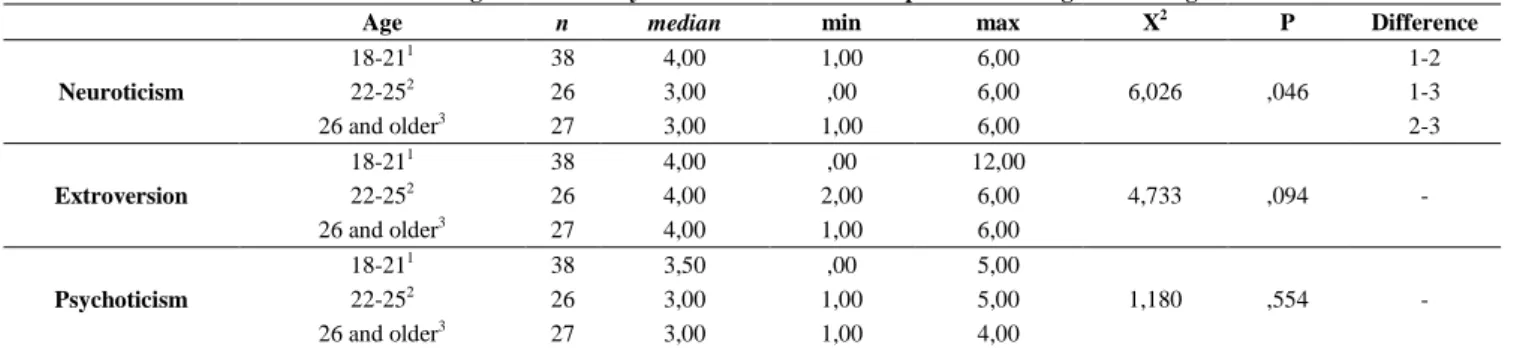
Table 3. Assessing the Personality Characteristics of Participants According to Their Age
Age n median min max X2 P Difference
Neuroticism 18-211 38 4,00 1,00 6,00 6,026 ,046 1-2 22-252 26 3,00 ,00 6,00 1-3 26 and older3 27 3,00 1,00 6,00 2-3 Extroversion 18-211 38 4,00 ,00 12,00 4,733 ,094 - 22-252 26 4,00 2,00 6,00 26 and older3 27 4,00 1,00 6,00 Psychoticism 18-211 38 3,50 ,00 5,00 1,180 ,554 - 22-252 26 3,00 1,00 5,00 26 and older3 27 3,00 1,00 4,00
Table 3 shows the scores obtained by participants from the lower dimensions of personality according to their age. It was determined that there was a statistically significant difference between the ages 18-21 and 22-25, 18-21 and
26 and older, 22-25 and 26 and older in the lower dimension of neuroticism, which is among participants’ lower dimensions of personality (p<0.05).
Table 4. Assessing the Scores of the Lower Dimensions of Personality according to the Gender of Participants
Gender n median min max Z P
Neuroticism Male 42 3,50 1,00 6,00 -,713 ,476 Female 49 3,00 ,00 6,00 Extroversion Male 42 4,00 ,00 6,00 -3,810 ,000 Female 49 5,00 1,00 12,00 Psychoticism Male 42 2,50 ,00 5,00 -,801 ,423 Female 49 2,00 1,00 5,00
44 World Journal of Social Sciences and Humanities
Examining Table 4; a statistically significant difference was determined between the scores of the lower dimension
of extroversion according to the gender of participants (p<0.05).
Table 5. Assessing the Scores of the Lower Dimensions of Personality according to the Sport Backgrounds of Participants
Sport Background n median min max Z P
Neuroticism 6-11 48 3,00 ,00 6,00 -2,046 ,041 12 and above 43 4,00 1,00 6,00 Extroversion 6-11 48 5,00 1,00 12,00 -1,259 ,208 12 and above 43 4,00 ,00 6,00 Psychoticism 6-11 48 2,00 ,00 5,00 -1,681 ,093 12 and above 43 2,00 1,00 5,00
Examining the scores of the lower dimensions of personality according to the sport backgrounds of participants in Table 5; a statistically significant difference
was determined between the sport backgrounds of participants and the score of the lower dimension of neuroticism (p<0.05).
Table 6. Assessing the Scores of the Lower Dimensions of Personality according to the Branches of Participants
Branch n median min max Z P
Neuroticism Tennis 48 3,00 ,00 6,00 -,044 ,965 Basketball 43 4,00 1,00 6,00 Extroversion Tennis 48 5,00 1,00 12,00 -2,951 ,003 Basketball 43 4,00 ,00 6,00 Psychoticism Tennis 48 2,00 ,00 5,00 -,972 ,331 Basketball 43 2,00 1,00 5,00
Examining Table 6; a statistically significant difference was determined between the scores of the lower dimension of extroversion according to the sport branches of participants (p<0.05).
4. Discussion and Conclusion
As a result of the descriptive statistical analysis; the scores obtained by voluntary study participants from the lower dimensions of personality were determined as 3,37±1,26 (neuroticism), 4,35±1,71 (extroversion) and 2,50±1,30 (psychoticism).
Examining the literature; in the study of Tazegül (12) that was conducted with elite sportsmen, the scores obtained by the sportsmen from the lower dimensions were determined as 3,523±1,497 (extroversion), 3,125±1,691 (neuroticism) and 1,877±1,287 (psychoticism). This study shows a parallelism with our study findings.
Table 3 shows the scores obtained by participants from the lower dimensions of personality according to their age. It was determined that there was a statistically significant difference between the ages 18-21 and 22-25, 18-21 and 26 and older, 22-25 and 26 and older in the lower dimension of neuroticism, which is among participants’ lower dimensions of personality (p<0.05). Examining the literature; there is no study investigating the relationship between the lower dimensions of personality and age, which might be associated with the fact that sportsmen focus on winning and success in infrastructure and competition preparation period, and they may not always win in competitions.
According to the Cattel 16 PF Personality Inventory conducted on professional 100 young soccer players by Kane, it was determined that players were more aggressive, dominant, slef-confident and emotionally balanced with respect to ones who do not join sport activities [13]. Morganalso determined a neuroticism level among 12 American, 4 Canadianand 7 South African wrestlercollege students who participated amateur world championship under standards considered normal [14].
Ogilvie [15] concluded that personality characteristics of successful women athletes did not display significant difference in comparison with mean scores of women in the society. The researcher reported that women athletes who exhibit considerable success in their career have personality characteristics similar to male athletes.
Geron, Furst and Rotsteinapplied Minnesota Multi-Dimensional Personality Inventory on 379 non-athlete males and 273 male athletes from 9 different branches (gymnastic, swimming, marathon, tennis, basketball, handball, volleyball, water poloand soccer) to investigate them in terms of gender, age, ethnicity and socio-economicstatus; and significant differences were determined with the 17 of the 29 variables. In another dimension, anxiety levels, sensuality at disruptive levels and excitement level were found among sprinter runners. Additionally, it was determined that although individual athletes found different in terms of personality profile in comparison withnon-athletes, when team players are compared with non-athletes, less difference was determined among variables [16].
Güven [17] investigated psychic, personality characteristics, intelligence level and way of and psychological characteristics of athletes who prefer mat wrestling. They gained higher scores with respect to non-athletes in terms of psychopathic, paranoid and hysteroid dimensions. Wrestlers are more extroverts. A significant difference was found between extroversion dimension and concrete/creative intelligence type among wrestlers.
A statistically significant difference was determined between the scores of the lower dimension of extroversion according to the gender of participants (p<0.05) (Table 4). As a result of the literature review; Bayram et al. [18]
determined a statistically significant difference between the scores of the lower dimension of extroversion according to gender. This study supports our findings.
It is thought that this condition will create different effects in every individual as sport has different effects upon the personality of individuals, brings self-confidence in individuals and enables them to easily establish communication.
World Journal of Social Sciences and Humanities 45
Examining the scores of the lower dimensions of personality according to the sport backgrounds of participants; a statistically significant difference was determined between the sport backgrounds of participants and the scores of the lower dimension of neuroticism (p<0.05) (Table 5). Literature involves no study examining the lower dimensions of personality according to sport backgrounds, which might be associated with emotional consistency, excessive reactiveness and anxiety of sportsmen due to their past psychological problems, familial problems, disabilities or disagreements with their clubs.
A statistically significant difference was determined between the scores of the lower dimension of extroversion according to the sport branches of participants (p<0.05) (Table 5). Literature involves no study examining the lower dimensions of personality according to sport branches, which might be associated with self-realization, self-confidence of sportsmen, as well as their rapid and better communication in the internal and external environment.
As a consequence, it was determined that personality characteristics was related with age, gender, sport background and branch.
This condition is thought to be caused by the fact that sportsmen are trained result-oriented in both their infrastructure and in their lives, are socialdue to the undeniable contributions of sport, establish a rapid communication, and have the required self-confidence and self-efficacy.
References
[1] Aracı, H. Physical Education at Schools, Bagırgan Publishing
House, Ankara, (1999).
[2] Öztürk, Ü. Physical Education at Secondary Schools. 2. Edition, Kayı Publishing: İstanbul, (1983).
[3] Fişek, K. Sport Management in Turkey and in the World. Faculty
of Social Sciences. High School of Press: Ankara, (1980).
[4] Filiz, Z. Assessing the Participation in Sport in the Socialization of University Students. Journal of Niğde University Physical Education and Sport Sciences, (2010). 4, (3), 192-203.
[5] Fişek, K. Sport Management. A.U. Faculty of Political Sciences
Publications. Ankara, (1980).
[6] Yüksel, Ö. Behavioral Sciences. Gazi Bookstore, Ankara: (2006).
[7] Savran, C. Linguistic Equivalance, Validity, Reliability and Norm Study of the Adjective List (Acl) according to the Conditions of Turkey and a Sample Application, Institute of Social Sciences, Marmara University, Department of Educational Sciences. İstanbul.(1993). (Unpublished Doctoral Thesis).
[8] Child, I.L. Personality in Culture. E. F. Borgatta& W. W. Lambert (Eds.), Handbooks of Personality Theoryand Research. Chicago: Rand Mcnally, (1968).
[9] Koruç, Z., Bayar P., Research Report on the Effects of Sport upon Personality, General Directorate of Youth and Sport, Sesam, Ankara, 1989.
[10] Karancı N, Dirik G, Yorulmaz O., Turkish Validity and Reliability of the Eysenck Personality Questionnaire – Reviewed and Shortened Form (EPQ-RSF), Turkish Psychiatry Journal, 2007, 18 (3), 254-261.
[11] Https://Www.Google.Com.Tr/?Gfe_Rd=Cr&Ei=_Ckuv_Eynm6z8 wesoojıcg&Gws_Rd=Ssl#Q=Eysenck+Ki%C5%9filik+Envanteri +K%C4%B1sa+Form (Access Date: 18/04/2016)
[12] Tazegül Ü., Determining the Relationship between the Personality Features of Elite Sportsmen and Their Styles of Coping with Stress, American Journal of Sports Science and Medicine, 2015, Vol. 3, No. 2, 35-38.
[13] Kuru, E. (2003). Personality Characteristics of Students in different statuses, from the Physical Education Department, G.U. Gazi Faculty of Educational Sciences Periodical 23(1):175-191.
[14] Tosunoğlu, F. (2008). Investigation of Personality Characteristics
of Team Player Students in the Secondary School Education with Respect to Sport Branches. Master Thesis. Gazi University, Ankara.
[15] Ogilvie, B.C. (1968). Psychological Consistencies within The Personality Of High-Level Competitors. Journal of the American Medical Association, 205(4) 780-786.
[16] Geron, E.,Furst, D, Rotsten., P.(1986). Personality of Athletes Participation in Various Sports. International Journal Of Sport Psychology
[17] Güven, Ö. (1988). Psychic Characteristics Playing Role in Preferences of Athletes who Preferred Mat Wrestling. Doctorate Thesis. Marmara University, Istanbul.
[18] Bayram N, Gürsakal S, Aytaç S., The Effect of Personality upon Explaining the Career Values of Students, Anadolu University, Journal of Social Sciences,2012.