Introduction
The Gobiesocidae is a diverse group of primarily shallow water or intertidal marine fishes consisting 50 genera and 169 species (Conway et al., 2017; Fricke et al., 2017). Their distinguishing characteristics include: pelvic fins modified into a thoracic suction disc, pelvic fin with one small modified spine and four or five soft rays, single dorsal fin without spines, no basibranchial, lateral line confined to
head, two postcleithra, hypurals fused into a single plate (Allen, 1984). Diplecogaster bimaculata is a member of Gobiesocidae (Clingfishes and singleslits), and is an Atlanto-Mediterranean demersal fish species distributed between 0 to 60 meters (Briggs, 1979) in the Black Sea, Sea of Marmara, Aegean Sea and the Mediterranean Sea, and also in the north-east Atlantic from Norway and Faroes south to Gibraltar.
The genus Diplecogaster, the clingfish, was first described by Fraser-Brunner (1938, p. 415), and considered as monotypic. After this revision of gobiesocid fishes, Briggs (1955) described Diplecogaster ctenocrypta, D. Reçu le 27 avril 2017 ; accepté après révision le 30 août 2017.
Received 27 April 2017; accepted in revised form 30 August 2017. Cah. Biol. Mar. (2018) 59 : 201-204
On the occurrence of Diplecogaster bimaculata
(Bonnaterre, 1788) in the Aegean Sea
Ozan SOYKAN1, Gökçen BİLGE2, Halit FİLİZ2, Sercan YAPICI2* (1)Ege University, Faculty of Fisheries, Bornova, İzmir, Turkey (2)Muğla Sıtkı Koçman University, Faculty of Fisheries, Kötekli, Muğla, Turkey
*Corresponding author: E-mail: [email protected]
Abstract: In June 2016, a two-spotted clingfish Diplecogaster bimaculata (Bonnaterre, 1788) specimen of 18.67 mm total length was captured by hand on a rock at one-meter depth from Akbuk Cove (Gökova Bay, southern Aegean Sea). Since there is no any morphometric data of the species in Turkish waters, now we provide the morphometric data of D. bimaculata for the Aegean Sea.
Résumé : Sur l’occurrence de Diplecogaster bimaculata (Bonnaterre, 1788) en Mer Egée. En juin 2016, un specimen d’une longueur de 18,67 mm de Diplecogaster bimaculata (Bonnaterre, 1788) a été capturé à la main sur une roche à un mètre de profondeur dans l’anse Akbuk (baie de Gökova, au sud de la Mer Egée). Comme il n’existe pas de données morphométriques de l’espèce dans les eaux turques, nous fournissons ici les données morphométriques de D. bimaculata en Mer Egée.
Keywords: Diplecogaster bimaculatalTwo-spotted clingfishlAkbük CovelAegean Sea DOI: 10.21411/CBM.A.A721C168
202 TwO-SPOTTED CLINGFISH IN THE AEGEAN SEA
megalops and D. bimaculata pectoralis, distinguishing a total of four species-group taxa in the genus. Later, Diplecogaster bimaculata euxinica from the Black Sea added another subspecies by Murgoci (1964, p. 229). Regarding eastern Atlantic and Mediterranean gobiesocids,
Hofrichter (1995) treated all these taxa as valid, comprising three valid species of Diplecogaster, or five valid taxa in the species group (including subspecies). Fricke et al. (2015) classified the genus within two species groups, namely Diplecogaster-bimaculata group and
O. SOYKAN, G. BİLGE, H. FİLİZ, S. YAPICI 203 Diplecogaster-ctenocrypta group, comprising a total of six
valid species.
The present article provides the occurrence and morphometric data of D. bimaculata for the Turkish seas and thus is a significant contribution to our current knowledge on the occurrence of the in the seas of Turkey.
Material and Methods
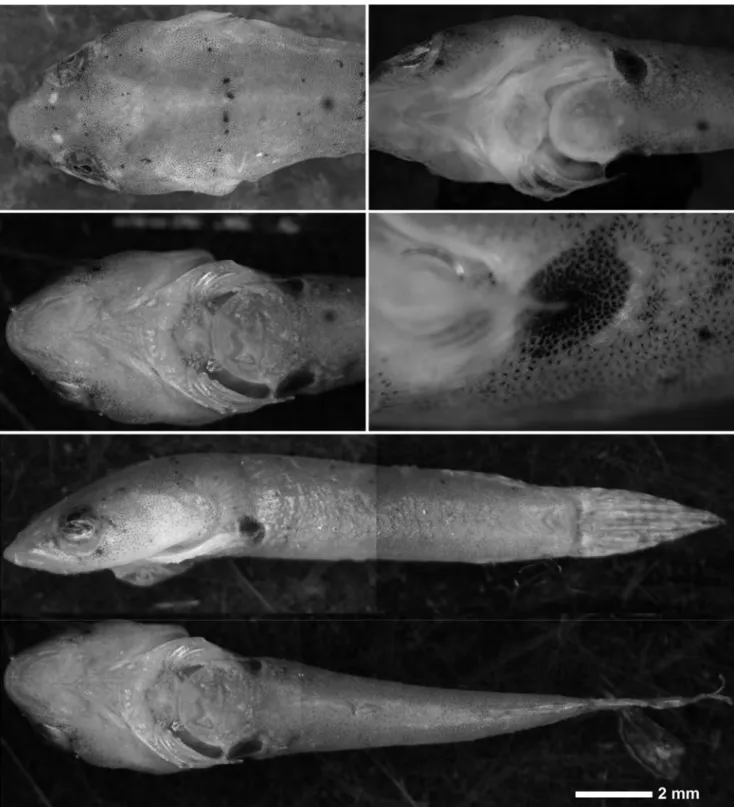
One two-spotted clingfish Diplecogaster bimaculata (Bonnaterre, 1788) specimen (with 18.67 mm TL) was captured by hand on a rocky bottom at about 1 meter depth from Akbuk Cove (37°02ʹ00.23ʺN-28°05ʹ57.46ʺE), Gökova Bay (southern Aegean Sea) on 25 June 2016 (sampling time, 1:30 p.m.). The specimen (Fig. 1) was fixed in 70% ethanol solution and deposited in the fish collection of Muğla Sıtkı Koçman University, Fisheries Faculty (MUSUM/PIS/2016/1). The alcohol fixed specimen was photographed under the Nikon SMZ-U stereo zoom microscope at 10x magnification under reflected light. Meristic data for dorsal, anal, ventral and pectoral fin rays and morphometric data of specimen were determined. In the laboratory, all relevant lengths were measured parallel to the longitudinal axis of the body, while depths were measured perpendicular to the axis using Digimizer image analysis software (Version 4.6.1).
Results and Discussion
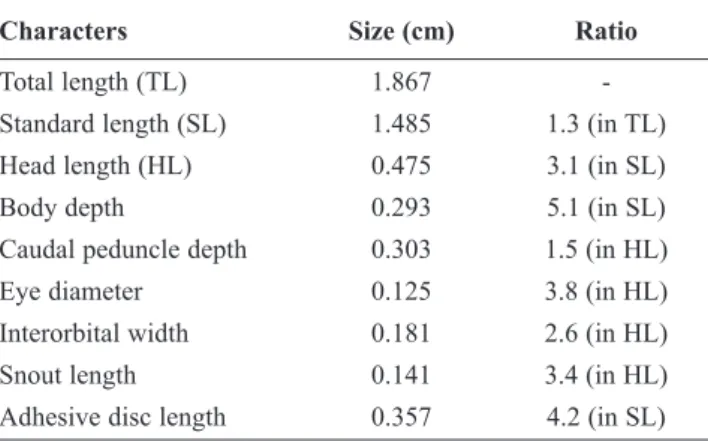
Meristic data of the fins were for the specimen were counted as D: 6, A: 4, P: 23 and C: 9, within the reported variation (D: 5-7, A: 4-6, P: 21-25, C: 9-12) described by Fricke et al. (2015). Morphometric measurements of the specimens are given in Table 1. Examined D. bimaculatus specimen has two lacrymal canal pores. Metric measurements, meristic counts, morphological descriptions
as well as the color were compatible with the descriptions of Fricke et al. (2015).
Diplecogaster bimaculata was reported for the first time in the Mediterranean from near to the Mljet Island, the Adriatic waters of former Yugoslavia in 1958 (Anonymous, 2000). Concerning the Turkish coasts, D. bimaculata has been reported by various researchers: Black Sea (Erazi, 1942), Sea of Marmara (Ostroumoff, 1894; Okuş & Yüksek, 2001; Keskin, 2007), Aegean Sea (Slastenenko, 1955-1956; Anonymous, 2006 & 2009) and the Levant Sea (Erazi, 1942; Can & Bilecenoğlu, 2005). However, they have failed to provide detailed morphometric information on the specimen(s) because D. bimaculata is rarely collected due to its cryptic, habitat-dependent behavior and small size.
Based on the information obtained from available literature, there are no detailed morphometric data of D. bimaculata, up to now, in Turkish waters, thus we hope that our results will contribute revisionary studies related to D. bimaculata.
Acknowledgements
we would like to thank Prof. Dr. Ronald Fricke from the State Museum of Natural History, Stuttgard, Germany, for his kindly helping species verification.
References
Allen L.G. 1984. Gobiesociformes: development and
relationships. In: Ontogeny and Systematics of Fishes,
Memorial Symposium dedicated to E.H. Ahlstrom, pp.
629-636. American Society of Ichthyologists and Herpetologists, special publication: n°1.
Anonymous 2000. The ichthyological collection of the
Zoological Museum Hamburg (ZMH). Division of Ichthyology and Herpetology, Zoological Museum Hamburg (ZMH).
Anonymous 2006. Biodiversity Assessment for the Coastal and
Marine Regions of Gökova Special Environmental Protection Area – Final Report. Submitted to Turkish Ministry of
Environment and Forestry, Special Environmental Protection Agency, Ankara, 352 pp.
Anonymous 2009. Biodiversity Assessment for the Coastal and
Marine Regions of Fethiye Göcek Special Environmental Protection Area – Final Report. Submitted to Turkish Ministry
of Environment and Forestry. Special Environmental Protection Agency, Ankara, 293 pp.
Briggs J.C. 1955. A monograph of the clingfishes (order
Xenopterygii). Stanford Ichthyological Bulletin, 6: i-iv + 1-224.
Briggs J.C. 1979. Gobiesocidae. In: Check-list of the fishes of the
north-eastern Atlantic and of the Mediterranean (CLOFNAM)
(J.C. Hureau ed), pp. 651-656. UNESCO: Paris.
Characters Size (cm) Ratio
Total length (TL) 1.867
-Standard length (SL) 1.485 1.3 (in TL)
Head length (HL) 0.475 3.1 (in SL)
Body depth 0.293 5.1 (in SL)
Caudal peduncle depth 0.303 1.5 (in HL)
Eye diameter 0.125 3.8 (in HL)
Interorbital width 0.181 2.6 (in HL)
Snout length 0.141 3.4 (in HL)
Adhesive disc length 0.357 4.2 (in SL)
Table 1. Diplecogaster bimaculata. Morphometrics for key
Can A. & Bilecenoğlu M. 2005. Atlas of Benthic fishes of Turkish
Seas. Arkadaş Yayınevi: Ankara. 224 pp. (in Turkish)
Conway K.W., Daemin, K., Rüber, L., Espinosa Pérez H.S. & Hastings P.A. 2017. Molecular systematics of the New world
clingfish genus Gobiesox (Teleostei: Gobiesocidae) and the origin of a freshwater clade. Molecular Phylogenetics and
Evolution, 112: 138-147. Doi: 10.1016/j.ympev.2017.04.024.
Erazi R.A.R. 1942. Marine fishes found in the Sea of Marmara
and in the Bosphorus. Revue de la Faculté des Sciences de
l’Université d’Istanbul, 7: 103-114.
Fricke R., Chen J.N. & Chen W.-J. 2017. New case of lateral
asymmetry in fishes: a new subfamily, genus and species of deep water clingfishes from Papua New Guinea, western Pacific Ocean. Comptes Rendus Biologies, 340: 47-62. Doi: 10.1016/j.crvi.2016.11.002.
Fricke R., Wirtz P. & Brito A. 2015. Diplecogaster tonstricula,
a new species of cleaning clingfish (Teleostei: Gobiesocidae) from the Canary Islands and Senegal, eastern Atlantic Ocean, with a review of the Diplecogaster-ctenocrypta species-group,
Journal of Natural History, 50: 731-748. Doi: 10.1080/
00222933.2015.1079659
Hofrichter R. 1995. Taxonomie, Verbreitung und Ökologie von
Schildfischen der Unterfamilie Lepadogastrinae (Gobiesocidae, Teleostei) [Unpublished doctoral dissertation]. Salzburg: Naturwissenschaftliche Fakultät, Paris Lodron Universität; viii + 448 pp.
Keskin Ç. 2007. Temporal variation of fish assemblages in
different shallow-water habitats in Erdek Bay, Marmara Sea, Turkey. Journal of the Black Sea/Mediterranean Environment,
13: 215-234.
Murgoci A.A. 1964. Contribution à la connaissance des
gobiesocides (ordre des Xenopterygii) de la Mer Noire. Revue
Roumaine de Biologie, Série de Biologie Animale, 9: 297–306.
Okuş E. & Yüksek A. 2001. General characteristics of the Sea of
Marmara. In: Sualtı Günleri-2001, pp. 8-25. Dokuz Eylül University: Izmir, (in Turkish).
Ostroumoff A. 1894. Dal’neishie materialyi k estestvennoi
istoriyii Bosfora. Bulletin de l’Académie impériale des
sciences de St.-Pétersbourg, 74: 1-46.
Slastenenko E. 1955-1956. Fishes of the Black Sea Basin. Et ve
Balık Kurumu Yayınları: İstanbul. 711 pp. (in Turkish).