Prunus is an economically important genus with 430 classified species including especially stone fruit species [Niklas 1997]. Prunus avium L. (sweet cher-ry) and Prunus cerasus L. (sour chercher-ry) are the spe-cies that were the fourth and fifth highest produced fruit species in 2016 with the production amounted to 2317956 tons and 1378216 tons, respectively [FAO, 2018]. Their fruits are used for fresh consumption and also marmelade, jam, vinegar, dry products but
espe-cially processed for juice [Hayaloglu and Demir 2015, Mitra et al. 2003].
Mahaleb cherry (Prunus mahaleb L.) trees, an important rootstock material for sweet cherry culti-vation, mainly grow in Turkey, Sudan, Iran, Armenia, and Greece, and also found in East and Middle of Eu-rope [Buman 1977]. Together with being used as root-stocks, slightly bitter fruits and seeds of the mahaleb trees are used as a tonic for the heart and a traditional
POMOLOGICAL AND PHYTOCHEMICAL EVALUATION
OF DIFFERENT CHERRY SPECIES: MAHALEB (Prunus mahaleb L.),
WILD SWEET CHERRY (Prunus avium L.) AND WILD SOUR CHERRY
(Prunus cerasus L.), SWEET AND SOUR CHERRY CULTIVARS
Fırat Ege Karaat
1, Kazim Gündüz
2, Onur Saraçoğlu
3, Hakan Yıldırım
2 1 Department of Plant Protection, Adıyaman University, Adıyaman, Turkey2 Department of Horticulture, Malatya Turgut Özal University, Malatya, Turkey 3 Department of Horticulture, Tokat Gaziosmanpaşa University, Tokat, Turkey
ABSTRACT
Cherries are known as health friendly fruits due to their abundant phytochemical compositions. This study was conducted to determine phytochemical and pomological fruit properties of different cherry species including mahaleb (Prunus mahaleb L.), wild sweet cherry (Prunus avium L.), wild sour cherry (Prunus
cerasus L.), two sweet cherries (‘Napoleon’ and ‘Starks Gold’) and one sour cherry (‘Kütahya’) cultivars.
For this aim, together with various pomological traits, total phenolics and anthocyanin contents, antioxidant capacity, organic acids, sugars, were analyzed in fruits of relevant genotypes. Results of all examined traits significantly varied between genotypes. Mahaleb showed the highest TSS (30.17%), fructose (8.71 μg/g) and glucose (20.74 μg/g) contents. Wild sour cherry gave the highest antioxidant capacity (13.25 mmol TE/ kg total weight), anthocyanin (351.0 mg Pg-3-glk/kg total weight), citric acid (0.56 μg/g) and malic acid (2.96 μg/g) contents. As a rootstock, mahaleb was found to be superior in some of the traits when compared to wild sweet cherry. Significant correlations were observed between various traits. Additionally, principal component analysis (PCA) revealed different relationships among the traits and evaluated genotypes. Key words: antioxidant capacity, Prunus avium L., Prunus cerasus L., Prunus mahaleb L., total phenolics INTRODUCTION
182 https://czasopisma.up.lublin.pl/index.php/asphc Karaat, F.E., Gündüz, K., Saraçoğlu, O., Yıldırım, H. (2019). Pomological and phytochemical evaluation of different cherry species: mahaleb (Prunus mahaleb L.), wild sweet cherry (Prunus avium L.) and wild sour cherry (Prunus cerasus L.), sweet and sour cherry cultivars. Acta Sci. Pol. Hortorum Cultus, 18(4), 181–191. DOI: 10.24326/asphc.2019.4.17
medicine for diabetes and gastrointestinal problems [Halilova and Ercisli 2010]. Its fruits are small, spher-ical, flat surface, and juicy. Fruit color turns from yel-low to red in early stages of maturation and then turns black with the increase in maturation [Jerkovic et al. 2011, Özbey et al. 2011].
Wild growing sweet cherry (Prunus avium L.) and wild growing sour cherry (Prunus cerasus L.) are mainly used as rootstocks in growing of sweet cher-ry and sour chercher-ry cultivars. However, they are also important for their fruits as a source of food and es-pecially used for medical purposes for thousands of years. The fruit stalks of wild types are boiled in water to be used as a diuretic or medicine for bladder disor-ders [Baytop 1984]. The fruits of wild growing sweet cherries vary in shape, size, color and taste and could possess unique nutritious and organoleptic character-istics [Ercisli 2004].
For recent decades, health problems have increased rapidly because of various factors, including increas-ing population, environmental degradation, negative changes in dietary habits and chemical composition of foods. On the other hand, diseases that directly threats human health, such as cancer built a global conscious and search for permanent, but also natural solutions for those health problems have gained great impor-tance [Liu 2003]. Accordingly, together with deter-mination of health friendly compounds found in food products by developed analysis methods, the demand for healthy food has increased. Fruits are abundant in those compounds, and especially the antioxidant and antimicrobial effects of phenolic compound ingredi-ents have significant positive effects on health, and are
accepted as a good source of antioxidant phytochemi-cals, which are called as functional foods [Nizamlıoğ-lu and Nas 2010].
Even though there are some previous studies per-formed regarding phytochemical profiling of sweet cherry cultivars [Hayaloglu and Demir 2015], sour cherry cultivars [Wojdyło et al. 2014], wild cherry [Karlidag et al. 2009], and mahaleb [Blando et al. 2016], relevant studies especially on wild sweet and sour cherries and inter-specific comparative studies are not found enough. In addition, most of previous studies have not included overall fruit quality parame-ters as well as different aspects of phytochemical eval-uations together.
For all those reasons, this study was conducted in order to evaluate variation of fruit quality parameters, including phytochemical composition between differ-ent cherry groups and relations between those parame-ters. For this aim, phytochemical composition and also pomological properties of mahaleb, wild sweet and wild sour cherry, and two sweet and one sour cherry cultivars were determined and the results were com-pared by different methods. Besides, the plant material included in the study gave the chance to compare the effects of mahaleb and wild sweet cherry as a root-stock on the evaluated parameters.
MATERIAL AND METHODS
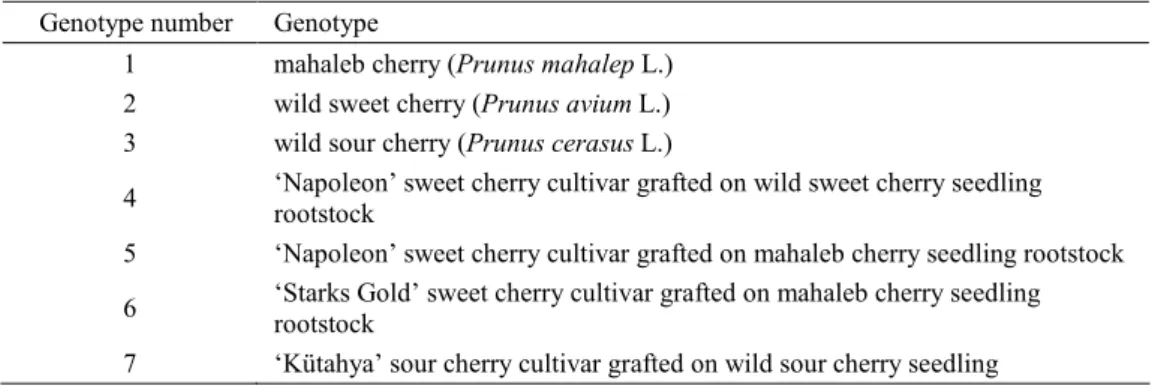
The study was conducted in Niğde Province of Turkey in 2015, which was a normal year in terms of climatic conditions for the area. Plant materials of the study consisted of mahaleb cherry, wild sweet cher-Table 1. Cherry genotypes subjected to assessments
Genotype number Genotype
1 mahaleb cherry (Prunus mahalep L.) 2 wild sweet cherry (Prunus avium L.) 3 wild sour cherry (Prunus cerasus L.)
4 ‘Napoleon’ sweet cherry cultivar grafted on wild sweet cherry seedling rootstock 5 ‘Napoleon’ sweet cherry cultivar grafted on mahaleb cherry seedling rootstock 6 ‘Starks Gold’ sweet cherry cultivar grafted on mahaleb cherry seedling rootstock 7 ‘Kütahya’ sour cherry cultivar grafted on wild sour cherry seedling
ry, and wild sour cherry seedlings grown from seeds, ‘Napoleon’ and ‘Starks Gold’ sweet cherry cultivars grafted on mahaleb cherry, ‘Napoleon’ sweet cher-ry cultivar grafted on wild sweet chercher-ry and ‘Küta-hya’ sour cherry cultivar grafted on wild sour cherry. The genotypes were numbered from 1 to 7 as given in Table 1.
The study was conducted according to randomized block design including the plantation and fruit sam-pling, and samples were collected from each genotype representing fruit samples as required at harvest matu-rity stage [Güneyli and Onursal 2014]. Pomological and phytochemical properties of collected samples were examined.
In terms of pomological parameters, fruit width, fruit height, fruit weight, stone weight, flesh/stone ra-tio, fruit skin color indices [L*, a*, b*, chroma (c*), and hue (h°)], total soluble solids (TSS) (%), titratable acidity (TA), TSS/TA, pH, were measured. In terms of phytochemical parameters, total phenolics (TP), trolox equivalent antioxidant capacity (TEAC), total monomeric anthocyanin content (TMAC), citric acid, malic acid, total specific acids, fructose, glucose and inverted sugars, were evaluated.
Fruit width (mm) and height (mm) were measured using digital calipers. Fruit and stone weight (g) were measured by precision scales (0.01 g), and flesh/stone ratio was calculated according to these values. Fruit skin color indices included in this study were: L*, a* and b* which are representing the lightness coefficient L*, ranges from black to white, the color of redness a* ranges from green to red and b* value is yellowness ranges from blue to yellow. Fruit skin color values of these indices were detected by Color Meter (Konica Minolta, CR-400) according to CIELAB objective color indices [McGuire 1992], and chroma (c*) and hue (h°) values were calculated from these indices. TSS was measured by hand refractometer (0–32% Brix), TA (%) was measured in terms of malic acid according to Haffner and Vestrheim [1997], and TSS/ TA value, indicating maturity index, which is an im-portant trait for eating quality of fruits, was calculated according to these values.
TP content (mg GAE/kg fruit weight) was mea-sured according to spectrophotometric method de-scribed by Singleton and Rossi [1965] using Fo-lin-Ciocalteu reagent. TEAC value (mmol TE/kg fruit
weight) was determined according to spectrophoto-metric method used by Rice-Evans et al. [1996] and modified by Özgen et al. [2006]. TMAC value (mg Pg-3-glk/kg fruit weight) was detected according to pH difference method spectrophotometrically described by Giusti and Wrolstad [2005]. Citric acid (μg/g) and malic acid (μg/g) contents were analyzed according to HPLC method described by Shui and Leong [2002], and total acids were calculated by addition of these acid contents. Fructose (μg/g) and glucose (μg/g) con-tents were detected according to HPLC method sug-gested by Bartolome et al. [1995], and inverted sugar contents were calculated by addition of these sugar contents.
All analyses were performed in three replicates, ex-cept from specific sugars and acids that were analyzed in two replicates. Statistical analyses were performed using SPSS 23.0 for Windows software. Results were evaluated according to Duncan’s test (P ≤ 0.05). Cor-relations between traits were determined according to Pearson’s correlation test. Besides, principal compo-nent analysis was performed to determine the relation-ships among traits and genotypes.
RESULTS AND DISCUSSION
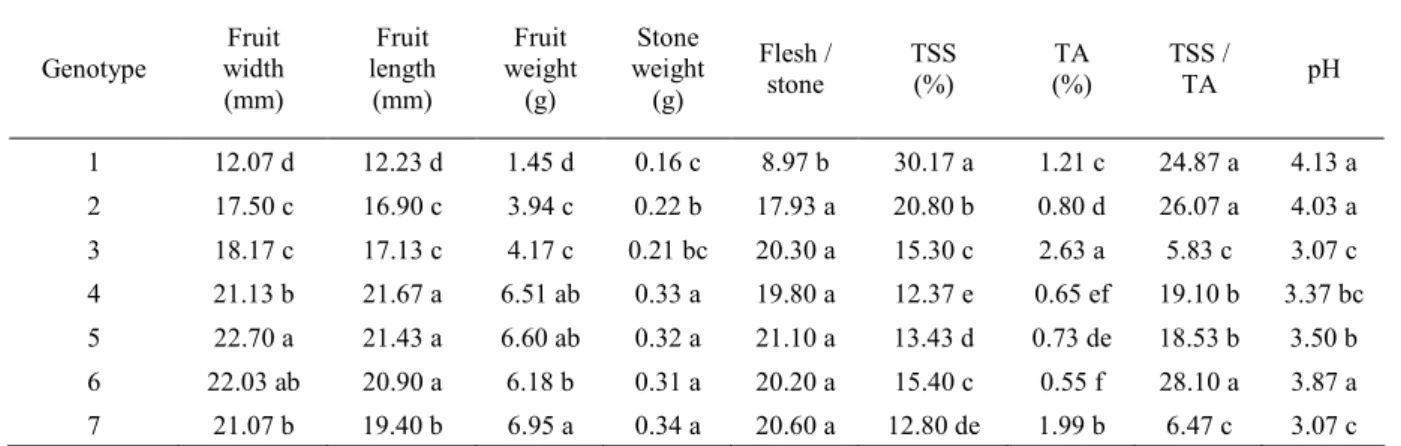
Fruits of mahaleb, wild sweet and wild sour cherries together with ‘Napoleon’ sweet cherry cultivar graft-ed on wild sweet cherry (‘Napolen’/wild sweet) and mahaleb (‘Napolen’/mahaleb), ‘Starks Gold’ sweet cherry cultivar grafted on mahaleb (‘Starks Gold’/ma-haleb), and ‘Kütahya’ sour cherry cultivar grafted on wild sour cherry (‘Kütahya’/wild sour), were evaluat-ed in terms of pomological and phytochemical traits included in the study. Results of the pomological traits were presented in Table 2 and 3, and results of phyto-chemical traits were shown in Table 4 and 5.
Pomological traits. As part of pomological
evalu-ations, variation of fruit sizes (width and length), fruit and stone weight, flesh/stone ratio, TSS, TA, TSS/TA and color parameters (L*, a*, b*, c*, h°) between the genotypes, were examined. Significant differences were found between genotypes in all evaluated traits.
In terms of fruit sizes, ‘Napoleon’/mahaleb was the only genotype resulted in the highest values in both size parameters. Fruit width of this genotype was found as 22.70 mm and was followed by ‘Starks
184 https://czasopisma.up.lublin.pl/index.php/asphc Karaat, F.E., Gündüz, K., Saraçoğlu, O., Yıldırım, H. (2019). Pomological and phytochemical evaluation of different cherry species: mahaleb (Prunus mahaleb L.), wild sweet cherry (Prunus avium L.) and wild sour cherry (Prunus cerasus L.), sweet and sour cherry cultivars. Acta Sci. Pol. Hortorum Cultus, 18(4), 181–191. DOI: 10.24326/asphc.2019.4.17
Table 2. Results of pomological traits for each cherry genotype subjected to assessment Genotype width Fruit
(mm) Fruit length (mm) Fruit weight (g) Stone weight (g) Flesh / stone TSS (%) (%) TA TSS / TA pH 1 12.07 d 12.23 d 1.45 d 0.16 c 8.97 b 30.17 a 1.21 c 24.87 a 4.13 a 2 17.50 c 16.90 c 3.94 c 0.22 b 17.93 a 20.80 b 0.80 d 26.07 a 4.03 a 3 18.17 c 17.13 c 4.17 c 0.21 bc 20.30 a 15.30 c 2.63 a 5.83 c 3.07 c 4 21.13 b 21.67 a 6.51 ab 0.33 a 19.80 a 12.37 e 0.65 ef 19.10 b 3.37 bc 5 22.70 a 21.43 a 6.60 ab 0.32 a 21.10 a 13.43 d 0.73 de 18.53 b 3.50 b 6 22.03 ab 20.90 a 6.18 b 0.31 a 20.20 a 15.40 c 0.55 f 28.10 a 3.87 a 7 21.07 b 19.40 b 6.95 a 0.34 a 20.60 a 12.80 de 1.99 b 6.47 c 3.07 c Differences between values marked with different letters are significant at P ≤ 0.05
TSS – total soluble solids, TA – titratable acidity
Table 3. Color measurement results of each cherry genotype subjected to assessment
Genotype L* a* b* c* h° 1 33.00 c 31.64 a 11.30 b 33.70 a 19.47 c 2 34.48 b 24.79 c 11.87 b 27.55 b 25.36 c 3 28.86 e 22.21 d 3.35 d 22.48 cd 8.30 c 4 28.48 ef 24.58 c 2.44 d 24.72 c 5.40 c 5 27.47 f 21.72 d 0.17 e 21.75 d 150.15 a 6 72.35 a –0.53 e 34.95 a 34.97 a 90.93 b 7 31.11 d 27.87 b 6.43 c 28.62 b 12.90 c
Differences between values marked with different letters are significant at P ≤ 0.05
Table 4. Results of TP, TEAC and TMAC for each cherry genotype subjected to assessment
Genotype (mg GAE/kg FW) TP (mmol TE/kg FW) TEAC (mg Pg-3-glk/kg FW) TMAC
1 2805.67 a 9.53 b 90.77 e 2 2452.33 ab 5.43 d 34.63 f 3 2750.33 a 13.25 a 351.00 a 4 1376.33 d 6.10 c 103.33 d 5 1783.33 cd 6.63 c 152.03 c 6 575.33 e 1.09 f 2.50 g 7 2069.67 bc 4.21 e 166.80 b
Differences between values marked with different letters are significant at P ≤ 0.05
Gold’/mahaleb (22.03 mm). ‘Napoleon’/wild sweet, ‘Napoleon’/mahaleb, ‘Starks Gold’/mahaleb geno-types resulted with highest fruit length values (21.67, 21.43, and 20.90 mm).
‘Kütahya’/wild sour was the only genotype result-ed in the highest values in all weight traits. Average fruit weight of this genotype was 6.95 g, which was followed by ‘Napoleon’/mahaleb and ‘Napoleon’/ wild sweet (6.60 and 6.51 g, respectively). Highest stone weight values were found in ‘Kütahya’/wild sour (0.34 g), ‘Napoleon’/wild sweet (0.33 g), ‘Napoleon’/ mahaleb (0.32 g), and ‘Starks Gold’/mahaleb (0.31 g). Flesh/stone ratios of the genotypes were similar ex-cept from mahaleb resulted in a lower value (8.97).
The highest TSS content was found in maha-leb (30.17%) and the highest TA value was found in wild sour cherry (2.63%). TSS/TA ratio was highest in ‘Starks Gold’/mahaleb (28.10), wild sweet (26.07), and mahaleb (24.87). Similarly, pH values were the highest in mahaleb (4.13), wild sweet (4.03) and ‘Starks Gold’/mahaleb (3.87) fruits.
As a yellow skin colored cultivar, ‘Starks Gold’ gave the highest L* and b* values (72.35 and 34.95, respectively) as expected. Mahaleb was the leading genotype in terms of redness with 31.64 a* value. ‘Starks Gold’/mahaleb and mahaleb gave the highest chroma (c*) values (34.97 and 33.70, respectively), while the highest hue (h°) value was obtained from ‘Napoleon’/mahaleb (150.15).
Karlidag et al. [2009] studied the wild sweet cher-ry genotypes collected from East Turkey. The black-ish wild sweet cherry genotypes included in this study varied between 0.76 and 1.11 g for fruit weight, 20 and 23.98% for TSS, 3.79 and 4.07 for pH, 1.19 and 1.53%
for TA. Mratinić et al. [2012] studied the wild sweet cherry genotypes collected from South-East Serbia. In this study, blackish wild sweet cherries were reported with their fruit length between 0.95 and 1.18 cm, fruit width 0.89 and 1.16 cm, fruit weight 0.78 and 1.34 g, stone weight 0.12 and 0.18 g, TSS content 17.95 and 26.15%, and TA 1.57 and 1.98%. Especially fruit sizes of the wild sweet cherry genotypes included in those studies were found to be smaller in fruit sizes and con-sequently lighter in fruit and stone weight.
Hayaloglu and Demir [2015] compared 0900-Ziraat, synonym of ‘Napoleon’, and ‘Starks Gold’ sweet cherry cultivars grafted on mahaleb. The researchers found fruit width 25.28 and 24.12 mm, fruit length 22.70 and 20.88 mm, fruit weight 7.39 and 6.26 g, TSS 16.56 and 14.08%, TA 0.79 and 0.75%, TSS/TA 20.94 and 18.58, pH 3.8 and 3.69, and color parameters of L*, a*, b*, c*, h° 63.74, 1.86, 27, 27.13, 86.05 and 27.18, 24.80, 10.17, 26.82, 21.83 for ‘Napo-leon’ and ‘Starks Gold’, respectively. Fruits of ‘Küta-hya’ sour cherry cultivar were investigated by Bolat and Pırlak [1998]. Researchers found the fruit weight 4.24 g, stone weight 0.34 g, fruit length 20 mm, fruit width 18.3 mm, TSS 10.8%, pH 4.60, TA 0.89 g/100 ml. There were some differences found between the results of these studies and our study that were proba-bly caused by growing conditions and crop load.
Phytochemical traits. All evaluated
phytochemi-cal traits significantly varied between genotypes and the results were given in Table 4 and 5. Wild sour cherry was the only genotype resulted with the high-est TP, TEAC and TMAC values (2750.33 mg GAE/ kg FW, 13.25 mmol TE/kg FW, and 351.00 mg Pg-3- -glk/kg FW, respectively) at the same time. Mahaleb Table 5. Results of organic acids and sugars for each cherry genotype subjected to assessment
Genotype Citric acid (µg/g) Malic acid (µg/g) Total acids (µg/g) Fructose (µg/g) Glucose (µg/g) Inverted sugar (µg/g)
1 0.44 ±0.05 2.05 ±0.14 2.48 ±0.19 8.71 ±0.71 20.74 ±1.90 29.45 ±2.61 2 0.16 ±0.01 1.30 ±0.13 1.46 ±0.11 6.92 ±0.02 15.49 ±0.98 22.41 ±1.00 3 0.56 ±0.01 2.96 ±0.66 3.52 ±0.67 5.18 ±0.61 9.14 ±0.90 14.32 ±1.50 4 0.05 ±0.00 0.92 ±0.07 0.97 ±0.08 4.42 ±0.01 7.68 ±0.08 12.10 ±0.07 5 0.06 ±0.01 0.98 ±0.00 1.04 ±0.01 4.70 ±0.02 7.98 ±0.05 12.68 ±0.07 6 0.10 ±0.00 0.87 ±0.08 0.97 ±0.08 5.73 ±0.03 10.92 ±0.12 16.65 ±0.08 7 0.00 ±0.00 1.90 ±0.07 1.90 ±0.07 3.98 ±0.03 6.03 ±0.88 10.01 ±0.91
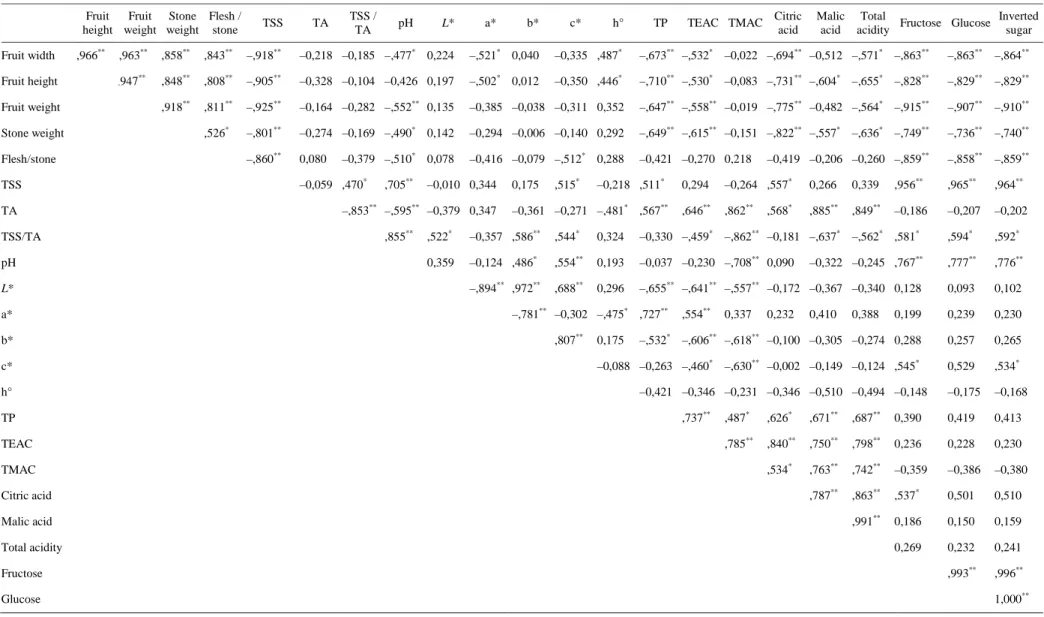
Table 6. Correlation coefficients between pomological and phytochemical traits in cherry genotypes Fruit height Fruit weight Stone weight Flesh / stone TSS TA TSS / TA pH L* a* b* c* h° TP TEAC TMAC Citric acid Malic acid Total
acidity Fructose Glucose Inverted sugar Fruit width ,966** ,963** ,858** ,843** –,918** –0,218 –0,185 –,477* 0,224 –,521* 0,040 –0,335 ,487* –,673** –,532* –0,022 –,694** –0,512 –,571* –,863** –,863** –,864** Fruit height ,947** ,848** ,808** –,905** –0,328 –0,104 –0,426 0,197 –,502* 0,012 –0,350 ,446* –,710** –,530* –0,083 –,731** –,604* –,655* –,828** –,829** –,829** Fruit weight ,918** ,811** –,925** –0,164 –0,282 –,552** 0,135 –0,385 –0,038 –0,311 0,352 –,647** –,558** –0,019 –,775** –0,482 –,564* –,915** –,907** –,910** Stone weight ,526* –,801** –0,274 –0,169 –,490* 0,142 –0,294 –0,006 –0,140 0,292 –,649** –,615** –0,151 –,822** –,557* –,636* –,749** –,736** –,740** Flesh/stone –,860** 0,080 –0,379 –,510* 0,078 –0,416 –0,079 –,512* 0,288 –0,421 –0,270 0,218 –0,419 –0,206 –0,260 –,859** –,858** –,859** TSS –0,059 ,470* ,705** –0,010 0,344 0,175 ,515* –0,218 ,511* 0,294 –0,264 ,557* 0,266 0,339 ,956** ,965** ,964** TA –,853** –,595** –0,379 0,347 –0,361 –0,271 –,481* ,567** ,646** ,862** ,568* ,885** ,849** –0,186 –0,207 –0,202 TSS/TA ,855** ,522* –0,357 ,586** ,544* 0,324 –0,330 –,459* –,862** –0,181 –,637* –,562* ,581* ,594* ,592* pH 0,359 –0,124 ,486* ,554** 0,193 –0,037 –0,230 –,708** 0,090 –0,322 –0,245 ,767** ,777** ,776** L* –,894** ,972** ,688** 0,296 –,655** –,641** –,557** –0,172 –0,367 –0,340 0,128 0,093 0,102 a* –,781** –0,302 –,475* ,727** ,554** 0,337 0,232 0,410 0,388 0,199 0,239 0,230 b* ,807** 0,175 –,532* –,606** –,618** –0,100 –0,305 –0,274 0,288 0,257 0,265 c* –0,088 –0,263 –,460* –,630** –0,002 –0,149 –0,124 ,545* 0,529 ,534* h° –0,421 –0,346 –0,231 –0,346 –0,510 –0,494 –0,148 –0,175 –0,168 TP ,737** ,487* ,626* ,671** ,687** 0,390 0,419 0,413 TEAC ,785** ,840** ,750** ,798** 0,236 0,228 0,230 TMAC ,534* ,763** ,742** –0,359 –0,386 –0,380 Citric acid ,787** ,863** ,537* 0,501 0,510 Malic acid ,991** 0,186 0,150 0,159 Total acidity 0,269 0,232 0,241 Fructose ,993** ,996** Glucose 1,000**
*Correlations significant at P ≤ 0.05 **Correlations significant at P ≤ 0.01
was another leading genotype in terms of TP content (2805.67 mg GAE/kg FW). Results indicated that ma-haleb, wild sweet and wild sour cherries were richer than the cultivars in TP contents. On the other hand, significant effects of rootstocks were observed on TP and TMAC contents when results of ‘Napoleon’/wild sweet and ‘Napoleon’/mahaleb were compared.
Results of organic acid analyses proved malic acid as the dominant organic acid in cherry fruits, and the highest malic acid contents were found in wild sour cherry (Tab. 5). Wild sour cherry was the leading genotype both in citric acid and malic acid, and con-sequently in total acid contents (0.56, 2.96, and 3.52 µg/g, respectively). ‘Kütahya’/wild sour did not con-tain citric acid, and ‘Napoleon’/wild sweet was the following lowest citric acid containing genotype (0.05 µg/g). The lowest malic acid amounts were obtained from ‘Starks Gold’/mahaleb (0.87 µg/g). Sugar con-tents were also presented in Table 5. Mahaleb was the leading genotype both in fructose, glucose, and con-sequently inverted sugar contents (8.71, 20.74, and 29.45 µg/g, respectively). ‘Kütahya’/wild sour gen-otype gave the lowest amounts for those parameters (3.98, 6.03, and 10.01 µg/g, respectively).
Karlidag et al. [2009] reported that blackish wild sweet cherries varied between 221 and 321 mg GAE/100 g FW for TP, and 69 and 83 mg/100 g FW
for total anthocyanin contents. Mratinić et al. [2012] reported that obtained values of blackish wild sweet cherries varied between 8.67 and 16.04% for inverted sugar, 1388 and 1544 mg/l for TP, anthocyanin 0.014 and 0.073 mg/l. TP results of Karlidag et al. [2009] found similar to our results, whereas Mratinić et al. [2012] reported lower results. On the other hand, re-sults on anthocyanin and inverted sugar contents were found different than our results.
Mahaleb fruits from different selections were ex-amined in a study Blando et al. [2016]. In this study, TP varied between 5.45 and 8.97 g GAE/kg FW, TEAC varied between 26 and 45 mmol TE/kg FW, and total anthocyanin varied between 2.60 and 5.50 g/kg FW. Taghizadeh et al. [2015] studied ten maha-leb selections and found TP between 0.66 and 1.99 g GAE/kg FW, and total anthocyanin 67.52 and 260.81 mg cyanidin-3-glucoside (CY) equivalent per g of dry extract. Results of those studies and our results indi-cated a large variation for TP, TEAC and TMAC of mahaleb genotypes that were reported as higher by Blando et al. [2016] and similar by Taghizadeh et al. [2015] when compared to our results.
Hayaloglu and Demir [2015] compared ‘Napo-leon’ and ‘Starks Gold’ cultivars grafted on mahaleb. The amount of TP was determined as 69.72 and 64.37 mg GAE/100 g FW, and total anthocyanin was found Table 7. Correlation between traits and the first two principal components (PC)
Pomological
traits λ = 45.07 PC1 λ = 32.58 PC2 Phytochemical traits λ = 56.92 PC1 λ = 34.25 PC2
Width ,968 ,216 Citric acid ,938 –,008
Length ,946 ,234 Malic acid ,860 –,383
Fruit weight ,966 ,114 Total acidity ,909 –,316
Stone weight ,839 ,163 Fructose ,566 ,819
Flesh/stone ,876 –,017 Glucose ,548 ,836 TSS –,978 ,089 Inverted sugar ,553 ,832 TA –,040 –,725 TP ,827 –,046 TSS/TA –,388 ,798 TEAC ,874 –,305 pH –,650 ,603 TMAC ,550 –,825 L* ,056 ,899 a* –,389 –,792 b* –,137 ,885 c* –,484 ,656 h° ,364 ,487
188 https://czasopisma.up.lublin.pl/index.php/asphc Karaat, F.E., Gündüz, K., Saraçoğlu, O., Yıldırım, H. (2019). Pomological and phytochemical evaluation of different cherry species: mahaleb (Prunus mahaleb L.), wild sweet cherry (Prunus avium L.) and wild sour cherry (Prunus cerasus L.), sweet and sour cherry cultivars. Acta Sci. Pol. Hortorum Cultus, 18(4), 181–191. DOI: 10.24326/asphc.2019.4.17
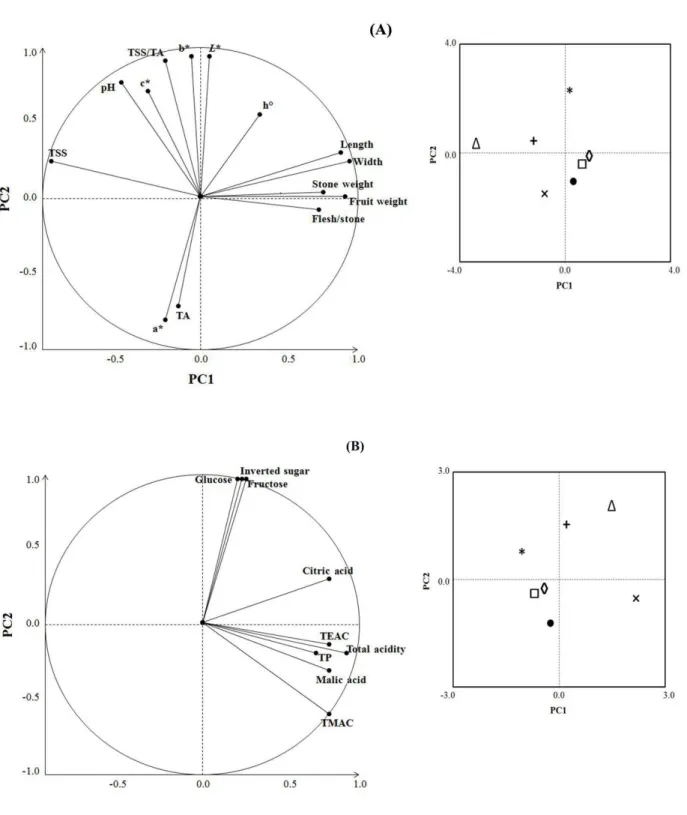
Fig. 1. Segregation of cherry genotypes according to pomological (A) and phytochemical (B) characteristics determined by principal component analysis; ∆ = mahaleb; + = wild sweet; × = wild sour; □ = ‘Napoleon’/wild sweet; ◊ = ‘Napoleon’/ mahaleb; * = ‘Starks Gold’/mahaleb; ● = ‘Kütahya’/wild sour
as 24.56 and 0.61 mg cyanidin-3-O-rutinoside equiva-lent (CRE) per 100 g of FW in ‘Napoleon’ and ‘Starks Gold’ cultivars, respectively. Malic acid and citric acid contents were reported as 23.61 and 5.11 g/kg FW for ‘Napoleon’, and 25.06 and 6.17 g/kg FW for ‘Starks Gold’. Our TP results were similar in ‘Starks Gold’ but higher in ‘Napoleon’. On the other hand, our re-sults for acids were found to be higher, which could be caused by a variety.
Bolat and Pırlak [1998] detected inverted sugar content of ‘Kütahya’ sour cherry cultivar fruits. Re-searchers reported inverted sugar contents as 9.24%; a similar result found in our study.
Correlations analysis performed to examine the
re-lationships between the traits and obtained results were given in Table 6. Fruit size parameters were found negatively correlated with TP, TEAC, citric acid, total acidity and sugars. Fruit and stone weight parameters were negatively correlated with pH, TP, TEAC, citric acid and sugars. TSS was found positively correlat-ed with pH, c*, TP, citric acid and sugars. TA posi-tively correlated with TP, TEAC, TMAC, citric acid, malic acid, and total acidity, whereas negatively cor-related with pH and h°. Color parameters of L* and b* negatively correlated with TP, TEAC and TMAC, whereas a* positively correlated with TP and TEAC. Positive correlations between TP, TEAC and TMAC parameters were determined and also these parameters were positively correlated with acids. Citric acid was positively correlated with malic acid and consequent-ly total acidity. Similarconsequent-ly positive correlations were found between fructose and glucose and consequently inverted sugar.
Principal component analysis. Principal
compo-nent analysis was applied to obtain a more clear visu-alization of the whole data as previously used for fruit traits and genotypes of cherries [Girard and Kopp, 1998]. The analyses were performed for pomological and phytochemical traits separately, and more than seventy and ninety percent of the variability observed on the traits, respectively, were explained by the first two components (PC1-PC2) (Tab. 7). Composing more than 70% of total variance, first two components (PC1 and PC2) were further investigated both for po-mological and phytochemical traits. The rest of the components (PC14 for pomological traits, PC3-PC9 for phytochemical traits) varied to a lesser extent
and they were not further considered in this study. Table 7 shows correlations between the original vari-ables and the first two principal components.
Pomological traits of width, length, fruit weight, stone weight, flesh/stone, TSS and pH were mainly rep-resented by PC1, account for 45.07% of the variance, and TA, TSS/TA, L*, a*, b*, c* and h° were mainly represented by PC2, account for 32.58% of the vari-ance. Phytochemical traits of citric acid, malic acid, to-tal acidity, TP, and TEAC were mainly represented by PC1, account for 56.92% of the variance, and fructose, glucose, inverted sugar, and TMAC were mainly rep-resented by PC2, account for 34.25% of the variance.
Component scores of the genotypes subjected to assessment are shown in Figure 1. Positive values of PC1 were indicated by genotypes with high fruit length, width, weight, stone weight and flesh/stone in pomological analyses. Genotypes ‘Napoleon’/wild sweet and ‘Napoleon’/mahaleb belong to this group. Positive PC1 values indicated high TEAC, total acid-ity, TP, and malic acid content in phytochemical anal-yses, and mahaleb, wild sweet and wild sour cherry located in this group. On the other hand, TSS was indicated by negative PC1 values, and mahaleb, wild sweet and wild sour cherry belonged to this group. The highest PC2 values indicated high pH, L*, b*, c* such as ‘Starks Gold’/mahaleb genotype in pomo-logical traits, and high fructose, glucose and inverted sugar content such as mahaleb and wild sweet cherry genotypes in phytochemical traits. Besides, genotypes scored negative PC2 values such as wild sour cherry and ‘Kütahya’/wild sour had low a* and TA contents.
CONCLUSIONS
In this study, pomological and phytochemical fruit quality properties of mahaleb, wild sweet and wild sour cherries together with ‘Napoleon’ (grafted both on mahaleb and wild sweet cherry) and ‘Starks Gold’ sweet cherry cultivars and ‘Kütahya’ sour cherry culti-var, were examined. Results indicated a high variabil-ity between cherry genotypes included in the study. Especially, the differences observed between cultivars and wild genotypes were higher. Mahaleb fruits were distinguished with their higher TSS and sugar con-tents, and wild sour cherry fruits were the richest in terms of phytochemical composition.
190 https://czasopisma.up.lublin.pl/index.php/asphc Karaat, F.E., Gündüz, K., Saraçoğlu, O., Yıldırım, H. (2019). Pomological and phytochemical evaluation of different cherry species: mahaleb (Prunus mahaleb L.), wild sweet cherry (Prunus avium L.) and wild sour cherry (Prunus cerasus L.), sweet and sour cherry cultivars. Acta Sci. Pol. Hortorum Cultus, 18(4), 181–191. DOI: 10.24326/asphc.2019.4.17
When rootstock performances of mahaleb and wild sweet cherry were compared, it was observed that fruit width, TSS, color parameters of a*, b*, c*, h°, and TMAC were significantly affected by rootstocks and most of the values were higher in plants grafted on mahaleb.
Correlation analyses were performed to observe the relationships between the traits and significant correla-tions were found between several parameters. Especial-ly, the correlations of phytochemical traits with fruit size, weight and color parameters were found notable.
Principal component analysis proved the high vari-ation found in most of the traits evaluated between the genotypes. Results revealed the difference between cultivars and wild genotypes, and especially maha-leb was concluded to have different characteristics in pomological traits, and wild sour cherry was distin-guished with higher phytochemical contents.
REFERENCES
Bartolome, A.P., Ruperez, P., Fuster, C. (1995). Pineapple fruit: Morphological characteristics, chemical composi-tion and sensory analysis of Red Spanish and Smooth Cayenne cultivars. Food Chem., 53, 75–79.
Baytop, T. (1984). Therapy with medicinal plants in Turkey (past and present). Nobel Press, Istanbul, p. 353. Blando, F., Albano, C., Liu, Y., Nicoletti, I., Corradini, D.,
Tommasi, N., Gerardi, C., Mita, G., Kitts, D.D. (2016). Polyphenolic composition and antioxidant activity of the under‐utilised Prunus mahaleb L. fruit. J. Sci. Food Agric., 96(8), 2641–2649.
Bolat, İ., Pırlak, L. (1998). Erzurum koşullarinda yetiştir-ilen Kütahya vişne çeşidinde bazi biyolojik özelliklerin ve meyve gelişiminin incelenmesi. Atatürk Üniv. Ziraat Fak. Derg., 29(1), 1–11.
Buman, G. (1977). Clonal selection in Prunus mahaleb rootstocks. Acta Hortic., 75, 139.
Ercisli, S. (2004). A short review of the fruit germplasm resources of Turkey. Genet. Resour. Crop. Evol., 51(4), 419–435.
FAO. (2018). Food and Agriculture Organization, Crop Sta-tistics, http://www.fao.org/faostat/en/#data/QC [date of acces: 21.07.2018].
Girard, B., Kopp, T.G. (1998). Physicochemical character-istics of selected sweet cherry cultivars. J. Agric. Food Chem., 46(2), 471–476.
Giusti, M.M., Wrolstad, R.E. (2005). Characterization and measurement of anthocyanins by UV-visible
spectrosco-py, Unit F1.2. In: Handbook of Food Analytical Chem-istry, Wrolstad, R.E., Schwartz, S.J. (eds.). Wiley, New York, 19–31.
Güneyli, A., Onursal, C.E. (2014). Ilıman İklim Meyvel-erinde Hasat Kriterleri. Gıda, Tarım ve Hayvancılık Bakanlığı, Meyvecilik Araştırma Enstitüsü, http://ara- stirma.tarim.gov.tr/marem/Belgeler/Yeti%C5%9Ftirici-lik%20Bilgileri/Il%C4%B1man%20%C4%B0klim%20 Meyvelerinde%20Hasat%20Kriterleri.pdf [date of ac-ces: 31.01.2019].
Halilova, H., Ercisli, S. (2010). Several physico-chemical characteristics of cherry laurel (Laurocerasos officinalis Roem.) Fruits. Biotechnol. Biotechnol. Equip., 24(3), 1970–1973.
Haffner, K., Vestreheim, S. (1997). Fruit quality of strawber-ry cultivars. Acta Hortic., 439(1), 325–332.
Hayaloglu, A.A., Demir, N. (2015). Physicochemical char-acteristics, antioxidant activity, organic acid and sugar contents of 12 sweet cherry (Prunus avium L.) cultivars grown in Turkey. J. Food Sci., 80(3), 564–570.
Jerković, I., Marijanović, Z., Staver, M.M. (2011). Screen-ing of natural organic volatiles from Prunus mahaleb L. honey: coumarin and vomifoliol as nonspecific bio-markers. Molecules, 16(3), 2507–2518.
Karlidag, H., Ercisli, S., Sengul, M., Tosun, M. (2009). Physico-chemical diversity in fruits of wild-growing sweet cherries (Prunus avium L.). Biotechnol. Biotech-nol. Equip. 23(3), 1325–1329.
Liu, R.H. (2003). Health benefits of fruit and vegetables are from additive and synergistic combinations of phyto-chemicals. Am. J. Clin. Nutr. 78(Suppl.), 17–20. McGuire, R.G. (1992). Reporting of objective color
mea-surements. HortScience, 27(12), 1254–1255.
Mitra, S.K., Bose, T.K., Rathore, D.S. (2003). Temperate fruits. Horticulture and Allied Publishers, Calcutta, In-dia, p. 309.
Mratinić, E., Fotirić-Akšić, M., Jovković, R. (2012). Analysis of wild sweet cherry (Prunus avium L.) germplasm diver-sity in South-East Serbia. Genetika, 44(2), 259–268. Niklas, K.J. (1997). The evolutionary biology of plants.
University of Chicago Press, Chicago.
Nizamlıoğlu, N.M., Nas, S. (2010). Meyve ve sebzelerde bulunan fenolik bileşikler; yapıları ve önemleri. Gıda Tekn. Elek. Derg., 5(1), 20–35.
Özbey, A., Öncül, N., Yildirim, Z., Yildirim, M. (2011). Ma-hlep ve maMa-hlep ürünleri. Gaziosmanpaşa Üniv. Ziraat Fak. Derg. 28(2), 153–158.
Özgen, M., Reese, R.N., Tulio, A.Z., Miller, A.R., Scheer-ens. J.C. (2006). Modified
2,2-azino-bis-3-ethylbenzo-thiazoline-6-sulfonic acid (ABTS) method to measure antioxidant capacity of selected small fruits and com-parison to ferric reducing antioxidant power (FRAP) and 2,2’-diphenyl-1-picrylhydrazyl (DPPH) methods. J. Agric. Food Chem., 54, 1151–1157.
Rice-Evans, C.A., Miller, N.J., Paganga, G. (1996). Struc-ture-antioxidant activity relationship of flavonoids and phenolic acids. Free Radic. Biol. Med., 20, 933–956. Shui, G., Leong, L.P. (2002). Seperation and determination
of organic acids and phenolic compounds in fruit juices and drinks by high-performance liquid chromatography. J. Chromatogr., 977, 89–96.
Singleton, V.L., Rossi, J.L. (1965). Colorimetry of total phenolics with phosphomolybdic-phosphotungstic acid reagents. J. Enol. Vitic., 16, 144–158.
Taghizadeh, S.F., Asgharzadeh, A., Asili, J., Sahebkar, A., Shakeri, A. (2015). Evaluation of total phenolic content and antioxidant activity in ten selected mahaleb (Prunus
mahaleb L.) genotypes. Int. J. Hortic. Sci. Technol.,
2(2), 187–197.
Wojdyło, A., Nowicka, P., Laskowski, P., Oszmiański, J. (2014). Evaluation of sour cherry (Prunus cerasus L.) fruits for their polyphenol content, antioxidant proper-ties, and nutritional components. J. Agric. Food Chem. 62(51), 12332–12345.