KADĠR HAS UNIVERSITY SCHOOL OF GRADUATE STUDIES
PROGRAM OF PSYCHOLOGY
HUMANS VS. ANIMALS: A CONTEMPORARY MORAL
PERSPECTIVE TOWARD DIETARY AND ETHICAL
LIFESTYLES
YUNUS BAYRAMOĞLU
MASTER‘S THESIS
HUMANS VS. ANIMALS: A CONTEMPORARY MORAL
PERSPECTIVE TOWARD DIETARY AND ETHICAL
LIFESTYLES
YUNUS BAYRAMOĞLU
MASTER‘S THESIS
Submitted to the School of Graduate Studies of Kadir Has University in partial fulfillment of the requirements for the degree of Master‘s Program of Psychology.
iii TABLE OF CONTENTS
TABLE OF CONTENTS ... iii
ABSTRACT ... vi
ÖZET ... vii
LIST OF TABLES ... viii
LIST OF FIGURES ... ix
1. INTRODUCTION ... 1
1.1. Veganism ... 2
1.2. Veganism In Social Sciences ... 3
1.3. Motivations For Veganism ... 4
1.4. Meat, Milk, Dairy And Eggs Commitment And Vegan Lifestyle ... 5
1.5. Moral Principles In Ethical Judgment Process ... 7
1.6. Moral Foundations Theory ... 8
1.7. Dietary Lifestyle And Prosociality ... 9
1.8. Analytic Thinking Style & Actively Open-Minded Thinking ... 10
1.9. The Present Study ... 10
2. METHOD ... 14
2.1. Participants ... 14
2.2. Materials And Procedure ... 15
2.2.1. Dietary lifestyle related measures ... 16
2.2.2. Individual differences measures ... 17
2.2.3. Morality related measures ... 19
3. RESULTS ... 23
3.1. Data Analysis Strategy ... 23
3.2. Scale Development ... 23
3.2.1. Motivations for veganism scale... 23
3.2.2. Reliability and validity of cow‘s milk, dairy and eggs commitment scale 26 3.2.3. Reliability and validity of vegan lifestyle scale ... 27
iv 3.4. Group Differences Between Dietary And Ethical Lifestyles On Variables Of
Concern ... 30
3.4.1. Demographical differences ... 30
3.4.2. Prosociality (toward humans & toward animals) ... 31
3.4.3. Motivations for veganism... 31
3.4.4. Actively open-minded thinking and analytic thinking style ... 32
3.4.5. Moral foundations differences between dietary and ethical lifestyle groups 33 3.4.6. Consequentialist thinking, moral minimalism, and utilitarian vs. deontological moral judgment ... 34
3.4.7. Differences of speciesist attitudes between dietary and ethical lifestyle groups……….. ... 35
3.4.8. Predicting utilitarian responses using dietary lifestyles logistic regressions 36 3.4.9. Dietary lifestyle differences in species-incompatible ethical dilemmas38 4. DISCUSSION ... 45
4.1. Limitations And Future Directions ... 52
4.2. Conclusions ... 54
5. REFERENCES ... 55
APPENDIX ... 61
Appendix A: Informed Consent Form ... 61
Appendix B: Demographics ... 62
Appendix C: Cognitive Reflection Test ... 65
Appendix D: Motivations For Veganism Scale ... 66
Appendix E: Meat Commitment Scale ... 70
Appendix F: Cow‘s Milk, Dairy And Eggs Commitment Scale ... 71
Appendix G: Vegan Lifestyle Scale ... 72
Appendix H: Consequentialist Thinking Scale ... 73
Appendix I: Prosociality Measures ... 77
Appendix J: Species-Compatible Ethical Dilemmas (Trolley Problem) ... 79
Appendix K: Species-Incompatible Ethical Dilemmas (Trolley Problem) ... 83
v Appendix M: Actively Open-Minded Thinking Scale ... 91 Appendix N: Debriefing Form ... 92 CURRICULUM VITAE ... 93
vi HUMANS VS. ANIMALS: A CONTEMPORARY MORAL PERSPECTIVE
TOWARD DIETARY AND ETHICAL LIFESTYLES ABSTRACT
Dietary practices are linked with ethics and morality based on different sources of motivations (e.g., moral philosophy). Some of these dietary practices can become a lifestyle with different behavioral patterns, habits and consuming choices in daily life (e.g., veganism). Veganism, by definition, opposes anthropocentrism (human-centrism) and regards animal life as having equal moral value as human life. Thus, using a revised version of the trolley problem, including species-incompatible scenarios (e.g., saving five dogs or one human) in the ethical dilemmas, that omnivores favored human life over animal life despite they were outnumbered (thus showing a speciesist attitude), whereas vegans showed species-egalitarian decision-making pattern and disregarded participants‘ species in dilemmas while making their ethical judgments. We also developed three new measures: Motivations for Veganism Scale (MfVS), Cow‘s Milk, Dairy and Eggs Commitment Scale (CMDECS) and Vegan Lifestyle Scale (VLS). MfVS included three motivations of ethical, health and environmental and its structural validity was supported by our data, suggesting there were three core motivations in the way of becoming a vegan. CMDECS and VLS were developed to differentiate between dietary vegans and lifestyle vegans, but there were inadequate number participants so this could not be investigated. We also found that vegans were thinking more analytically and more open-minded. Finally, we found significant dietary and ethical lifestyle differences in terms of Moral Foundations. Results were interpreted in the light of the existing body of knowledge about moral psychology.
Keywords: anthropocentrism, veganism, speciesism, speciesist attitudes, utilitarianism, deontology, moral foundations, motivations for veganism, analytic thinking, open-mindedness
vii HUMANS VS. ANIMALS: A CONTEMPORARY MORAL PERSPECTIVE
TOWARD DIETARY AND ETHICAL LIFESTYLES ÖZET
Besidüzensel pratikler etik ve ahlak ile farklı motivasyon kaynaklarına dayanarak iliĢkilenmiĢtir (örn., ahlak felsefesi). Bu besidüzensel pratiklerden bazıları gündelik hayatta farklı davranıĢsal örüntülerle, alıĢkanlıklarla ve tüketim seçimleriyle bir yaĢam tarzı olabilmektedir (örn., veganizm). Veganizm, tanım olarak, insanmerkezciliğe karĢıdır ve hayvan hayatını insan hayatıyla eĢit ahlaki değerde görür. Bu nedenle, tramvay probleminin değiĢtirilmiĢ bir versiyonu kullanıldığında ve etik ikilemlere tür-uyumsuz senaryolar (örneğin, beĢ köpeği veya bir insanı kurtarmak) da dahil edildiğinde, hepçiller sayıca az olmasına rağmen hayvan hayatına nazaran insan hayatını tercih etmiĢtir (böylelikle türcü bir tavır göstermiĢlerdir) fakat veganlar tür-eĢitlikçi karar verme modeli göstererek etik karar verirken ikilemlerde katılımcıların türlerini göz ardı etmiĢlerdir. Bunun yanı sıra, üç yeni ölçek geliĢtirilmiĢtir: Veganizm Motivastonları Ölçeği (MfVS), Ġnek Sütü, Süt Ürünü ve Yumurta Bağlılık Ölçeği (CMDECS) ve Vegan YaĢamtarzı Ölçeği (VLS). MfVS, etik, sağlık ve çevresel olmak üzere üç motivasyon içermektedir ve yapısal geçerliliği verilerimizle desteklenmiĢtir. Bu da vegan olma yolunda üç çekirdek motivasyonun olduğu anlamına gelmektedir. CMDECS ve VLS besidüzensel veganları ve yaĢamtarzı veganları ayrıĢtırmak üzere geliĢtirilmiĢtir, fakat yeterli sayıda katılımcı olmadığı için bu önerme incelenememiĢtir. Bir baĢka bulgumuz ise veganların daha analitik düĢündükleri ve daha açık fikirli olduklarıdır. Son olarak, Ahlaki Temeller bazında anlamlı besidüzensel ve etik yaĢamtarzı farklılıkları bulunmuĢtur. Sonuçlar, ahlak psikolojisi ile ilgili var olan bilgi birikiminin ıĢığında yorumlanmıĢtır.
Anahtar Sözcükler: insanmerkezcilik, veganizm, türcülük, türcü tutumlar, faydacılık, görev etiği, ahlaki temeller, veganizm motivasyonları, analitik düĢünce, açık fikirlilik
viii LIST OF TABLES
Table 3.1 Zero-order Correlations between Variables of Concern…………28 Table 3.2 Post-hoc comparisons with Bonferroni correction, investigating the interaction term between Dilemma Type and
ix LIST OF FIGURES
Figure 3.1 Confirmatory Factor Analysis of Motivations for
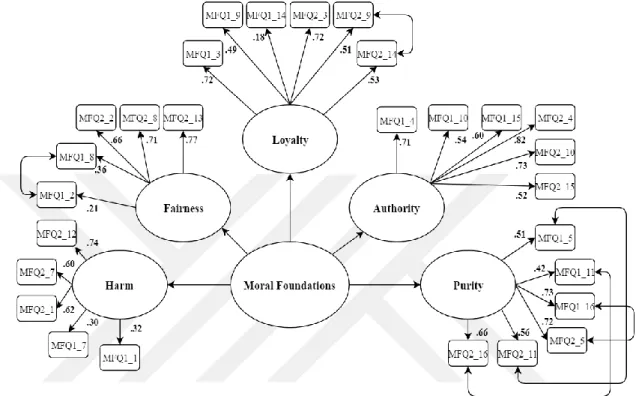
Veganism Scale………...25 Figure 3.2 Confirmatory Factor Analysis of Moral Foundations
Questionnaire………..30 Figure 3.3 Estimated marginal mean plots of three dietary
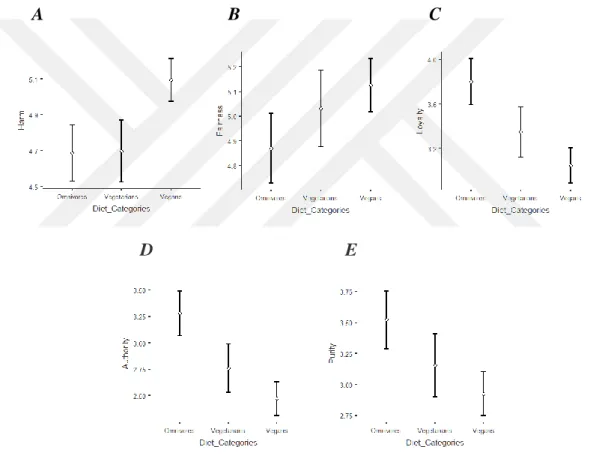
and ethical groups on Moral Foundations: A = Harm;
B = Fairness; C = Loyalty; D = Authority; E = Purity………34 Figure 3.4 Estimated marginal means plots of four logistic
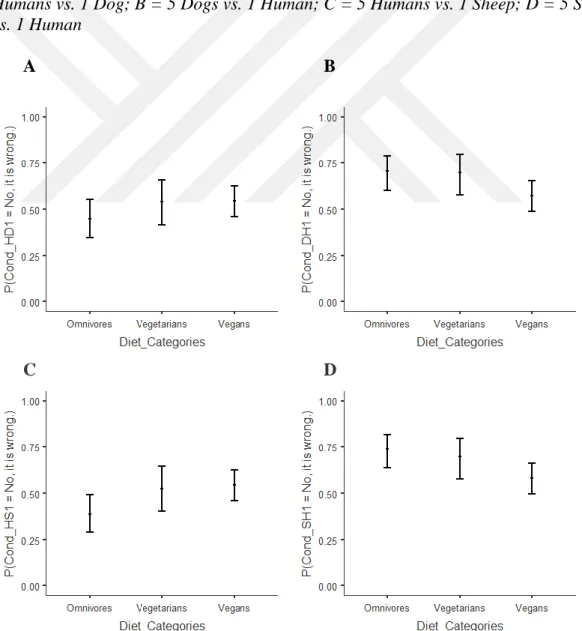
regression analyses; A = 5 Humans vs. 1 Dog; B = 5 Dogs vs. 1 Human; C = 5 Humans vs.
1 Sheep; D = 5 Sheep vs. 1 Human……….37 Figure 3.5 The Plot of Speciesism: Secondary Utilitarianism
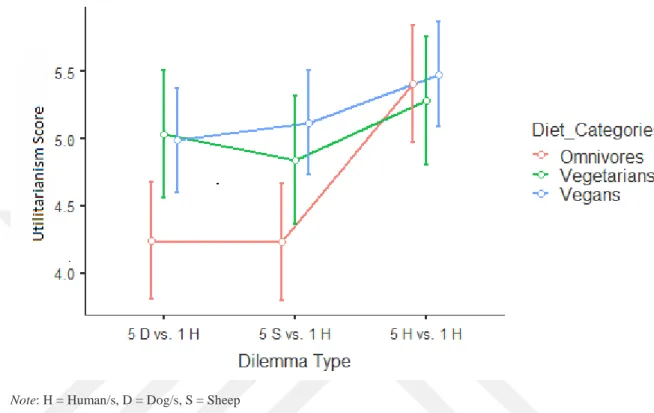
Scores of Dietary and Ethical Lifestyle Groups on
Species-Incompatible Moral Dilemmas………..39 Figure 3.6 Mean secondary utilitarianism scores of three dietary
and ethical lifestyle groups on 5 Dogs vs. 1 Human, 5 Sheep vs. 1 Human and 5 Humans vs. 1 Human
1
1. INTRODUCTION
Dietary practices are linked with ethics and morality based on different sources of motivation (e.g., religion, social justice ideals, moral philosophy). Some of these dietary practices can become a lifestyle with different behavioral patterns, habits and consuming choices in daily life (e.g., omnivorism, veganism). Throughout human history, anthropocentrism has been one of the most dominant ways of thinking, defined as the philosophical viewpoint arguing that human beings are the central or most significant entities in the world. Anthropocentrism regards humans as separate from and superior to nature and holds that human life has intrinsic value while other entities (including animals, plants, mineral resources, and so on) are resources that may justifiably be exploited for the benefit of humankind (Boslaugh, 2016). Also, Jonathan Padwe (2013) describes anthropocentrism as a human-centered, or ―anthropocentric,‖ point of view. He states that in philosophy, anthropocentrism can refer to the point of view that humans are the only, or primary, holders of moral standing. Anthropocentric value systems thus see the nature in terms of its value to humans; while such a view might be seen the most clearly in advocacy for the sustainable use of natural resources, even arguments that advocate for the preservation of nature on the grounds that pure nature enhances the human spirit must also be seen as anthropocentric. Different life styles and ethical perspectives such as veganism, is claimed to be in contrary to this perspective of anthropocentrism, which regards animal life as an equal to humans in terms of moral standing and value. This perspective can be linked to differences in the perspectives and involvements of religion (religious affiliation and religiosity), beliefs in morality and ethics. Therefore, in this thesis, the aim is to unveil the similarities and differences between different dietary and ethical lifestyles (e.g., omnivorism, vegetarianism, dietary veganism and lifestyle veganism), on the grounds of religiosity and religious affiliation, moral foundations, ethical decision making and cognitive thinking styles. Since there are significant lifestyle differences, including dietary and consuming practices among people that adopt different dietary and ethical lifestyles, the factors that might lead to these differences or in association with the perspectives, attitudes, intentions and behaviors of omnivores, vegetarians and vegans are expected to
2 be significantly separated on specifically these aspects of ethics, religiosity and morality. Lifestyle vegans claim that there are differences in terms of ethical perspectives between themselves and the other dietary and ethical lifestyle groups, including omnivores and vegetarians, meaning that they perceive what is right and wrong very differently (especially in the case of the relationship between homo-sapiens and the animal kingdom). Based on this claim, it can be expected for people from different dietary and ethical lifestyle groups to differ in terms of ethical decision making and sense of morality. Additionally, since meat-eating attitudes, intentions and practices alongside with anthropocentrism exist in some of major religions such as Christianity and Islam, one can also expect some significant differences in terms of religiosity and religious affiliation between omnivores, vegetarians and vegans. Although it is very possible for a believer to be a lifestyle vegan, it is expected that this possibility is very unlikely because of the anthropocentric nature of the majority of the dominant religions, therefore the religiosity is also included in this research. In order for us to start investigating these possible differences that are mentioned above, there should be a clear explanation of what the dietary and lifestyle differences between these groups of people are, including first and foremost, veganism.
1.1. VEGANISM
Veganism is being defined today with limited changes across different sources. It can be said that veganism may be perceived by general population mainly as a plant-based diet and as is being followed solely or most likely for health reasons such as controlling cholesterol levels or losing weight. But in fact, veganism has a well-documented philosophy behind it, and it can be defined as a philosophy and way of living which seeks to exclude—as far as is possible and practicable—all forms of exploitation of, and cruelty to, animals for food, clothing or any other purpose; and by extension, promotes the development and use of animal-free alternatives for the benefit of humans, animals, and the environment. In dietary terms it denotes the practice of dispensing with all products derived wholly or partly from animals. (The Vegan Society, n.d.). Although a philosophy is involved in the case of veganism, alternate sources involve people who themselves follow a plant-based diet without any philosophical background into the term as well. Based on these sources, veganism is the practice of abstaining from the
3 use of animal products, particularly in diet, and an associated philosophy that rejects the commodity status of animals (Francione, 2012; Pedersen & Staescu, 2014; Steiner, 2013). A follower of the diet or the philosophy is known as a vegan, a term coined by Donald Watson (Lowbridge, 2017; Watson, 2002).
1.2. VEGANISM IN SOCIAL SCIENCES
Veganism in social sciences almost always appears with the term vegetarianism, as it preserves the roots of the vegan philosophy and ideology. Vegetarianism in particular is defined as the voluntary practice of abstention from meat, which can be adopted for a variety of (potentially overlapping) motivations, such as a concern for personal health, animals, or the environment (Beardsworth & Keil, 1992, 1997; Fox & Ward, 2008; Judge & Wilson, 2018).
There are several research directions in social sciences, regarding the concepts of vegetarianism, veganism, and their correlates. For example, a line of research focuses on the relationship between meat-eating and animal products consuming behavior. These mainly include the attitudes, prejudice and bias toward vegetarians and vegans (Chin et al., 2002; Cole & Morgan, 2011; Judge & Wilson, 2018; MacInnis & Hodson, 2017), meat-eating and masculinity (Rozin et al., 2012; Ruby & Heine, 2011; Thomas, 2016), motivations for vegetarianism (Fox & Ward, 2008; Hoffman et al., 2013; Rosenfeld & Burrow, 2017), vegetarianism/veganism and health (Dinu et al., 2016; Dyett et al., 2013; Heiss et al., 2017; Mendes, 2013; Sneijder & Molder, 2004), comparisons between vegans of health reasons and vegans of ethical reasons (Hoffman et al., 2013; Radnitz et al., 2015), judgments on animals‘ moral standing (Piazza et al., 2014, 2018; Piazza & Loughnan, 2016), rationalizations of meat consumption (4N‘s; Piazza et al., 2015), vegansexuality (vegans engaging in sexual relationships and intimate partnership only with other vegans; Potts & Parry, 2010), vegans‘ attitudes toward animal agriculture (Janssen et al., 2016), differences between conscientious omnivores and vegetarians in the evaluation of meat and animals (Rothgerber, 2015) and childhood responsiveness to animal suffering and its relationship with adult animal rights lifestyle (Pallotta, 2008). Although we are able to see a considerable amount of work on the subject of abstaining from meat and animal products, there are little to no
4 research, investigating the motivations for becoming vegan and the potential correlates of these motivations. One of the aims of this study was to investigate these associations.
1.3. MOTIVATIONS FOR VEGANISM
Veganism, as the case could be the same in other philosophical stances in contrary to anthropocentrism, can be seen also as an anthropocentric approach itself, or be practiced as one. This could be caused by people which follows a dietary pattern leaving out all the animal products for mainly health reasons (physical and/or mental), enhance their own quality of life and physical attractiveness, by an anthropocentric point of view. But, this is not entirely the case. In the literature, different motivations in cases of both vegetarianism and veganism have been evaluated with different perspectives. For example, a study in the past has already accomplished that in case of vegetarianism. In a qualitative study, Fox and Ward (2008) investigated the motivations of vegetarianism and found that ethical and health related motivations are the most dominant motivations, while concerns about the environment is indisputable in the case of understanding the motivations of vegetarians. After this important finding, Hoffman and her colleagues (2013) investigated the differences between health and ethical vegetarians, based on strength of conviction, nutrition knowledge, dietary restriction, and duration of adherence. As a result of this study, some significant differences between the two groups have been reported. Most recently, Rosenfeld and Burrow (2017) acknowledged the two-dimensional motivational approach toward vegetarianism (e.g., ethical & health) and additionally, proposed their own reasoning. Their perspective was named Unified Model of Vegetarian Identity (UMVI) and included three types of goals: prosocial, personal and moral, as a novel framework for conceiving plant-based dietary motivations.
Two-dimensional approach of ethical and health motivations has already been studied by comparing these two groups, also in the case of veganism. In the study of Radnitz and her colleagues (2015), the differences of lifestyle choices between health and ethical vegans were examined. By the phrase ―lifestyle choices‖, they investigated nutritional input and dietary practices -which was handled differently in this study- and found that there were significant differences between these groups based on both nutritional input and dietary practices.
5 In this study, however, we aim to investigate the three motivations of ethical, health and environmental in the case of veganism. By recognizing the ethical and health reasons are already defined and demonstrated (even if there are a small number of studies), we predict that the environmental motivations are also key in understanding the motivations for veganism, based on the rising popularity and recognition of the environmental concerns and anecdotal evidence. In order to be able to differentiate between anthropocentric vegans and species-egalitarian lifestyle vegans, a new quantitative measurement tool is further needed.
1.4. MEAT, MILK, DAIRY AND EGGS COMMITMENT AND VEGAN LIFESTYLE
Another important area of interest in the research of vegetarianism and veganism could be considered as meat consumption. Although meat consumption is assumed to be one of the most important parts of the dietary patterns of ordinary people today, some groups (e.g., vegetarians & vegans) do not consume meat. Who do consume meat however, differ at their level of commitment to this dietary item. In a study of Piazza and his colleagues (2015), people‘s rationalizations for consuming meat has been investigated. In their study, researchers extended Melanie Joy‘s (2010) 3N‘s for consuming meat by adding a fourth common rationalization (niceness; the hedonistic quality of meat-eating) and finalized the 4N‘s, including natural, normal, necessary and
nice. Natural dimension refers to the belief that eating meat comes natural to humans. Normal dimension refers to the normative aspect of meat-eating, specifically the
perception that the majority eat meat and it is a normal behavior. Necessary dimension refers to the perception that eating meat is healthy and abstaining from meat is unhealthy, therefore eating meat is a necessity for humans. Finally, nice dimension refers to the joyful and hedonistic aspect of meat-eating and the perception that meat is delicious. When researchers investigated the correlates of 4N‘s of meat-eating, specifically, they found that holding the belief of 4N‘s was positively associated with speciesism and negatively related to pride in animal-product decisions, moral self-regard derived from animal-product decisions, and animal-welfare advocacy and restriction of animal products. Based on this finding, one can speculate that there was a significant association between motivations of eating meat and speciesism. Moreover,
6 meat-eaters (or omnivores as referred in this study) did not feel any pride and moral self-regard in terms of meat consumption, they were showing less favoritism toward animal welfare as their motivations of meat-consumption rise and they did not restrain for animal products based on these associations. Following these findings, Meat Commitment Scale (MCS) was developed by Piazza and Loughnan (2014) to understand and furthermore show the validity of the 4N‘s measurement of rationalization.
Because MCS was only able to differentiate between omnivores and the other dietary and ethical groups, we developed a new scale to differentiate dietary vegans and lifestyle vegans. Dietary vegans could be conceptualized as people who do not consume any animal products in dietary manner, but use other animal products or engage any activities that directly or indirectly harm animals in the process. These products could be perfumeries (deodorants, perfumes, make-up items and other products of bodily maintenance/personal care) for which animal subjects are used for experimentation, clothing and furniture material such as fur, leather and so on. Lifestyle vegans on the other hand, do not consume any animal products and furthermore do not engage in any activities or do not use any material for which any animals will be hurt in the process. To capture these differences, we developed the Vegan Lifestyle Scale (see Materials section). By this way, we will be able to investigate if there are any differences between dietary and lifestyle vegans in the case of speciesist attitudes both in this study and in further studies.
Although previous work investigated the potential correlates of vegan lifestyles and group differences between different dietary lifestyles (and basic motivations behind them) on daily life pratices, they have not investigated how these dietary lifestyles could be associated with ethical decision-making. Based on all the argumentations and examples of the difference of perspectives between dietary and ethical groups, it is plausible to predict that their ethical judgment processes (normative ethical approaches; utilitarianism vs. deontology) could be different. Thus, we also aimed to fill this gap and unveil any associations between differences between omnivores, vegetarians and vegans in terms of ethical judgment processes using well-known ethical dilemma questions with subtle revisions (e.g., trolley dilemma).
7 1.5. MORAL PRINCIPLES IN ETHICAL JUDGMENT PROCESS
For decades, two moral principles have been proposed that play a central role in research on moral judgment. The first principle, utilitarianism perspective in normative ethics is focused on whether the consequences of an action maximize general well-being (Mill, 1861). The second principle, deontology, is often focused on whether the action is in accordance with universal rights and duties (Kant, 1785). This approach specifically, offers a perspective by which an action‘s outcome is unimportant in ethical judgment process. For example, an innocent person should never be sacrificed even if the sacrifice would lead to the survival of a much greater number of people. One of the leading frameworks of the psychology of moral decision-making is the dual-process approach (see Greene et al., 2001). In this perspective, utilitarian and deontologic judgments can be explained on the basis of the operation of two separate mental processes. Type 1 processes are primitive, automatic, and intuitive, whereas Type 2 processes are more deliberate, closer to the current mental status of homo-sapiens, are controlled and analytic. (see also Aktas et al., 2017 for a more detailed introduction).
In this study, we aimed to investigate if there are any differences in the matter of ethical judgments between different groups of omnivores, vegetarians, dietary and lifestyle vegans. As mentioned above, omnivores, vegetarians and vegans proposedly have different perspectives in terms of ethics of daily life including moral regard to non-human animals, food consumption, treatment of animals and so on. Based on this proposition, we propose that their ethical judgment patterns may differ as a function of their dietary life-styles. More specifically, since vegans have strict red lines toward treatment of animals, which items will be included in the category of food, or non-human animal‘s moral value compared to non-humans, they may disregard any typical utilitarian perspectives on a lot of subjects when looking through the glasses of an omnivoristic standpoint. This may differentiate vegans and non-vegans especially in terms of normative ethics, especially if the actors (i.e., human vs. animal) varied in the ethical judgment scenarios. Furthermore, a new approach has been taken in order to further look into if these different groups of dietary and ethical lifestyles see if animals and humans are equal or not in moral value for them. To do this, we revised the typical moral dilemma paradigm changing species of victims.
8 If we expect some differences in terms of ethical judgment based on their choices of consumption and perception of food, it is only logical to consider that they may hold different moral values in different scenarios. If they have different preferences in terms of moral dilemmas, people with different dietary life styles (i.e., omnivores, vegetarians and vegans) may also be differed from each other on their sense of morality. More specifically, what they hold sacred and what they feel are relevant in terms of morality and cooperation could be observed at basic moral values. Therefore, we examined moral foundations differences among people who identified themselves with different dietary life-styles.
1.6. MORAL FOUNDATIONS THEORY
The study of understanding the mental structures behind moral judgments have been studied intensively for the past 50 years, mostly including harm and justice as the basis of morality (Darley & Shultz, 1990; Haidt, Koller & Dias, 1993; Kohlberg, 1969; Nichols, 2002; Nichols & Folds-Bennett, 2003; Piaget, 1965; Rozin, Lowery, Imada & Haidt, 1999; Shweder, Much, Mahapatra & Park, 1997). The Moral Foundations Theory (MFT), however, changed the course of moral judgment research by criticizing Kohlberg's justice-based morality guided by reasoning (Kohlberg, 1969), and offered a multi-foundational model of morality guided by intuitions (Graham, Haidt & Nosek, 2009; Graham et al., 2013; Haidt & Joseph, 2004; Haidt, 2001, 2007, 2012). According to MFT, previous conceptualizations of moral psychology have an implicit bias toward a western, liberal and individualistic understanding of morality which is in fact adopted by a small minority in the world (see Henrich, Heine & Norenzayan, 2010). The theory regards morality as being based on five separate intuitive foundations each of which is supposed to be an evolutionary adaptation designed to solve different adaptive problems.
The five foundations of MFT are care/harm, fairness/cheating, loyalty/betrayal, authority/subversion, and sanctity/degradation. The care/harm foundation is defined as the motivation to care for one's offspring and others that are in need and to protect them from coming to harm. The fairness/cheating foundation is the motivation to act in accordance with justice norms within one's group and to detect those who freeride by benefitting from the group without paying any costs. The loyalty/betrayal foundation is
9 the motivation to protect the interests of one's group against rival groups. The authority/subversion foundation is the motivation to respect those higher than oneself in the social hierarchy and thus to preserve the social order. Finally, the sanctity/degradation foundation is the motivation to be pure both physically and spiritually, to respect the sacred and to suppress carnal desires.
Since cooperation and helping others are considered as a part of being a moral person and for example it may be considered specifically to be in relationship with care dimension (caring others in need is directly related to prosociality), we also investigated the link between dietary life-style and prosociality. Thus, it would be expected that non-vegans would report more prosocial attitudes toward humans compared to non-vegans, whereas vegans tend to show dislike to the current stance of general human ethics, or even misanthropy (as a speculation) based on anecdotal evidence. Additionally, since veganism could be considered as the rejection of anthropocentric philosophy, lifestyle vegans (i.e., people that become vegans mainly because of ethical controversy) would be presumed to show more prosocial attitudes toward animals.
1.7. DIETARY LIFESTYLE AND PROSOCIALITY
Prosociality can be described as acting in the benefit of other human beings. In addition to this, we defined prosociality as actions in the benefit of animals as well as humans. Therefore, we assessed the two constructs of prosociality toward humans and prosociality toward animals in this study. Prosociality toward humans includes helping other people in need, including donating blood, donating money et cetera. Prosociality toward animals includes joining parades against animal cruelty, including sea worlds, zoos, circuses, meat and dairy industries and so on. It also includes helping street animals that are in need, providing food, water and shelter.
Because we expect such differences in terms of ethical judgment processes, sense of morality and the importance of specific moral foundations and prosociality, we would expect that analytic thinking style and open-mindedness could also be associated dietary life-style and moral judgment processes (see Aktas et al., 2017 for the role of analytic thinking style and open-mindedness on moral judgment). Specifically, for a person to divert from society norms about ethics in such a drastic manner, one should elaborate moral and ethical problems more, think more analytically in the case of ethics, be more
10 open-minded in the case of their sense of ethics and morality and therefore should be open to change (both his ethical and moral views and behavior if necessary).
1.8. ANALYTIC THINKING STYLE & ACTIVELY OPEN-MINDED THINKING
One of the manifestations of analytic thinking could be cognitive reflection in contrast to intuition. For this aim, The Cognitive Reflection Test (CRT) was devised by Frederick (2005) and is supposed to be a measure of cognitive reflection of individuals. The variable CRT aims to measure can also be conceptualized as analytic thinking style (ATS). It is comprised of three mathematical text-based problems, which elicit first an intuitive (wrong) answer and can only be solved when consciously thinking of the true answer. The theory behind this task assumes that there are two distinct cognitive processes involved: a fast intuitive one and a slow and rather reflective one (Epstein, 1994). Some researchers called them System 1 (i.e., spontaneous, instantly, effortlessly) and System 2 processes (i.e., effortful, motivated, reflected; Stanovich & West, 2000). To solve the CRT items, one has to ignore the first intention of the System 1 processes and switch to System 2 processes to think intentionally about the correct answer (see Stieger & Reips, 2016).
In addition to the reflection and impulsivity concepts, Baron (1993) developed a reasoning style called actively open-minded thinking (AOT). This style of thinking includes the tendency to weigh new evidence against a favored belief, be open to new information and ideas, to spend sufficient time on a problem before giving up, and to consider carefully the opinions of others in forming one‘s own. (Haran et al., 2013).
1.9. THE PRESENT STUDY
This study contributes into the literature by several ways. First, we developed a novel three-dimensional questionnaire that measures including main motivations in the way of becoming a vegan, and these are ethical, health and environmental. Second, we investigated if there were any significant differences between individuals identifying themselves with different dietary life-styles on multiple variables such as ethical judgment, moral foundations, religiosity, prosociality (with addition of prosociality
11 toward animals), etc. This second contribution mostly includes explanatory efforts. Third, with a quasi-experimental design, we investigated by using multiple statistical analyses such as mixed-design ANOVA and logistic regressions if different dietary and ethical lifestyle groups differ in terms of speciesist attitudes or preferences. Above all and maybe as the most important contribution, we introduce vegan philosophy and lifestyle into psychology literature. Furthermore, with a new revision of ethical dilemmas for our purposes, people belonging in these different groups will be deciding deontological or utilitarian action in a different manner.
In the original trolley problem as an ethical dilemma, there is a runaway trolley going down the road. If there are no interventions taking place, the trolley will hit and kill five workers that are working on the road. But there is a second option. There is a button and if someone pushes that button, the trolley will change its course and kill one person that is working on the other road. The participant in this dilemma, is asked to choose between pushing and not pushing the button. Pushing the button and changing the course of the trolley would mean a utilitarian choice, aiming to save as many people as possible. Not pushing the button, however, would mean a deontological choice, deciding not to interfere with how things are going and not actively killing the other person on the other road, because killing is universally considered wrong.
In this study however, the original demonstration has been revised. More specifically, instead of presenting two sides that are both humans, we changed it to involve species-to-species comparisons. Thus, participants were asked to choose between one human and five dogs, and one dog and five humans. Again, participants were asked to choose between one human and five sheep, and one sheep and five humans. In addition to all these new additions, the original question remains, by presenting the participants same-species comparisons (e.g., human vs. human, dog vs. dog, sheep vs. sheep). By this way, we aimed to understand if people from different dietary and ethical lifestyles regard human and animal life differently; and if this is the case, what will be the pattern of this moral value and preference.
In this study, we sought answers to several research questions. First, the study aimed to investigate if five groups of dietary and ethical lifestyles would differ in terms of motivations for veganism. Specifically, we expected that dietary and ethical vegans
12 would score higher on the Motivations for Veganism Scale, compared to vegetarians and omnivores.
Second, we aimed to investigate if five groups of dietary and ethical lifestyles would significantly differ in terms of meat commitment; milk, dairy and eggs commitment and vegan lifestyle. Specifically, it was expected that both dietary and ethical vegans would have less milk, dairy and eggs commitment compared to vegetarians and omnivores. Vegetarians, and both vegan groups (e.g., dietary & lifestyle) will have less meat commitment compared to omnivores.
Third, we investigated if five groups of dietary and ethical lifestyles would significantly differ in terms of moral foundations and prosociality. Specifically, we expected that vegans would be less prosocial toward humans, but more prosocial toward animals mostly because of their felt injustices done to animals by humans and their higher sympathies toward the entirety of the animal kingdom. Furthermore, it was hypothesized that vegans and omnivores would give different weight on the five moral dimensions of MFQ. More specifically, vegans would report higher importance and relevance for harm and fairness dimensions, while omnivores would score higher on loyalty, authority, and purity dimensions. Because veganism stands on the ground that humans unnecessarily and significantly hurt animals and it is unjust, and because vegans are deviating substantially from their society which inherits a meat-eating and animal using culture that involves seeing some specific animals as commodities, the difference on loyalty, authority and purity was expected.
Fourth, we also tested if omnivores would be more intuitive on Cognitive Reflection Test compared to other groups. It was expected of vegans to score more analytically on CRT compared to omnivores. In parallel with this direction, we also tested group differences in Actively Open-Minded Thinking (AOT). Specifically, it was expected that vegans would be higher on AOT, compared to vegetarians and omnivores. This expectation derived from the aforementioned status of vegans which includes a substantial deviation from their society in terms of how they live their lives and how they see animals. To make such gigantic changes in his life toward what he thinks is morally good and right, one must tend to think more analytically in the face of a problem. Additionally, one also should be more open-minded for him to be able to
13 acquire more information about a subject that is extremely disturbing to think about and elaborate.
Fifth, we tested how dietary lifestyle could be associated with moral judgments using different measures (i.e., Consequentialist Thinking Scale (CTS) and ethical dilemmas). It was hypothesized that vegans would make more deontological judgments in CTS. Since their ethical stance toward life via veganism is very much duty-oriented (e.g., I should not eat meat because it is just wrong), this pattern was the first that comes to mind.
Last, we examined how people with different dietary lifestyles varies in terms of the responses on the ethical dilemmas. For this study, we intentionally changed victims‘ species to see how vegans, vegetarians, and omnivores respond these different scenarios. Although we could not make utilitarianism or deontological judgment inferences by just looking at the number of rescued actors in responses, these revised dilemmas could enable us to see how vegans, vegetarians, and omnivores give weight the potential alternatives. Specifically, we expected that regardless of the amount of people or animals in the dilemma, omnivores would always favor humans. More specifically, it was hypothesized that omnivores would differ in terms of their answers they give on same-species dilemmas and cross-species ones. However, in the case of vegans, this would not be the case. We hypothesized that lifestyle vegans would not differentiate with their answers based on the species of victims in the dilemmas, because they would see humans and animals as equals and would not favor humans in these dilemmas.
14
2. METHOD
2.1. PARTICIPANTS
We recruited 612 participants for the study. However, 325 participants did not answer all of the questions and therefore did not finish the questionnaire, by mostly rejecting to answer moral dilemma questions, therefore they were excluded from the data for further analyses. Remaining 287 participants had a mean age of 26.83 (SD = 7.83). Out of 287, 242 participants were female (84.3%), 33 participants were male (11.5%) and the rest of the participants preferred not to mention their gender.
Following Piazza et al.‘s (2015) classification, we collected data from people defined themselves in five main groups of dietary and ethical lifestyles. These were omnivores [Consume animal products, except those excluded for taste preference, medical (e.g., allergy, intolerance), and/or religious reasons], semi or partial vegetarians [Consume some, but not all, of the following: red meat (beef, veal, etc.), pork, poultry, fish, and/or seafood. Consume eggs and dairy products], vegetarians [Never consume red meat (beef, veal, etc.), pork, poultry, fish, or seafood, but may consume eggs and/or dairy products. Never consume any animal products, including red meat], strict vegetarians
or dietary vegans [Never consume any animal products, including red meat (beef, veal,
etc.), pork, poultry, fish, seafood, eggs, dairy products, or other animal products (e.g., gelatin, casein, etc.)], and lifestyle vegans [Never consume any animal products, and avoid some or all non-food animal products (e.g., leather, silk, cosmetics containing animal ingredients, etc.) and/or products tested on animals.] respectively.
Based on self-reports, 88 omnivores, 41 semi or partial vegetarians, 22 vegetarians, 6
strict vegetarians or dietary vegans, and 130 lifestyle vegans participated to the study.
All of omnivores were recruited from psychology departments of two different universities in Istanbul, Turkey, in exchange for course credit. Nearly all of the rest of our participant pool were recruited through social media platforms (Facebook &
15 Instagram). Participants that were recruited from Instagram were contacted through collaborations with users that had high numbers of vegan followers, and the participants were compensated by receiving gift cards (2 x 50 Turkish Liras) that can be used in vegan shops, or gift boxes that contain vegan food items. Participation via Facebook was entirely voluntary.
Because there were not enough participants in each dietary and ethical lifestyle group for statistical comparisons, we merged some of the groups in order to conduct the analyses more accurately. Specifically, the two groups of semi or partial vegetarians and vegetarians were merged as vegetarians. Additionally, the two groups of strict
vegetarians and dietary vegans and lifestyle vegans were merged as vegans. Finally, we
had three groups of omnivores, vegetarians, and vegans for further analyses. As total we had 88 omnivores, 63 vegetarians and 136 vegans, which were more equally distributed and more fit to the further statistical analyses.
2.2. MATERIALS AND PROCEDURE
For data collection process, we devised an online link via qualtrics. All items in questionnaires were presented in a randomized order. In the first page, participants were presented a series of demographic questions, including age, gender, education level, religious affiliation, and religiosity (i.e., ―how religious are you?‖; not at all religious 1 – 7 extremely religious), ethnicity, political orientation and a single item of where does the person stand on the political spectrum (extreme left 1 – 7 extreme right). At the end of the demographics section, participants were asked where they would place themselves in terms of five main groups of dietary and ethical lifestyles (i.e., omnivore, semi or partial vegetarian, vegetarian, strict vegetarian or dietary vegan, lifestyle vegan)
(for all materials see
https://osf.io/rncd4/?view_only=ab5f91cc2e19410380423a4e3b609fc0).
Then, we asked our participants how many months they have been vegan and for how many months they have been vegetarian before they became a vegan (if they had selected dietary or lifestyle vegan options). Additionally, we asked participants who identified themselves as semi or partial vegetarian or vegetarian for how many months they have been vegetarian.
16 2.2.1. Dietary Lifestyle Related Measures
Motivations For Veganism
We developed a scale (Motivations for Veganism Scale; MfVS) to measure main motivations on being vegan (i.e., ethical, health, environmental). The scale was consisted of 12 items; α = .93), the psychometric properties of the scale presented in the Results section.
Three dimensions were comprised of 4 items each, with one reverse item in each dimension. These were ethical motivations [e.g., ―I have chosen (or thinking to choose) a vegan lifestyle because of ethical reasons.‖, ―I think that consuming or using animal products are wrong because animals are not our commodities.‖; α = .77], health
motivations [e.g., ―I have chosen (or thinking to choose) a vegan lifestyle because of
health reasons.‖, ―Following a plant-based diet and avoiding animal products are better for my health.‖; α = .86] and environmental motivations [e.g., ―I have chosen (or thinking to choose) a vegan lifestyle because of environmental reasons.‖, ―Giving up meat and animal products is reducing my carbon footprint on this planet and serve to
protect our environment.‖; α = .84] (see
https://osf.io/rncd4/?view_only=ab5f91cc2e19410380423a4e3b609fc0).
Meat Commitment
In order to assess participants‘ commitment to consume meat, Meat Commitment Scale (Piazza & Loughnan, 2014, Piazza et al., 2015; MCS) was used. This measure has 7 Likert type items (not at all agree 1 – 5 totally agree; e.g., ―I don‘t want to eat meals without meat.‖, ―I would never give up eating meat.‖; α = .92) and has been previously shown to have a strong test-retest reliability and internal consistency (Piazza et al., 2015) (see https://osf.io/rncd4/?view_only=ab5f91cc2e19410380423a4e3b609fc0).
Cow’s Milk, Dairy And Eggs Commitment
We adapted Cow‘s Milk, Dairy and Eggs Commitment Scale (CMDECS) from MCS that has been developed by Piazza and Loughnan (2014) and has been used first in
17 Piazza et al.‘s (2015) research to assess participants‘ commitment to consume animal products except meat with 7 items. This scale was almost identical with MCS, mostly substituting the word meat with the phrase ―cow‘s milk, dairy and eggs‖ across the questions (not at all agree 1 – 5 totally agree; e.g., ―I don‘t want to eat meals without either cow‘s milk, dairy, eggs or sauces using these ingredients.‖, ―I would never give up cow‘s milk, dairy and eggs.‖; α = .93). Psychometric properties of the scale were presented in the Results section.
Vegan Lifestyle
In order to assess participants‘ attitudes of committing to a vegan lifestyle, which specifically means refraining from products that contribute to the exploitation and harming of animals, we developed the Vegan Lifestyle Scale (VLS). Aim of this measure to be brought to life was the prospective ability to support the validity analyses of MfVS and CMDECS.
This measure has 4 Likert type items (not at all agree 1 – 5 totally agree; e.g., ―I always buy products that are cruelty-free.‖, ―When I need to buy clothing, I do not choose to buy any items that are made from animal skin, fur or any other products causing harm to animals.‖; α = .82). The scale development will be analyzed in terms of validity in the
Results section (see
https://osf.io/rncd4/?view_only=ab5f91cc2e19410380423a4e3b609fc0).
2.2.2. Individual Differences Measures
Prosociality (Toward Humans & Toward Animals)
In order to assess prosocial attitudes of participants, two different measures of prosociality were used. First, we used a single item first used by Clobert and Saroglou (2013): ―If you were to win some money by a lottery, what percentage of it you would keep to yourself and your relatives and what percentage would you give to strangers for help (donation, granting scholarship to students, building a school, etc.).‖ The prosociality score was derived from the percentage given to strangers for help. Higher percentages indicate higher prosociality (see Bayramoglu, Harma & Yilmaz, 2018).
18 Second, we used a revised version of the scale developed by Jordan and her colleagues (2011). Original three-item scale had a Cronbach‘s Alpha score of .60. In our revised version, we transferred the third item (i.e., ―Assume that people in your neighborhood are organizing a project of traveling street to street distributing food to hungry animals. How likely is it for you to participate?‖) to prosociality toward animals scale. After the revision, participants responded to a series of randomly ordered items about their likelihood of donating to charity, donating blood, volunteering, vacationing, attending a party, and seeing a movie in the next month [most unlikely to act on it 1 – 7 most likely to act on it; prosociality toward humans items: ―Assume that in your school there is somebody whose parents went bankrupt. How likely is it for you to donate to contribute the students' school expenses?‖, ―Assume that there has been an earthquake centered nearby which also affected your own city. How likely is it for you to go to the Red Cross (or any other center) voluntarily and donate blood?‖]. Third, we also measured the prosocial intentions toward animals with two items with a new addition of the second question (i.e., ―Assume that people in your neighborhood are organizing a project of traveling street to street distributing food to hungry animals. How likely is it for you to participate?‖, ―Assume that a group of people in your own city or district are organizing a demonstration against the animal cruelty taking place in waterparks and circuses. How likely is it for you to participate?‖). (see https://osf.io/rncd4/?view_only=ab5f91cc2e19410380423a4e3b609fc0).
The first two items formed the dimension of prosocial intentions toward humans (α = .65), and the last two items including the recent addition formed the dimension of
prosocial intentions toward animals (α = .73).
Analytic Thinking Style
To measure analytic thinking style (ATS), Cognitive Reflection Test (CRT) was used. It was first introduced by Frederick (2005) and is supposed to be a measure of cognitive reflection in contrast to intuition. It is comprised of three mathematical text-based problems, which elicit first an intuitive (wrong) answer and can only be solved when consciously thinking of the true answer (i.e., ―A bat and a ball cost $1.10 in total. The bat costs $1.00 more than the ball. How much does the ball cost?‖, ―If it takes 5
19 machines 5 minutes to make 5 widgets, how long would it take 100 machines to make 100 widgets?‖, ―In a lake, there is a patch of lily pads. Every day, the patch doubles in size. If it takes 48 days for the patch to cover the entire lake, how long would it take for the patch to cover half of the lake?‖). Analytic (right) answers were coded as 1, while the intuitive (wrong) answers were coded as 0. Scores then summed up to represent a total score of analytic thinking style, in which higher points indicate higher analytic thinking (see https://osf.io/rncd4/?view_only=ab5f91cc2e19410380423a4e3b609fc0).
Actively Open-Minded Thinking
To measure the participants‘ open-mindedness, Actively Open-Minded Thinking Scale (Baron, 1993) was used. This style of thinking includes the tendency to weigh new evidence against a favored belief, be open to new information and ideas, to spend sufficient time on a problem before giving up, and to consider carefully the opinions of others in forming one‘s own. (see Haran et al., 2013). The scale has 7 items with Likert type measurement, of which 4 of them were reverse items (Absolutely disagreed 1 – 5 Absolutely agreed; e.g., ―Beliefs should always be revised in response to new information or evidence.‖, ―One should disregard evidence that conflicts with your established beliefs.‖; α = .61).
2.2.3. Morality Related Measures
Moral Foundations
Moral foundations of participants were assessed by Moral Foundations Questionnaire (MFQ-30; Graham, Haidt & Nosek, 2009), in which there are 5 dimensions and two subscales that contain 30 Likert type questions in total, 6 questions for each dimension of care/harm (α = .58), fairness/cheating (α = .56), loyalty/betrayal (α = .71), authority/subversion (α = .81) and sanctity/degradation (α = .79).
First subscale contains 15 Likert type items (3 items for each dimension) that asks participants how much they agree with each statement (strongly disagree 1 – 6 strongly agree). Second subscale also contains 15 Likert type items (3 items for each dimension) that asks how much the following items are relevant with morality (not at all relevant 1
20 – 6 extremely relevant). Finally, 3 questions from the first subscale and 3 questions from the second subscale were brought together and averaged to finalize each dimension score.
Utilitarian Vs. Deontological Ethical Judgment
To assess participants‘ utilitarianism, two different measures were adopted. First, Consequentialist Thinking Scale (CTS; Piazza & Sousa, 2013) was used. This measure has 14 items with Likert type questions [Deontological response 1 – 3 Consequentialist (utilitarian) response; e.g., ―Which of the following statements best characterizes your position on killing?‖, possible answers are: ―It is never morally permissible to kill someone.‖ (deontological answer), ―If killing someone will produce greater good than bad consequences, then it is morally permissible to kill that person.‖ (weak consequentialist answer), ―If killing someone will produce greater good than bad consequences, then it is morally obligatory to kill that person.‖ (consequentialist
answer); α = .83) (see
https://osf.io/rncd4/?view_only=ab5f91cc2e19410380423a4e3b609fc0).
Second, a revised version of trolley problem was used. Participants were asked to elaborate on a problem, in which there was a run-away trolley. If the trolley‘s path is not intervened, it will hit and kill five workers that are working on the rail-road. However, if the trolley‘s path is changed, one worker that is working at the other rail-road will be killed, while the other five will be saved. After explained in writing, participants are asked to judge whether it is morally right to press the button and cause one person to die in order to save five (i.e., ―yes, it is right‖, ―no, it is not right‖). Additionally, participants are asked if it is permissible to press the button (never permissible 1 – 5 totally permissible) and if it is compulsory (never compulsory 1 – 5 totally compulsory). Finally, participants are asked how hard was it to provide an answer to that moral dilemma (not at all hard 1 – 5 extremely hard).
Yes-no answers were coded as 1 and 2 respectively, and the responses to this dichotomous variable represented their main utilitarianism score. Summed score of being permissible and being compulsory formed the secondary utilitarianism score,
21 while extracting the being compulsory score from being permissible score formed the
moral minimalism score (adopted from Aktas, Yilmaz & Bahçekapili, 2017).
However, since the focus of this research is to understand if people that adopt different dietary and ethical lifestyles (i.e., omnivores, vegetarians, vegans) differ in terms of ethics and morality, two additional moral dilemmas with the same set of questions were added. These included dogs and sheep as characters in themselves and participants were asked to provide answers for them as well (i.e., 5 dogs vs. 1 dog, 5 sheep vs. 1 sheep). We used dogs and sheep for different reasons. We included dogs because dogs are considered one of the most liked pets both in the western societies and in the world. People adopt them and provide for them for the entirety of their lives and dogs in general holds a special place in the human world. We included sheep because they are considered mostly as edible and usable, as a commodity in general. Sheep are considered as having usable utilities such as wool, meat and milk. Sheep provides an important contribution in moral dilemmas, by enabling the comparison between dogs and themselves, as holding both titles of animal and a ―commodity with multiple
utilities‖ from the omnivores‘ perspective.
Speciesism
To measure participants‘ speciesist attitudes, a novel approach has been adopted for this research. In this approach, participants again presented with moral dilemmas, in which victims were incompatible in terms of the species they included. Specifically, there were 4 additional dilemmas presented in random order, in which there were humans on the one side, and a different animal species on the other side (i.e., 5 humans vs. 1 dog, 5 dogs vs. 1 human, 5 humans vs. 1 sheep, and 5 sheep vs. 1 human). There were three important questions that have been taken into consideration in terms of statistical analyses. First, after explained in writing, participants were asked to judge whether it is morally right to press the button and cause one death in order to save five (i.e., ―yes, it is right‖, ―no, it is not right‖). Additionally, participants were asked if it was permissible to press the button (never permissible 1 – 5 totally permissible) and if it was compulsory (never compulsory 1 – 5 totally compulsory). Yes-no answers were coded as 1 and 2 respectively, and the responses to this dichotomous variable represented their main
22 permissible and being compulsory formed the secondary utilitarianism score. Main aim behind this approach was to understand if groups of dietary and ethical lifestyles would differ on these species-incompatible dilemmas in terms of utilitarianism. For example, if a person is making utilitarian judgments in general (on species-compatible dilemmas), this must apply to all settings even if the dilemmas are species-incompatible dilemmas. But if a person makes deontological judgments on dilemmas in which there are 5 animals and 1 human but makes utilitarian judgments on species-compatible dilemmas (e.g., 5 humans vs. 1 human), this would mean that this person gives more value and importance to human life compared to animal life. By this type of a measurement strategy, we will be able to tell how different groups of dietary and ethical lifestyles approach utilitarianism and the value and importance of human life compared to other species, alongside with their speciesist attitudes. Although saving five animals (sheep or dog) rather than one human may not be conceptualized as utilitarianism for some people, we labeled this kind of response as utilitarianism to make the results more interpretable thoroughout the study.
23
3. RESULTS
3.1. DATA ANALYSIS STRATEGY
In the results section, first, we analyzed the development of the three new scales of Motivations for Veganism Scale, Cow‘s Milk, Dairy and Eggs Scale, and Vegan Lifestyle Scale. Second, we tested group differences of different dietary and ethical groups using MANOVA, MANCOVA ANOVA, ANCOVA and logistic regressions. We analyzed group differences in terms of demographics using ANOVA. We analyzed prosociality toward humans and toward animals with three separate ANOVA‘s. We conducted a 3 X 3 mixed-design ANOVA on MfVS. Then for the analysis of group differences in terms of Actively Open-Minded Thinking and Analytic Thinking style, we conducted two separate ANCOVA‘s. We conducted a MANCOVA and 5 separate ANCOVA‘s for MFQ. In order to analyze group differences in terms of consequentialist thinking, we run an ANOVA, and after that, we performed a MANOVA by including ethical dilemmas. Finally, for speciesism we conducted four logistic regressions and a mixed design ANOVA. Analyses were conducted by Jamovi 0.9.6.9 (jamovi project, 2018). All data and supplementary materials were provided on OSF (see https://osf.io/rncd4/?view_only=ab5f91cc2e19410380423a4e3b609fc0).
3.2. SCALE DEVELOPMENT
3.2.1. Motivations For Veganism Scale
Motivations for Veganism Scale was developed to assess three core motivations in the way of becoming a vegan. These motivations are thought of as attitudes and views on three most-centric approaches toward adopting the vegan philosophy and lifestyle, and these are ethical, health and environmental motivations. In addition to three subscales, we computed total score referring global motivations for veganism. Higher score refers to stronger attitudes toward vegan life style.
24 Structural Validity
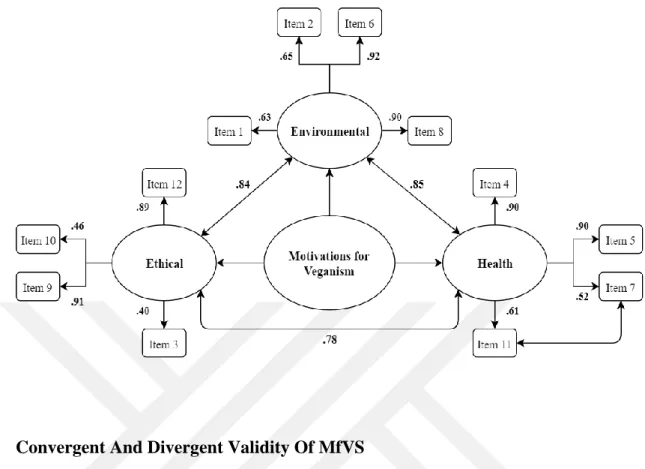
First, a confirmatory factor analyses was conducted to see whether the three-dimensional approach is sufficient in explaining MfVS. Thus, the model was estimated with three latent factors of ethical, health and environmental. Model fit was evaluated by the Chi-Square Model Fit index, the Comparative Fit Index (CFI), Tucker Lewis Index (TLI), the Standardized Root Mean Square Residual (SRMR), and the Root Mean Square Error of Approximation (RMSEA). The χ2/df ratio was also used as an additional model fit index because the Chi-Square test of absolute model fit is sensitive to sample size.
Following previous work, RMSEA value below .06 was considered a good fit (Hu & Bentler, 1999; Steiger, 2007) but an RMSEA value above .10 was considered a poor fit (Browne & Cudeck, 1993; Hu & Bentler, 1999), while SRMR values less than .06 were evaluated as an indicator of a good fit (Hu & Bentler, 1999). Additionally, the CFI is one of the most widely reported fit indices, with Hu and Bentler (1999) suggesting values equal to, or greater than, .95 on this index as a good fit, while higher TLI (a more conservative goodness of fit index) in conjunction with a low SRMR value is an indicator of a better fit.
Initial CFA yielded poor fit to the data (χ2 = 474, p < .001; χ2/df = 9.29; CFI = .85; TLI = .81, SRMR = .08; RMSEA = .17, 90% CI (.16–.18)). However, model modification indices also suggested some correlated errors between observed variables. Only within factor items were enabled to be freed as suggested elsewhere (Hoyle, 1995). There was one suggestion which yielded a considerable amount of improvement to the model. Modification indices suggested correlated error between item 7 (i.e., I have chosen (or thinking to choose) a vegan lifestyle because of health reasons.) and 11 (i.e., I thought that if I would give up animal products I would be much healthier and therefore I became/thinking to become a vegan), representing health dimension. After freeing up the error variances between these items, the model fit well to the data (χ2 = 221, p < .001; χ2/df = 4.42; CFI = .94; TLI = .92, SRMR = .06; RMSEA = .10, 90% CI (.09– .12), see Figure 1). Reliability analyses also yielded satisfactory Cronbach‘s alpha values for all the factors of the MfVS (i.e., α = .77 for ethical dimension, α = .86 for health dimension, α = .84 for environmental dimension).
25
Figure 3.1: Confirmatory Factor Analysis of Motivations for Veganism Scale
Convergent And Divergent Validity Of MfVS
Correlations between MfVS and its dimensions, Vegan Lifestyle Scale (VLS), Meat Commitment Scale (MCS), and Cow‘s Milk, Dairy and Eggs Commitment Scale (CMDECS) were run. Results revealed strong significant correlations between these variables (see Table 1). Specifically, MfVS was positively correlated with VLS (r = .57,
p < .001) and was negatively correlated with MCS and CMDECS (r = -.77, p < .001; r =
-.78, p < .001, respectively). Moreover, the relationships between subscales of VLS, MCS, and CMDECS were also significant in a expected direction. Specifically, ethical MfV was positively correlated with VLS (r = .61, p < .001) and was negatively correlated with MCS and CMDECS (r = -.78, p < .001; r = -.78, p < .001, respectively), health MfV was positively correlated with VLS (r = .47, p < .001) and was negatively correlated with MCS and CMDECS (r = -.61, p < .001; r = -.67, p < .001, respectively), and finally environmental MfV was positively correlated with VLS (r = .54, p < .001) and was negatively correlated with MCS and CMDECS (r = -.73, p < .001; r = -.74, p < .001, respectively; see Table 1).
To investigate discriminant validity, we conducted a one-way MANOVA to see if omnivores, vegetarians and vegans differ in the dimensions of MfVS. As a result, Box‘s
26 test of equality of covariance matrices was significant, Box‘s M = 135.16, F(12, 196546.50) = 11.07, p < .001. Therefore, Using Hotelling‘s Trace, there were significant group differences on MfVS, V = 1.87, F(6,560) = 87.23, p = < .001. Univariate analyses of ethical, health and environmental motivations also reported significant differences across groups, F(2, 283) = 227, MSE = 153, p = <.001; F(2, 283) = 143.86, MSE = 200.15, p = <.001; F(2, 283) = 187.46, MSE = 150.52, p = <.001; respectively. Both in multivariate and univariate analyses, vegans scored significantly higher compared to vegetarians and vegans, and vegetarians scored significantly higher compared to omnivores, suggesting that MfVS could successfully discriminate people with different dietary life styles.
3.2.2. Reliability And Validity Of Cow’s Milk, Dairy And Eggs Commitment Scale
Reliability analysis of CMDECS revealed a satisfactory internal consistency (7 items, α = .93). In order to investigate the validity of the measure (adapted from MCS), the correlations between CMDECS and MCS, MfVS, VLS were further examined. Furthermore, because CMDECS was measuring commitment to consume non-meat animal products, vegans were expected to score lowest compared to the other two groups of vegetarians and vegans. To tackle this question, a one-way ANOVA was conducted.
Correlation analyses revealed significant associations, with CMDECS showed positive correlation with MCS (r = .71, p < .001), and showed negative correlations with VLS and MfVS (r = -.48, p < .001; r = -.79, p < .001, respectively, see Table 1). One-way ANOVA with Scheffe post-hoc test revealed significant differences. Specifically, vegans (M = 1.11, SD = .29) reported lower commitment to consume non-meat animal products compared to vegetarians (M = 2.24, SD = 1.01) and omnivores (M = 3.00, SD = .74), while vegetarians reported lower levels opf commitment than omnivores, F(2, 283) = 227.82, MSE = 98.41, p < .001.
27 3.2.3. Reliability And Validity Of Vegan Lifestyle Scale
Reliability analysis of VLS yielded satisfactory internal consistency (4 items, α = .82). To investigate the validity of the measure, the correlation between VLS and MCS, CMDECS and MfVS were examined. Furthermore, because VLS is measuring self-reported behaviors in the case of a vegan lifestyle, vegans are expected to score highest compared to the other two groups of vegetarians and omnivores. To answer this question, a one-way ANOVA was conducted.
Correlation analysis revealed a negative correlation between VLS and MCS (r = -.59, p < .001), CMDECS (r = -.48, p < .001), and MfVS (r = .57, p < .001). One-way ANOVA with Scheffe post-hoc test also revealed significant differences between participants who reported different dietary life styles. Specifically, vegans (M = 4.87, SD = .27) scored higher than vegetarians (M = 4.37, SD = .54) and omnivores (M = 3.93, SD = .84), while vegetarians scored higher compared to omnivores, F(2, 283) = 76.86, MSE = 23.84, p < .001.