arXiv:1310.1163v2 [hep-ex] 8 Oct 2013
Observation of a charged (D ¯
D
∗)
±mass peak in e
+e
−→ πD ¯
D
∗at
√
s
= 4.26 GeV
M. Ablikim1, M. N. Achasov8,a, O. Albayrak4, D. J. Ambrose41, F. F. An1, Q. An42, J. Z. Bai1, R. Baldini Ferroli19A, Y. Ban28, J. Becker3, J. V. Bennett18, M. Bertani19A, J. M. Bian40, E. Boger21,b, O. Bondarenko22, I. Boyko21, S. Braun37,
R. A. Briere4, V. Bytev21, H. Cai46, X. Cai1, O. Cakir36A, A. Calcaterra19A, G. F. Cao1, S. A. Cetin36B, J. F. Chang1, G. Chelkov21,b, G. Chen1, H. S. Chen1, J. C. Chen1, M. L. Chen1, S. J. Chen26, X. R. Chen23, Y. B. Chen1, H. P. Cheng16,
X. K. Chu28, Y. P. Chu1, D. Cronin-Hennessy40, H. L. Dai1, J. P. Dai1, D. Dedovich21, Z. Y. Deng1, A. Denig20, I. Denysenko21, M. Destefanis45A,45C, W. M. Ding30, Y. Ding24, L. Y. Dong1, M. Y. Dong1, S. X. Du48, J. Fang1, S. S. Fang1, L. Fava45B,45C, C. Q. Feng42, P. Friedel3, C. D. Fu1, J. L. Fu26, O. Fuks21,b, Y. Gao35, C. Geng42, K. Goetzen9, W. X. Gong1,
W. Gradl20, M. Greco45A,45C, M. H. Gu1, Y. T. Gu11, Y. H. Guan38, A. Q. Guo27, L. B. Guo25, T. Guo25, Y. P. Guo27, Y. L. Han1, F. A. Harris39, K. L. He1, M. He1, Z. Y. He27, T. Held3, Y. K. Heng1, Z. L. Hou1, C. Hu25, H. M. Hu1, J. F. Hu37, T. Hu1, G. M. Huang5, G. S. Huang42, J. S. Huang14, L. Huang1, X. T. Huang30, Y. Huang26, T. Hussain44,
C. S. Ji42, Q. Ji1, Q. P. Ji27, X. B. Ji1, X. L. Ji1, L. L. Jiang1, X. S. Jiang1, J. B. Jiao30, Z. Jiao16, D. P. Jin1, S. Jin1, F. F. Jing35, N. Kalantar-Nayestanaki22, M. Kavatsyuk22, B. Kloss20, B. Kopf3, M. Kornicer39, W. Kuehn37, W. Lai1, J. S. Lange37, M. Lara18, P. Larin13, M. Leyhe3, C. H. Li1, Cheng Li42, Cui Li42, D. L Li17, D. M. Li48, F. Li1, G. Li1, H. B. Li1, J. C. Li1, K. Li12, Lei Li1, N. Li11, P. R. Li38, Q. J. Li1, W. D. Li1, W. G. Li1, X. L. Li30, X. N. Li1, X. Q. Li27, X. R. Li29, Z. B. Li34, H. Liang42, Y. F. Liang32, Y. T. Liang37, G. R. Liao35, D. X. Lin13, B. J. Liu1, C. L. Liu4, C. X. Liu1,
F. H. Liu31, Fang Liu1, Feng Liu5, H. B. Liu11, H. H. Liu15, H. M. Liu1, J. P. Liu46, K. Liu35, K. Y. Liu24, P. L. Liu30, Q. Liu38, S. B. Liu42, X. Liu23, Y. B. Liu27, Z. A. Liu1, Zhiqiang Liu1, Zhiqing Liu1, H. Loehner22, X. C. Lou1,c, G. R. Lu14, H. J. Lu16, J. G. Lu1, X. R. Lu38, Y. P. Lu1, C. L. Luo25, M. X. Luo47, T. Luo39, X. L. Luo1, M. Lv1, F. C. Ma24, H. L. Ma1,
Q. M. Ma1, S. Ma1, T. Ma1, X. Y. Ma1, F. E. Maas13, M. Maggiora45A,45C, Q. A. Malik44, Y. J. Mao28, Z. P. Mao1, J. G. Messchendorp22, J. Min1, T. J. Min1, R. E. Mitchell18, X. H. Mo1, H. Moeini22, C. Morales Morales13, K. Moriya18,
N. Yu. Muchnoi8,a, H. Muramatsu41, Y. Nefedov21, I. B. Nikolaev8,a, Z. Ning1, S. Nisar7, S. L. Olsen29, Q. Ouyang1, S. Pacetti19B, J. W. Park39, M. Pelizaeus3, H. P. Peng42, K. Peters9, J. L. Ping25, R. G. Ping1, R. Poling40, E. Prencipe20, M. Qi26, S. Qian1, C. F. Qiao38, L. Q. Qin30, X. S. Qin1, Y. Qin28, Z. H. Qin1, J. F. Qiu1, K. H. Rashid44, C. F. Redmer20,
M. Ripka20, G. Rong1, X. D. Ruan11, A. Sarantsev21,d, S. Schumann20, W. Shan28, M. Shao42, C. P. Shen2, X. Y. Shen1, H. Y. Sheng1, M. R. Shepherd18, W. M. Song1, X. Y. Song1, S. Spataro45A,45C, B. Spruck37, G. X. Sun1, J. F. Sun14, S. S. Sun1, Y. J. Sun42, Y. Z. Sun1, Z. J. Sun1, Z. T. Sun42, C. J. Tang32, X. Tang1, I. Tapan36C, E. H. Thorndike41, D. Toth40, M. Ullrich37, I. Uman36B, G. S. Varner39, B. Wang1, D. Wang28, D. Y. Wang28, K. Wang1, L. L. Wang1, L. S. Wang1, M. Wang30, P. Wang1, P. L. Wang1, Q. J. Wang1, S. G. Wang28, X. F. Wang35, X. L. Wang42, Y. D. Wang19A, Y. F. Wang1, Y. Q. Wang20, Z. Wang1, Z. G. Wang1, Z. H. Wang42, Z. Y. Wang1, D. H. Wei10, J. B. Wei28, P. Weidenkaff20,
Q. G. Wen42, S. P. Wen1, M. Werner37, U. Wiedner3, L. H. Wu1, N. Wu1, S. X. Wu42, W. Wu27, Z. Wu1, L. G. Xia35, Y. X Xia17, Z. J. Xiao25, Y. G. Xie1, Q. L. Xiu1, G. F. Xu1, Q. J. Xu12, Q. N. Xu38, X. P. Xu29,33, Z. Xue1, L. Yan42, W. B. Yan42, W. C Yan42, Y. H. Yan17, H. X. Yang1, Y. Yang5, Y. X. Yang10, Y. Z. Yang11, H. Ye1, M. Ye1, M. H. Ye6, B. X. Yu1, C. X. Yu27, H. W. Yu28, J. S. Yu23, S. P. Yu30, C. Z. Yuan1, W. L. Yuan26, Y. Yuan1, A. A. Zafar44, A. Zallo19A, S. L. Zang26, Y. Zeng17, B. X. Zhang1, B. Y. Zhang1, C. Zhang26, C. B Zhang17, C. C. Zhang1, D. H. Zhang1, H. H. Zhang34,
H. Y. Zhang1, J. L. Zhang1, J. Q. Zhang1, J. W. Zhang1, J. Y. Zhang1, J. Z. Zhang1, LiLi Zhang17, S. H. Zhang1, X. J. Zhang1, X. Y. Zhang30, Y. Zhang1, Y. H. Zhang1, Z. P. Zhang42, Z. Y. Zhang46, Zhenghao Zhang5, G. Zhao1, J. W. Zhao1, Lei Zhao42, Ling Zhao1, M. G. Zhao27, Q. Zhao1, S. J. Zhao48, T. C. Zhao1, X. H. Zhao26, Y. B. Zhao1, Z. G. Zhao42, A. Zhemchugov21,b, B. Zheng43, J. P. Zheng1, Y. H. Zheng38, B. Zhong25, L. Zhou1, X. Zhou46, X. K. Zhou38,
X. R. Zhou42, K. Zhu1, K. J. Zhu1, X. L. Zhu35, Y. C. Zhu42, Y. S. Zhu1, Z. A. Zhu1, J. Zhuang1, B. S. Zou1, J. H. Zou1 (BESIII Collaboration)
1 Institute of High Energy Physics, Beijing 100049, People’s Republic of China 2 Beihang University, Beijing 100191, People’s Republic of China
3 Bochum Ruhr-University, D-44780 Bochum, Germany 4 Carnegie Mellon University, Pittsburgh, Pennsylvania 15213, USA 5 Central China Normal University, Wuhan 430079, People’s Republic of China
6 China Center of Advanced Science and Technology, Beijing 100190, People’s Republic of China 7 COMSATS Institute of Information Technology, Lahore, Defence Road, Off Raiwind Road, 54000 Lahore
8 G.I. Budker Institute of Nuclear Physics SB RAS (BINP), Novosibirsk 630090, Russia 9 GSI Helmholtzcentre for Heavy Ion Research GmbH, D-64291 Darmstadt, Germany
10 Guangxi Normal University, Guilin 541004, People’s Republic of China 11 GuangXi University, Nanning 530004, People’s Republic of China 12 Hangzhou Normal University, Hangzhou 310036, People’s Republic of China 13 Helmholtz Institute Mainz, Johann-Joachim-Becher-Weg 45, D-55099 Mainz, Germany
14 Henan Normal University, Xinxiang 453007, People’s Republic of China
15 Henan University of Science and Technology, Luoyang 471003, People’s Republic of China 16Huangshan College, Huangshan 245000, People’s Republic of China
18 Indiana University, Bloomington, Indiana 47405, USA
19(A)INFN Laboratori Nazionali di Frascati, I-00044, Frascati, Italy; (B)INFN and University of Perugia, I-06100, Perugia, Italy
20Johannes Gutenberg University of Mainz, Johann-Joachim-Becher-Weg 45, D-55099 Mainz, Germany 21 Joint Institute for Nuclear Research, 141980 Dubna, Moscow region, Russia
22 KVI, University of Groningen, NL-9747 AA Groningen, The Netherlands 23Lanzhou University, Lanzhou 730000, People’s Republic of China 24Liaoning University, Shenyang 110036, People’s Republic of China 25 Nanjing Normal University, Nanjing 210023, People’s Republic of China
26 Nanjing University, Nanjing 210093, People’s Republic of China 27 Nankai university, Tianjin 300071, People’s Republic of China 28 Peking University, Beijing 100871, People’s Republic of China
29Seoul National University, Seoul, 151-747 Korea 30Shandong University, Jinan 250100, People’s Republic of China 31 Shanxi University, Taiyuan 030006, People’s Republic of China 32 Sichuan University, Chengdu 610064, People’s Republic of China
33 Soochow University, Suzhou 215006, People’s Republic of China 34Sun Yat-Sen University, Guangzhou 510275, People’s Republic of China
35Tsinghua University, Beijing 100084, People’s Republic of China
36 (A)Ankara University, Dogol Caddesi, 06100 Tandogan, Ankara, Turkey; (B)Dogus University, 34722 Istanbul, Turkey; (C)Uludag University, 16059 Bursa, Turkey
37 Universitaet Giessen, D-35392 Giessen, Germany
38 University of Chinese Academy of Sciences, Beijing 100049, People’s Republic of China 39 University of Hawaii, Honolulu, Hawaii 96822, USA
40University of Minnesota, Minneapolis, Minnesota 55455, USA 41University of Rochester, Rochester, New York 14627, USA
42 University of Science and Technology of China, Hefei 230026, People’s Republic of China 43 University of South China, Hengyang 421001, People’s Republic of China
44 University of the Punjab, Lahore-54590, Pakistan
45 (A)University of Turin, I-10125, Turin, Italy; (B)University of Eastern Piedmont, I-15121, Alessandria, Italy; (C)INFN, I-10125, Turin, Italy
46Wuhan University, Wuhan 430072, People’s Republic of China 47Zhejiang University, Hangzhou 310027, People’s Republic of China 48Zhengzhou University, Zhengzhou 450001, People’s Republic of China
a Also at the Novosibirsk State University, Novosibirsk, 630090, Russia b Also at the Moscow Institute of Physics and Technology, Moscow 141700, Russia
c Also at University of Texas at Dallas, Richardson, Texas 75083, USA dAlso at the PNPI, Gatchina 188300, Russia
We report on a study of the process e+e−
→ π±(D ¯D∗)∓at√s = 4.26 GeV using a 525 pb−1data sample collected with the BESIII detector at the BEPCII storage ring. A distinct charged structure is observed in the (D ¯D∗)∓invariant mass distribution. When fitted to a mass-dependent-width Breit-Wigner lineshape, the pole mass and width are determined to be Mpole= (3883.9±1.5±4.2) MeV/c2 and Γpole = (24.8 ± 3.3 ± 11.0) MeV. The mass and width of the structure, which we refer to as Zc(3885), are 2σ and 1σ, respectively, below those of the Zc(3900) → π±J/ψ peak observed by BESIII and Belle in π+π−J/ψ final states produced at the same center-of-mass energy. The angular distribution of the πZc(3885) system favors a JP = 1+quantum number assignment for the structure and disfavors 1− or 0−. The Born cross section times the D ¯D∗branching fraction of the Z
c(3885) is measured to be σ(e+e−
→ π±Zc(3885)∓) × B(Zc(3885)∓→ (D ¯D∗)∓) = (83.5 ± 6.6 ± 22.0) pb. Assuming the Zc(3885) → D ¯D∗signal reported here and the Zc(3900) → πJ/ψ signal are from the same source, the partial width ratio Γ(Zc(3885)→D ¯D∗)
Γ(Zc(3900)→πJ/ψ) = 6.2 ± 1.1 ± 2.7 is determined.
PACS numbers: 14.40.Rt, 13.25.Gv, 14.40.Pq
The Y (4260) resonance was first seen by BaBar as a peak in the e+e− → π+π−J/ψ cross section as a function of e+e− center-of-mass (CM) energy [1]. It was subse-quently confirmed by CLEO [2] and Belle [3]. Its produc-tion via the e+e− annihilation process requires the quan-tum numbers of the Y (4260) to be JP C= 1−−. A pecu-liar feature is the absence of any apparent corresponding
structure in the cross sections for e+e− → D(∗)D¯(∗)(π) in the√s = 4260 MeV energy region [4]. This implies a lower-limit partial width of Γ(Y (4260) → π+π−J/ψ) > 1 MeV [5] that is one order-of-magnitude larger than measured values for conventional charmonium meson transitions [6], and indicates that the Y (4260) is prob-ably not a conventional quarkonium state.
A similar pattern is seen in the b-quark sector, where anomalously large cross sections for e+e−→ π+π−Υ(nS) (n = 1, 2, 3) at energies around√s = 10.86 GeV reported by Belle [7] were subsequently found to be associated with the production of charged bottomonium-like resonances, the Zb(10610)+ and Zb(10650)+, both with strong de-cays to π+Υ(nS) and π+h
b(mP ) (m = 1, 2) [8]. The Zb(10610)+mass is just above the mB+ mB∗ threshold
and it decays copiously to B ¯B∗, while the Z
b(10650)+ mass is just above the 2mB∗ threshold and it decays
co-piously to B∗B¯∗ [9]. Their proximity to the B ¯B∗ and B∗B¯∗ thresholds as well as their decay patterns suggest that these states may be molecule-like meson-meson vir-tual states [10]; a subject of considerable interest [11].
Recently BESIII reported the observation of a promi-nent resonance-like charged structure in the πJ/ψ in-variant mass distribution for e+e− → π+π−J/ψ events collected at √s = 4.26 GeV, dubbed the Zc(3900). A fit to a Breit-Wigner (BW) resonance lineshape yields
M = (3899.0 ± 3.6 ± 4.9) MeV/c2 and Γ = (46 ±
10 ± 20) MeV [12]. (Here, and elsewhere in this re-port, the first errors are statistical and the second sys-tematic.) This observation was subsequently confirmed by Belle [13]. The Zc(3900) mass is ∼20 MeV/c2 above the D ¯D∗mass threshold, which is suggestive of a virtual D ¯D∗ molecule-like structure [14, 15]; i.e., a charmed-sector analog of the Zb(1610). (BESIII also reported resonance-like structures in charged D∗D¯∗ and πh
c sys-tems at M ≃ 4025 MeV, which may be a charmed-sector analog of the Zb(10650 [16].) Another possibility is a diquark-diantiquark state [17]. It is important to mea-sure the rate for Zc(3900) decays to D ¯D∗ and compare it to that of the πJ/ψ.
Here we report the observation of a peak in the (D ¯D∗)− invariant-mass distribution in e+e− → π+(D ¯D∗)− annihilation events at√s = 4.26 GeV with a 525 pb−1data sample detected by the BESIII detector at the BEPCII electron-positron collider. In the follow-ing, this structure is referred to as the Zc(3885). The π+(D ¯D∗)−final states are selected by means of a partial reconstruction technique in which only the bachelor π+ and one final-state D meson are detected, and the pres-ence of the ¯D∗is inferred from energy-momentum conser-vation. (In this report, the inclusion of charge conjugate states is always implied.) We perform parallel analyses of both isospin channels (π+D0D∗− and π−D+D¯∗0) as a consistency check. The D mesons are reconstructed in the D0→ K−π+ and D+→ K−π+π+ decay channels.
The BESIII detector is a large-solid-angle magnetic spectrometer consisting of a 50-layer Helium-gas-based main cylindrical drift chamber (MDC), a barrel-like ar-rangement of time-of-flight scintillation counters (TOF), and an electromagnetic calorimeter comprised of CsI(Tl) crystals located inside a superconducting solenoid coil that provides a 1 T magnetic field. An iron flux-return located outside of the coil is instrumented with resistive
plate chambers to identify muons. The charged particle momentum resolution for 1 GeV/c charged tracks is 0.5% and the energy resolution for 1 GeV photons is 2.5%. Measurements of dE/dx in the MDC and flight times in the TOF are combined to determine pion, kaon and proton identification (ID) probabilities. The hypothesis with the highest ID probability is assigned to each par-ticle. The detector is described in detail in Ref. [18].
To study the detector response and identify potential backgrounds, we use samples of Monte Carlo (MC) simu-lated events that are produced by the EVTGEN genera-tor [19] in conjunction with KKMC [20], which generates ISR photons, and simulated using a GEANT4-based [21] software package [22]. In addition to signal channels and various potential background processes, we simu-lated generic events using Born cross sections for char-monium processes that have been measured, Lundcharm to generate production of other, non-measured charmo-nium states [23] and PYTHIA for unmeasured hadronic final states [24].
For the π+D0-tag analysis, we select events with three or more well reconstructed charged tracks in the polar angle region | cos θ| < 0.93, with points of closest ap-proach to the e+e− interaction point that are less than 10 cm in the beam direction and 1 cm in the plane per-pendicular to the beam direction. At least one of the tracks is required to be negatively charged and identified as a kaon. In addition, we require at least two positively charged tracks that are identified as π+mesons. We des-ignate K−π+ combinations with invariant mass within 15 MeV/c2 of m
D0 as D0 candidates. For events with
two or more K−π+combinations, we retain the one with invariant mass closest to mD0. For the π−D+-tag
analy-sis, the selection is the same except for the requirement of an additional π− track that is identified as the bachelor pion and the mass requirement |M(K−π+π+) − m
D+| <
15 MeV/c2 to select the D+ candidates.
The left panel of Fig.1shows the distribution of masses recoiling against the detected π+D0 system [25], where a prominent peak at mD∗−is evident. The solid-line
his-togram shows the same distribution for MC-simulated e+e− → π+D0D∗−, D0 → K−π+ three-body phase-space events. Because of the limited phase phase-space, some events from the isospin partner decay π+Z
c(3885)−, Zc(3885)−→ D−D∗0, where the detected D0 is a decay product of the D∗0, also peak near m
D∗−, as shown by
the dashed histogram that is for MC-simulated e+e−→ π+Z
c(3885)−, Zc(3885)− → D−D∗0, D∗0 → γ or π0D0 decays. Here the mass and width of the Zc(3885) are set to our final measured values. Since the D ¯D∗ invariant mass distribution is equivalent to the bachelor pion recoil mass spectrum, the shape of the Zc(3885) → D ¯D∗signal peak is not sensitive to the parentage of the D meson that is used for the event tagging. The right panel of Fig. 1 shows the corresponding plots for the π−D+ tagged events, where the solid histogram shows the
contribu-tion from MC-simulated e+e− → π−D+D¯∗0 three-body phase-space events. Here, also, the π−D+-tagged event sample that is used to study π−D+D¯∗0 includes some cross feed from the π−Z
c(3885)+, Zc(3885)+ → ¯D0D∗+ signal channel, where the D+ used for tagging is a decay product of the D∗+. The dashed histogram is from MC-simulated e+e− → π−Z c(3885)+, Zc(3885)+→ ¯D0D∗+, D∗+→ π0D+ events. ) 2 ) (GeV/c + π 0 (D recoil M 1.96 1.98 2.00 2.02 2.04 2.06 2 Events / 1 MeV/ c 0 20 40 60 80 100 120 140 160 ) 2 ) (GeV/c -π + (D recoil M 1.96 1.98 2.00 2.02 2.04 2.06 2 Events / 1 MeV/ c 0 50 100 150 200 250
FIG. 1. The πD recoil mass distribution for the π+D0- (left)
and π−D+-tagged (right) events. Points with errors are data, the
hatched histogram shows the events from the D mass sidebands. The solid and dashed histograms are described in the text.
We apply a two-constraint kinematic fit to the selected events, where we constrain the invariant mass of the D0 (D+) candidate tracks to be equal to m
D0 (mD+) and
the mass recoiling from the π+D0 (π−D+) to be equal to mD∗−(mD¯∗0). If there is more than one bachelor pion
candidate in an event, we retain the one with the small-est χ2 from the kinematic fit. Events with χ2 < 30 are selected for further analysis. For the π+D0-tag analysis, we require M (π+D0) > 2.02 GeV to reject the events of the type e+e− → D∗+D∗−, D∗+ → π+D0. The left (right) panel of Fig.2 shows the distribution of D0D∗− (D+D¯∗0) invariant masses recoiling from the bachelor pion for the π+D0 (π−D+) tagged events. The two dis-tributions are similar and both have a distinct peak near the mD+ mD¯∗ mass threshold. For cross-feed events,
the reconstructed D meson is not in fact recoiling from a ¯D∗ and the efficiency for satisfying these selection
re-quirements decreases with increasing D ¯D∗mass. Studies
with phase-space MC event samples show that this ac-ceptance variation is not sufficient to produce a peaking structure.
To characterize the observed enhancement and de-termine the signal yield, we fit the histograms in
the left and right panels of Fig. 2 using a
mass-dependent-width Breit-Wigner (BW) lineshape to model the signal and smooth threshold functions to
repre-sent the non-peaking background. For the signal,
we use dN/dmD ¯D∗ ∝ (k∗)2ℓ+1|BWZc(mD ¯D∗)|2, where
k∗ is the Z
c momentum in the e+e− rest frame, ℓ is the π-Zc relative orbital angular momentum and BWZc(mD ¯D∗) ∝ √m D ¯D∗ΓZc m2 Zc−m 2 D ¯D∗−imZcΓZc. Here ΓZc = Γ0(q∗/q0)2L+1(mZc/mD ¯D∗), where q∗(mD ¯D∗) is the D
momentum in the Zc(3885) rest frame, q0 = q∗(mZc)
and L is the D- ¯D∗ orbital angular momentum. In the default fits, we set ℓ = 0, L = 0 and leave mZc and
Γ0 as free parameters. We multiply the BW by a poly-nomial determined from a fit to the MC-determined mass-dependent efficiency to form the signal probabil-ity densprobabil-ity function (PDF). Mass resolution effects are less than 1 MeV/c2 and, thus, ignored. For the non-peaking background for the M (D ¯D∗) distribution, we use: fbkg(mD ¯D∗) ∝ (mD ¯D∗ − Mmin)
c(M
max− mD ¯D∗)
d,
where Mminand Mmax are the minimum and maximum
kinematically allowed masses, respectively. The expo-nents c and d are free parameters determined from the fits to the data.
) 2 ) (GeV/c -D* 0 M(D 3.85 3.90 3.95 4.00 4.05 4.10 4.15 2 Events / 4 MeV/ c 0 10 20 30 40 50 60 70 80 90 ) 2 ) (GeV/c 0 * D + M(D 3.85 3.90 3.95 4.00 4.05 4.10 4.15 2 Events / 4 MeV/ c 0 20 40 60 80 100
FIG. 2. The M (D0D∗−) (left) and M (D+D¯∗0) (right)
distribu-tions for selected events. The curves are described in the text. The results of the fits are shown as solid curves in Fig.2. The dashed curves show the fitted non-resonant background. The fitted BW masses and widths from the π+D0 (π−D+) tagged sample are 3889.2 ± 1.8 MeV/c2 and 28.1 ± 4.1 MeV (3891.8 ± 1.8 MeV/c2 and 27.8 ± 3.9 MeV), where the errors are statistical only. Since the mass and width of a mass-dependent-width BW are model dependent and may differ from the actual reso-nance properties [27], we solve for P = Mpole− iΓpole/2, the position in the complex (M, Γ) plane where the BW denominator is zero, and use Mpole and Γpole to charac-terize the mass and width of the Zc(3885) peak. TableI lists the pole masses and widths for the π+D0and π−D+ tagged samples.
TABLE I. The pole mass Mpoleand width Γpole, signal yields and fit quality (χ2/ndf) for the two tag samples.
Tag Mpole(MeV/c2) Γpole(MeV) Zcsignal (evts) χ2/ndf π+D0 3882.3 ± 1.5 24.6 ± 3.3 502 ± 41 54/54 π−D+
3885.5 ± 1.5 24.9 ± 3.2 710 ± 54 60/54
Monte Carlo studies of possible sources of peaking backgrounds in the D ¯D∗ mass distribution show that processes of the type e+e−→ D ¯D
X, ¯DX → ¯D∗π, would produce a near-threshold reflection peak in the D ¯D∗ mass distribution, where DX denotes a D∗π resonance
with mass near the upper kinematic boundary. This
boundary, √s − mD, is 30 MeV/c2 below the mass of the lightest established D∗π resonance, the D
with MD1 = 2421.3 ± 0.6 MeV/c
2 and Γ
D1 = 27.1 ±
2.7 MeV [6], which suggests that contributions from D ¯D1(2420) final states, either from Y (4260) → D ¯D1 de-cays or non-resonant e+e− → D ¯D
1 production, are be-yond the kinematic reach at√s = 4260 MeV and, there-fore, are small. However, some models for the Y (4260) attribute it to a bound D ¯D1 molecular state [14], where sub-threshold ¯D1 → ¯D∗π decays might be important and, possibly, produce a reflection peak in the D ¯D∗mass distribution that mimics a Zc(3885) signal.
To study this possibility, we separated the events into two samples according to | cos θπD| > 0.5 and | cos θπD| < 0.5, where θπD is the angle between the bachelor pion and the D meson directions in the Zc(3885) rest frame. The D ¯D1MC events predominantly have | cos θπD| > 0.5 while, in contrast, e+e− → πZ
c signal-MC sample has similar numbers of events with | cos θπD| > 0.5 and | cos θπD| < 0.5. We define an asymmetry parame-ter A = (n>0.5 − n<0.5)/(n>0.5+ n<0.5), where n>0.5 (n<0.5) is the fitted number of Zc(3885) signal events for | cos θπD| > 0.5 (< 0.5). For the data, Adata = 0.12±0.06, close to the MC value for e+e− → πZ
c(3885): AπZc
MC = 0.02 ± 0.02, and far from the MC result for the e+e− → D ¯D
1 hypothesis: AD ¯MCD1 = 0.43 ± 0.04. We conclude that the D ¯D1contribution to our observed Zc(3885) → D ¯D∗signal is small.
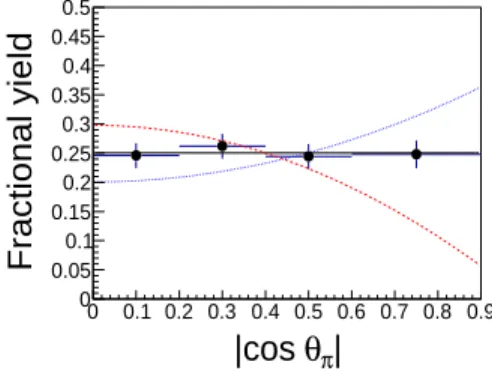
|
πθ
|cos
0 0.1 0.2 0.3 0.4 0.5 0.6 0.7 0.8 0.9Fractional yield
0 0.05 0.1 0.15 0.2 0.25 0.3 0.35 0.4 0.45 0.5FIG. 3. (1/Ntot)dN/d| cos θπ| versus | cos θπ| for Zc(3885) events
in data. The solid, dashed and dotted curves show expectations for JP = 1+, 0−and 1−, respectively.
If the JP quantum numbers of the Z
c(3885) are 1+, the relative π-Zc orbital in the decay Y (4260) → πZccan be S- and/or D-waves. Since the decay is near threshold, the D-wave contribution should be small, in which case the dN/d| cos θπ| distribution would be flat, where θπ is the bachelor pion’s polar angle relative to the beam direction in the CM. If JP = 0−, the decay can only proceed via a P -wave and is polarized with Jz = ±1; in this case dN/d cos θπ∝ sin2θπ. Similarly, JP = 1− also implies a P -wave with an expected distribution that goes as 1 + cos2θ. Parity conservation excludes JP = 0+.
We sliced the data into four | cos θπ| bins and repeated the fits described above for each bin. The | cos θπ |-dependence of the efficiency is determined from
sig-nal MC event samples. Figure 3 shows the efficiency-corrected fractional signal yield vs. | cos θπ|. The solid (dashed) curve shows the result of a fit to a flat (sin2θπ) distribution. The data agree well with the flat expecta-tion for JP = 1+, with χ2/ndf = 0.44/3 and disagree with those for JP = 0−, for which χ2/ndf = 32/3, and 1−, where χ2/ndf = 16/3.
We use the fitted numbers of signal events for the π+D0-tagged sample, N
π+(Zc− → (D ¯D∗)−), and for the
π−D+-tagged sample, N
π−(Zc+→ (D ¯D∗)+) to make two
independent measurements of the product of the cross section and branching fraction σ(e+e−→ πZ
c)×B(Zc→ D ¯D∗). We assume isospin symmetry and, for the π+D0 -tagged channel, use the relation
σ(e+e−→ π+Z c(3885)−) × B(Zc−→ (D ¯D∗)−) (1) = N − π+(Zc−→ (D ¯D∗)−) L(1 + δ)BD0→K−π+(ǫ01+ ǫ02)/2 ,
where L = 525 ± 5 pb−1 is the integrated luminosity, (1+δ) = 0.87±0.04 is the radiative correction factor [28], ǫ0
1 = 0.46 is the efficiency for π+Zc−, Zc− → D0D∗− MC events and ǫ0
2 = 0.21 is the efficiency for π+Zc−, Z−
c → D−D∗0, D∗0 → γ/π0D0 MC events. The re-sulting value is σ(e+e− → π+Z−
c ) × B(Zc(3885)− → (D ¯D∗)−) = 84.6 ± 6.9 pb, where the error is statistical only.
For the π−D+-tagged channel, we use σ(e+e−→ π−Z c(3885)+) × B(Zc+→ (D ¯D∗)+) (2) = Nπ−(Zc+→ (D ¯D∗)+) L(1 + δ)BD+→K−π+π+(ǫ+ 1 + ǫ + 2BD∗+→π0D+)/2 , where ǫ+1 = 0.34 is the efficiency for π−Zc+, Zc+ → D+D¯∗0 MC events and ǫ+
2 = 0.24 is the efficiency for π−Z+
c , Zc+ → ¯D0D∗+, D∗+ → π0D+ MC events. The result is σ(e+e−→ π−Z
c(3885)+)×B(Zc+→ (D ¯D∗)+) = 82.3 ± 6.3 pb (statistical error only) and in good agree-ment with that for the π+D0-tag sample, which justifies our assumption of isospin invariance.
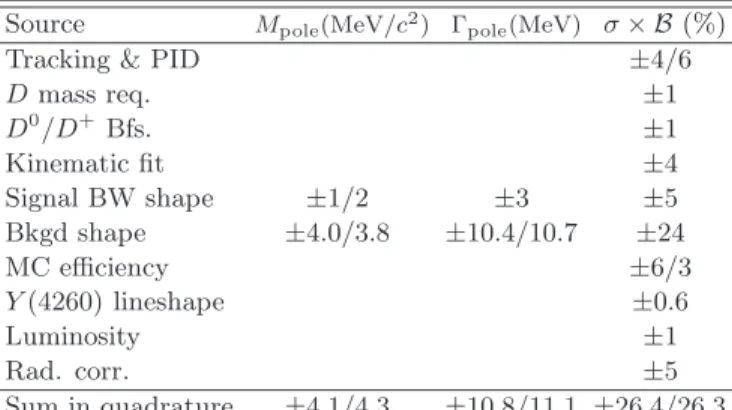
Systematic errors include uncertainties from tracking, particle ID, D mass and decay branching fraction, kine-matic fit, signal and background shapes, MC efficiency, Y (4260) lineshape, the radiative correction factor and the luminosity. The uncertainties from tracking and par-ticle ID are both 1% per track. The uncertainties from D selection and the kinematic fit are determined from a e+e− → D∗+D∗− control sample that has the same final state as the π+D0D∗− signal events. The variation of the efficiency over the Zc(3885) mass uncertainty range is included as a systematic error. The systematic errors for the luminosity and Y (4260) resonance parameters are taken from Ref. [12]. For the signal shape error we use the difference between the the pole mass & width and sig-nal yield from the fits that use a mass-dependent width (default) and the mass, width and yield from fits with
TABLE II. Contributions to systematic errors on the pole mass, pole width and signal yield. When two values are listed, the first is for π+D0tags and the second for π−D+ tags.
Source Mpole(MeV/c2) Γpole(MeV) σ × B (%)
Tracking & PID ±4/6
D mass req. ±1 D0/D+ Bfs. ±1 Kinematic fit ±4 Signal BW shape ±1/2 ±3 ±5 Bkgd shape ±4.0/3.8 ±10.4/10.7 ±24 MC efficiency ±6/3 Y (4260) lineshape ±0.6 Luminosity ±1 Rad. corr. ±5 Sum in quadrature ±4.1/4.3 ±10.8/11.1 ±26.4/26.3
mass-independent-width BW lineshapes. The most sig-nificant contributions to the systematic errors are related to the choice of background shape. For this, we compare results from the default fit with those that use a symmet-ric exponential threshold function and the distribution of wrong-sign πD events extracted from the data.
In all the fits used in this analysis, it is assumed that the πZc(3885) system is produced in an S-wave and the D ¯D∗system produced in the decay of the Z
c(3885) is also in an S-wave. Attempts to fit the peak using P -wave line shapes all failed to converge. This compatibility with S-wave is consistent with the observed cos θπ distribution. The contributions from each source are summarized in Table II. We assume that the errors from the different sources are uncorrelated and use the sums in quadrature as the total systematic errors.
For the final mass, width and cross section values, we use weighted averages of the results from the two tag modes, with the near-complete correlations between the systematic errors taken into account. The results are listed in Table III, where we also include results for the Zc(3900) → πJ/ψ taken from Ref. [12] for compar-ison. When statistical and systematic errors are added in quadrature, the Zc(3885) mass is about 2σ lower than that for the Zc(3900) and the width is 1σ lower.
TABLE III. Parameters for the Zc(3885) → D ¯D∗ reported here and those for the Zc(3900) → πJ/ψ taken from Ref. [12]. Zc(3885) → D ¯D∗ Zc(3900) → πJ/ψ Mass (MeV/c2) 3883.9 ± 1.5 ± 4.2 3899 ± 3.6 ± 4.9 Γ (MeV) 24.8 ± 3.3 ± 11.0 46 ± 10 ± 20 σ × B (pb) 83.5 ± 6.6 ± 22.0 13.5 ± 2.1 ± 4.8
In summary, we report observation of a strong, near-threshold enhancement, Zc(3885), in the D ¯D∗ invariant mass distribution in the process e+e− → π±(D ¯D∗)∓ at
√
s = 4.26 GeV. Attempts to fit the Zc(3885) peak with a P -wave BW lineshape failed to converge, and the | cos θπ| distribution agrees well with S-wave expectations; both results favor a JP = 1+ quantum number assignment. Other J 6 1 assigments are eliminated.
An important question is whether or not the source of the Zc(3885) → D ¯D∗ structure is the same as that for the Zc(3900) → πJ/ψ. The fitted Zc(3885) mass is about 2σ below that of the Zc(3900) [12, 13]. However neither fit considers the possibility of interference with a coher-ent non-resonant background that could shift the results. A JP quantum number determination of the Z
c(3900)± would provide an additional test of this possibility.
Assuming the Zc(3885) structure reported here is due to the Zc(3900), the ratio of partial decay widths is de-termined to be Γ(Zc(3885)→D ¯D∗)
Γ(Zc(3900)→πJ/ψ) = 6.2 ± 1.1 ± 2.7 (here
the main systematic errors are almost entirely uncor-related). This ratio is much smaller than typical val-ues for decays of conventional charmonium states above the open charm threshold. For example: Γ(ψ(3770) → D ¯D)/Γ(ψ(3770) → π+π−J/ψ) = 482 ± 84 [6] and Γ(ψ(4040) → D(∗)D¯(∗))/Γ(ψ(4040) → ηJ/ψ) = 192 ± 27 [26]. This suggests the influence of very different dy-namics in the Y (4260)-Zc(3900) system.
The BESIII collaboration thanks the staff of BEPCII and the computing center for their strong support. This work is supported in part by the Ministry of Science and Technology of China Contract No. 2009CB825200; National Natural Science Foundation of China (NSFC) Contract Nos. 10821063, 10825524, 10835001, 10935007, 11125525, 11235011; Joint Funds of the National Nat-ural Science Foundation of China under Contract Nos. 11079008, 11179007, 11079027; Chinese Academy of Sciences (CAS) Large-Scale Scientific Facility Program; CAS Contract Nos. KJCX2-YW-N29, KJCX2-YW-N45; 100 Talents Program of CAS; German Research Founda-tion (DFG) Contract No. Collaborative Research Cen-ter CRC-1044; Istituto Nazionale di Fisica Nucleare, Italy; Ministry of Development of Turkey Contract No. DPT2006K-120470; U. S. Department of Energy Con-tract Nos. DE-FG02-04ER41291, DE-FG02-05ER41374, DE-FG02-94ER40823; U.S. National Science Founda-tion; University of Groningen (RuG); Helmholtzzentrum f¨ur Schwerionenforschung GmbH (GSI) Darmstadt; Ko-rean National Research Foundation (NRF) Grant No. 20110029457.
[1] B. Aubert et al. (BaBar Collaboration), Phys. Rev. Lett. 95, 142001 (2005).
[2] Q. He et al. (CLEO Collaboration), Phys. Rev. D 74, 091104(R) (2006).
[3] C.Z. Yuan et al. (Belle Collaboration), Phys. Rev. Lett. 99, 182004 (2005).
98, 092001 (2007); Phys. Rev. Lett. 100, 062001 (2008); Phys. Rev. D 77, 011103 (2008); Phys. Rev. Lett. 101, 172001 (2008); and Phys. Rev. D 80, 091101 (2009). [5] X.H. Mo et al., Phys. Lett. B640, 182 (2006).
[6] J. Beringer et al. (Particle Data Group), Phys. Rev. D 86, 010001 (2012).
[7] K.-F. Chen et al. (Belle Collaboration), Phys. Rev. Lett. 100, 112001 (2008).
[8] A. Bondar et al. (Belle Collaboration), Phys. Rev. Lett. 108, 122001 (2012).
[9] I. Adachi et al. (Belle Collaboration), arXiv:1209.6450v2 [hep-exp].
[10] A.E. Bondar et al., Phys. Rev. D 84, 054010 (2011), D.V. Bugg, Europhys. Lett. 96, 11002 (2011), I.V. Danilkin, V.D. Orlovsky and Yu.A. Simonov, Phys. Rev. D 85, 034012 (2012), C.-Y. Cui, Y.-L. Liu and M.-Q. Huang, Phys. Rev. D 85, 054014 (2012), T. Guo, L. Cao, M.-Z. Zhou and H. Chen, arXiv:1106.2284 [hep-ph], and J.-R. Zhang, M. Zhong and M.-Q. Huang Phys. Lett. B704, 312 (2011).
[11] See, for example, M.B. Voloshin and L.B. Okun, JETP Lett. 23, 333 (1976); M. Bander, G.L. Shaw and P. Thomas, Phys. Rev. Lett. 36, 695 (1977); A. De Ru-jula, H. Georgi and S.L. Glashow, Phys. Rev. Lett. 38, 317 (1977); A.V. Manohar and M.B. Wise, Nucl. Phys. B 339, 17 (1993); N.A. T¨ornqvist, hep-ph/0308277 (2003); F.E. Close and P.R. Page, Phys. Lett. B 578, 119 (2003); C.-Y. Wong, Phys. Rev. C 69, 055202 (2004); S. Pakvasa and M. Suzuki, Phys. Lett. B 579, 67 (2004); E. Braaten and M. Kusunoki, Phys. Rev. D 69, 114012 (2004); E.S. Swanson, Phys. Lett. B 588, 189 (2004); D. Gamer-mann and E. Oset, Phys. Rev. D 80, 014003 (2009) & Phys. Rev. D 81, 014029 (2010).
[12] M. Ablikim et al. (BESIII Collaboration), Phys. Rev. Lett. 110, 252001 (2013).
[13] Z.Q. Liu et al. (Belle Collaboration), Phys. Rev. Lett. 110, 252002 (2013).
[14] Q. Wang, C. Hanhart and Q. Zhao, Phys. Rev. Lett. 111,
132003 (2013).
[15] N. Mahajan, arXiv:1304.1301 [hep-ph], M.B. Voloshin, Phys.Rev. D 87, 091501 (2013), J.-R. Zhang, Phys. Rev. D 87, 116004 (2013), F.-K. Guo, et al., Phys. Rev. D 88, 054007 (2013) and C.-Y. Cui et al., arXiv:1304.1850. [16] M. Ablikim et al. (BESIII Collaboration),
arXiv:1308.2760 [hep-ex] and M. Ablikim et al. (BESIII Collaboration), arXiv:1309.1896 [hep-ex].
[17] R. Faccini et al., Phys. Rev. D 87, 111102R (2013); and M. Karliner and S. Nussinov, JHEP 1307, 153 (2013). See, also, A. Ali, C. Hambrock and W. Wang, Phys. Rev. D 85, 054011 (2012).
[18] M. Ablikim et al. (BESIII Collaboration), Nucl. Istrum. and Methods Phys. Res., Sect. A 614, 345 (2010). [19] D.J. Lange, Nucl. Istrum. and Methods Phys. Res., Sect.
A 462, 152 (2001).
[20] S. Jadach, B.F.L. Ward, and Z. Was, Comput. Phys. Commun. 130, 260 (2000); Phys. Rev. D 63, 113009 (2001).
[21] S. Agostinelli et al. (Geant4 Collaboration), Nucl. Istrum. and Methods Phys. Res., Sect. A 506, 250 (2003). [22] Z.Y. Deng, et al., High Energy Phys. Nucl. Phys. 30 371,
(2006).
[23] R.G. Ping et al., Chinese Phys. C 32, 599 (2008). [24] T. Sj¨ostrand, S. Mrenna and P. Skands, JHEP 026, 0605
(2006).
[25] We minimize the effect of the D mass resolution by plot-ting Mrecoil= RM (πD) + M (D) − mD, where RM (πD) is the recoil mass inferred from four-momentum conser-vation and M (D) is the measured D mass.
[26] M. Ablikim et al. (BESIII Collaboration), Phys. Rev. D 86, 071101 (2012).
[27] See, for example, A.R. Bohm and N.L. Harshman, arXiv:hep-ph/0001206 and references cited therein. [28] We use a second-order QED calculation and unpublished
BESIII energy-dependent measurements of σ(e+e− → πD ¯D∗) to compute the radiative correction; see E. A. Kuraev and V. S. Fadin, Yad. Fiz. 41, 733 (1985) [Sov. J. Nucl. Phys. 41, 466 (1985)].