Ground-state properties of the two-dimensional charged Bose gas
B. Davoudi,1E. Strepparola,2 B. Tanatar,3and M. P. Tosi21
Institute for Studies in Theoretical Physics and Mathematics, Tehran 19395-5531, Iran
2Istituto Nazionale di Fisica della Materia and Classe di Scienze, Scuola Normale Superiore, I-56126 Pisa, Italy 3Department of Physics, Bilkent University, Bilkent, Ankara 06533, Turkey
共Received 3 April 2000; revised manuscript received 11 September 2000; published 13 February 2001兲 We study the two-dimensional gas of charged bosons interacting via a logarithmic potential within the quantal hypernetted-chain approximation. The pair correlation function, the static structure factor, the ground-state energy, and the spectrum of collective excitations are calculated over a range of the density parameter rs.
We find that the static and dynamical properties are described rather well in this approach in comparison to previous theories. Our results are in good agreement with the available quantum Monte Carlo simulations. DOI: 10.1103/PhysRevB.63.104505 PACS number共s兲: 67.40.Db, 05.30.Jp, 71.45.Gm
I. INTRODUCTION
Two-dimensional 共2D兲 electronic systems have attracted tremendous attention in the last two decades, and are the subject of continuing interest.1,2 The Coulomb interaction potential and the many-body effects it induces play an im-portant role in determining the ground-state properties. The application of a 2D electron gas model in describing semi-conductor heterojunctions and various other structures has proved quite useful for our understanding of correlation ef-fects in low-dimensional systems. In the artificially fabri-cated semiconducting materials the underlying Coulomb in-teraction has a three-dimensional character. The Coulomb potential between point charges in a strictly 2D space, on the other hand, is obtained from the solution of the Poisson equation 共in 2D兲 to give logarithmic behavior, viz., ln r, in contrast to the 1/r dependence encountered in 3D. The loga-rithmic potential has been utilized to develop a successful theory3of defects and phase transitions mediated by them in 2D systems. The quantum aspects of 2D charged particles are relatively less studied. In this paper we investigate some ground-state properties of charged bosons interacting with a ln r potential. The model of a charged Bose fluid has been gaining attention in connection with high-Tc super-conductors,4and our study should provide further insight to the correlation effects5 in these systems.
The ground-state correlations in 2D charged systems in-teracting via the ln r potential have been studied with a va-riety of methods. Calinon et al.6 investigated the properties of a classical one-component plasma 共OCP兲 using the ap-proximation technique of Singwi, Tosi, Land, and Sjo¨lander7 共STLS兲. Bakshi et al.8employed the convolution approxima-tion for the classical OCP, and found lower ground state energies as a function of the coupling strength. Monte Carlo and molecular dynamics simulations of the classical system were also presented.9Quantum 2D electron gas studies were presented by Thakur and Pathak10 within the STLS. The static and dynamic quantities of physical interest showed qualitatively similar results to the 3D case. Dharamvir and Pathak11later examined the ground-state energy of the same system and showed that the Hartree-Fock contribution ex-actly cancels the divergence in the electrostatic contribution. The binding energies of classical systems for various lattice
structures are also known.12 Quantum Monte Carlo 共QMC兲 simulations of the 2D Bose Coulomb liquid were performed by Magro and Ceperley13 motivated by the possibility of superfluidity without a condensate. They show, using an ar-gument by Pitaevskii and Stringari,14 that the predominance of long-wavelength plasmons rules out the existence of a condensate. In a recent study, Moudgil et al.15 considered a charged Bose fluid within the STLS scheme. The same method was also attempted earlier by Caparica and Hipoˆlito.16 Moudgil et al.15 considered the system to be in the condensate phase, and reported numerical instabilities beyond rs⬇11. Despite their assumption of the condensate, their calculated results for the static structure factor com-pared well with the QMC calculations.13 Strepparola and Tosi17 showed that the numerical instability mentioned above is an artifact: the STLS equations can be solved for even larger values of rs, but the utility of this approach is limited as it does not provide an overall agreement with the QMC results.
Our aim in this paper is to investigate the ground state properties of 2D charged bosons within the hypernetted-chain 共HNC兲 approximation scheme,18 which has proved to be rather accurate for 3D and 2D charged Bose systems in-teracting via the 1/r potential.19 We are motivated by the success of the HNC scheme in correctly describing the prop-erties of charged quantum systems especially in comparison with QMC simulations.20We present a comparative study of the ground-state energy, correlation functions, and plasmon dispersion of 2D charged bosons to demonstrate that the present approach portrays the static and dynamic properties rather well. The static structure factor develops a peak as the density of the system is lowered, which signals the onset of an ordered phase. Our calculated ground-state energy agrees remarkably well with the available QMC data.13 The plas-mon energies also indicate a phase transition at low density through dynamical coupling between the plasmon mode and two other collective excitations.
In the rest of this paper, we first give an outline of the HNC formalism and some results based on the RPA and STLS scheme in Sec. II. Our results are presented and dis-cussed in Sec. III. We conclude with a brief summary and some remarks in Sec. IV.
II. THEORY A. HNC formalism
We consider a two-dimensional charged Bose gas which interacts via a logarithmic potential V(r)⫽⫺⑀ln(r/L), 共where L is an arbitrary length scale兲 obtained from the so-lution to the 2D Poisson equation. The Hamiltonian of the system can be written as
H⫽⫺ 1 rs 2
兺
i ⵜi 2⫺兺
i⬍ j ln共ri j兲⫹UB, 共1兲 where UB is a constant energy due to the presence of the neutralizing background, i and j are particle indices, and we have used the length scale L⫽rsa and energy scale ⑀. The dimensionless parameter rs is defined through ⫽1/(rs2a2), in terms of the density.The HNC approximation consists in minimizing the ex-pectation value of the total energy with respect to the varia-tional many-body wave function, assumed to be in the Jastrow-Feenberg form, and using the hypernetted-chain clo-sure to relate the distribution functions to the two-body 共or higher兲 correlation functions. In this work we adopt the so-called HNC/0 approximation共we use the abbreviation HNC兲 to calculate the ground-state correlation functions and en-ergy, which neglects the three-body correlations or elemen-tary diagrams. The formal structure and details of the varia-tional approach to the many-body problem has been discussed in a number of papers.19,21We briefly present the main ingredients of the calculational scheme.
It is known that in the HNC approximation,19 when the elementary diagrams are ignored, the total energy can be written as E⫽Er⫹Ek, 共2兲 with Er N ⫽ 2
冕
d 2r冋
关g共r兲⫺1兴V共r兲⫹ប 2 m冏
ⵜ冑
g共r兲冏
2册
, Ek N ⫽⫺ ប2 8m冕
d2q 共2兲2q 2关S共q兲⫺1兴 3 S共q兲 , 共3兲where S(q) and g(r) are the structure factor and pair corre-lation function, respectively. The first and second term in Eq. 共2兲 are associated with the potential and kinetic energies.
The HNC self-consistent equations can be obtained by minimizing the energy defined in Eq.共2兲 with respect to g(r) or S(q). The resulting Euler-Lagrange equation yielding the optimized correlation functions22reads
⫺ប 2
mⵜ
2
冑
g共r兲⫹关V共r兲⫹wind共r兲兴冑
g共r兲⫽0, 共4兲 where V(r)⬃ln(r) is the bare interaction potential andwind(r) is the induced interaction. In the momentum space formulation of this approach, the form of S(q) can be ex-pressed in terms of the particle-hole interaction as19
S共q兲⫽
再
1⫹ 4mប2q2Vp-h共q兲
冎
⫺1/2
, 共5兲
where the interaction part is given by
Vp-h共r兲⫽g共r兲V共r兲⫹ប
2
m兩ⵜ
冑
g共r兲兩2⫹关g共r兲⫺1兴wind共r兲, 共6兲 and the Fourier transform of the induced interaction satisfies the self-consistency relation
wind共q兲⫽⫺ប
2q2
2m 关S共q兲⫺1兴⫺Vp-h共q兲. 共7兲 The particle-hole interaction Vp-h(q) here is an effective bo-son interaction which should not be confused with a similar terminology in Fermi systems. We are following Apaja
et al.19 in outlying the formal expressions of the HNC theory. One should also note that throughout the calculations we have used the dimensionless Fourier transform as fol-lows:
f共q兲⫽
冕
d2r f共r兲eiq•r. 共8兲The set of Eqs.共5兲, 共6兲, and 共7兲 can be solved iteratively for
g(r) and S(q). Then, one may go back and calculate the
ground state energy using the expression given by Eq.共2兲. We note that the logarithmic potential considered in the present application of the HNC scheme presents some nu-merical problems if the above expressions are used directly. To circumvent these difficulties, we introduce the following transformations in the HNC equations: Vp-h(r)→Vp-h(r) ⫺V(r) and wind(r)→wind(r)⫹V(r). These give rise to a new set of equations for the static structure factor
S共q兲⫽
再
1⫹ 4mប2q2关Vp-h共q兲⫹V共q兲兴
冎
⫺1/2
, 共9兲
and for the effective particle-hole interaction,
Vp-h共r兲⫽ប
2
m兩ⵜ
冑
g共r兲兩2⫹关g共r兲⫺1兴wind共r兲, 共10兲 the induced interaction being still given by Eq.共7兲. The new set of equations is free from numerical divergence problems, since the Fourier transform of the bare interaction is avoided. In the following section, we present our numerical results for various quantities of interest.
B. RPA and STLS energies
It would be of interest to compare the results of the HNC approximation with those of the RPA and STLS. Here, we sketch the calculation of ground state energies in the latter approaches. The potential energy per particle is given by
u⫽⫺1
2
冋
共␥⫺ln 2兲⫹冕
0⬁
dq ln qdS共q兲
where␥⫽⫺0.577215 is the Euler-Mascheroni constant. We have used the length and energy scalings introduced earlier. The above expression is obtained by considering a represen-tation of the 2D Coulomb interaction23
V共q兲⫽ d ds
冉
22⫺s⌫共1⫺s/2兲
⌫共s/2兲 qs⫺2
冊
s⫽0, 共12兲 ⌫(x) being the Gamma function, in the potential energy 共per particle兲 formula u⫽12兺kV(k)关S(k)⫺1兴, and by integrating
by parts.
In the STLS approximation17 we have
dS共q兲 dq ⫽⫺rs 2S3共q兲
冋
S共q兲⫺1 q3 ⫺8 1⫺G共q兲 q5册
, 共13兲where G(q) is the local field factor for exchange and corre-lation. In particular, the RPA follows when we set G(q) ⫽0, and the potential energy per particle is obtained analyti-cally as
uRPA⫽⫺1
2
冋
␥⫺ln 2⫹ 12ln rs
册
. 共14兲 The ground-state energy is calculated through an integral over the coupling strengthE⫽ 2 rs2
冕
0rs
drs
⬘
rs⬘
u共rs兲, 共15兲which in the RPA yields the analytical result
ERPA⫽1
8关1⫺4␥⫹4 ln 2⫺2 ln rs兴. 共16兲 In the case of the STLS approximation, the integrals for u and E need to be computed numerically.
III. RESULTS AND DISCUSSION
In this section we present the results of the numerical calculations for static and dynamic properties of the 2D gas of charged bosons. We numerically solve the set of Eqs.共9兲, 共10兲, and 共7兲 with the repulsive logarithmic potential and find the static structure factor and the pair correlation function, from which all other physical quantities of present interest follow. The principle of our numerics is based on a self-consistent iteration by initially choosing Vp-h⫽0 and wind ⫽0, and continuing the procedure until a desired accuracy in the converged results is achieved. The calculations are done for different values of the density parameter rs.
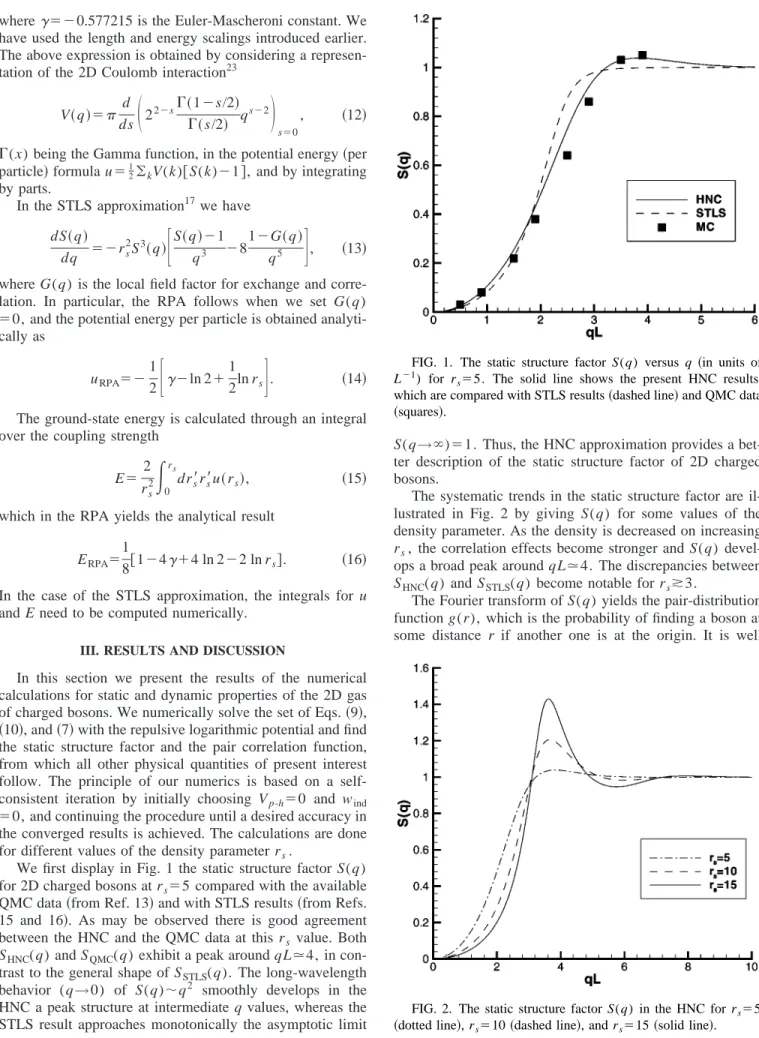
We first display in Fig. 1 the static structure factor S(q) for 2D charged bosons at rs⫽5 compared with the available QMC data共from Ref. 13兲 and with STLS results 共from Refs. 15 and 16兲. As may be observed there is good agreement between the HNC and the QMC data at this rs value. Both
SHNC(q) and SQMC(q) exhibit a peak around qL⯝4, in con-trast to the general shape of SSTLS(q). The long-wavelength behavior (q→0) of S(q)⬃q2 smoothly develops in the HNC a peak structure at intermediate q values, whereas the STLS result approaches monotonically the asymptotic limit
S(q→⬁)⫽1. Thus, the HNC approximation provides a
bet-ter description of the static structure factor of 2D charged bosons.
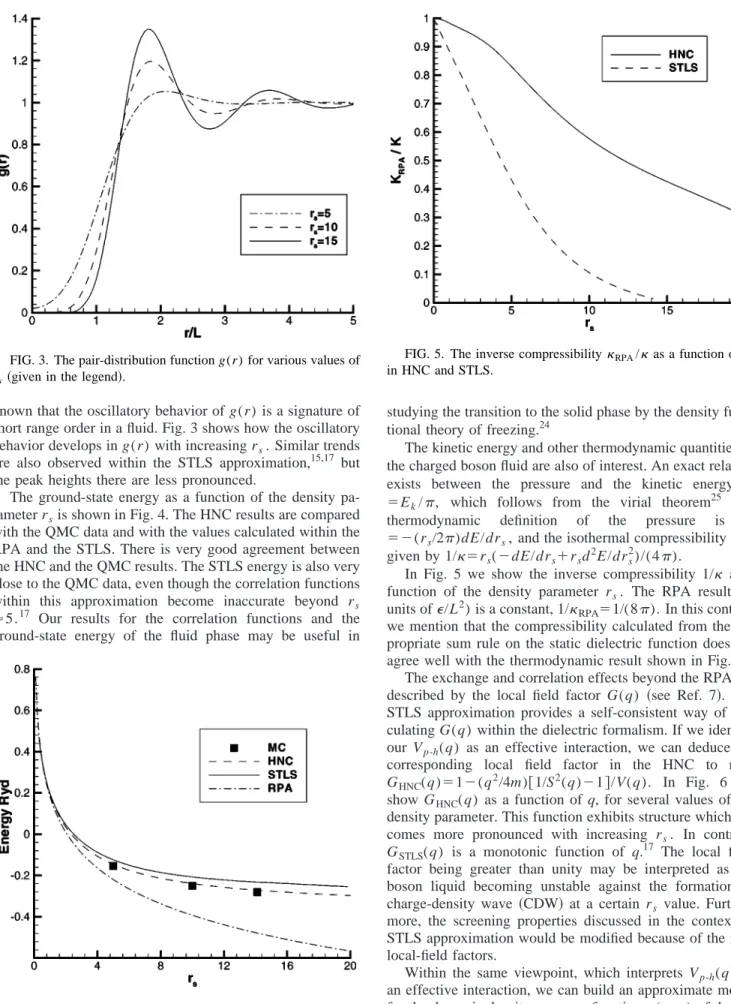
The systematic trends in the static structure factor are il-lustrated in Fig. 2 by giving S(q) for some values of the density parameter. As the density is decreased on increasing
rs, the correlation effects become stronger and S(q) devel-ops a broad peak around qL⯝4. The discrepancies between
SHNC(q) and SSTLS(q) become notable for rsⲏ3.
The Fourier transform of S(q) yields the pair-distribution function g(r), which is the probability of finding a boson at some distance r if another one is at the origin. It is well
FIG. 1. The static structure factor S(q) versus q 共in units of
L⫺1) for rs⫽5. The solid line shows the present HNC results, which are compared with STLS results共dashed line兲 and QMC data
共squares兲.
FIG. 2. The static structure factor S(q) in the HNC for rs⫽5
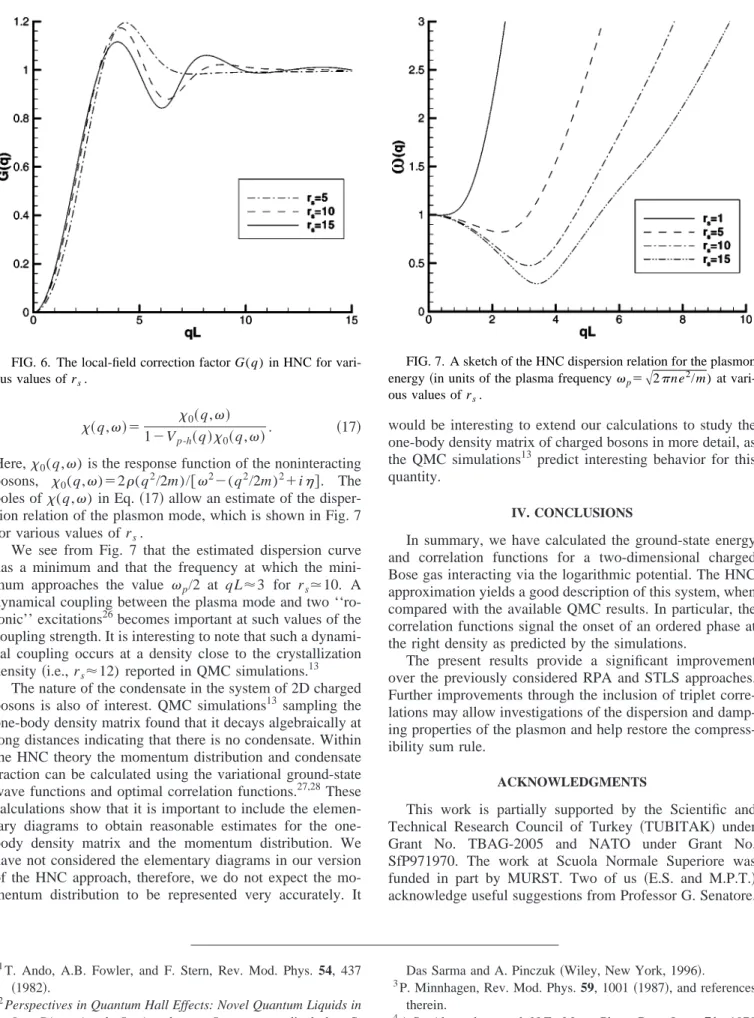
known that the oscillatory behavior of g(r) is a signature of short range order in a fluid. Fig. 3 shows how the oscillatory behavior develops in g(r) with increasing rs. Similar trends are also observed within the STLS approximation,15,17 but the peak heights there are less pronounced.
The ground-state energy as a function of the density pa-rameter rsis shown in Fig. 4. The HNC results are compared with the QMC data and with the values calculated within the RPA and the STLS. There is very good agreement between the HNC and the QMC results. The STLS energy is also very close to the QMC data, even though the correlation functions within this approximation become inaccurate beyond rs ⬇5.17 Our results for the correlation functions and the ground-state energy of the fluid phase may be useful in
studying the transition to the solid phase by the density func-tional theory of freezing.24
The kinetic energy and other thermodynamic quantities of the charged boson fluid are also of interest. An exact relation exists between the pressure and the kinetic energy P ⫽Ek/, which follows from the virial theorem25 The thermodynamic definition of the pressure is P
⫽⫺(rs/2)dE/drs, and the isothermal compressibility is given by 1/⫽rs(⫺dE/drs⫹rsd2E/drs
2 )/(4).
In Fig. 5 we show the inverse compressibility 1/ as a function of the density parameter rs. The RPA result 共in units of⑀/L2) is a constant, 1/RPA⫽1/(8). In this context, we mention that the compressibility calculated from the ap-propriate sum rule on the static dielectric function does not agree well with the thermodynamic result shown in Fig. 5.
The exchange and correlation effects beyond the RPA are described by the local field factor G(q) 共see Ref. 7兲. The STLS approximation provides a self-consistent way of cal-culating G(q) within the dielectric formalism. If we identify our Vp-h(q) as an effective interaction, we can deduce the corresponding local field factor in the HNC to read
GHNC(q)⫽1⫺(q2/4m)关1/S2(q)⫺1兴/V(q). In Fig. 6 we show GHNC(q) as a function of q, for several values of the density parameter. This function exhibits structure which be-comes more pronounced with increasing rs. In contrast,
GSTLS(q) is a monotonic function of q.17 The local field factor being greater than unity may be interpreted as the boson liquid becoming unstable against the formation of charge-density wave 共CDW兲 at a certain rs value. Further-more, the screening properties discussed in the context of STLS approximation would be modified because of the new local-field factors.
Within the same viewpoint, which interprets Vp-h(q) as an effective interaction, we can build an approximate model for the dynamic density response function(q,) of the 2D charged-boson fluid as
FIG. 3. The pair-distribution function g(r) for various values of
rs共given in the legend兲.
FIG. 4. The ground-state energy E(rs) per particle within the
HNC, RPA, and STLS approximations, compared with QMC data.
FIG. 5. The inverse compressibilityRPA/ as a function of rs
共q,兲⫽1⫺Vp-h共q兲0共q,0共q,兲 兲. 共17兲 Here,0(q,) is the response function of the noninteracting bosons, 0(q,)⫽2(q2/2m)/关2⫺(q2/2m)2⫹i兴. The poles of(q,) in Eq.共17兲 allow an estimate of the disper-sion relation of the plasmon mode, which is shown in Fig. 7 for various values of rs.
We see from Fig. 7 that the estimated dispersion curve has a minimum and that the frequency at which the mini-mum approaches the value p/2 at qL⬇3 for rs⯝10. A dynamical coupling between the plasma mode and two ‘‘ro-tonic’’ excitations26becomes important at such values of the coupling strength. It is interesting to note that such a dynami-cal coupling occurs at a density close to the crystallization density 共i.e., rs⬇12) reported in QMC simulations.13
The nature of the condensate in the system of 2D charged bosons is also of interest. QMC simulations13 sampling the one-body density matrix found that it decays algebraically at long distances indicating that there is no condensate. Within the HNC theory the momentum distribution and condensate fraction can be calculated using the variational ground-state wave functions and optimal correlation functions.27,28These calculations show that it is important to include the elemen-tary diagrams to obtain reasonable estimates for the one-body density matrix and the momentum distribution. We have not considered the elementary diagrams in our version of the HNC approach, therefore, we do not expect the mo-mentum distribution to be represented very accurately. It
would be interesting to extend our calculations to study the one-body density matrix of charged bosons in more detail, as the QMC simulations13 predict interesting behavior for this quantity.
IV. CONCLUSIONS
In summary, we have calculated the ground-state energy and correlation functions for a two-dimensional charged Bose gas interacting via the logarithmic potential. The HNC approximation yields a good description of this system, when compared with the available QMC results. In particular, the correlation functions signal the onset of an ordered phase at the right density as predicted by the simulations.
The present results provide a significant improvement over the previously considered RPA and STLS approaches. Further improvements through the inclusion of triplet corre-lations may allow investigations of the dispersion and damp-ing properties of the plasmon and help restore the compress-ibility sum rule.
ACKNOWLEDGMENTS
This work is partially supported by the Scientific and Technical Research Council of Turkey 共TUBITAK兲 under Grant No. TBAG-2005 and NATO under Grant No. SfP971970. The work at Scuola Normale Superiore was funded in part by MURST. Two of us 共E.S. and M.P.T.兲 acknowledge useful suggestions from Professor G. Senatore.
1
T. Ando, A.B. Fowler, and F. Stern, Rev. Mod. Phys. 54, 437 共1982兲.
2Perspectives in Quantum Hall Effects: Novel Quantum Liquids in Low-Dimensional Semiconductor Structures, edited by S.
Das Sarma and A. Pinczuk共Wiley, New York, 1996兲.
3P. Minnhagen, Rev. Mod. Phys. 59, 1001共1987兲, and references therein.
4A.S. Alexandrov and N.F. Mott, Phys. Rev. Lett. 71, 1075
FIG. 6. The local-field correction factor G(q) in HNC for vari-ous values of rs.
FIG. 7. A sketch of the HNC dispersion relation for the plasmon energy共in units of the plasma frequencyp⫽
冑
2ne2/m) at vari-ous values of rs.共1993兲; R. Mincas, J. Ranninger, and S. Robaszkiewicz, Rev. Mod. Phys. 62, 113共1992兲.
5S. Conti, M.L. Chiofalo, and M.P. Tosi, J. Phys.: Condens. Matter 6, 8795共1994兲.
6R. Calinon, K.I. Golden, G. Kalman, and D. Merlini, Phys. Rev. A 20, 329共1979兲; 20, 336 共1979兲.
7K.S. Singwi, M.P. Tosi, R.H. Land, and A. Sjo¨lander, Phys. Rev. 179, 589共1968兲; K.S. Singwi and M.P. Tosi, Solid State Phys. 36, 177共1981兲.
8P. Bakshi, R. Calinon, K.I. Golden, G. Kalman, and D. Merlini, Phys. Rev. A 23, 1915共1981兲.
9J. Caillol, D. Levesque, J.J. Weiss, and J.-P. Hansen, J. Stat. Phys. 28, 235 共1982兲; S.W. de Leeuw and J.W. Perram, Physica A 113, 546共1982兲; 119, 441 共1983兲.
10J.S. Thakur and K.N. Pathak, J. Phys. C 16, 6551共1983兲. 11K. Dharamvir and K.N. Pathak, J. Phys.: Condens. Matter 2, 4429
共1990兲. 12
R.R. Sari, D. Merlini, and R. Calinon, J. Phys. A 9, 1539共1976兲. 13W.R. Magro and D.M. Ceperley, Phys. Rev. Lett. 73, 826共1994兲. 14L. Pitaevskii and S. Stringari, J. Low Temp. Phys. 85, 377共1991兲. 15R.K. Moudgil, P.K. Ahluwalia, K. Tankeshwar, and K.N. Pathak,
Phys. Rev. B 55, 544共1997兲.
16A.A. Caparica and O. Hipoˆlito, Phys. Rev. A 32, 560共1985兲. 17E. Strepparola and M.P. Tosi, Mod. Phys. Lett. B 12, 459共1998兲.
18E. Feenberg, Theory of Quantum Fluids共Academic Press, New York, 1969兲.
19V. Apaja, J. Halinen, V. Halonen, E. Krotscheck, and M. Saarela, Phys. Rev. B 55, 12 925共1997兲.
20G. Sugiyama, C. Bowen, and B.J. Alder, Phys. Rev. B 46, 13 042 共1992兲; S. Moroni, S. Conti, and M.P. Tosi, ibid. 53, 9688 共1996兲.
21E. Krotscheck and M. Saarela, Phys. Rep. 232, 1共1993兲. 22See also for original development of the theory, L. Lantto, Nucl.
Phys. A238, 297共1979兲; R.A. Smith, ibid. A238, 186 共1979兲. 23E.R. Smith, Mol. Phys. 45, 915共1981兲.
24S. Moroni and G. Senatore, Europhys. Lett. 16, 373共1991兲; C.N. Likos, S. Moroni, and G. Senatore, Phys. Rev. B 55, 8867 共1997兲.
25For a 2D system of particles interacting via the r⫺␣law, the virial theorem reads 2Ek⫹␣u⫽2P/, where P is the pressure. For an
ln r interaction␣⫽0 and P⫽Ek.
26
H.M. Bo¨hm, S. Conti, and M.P. Tosi, J. Phys.: Condens. Matter 8, 781共1996兲; S. Conti, R. Nifosı´, and M.P. Tosi, ibid. 9, L475 共1997兲; R. Nifosı´, S. Conti, and M.P. Tosi, Phys. Rev. B 58, 12 758共1998兲.
27M. Puoskari and A. Kallio, Phys. Rev. B 30, 152共1984兲. 28E. Manousakis, V.R. Pandharipande, and Q.N. Usmani, Phys.