MULTI-CHANNEL TDMA SCHEDULING IN
WIRELESS SENSOR NETWORKS
a thesis
submitted to the department of computer engineering
and the graduate school of engineering and science
of bilkent university
in partial fulfillment of the requirements
for the degree of
master of science
By
¨
Ozge Uyanık
June, 2013
I certify that I have read this thesis and that in my opinion it is fully adequate, in scope and in quality, as a thesis for the degree of Master of Science.
Assoc. Prof. Dr. ˙Ibrahim K¨orpeo˘glu(Advisor)
I certify that I have read this thesis and that in my opinion it is fully adequate, in scope and in quality, as a thesis for the degree of Master of Science.
Prof. Dr. ¨Ozg¨ur Ulusoy
I certify that I have read this thesis and that in my opinion it is fully adequate, in scope and in quality, as a thesis for the degree of Master of Science.
Assoc. Prof. Dr. Ahmet Co¸sar
Approved for the Graduate School of Engineering and Science:
Prof. Dr. Levent Onural Director of the Graduate School
ABSTRACT
MULTI-CHANNEL TDMA SCHEDULING IN
WIRELESS SENSOR NETWORKS
¨
Ozge Uyanık
M.S. in Computer Engineering
Supervisor: Assoc. Prof. Dr. ˙Ibrahim K¨orpeo˘glu June, 2013
In wireless sensor networks (WSNs) that use TDMA-based scheduled channel ac-cess, spatial re-use of time-slots is possible among a non-conflicting set of nodes. In this way, data gathering delays can be reduced and aggregate network through-put can be increased. Besides spatial re-use, available multiple channels, which is already an available feature in some sensor node platforms, can be utilized to increase concurrency and minimize the number of time-slots required for a round of communication. In this thesis, we propose TDMA-based scheduling al-gorithms for multi-channel wireless sensor networks. By redefining the conflicts in a multi-channel environment, we extend two existing single-channel TDMA scheduling algorithms into multi-channel structure. We also present two channel assignment schemes (called NCA and LCA) appropriate to use with the extended multi-channel scheduling algorithms. We evaluate our proposed schemes by ex-tensive simulation experiments and compare them with other single-channel and multi-channel algorithms from literature. The results show that in large networks our proposed algorithms can provide better performance, more concurrency, and up to 50% less delay compared to other methods.
Keywords: Wireless sensor networks, multi-channel, TDMA, scheduling, channel assignment.
¨
OZET
KABLOSUZ ALGILAYICI A ˘
GLARDA C
¸ OK KANALLI
ZAMAN B ¨
OLMEL˙I C
¸ OKLU ER˙IS
¸ ˙IM ZAMANLAMASI
¨
Ozge Uyanık
Bilgisayar M¨uhendisli˘gi, Y¨uksek Lisans
Tez Y¨oneticisi: Assoc. Prof. Dr. ˙Ibrahim K¨orpeo˘glu Haziran, 2013
Zaman b¨olmeli ¸coklu eri¸sim (TDMA) tabanlı zamanlanmı¸s kanal eri¸simi kul-lanan kablosuz algılayıcı a˘glarında (KAA) zaman dilimlerinin uzaysal yeniden kullanımı ¸cakı¸smayan d¨u˘g¨um k¨umeleri i¸cin m¨umk¨und¨ur. Zaman dilimlerinin uzaysal yeniden kullanımın yanı sıra bazı algılayıcı d¨u˘g¨um d¨uzlemlerinde de yer alan kullanılabilir birden fazla kanal ¨ozelli˘gi e¸s zamanlılı˘gı artırmak ve bir tur ileti¸simde gereken zaman dilimi sayısını azaltmak i¸cin kullanılabilir. Bu tezde, ¸cok kanallı kablosuz algılayıcı a˘gları i¸cin TDMA-tabanlı zamanlama algoritmaları ¨
onerilmektedir. C¸ ok kanallı ortamda ¸cakı¸sma tekrar tanımlanarak mevcut iki adet tek-kanallı TDMA zamanlama algoritması ¸cok kanallı yapıya geni¸sletilmektedir. Ayrıca, geni¸sletilmi¸s ¸cok-kanallı zamanlama algoritmaları ile kullanıma uygun
NCA ve LCA adı verilen kanal atama y¨ontemleri ¨onerilmektedir. Onerilen¨
y¨ontemler ayrıntılı benzetim ve deneylerle de˘gerlendirilmektedir ve literat¨urde bilinen di˘ger tek-kanallı ve ¸cok-kanallı algoritmalarla kar¸sıla¸stırılmaktadır. Elde edilen sonu¸clar ¨onerdi˘gimiz algoritmaların geni¸s a˘glarda kar¸sıla¸stırılan di˘ger y¨ontemlerden daha iyi ba¸sarım ve e¸s zamanlılık g¨osterdi˘gini ve %50’ye varan ¨
ol¸c¨ude daha az gecikme sa˘gladı˘gını g¨ostermi¸stir.
Anahtar s¨ozc¨ukler : Kablosuz algılayıcı a˘gları, ¸cok-kanallı, zamanlama, kanal atama.
Acknowledgement
First of all, I am grateful to my supervisor Assoc. Prof. Dr. ˙Ibrahim K¨orpeo˘glu his guidance and support during my thesis study. I wouldn’t have finished this thesis without his guidance and encouragement. Being his student is a pleasure and privilege for me. Once again, I would like to thank him.
I would like to thank to Prof. Dr. ¨Ozg¨ur Ulusoy and Assoc. Prof. Dr. Ahmet Co¸sar for their kindness to accept participating in the jury and spending their valuable time for evaluating my thesis.
I would like to thank to T ¨UB˙ITAK, for the support provided for my MSc
study.
I would like to express my gratitude to all my teachers in my life for con-tributing to my success so far.
I am very glad to meet my friends in Wireless Lab Group and want to thank them for their guiding and kind friendship.
I would like to thank to Alper G¨un for his sincere support and encouragement. Last but not least, special thanks to my parents and sister for their endless love and support.
Contents
1 Introduction 1 2 Related Work 6 3 Background Information 14 3.1 Network Model . . . 14 3.2 Conflict Types . . . 16 3.3 Scheduling Problem . . . 184 Multi-channel TDMA Scheduling Schemes 20
4.1 Node Based Scheduling . . . 23
4.1.1 NCA: Our Proposed Node Channel Assignment (phase 1) . 23
4.1.2 COLOR: Extended Slot Assignment Algorithm (phase 2) . 26
4.1.3 NODE: Extended Node Based Scheduling Algorithm
(phase 3) . . . 28 4.2 Level Based Scheduling . . . 30
CONTENTS vii
4.2.1 LEVELTREE: Extended Linear Network Creation
Algo-rithm . . . 30
4.2.2 LCA: Our Proposed Level Based Channel Assignment (phase 1) . . . 32
4.2.3 Slot (Color) Assignment to Levels (phase 2) . . . 32
4.2.4 LEVEL: Extended Level Based Scheduling Algorithm (phase 3) . . . 33
4.3 An Algorithm from Literature for Comparison . . . 36
4.4 Summary . . . 38
5 Performance Evaluation 40 5.1 Simulation Environment . . . 40
5.2 Simulation Results . . . 44
5.2.1 Delay versus Density . . . 44
5.2.2 Delay versus Interference Range . . . 45
5.2.3 Delay versus Number of Channels . . . 46
6 Conclusion and Future Work 53 6.1 Future Work . . . 54
List of Figures
3.1 Primary Conflict: Transmission and reception of node j in G and
its representation in GC. . . 16 3.2 Primary Conflict: Transmission of siblings to node j in G and its
representation in GC. . . 17
3.3 Secondary Conflict: Node j in the transmission range of another
node in G and its representation in GC. . . 17
4.1 NCA channel assignment of G using GC. . . 25
4.2 Coloring single-channel and multi-channel network. . . 27
4.3 Node-based scheduling of single-channel and multi-channel network. 29
4.4 LCA channel assignment and coloring of single-channel and
multi-channel network. . . 33
4.5 Level-based scheduling of single-channel and multi-channel network. 35
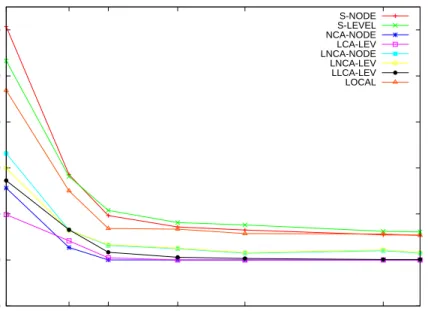
5.1 Density of the nodes on the area. . . 41 5.2 Delay versus density. Interference range = 2 x transmission range.
LIST OF FIGURES ix
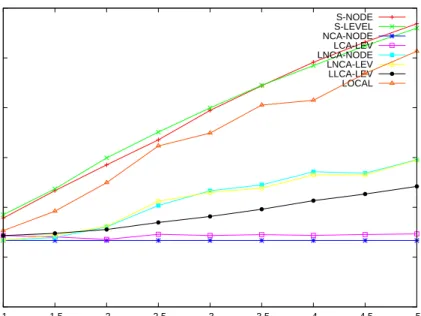
5.3 Delay versus ratio of interference to communication range. Density = 0.1. Number of channels = 3. . . 46 5.4 Delay versus ratio of interference to communication range. Density
= 9. Number of channels = 3. . . 47
5.5 Delay versus number of channels. Interference range = 2 x
trans-mission range. Density = 0.1. . . 48
5.6 Delay versus number of channels. Interference range = 2 x
trans-mission range. Density = 0.25. . . 49
5.7 Delay versus number of channels. Interference range = 2 x
trans-mission range. Density = 0.45. . . 50
5.8 Delay versus number of channels. Interference range = 4 x
trans-mission range. Density = 0.1. . . 50
5.9 Delay versus number of channels. Interference range = 3 x
trans-mission range. Density = 0.1. . . 51 5.10 Delay versus number of channels. Interference range = 2 x
trans-mission range. Density = 0.1. . . 51 5.11 Delay versus number of channels. Interference range =
List of Tables
Chapter 1
Introduction
In this thesis, we study methods for effective time division multiple access (TDMA) scheduling in wireless sensor networks (WSNs) by utilizing multi-channel capability of sensor nodes and spatial re-use of multi-channels and time-slots. The goal is to come up with schedules that minimize the number of time-slots re-quired for a round of data gathering and increase aggregate network throughput. We also propose algorithms for efficient channel assignment to sensor nodes.
Sensor nodes are devices that are low-cost, low-power, and have short com-munication range. A typical sensor node consists of sensing, data processing and communication units [1]. Each sensor node senses and produces data signal to be transported to a central location, so called base station or sink. A large number of sensors are usually deployed to cover an area of interest for various purposes such as environment monitoring, fire detection, or industrial automation control. Depending on the application, a monitoring activity may require a wireless sensor network to collect data from sensor nodes to the sink node as quickly
as possible. It is also important that the data is carried without losses and
errors. Errors and losses can happen due to collisions and interference. A proper scheduling method can prevent them.
Because of the short transmission range of sensor nodes [2], which is approx-imately 10 to 100 m depending on power output and environmental characteris-tics, covering a large area of interest requires the deployment of a large number of sensor nodes. These nodes need to cooperate for transmission of packets to the center. That means multi-hop communication is required to carry the data from a sensor node to the sink node. Hence, besides producing and transmitting its own data, each node needs to relay (forward) the data of other sensor nodes, the descendant nodes, as well.
Since wireless sensor nodes are usually battery-powered and therefore have limited source of energy, the lifetime of a sensor network, besides many other things, is affected by medium access control (MAC) protocol used. MAC pro-tocols using time division multiple access (TDMA) are very successful in avoid-ing collisions compared to contention-based protocols [3]. Besides, efficiency in power is obtained more easily in TDMA-based MAC protocols, since nodes can remain silent and only get activated at their scheduled time-slots, whereas idle-listening and collisions cause energy waste in contention-based protocols. More-over, TDMA-based protocols can create a schedule for transmissions with some QoS guarantees in terms of delay, jitter and throughput. It is very difficult for contention-based protocols to provide such guarantees.
Main objective in a TDMA scheduling scheme is to assign time-slots to nodes
for accessing a channel, considering network topology and interference. The
schedule produced by a TDMA protocol in a wireless sensor network enables the data packets of all sensor nodes to reach to the sink in a collision free manner. The number of slots used for a round of data gathering from all sensor nodes to the sink node is defined to be the schedule length. Shortening the schedule length with an intelligent scheduling algorithm makes the network accomplish the same data gathering task faster, hence reduces delay and increases throughput.
An appropriate scheduling mechanism is required in order to arrange trans-mission order of sensor nodes to prevent collisions and to carry data to sink as fast as possible. An effective factor in arrangement of scheduling is interference. When operating on the same frequency, nodes that are spatially close to each
other can interfere and affect transmission of each other by causing incorrect de-coding of packets at the receiver side, unless a method to completely eliminate or reduce the interference is applied.
Some sensor node platforms have multiple channels that can be used for trans-mission. For example, IEEE 802.15.4 [2] standard specifies medium access control and physical layer for low-rate wireless personal area networks (LR-WPANs) and can operate in one of the three different unlicensed bands, supporting 1 channel in 868 MHz band, 10 channels in 902 MHz band, and 16 channels in 2.4 GHz ISM (industrial, scientific and medical) band. Upper layers of the standard are not defined and can be specified in various standards, such as ZigBee [4] and Wire-lessHART [5]. Contention based or TDMA based channel access method can be applied over the base MAC layer of the sensor nodes using IEEE 802.15.4 stan-dard. Since multiple channels are available, sensor nodes can apply intelligent channel assignment and channel access scheduling algorithms.
Another short-range wireless technology that supports multiple channels and that also uses 2.4 GHz ISM band is the ubiquitous IEEE 802.11 [6] standard, also known as Wi-Fi. Although there are 14 channels defined in the standard, availability of the channels depends on band regulations of countries. For exam-ple, channels 1-13 are supported in Europe and China. Only first 11 channels are supported in the United States and Canada, whereas channel 14 is specific to Japan. Most existing studies consider only 11 channels.
On 2.4 GHz, channels of 802.11 overlap with channels of 802.15.4 and can interfere with each other. Therefore, coexistence of multiple networks in an envi-ronment can have a negative effect on each other even though the networks use different wireless technologies. Coexistence issues of 802.11 and 802.15.4 as well as other wireless technologies operating on the ISM band are investigated through studies in [7, 8, 9, 10, 11, 12]. In a multi-network environment, the number of available channels for successful transmission in a WSN can be even less, as other wireless technologies such as 802.11 co-exists.
We consider data collection applications for which traffic in the network is routed along a tree structure spanning all the sensor nodes and rooted at the sink
node. Data packets produced by sensor nodes are transmitted to the sink over multiple-hop paths on the tree. A large number of sensor nodes are organized into a logical tree. Here, we are not concerned about how such a tree can be formed. We assume it is given. We also assume TDMA-based channel access is used by sensor nodes so that fast and energy efficient data collection can be performed in a collision-free manner.
In [13], Ergen et al. propose TDMA-based single-channel node-based and level-based scheduling for WSNs. In their scheduling algorithms, routing tree is assumed to be given and interference graph is assumed to be known. Since the whole network shares only one channel, transmission of any nodes nearby possibly causes conflicts. Successful transmission is guaranteed via assigning a time-slot in which any other conflicting nodes do not transmit. This step is achieved by coloring the conflict-graph of the original network, whose nodes are transmission edges of the original network. Edges of the conflict-graph correspond to the transmissions that should not occur at the same time-slot. In this way, any two of the connected nodes in the conflict-graph should have a different color so that corresponding transmission links are not activated at the same time. In their method, after determining transmission slots by assigning colors, they propose scheduling algorithms that schedules the network until all packets reach to a base station. Their proposed node-based schedule gives equal chance to the nodes in the network. Another novel approach they propose, level-based scheduling, balances the movements of the packets across the network by considering hop-distances of the nodes to the base station and performs well when majority of the nodes are far away from the base station.
Having the single-channel TDMA scheduling methods proposed in [13] as our starting point, we expect to reduce the schedule length, hence reduce the delay, further by utilizing multiple channels in a WSN. When multiple channels are available and utilized, nodes in a WSN will have more chance to concurrently access the channel in a collision free manner, since they will have more freedom for preventing interference: they can either choose non-conflicting time-slots or they can choose different radio channels.
In this thesis, we first evaluate node-based and level-based spatial TDMA scheduling in WSNs that use a single-channel. Then, we propose our extensions to these algorithms for networks where multiple channels can be assigned to nodes. Moreover, we propose appropriate channel assignment algorithms, NCA and LCA, to be used with node-based and level-based scheduling algorithms, re-spectively. We evaluate through extensive simulations the performance of our proposed multi-channel solutions. We also compare our algorithm with afore-mentioned single-channel scheduling algorithms as well as with a multi-channel scheduling algorithm from literature. Our results show that our proposed solu-tions perform well even for the case where the number of available channels is quite limited.
Our contributions in this thesis are three-fold:
• First, we evaluate and redefine conflicts types in order to distinguish the ones that can be resolved by utilizing multi-channels.
• Second, we extend single-channel scheduling algorithms of [13] into a multi-channel structure. Hence, for any given network, multiple multi-channels can be scheduled without collision by distinguishing the conflicts. Since the number of available channels can be limited, channel assignment need to be done carefully and efficiently.
• Finally, we propose two channel assignment algorithms (NCA and LCA) that are used in combination with time-slot assignment and scheduling al-gorithms.
The rest of this thesis is organized as follows. In chapter 2, some related work is discussed. In Chapter 3, some background information is presented. Our proposed multi-channel scheduling schemes, plus an existing related algorithm that is compared with our algorithms, are presented in Chapter 4. Our simulation environment and our simulation results are presented and interpreted in Chapter 5. Finally, conclusions and future work are presented in Chapter 6.
Chapter 2
Related Work
Multi-channel TDMA algorithms are studied in depth in [14, 3, 15, 16, 17, 18] and [19]. Zhang et al. [14] propose coloring and coding based distributed
multi-channel TDMA scheduling in wireless ad-hoc networks. They categorize the
conflicts caused by wireless links into two types: explicit and implicit. Explicit conflicts are proposed to be avoided by a time-slot allocation method whereas avoiding of implicit conflicts relies on an algebraic coding based algorithm that utilizes multiple channels. Jovanovic et al. [3] propose TFMAC, a multi-channel MAC protocol for WSNs that incorporates multiple channels into TDMA. In TFMAC, a node randomly chooses a frequency and broadcasts it to its neigh-bors before activation period. Then it collects timetables from its neighneigh-bors to decide the time-slots to be active. TFMAC employs a control slot to exchange control messages. Incel et al. [16] propose local time-slot assignment for raw data convergecast and utilize multiple channels using RBCA channel assignment algo-rithm proposed in [20]. We give more details about the RBCA with local time-slot assignment scheme in further chapters, since we compare our algorithms with this scheme.
Scheduling in industrial WSNs are studied in [21, 22] and [17]. In [23], an in-dustrial environment is described to be harsher due to unpredictable variations in temperature and presence of heavy equipment. Therefore, industrial WSNs have
different requirements. An integrated slot assignment and channel allocation al-gorithm is proposed by Zhang et al. [21] that is compatible with some well-known standards of industrial WSNs: WirelessHART [5], WIA-PA [24], ISA100.11a [25] standards. Routing tree is colored in the channel assignment phase. After chan-nel assignment, time-slot allocation algorithm is applied which consists of rules identified according to parent or sibling type of relationships. In our methods, however, coloring is used for slot allocation. Yuan et al. [22] proposed tree con-vergecast scheduling with multiple channels for WirelessHART. MAC layer of WirelessHART combines TDMA and frequency hopping, and abandons spatial reuse. It allows only one link to be active on each channel in each time-slot. They propose an optimal schedule using integer programming and also propose suboptimal schedules using heuristics based on max distance first, node-coloring, level-coloring and busy sender first approach. Zhang et al. [17] present time and channel optimal convergecast scheduling for WirelessHART networks with a multi-line routing topology. Our channel assignment and time-slot allocation methods for WSNs differ from the above studies in literature as our methods allow spatial reuse of a frequency and time-slot whereas it is abandoned in Wire-lessHART.
TDMA with data aggregation at intermediate nodes are studied in [26, 27] and [16] for WSNs. Gobriel et al. [26] propose TDMA-ASAP, assuming in network-aggregation is happening at each receiving node. For that, no child is scheduled after its parent. In order to exploit parallel transmissions, they apply level by level graph coloring and introduce slot stealing mechanism to avoid empty slots to be unused. Diaz-Anadon et al. [27] propose DATP, a distributed TDMA scheduling protocol that aggregates and compresses cross-correlated data at neighboring nodes by empirically verifying that a time-slot is collision-free for event-triggered WSNs that execute a scheduling phase. Incel et al. [16] consider aggregating all packets received from descendants into a single packet where a node has to wait for all its descendants to finish aggregation phase before it can transmit its own data.
In [28] and [16], power control is used as a method to decrease radio interfer-ence and to improve spatial reuse in TDMA networks so that schedule length is
minimized.
Multi-channel communication is studied in various wireless networks in [29, 30, 15, 18, 31, 32] and [33]. Wu et al. [29] propose TMCP for WSNs, tree-based multi-channel protocol that partitions network into multiple sub-trees and greedily allocates channels to each sub-tree. In [30], Zhou et al. propose MMSN, a multi-frequency MAC protocol for WSNs, that is the first in the literature. Sala-jegheh et al. [15] propose HyMAC. In HyMAC, base station calculates frequency and time-slot of each node based on the neighbor lists sent to it. It performs a BFS to construct a tree rooted at the sink and then assigns a time-slot and fre-quency respecting interference to previously assigned nodes in the neighborhood. It increases the time-slot while starting a new level. Annamalai et al. [18] propose CTCCAA that centrally constructs a convergecast tree with schedules assigned for collision-free transmissions by utilizing multiple frequencies if available. Pro-posed tree construction is also showed to be as effective as a tree specifically designed for broadcasting. Bilgin et al. [31] investigate performance of multi-channel WSNs on a smart grid environment such as a mains-power control room, by also considering the overlapping channels of 802.15.4 and 802.11b. They are setting channels for sensor nodes in such a way that the selected channels are not affected by 802.11b. Gonga et al. [32] present an experimental test-bed setup for the analysis of single-channel and multi-channel communication in sparse and dense multi-hop WSNs under the interference of different 802.11 channels.
Multi-channel communication is also used in clustered networks. In a clustered WSN, nodes are formed into groups. In this way, a cluster head node, which can have a more powerful battery and higher communication range, is used for inter-cluster communication. Studies [34, 35, 36] and [19] are on inter-clustered WSNs. Xun et al. [34] propose a coordinator based multi-channel MAC protocol. Abdeddaim et al. [35] propose MCCT that constructs a multi-channel cluster tree, grouping spatially close nodes with a common channel and assigning a non-leaf node as a coordinator. Zhang et al. [36] propose TDMA scheduling using a single channel for a cluster formed by leaf nodes. Intermediate nodes responsible for each cluster are further clustered into groups, each cluster sharing a common transmission and control frequency. Hunkeler et al. [19] present IMPERIA for centrally managing
WSNs in a clustered structure using TDMA. In its data collection frame where nodes forward their data through clusters, each cluster uses an individual channel. Typical design observed in studies [35, 36, 19] is that multi-channel capability is utilized in clusters such that each cluster is assigned a different channel and intra-cluster communication is done on a single channel.
Ergen et al. [13] propose node-based and level-based TDMA scheduling al-gorithms for single-channel WSNs. We extend these single-channel scheduling algorithms and adapt them to be used with multi-channel networks. We give details of these algorithms in Chapter 4.
TDMA scheduling algorithms using a single-channel are investigated in vari-ous studies in literature [37, 38, 28, 26, 39, 27, 40, 41, 42, 13, 19]. In [37] Verga-dos et al. propose FFSVA and load balanced LB-FFSVA, fair TDMA scheduling algorithms for wireless multi-hop networks. The concept of weight factor is intro-duced and integrated with the scheduling algorithm in order to provide fairness. In FFSVA, the set of nodes to transmit in a time-slot is determined by testing the nodes in an order that was created according to a rule using the weight fac-tor. The weight factor is updated at each time-slot so the nodes are re-ordered. LB-FFSVA is used with a cost value introduced for each node and updated at each time-slot to avoid nodes that take part in other transmissions.
Djukic et al. [38] frame the TDMA scheduling problem as a network flow problem on the conflict-graph of the network. Using constraints they formulate a linear min-max delay optimization for TDMA networks that minimizes the max-imum delay in a routing tree rooted at the sink. They also decompose TDMA scheduling and show that if the transmission order is fixed, the schedule can be found in polynomial time, and propose a heuristic that adds spatial reuse by introducing a ranking function that allows links far enough on the same path to transmit in the same time-slot. Wang et al. [2] propose a fair spatial re-use based TDMA scheduling scheme, FSTS, to reduce the difference in end-to-end delivery rates of nodes. They formulate fairness based on feedback neural network compu-tations and propose algorithms to make use of maximum transmission capability in order to utilize spatial re-use and re-use of idle slots. Quintas et al. [40] study a
low power schedule with the same length of a pre-defined frame length to obtain energy efficiency. The power consumption of each slot in the schedule is recorded. Their proposed algorithm obtains energy efficiency by searching and swapping slot pairs for a low-power schedule with the same length. Panigrahi et al. [41] study TDMA with link coloring under angular interference model they propose for long distance Wi-Fi networks. Wang et al. [42] study TDMA link scheduling under protocol interference model for static wireless networks consisting of nodes with different transmission and interference ranges, proposing coloring algorithms that consider traffic load.
Eliminating interference is important for successful transmission, because transmission on interfering links at the same time results in conflicts, requiring re-transmissions, which cause increase in schedule length. Schedules should be designed so that transmissions are not affected by interference. Therefore, correct modeling of interference is an important issue. Gupta and Kumar in [43] propose two methods to model the interference for successful reception of a transmission over one hop: protocol model and physical model. In protocol interference model, a transmission is successful at the receiver if any other nodes transmitting on the same channel is farther than this receiving node by a given threshold. In physical interference model, a successful transmission requires a minimum signal to inter-ference ratio threshold. Jain et al. [44] study the effect of interinter-ference in multi-hop networks and model the interference using a conflict-graph that indicates which group of links mutually interfere and cannot be active simultaneously. They also show that given a set of source and destination nodes, finding an optimal throughput is NP-hard under the protocol interference model. Angular interfer-ence model proposed by Panigrahi et al. [41] considers undirected links and takes into account the effect of earth’s curvature unique to long-distance links.
Many-to-one communication paradigm is known as convergecast [16]. Various studies have been done based on convergecast traffic [45, 13, 16, 22, 17, 18, 19, 46]. Song et al. [45] propose a time-optimum distributed packet scheduling algorithm for many-to-one routing in WSNs by marking links as even or odd to activate alternatively. Ergen et al. [13] propose two centralized scheduling algorithms for
WSNs where data traffic forms a tree. Incel et al. [16] study both raw data con-vergecast and aggregated concon-vergecast using TDMA scheduling in WSNs. Con-vergecast in [22, 17] is on industrial WSNs. In [46], Lu et al. propose DMAC, a MAC protocol designed for data gathering trees in WSNs by staggering ac-tive/sleep scheduling of the nodes according to their depth in the tree.
Various studies consider and use multiple channels that might be available in the wireless communication technology used by sensor nodes. An appropriate channel assignment scheme is needed in order to efficiently assign channels to nodes so that interference is eliminated to enable parallel transmissions. Channel assignment schemes are extensively analyzed in [29, 30, 34, 16, 18, 35, 33]. Greedy PMIT algorithm in [29] assigns a channel and a parent to each node assuming the interference sets are already known. Algorithm starts with applying a BFS starting from root and computes a fat tree that is a shortest path tree, where branches from the sink node to each sensor node are paths with minimum hop count. Channel allocation is done level-by-level from top to bottom of the tree. At each level, nodes with fewer parents are processed first, because they are considered to be more constrained to choose channels. An optimal channel, in other words an optimal tree, is selected for a node that it can connect and bring the least interference to tree. Parent of the node in the tree is chosen so as to cause least interference.
Zhou et al. [30] propose four different frequency assignment schemes depending on different WSN attributes. First scheme is the exclusive frequency assignment algorithm that guarantees nodes within two-hops are assigned different channels provided that the number of available frequencies is greater than or equal to the number of nodes within two-hops. In the second scheme, even-selection strategy is proposed for the cases where there are not enough frequencies. Even-selection scheme, randomly chooses one of the least chosen frequencies. In the third scheme, eavesdropping, communication cost of broadcasting selected frequencies is lowered by proposing a random backoff period to overhear the selected frequencies of other nodes. In the fourth scheme, implicit consensus, a node locally calculates its frequency using a pseudo-random number generator that is shared by nodes and that takes node ID as seed. Local computation is performed by only the
nodes within two-hop neighborhood.
Xun et al. [34] propose MCMAC multi-channel MAC protocol. MCMAC uses one of the channels as a control channel to exchange control messages. Cluster-head distribute channels for source and destination nodes and broadcasts the channel assignment information packet on the control channel. If the number of channels is not sufficient for transmission requests, clusterhead stores some requests in the queue according to priority or other factors.
Incel et al. [16] study multi-channel scheduling and discuss three channel as-signment methods. Joint Frequency Time Slot Scheduling (JFTSS) starts with the link that has the highest number of packets to transmit. If the link loads are equal, then the link that is more-constrained in terms of interference is consid-ered first and the most available slot-channel pair is assigned. The nodes that do not interfere can be assigned the same time-slot and channel. In Tree-Based Multi-channel Protocol (TMCP), network is partitioned into multiple sub-trees where each sub-tree is assigned a different channel. This method is efficient since nodes do not require channel switching. In Receiver-Based Channel Assignment (RBCA), children of a common parent transmit on the same channel. Therefore, each node operates in at most two channels. Initially, all receivers are assigned the same channel. Then, for each receiver, a set of interfering parents are created and an available channel starting from the most interfered parent is assigned.
Zhang et al. [33] propose centralized time-slot scheduling and local distributed channel allocation for WSNs. In channel scheduling, channel model is constructed with dynamic programming method by taking into consideration probing cost and channel quality.
Distributed scheduling has also attracted a lot of attention. Studies in [45, 47, 42, 13, 16] include distributed scheduling algorithms for WSNs and multi-hop networks in general. A distributed TDMA MAC protocol is proposed in [48].
Surveys on WSNs are presented in [1, 49, 50].
or MAC protocol. Depending on the algorithm, packet transmission chance of a node can be affected from its location in the topology. Schedule length can be decreased specifically for different type of topologies. Wang et al. [39] propose fairness in end-to end delivery in its spatial TDMA scheduling algorithm so that nodes with different quality and distance to the sink are treated equally. Ergen et al. [13] propose level-based scheduling where movement of the packets across the network is much better balanced for topologies with high density further away from the sink. Their proposed node-base scheduling algorithm gives equal chance to the nodes in the network and performs better in topologies of equal density of packets across the network or higher packet density at low levels. Lu et al. [46] design DMAC to solve data forwarding interruption problem, whereby not all nodes on a multi-hop path to the sink are notified of data delivery in progress, that results in significant sleep delay, and allow continuous packet forwarding by giving the sleep schedule of a node an offset that depends upon its depth in the tree.
We propose centralized multi-channel TDMA scheduling algorithms. We first improve node-based and level-based TDMA scheduling algorithms for
single-channel WSNs in [13] by extending them into multi-single-channel structure. Our
proposed channel assignment schemes utilize multiple channels in the network in which a channel can be assigned to more than one node for a time-slot. In our proposed channel assignment, starting from root greedily, children of a parent transmit on the same channel and transmission channel of the children is assigned the same with their parent whenever it does not cause conflicts. Time-slot as-signment to nodes is done by coloring conflict graph of the original network. A time-slot can assigned to more than one node as long as the resulting set of nodes for a time-slot is non-conflicting. Therefore, in our network, the same channel and time-slot can be spatially re-used by more than one node, whereas this is abandoned in industrial WSNs.
Chapter 3
Background Information
This chapter introduces network model used in this thesis, defines conflict types and details the scheduling problem.
3.1
Network Model
We assume that the network consists of one base station, also referred as sink node, and sensor nodes, sometimes also referred as sensors or nodes. Base sta-tion constantly collects data transferred by sensor nodes. Sensor nodes generate data packets and transmit these data packets to base station. All the nodes are assumed to be of the same type such that they transmit with the same power using the same hardware, hence nodes have equal transmission range and equal interference range and, adopting the ideal network model, transmission disk is assumed to be circle. We assume node places are fixed. Routing tree is con-structed in such a way that each node is connected to sink node either directly or through multi-hops. If a node is not directly connected to sink, it is connected to another sensor node selected as parent. The node selected as parent is a neigh-boring node with smallest number of hops to the sink node. In the case there are multiple choices for parents with equal smallest number of hops to sink, the one with shortest total path length to sink is chosen. Level of a node is the number
of hops from the node to the sink.
The network model proposed in [13] forms the basis of network model in this thesis. The network is represented by a graph G = (V, E). Here, V is the set of vertices, in this case sensor nodes; and E is the set of edges, in this case transmission links to be scheduled. N = |V | is the number of nodes in G. The edges E ⊂ V ×V are undirected. Every sensor node is connected to only one sensor node or base station directly for the transmission of its data packets. Thus, the graph forms of a tree. If the node is not directly connected to sink, node transmits its packet to its parent where packet reaches the sink via multiple hops forwarded by nodes. All traffic is collected at the sink.
A transmitting node may interfere with another active node which causes col-lisions. Therefore, interfering nodes should not transmit at the same time. Well-known protocol interference model in [43] is used, that identifies the interference at the receiver, based on distance. Interference graph C = (V, I) is assumed to be known. I ⊂ V ×V is the set of edges such that (u, v) ∈ I if nodes u and v are in the interference range of each other or although they are far enough to be affected by each other’s transmission, one of them can interfere by a transmission intended for the other. If two nodes u, v are connected in the interference graph, v should not be scheduled to receive from another node while u is transmitting.
The conflict-graph corresponding to G = (V, E) and C = (V, I) is called GC = (V, EC). In the conflict-graph, each edge of the original graph G that is a transmission link to be scheduled is represented by a node. Since each sensor node in the original graph has only one transmission link which is to its parent for the packets destined to sink, in the conflict-graph there is only one node regarding a transmission link originating from a node because there is only one transmission edge for the node, for the traffic destined to sink. Hence, in the representation of this single edge, node itself can be directly used as a notation indicating the transmission to its parent. Therefore, node set in the conflict-graph referring to transmission links of the original graph are represented by original nodes. for simplifying the notation such that node i ∈ V in GC corresponds to the transmission link (i, pi) ∈ E where pi is the parent of i.
In the conflict-graph, EC comprises the edges between node pairs in G that should not transmit at the same time. Since each node has a half-duplex radio interface, it cannot transmit and receive in the same time-slot, and primary and secondary conflicts are considered in determining EC.
3.2
Conflict Types
There are two types of conflicts for the transmissions introduced by the nodes in the network. First type of conflict is called primary conflict that occurs as a node cannot both transmit and receive at the same time-slot as well as cannot receive more than one transmissions destined to it at the same time-slot. This is due to nature of the sensor nodes consisting of half-duplex radios. If (i, j) ∈ E, (i, j) ∈ EC, since a node can not both transmit and receive at the same time-slot. This primary conflict and its representation in GC is illustrated in Figure 3.1. Also, if (i, j) ∈ E and cj is a child of j in G i 6= cj, (i, cj) ∈ EC because a
parent can not receive from more than one child at one time-slot. Illustration of this primary conflict and its representation in the conflict-graph GC is given in Figure 3.2. j i j i pj
Figure 3.1: Primary Conflict: Transmission and reception of node j in G and its representation in GC.
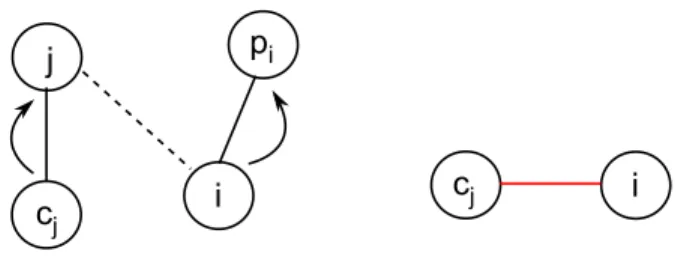
The other conflict is called secondary conflict that occurs when an intended receiver of a particular transmission is also within the transmission range of an-other transmission destined to anan-other receiver. If (i, j) ∈ I and (i, j) /∈ E, and
j
i cj
i cj
Figure 3.2: Primary Conflict: Transmission of siblings to node j in G and its representation in GC.
cj is a child of j in G, (i, cj) ∈ EC, because if i is transmitting, child cj of j
cannot transmit at the same time-slot as j would hear from both i and cj. This
situation is illustrated in Figure 3.3 together with its representation in GC.
cj
j pi
i cj i
Figure 3.3: Secondary Conflict: Node j in the transmission range of another node in G and its representation in GC.
Ergen et al. [13] gives definitions of primary and secondary conflicts which are described above. In this thesis, since our aim is to decrease schedule length by mitigating interference, our motivation is to distinguish the transmission links that can be resolved when operating on different channels. Therefore, based on primary and secondary conflict definitions, we consider primary conflicts that are caused by sibling-sibling or parent-child relations as cannot be eliminated by setting to different channels, whereas secondary conflicts can be eliminated by utilizing multiple channels and setting transmission links to different channels.
Moreover, in order to distinguish conflict types in the conflict-graph efficiently, we modified the conflict-graph to be a an edge-labeled conflict-graph where edges are associated with two different labels where one label is assigned to edges of primary conflicts and the other is assigned to edges of secondary conflicts. For in-stance, in the conflict-graphs of the primary conflicts in Figures 3.1 and 3.2, edges are associated with black color, whereas edge of the conflict-graph in secondary
conflict example in Figure 3.3 is associated with red color. This modification in the conflict-graph reduces computation overhead in the next phases.
3.3
Scheduling Problem
A scheduling frame, a schedule, consists of equal-duration time-slots that node or nodes assigned for transmissions. As also stated in [13], we assume duration of a time-slot is enough for a successful transmission of a data packet as well as a guard interval to compensate for synchronization issues. Scheduling frame starts with each node generating a positive number of packets and ends when all these packets reach at the sink node. In the schedule, each edge in G, that is each node in GC are assigned at least one time-slot for transmission. We assumed that interference graph C is given. With this knowledge, scheduling problem is finding a scheduling frame with minimum length during which all nodes can send their packets to sink. Apart from [13], in finding a minimum length scheduling frame, we also take into account utilizing multiple channels.
The scheduling problem mentioned above is proved to be NP-complete in [13] by reducing NP-complete problem of finding the chromatic number of a graph to the scheduling problem under use of a single channel. Moreover, finding an optimum channel assignment to remove secondary conflicts is NP-complete [51]. Therefore, in the solution of this problem we used polynomial time heuristics. Our heuristic is based on reducing the number of transmission links affected from secondary conflicts by assigning them to different transmission channels.
Channel allocation to nodes is based on the approach that a node is assigned channels for transmission and reception states. In this way, a node operates on at most two different channels: transmission channel and reception channel. The channel on which the node will transmit or receive will be calculated centrally. On the transmission state, the node will operate on transmission channel and on the reception state the node will operate on receive channel assigned by the central mechanism.
The central mechanism uses as few numbers of channels as possible to elim-inate the interference by spatial reuse of channels such that a channel can be assigned to a number of nodes.
We also study the scheduling problem under limited number of channels avail-able. Having a limited number of channels available, eliminating all secondary conflicts by channel allocation may not be possible. Appropriate channel selection policy is proposed for this case.
The central mechanism produces the schedule proposed by the heuristic algo-rithms by spatial reuse of a time-slot where none of the conflicting nodes transmit at the same time.
Chapter 4
Multi-channel TDMA Scheduling
Schemes
Since both channel assignment and scheduling problems to eliminate secondary conflicts are NP-complete, our proposed solutions depend on heuristics. As part of our solution, two centralized single-channel scheduling heuristics in [13] are modified and improved for multi-channel scheduling. We perform static channel assignment. Nodes are not frequently and dynamically hopping among multiple channels. A node can change at most between two channels (one channel for reception, one channel for transmission) that are statically and permanently as-signed to the node for the lifetime of the network. Static channel assignment is preferred to reduce complexity in sensor nodes.
As mentioned above, our solution is based on the node-based and level-based TDMA scheduling algorithms proposed by Ergen et al. [13]. Their scheduling algorithms are effective in single-channel WSNs, however, do not take into account multi-channel capability of sensor radios. Hence, they cannot utilize multiple channels. Moreover, the algorithms in [13] are not in a form that is directly applicable for multi-channel networks. They need to be modified first to operate in a multi-channel environment.
on a multi-channel WSN. But this is not enough. We also need an algorithm to decide which channel will be used by each node, i.e., a channel assignment algorithm. Therefore, we also propose channel assignment algorithms. After such an assignment, the modified versions of the scheduling algorithms of [13] are used to assign time-slots to the nodes. At the end, a conflict-free schedule is obtained so that packets are carried to the sink without collisions and with a minimal schedule length possible.
A key parameter that is important for the effectiveness of our multi-channel scheduling algorithms is the number of channels that can be used by the al-gorithms (i.e., number of available channels). In theory, this number can be unlimited, but in practice it is limited due to several reasons such as the wireless standard restrictions or the interference existing in the environment. Therefore, the proposed algorithms should be effective in assigning channels even with few numbers of available channels.
Another important issue in designing a channel assignment scheme is perform-ing long-durational (or static) assignments and keepperform-ing channel switchperform-ings among the assigned channels as minimum as possible. This is because running the chan-nel assignment algorithm dynamically and frequently causes extra overhead to the network and frequent channel switching increases power consumption and re-quires more complex transceivers. Assigning the channels once and using them for the whole lifetime of the network is a more efficient approach in terms of overhead caused to the nodes and network. Therefore, our channel assignment approach follows static assignment and minimal channel switching principles. Each node is assigned one or at most two channels that will be used for the whole lifetime. If a node is assigned two channels, the node switches between those two channels during a data gathering operation. In data gathering operation a node either op-erates in receiving mode or transmitting mode. Channel switching occurs when a node changes its operation mode. If a node is assigned the same channel both for transmitting and receiving operations, then it never does channel switching and always remains on the same channel.
channel switching. However, this requires sink node to have multiple radios as in [29] where each radio operates on a different channel or network consists multiple sinks unless the sink itself switches channels. Moreover, for networks with tree-shaped traffic, static channel assignment schemes assign unique channels to the sub-trees of the network rooted at the children of the sink. This has its own disadvantages, such as intra-subtree secondary conflicts cannot be resolved. As a result, our proposed channel assignment schemes use channel switching, but at a minimum level.
Our proposed multi-channel scheduling schemes operate in three phases:
• Phase 1 (channel assignment): First, a channel assignment algorithm is applied to the network to determine the channels each node will use during the lifetime of the network. The algorithm tries to mitigate interference by trying to assign different channels to conflicting nodes. Since the number of channels available can be limited, some conflicts may remain unresolved at the end of this phase.
• Phase 2 (slot assignment - coloring): Then, time-slots (colors) are assigned to nodes using a coloring algorithm. Each node is assigned a specific time-slot for transmission in a frame. As a result of this phase, all conflicts are revolved.
• Phase 3 (scheduling): Finally, the network is scheduled according to as-signed channels and slots so that for each time-slot a non-conflicting set of nodes who have packets to send can transmit those packets without colli-sions until all packets reach to the base station.
In [13], since a single channel is used, the first phase is not needed. Only the second and third phases are needed. [13] proposes two single-channel schemes, a node-based scheme (S-NODE) and a level-based scheme (S-LEVEL), which involve coloring and scheduling algorithms. In this thesis, we extend these color-ing and schedulcolor-ing algorithms for multi-channel multi-hop networks, while also proposing two new channel assignment algorithms: Node Channel Assignment
(NCA) to be used in combination with node-based scheduling, and Level Chan-nel Assignment (LCA) to be used in combination with level-based scheduling.
In this chapter, we first introduce node-based scheduling proposed in [13] and show our extensions to it together with our channel assignment algorithm. As a result we obtain a multi-channel node-based scheduling algorithm. Then, we introduce level-based scheduling proposed in [13], the extensions we performed to it and our channel assignment scheme to be used with it. As a result we obtain multi-channel level-based scheduling in a similar fashion. We describe our algorithms in detail with some examples.
4.1
Node Based Scheduling
In the multi-channel node-based scheduling, first our channel assignment algo-rithm NCA (Algoalgo-rithm 3) is applied. After having assigned the channels, nodes in the network are assigned slots (colored) using the algorithm COLOR (Algo-rithm 2) such that each node is assigned a time-slot that it can transmit simulta-neously with non-conflicting nodes. Finally, nodes are scheduled using algorithm NODE (Algorithm 3) for transmissions according to their slots and channels until all data packets reach to the BS. Multi-channel node-based scheduling is presented together with single-channel node-based scheduling which forms the basis of this multi-channel approach. Extensions to the single-channel base algorithms are shown in bold.
4.1.1
NCA: Our Proposed Node Channel Assignment
(phase 1)
Our Node Channel Assignment (NCA) algorithm is a greedy algorithm for multi-channel node-based scheduling. A node operates either in transmission or re-ception mode whenever it is active in the scheduling phase. Main approach in
our channel assignment scheme is that a node is assigned a transmission chan-nel that does not cause any secondary conflict when it is active (when node is transmitting). In this channel assignment scheme, a node operates on at most two channels. A node is preferred to operate on a single channel used for both transmission and reception to avoid channel switching. When this is not possible, two channels are assigned to the node, one for transmission and one for reception. The channels are assigned in such manner that secondary conflicts are eliminated (if possible).
Our Node Channel Assignment algorithm is given in Algorithm 1. In NCA, a node is assigned a channel that is the same with its parent and respecting inter-ference rules. If not possible, then another available channel is assigned. Among the available channels, a non-conflicting channel is chosen. In the limited channel version of our channel assignment scheme, if a non-conflicting channel is not avail-able, the least conflicting channel is assigned for transmission. Least conflicting channel is determined by the number of conflicts caused if node operates on a channel. As the number of conflicting nodes that a node conflicts increases, it is more likely that a new color (time-slot) is required for the node in the coloring phase.
Algorithm 1 Node channel assignment algorithm - NCA
Input: Graph G = (V, E) with conflict-graph GC = (V, EC), ] of channels Output: Graph G = (V, E) with channels assigned
1: node n = sink
2: In the depth first traversal of the network: 3: if channeln == null then
4: pn = parent of n
5: assign channelpn to all children of pn
6: if ∃j assigned to channelpn s.t. (j, n) ∈ ECcis of secondary conflict then
7: find channelavailable s.t. ¬∃j assigned to channelavailable s.t. (j, n) ∈ ECc
is of secondary conflict and assign to all children of pn
8: end if
9: end if
In the case that a non-conflicting channel is unavailable, whichever channel is assigned, node conflicts with some number of other nodes. In this case, the channel with the least number of conflicting nodes is chosen and assigned as
transmission channel so as to cause least number of conflicts. Before the algorithm starts, the sink node is assigned a receiving channel and this channel is set as the transmission channel of the sink’s children.
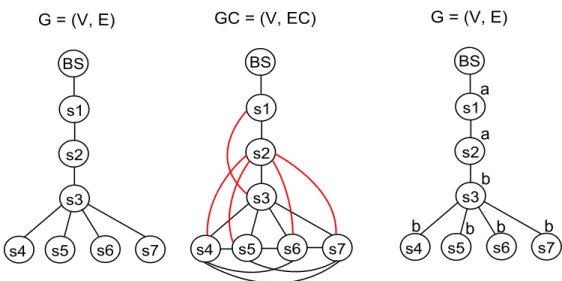
BS s1 s2 s3 s4 s5 s6 s7 G = (V, E) BS s1 s2 s3 s4 s5 s6 s7 GC = (V, EC) BS s1 s2 s3 s4 s5 s6 s7 G = (V, E) b b b b b a a
Figure 4.1: NCA channel assignment of G using GC.
NCA follows a depth first traversal of the nodes in the network starting from the root and is applied to nodes whose channels are not assigned yet. Channel of a node may have been assigned previously, because of being a sibling of a node, since assigned channel of a node is supposed to be the same with channel of its siblings. This is because while a node is transmitting to its parent, node’s siblings cannot transmit at the same time and wait for their turn. Therefore, it is unnecessary to assign siblings of the node a channel other than node’s channel. This approach has two benefits: first, waste of available channels is avoided; second, a node that operates in the receive state for a while does not necessarily do channel switching for each of its data reception from children.
As an example, assuming c1j and c2j are children of node j, even though we
assign different transmission channels to c1j and c2j, they cannot transmit at
the same time-slot, because j cannot receive from both of them at the same slot. Besides, assuming c2j is scheduled to transmit after transmission slot of c1j, if
they transmit on different channels, then node j has to switch its channel for c2j.
NCA avoids this situation by assigning the same channel to siblings. Moreover, since channel of node j is assigned earlier than its children, NCA prefers to assign
c1j and c2j the channel of j if it does not cause collisions. In this way unnecessary
channel switching is avoided, i.e. j always operates on the same channel whether in receive mode or transmit mode. In the depth first traversal of the network starting from the sink, for every node whose channel is not assigned an available channel is assigned to the siblings and the node itself.
Figure 4.1 illustrates an example network, its associated conflict-graph with primary and secondary conflicts where edges in red correspond to secondary con-flicts, and result of NCA channel assignment on the original network showing transmission channels.
In the limited channel version of the algorithm, as long as there is an avail-able channel, secondary conflicts are resolved. If a non-conflicting channel is not available, then a channel with least number of conflicts is assigned. Unresolved secondary conflicts are resolved further in color assignment phase by assigning different time-slots.
This algorithm assigns a channel to node i in O(dmax) steps where dmax is the
maximum degree of a node in GC. So, the running time is O(dmax|V |).
4.1.2
COLOR: Extended Slot Assignment Algorithm
(phase 2)
The slot assignment algorithm, COLOR (Algorithm 2) is extended from [13]. COLOR algorithm assigns colors, i.e., time-slots, to the nodes, determining their transmission turn in a round initially.
In this algorithm, firstly, nodes are ordered in a non-increasing manner ac-cording to number of conflicts existing after the channel assignment phase. Then, a different slot is assigned to each primarily or secondarily conflicting node. For multi-channel networks, this coloring is modified (bold part in the while loop) so that the same color can be assigned to a node which secondarily conflicts with another node whose color is already assigned and who has been assigned a dif-ferent channel. Thus, previously conflicting nodes because of operating on the
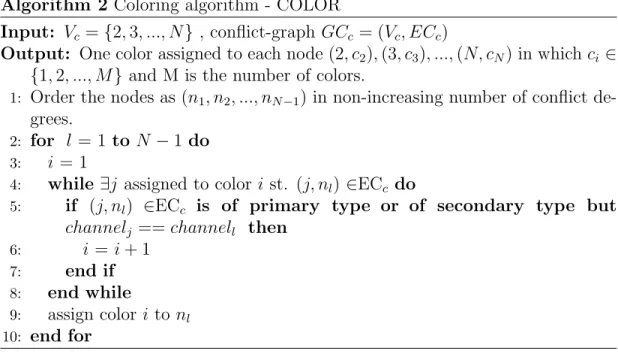
Algorithm 2 Coloring algorithm - COLOR
Input: Vc = {2, 3, ..., N } , conflict-graph GCc= (Vc, ECc)
Output: One color assigned to each node (2, c2), (3, c3), ..., (N, cN) in which ci ∈
{1, 2, ..., M } and M is the number of colors.
1: Order the nodes as (n1, n2, ..., nN −1) in non-increasing number of conflict
de-grees.
2: for l = 1 to N − 1 do
3: i = 1
4: while ∃j assigned to color i st. (j, nl) ∈ECc do
5: if (j, nl) ∈ECc is of primary type or of secondary type but
channelj == channell then
6: i = i + 1
7: end if
8: end while
9: assign color i to nl
10: end for
same channel and who have secondary conflicts can now do transmissions on the same time-slot if they are assigned different channels. The algorithm assigns a color to a node in O(V ) steps, so the running time is O(|V |2). Figure 4.2 shows
coloring of the network with both single-channel and multiple channels assigned, respectively. BS s1 s2 s3 s4 s5 s6 s7 G = (V, E) BS s1 s2 s3 s5 s6 s7 GC = (V, EC) b b b b b a a s4 BS s1 s2 s3 s5 s6 s7 GC = (V, EC) s4
4.1.3
NODE: Extended Node Based Scheduling
Algo-rithm (phase 3)
Having assigned channels and time-slots, network can now be scheduled so that all data packets produced by nodes reach to the sink node. Algorithm 3, called NODE, gives details of the node-based scheduling. A super-slot in node-based scheduling consists of a number of consecutive time-slots, i.e., nodes with at least one packet at the beginning of a super-slot transmit at least one packet during the super-slot. Length of a super-slot at most equals to the number of colors used in coloring of the original network. In the multi-channel version, this scheduling algorithm is modified (bold part in the center) such that a node can join to a set of nodes for transmission although it has secondary conflicts with the nodes, provided that it is assigned a different channel.
Algorithm 3 Node-based scheduling algorithm - NODE
Input: Graph G = (V, E) with conflict-graph GC = (V, EC), color assignment of the nodes Vc using M colors
Output: Transmission schedule for nodes of G
1: while at least one packet has not reached BS do
2: for s = 1 to M do
3: sets = set of nodes corresponding to color s with at least one packet
4: T = sets
5: if T 6= ∅ then
6: setos = set of nodes not corresponding to color s with at least one
packet
7: for each node k ∈ setos do
8: if (k, j) /∈ EC or channelj 6= channelk in case they have
sec-ondary conflict ∀j ∈ T then
9: T = T ∪ {k}
10: end if
11: end for
12: assign current slot to set T
13: update the place of the packets
14: end if
15: end for
In node-based scheduling, Algorithm NODE (Algorithm 3) creates non-conflicting slot sets where each set includes nodes that can transmit in the corre-sponding slot in a conflict-free manner. This non-conflicting set of nodes in that slot set are scheduled to do transmission at the same time in that slot. The algo-rithm starts with including all nodes in a set which have at least one packet to transmit for a time-slot (color). Then, other nodes which have at least one packet to transmit and do not conflict with any of the nodes in the set are included one by one, as long as the resulting set is non-conflicting.
In multi-channel networks, in the addition phase of the other nodes that belong to other sets, who are assigned a different slot than the current slot, a node is included to transmit if not only in the case it does not conflict, but also in the case it has secondary conflict with at least one of the nodes in the set but has a different transmission channel. Using multiple channels, a set that corresponds to a color (time-slot) with at least one packet can have greater number of nodes to transmit data compared to using single channel, because interference is eliminated and more transmissions can occur at the same time-slot. Thus, throughput in terms of data packet per time-slot increases. Running time of the algorithm is
O(ldmax|V |) where dmax is the maximum degree of a node in GC and l is the
total number of slots in the schedule.
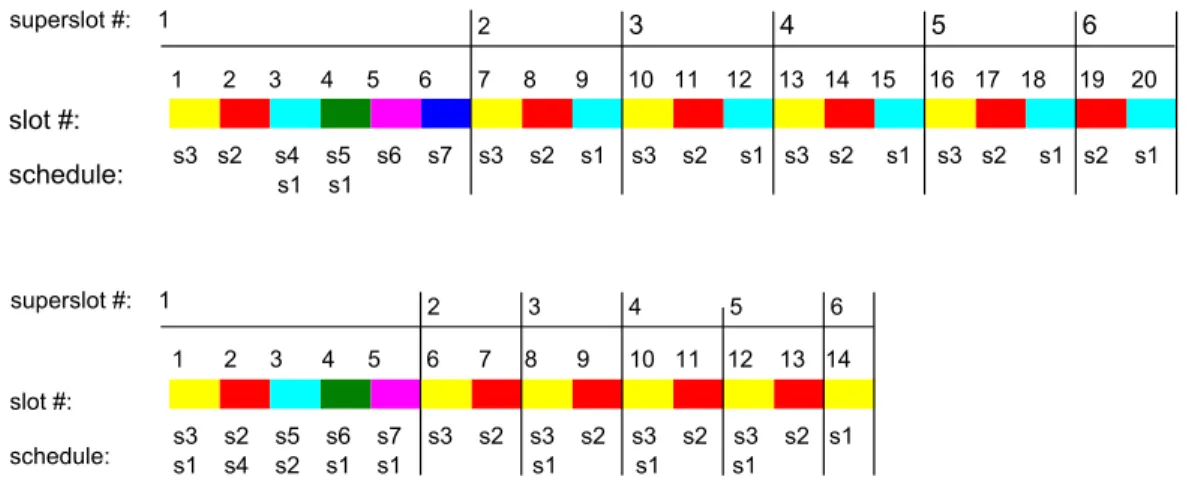
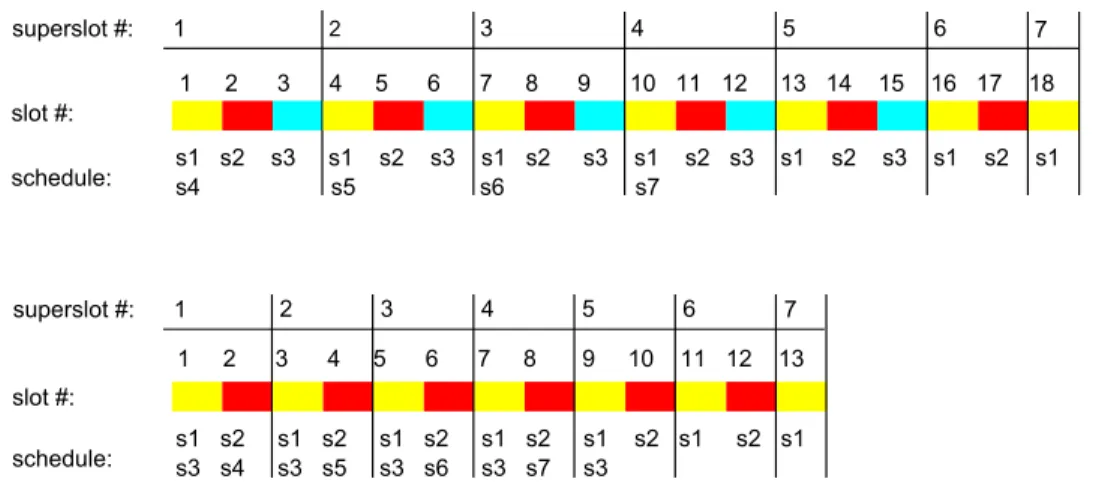
superslot #: 1 slot #: schedule: 2 3 4 5 6 s3 s2 s4 s5 s6 s7 s3 s2 s1 s3 s2 s1 s3 s2 s1 s3 s2 s1 s2 s1 s1 s1 superslot #: 1 slot #: schedule: 2 3 4 5 6 s3 s2 s5 s6 s7 s3 s2 s3 s2 s3 s2 s3 s2 s1 s1 s4 s2 s1 s1 s1 s1 s1 1 2 3 4 5 6 7 8 9 10 11 12 13 14 15 16 17 18 19 20 1 2 3 4 5 6 7 8 9 10 11 12 13 14
Figure 4.3: Node-based scheduling of single-channel and multi-channel network. Figure 4.3 illustrates node-based scheduling of the single-channel and multi-channel networks using NCA algorithm for multi-channel assignment in Figure 4.2. In the schedules, transmitting nodes are shown slot by slot until all packets reach to
sink. Multi-channel node-based scheduling using (NCA-NODE) produced a 30% decrease in the schedule length compared to single-channel scheduling algorithm (S-NODE) of [13].
4.2
Level Based Scheduling
Our multi-channel level-based scheduling scheme is based on the level-based scheduling algorithm of [13]. Level of a node is the number of hops to sink. Level-based scheduling balances movement of the packets across the network much better for topologies having higher density further away from the sink. In order to do this, first a linear network, also referred as level-tree, is created using LEVELTREE algorithm (Algorithm 4) that is modified from [13]. Then, our level channel assignment algorithm LCA (Algorithm 5) is used to assign channels to the levels using this linear network representing the original network. After chan-nel assignment, level-tree is colored (time-slots are assigned to levels). Then, the nodes of the original network are assigned channels and colors depending on their levels (a node is assigned the channel and color of its level). Finally, the original network is scheduled with the level-based scheduling LEVEL (Algorithm 6).
4.2.1
LEVELTREE: Extended Linear Network Creation
Algorithm
In the linear network, also called as level-tree, each level is represented by a node and a level conflict-graph is generated. In the level-tree, inter-level conflicts are marked such that if at least two nodes in different levels are conflicting, the level nodes in the level-tree are considered to be conflicting as well. Algorithm 4, LEVELTREE, explains how to create such a linear network and its associated interference and conflict-graphs. In the conflict-graph of the level-tree, edges cor-respond to primary and secondary conflict edges as described in previous chapters. GL = (V L, EL) is a linear network with nodes V L = {v1, ..., vN} where N is the
nodes in V L. A node in V L corresponds all nodes belonging to that level in V . The interference graph of the linear network is CL = (V L, IL) which includes edge (vj, vl) if there is an interference edge between a node at level j and any
node at level l in the original network G = (V, E) for j, l ≥ 1. Conflict graph of the linear network is GCL = (V L, ECL), which includes an edge (vj, vl) if the
transmissions of a node at level j and a node at level l conflict in the original network.
Initially, the algorithm adds one node for each level. Then it adds edges between node levels. After that, for every conflicting node pairs, the algorithm adds secondary and primary conflict edges. Since consecutive levels have parent and child relationships, they are assigned primary conflict edges in ECL.
Running time of the algorithm is O(|V |2).
Algorithm 4 Algorithm to find a linear network corresponding to original net-work - LEVELTREE
Input: (V, E, I, EC)
Output: (V L, EL, IL, ECL) 1: add node v1 to V L
2: l = 2
3: while l ≤ levelOf T ree do
4: add node vl to V L
5: add edge (vl−1, vl) to EL
6: add primary conflict edge (vl−1, vl) to IL(ECL)
7: if ∃(u, v) ∈ I(EC) with u at level l and v at level j satisfying j < l and j and l are not consecutive levels then
8: add secondary conflict edge (vj, vl) to IL(ECL)
9: end if
10: l + +
4.2.2
LCA: Our Proposed Level Based Channel
Assign-ment (phase 1)
Channel assignment algorithm NCA is not appropriate to use for level-tree since each node in the level-tree corresponds to the set of nodes belonging to a level. NCA would result in some sequential levels assigned the same channel considering them as parent and child relation which is undesirable since it lowers effectiveness of the approach. Level Channel Assignment algorithm (LCA) is designed to solve the drawback introduced by NCA on the level-tree. Hence, we propose LCA (Algorithm 5) for multi-channel level-based scheduling.
Algorithm 5 Level channel assignment algorithm - LCA
Input: Graph G = (V, E), GL = (V L, EL) with conflict-graph GCL = (V L, ECL), ] of channels
Output: Graph G = (V, E) with channels assigned
1: node n = sink
2: setleveln = set of nodes in G at leveln
3: In the depth first traversal of the network in GL: 4: if channeln == null then
5: assign channelavailable to n and setleveln
6: end if
LCA starts in a similar fashion with NCA and assigns a different channel to node in the level-tree where there is a primary or secondary conflict. In the limited version, if a non-conflicting channel is unavailable, then a channel with least number of conflicts is assigned. This algorithms assigns a channel to node i in O(dmax) steps, so the running time is O(dmaxj) where dmax is the maximum
degree of a node in GCL and j is the number of nodes in the linear network.
4.2.3
Slot (Color) Assignment to Levels (phase 2)
The same color assignment algorithm (COLOR) described in the previous section is used determine the color of each level of level-tree.
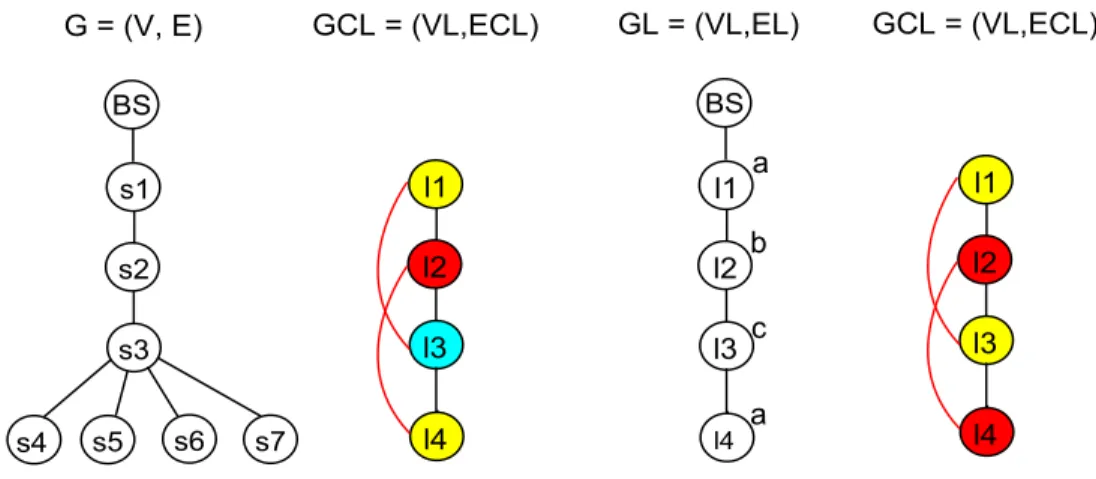
Figure 4.4 illustrates the original network, coloring of its associated single-channel level conflict-graph, multi-single-channel assignment to level graph using LCA, and coloring of its associated level conflict-graph. In the single-channel network, only level 1 and level 4 do not conflict and are assigned the same time-slot. On the other side, assigning multiple channels to level-tree using LCA removes secondary conflicts among levels and results in throughput increase in terms of data packets per time-slot. BS s1 s2 s3 s4 s5 s6 s7 G = (V, E) l1 l2 l3 l4 GCL = (VL,ECL) BS l1 l2 l3 l4 GL = (VL,EL) a b c a l1 l2 l3 l4 GCL = (VL,ECL)
Figure 4.4: LCA channel assignment and coloring of single-channel and multi-channel network.
4.2.4
LEVEL: Extended Level Based Scheduling
Algo-rithm (phase 3)
After color assignment, level-based scheduling in Algorithm 6, called LEVEL, schedules the network for packet transmissions to sink. A super-slot in level-based scheduling consists of consecutive time-slots, i.e., levels with at least one packet at the beginning of a super-slot forwards at least one packet during the super-slot. Length of a super-slot can be at most equal to the number of colors used in coloring level-tree.
First, nodes of the levels corresponding to a slot (color) which have at least one packet to transmit are included in the set. From the set, a non-conflicting set of nodes with at least one packet to transmit is created. Then, other nodes belonging to other levels which have at least one packet to transmit and do not
conflict with any of the nodes in the set are included one by one, as long as the resulting set is non-conflicting.
In multi-channel networks, in the phase of adding other nodes belonging to other sets, who are assigned a different slot than the current slot, a node is included to transmit if not only it does not conflict, but also in the case it has secondary conflict with at least one of the nodes in the set, however, has a different transmission channel than the channel of the node it has secondary conflict (bold part in the algorithm).
Running time of the algorithm is O(ldmaxj) where dmaxis the maximum degree
of a node in GC and l is the total number of slots in the schedule. Algorithm 6 Level-based scheduling algorithm - LEVEL
Input: Graph G = (V, E) with conflict-graph GC = (V, EC), color assignment of the corresponding linear network GCL using M colors
Output: Transmission schedule for nodes of G
1: while at least one packet has not reached BS do
2: for s = 1 to M do
3: sets = set of levels corresponding to color s
4: T = ∅
5: for j = 1 to |sets| do
6: T = T ∪ {a non conflicting set of nodes from level sets(j) with at least
one packet}
7: end for
8: if T 6= ∅ then
9: setos = set of levels not corresponding to color s
10: for each node k belonging to a level in setos do
11: if (k, j) /∈ EC or channelj 6= channelk in case they have
sec-ondary conflict ∀j ∈ T then
12: T = T ∪ {k}
13: end if
14: end for
15: assign current slot to set T
16: update the place of the packets
17: end if
18: end for