RAP Conference Proceedings, vol. 4, pp. 136–138, 2019
ISSN 2466-4626 (online) | doi: 10.37392/RapProc.2019.27
WWW.RAP-PROCEEDINGS.ORG
DETERMINATION OF THE MINIMUM DETECTABLE DOSE AND THE EFFECT OF
DIFFERENT FILTERS ON THE TLD-100H 260 °C THERMOLUMINESCENCE PEAK
Kemal Firat Oguz
1*, Mehmet Yüksel
21Maltepe University, Vocational School, Department of Medical Imaging Techniques, Istanbul, Turkey 2Çukurova University, Arts-Sciences Faculty, Physics Department, Adana, Turkey
Abstract. Thermoluminescence dosimeters have been an important tool for measuring the ionizing radiation dose in the field of personal, clinical, environmental and space applications. In this study, thermoluminescence glow curves of newly synthesized Mg,Cu,P doped LiF (TLD-100H) were recorded using four different filters in order to investigate the effect of different filter packs on TL glow peaks. It was observed that the TLD-100H dosimeter has four TL glow peaks at 100 oC, 150 oC, 200 oC and 260 oC for the heating rate value of 1 °C/s. Additionaly, the minimum detectable
dose of the TLD-100H dosimeter for a TL peak of 260 oC has been determined using the thermoluminescence method
as a preliminary work.
Keywords: Thermoluminescence, TLD-100H, dosimeter, filter packs, minimum detectable dose
1.INTRODUCTION
Thermally stimulated luminescence materials have been an important tool in measuring the ionizing radiation dose. Due to some advantages of the thermoluminescence dosimeters in the field of personal, clinical, environmental and space applications, many studies have been carried out to produce more efficient TL dosimeters in recent years [1]. The first idea of doping LiF with Mg, Cu and P was proposed by Nakajima et al [2]. P, Mg, Cu doped LiF (TLD-100H) materials have some advantages like higher sensitivity, an extended range of linearity, a lack of supralinearity and a nearly ideal tissue equivalence response to lower energy photons compared to Mg, Ti doped LiF (TLD-100) materials [3,4]. In addition, the most important characteristic of TLD-100H dosimeter relative to the TLD-100 dosimeter is the saturation of the thermoluminescence dose response. TLD-100H dosimeter has the saturation of the TL dose response at about 1 kGy [5]. Another important feature of the TLD-100H thermoluminescence dosimeter is approximate tissue equivalence in personal and medical dosimetry applications [6]. The thermoluminescence glow curve of TLD-100H consists of several peaks and the 220 °C peak known as the main peak which is used in dose measurement applications. The standard annealing procedure of TLD-100H is 200 °C for 10 minutes [7]. The aim of this study is to determine the effect of different filters on TLD-100H thermoluminescence peaks, maximum temperatures of the glow peaks and the minimum detectable dose (MDD) for the 260 °C TL glow peak.
2.MATERIALS AND METHODS
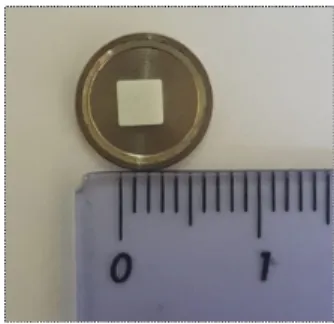
In the present study, LiF:Mg,Cu,P (TLD-100H) thermoluminescence dosimeters (TLDs) purchased from the Freiberg Instruments GmbH company were used in the form of chips (3.2 mm × 3.2 mm x 0.9 mm) (Fig. 1).Dose response is mainly an intrinsic property of TL elements (it may be also influenced by properties of a particular reader and its settings). TLD-100H detectors have linear dose response up to 20 Gy (within 10%). All thermoluminescence (TL) measurements of the TLD-100H dosimeters were carried out using an automatic lexsyg smart TL/OSL reader system (Fig. 2).
Figure 1. LiF:Mg,Cu,P (TLD-100H) dosimeter TLD-100H dosimeters were annealed at 200 °C for 10 minutes in the oven and then the TLDs were irradiated with a test dose of 0.1 Gy using 90Sr/90Y beta
source. TL glow curves were recorded using a lexsyg smart TL/OSL reader [8] in the nitrogen atmosphere
K.F. Oguz et al., Determination of the minimum detectable dose..., RAP Conf. Proc., vol. 4, 2019, 136–138
137
with a constant heating rate of 5 °C/s from room temperature to 450 °C. The filter test experiments were carried out using TL-Wideband blue, TL-565 nm, TL-410 nm and TL-565 nm filter packs.
Figure 2. Lexsyg smart TL/OSL reader 3.RESULTS AND DISCUSSION
3.1. Filter tests and thermoluminescence (TL) glow peaks
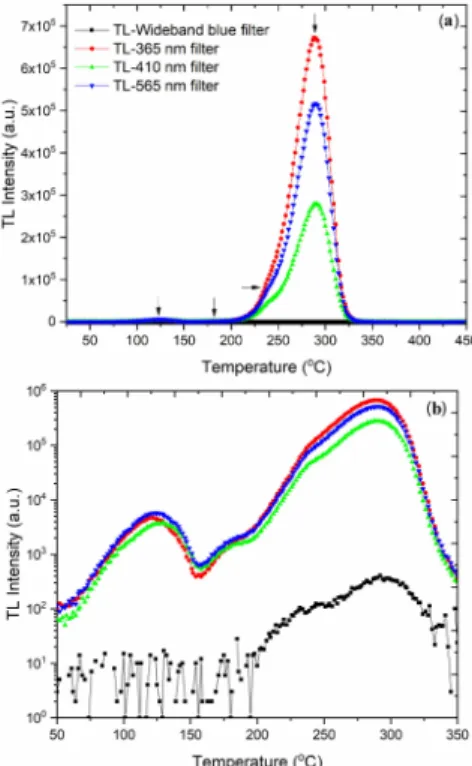
In the present study, three annealed TLD-100H chips were irradiated with 0.1 Gy, then TL signals were recorded using four different filter packs (Table 1) to investigate the effect of filter packs on TL glow peaks, and TL background signals were subtracted from all obtained TL signals.
Table 1. Filter packs for lexsyg smart TL/OSL reader The TL glow curves of the TLD-100H dosimeter for different filter packs are shown in Fig. 3.
Figure 3. Filter test experiment results for TLD-100H dosimeters in lexsyg smart TL/OSL reader (HR: 5°C/s, Dose: 0.1 Gy).
As seen in Fig. 3, while the highest TL intensity was observed in the TL-365 nm filter, TL-410 nm and TL-565 nm filters also have a high TL intensity for the 290 oC TL glow peak in the dose level of 0.1 Gy. In the
light of these results, it can be said that the TL-365 nm filter pack is more suitable for measuring low radiation doses. However, it is considered that the TL-wideband blue filter pack is more appropriate to prevent damage to photomultiplier tube (PMT) in dosimetric studies using high radiation doses.
The obtained TL glow curve of the TLD-100H dosimeter using TL-wideband blue filter pack is shown in Fig. 4 for beta dose of 10 Gy.
Figure 4. The thermoluminescence glow curve of the TLD-100H dosimeter (HR: 1°C/s, Dose: 10 Gy and
TL-wideband blue filter pack)
It can easily be seen in Fig. 4 that the TL glow curve of the TLD-100H dosimeter consists of four TL glow peaks at 100 °C, 150 °C, 200 °C and 260 °C for the heating rate value of 1 °C/s.
3.2. Minimum detectable dose (MDD)
The minimum detectable dose (MDD) value of the TLD-100H dosimeters were calculated for the 260 °C TL glow peaks (see Fig. 4) applying the methods used in the literature [9-11]and the following equation 1. To calculate the MDD value, three TLD-100H dosimeters were used for background variation measurements and the TL reader was calibrated using the samples irradiated with 0.5, 1, and 4 Gy beta doses using the TL-wideband blue filter pack. The MDD value was calculated to be 3.81±0.02 cGy.
F
B
D
(
*2
B)
0
(1)(where, B*=124.2; σB=2.52 and F=2.95x10⁻⁴ Gy)
4.CONCLUSION
In the present study, the effect of different filters on the TL glow peaks of the TLD-100H dosimeter, the maximum TL peak temperatures and the minimum detectable dose (MDD) were investigated using the thermoluminescence method. As a result of the study, the following findings were obtained.
The result of the filter test experiment shows that the highest TL intensity was observed in the TL-365 nm filter pack.
K.F. Oguz et al., Determination of the minimum detectable dose..., RAP Conf. Proc., vol. 4, 2019, 136–138
138
The TLD-100H dosimeter has four main TL peaks at 100 °C, 150 °C, 200 °C and 260 °C for the heating rate value of 1 °C/s.
The minimum detectable dose of the TLD-100H dosimeter for the 260 °C TL glow peak was calculated to be 3.81±0.02 cGy using the TL-wideband blue filter pack.
Acknowledgements: This study was carried out at the Maltepe University and Cukurova University. The authors are grateful to Research Fund of the Maltepe University for its financial support.
REFERENCES
1. K. F. Oguz et al., “Study of luminescence of Mn-doped CaB4O7 prepared by wet chemical method”, J. Alloys
Compd., vol. 683, no. C, pp. 76 – 85, May 2016. DOI: 10.1016/j.jallcom.2016.05.050
2. T. Nakajima, Y. Murayama, T. Matsuzawa, A. Koyano, “Development of a new highly sensitive LiF thermoluminescence dosimeter and its applications”, Nucl. Instrum. Methods, vol. 157, no. 1, pp. 155 – 162, Nov. 1978.
DOI: 10.1016/0029-554X(78)90601-8
3. P. Bilski et al., “Characteristics of LiF:Mg,Cu,P thermoluminescence at ultra-high dose range,” Radiat. Meas., vol. 43, no. 2 – 6, pp. 315 – 318, Feb.-Jun. 2008. DOI: 10.1016/j.radmeas.2007.10.015
4. B. Ben-Shachar, M. Weinstein, U. German, “LiF:Mg, Cu, P vs LiF:Mg, Ti: A comparıson of some dosımetrıc propertıes,” in Proc. 20th Conf. Nucl. Soc. Isr. (INS), Dead Sea, Israel, 1999, pp. 181 – 184.
Retrieved from:
https://inis.iaea.org/collection/NCLCollectionStore/_P ublic/31/049/31049561.pdf
Retrieved on: May 31, 2019
5. K. Remy, S. Sholom, B. Obryk, S. W. S. McKeever, “Optical absorption in LiF, LiF:Mg, LiF:Mg,Cu,P
irradiated with high gamma and beta doses,” Radiat. Meas., vol. 106, pp. 113 – 117, Nov. 2017.
DOI: 10.1016/j.radmeas.2016.11.007
6. S. P. Voss et al., “Effect of TLD-700H (LiF: Mg, Cu, P) sensitivity loss at multiple read-irradiation cycles on TLD reader calibration,” Radiat. Meas., vol. 46, no. 12, pp. 1590 – 1594, Dec. 2011.
DOI: 10.1016/j.radmeas.2011.04.017
7. M. Moscovitch, Y. S. Horowitz, “Thermoluminescent materials for medical applications: LiF:Mg,Ti and LiF:Mg,Cu,P,” Radiat. Meas., vol. 41, suppl. 1, pp. 71 – 77, Dec. 2006.
DOI: 10.1016/j.radmeas.2007.01.008
8. D. Richter, A. Richter, K. Dornich, “Lexsyg smart — a luminescence detection system for dosimetry, material research and dating application,” Geochronometria, vol. 42, no. 1, pp. 202 – 209, Dec. 2015.
DOI: 10.1515/geochr-2015-0022
9. C. Furetta, M. Prokic, R. Salamon, G. Kitis, “Dosimetric characterisation of a new production of MgB4O7:Dy,Na thermoluminescent material,” Appl. Radiat. Isot., vol. 52, no. 2, pp. 243 – 250, Feb. 2000.
DOI: 10.1016/s0969-8043(99)00124-4 PMid: 10697735
10. M. Yüksel, "Termolüminesans Yöntemi ve Dozimetrik Çalışmalar," içinde Fen Bilimleri ve Matematik Temel Alanı Örnek Araştırmaları Kitabı, A. Yakar, H. Topalki, editörler, 1. baskı, Ankara, Türkiye: NOBEL Akade. Yayın., ss. 171 - 192, Kasım 2018.
(M. Yüksel, “Thermoluminescence Method and Dosimetric Studies,” in Science and Mathematics Basic Field Sample Research Book, A. Yakar, H. Topalki, Eds., 1st ed., Ankara, Turkey: NOBEL Acad. Publ., pp. 171 – 192, Nov. 2018.)
Retrieved from:
https://www.nobelyayin.com/detay.asp?u=15124
Retrieved on: May 25, 2019
11. M. Yüksel, “Thermoluminescence and dosimetric characteristics study of quartz samples from Seyhan Dam Lake Terraces”, Can. J. Phys., vol. 96, no. 7, pp. 779 - 783, Jul. 2018.