ISTANBUL BILGI UNIVERSITY
GRADUATE SCHOOL OF SOCIAL SCIENCE
UNDERNEATH THE SKIN: THE WOUND THROUGH THE
PSYCHOANALYTIC THEORY
MA in CULTURAL STUDIES MA THESİS
Mert Özgen
Thesis Advisor: Dr. Bülent SOMAY
İSTANBUL BİLGİ ÜNİVERSİTESİ
SOSYAL BİLİMLER ENSTİTÜSÜ
DERİNİN ALTINDAKİ : PSİKANALİTİK KURAM
BAĞLAMINDA YARA
KÜLTÜREL İNCELEMELER YÜKSEK LİSANS PROGRAMI YÜKSEK LİSANS TEZİ
Mert Özgen
Tez Danışmanı: Dr. Bülent SOMAY
UNDERNEATH THE SKIN : THE WOUND THROUGH THE PSYCHOANALYTIC THEORY
DERİNİN ALTINDAKİ : PSİKANALİTİK KURAM BAĞLAMINDA YARA
Mert Özgen 111611047
Thesis Advisor Dr. Bülent Somay :
Assoc. Prof. Ferda Keskin :
Dr. Cüneyt Çakırlar :
Date Approved : June 2016
Number of Pages: 66
Keywords Anahtar Kelimeler 1) Skin 1) Deri
2) Skin-Ego 2) Deri-Ben 3) Wound 3) Yara 4) Uncanny 4) Tekinsiz 5) Psychoanalysis 5) Psikanaliz
ABSTRACT
Underneath The Skin: The Wound Through The Psychoanalytic Theory
Mert Özgen June, 2016
This research sets out to study the connotative meaning of the corporal wound in the context of psychoanalytic theory through the Christian iconography and the representation of the wound on Christ’s chest at the scene of Crucifixion. This study analyzes the transformation of the wounded body into an uncanny entity by virtue of the connotation of the visual representation of the wound as a vulva. The wound as an corporal opening, threatening the integrity of the skin that covers the body, excoriates and flays the skin and so redefines the conventional definition of the body as an unknown and unfamiliar entity. The concept of “uncanny” that theorized by Sigmund Freud, highly corresponds to the redefined interpretation of the wounded body. As a result of tearing the skin and violating the main function of the psychic envelope, now the body with its openings literally is an ‘uncanny body’. The French psychoanalyst Didier Anzieu declares that skin is not only tangible, but also a representation that surrounds and covers the psyche, through his innovative concept ‘Skin-Ego’. The skin is where the disturbances are kept as a memory on in the form of skin disorders and/or bruises and wounds, and also is where the perception of the body appears for the first time; this is also where the Ego arises, through Freudian discourse. The wound, by blocking the function of the Skin-Ego, undermines and/or eliminates the familiar perception of the body. Through removing the boundary between inside and outside, and through the visibility of the representation of the open wound as female genitalia, body transforms itself into a unusual, unfamiliar and unknown form. This transforming body is now an uncanny body itself.
ÖZET
Derinin Altındaki: Psikanalitik Kuram Bağlamında Yara
Mert Özgen Haziran, 2016
Bu çalışmanın amacı, Hıristiyan ikonografisi ve İsa’nın çarmıha gerilme sahnesini anlatan temsillerden yola çıkarak, bedensel yaranın psikanalitik kuram bağlamında ima ettiği temsiliyeti ele almaktır. Yaranın görsel temsilinin çağrıştırdığı dişilik organının, yaralı bedeni tekinsiz bir mecraya dönüştürmesi bu çalışmayla irdelenmektedir. Yarayla ele alınan açıklık, bedeni çevreleyen derinin alışıla gelmiş bütünselliğini tehdit ederek, deriyi yırtıp açarak, bedeni alışılmadık, yabancı ve hatta bilinmeyen bir oluşuma dönüştürmektedir. Sigmund Freud’un kuramlaştırdığı “tekinsiz” kavramı, bedenin açıklığıyla birlikte kurgulanan tanımıyla oldukça örtüşmektedir. Derinin yırtılmasıyla bedeni çevreleyen zarfın başlıca görevinin ihlal edilmesinin sonucu olarak, artık beden tam anlamıyla “tekinsiz beden” olarak adlandırılmaktadır. Fransız psikanalist Didier Anzieu, “Deri-Ben” kavramıyla deriyi sadece fiziksel değil, aynı zamanda tini saran, çevreleyen ve örten bir temsiliyet olarak ele alır. Çocuğun beden yüzeyi deneyiminden hareketle, deri hem bir hafıza yeri, hem de ‘ben’ kavramının oluştuğu yerdir; bu tanım, Freudyen ‘ego’ kavramının oluşumunun başlangıcıdır. Açıklıklarıyla yara, deri-ben kavramının işlevlerini engelleyerek, ‘ben’ kavramını zedeler veya ortadan kaldırır. İç ve dış arasındaki sınırın da kalmasıyla, birey bastırılmış olanı geri dönüştürür ve yaranın temsil ettiği dişilik organın da etkisiyle beden alışılmadık bir dönüşüm içine girer. Bu dönüşen beden tekinsiz bir bedendir.
Acknowledgment
I would like to express my great appreciations to my advisor Dr. Bülent Somay for his guidance and support. I am highly grateful to my mentor and dear friend Selen Ansen who brings light to my thoughts as well as my life. I would like to thank Assoc. Prof. Ferda Keskin and Cüneyt Çakırlar for their constructive suggestions and comments on my thesis.
I am grateful to my lovely friend Zeynep Esendemir for helping me editing my thesis with patience. I would also like to thank my friends and Nicholas Bianchi for their encouragement and precious support that makes this thesis possible. I would like to express my sincere gratitude to my beloved family; they have been a constant support and source of love to me my whole life. And I would like to express my heartfelt appreciation to my beautiful mother Canan Özgen who is always there to hold my hand through every step of my life.
Lastly, I dedicate this thesis to my stunning sister Pınar Özgen who inspires me to write about wound.
Istanbul, May 2016 Mert Özgen
Table of Contents ABSTRACT _________________________________________ i ÖZET ______________________________________________ ii ACKNOWLEDGEMENT ______________________________ iii TABLE OF CONTENTS ______________________________ iv LIST OF FIGURES ___________________________________ v INTRODUCTION ____________________________________ 1 CHAPTER I
The Skin: The Veil of The Body ________________________ ___ 11 1.1. The Skin, The Visible ____________________ __ 13 1.1.1. On Touching ____________________ _ 15 1.2. The Skin-Ego ___________________________ __ 22 1.3. The Functions of The Skin-Ego _______________ 24 CHAPTER II
To Lift The Veil ________________________________________ 2.1. A Black Hole On The Skin ___________________ 28 2.2. The Pathway to Vulva: The Mandorla ___________ 34 2.3. The Connotative Meaning of The Wound ________ 40 CHAPTER III
The Open Wound ______________________________________ 45 3.1. The Metamorphosis and The Uncanny Body__ ___ 50 CONCLUSION _____________________________________ 55 BIBLIOGRAPHY _____________________________________ 59 CV __________________________________________________ 65
List of Figures
Page
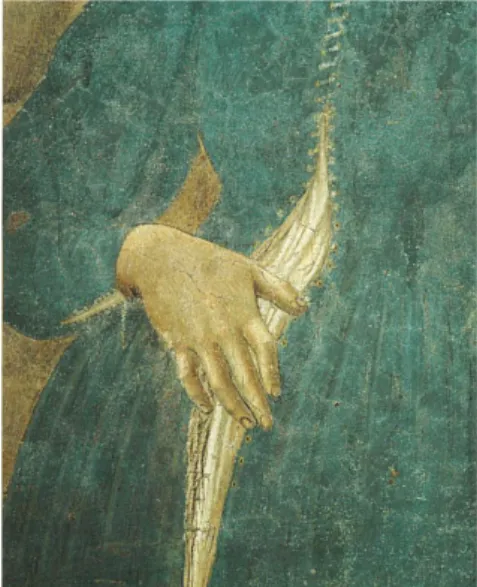
Figure I : Veronica 38
Figure II : The Rhomb and The Mandorla Schema 39
Figure III : Madonna del Parto 40
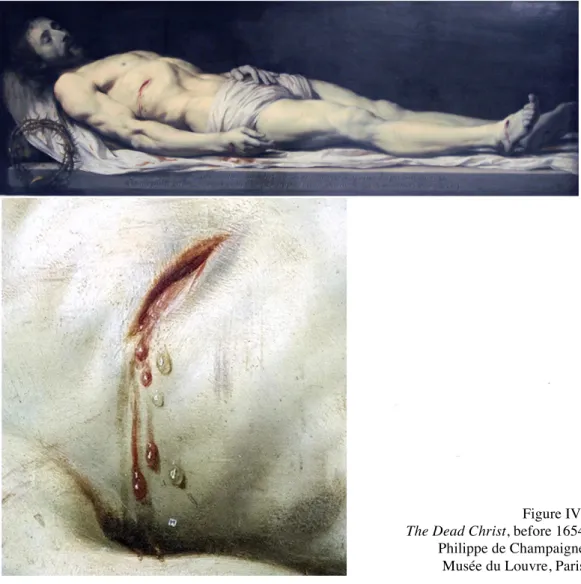
Figure IV : The Dead Christ 42
INTRODUCTION
“… the subject is something which is finally identified to the body as such. So the subjective creation as a sort of paradigm is only experimentation of the limits of the body. The subject is something like an experience of its proper limits, an experience of finitude, an experience of the limits of the concrete unity of the body. But finally, what is a limit of the body, a limit of the living body?”1
The plenary discussions on corporeality always reconstruct the perception of the body and aim to see beyond a physical form as more than an entity, as a concrete being with flesh and bones. All studies based on the notion of what a body is – that analyze the psychological and philosophical (also anthropological and sociological) approaches to the concept of the body over hand-painted portraits to mug shots, personal care methods to collective protection theories, the sexuality as a study of psychology not through morality – help create various
1 “Alain Badiou,” accessed May 17, 2016,
unprecedented views and work to form an alternative definition for the perception of a body.
Many disciplines intervene when the research topic is on the concept of the body; as the sensations, the techniques of bodily movements, consumption or expression styles have been investigated, methods and studies of the epistemology are getting varied as required. Also, the developing studies on gender and identity cannot be considered without consulting the studies on the history of thought about the body. The studies of the body consolidate science and knowledge, and see the Body as an actor on a stage.
The body, even as a vision and not just a biological phenomenon, is more socially composed creation with solid or flexible boundaries that are imposed by each culture differently at each age. The functions of the body and the senses are also remarkably open to discussion for many theorists, philosophers, critics and psychoanalysts.
The ornaments of a human being, like a veil, a garment and a spear, are also important and signifiers for defining what is socially distinctive or what is civilized. All the considerations towards the body and also on the attachments that has been used through out, are consistently essential, substantial and highly noteworthy in order to understand the mankind and the humanity.
What is the body? The answer of this ‘simple and quite brief’ question cannot be easily explained. It is such a dominant and crucial study topic that many academics rummage about just like Michel Foucault, Marcel Mauss, Merleau-Ponty, Judith Butler, Donna Haraway, Elizabeth Grosz, Deleuze and Guattari and many others. They are all skeptical about the solid and immutable
boundaries of the body. The understanding of what the body is and its function(s) has changed radically and geographically over time.
As stated by Mary Douglas in her book ‘Purity and Danger: An Analysis of Concepts of Pollution and Taboo’ (first published in 1966) regarding the body is a model that stands for any bounded system.2
The boundaries of the body “represent any boundaries, which are threatened or precarious. The body is a complex structure. The function of its different parts and their relation afford a source of symbols for other complex structures. We cannot possible interpret rituals concerning excreta, breast milk, saliva and the rest unless we are prepared to see in the body a symbol of society, and to see the powers and dangers credited to social structure reproduced in small on the human body.”3 Douglas mentions that the body symbolizes everything; the body is a microcosmic reflection/representation of the public. Therefore, the body movements of each society differ one to another: i.e. the French people smoke, walk, swim, eat and also make fashion dissimilarly comparing to Americans do and vice versa. Marcel Mauss, during his lectures on Techniques of the Body in 1934, explains that the body is “‘miscellaneous’ social” phenomenon.4
The body, according to Mauss, is “man’s first and most natural instrument. Or more occurately, not to speak of instruments, man’s first and most natural technical object.” The same can be said with all instruments: the body as an instrument that also needs to be learned first. For Mauss, this learning process is totally cultural. On the other hand, Foucault declares that “the soul is the…instrument of
2 Mary Douglas, Purity and Danger: An Analysis of Concepts of Pollution and Taboo (London ; New York: Routledge, 2002). 3 Ibid., 142. 4 “Mauss_Techniques Body.pdf,” 456, accessed May 17, 2016, http://isites.harvard.edu/fs/docs/icb.topic1458086.files/Mauss_Techniques%20Body.pdf.
a political anatomy; the soul is the prison of the body.”5
, the instrument of the state that is always under constant surveillance. Every aspect of social life was mechanized: education, army, behaviors and also sexuality. Foucault analyzes the period before 18th
century, the time that allows corporal punishments, public executions and torture. The title Discipline and Punish highly corresponds Foucault’s discourse on the essence of social life: discipline and punishment are both oppressively omnipresent in society. “The historical moment of the disciplines was the moment when the art of the human body was born… What was then being formed was a policy of coercions that act upon the body, a calculated manipulation of its elements, its gestures, its behavior. The human body was entering a machinery of power that explores it, breaks it down and rearranges it. A ‘political anatomy’, which was also a ‘mechanics of power’, was being born.”6
The power is definitely not gender-neutral; the phallus is power: the phallus strengthens the patriarchal order in society. Thus, the discipline in society and the perception of the visual body and also the world are depicted through masculinity: the male gaze.7
Nancy Fraser also examines the problematic of the dominance of the male power through the political-economic and cultural differentiation between the representation of the phallus and the vulva as two genders. “Gender, … , has political-economic dimensions. It is a basic structuring principle of the economy. … The result is a political-economic structure that generates gender-specific models of exploitation, marginalization, and deprivation. This structure constitutes gender as a political-economic
5 Michel Foucault, Discipline & Punish: The Birth of the Prison, trans. Alan Sheridan, 2nd edition (New York: Vintage Books, 1995), 30. 6 Ibid., 138. 7 Laura Mulvey, Visual and Other Pleasures, 2nd edition (Houndmills, Basingstoke, Hampshire England ; New York: Palgrave Macmillan, 2009).
differentiation endowed with certain class-like characteristics.”8
In the late 20th century, many philosophers and theorists like Judith Butler argue that gender roles are socially constructed.9
Claiming this is not a denial of physical integrity and/or visible reality of the body. Cultural and social approach towards the body is a moral judgment that the aesthetics of the image. The concept of aesthetics and the ‘ideal’ form of the beauty that each society determines at each age depend on the moral judgments created/formed/formulated by social intuitions.10 Hence, in mostly American and Asian culture, many women have plastic surgery to transform their appearances into the ‘ideal’ feminine beauty, and likewise men lift weights and get hair transplants and pectoral implants in order to form their bodies as masculine ideals.11
Deleuze and Guattari, a French philosopher and a French psychiatrist, influenced by a French poet Antonin Artaud’s phrase ‘the body without organs’, figure the concept of ‘reversibility’ of the body.12
The body as a subject can become an object, and so as an object become a subject through vision and touching. The state of being both a subject and an object at the same time represents the body as a unique entity and therewithal as a universal existence to all humanity. 8 Nancy Fraser, Justice Interruptus: Critical Reflections on the “Postsocialist” Condition, 1 edition (New York: Routledge, 1996), 23. 9 Judith Butler, Gender Trouble: Feminism and the Subversion of Identity (New York: Routledge, 2006). 10 Umberto Eco, ed., History of Beauty (New York: Rizzoli, 2010). 11 Kathy Davis, Reshaping the Female Body: The Dilemma of Cosmetic Surgery (New York: Routledge, 1995); Suzanne Fraser, Cosmetic Surgery, Gender and Culture (Palgrave Macmillan UK, 2003). 12 Gilles Deleuze and Felix Guattari, A Thousand Plateaus: Capitalism and Schizophrenia, trans. Brian Massumi, 1St Edition edition (Minneapolis: University of Minnesota Press, 1987); Gilles Deleuze, The Logic of Sense, ed. Constantin V. Boundas, trans. Mark Lester and Charles Stivale, Revised ed. edition (New York: Columbia University Press, 1990).
Despite centuries of debates about the implicit definitions of the body, there is no common and universal description. Each culture in each period reconstructs and redefines the notion of the body through its own desires, discipline or superstitions. The studies on the perception of the body, physical and also social, testify that the definition is always shifting, and have been ambivalent and vague. The body because of its conflicting, ambiguous and obscure meaning and definition through the centuries, literally, is unknown that makes itself fantastic and worth to be exceptionally focused on.
Body takes a place in the extent with its own cover/envelope: the skin. This physical and tangible body can be touched, smelled or seen through the skin.13
Skin is the surface of the body that is also an interface between the in and out. This interface protects the inside of the body from external effects and disturbances.
The skin, while protecting the inside from external disturbances, keeps the disturbances as a memory on itself in the form of skin disorders and/or bruises and wounds.14
From the Fall of man, the corporal punishments, torture and sufferings have been represented on the surface of the body.15
Besides, sexual stimulation and corporal pleasures consist of sensual, somatic touch through the skin.16
Considering all, skin is a reflector, a mirror that represents the inside and make it visible to eye. It makes the body visible to the others; the tactile sensory activities open the body to the others.
13 Corbin, Alain, Jean-Jacques Courtine and Georges Vigarello, Bedenin Tarihi 1 - Rönesans’tan Aydınlanma’ya (Yapı Kredi Yayınları, 2007), 7. 14 Didier Anzieu, Deri-Ben, (Metis Yayınları, 2008), 69–71. 15 Didier Anzieu, The Skin Ego (New Haven: Yale Univ Pr, 1989), 45. 16 Anzieu, Deri-Ben, 69.
This thesis focuses on the notion of the skin not as an object, but as a representation of the psyche through its integrity and also, contradistinctively, through its openings. The main question that guides the quest about the skin and its openings is “how the body with openings, cuts and wounds on its skin, that are obvious threats to the corporeal integrity of the body, can be defined?” The function of the skin, plainly, is to cover the body; no eye is entitled to observe and see naturally what exists under the skin without the need of a medical supply. This question with a myriad of answers motives to rethink the concept of to being covered by solid skin through psychoanalysis and philosophy and brings other thought-provoking questions in its wake: what does a wound represent beside being a medical symptom and how can an open wound be designated and identified by means of psychoanalytic studies?
The enlightening graduate courses that are taught at Istanbul Bilgi University like “Melancholy and Modernity” lectured by Ferda Keskin, “Psychoanalytic Method in Culture” and “The Fantastic, the Mimetic and the Psychotic” by Bülent Somay and “The Corporeity in Modern and Contemporary Thought” lectured by Selen Ansen highly contribute to the figuration of this thesis. These lectures provide a wider psychoanalytic and philosophical perspective to the thinking of the skin.
This thesis frequently appeals to the psychoanalytic method; there are – on purpose and on point – unspoken/unwritten approaches for the thinking of the skin and body in order not to digress the fluidity and clarity of the study. This limitation is because of the restriction of time and words that a master’s thesis should contain; if not, the thinking of the skin can be perceived through
numerous disciplines such as medical science, sociology, women’s studies, gender and queer studies and etc.
Blaise Pascal, a French physicist, once wrote in his letter to the Reverend Fathers in December 4, 1656; “The present letter is a very long one, simply because I has no leisure to make it shorter.”17
By taking into consideration the oblique implication of Pascal, the study intends to be an understandable and clear text that is written cautiously so as not to be pleonastic. Therefore, the concept of the skin and the wound is touched on through certain theories.
It is substantial to declare that this thesis is analyzing the psychoanalytic definition of the open wound and trying to identify the skin with openings through the psychoanalytic method.
This thesis sets out to study the connotative meaning of the corporal wound in the context of psychoanalytic theory through the Christian iconography and the representation of the wound on Christ’s chest at the scene of Crucifixion. This study analyzes the transformation of the wounded body into an uncanny entity by virtue of the connotation of the visual representation of the wound in art as female genitalia. The wound as a corporal opening, by threatening the integrity of the skin that covers the body, excoriates and flays the skin and so redefines the conventional definition of the body as an unknown and unfamiliar entity. The concept of “uncanny” that theorized by Sigmund Freud, highly corresponds to the redefined interpretation of the wounded body. As a result of tearing and violating the main function of skin, the body transforms into an ‘uncanny body’. The skin is where the disturbances are kept as a memory on in the form of skin disorders and/or bruises and wounds, and also is where the
perception of the body appears for the first time; this is also where the Ego arises. The wound, by blocking the function of the Skin-Ego and Ego, undermines and/or eliminates the familiar perception of the body. Thus, body transforms itself into an unusual, unfamiliar and unknown form. This transforming body is now an uncanny body itself.
Semiotics is the most instructive study in the context of this research; it allows analyzing many various texts, concepts and approaches simultaneously in order to interpret and define profoundly the sign that is the open wound in this study. This interdisciplinary approach that semiotics ensures, helps to bring the wounded body and the uncanny body together through psychoanalytic theory. In order to examine thoroughly the affinity between the wounded body and the uncanny body, the wound of Christ is the predominant origin and also a guiding pathway for to read the notion of the open wound with a variant point of view. The portrayal of the open wound is frequently represented as a vulva lookalike form nearly in all of the paintings that picture the crucifixion scene in Western art. This transformation links to Kafka’s Metamorphosis in many aspects but mainly in the thought of castration. The wounded body of Christ has been altered with the unfamiliar opening on the skin, so the body of Gregor Samsa with his metamorphosis. The wounded body of Christ as a visual representation, and the mutated body of Gregor Samsa as a literary representation are both a distinct images of the uncanny bodies.
The first chapter of the thesis that is entitled “The Skin: The Veil of The Body”, tenders the content of the tangible skin. In order to explore the psychological content refers to skin, the concept of the Skin-Ego theorized by the French psychoanalyst Didier Anzieu is a most valid pathway that should be
touched on. Anzieu’s intensive concept eases the understanding of the importance of the skin and its functions, also emphasizes the essentialness of the integrity of the skin. 18
The second chapter, “To Lift The Veil”, questions the concept of the inside and the outside with suspicion through the term extimacy coined by Jacques Lacan. The term brings the interior and the exterior, also the intimacy and the exteriority together. If the skin is a barrier between inside and outside, considering Lacan’s and also Jacques-Alain Miller’s approach to extimacy, a corporal wound that cuts the boundary, the skin should be an opening that unites inside and outside. Further in the second chapter, based on the grounded theory of Didier Huberman, the image of the wound on the skin of Christ illustrated by Philippe de Champaigne’s The Dead Christ painting, will be analyzed through the psychoanalytic method.19
The third and last chapter reveals the overlapping interpretations of the open wound, the melancholy represented by Sigmund Freud and the metamorphosis of Franz Kafka.20
The chapters in this study, just like lifting of a veil gradually, flay the skin layer by layer and lay bare the invisible that has been kept underneath the skin. This thesis examines the connotative meaning of the wound through non-medical language and identifies the body with the corporal openings that betray the integrity of the skin.
18 Anzieu, The Skin Ego. 19 Jacques Lacan, The Seminar of Jacques Lacan: The Ethics of Psychoanalysis 1959-1960 (Vol. Book VII), ed. Jacques Alain-Miller, trans. Dennis Porter (New York: W. W. Norton & Company, 1997); Jacques-Alain Miller, “Extimity Jacques-Alain Miller – the Symptom 9,” The Symptom 9, accessed March 27, 2016, http://www.lacan.com/symptom/?p=36; Georges Didi-Huberman, L’image ouverte: Motifs de l’incarnation dans les arts visuels, GALLIMARD edition (Paris: Gallimard, 2007). 20 Sigmund Freud, General Psychological Theory: Papers on Metapsychology (Simon and Schuster, 2008); Franz Kafka, The Metamorphosis (Classix Press, 2009).
CHAPTER I
THE SKIN: The Veil of The Body
“… the skin itself served as a notebook, a reminder of what was not allowed to be forgotten.21
”
The notion of Skin-Ego, Le Moi-Peau in French, for the first time by Didier
Anzieu, a French psychoanalyst who studied in the field of dermatology for many years, was mentioned in an article published in Nouvelle Revue de
Pyschoanalyse, Numéro 9.22
The term Skin-Ego is based on what skin is and its functions. The article served as an introduction to the formulation of skin-ego; in 1985, Anzieu presented his deeper researches by a book titled ‘Le Moi-Peau’ that describes the concept precisely.23
According to Anzieu, while skin is the surface of the body, it also designates a mental representation psychoanalytically; in that it is the intermediate between concept and metaphor, makes the mental content
21 Elizabeth A. Grosz, Volatile Bodies: Toward a Corporeal Feminism (Allen & Unwin, 1994), 132.
22 J.-B. Pontalis, ed., NOUVELLE REVUE DE PSYCHANALYSE - 1974 n°09 : Le Dehors et Le
Dedans (Gallimard, 1974), 195–209.
visible. Anzieu defines and develops his researches referring to the importance of the skin.
Skin, the surface of the body, is the largest sense organ and also an interface between in and out by separating them from each other. The surface protects the inner body and/or the psyche from external effects and externalities physiologically and psychologically.24
A baby in the womb, surrounded and protected by a membrane that provides the essential contact with the mother is through an interface. After the birth, the primary relation with the mother by the care - like breastfeeding, cuddling, touching, watching and etc. - given to the baby; this interaction is rebuilt through the skin. According to the researches on pediatrics, the relationship build with mother percutaneously has an important role in the child’s psychological development; i.e., children who have not been touched enough or over touched face some major psychological problems. Psychoanalysts stage that the most skin diseases that children have are the symptoms of underdeveloped sense of touch and/or being stimulated strongly. These symptoms are for defensive purposes or self-protection.25
Also many dermatologists emphasize the importance of the skin on mental development many times: most patients with skin diseases, are prone to mental distress.
Anzieu defines Skin-Ego as representation and reflection of mental development as well as the experience of perceiving the existence of the body surface during the early stages of development of the infant’s identity at the same time. Anzieu goes on to underline the eight functions of the skin-ego, and states
24 Claude Bouillon, Deri - Bedenin Örtüsü (Yapı Kredi Yayınları, 2009), sec. 2.
25 For further reading; See. Tevfika Tunaboylu-İkiz, Psikanaliz Buluşmaları 3 - Psikosomatik (Bağlam Yayıncılık, 2006).
that a disruption and/or a lack of at least one of these eight functions, causes the deterioration of the formula for the skin-ego.26
1.1. The Skin, The Visible
All the entities, a body, organs have a cover: skin and flesh.27 Skin is the largest organ of the body that protects the body against external factors: and in this sense, it is most vital amongst other organs. Without tasting, smelling, hearing and seeing, one would exist in a different experiential world, but live without sense of touch at all. The total lack of the sense of touch would be fatal.
. . . you find human beings who suffer from blindness or deafness, or no sense of smell, and this does not prevent them from living, nor from succeeding in communicating, perhaps in a somewhat more complicated way, but they do communicate. By contrast, there is no human being without a virtually complete envelope of skin. If one seventh of the skin is destroyed by accident, lesion, or burns, the human being dies. One can find a symbolic mode of communication even with a child who is both deaf and blind at birth, starting from increasingly differentiated tactile contacts. The skin is so fundamental, its functioning is taken so much for granted, that no one notices its existence until the moment it fails.28
Although the skin envelopes all of the other sensory organs of the body, has more biological functions comparing to the sensory organs: breathing, sweating, throwing out the secretions, maintaining the movement of the muscle 26 Didier Anzieu, Deri-Ben (Metis Yayınları, 2008), 138–49. 27 Bülent Somay, in his writing “Ten, Ben ve Gen”, defines the terms the skin and the flesh and explains the difference between. According to Somay, as a summary, skin is the cover of the body; on the other hand, flesh is the meat that is the core of the body, including the skin, and also that welcomes the sexual and carnal connotations. Bülent Somay, “Ten, Ben ve Gen,” in Cogito Ten: Derinden (Yapı Kredi Yayınları, 2006), 162. 28 Didier Anzieu and Gilbert Tarrab, A Skin for Thought: Interviews with Gilbert Tarrab on
fibers and tendons, etc. and effecting the circulation, digestion and the reproduction implicitly. Framing all that the human body encompasses, keeping it upright and functioning29
, also activating the nervous system by the nerves that lay under are the other functions of the skin. As Montagu and Matson declare: skin is the external nervous system of the organism.30
Skin is one of the main sources, other than the brain that stimulates the body for sexual arousal and pleasure where the corporal punishments, pain and sufferings are represented on. 31
The skin, while protecting the inside from external disturbances, keeps the disturbances as a memory on itself in the form of skin disorders and/or bruises and wounds.32
The skin is a reflector, and a mirror that represents the inside and make it visible to eye. According to Didier Anzieu, the skin has three basic functions:
“The first function of the skin is to be the sac that contains and retains inside itself all the good, full material that has accumulated through breast-feeding, everyday care, and the experience of being bathed in words. Its second function is to be the interface that marks the border with the external world, which it keeps on the outside, the barrier that protects one against being penetrated by the aggression and greed of others, whether people or objects. The third function of the skin, which it shares with the mouth and carries out at least as much as the mouth does, is to be a site and a primary mode of communication with other people, to establish meaningful relations; in addition, it is a surface for registering the traces left by those others.”33
29 Anzieu, Deri-Ben, 50. 30 Ashley Montagu and Floyd W. Matson, The Human Connection (McGraw-Hill Companies, 1979), 88. 31 Dr R. K. Freinkel and D. T. Woodley, The Biology of the Skin (CRC Press, 2001), chap. 2. 32 Anzieu, Deri-Ben, 69–71. 33 Didier Anzieu, The Skin Ego (New Haven: Yale Univ Pr, 1989), 44.
The skin of a human being, to an outsider observer offers distinctive physical characteristics that facilitates or complicating the determination of the identity through age, gender, ethnicity, personal history, etc. just like the clothes covering the body/skin do: pigmentation, wrinkles, lines, pores, hairs, nails, scars and wounds, pimples, moles, also, the roughness or smoothness of the skin, the smell being changed by perfume determine the identity of the self.34
Anzieu’s definition that the skin is an interface that marks the boundary barrier with what is on the inside & out and that it keeps the outside out is particularly interesting. What happens if this interface and the outside merge? In order to understand the corporal opening through psychoanalytic theory, mentioning the importance of touch and underlining the term Skin-Ego will create a pathway that will be discussed further on.
1.1.1. On Touching
Touch is a primary process by which humans gather information about the world.35
If the length of entry in the Oxford Dictionary of English corresponds with the significance of a word, then the extended definition on ‘touch’ declares the importance of the word: it is being in contact with someone; bringing one’s hand into contact with, handling in order to interface with; causing harm to someone,
34 Anzieu, Deri-Ben, 51–52.
35 Michael G. Hunter and Jim Struve, The Ethical Use of Touch in Psychotherapy (SAGE Publications, 1997), 3.
affecting or concerning; being or becoming visible or apparent, producing feelings of affection, gratitude, or sympathy in, etc.36
Touch is one of the senses that develop first; the reflex of touch as an act of
tickling is noticeable in a eight weeks fetus.37
The skin that clothes the entire body is the organ of touch. The exterior, veil and cover of the body is a sensory organ by itself.
The importance of touch is an extensive field of study for phenomenology.38
Touch is highly associated with the perception of one’s own body and the body of the other: according to Edmund Husserl, touch is the only and the most important sense that shifts the body into an appearing corporeality.39 Maurice Merleau-Ponty, inspired by Husserl’s discussion, also describes the importance of touch through phenomenology. Merleau-Ponty writes:“...if I can, with my left hand, feel my right hand as it touches an object, the right hand as an object is not the right hand as it touches: the first is a system of bones, muscles and flesh brought down at a point of space, the second shoots through space like a rocket to reveal the external object in its place. In so far as it sees or touches the world, my body can therefore be neither seen nor touched. What prevents its ever being an object, ever being ‘completely constituted’ is that
36 Angus Stevenson, Oxford Dictionary of English (OUP Oxford, 2010), 1879.
37 Anthony Synnott, The Body Social: Symbolism, Self and Society (Routledge, 1993), 156. 38 Philosophical discussions of perception mostly based on vision. On the other hand, some philosophers like Edmund Husserl and Maurice Merleau-Ponty, underline touch is an essential way to perceive the world. Although Merleau-Ponty gives importance to touch, he also mentions the effect of vision on the mind and perception. Because this thesis focuses on the notion of skin and skin openings, I will examine the sense of touch deeply besides vision. For further information and reading on the discussion on the vision and phenomenology: Maurice Merleau-Ponty, The Visible and the Invisible, ed. Claude Lefort, trans. Alphonso Lingis, 1st edition (Northwestern University Press, 1968); Maurice Merleau-Ponty, Galen A. Johnson, and Michael B. Smith, The Merleau-Ponty Aesthetics Reader: Philosophy and
Painting (Northwestern University Press, 1993), pt. 2.
39 Edmund Husserl, Ideas Pertaining to a Pure Phenomenology and to a Phenomenological
Philosophy: Second Book Studies in the Phenomenology of Constitution, trans. R. Rojcewicz
it is that by which there are objects. It is neither tangible nor visible in so far as it is that which sees and touches.”40
Husserl and Merleau-Ponty both lead the study of the tactile perception of the body. They specifically question the experience of touching the one hand with the other. For Husserl, this experience embodies a double sensation: each hand is both perceiver and perceived. “The sensation is doubled in the two parts of the Body, since each is precisely for the other an external thing that is touching and acting upon it, and each is at the same time Body”.41
This double sensation – being the perceiver and the perceived at the same time is a way to represent the body as an entity itself and also a network to the perceived world.42 Merleau-Ponty expands the discussion further considering the concept of the ‘reversibility’ of touch – as being the perceiver and the perceived - by thinking the possibility of intersubjectivity.
“…while each monocular vision, each touching with one sole hand has its own visible, its tactile, each is bound to every other vision, to every other touch; it is bound in such a way as to make up with them the experience of one sole body before one sole world, through a possibility for reversion, reconversion of its language into theirs, transfer, and reversal ....
Now why would this generality, which constitutes the unity of my body, not open it to other bodies? The handshake too is reversible; I can feel myself touched as well and at the same time as touching.”43
According Merleau-Ponty, through touching and/or being touched by
40 Maurice Merleau-Ponty, Phenomenology of Perception (Routledge, 1962), 92.
41 Husserl, Ideas Pertaining to a Pure Phenomenology and to a Phenomenological Philosophy, 153.
42 On the relation between vision and phenomenology, Husserl remarks that the experience of seeing the body does not involve at the same intimacy of touching one’s own body by becoming perceiver-perceived at the same time: an eye does not appear to one’s own vision. Ibid., 155.
another person, the experience of touch now is a form of unification with another subject; that it is not just an object of perception anymore.44
The body is a ‘perceiving thing’ and a ‘subject-object’ considering: the touched hand becomes a touching hand.45
His concept focuses on to the multiplicity of sense perceptions. The experience of touch – being perceiver-perceived, subject-object, reversible and intersubjective simultaneously – is the perception of the body and also beyond it. Humans perceive the world through touch and through intricate experience of perceiving its own body by touching. According to Merleau-Ponty, the perception that makes the body subjective through touch, is the same that opens up the intimacy of the body to other bodies experiencing to touch and to be touched, and to see and be seen simultaneously. Now, the skin is not just matter but can be understood as the sensibility of the seen and also the sight of the sensible.46
The skin releases the body to the world and the other bodies. The segregation between the self and the other is subverted in the intimacy of the physical contact through touch.
Didier Anzieu, while defining the notion of Skin-ego, in addition to the importance of touch, explains the effect of implementation and/or violation of the tactile prohibitions on child’s mental and social development. According to Anzieu, ego is the protection of the body’s surface: the skin and all of its functions, primarily touching, are there for to maintain the psyche. “The earliest prohibitions a family imposes on a child, once it enters the world of (locomotor) movement and (infra-verbal and pre-linguistic) communication, are essentially
44 Maurice Merleau-Ponty, Signs (Northwestern University Press, 1964), 168. 45 Ibid., 166.
46 Sara Ahmed and Jackie Stacey, eds., Thinking Through the Skin (New York, N.Y: Routledge, 2001), 5.
to do with tactile contacts” writes Anzieu47
. He remarks, touching is important only in certain and necessary moments; for the rest of the time it is prohibited. This prohibition reveals three problems of the touch: (1) sexual seduction, (2) acts of bodily care as constituting the Skin-ego and auto-eroticism, and (3) touch as proof that the touched object exists.48
Anzieu mentions that all the prohibitions are dualities in nature and that they inhibit the some of the certain functions and cause others to change their form. He lists the dualities as four49
:
1. The taboo of touching that relates both sexuality and aggression, embodies two basic drives. One of the prohibitions states “do not touch the sensitive areas of your body or the other’s, otherwise you will be overwhelmed with an excitation you are not capable of satisfying and/or understanding”, aims to protect the child against the sexuality toward his own of the other people’s body. The other prohibition is “in order to not break them or hurt yourself, do not touch external objects and do not use violence/force upon the parts of other people’s and/or your won body”, aims to protect the child from the aggression.
In the taboo of touching, sexuality and aggression are both the expressions of instinctual violence in general.
2. Every prohibition has a dual face: a face turned outwards (that receives and filters the interdictions communicated by people), and a face towards the inner reality (that deals with the representational and affective representatives of instinctual currents). The taboo on
47 Anzieu, Deri-Ben, 183.
48 Didier Anzieu, The Skin Ego (New Haven: Yale Univ Pr, 1989), chap. Ten - The Prohibitions and their four dualities.
touching helps to create an interface / a border between the Id and the Ego. The first tactile interdiction imposed to child aid is the principle of self-preservation. The tactile prohibition separates the protected and protective familiar physical area from the disturbing and dangerous unfamiliar area. This differentiation invites the child to touch the unfamiliar things in order to know them. But also, the interdiction teaches to be forearmed against the dangers of ignorance: you are not able to touch the things as you did before like putting it in your mouth or smashing it: you are only able to pick up an object in order to understand how it works. The prohibition on touching helps the child to alter the orders of reality after the early tactile body-to-body experience; with this experience the child is able to differentiate its own body from others.
3. Every prohibition is constructed in two phases. The Oedipal taboo that focuses on the threat of castration restricts the love relations according to sexes and generations. The prohibition on touching also has a dual starting-point. There are two structures of tactile experience that have to be focused: (1) a contact/touch that has connotations of the common skin phantasy in the form of an embrace, which involves a large portion of the skin, (2) the touch of the hand cares for the infant’s body, that must be limited once the child has mastered the gestures of pointing and grasping objects and when the skin-to-skin contact is too erogenous. The primary taboo on touching follows the first tactile experience
transposes the effects of biological birth onto psychic and demands the separate existence to become an individual self. The taboo forbids the return to the womb, now a phantasy, and is specifically opposed to attachment. The secondary taboo on touching applies to the drive of mastery: you are not allowed to touch, grasp, or master everything; you have to know that there is a risk of a refusal or a delay. “The hands that steals, strikes or masturbates will be tied up or cut off” is the threat of physical punishment that corresponds to the secondary taboo in familial and/or social discourse.
4. Every prohibition is bilateral: this can also be applied to a person who is addressed it to, not only to the person who is issuing it. Parents must not act on their incestuous and Oedipal desires when their children are on the brink of sexual maturity. The taboo on touching must be respected by the parents to achieve the effect of restructuring psychical functionality. Serious breaches of taboo touching will result in a trauma that can cause major psychopathological consequences.
The taboos on touching is minimized or emphasized from one culture to another; no society can be found which does not have a taboo on touching.50
The sanctions range from moral disapproval to aggressive corporal punishments, and
50 The difference of tactile experiences between genders is one of the study fields on Gender Studies. The meaning of the social life tactility in many areas like talking, violence and having sex are gender-specific. ‘How to perform gender through skin and/or is it possible to’ is one of the basic questions. For further reading on the body and gender and how body performs the gender: Judith Butler, Gender Trouble: Feminism and the Subversion
is applied to the transgressions against the tactile taboos are shifting in consequence.51
1.2. The Skin-Ego
“… the ego is ultimately derived from bodily sensations, chiefly from those springing from the surface of the body.”52
Anzieu offers a unique approach to the relation between the body and the mind: he constitutes a new theory on the body contrary to most post-structuralist theories. With this new concept, he forms to human subjectivity: the surface of the body, the skin, is a compelling constituent of the structure and functions of the mind. Anzieu reconsiders the Freudian study on the Ego and the unconscious through corporeality. The term Skin-Ego refers the surface of the body as the primary sense that determines the formation of the ego. The skin-ego individualizes the psychic functioning and also transforms the visual – touchable and observable - skin into the unique entity.
According to Freud, the body sensations and feelings are the primary essences of the ego. The roots of the ego are appearing in the internal perceptions of the state of latency and/or primordial feelings of the body. As Freud declares, there are three components of the personality. The id is the biological and instinctual component of the personality that has been mediated with the external world through the ego. Succinctly, the ego is the psychological component that is
51 Anzieu, Deri-Ben, 196.
52 Sigmund Freud, The Ego and the Id, ed. James Strachey, trans. Joan Riviere (New York: Norton, 1989), 20.
the representation of the process of making the conscious decisions. The superego is the social and ethical component that provides the conscience.53
Ego is the interface, a psychic envelope, between the self that also includes the ego itself, and the external world. The ego is a cause of the perception of reality that Freud calls reality principle. Simply put, the ego tries to filter, compress and/or buffer the desires of the id for them to be acceptable by reality and the external world.
An infant, 0-6 months old, is in a ‘helplessness’ state that, instead of a full formation of ego, a body ego develops.54
Anzieu contends that the body ego, helps the infant to develop a fully-fledged ego is currently a skin-ego. He upholds that the body functions of the newborn in the pre-ego phase are performed through the skin. The skin of the infant performs the vital functions of the body that ego should take over; eventually this shifting will present the fully-fledged ego to form inherently. Anzieu remarks that the mental imagery of skin-ego of a child is created through its body surface experiences during the early stages of development, which represents itself as an Ego that encompasses physical content.55
In other words, the skin-ego is Ego only when the infant is capable of expressing itself through its body and functions, and through experiences of the surface of the body. The newborn will experience the skin through a phantasy that is the mode of mental functioning characteristic of the primary processes including self-protection and hunger. For Anzieu, the phantasy is not only towards its own skin, but also to the skin of the mother; and he states 53 For a deeper understanding of the term Ego: Bülent Somay’s CULT 525 Psychoanalytic Method in Culture course has helped me much during my Cultural Studies Graduate Program in 2012. 54 Sigmund Freud, The Standard Edition of The Complete Psychological Works of Sigmund Freud Vol I. (1886-1899), ed. James Strachey (London: The Hogarth Press, n.d.), 322–24. 55 Anzieu, The Skin Ego, 61.
it is a phantasy of a shared skin: representation of their symbiotic union.56 The infant experiences its own body through the skin of the mother, without having the awareness of being a singular being. As the infant grows mentally, the sense of individuality develops through discovering its own body as a three-dimensional being through the tactile exchanges with the mother.
The individualization of the infant, is also an effect of a shared skin phantasy in a way: it is a transition of the phantasy of shared skin into the skin-ego. In other words, the moment when a baby develops the capacity to envision itself as a unique, singular being, body that is covered by its own skin, the skin-ego is achieved.57
Therefore, the acquisition of the skin-ego is at a time that the infant’s own skin is perceived as physically and mentally as an entity: at that point, the surface of the body is its own skin.
1.3. The Functions of The Skin-Ego
In the book published on Skin-Ego, Didier Anzieu discusses eight functions of skin-ego: maintenance, containment, protection, individuation, intersensoriality, sexualization, libidinal recharging and inscription. 58
The first function of Skin-ego that Anzieu describes is ‘maintenance’. Just as the skin supports the skeleton and muscular system, the skin-ego maintains the psyche.59
The holding hand that is the primary physical support of the mother, is unconsciously incorporated into the infant as a maintenance of its body in a state
56 Ibid., 45. 57 Ibid., 60.
58 Anzieu, Deri-Ben, 140–49. 59 Ibid., 140.
of unity and solidity. This function is acquired through the body’s introjection of this physical support.
The second function of ‘containment’ is carried out by the mother’s handling of the infant that is the physical manipulation of the mother to the baby’s body.60
As the mother’s handling of the infant change, the image-sensation of the skin in the infant also changes: (1) the image-image-sensation of the skin in the infant is represented as a sac and as a corporal envelop with bodily contents, and (2) the image-sensation of the skin forms the ego as a psychic envelop with psychic content. The sense of physical and psychic containment of the infant is actualized by the mother’s handle.
The third one: ‘protection’ is to protect the psyche against physical trauma.61
The baby, in the period that the ego cannot develop a function to protect the body from external affects, is protected against outside stimulation by the surface of the mother’s body as a proxy. After a while, the infant will be able to experience its own bodily surface as a shield to protect its own body from the outside.
‘Individuation’ is the fourth function of the skin-ego: individualize the Self, and also give the Self a sense of its own uniqueness.62
The corporal boundary and the psychic envelope help the infant to identify its own Self, and differentiate it from the self of the other.
The fifth function is ‘intersensoriality’:63
for Anzieu, the skin-ego leads to a feeling of a “common sense”, but still the touch is the most fundamental sense
60 Ibid., 143. 61 Ibid., 145. 62 Ibid., 146. 63 Ibid.
among them all. Now, the infant is able to manage all its sensory perceptions simultaneously instead of being afflicted by them.
The sixth function of the skin-ego is ‘sexualization’. The erogenous zones of the infant are awakened unconsciously through the skin-to-skin contact with the mother through her acts of holding and/or handling. These primitive pleasures are the most essential drives considering the sexual development of the baby: localization of the erogenous zones and recognition of gender differences.
‘Libidinal recharging’ of psychical functioning is the seventh and last function of the skin-ego to the skin as a surface that is subject to constant sensorimotor stimulation by external excitations. The skin-ego maintains the internal energy tension and distributes it among the psychical sub-system.
The eight and the last function of the skin-ego is registering tactile sensory traces. Just like the skin archives external traces of the infant’s physical experiences, so the skin-ego stores the internal traces. Skin-ego is like a parchment that sustains the first-outline of an original pre-verbal writing made up of traces upon the skin.
Didier Anzieu’s work on the surface of the human body, shows corporeality is substantial as well as the psychic, and mentions the importance of the relation between the physical skin and the psychic skin. This bilateral relationship is essential for the development of the Self and the body. The skin of the psyche is not just a touchable surface, and also a skin that is visual, olfactory, auditory and gustatory skin at the same time. For Anzieu, all senses of sight, smell, taste and sound, with the sense of touch assemble the skin of the psyche.64 He also mentions that the continuity and integration of the skin ensure a strong
experience of having/being a skin itself; so that a subject can subsist. If the containment function of the skin-ego fails somehow, Anzieu underlines, the collapse of the notion of the skin will be predictable.65
In this case, as a reaction to non-functioning skin-ego, the person may act aggressively to its skin trying to find a disparate fashion to reclaim its own skin as a new entity. Sado-masochistic sex, piercing, tattooing and also cutting the skin are definite examples of some aggressive acts. These acts give a new definition to the skin, and transform it into, like Anzieu cites, defensive second skin.66
What a body transforms into under loosing its continuity and integration? How a body can be defined for having unnatural, artificial corporal openings and/or as being flayed skin that, from now on, does not support and maintain the solid boundaries of the visual body?
65 Ibid., 124. 66 Ibid., 220.
CHAPTER II
TO LIFT THE VEIL
“The body provides a point of mediation between what is perceived as purely internal and accessible only to the subject and what is external and publicly observable, a point from which to rethink the opposition between the inside and the outside, the public and the private, the self and other, and all the other binary pairs associated with mind/body opposition.67
”
2.1. A Black Hole On The Skin68
It is always feasible to consider a work of fine arts and literature not just with a certain point of view of its apparent content, but by searching the underlying political and/or psychological message that has/had been confidentially fades in. Most of philosophers, theorists and critics analyze the art
67 Grosz, Volatile Bodies, 20.
68 Influenced by the subhead “A Black Hole in Reality” in the book Looking Awry written by Slavoj Žižek.
works which require a more detailed consideration and thinking69
; such as Slavoj Žižek, Slovenian cultural critic and philosopher, considers the works of popular culture from Alfred Hitchcock to Stephen King, through Jacques Lacan’s teaching. Žižek explains the strenuous philosophical theories of the French psychoanalyst who has been one of the most highlighted psychoanalysts since Sigmund Freud. In his book “Looking Awry,” Žižek aims to reveal the understanding of what is ‘reality’ and ‘substance’, in the subtitled section “A Black Hole in Reality”, which refers to a literary work of popular culture science fiction novel by Robert Heinlein, The Unpleasant Profession of Jonathan
Hoag.70
Jonathan Hoag contacts a private investigator Ted Randall to find out what his profession is; he is absolutely unfamiliar with his actions for living. Hoag especially has no recognition of the times spent on the thirteenth floor of the Acme building where he has been working, except for the blood-like substance underneath his fingernails every evening. Thus the suspenseful investigation begins. With his partner, Ted tries to fingerprint Hoag; however, despite Hoag not wearing any gloves, they cannot find any prints. On top of that, Randall is not able to reach the – nonexistent – thirteenth floor. Everything is now imperceptible and unknown.71
Ted Randall, the same day, dreams of his
69 For exemplify, see. Michel Foucault, This Is Not a Pipe (University of California Press, 1983); and Gilles Deleuze, Francis Bacon: The Logic of Sensation (A&C Black, 2003).
70 Slavoj Žižek, Looking Awry: An Introduction to Jacques Lacan Through Popular Culture (MIT Press, 1992), chap. 1.
71 The word ‘unknown’ matches perfectly with Freud’s ‘uncanny’. And, it is required to mention the etymology of ‘uncanny’ at this point. The word ‘uncanny’, originally Scottish, is a combination of un- (not) and canny. Canny (adj.), is Scottish formation from ‘can’ in its sense of ‘know how to’, plus –y. With this knowledge, it is easy to understand ‘uncanny’; simply it means ‘unknown’. If we reread the science fiction novel with this perception, apparently the condition that Hoag in, is totally uncanny itself. I will try to explain ‘uncanny’ more detailed in the following text.
"Online Etymology Dictionary,” accessed March 29, 2016, http://www.etymonline.com/index.php?term=canny&allowed_in_frame=0.
double in the mirror.72
And his doppleganger tells Randall to pursue him to where the committee of twelve is, known as the ‘Sons of Bird’. The president of the committee explains to Randall that they are now on the thirteenth floor. With time, and through their investigative efforts Randall figures out that this committee believes in a ‘Great Bird’ that rules the universe. After he returns to ‘reality’, he recognizes that the images are real and covers up the mirrors by painting in order to not reach them again. Meanwhile, because of his wife Cynthia who has an improbable slumber, Randall asks a doctor to examine her, where she is diagnosed with a neuromuscular disease. After realizing that the doctor is a member of Sons of Bird, Randall locks the doctor in the bathroom. Afterwards, when Randall enters the bathroom, he finds a hole in the painted surface of the mirror, and a black bag on the floor that brings Cynthia back to life. Once Hoag becomes aware of his real identity and is aware of all he invites Ted and Cynthia to have a picnic in the park: he tells them that he is an art critic. Our universe is one of the universes that been created by universal artists as works of art. These artists, from time to time, send into their creations one of their own kind to control the artistic perfection of their works. Hoag is one of the distinctive art critics who has a flaw in his identity and asks Randall’s help for awareness. The members of the committee – that interrogates Randall – are only reflections of the evil to break off the artistic performance of the real gods who the artists themselves are. That blood-like substance underneath Hoag’s
72 Focusing on Lacan’s mirror stage, Allen defines the mirror stage as “the moment when the distinction between the me and the not-me is constituted.” It helps us to understand better or question why the author creates a look-alike image of Randall through mirror. Richard Allen, Projecting Illusion: Film Spectatorship and the Impression of Reality (Cambridge University Press, 1997), 27.
fingernails is the ichor that spreads fear.73
Hoad informs them that some minor defects have been discovered in the universe and will be fixed in a few hours. He advises Randall and Cynthia, on the drive back to New York, not to open the window of their car despite what they might see, so that they never notice what is going on. On the way back to home, as they pass an accident, out of a sense of duty, they crack open the car window to inform the patrolman of the accident. But once they open the window they see that outside of the car there is no accident, no patrolman, no sunlight, nothing but a grey mist. To see the city is now beyond the bounds of possibility, not as a result of the dense of the mist, just because of the emptiness. Even though Cynthia tries to roll up the window in seconds, the mist drifts inside quickly. After roll up the window, the city scene, and also the accident is visible again through the window. Randall, carefully and in suspense, rolls down the window for the last time and through the opening they see the spooky and haunted emptiness. The novel ends stating that Ted and Cynthia Randall live in a rural and isolated area without any mirrors. Every night Ted handcuffs one of Cynthia’s wrists to one of his.74
The most crucial point when rereading this science fiction novel with a corporeal perspective, is the car window as a metaphor as the sense of an interface: Žižek declares it is a borderline separating the outside from the
inside.75
It is conceivable through corporeality to consider the skin as a borderline not just separating the outside from the inside, but also the inside from the outside too, exactly like the window does. We have to question the uneasiness of experiencing the inside and outside at the same time, like Ted and
73 Ichor is the heavenly golden fluid that is the blood of the real gods in Greek mythology. 74 Robert Anson Heinlein, The Unpleasant Profession of Jonathan Hoag (Berkley Books, 1983).
Cynthia do at the end of the novel. This uneasiness is a result of the unexpected and sudden observations of how the inside is hanging by a single thread and how pervious the borderline, window and the skin are. External objects appear to be
fundamentally “unreal”. It is precisely this phenomenological experience of the barrier separating the inside from the outside, this feeling that the outside is ultimately “fictional,” that produces the horrifying effect of the final scene in Heinlein’s novel.76
Outside and inside, the state of being exterior or interior, outer world or inner, exteriority or intimacy… The term extimacy, coined by the French psychoanalyst Jacques Lacan, literally joins exteriority with intimacy.77
This psychologically created term, briefly, means intimate exteriority.78 Extimacy marks the non-distinction between the surface and the depth, and questions this dualism. The term clearly states the combination of both.
Lacan describes extimacy through the Thing. The concept of Thing is everything apart from the symbolic order that cannot be dialectically expressed.79 It has been excluded from inside, and hence, creates the exteriority. At the end of the novel, the mysterious grey mist represents the Thing; it is the origin of the subject’s (both Ted and Cynthia’s) exteriority and also comprises the subject’s intimate experience that makes the external exists. The window is the edge, the interface and the borderline between the inside ad the outside and connotes
76 Ibid.
77 The merging of interiority and exteriority and also the problematic of the exteriority, is one of the main researches, not just by Lacan, done by many psychoanalysts and philosophers. Foucault is one of them who questions and challenges the term exteriority. See.
Michel Foucault, Archaeology of Knowledge (Psychology Press, 2002), 118–26.
78 Lacan, The Seminar of Jacques Lacan: The Ethics of Psychoanalysis 1959-1960 (Vol. Book
VII), 139.