Abstract
Natural disasters that have occurred in recent years in Turkey have caused loss of property as well as deaths. Thus, they have necessitated the immediate construction of much housing. Many users neither adopted this housing, nor settled into it. The aim of this paper is to explore how user participation in design and construction process affects user satisfaction. As part of the study, a questionnaire was run (n=100) in a mass housing area with 168 units in Düzce, which was realized by the participation of the users after the 1999 Marmara earthquakes. The results of the questionnaire were evaluated on SPSS (Statistical Package for Social Sciences) using one sample t-test, Mann-Whitney U test and chi-square test. Results showed that, in terms of houses‘ exterior spaces and general characteristics, there is no significant difference between the residents who participated to design and construction process and who did not. As for psychological needs and quality of interior spaces, the degree of satisfaction of the users that participated in the design and construction process was found higher than the ones that did not participated. In general, the study revealed that not only were the users pleased to have been involved in the process, but they were also satisfied with their accommodation.
Keywords: Residential quality, user satisfaction, participatory design. .
Introduction
The most important reasons for the housing problem in Turkey have been the rapid increase in population and urbanization. Other factors that increase the need for housing are natural disasters. The earthquakes that have occurred in recent years have resulted in considerable loss of property and life and have necessitated much rapid construction of houses. On the other hand, the large housing deficit that emerged after the earthquake and called for an immediate solution resulted in housing construction that were produced without considering factors such as socio-cultural data, user needs, habits and spatial quality.
ITU A
|Z
VOL: 7 NO: 1 18-37, 2010-1
The effect of user participation in satisfaction: Beyciler
after-
earthquake houses in Düzce
Deniz E RĠNSEL ÖNDE R*, Emine KÖSEOĞLU *, Ömer BĠLE N**,
V e n h a r D E R
Yıldız Technical University, Faculty of Architecture, Istanbul TURKEY, ** Yıldız Technical University, Department of Statistics, Istanbul TURKEY
Experiences in Turkey have revealed that houses constructed following a natural disaster should not only be securely constructed, it should also take into consideration the different psycho-social conditions of the permanent house users, especially after the natural disaster, otherwise the housing area will remain uninhabited for many years.
After the Marmara earthquakes, some practices were executed in order to provide user participation during the construction of after-earthquake houses. One of these examples was the Düzce, Beyciler houses, where this article‘s field work was realized. The design approach which was based on the user‘s socio-cultural and economic values and on evaluating the environment according to their comments will provide valuable data for the future construction process in case of after-earthquake housing.
In this paper, first, the concepts of the quality of the house and the user satisfaction depending on the quality, and then, user‘s participation in the construction process as the other factor affecting user satisfaction, were discussed.
The rest of this paper is structured as follows. In the next section, the concepts are defined and reviewed, after which, the relation between these concepts are elucidated. Next, the methodologies and data collection methods utilized in this study are explained. Then, the findings of this study are discussed, and the paper is concluded with a section presenting the general results.
Theoretical background Research question:
Does user participation have an effect on user satisfaction through the mediating construct, housing quality?
Diagram 1. Theoretical framework.
In this study, it is aimed to demonstrate a theoretical connection between housing quality and user participation, where user satisfaction mediates this relation. One of the most important factors providing user satisfaction is user participation during the design and construction phases (enabling the user to design the house according to his/her needs).
―Home‖, by reflecting a person‘s worldview, and his or her place and status in the society, contains a different meaning than ‗shelter.‘ According to Bachelard (1964), home is defined as the center of our personal space, whereas according to Porteous (1976) home is the core of our territoriality. Arias (1993) agrees that meaning of home is variable, depending on the
User Participation Housing Quality User Satisfaction
continuation, self-expression, self-identity, and social relations for a shelter to become ‗home.‘
User satisfaction with the housing is related to how much the housing can fulfill the desires and necessities of the user, and has a direct effect on the satisfaction and the perceived prosperity in the society. While Cooper (1975) counts the necessities in the housing as physiological, security, expressing cognitive characteristics and aesthetics, Marans (1979) prefers to count the needs of moving away from urbanized environment, living the nature, having privacy and security, belonging to somewhere and determining social status. Finally, Özsoy et al. (1995) brings a new dimension to the issue by stating that the necessities of an individual are universal, while the ranking of such priorities may change from culture to culture. As can be seen from these lines of research, user satisfaction is not only a physical formulation, but it is as well a personal, social and cultural issue that aims to provide satisfaction with the house and its environment at large.
User Satisfaction
Yanar (1994) has shown that residential satisfaction is directly related to topics such as the desires and expectations of the individual, how they perceive the physical environment, how these perceptions influence their behaviors, the adaptation of the individual to the residence and its environment or change in the residence and the environment because of inadaptability, choice of residence, standards of the residence, user requirements, the quality of the environment and the life and habitability of the residence.
Liu (1999) has analyzed the physical and social components of the residences in Hong Kong which affected the residential satisfaction of the users. In order to determine the factors of perception of the users‘ dissatisfaction, he compared the users of the private sector and the public sector practices. Another satisfaction assessment was carried out in Nigeria on residences constructed by the public sector. The users were dissatisfied with the general status of the residences, structural construction, structural features and operations. However, they were pleased with the neighborhood. The article stated the necessity for the change in the public regulations and methods of control related to residential practices and the requirement for good quality structures (Ukoha, and Beamish, 1997).
In some studies, residential satisfaction is discussed in relation to the ―features‖ of the residences. Erdoğan and her colleagues (2007) have investigated the satisfaction of people in modern and historical environments. According to their results, social environment and the physical features have a positive effect on satisfaction with the accommodation. However, Türkoğlu (1997) has assessed planned and squatter residences in Istanbul from the users‘ point of view. According to her results, those in legal residences are more satisfied than the others (Türkoglu, 1997). In another study, the users‘ satisfaction was measured in two new residences with a high population. One of these residences consisted of small groups of detached houses and the other consisted of town houses. According to the results, satisfaction is directly related to the design of the house rather than the decisions of general residency (Day, 2000).
A study on the changes of the users‘ residential satisfaction emphasized that users, over the course of time, start to change the environment and create environments that are more flexible and open to change. The study focused on the size, residential organisation, the change and variety of the physical features and identified the planning types that can be used in housing practice in the future (Altaş and Özsoy, 1998).
Following the ideas presented until now, it is stated that the satisfaction of the users depend on a number of variables such as the meaning they place on their housing, their view of it, its design, their expectations of their neighborhood, their life styles and backgrounds. Most certainly, the quality of housing and its environment is an important factor affecting user satisfaction (Özsoy and Gökmen, 2005; Apak et al., 2005; Romice, 2005).
In this paper, it is suggested that user satisfaction is not only affected by physical environmental features, but it is as well influenced by personal, social and cultural issues. In addition, quality is important for satisfaction as it is related to the expectations and accordance with their lifestyles.
Residential Quality
To define a housing area as of good quality, it has to be above minimum standards and its environment has to have some certain characteristics. For instance, how much it fits the users and answers their desires and necessities. In addition to that, the characteristics of the users emerge as an important factor.
Certain studies in the literature have examined the policy documentation in order to promote the quality of houses and suggest new rules. One of these studies discussed the current practice in England. The paper suggested that there are other disciplines which might profitably be drawn on, and which would help to capture the more amorphous level at which people experience, relate to, and dwell in their environments (Bridget , 2001). Another study was carried out in a small settlement in Italy. In order not to repeat the same mistakes made in construction practices in Italy, new practices and control rules were suggested. The administration applied these rules in four stages:
• Consultation to support design inception • Review of scheme design documents • Review of detailed design documents • On-site inspection (Gottfried et al., 1999)
Studies that evaluate the quality of housing and environmental relations were also made. In a study, some instruments were presented that measured the quality of users‘ relations with the nearby environment. These instruments include 11 scales that measured the perceived environmental qualities of the close environment and a scale that measured the involvement with/dependence on the close environment. The 11 scales included four main criteria: spatial elements, human dimensions, functional dimensions and contextual dimensions (Bonaiuto et al., 2003). Kellekçi and Berköz (2006) suggested a model which aimed to detect the factors that
determined the factor groups related to easy accessibility, environmental quality variants, safety of the environment, neighborhood relationships, and the view of the house‘s surrounding and economic values. However, Gültekin (2002) measured the quality of the houses in various mass housing areas within the framework of the basic construction components of the inner spaces. A considerable number of users complained that the quality of the houses did not match with the price that they had paid. This shows that the quality of the production and construction of the houses was inadequate despite the fact that expectations can change according to target users (Gültekin, 2002). In addition, the quality of an area or geographical settlement (i.e. city, neighborhood, housing) is a subjective fact, and any person living at the settlement can have different views on that place. In addition to that, these views reflect the perception and judgment of that person, which can vary depending on his or her prominent characteristics, needs and past experiences (Marans, 2003).
When the expectations and experiences of the users from their housing areas are in question, the benefit of incorporating the users into the planning and design processes cannot be denied. While formation of the environment was once a result of people‘s direct relationship with it, there are now other people and institutions in between. Most of the decisions that will constitute the future environment of the users are made according to the restrictions imposed by these groups. It is claimed that such problems can be solved by identifying the users‘ requirements, including the users in the decision-making process and referring to their ideas in the programming phase (Özsoy, 1994). According to Sanoff (1990), this is only possible when the users participate in the design process. Depending on the users‘ experiences with the design process, he stated that the real source of the user satisfaction is not the level of requirements that are met but the feeling of having affected the decisions. Having an opportunity to make a contribution to his/her environment allows the user to affect their environment with their own personal characteristics. The more people are interested in forming and caring for their environment, the more compatible the environment will be for them.
User Participation
Participatory techniques regulations in the literature are defined as a kind of game or workshop (Sanoff, 1983, 1991). In recent years it has been accepted as an improvement by the architecture and planning authorities (Sanoff, 2000). Sanoff (2006) mentions that processes of participatory techniques are applied in areas of industry and information technology as well as in urban design and planning. He pointed out that practices like developing new visions for the common benefits for the citizens, strategic planning and providing a negotiable, democratic atmosphere enable a ‗society‘ to recognize itself and understand what is being done and why it is being done. He also stated that such practices provide benefits that strengthen the citizens such as increasing the societal capital and promoting a sense of community.
As it is known that on information technologies present new horizons for the formation of the cities in relation to participatory techniques. Computer programs were used in the past (Coleman, 1973). Now, by employing the fast growing media, new communication platforms are being developed, the distances are reducing and participatory management is at hand. In the
study by Hanzl (2007), experiments on different practices were carried out and it was found that the technology enabled collective work and motivated the participation of the society in generating an urban database. Hanzl (2007) also noted that the contribution of the technology will increase for the better in future planning practice. The people who carry out these practices using the media and the technology and contribute to it (that is, the human factor) undoubtedly share in the success of these practices.
Attracting the user to the design activity in this respect is an important step in meeting their legitimate and real demands. Luck (2007) collaborated with many design practices in order to observe design workshops directed by experienced and less experienced architects. The methods of motivating the users, questioning and motivating the participation were discussed. It was noted that the level of success, increased with the architects gaining new skills and experience over. On the other hand, certain studies were carried out in order to identify the users‘ participation attitudes and the realized context, to reveal which of these attitudes and contexts are efficient and raise the user satisfaction. The results identified specific user participative behaviors as most beneficial in different contexts (McKeen and Guimaraes, 1997).
Certain studies in the literature have criticized participatory practices or identified their negative features. They state that these participatory practices are often used in planning processes but that the results are not put into practice (Imrie, 1999; Sancar, 1999; Leggett, 2002). On the other hand, Toker and Toker (2006) have noted that the examples of ‗fake participation‘ that are practiced according to the idea of ‗design in favor of the community‘ give rise to a new context which overlooks the misuse of the concept ‗design for the sake of community‘. They have defended the idea that even in the era of pragmatism, the ‗real participation‘ should be the base for the concept of ‗design for the sake of community‘. They have defined four basic elements necessary to guarantee the ‗real participation‘ in the ‗design for the sake of community‘ and illustrated the practices of these with the projects in which they participated (Toker and Toker, 2006).
All views discussed above agree on the fact that participatory design is also a social activity. In addition to the knowledge the user gains about architecture and construction during the program, it should be kept in mind that it contributes to the process of educating the public by enabling the people to learn how to act and participate in the society and share the responsibilities. The process also creates a democratic environment.
There are not many (projects–constructions–residents) design/construction experiments in residential developments that have been handled with participatory design practices in Turkey. The most well-known examples of these practices are the housing projects in İzmit built in early 1970s and the Cumhuriyet District in Edirne in the same period. The case analyzed in this article is a sample of participatory design realized after many years. It is a project that was realized with the help of two institutions and it obviously achieved its aims.
Methodology
Characteristics of the study area
The permanent housing produced after the 1999 Marmara earthquake has largely been realized by the Project Implementation Unit and the Ministry of Public Works and Settlement. In addition to these practices, some other small-scale projects by private enterprises have also been realized. Beyciler Housing Project is among the studies carried out with user participation. Beyciler Housing Project is a social housing project realized by cooperation between the International Blue Crescent and the Municipality of Düzce (www.beycilerevleri.org.tr, 2005). The project aimed to assist the most disadvantaged 168 households who lived in temporary shelters and rented houses.
The project was, in essence, an application of a participation program which made it possible to execute a socially acceptable, transparent selection of households. Households, to enable and to contribute to the shaping of their houses, participated in project management.
In this process, while choosing the families to be beneficiaries among the applied candidates, factors such as being a large family with one adult male and low income or having a disabled member in the family were also considered. However, there have been some families who did not want to take part in the participatory program, expressing these factors as excuses. Thus, in order to motivate the women to participate in the project, alternative assignments were prepared, such as ―cooking meals for workers‖ and ―babysitting (in the social center) for the children whose mothers could not find a place for the supervision of the kids. Furthermore, other functions such as guarding at night, watering the casted concrete periodically were also defined as valid contributions. In the course of time, senior citizens, disabled members or members with a bad state of health were motivated to participate in these functions as well. Since working in the social center is easier and more attractive than the other duties, the members who would work in these positions were chosen by the owners in the monthly meetings. Leaders of Mavi Hilal (Blue Crescent is the leading charitable organization) did not announce the participants‘ contribution share in the project up until the last month and this practice created a competitive atmosphere for the participants. At the end of the process, the members of Mavi Hilal stated that minimum participation rate is 50 working days. In conclusion, the total number of participation time of the users is 8.935,5 days and each family participated in the work for 53 days on average.
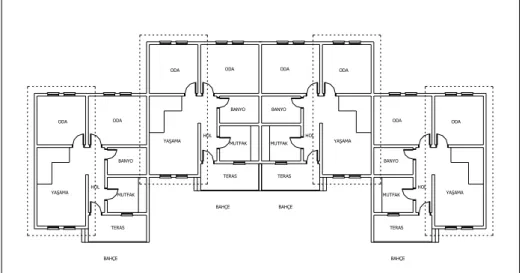
The houses were planned as row houses (floor area of 67.66 m2 net for downstairs and 21,77 m2 net for upper level). Four houses adjacent to each other were formed as a block with the concept of using the land more efficiently and supporting the ―neighborhood‖ concept of physical development (Figure 1). Beyciler Houses Project covered the construction of 168 houses in 42 blocks that were granted to the families in most need. The houses were handed over with completed exteriors but incomplete interiors, which were to be completed by the beneficiaries. The ground level, which offers a standard living space for an average size family gave the beneficiaries an opportunity to make ―a new beginning‖. On the other hand, handing over upper level in incomplete form provides an opportunity to
―expand‖ this standard living space by their own efforts. Additionally, Beyciler Houses was able to maintain its low-cost housing and reach more families by handing over the upstairs ―incomplete‖.
HOL MUTFAK YAŞAMA BAHÇE TERAS ODA BANYO HOL ODA YAŞAMA MUTFAK BAHÇE BAHÇE BAHÇE TERAS TERAS TERAS BANYO MUTFAK HOL BANYO MUTFAK BANYO YAŞAMA HOL ODA
ODA ODA ODA ODA
YAŞAMA ODA
Figure 1: Beyciler Housing Project – a block of four detached houses.
Figure 2: A housing block of four units Data collection
A mass housing project realized through user participation in Düzce after the 1999 Marmara earthquakes was analyzed in this study. The aim of this study was to identify to what extent user participation in the design process affects user satisfaction. A survey was conducted by interviewing the users selected randomly in the area. The questions in the survey were prepared in order to identify to what extent the users participated in the project, their ideas about their houses and their satisfaction with their houses.
The questionnaire forms used in this study were prepared based on a previous research successfully carried by Dülgeroğlu and the others in 1996. The study was conducted in order to determine the quality assessments by quality perceptions of the users and the designers related to the dwellings in four different housing areas in Istanbul and the most important reason of considering the study as a guide is that:
* It was aimed at Turkish society,
* It produced data that reinforced the results found in the area before,
* The results were given to Housing Development Administration of Turkey to be used in the future planning process of new housing areas and in the designs of mass housing units.
The questionnaire had four parts:
The first part included questions about users‘ characteristics such as their status in their houses, the length of time for which they had been living in the houses, and status about participation in the meetings during design and construction process.
The second part of the questionnaire covered some statements about the relationships between the houses and their exterior spaces and general characteristics of the houses.
In the third part, there are some statements about psychological needs and quality of interior spaces.
The fourth part of the questionnaire consisted of some statements regarding the changes that the users had already made and the changes that they intended to make.
The data obtained from the questionnaire was evaluated through the SPSS programme on computer.
For the first part of the questions, descriptive analysis (frequency tabulations) was used. For the second and third parts of the questions, one sample t-test (to measure the level of satisfaction) and Mann-Whitney-U nonparametric t-test (to measure the effect of participation on satisfaction) were used respectively. Eventually, for the fourth part of the questions, chi-square test (cross-tabulations) was used in order to determine the changes that had been carried out and the intended changes.
For the second and third parts of the questions, a 5-point Likert-type scale was used (values ranged from 1=certainly disagree to 5=certainly agree). Results
Overall, 100 participants answered the questionnaire. Of the 84 participants that answered the question about the length of time for which they lived in the house; 24 participants lived in their houses for 0–3 years, 60 participants lived in their houses for 4–5 years, and 5 participants lived in their houses for more than 6 years. 90 participants attended the meetings about the design and construction of the houses, while 6 participants did not.
Levels of Satisfaction
employed for the statements about the relationships between the houses and their exterior spaces and general characteristics of the houses and the statements about psychological needs and quality of interior spaces.
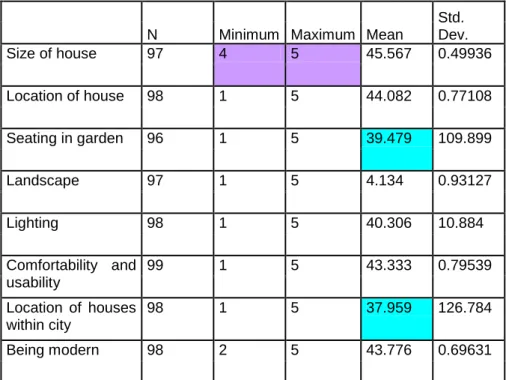
Table 1. Findings about Relationships Between the Houses’ Exterior Spaces
and General Characteristics.
N Minimum Maximum Mean
Std. Dev. Size of house 97 4 5 45.567 0.49936 Location of house 98 1 5 44.082 0.77108 Seating in garden 96 1 5 39.479 109.899 Landscape 97 1 5 4.134 0.93127 Lighting 98 1 5 40.306 10.884 Comfortability and usability 99 1 5 43.333 0.79539 Location of houses within city 98 1 5 37.959 126.784 Being modern 98 2 5 43.776 0.69631
The satisfaction point for users for the houses‘ exterior spaces and general characteristics was assigned to be 4=agree. The statistical hypothesis in this test was that: the satisfaction point for each variable was 4=agree.
Within the 95% reliability score, as the satisfaction point of the size of the house is 4 at minimum and the mean is 4.5567, the size of the house variable has the highest level of satisfaction. This level of satisfaction is followed by location of the house (mean=4.4082), modern image (mean=4.3776), comfortability and usability (mean=4.3333), landscape (mean=4.134), lighting (mean=4.0306) and seating in the garden (mean=3.9479=4) respectively. Location of the houses within the city remains below the testing value with its mean score (mean=3.7959).
The satisfaction point for users for psychological needs and quality of interior spaces was assigned as 4=agree. The statistical hypothesis in this test was that: the satisfaction point for each variable was 4=agree.
Within the 95% reliability score, as the satisfaction point for the size of the rooms is 4 at minimum and the mean is 4.6531, the size of the rooms variable has the highest level of satisfaction.
Table 2. Findings about Psychological Needs and Quality of Interior Spaces
N Minimum Maximum Mean
Std. Dev. Size of rooms 98 4 5 4.6531 0.47844 Isolation 98 1 5 4.1429 1.10295 Easy to upkeep 98 2 5 4.4286 0.71796 Well-designed 99 2 5 4.4646 0.67481 Feeling of home 96 2 5 4.5104 0.58029
Safe and enduring 98 1 5 4.5204 0.69207
Visual privacy 96 1 5 4.3750 0.82398 New, modern 96 2 5 4.5000 0.61559 Giving a feeling of happiness 97 2 5 4.4639 0.63018 Humidity 95 1 5 4.4316 0.78079 Storage facilities on ground floor 96 1 5 3.8021 1.20193
Size and types of
windows 97 1 5 4.0825 1.02744
Aesthetic value 97 2 5 4.2577 0.76755
Colour and texture of
building 99 1 5 4.0707 0.96100
Interior noise 96 1 5 3.8958 1.26057
The Effect of Participation in Satisfaction
Mann-Whitney U, one of the non-parametric tests, was employed to measure the effect of participation on satisfaction.
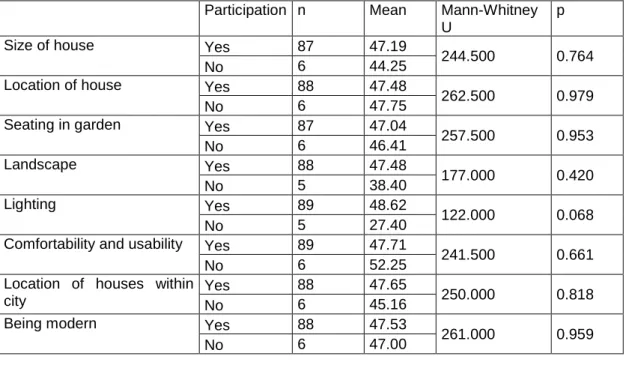
In terms of houses‘ exterior spaces and general characteristics, there is no significant difference between the residents who participated to design and construction process and who did not.
Table 3. Findings about Relationships Between Houses’ Exterior Spaces and General Characteristics
Participation n Mean Mann-Whitney U
p
Size of house Yes 87 47.19
244.500 0.764
No 6 44.25
Location of house Yes 88 47.48
262.500 0.979
No 6 47.75
Seating in garden Yes 87 47.04
257.500 0.953 No 6 46.41 Landscape Yes 88 47.48 177.000 0.420 No 5 38.40 Lighting Yes 89 48.62 122.000 0.068 No 5 27.40
Comfortability and usability Yes 89 47.71
241.500 0.661
No 6 52.25
Location of houses within city
Yes 88 47.65
250.000 0.818
No 6 45.16
Being modern Yes 88 47.53
261.000 0.959
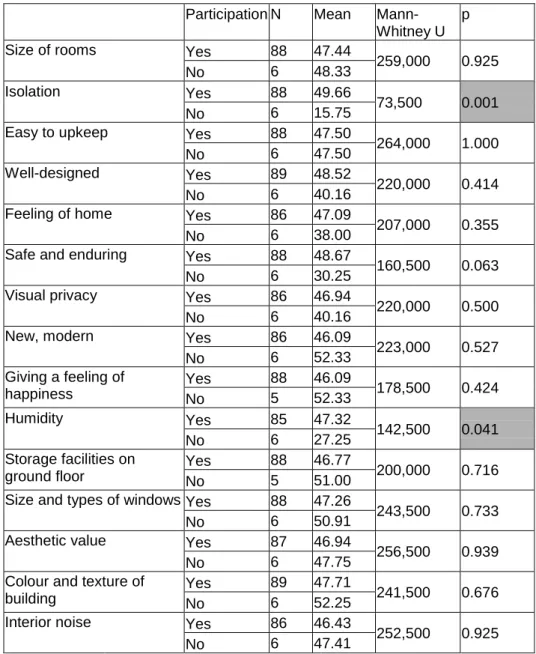
There is a significant difference between the two groups (who participated to the design and construction process and who did not) due to the psychological needs and quality of interior spaces (p<0.05).
Table 4. Findings about Psychological Needs and Quality of Interior Spaces
Participation N Mean Mann-Whitney U
p
Size of rooms Yes 88 47.44
259,000 0.925
No 6 48.33
Isolation Yes 88 49.66
73,500 0.001
No 6 15.75
Easy to upkeep Yes 88 47.50
264,000 1.000
No 6 47.50
Well-designed Yes 89 48.52
220,000 0.414
No 6 40.16
Feeling of home Yes 86 47.09
207,000 0.355
No 6 38.00
Safe and enduring Yes 88 48.67
160,500 0.063
No 6 30.25
Visual privacy Yes 86 46.94
220,000 0.500
No 6 40.16
New, modern Yes 86 46.09
223,000 0.527 No 6 52.33 Giving a feeling of happiness Yes 88 46.09 178,500 0.424 No 5 52.33 Humidity Yes 85 47.32 142,500 0.041 No 6 27.25 Storage facilities on ground floor Yes 88 46.77 200,000 0.716 No 5 51.00
Size and types of windows Yes 88 47.26
243,500 0.733
No 6 50.91
Aesthetic value Yes 87 46.94
256,500 0.939
No 6 47.75
Colour and texture of building
Yes 89 47.71
241,500 0.676
No 6 52.25
Interior noise Yes 86 46.43
252,500 0.925
No 6 47.41
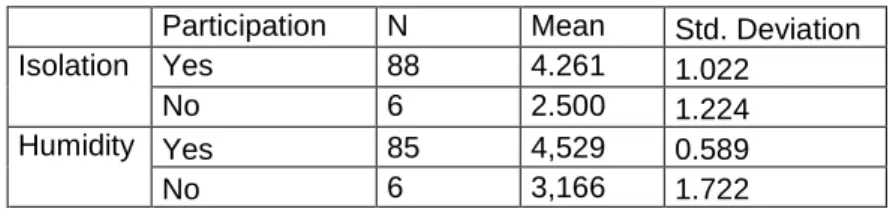
The two variables which supplied the significant differences were isolation and humidity. Mean values show that for the residents who participated to the design and construction process are more satisfied than who did not participated (m=4.261 for isolation, m=4.529 for humidity).
Tablo 5. Mean values for isolation and humidity.
Participation N Mean Std. Deviation
Isolation Yes 88 4.261 1.022
No 6 2.500 1.224
Humidity Yes 85 4,529 0.589
No 6 3,166 1.722
Changes in Spatial Features
Cross-tabulations were used in order to determine the relationships between the changes made and the intended changes to the interior and exterior equipments of the houses.
According to the results, 70.7% of the respondents changed the floor covering. 58.6% of those who did not change the floor covering wanted to change it. The intention to change the floor covering was actually carried out with 99% reliability.
57.6% of the users added cupboards to the houses. In this ratio, 8.8% of the respondents wanted to add cupboards to the houses. 71.4% of those who did not add cabinets to the houses wanted to do so. The Intention of adding cabinets to houses was actually carried out with 99% reliability.
Conclusions
The most significant result determined in this study is that after an extremely negative event such as an earthquake, positive effects were observed within a small group of people. The people, who had a very low income and lived in illegally and improperly-built houses made of scrap materials before the earthquake, continued to live in temporary sheds after the earthquake. For this reason, the organized, though modest, housing area in Beyciler and the new physical environment had made a significant difference for the users. Shortly, it can be said that Düzce earthquake has created an opportunity for a rapid social and spatial advancement for the beneficiary families.
The results of the questionnaire study made about the houses are summarized below.
Results for relationships between the houses’ exterior spaces and general characteristics
The size of the house was the variable that had the highest level of satisfaction. It can be interpreted as: most of the respondents were satisfied with the size of their houses.
Location of the houses within the city variable received the lowest level of satisfaction. Most of the respondents complained that their houses were quite distant from the city centre when compared to the houses that they had lived in before. It is difficult for these types of mass housing to be located in the dense town centres. Still it is considered that as the city develops and when the social units of the mass housing area are completed, the mass housing area will be closer to the town centre and will integrate with it. As for the participation variable, the results show that participation has no affect on users‘ satisfaction in terms of the houses‘ exterior spaces and
general characteristics.
In addition, the results of the factor analysis showed that modern image, comfort and usability and the size of the house were the primary factors for the users. Seating in the garden and the landscape came second.
Results for psychological needs and quality of interior spaces
The size of the rooms variable had the highest level of satisfaction. Users were not satisfied with the storage facilities on the ground floor and inadequate sound insultion. Again, it can be noted that there was general satisfaction with the houses.
The results show that participation has an affect on users‘ satisfaction on psychological needs and quality of interior spaces. The people that participated the design and construction process were more satisfied with the degree of the humidity and isolation.
Giving a feeling of home, being well-designed, being easy to upkeep, making people happy and sufficiently large rooms were the primary factors for the users. Isolation and protection from interior noise came last. Users cared most about the psychological aspects. The physical features of the building were not primary needs for those users.
Results for changes of spatial features
Most of the users changed the floor covering. A majority of those who did not change the floor covering wanted to change it. Most of the users added cabinets. And most of those who did not add a cabinet wanted to add one. When the users moved to their new homes, the floors were covered in screed. That was why most of the users regarded the change in floor covering as a primary need. They replaced it with a cheap PVC covering. In Turkish society, some people leave their shoes outside before they entering the houses. And they usually use carpets on the floor covering. So, that the floor be easily cleanable is very important for most Turkish people.
In conclusion, the fact that the overall level of satisfaction with the after-earthquake houses in Düzce, Beyciler was high can be interpreted in two ways:
First, the level of satisfaction was directly related to: the previous lives of the users, the earthquake they experienced, the poor conditions after the earthquake, and their low expectations about the subsequent built environment. Taş and his colleagues (2007) also supported this idea. They have measured the user satisfaction in the after-earthquake houses in Gündoğdu, Kocaeli Province, Turkey. According to their results, the satisfaction rating was high although optimal standards were not met. The houses that were studied met the expectations of the users or/and the users had minimal expectations. Obviously, to have a proper and safe house to live in is the primary concern of the users who have suffered psychological, sociological and economic damage.
way that people evaluate their own lives. In order to understand and choose the objective determinants properly, the values of people need to be understood.
Second, in the case study, almost all of the families participated in the design and construction process as a construction worker, a watchman, as a cook or a babysitter. Thus, the users‘ contribution and effort in the project has an important role in the high satisfaction of the users.
Finally, it can be concluded that these kinds of studies which explore the effect of participatory design on user satisfaction and the effect of participation on residential quality should be applied to any housing areas and similar researches should be repeated on them.
* Corresponding author. References
Altas N.E. and Ozsoy A., (1998), Spatial Adaptability and Flexibility as
Parameters of User Satisfaction for Quality Housing, Building and
Environment, Volume 33, Number 5, September, pp. 315-323(9). Apak, S., Ülken, G. and Ünlü, A., (2005), An Evaluation of ―the Feeling of
Security‖ in a New Mass Housing Compound in İstanbul, Housing, Space and Quality of Life, Ethnoscapes, Ashgate,
Arias, E:G., (1993), Housing Preferences and Their Intensity, The Meaning and Use of Housing: International Perspectives, Approaches and Their Application, Ed. Ariasi E.G., Avebury, England.
Bachelard, (1964), The Poetics of Space, New York: Orion Press.
Bonaiuto, M., Fornara, F. and Bonnes, M., (2003), Indexes of Perceived Residential Environment Quality and Neighbourhood Attachment in Urban Environments: A Confirmation Study on the City of Rome, Landscape and Urban Planning, 65 :41–52.
Bridget J., F, (2001), Discourses of Design: Perspectives on the Meaning of Housing Quality and ―Good‖ Housing Design , Housing, Theory and Society, Volume 18, Issue 1 & 2 February 2001 , pages 79 – 92. Coleman, J. R., (1973), Computer Aids for Participation in Housing Design,
Computer-Aided Design, Volume 5, Issue 3, July 1973, Pages 166-170.
Cooper, C.C., (1975), Easter Hill Village, Some social Implications of Design, The Free Press, New York.
Day,L., (2000), Choosing a House: The Relationship between Dwelling Type, Perception of Privacy and Residential Satisfaction, Journal of Planning Education and Research, 19; 265.
Diener and Eunkook Suh,(ed) (1997), Measuring Quality Of Life: Economic,
Social, And Subjective Indicators, Social Indicators Research,
Volume 40, Numbers 1-2.
Dülgeroğlu, Y.; Aydınlı,S. and Pulat,G.,(1996), Toplu Konut Uygulamalarında Niteliksel Değerleri Araştırmaya Yönelik Bir Çevre Analizi, T.C. Başbakanlık Toplu Konut İdaresi Başkanlığı, Konut Araştırmaları Dizisi–4, ODTÜ Basım İşliği, Ankara.
Erdogan, N, Akyol,A; Ataman, B and Dökmeci, V., (2007), Comparıson Of Urban Housing Satisfaction In Modern And Traditional Neighborhoods in Edirne, Turkey, Social Indicators Research, 81: 127–148.
Gottfried, A., Angelis, E. De and Trani, M. L., (1999), Results from the Application of a Performance-based Housing Regulation in Cadoneghe, Italy, Automation in Construction, Volume 8, Issue 4, pp. 445-453.
Gültekin, A. T., (2002), Toplu Konutlarda Yapı Bileşenlerinin Kalite Değerlendirmesi, Gazi Üniv. Müh. Mim. Fak. Der., Cilt 17, No 3, 137-152.
Hanzl, M., (2007), Information Technology as a Tool for Public Participation in Urban Planning: a Review of Experiments and Potentials, Design Studies, 28, 289-307.
Imrie, R., (1999), The Role of Access Groups in Facilitating Accessible Environments for Disabled People, Disability and Society, Vol 14 No 4, pp 463-482.
Kellekçi, Ö.L. and Berköz, L., (2006), Konut ve Çevresel Kalite Memnuniyetini Yükselten Faktörler, itüdergisi/a mimarlık, planlama, tasarım, Cilt:5, Sayı:2, Kısım:1, 165-176.
Leggett, W., (2002), Reflexive Modernization and Reconstructing the Third Way: A Response to Mouzelis, The Sociological Review, Vol 50 No 3, pp 416-436.
Liu, A.M.M., (1999), Residential Satisfaction in Housing Estates: A Hong Kong Perspective, Automation in Construction, 8_511–524.
Luck,R., (2007), Learning to Talk to Users in Participatory Design Situations, Design Studies, 28,217-241.
Marans, R.W., (1979), The Determinants of Neighborhood Quality: An Analysis of the 1976 Annual Housing Survey, U.S. Department of Housing and Urban Development, Housing Survey Studies, 3, U.S. Government Printing Office,Washington.
Marans, R.W., (2003), Understanding Environmental Quality Through Quality of Life Studies: The 2001 DAS and Its Use of Subjective and Objective Indicators, Landscape and Urban Planning , 65, ss.73-83. McKeen, J. D. and Guimaraes, T., (1997), Successful Strategies for User
Participation in Systems Development, Journal of Management Information Systems, Vol. 14 No. 2, pp. 133 – 150.
Özsoy, A., (1994), Konut Tasarım ve Değerlendirilmesinde Davranışsal Veriler, İTÜ, İstanbul.
Özsoy, A., (1995), Toplu Konutlarda Kalite ve Sürdürülebilirliği, Mimari ve Kentsel Çevrede Kalite Arayışları Sempozyumu, 5-7 Haziran 1995, İTÜ, İstanbul.
Özsoy,A., Esin-Altaş, N., Ok, V., and Pulat, G., (1995), Toplu Konutlarda Davranışsal Verilere Dayalı Nitelik Değerlendirilmesi, Araştırma Raporu, TÜBİTAK, İTÜ,Mimarlık Fakültesi,İstanbul.
Özsoy, A. and Gökmen, G. P., (2005), Space Use, Dwelling Layout and Housing Quality: An Example of Low-Cost Housing in İstanbul, Housing, Space and Quality of Life, Ethnoscapes, Ashgate,
Porteus, J. D., (1976), Home: The Territorial Core, Geographical Review, Vol. 66, pp. 383-390.
Romice, O., (2005), Neighbourhood Quality of Life-Global and Local Trends, Atttudes and Skills for Development, Housing, Space and Quality of Life, Ethnoscapes, Ashgate.
Sancar, F. H., (1999), An Integrative Approach to Public Participation and Knowledge Generation in Planning and Design, Directions, Person– Environment Research and Practice, Ashgate Publishing, Aldershot pp 99–139.
Sanoff, H., (1983), Human Exchange Techniques for Citizen Participation, Design Studies, Vol 4 No 2 pp 157-164.
Sanoff, H., (1990), Participatory Design, Theory and Techniquues, North Carolina.
Sanoff, H., (1991), Visual Research Methods in Design, Van Nostrand Reinhold, New York
Sanoff, H ., (2000), Community Participation Methods in Design and Planning, John Wiley & Sons Inc, New York.
Sanoff, H., (2006), Multiple Views Of Participatory Design, METU JFA, 2: 131.
Smith, (1994), The essential Qualities of a Home, Journal of Environmental Psychology, vol. 14, no1, pp. 31-46.
Tas,N., Cosgun,N. and Tas,M., (2007), A Qualitative Evaluation of the aAfter Earthquake Permanent Housings in Turkey in Terms of User Satisfaction—Kocaeli, Gundogdu Permanent Housing Model, Building and Environment, 42, 3418–3431.
Toker,Z. and Toker,U., (2006), Community Design in Its Pragmatist Age: Increasing Popularity and Changing Outcomes, METU JFA, (23:2), 155-166.
Türkoglu, H.D., (1997), Residents‘ Satisfaction of Housing Environments: The Case of Istanbul, Turkey, Landscape and Urban Planning, 39 :55-67.
Ukoha, O. M. and Beamish, J.O, (1997), Assessment of Residents' Satisfaction with Public Housing in Abuja, Nigeria, Habitat International, Volume 21, Issue 4, December, Pages 445-460. Yanar, B. Ö., (1994), Konut ve Çevresinde Kullanıcı Tatmininin
Ġrdelenmesi, Doktora Tezi, İTÜ, İstanbul.
Zube, E. H.; Vining, J.; Law, C. S. and Bechtel, R. B.; (1985), Perceived Urban Residential Quality, Environment and Behavior, Vol. 17, No. 3, 327-350.
www.beycilerevleri.org.tr 2005.
Kullanıcı katılımının memnuniyet üzerine etkisi: Düzce, Beyciler deprem sonrası konutları Giriş
Türkiye‘de konut sorunun en önemli nedenleri hızlı nüfus artışı ve kentleşme olarak görülmektedir. Bunun yanında konut ihtiyacını artıran bir diğer neden ise doğal afetlerdir. Son yıllarda meydana gelen depremler büyük mal ve can kayıplarına neden olmuş, hızla çok sayıda konutun inşa edilmesine gerek görülmüştür. Öte yandan depremden sonra ortaya çıkan ve acil olarak giderilmesi gereken büyük konut açığı sosyo-kültürel verilerin, kullanıcı gereksinimlerinin, alışkanlıkların ve mekânsal kalite gibi faktörlerin yeterince göz önüne alınmadan konut üretilmesine neden olmaktadır. Afet sonrası kalıcı konut kullanıcılarının psikolojik açıdan diğer kullanıcılardan farklı olmaları da göz önünde bulundurulmadan inşa edilmeleri konutların boş kalmalarına, yıllarca kullanılmamalarına neden olmaktadır. Kısaca, Türkiye‘de yaşanılan deneyimler, afet sonrası konut üretiminin, salt güvenli yapı yapma sorumluluğu olarak ele alınmaması gerekliliğini ortaya çıkarmıştır.
Konut tasarım ve uygulamalarının kalitesinin arttırılması amacıyla kullanıcının her türlü istek ve gereksinimlerini doğrudan karışlanması gerekmektedir. Bu amaçla belirlenen kriterler kullanıcı memnuniyetini arttıracaktır. Konut ve çevresi ölçeğinde, konut memnuniyeti sorununu yalnızca fiziksel biçimleniş olarak değil kişisel ve sosyal önemi olan bir anlamda memnuniyeti sağlamaya yönelik olarak ele almak doğru olacaktır.
Bu amaçla kullanıcıların konut uygulamaları için önemi daha da fazla olan kullanıcı katılımı yöntem olarak karşımıza çıkmaktadır.
Türkiye‘de katılımcı tasarım çalışmaları uygulanmış çok sayıda proje- yapı-yerleşim bulunmamaktadır, bu nedenle konunun önemini hatırlatmak ve bu şekilde gerçekleşmiş bir örneği irdeleyerek daha sonraki tasarımlara veri oluşturmak yararlı olacaktır.
Bu çalışmanın amacı, kullanıcıların tasarım sürecine dâhil edilmelerinin kullanıcı memnuniyetine olan etkisini araştırmaktır. Araştırmada, tasarım sürecine kullanıcı katılımının kullanıcı memnuniyetini ne düzeyde etkilediğini belirlemek amacıyla Düzce ilinde 1999 Marmara Depremleri sonrasında kullanıcı katılımıyla gerçekleştirilmiş bir toplu konut projesi alan çalışması gerçekleştirilmiştir.
Çalışmada, kaliteye bağlı kullanıcı memnuniyeti, daha sonra memnuniyeti etkileyen bir kriter olarak kullanıcı katılımı tartışılmaktadır.
Makalenin çatkısı aşağıdaki gibi kurgulanmıştır:
Kavramlar arasındaki ilişkiler ortaya konmuş, tartışılmış ve değerlendirilmiş,
Metodoloji ve veri toplama yöntemleri açıklanmış,
Araştırmanın bulguları ortaya konarak sonuçlar değerlendirilmiştir. Araştırma Sorusu: Kullanıcı katılımı, konut kalitesi yoluyla kullanıcı memnuniyetine etki eder mi?
Kullanıcı memnuniyetine etki eden en önemli faktörlerden biri, kullanıcıya kendi gereksinimlerine göre yaşayacağı mekânı şekillendirme olanağı sağlayan, projenin tasarım ve üretim sürecine kullanıcı katılımıdır.
Çünkü memnuniyet konutun kullanıcının istek ve gereksinimlerine ne kadar cevap verdiğiyle ilişkilidir. Cooper (1975) kullanıcıların konuttan beklentilerini psikolojik, güvenlik, estetik ve bilişsel olarak ele almıştır. Marans (1979) doğada yaşama, mahremiyet ve güvenlik bir yere ait olma ve sosyal statü belirleme olarak sınırlandırmıştır. Özsoy ve meslektaşları (1995) insanın evrensel olduğu, gereksinimlerinin kültürden kültüre değişkenlik gösterdiğini belirtmektedir.
Çevrenin biçimlendirilmesi insanların çevreleriyle doğrudan ilişkilerinin bir sonucu iken, günümüzde çeşitli kişi ve kuruluşlar ilişkileri düzenlemektedir. Kullanıcı grubunun gelecekteki yaşam çevresini oluşturacak olan kararların büyük bir çoğunluğu bu grupların getirdiği kısıtlamalarla alınır. Bu tür sorunlar ancak ve yalnız, kullanıcı grubunun ihtiyaçlarının belirlenebilmesi ve bir şekilde kararlara katılabilmesi, programlama aşamasında görüşlerine başvurulması ile çözümlenebileceği belirtilmektedir (Özsoy, 1994). Sanoff‘a (1990) göre ise katılımcı tasarım deneyimlerine dayanarak kullanıcı memnuniyetinin asıl kaynağının ihtiyaçların karşılanma derecesinin değil kararları etkileyebilmiş olma hissidir. Kullanıcının çevresine katkıda bulunabilme imkânının olması, kişiye kendi bireysel özellikleri ile çevresini
daha çok etkileme şansı verir. Kişi çevresinin biçimlenmesi ve bakımıyla ne kadar ilgili ise çevresi onun için o kadar uyumlu hale gelir.
Makale kapsamında kullanıcı katılımıyla ilgili farklı görüşler ele alınmış, tartışılmıştır. Burada kullanıcı katılımın sosyal bir aktivite olduğu kadar eğitimin de bir parçası olduğu unutulmamalıdır. Aynı zamanda, bu tür projeler demoktratik ortamın yaratılmasına da katkı sağlamaktadır.
Bu makalede de, kullanıcı memnuniyeti sadece fiziksel çevre özellikleriyle değil, aynı zamanda kişisel, sosyal ve kültürel özelliklerden de etkilendiğini vurgulamaktadır. Ayrıca, ―konut kalitesi‖ beklentilerle ve yaşam tarzlarıyla ilişkili olan ve memnuniyeti doğrudan etkileyen bir başka önemli kriterdir. Burada göz ardı edilmemesi gereken önemli veri ise kullanıcıların özellikleridir.
Çalışma Alanının Özellikleri
Beyciler Konutları, Uluslararası Mavi Hilal ve Düzce Belediyesi‘nin işbirliği ile gerçekleştirilen bir sosyal konut projesidir (www.beycilerevleri.org.tr, 2005). Projede başvuranlar arasında en dezavantajlı 168 aileye yardım edilmesi amaçlanmıştır. Aileler, kendi evlerinin tasarım ve üretiminde bulunabilmeleri için sürece dâhil edilmişlerdir.
Konut alanı, Düzce yerleşimin kuzey doğusunda sıra evler olarak tasarlanmıştır. Toplam 42 bloktan oluşan konut grubunda her blok dört konuttan oluşmaktadır. Birimlerin alanları 67.66 m2
dir. Veri Toplama
Çalışma alanında, rastgele seçilen kullanıcılarla bir anket çalışması yapılmıştır. Sorular, katılımcıların tasarım ve üretim aşamalarına katılıp katılmadıklarını, konutları hakkındaki düşüncelerini ve yaşadıkları evlere ilişkin memnuniyet düzeylerini saptaya yöneliktir. Anket sonuçları SPSS programında tek grup t testi, Mann-Whitney U testi ve ki-kare testi kullanılarak değerlendirilmiştir.
Bulgular
Anket sorularını 100 kişi cevaplamıştır.
Kullanıcı memnuniyetini ölçmek için, Tek Yönlü t-test kullanılmış, konutların dış mekân ve genel özellikleri için memnuniyet noktası 4=Katılıyorum olarak belirlenmiştir.
%95 güvenilirlik düzeyinde, dış mekan özellikleri ve genel özellikler açısından bakıldığında, konutların büyüklüğü için memnuniyet noktası minimum 4, maksimum 4.5567 olduğundan, konutun büyüklüğü değişkeni en yüksek memnuniyet derecesini alan değişken olmuştur.
%95 güvenilirlik düzeyinde, psikolojik gereksinimler ve iç mekan özellikleri açısından bakıldığında, odaların büyüklüğü için memnuniyet noktası minimum 4, maksimum 4.6531 olduğundan, odaların büyüklüğü değişkeni en yüksek memnuniyet derecesini alan değişken olmuştur.
Kullanıcı katılımının memnuniyete olan etkisini ölçmek için parametrik olmayan testlerden biri olan Mann-Whitney U testi kullanılmıştır.
Dış mekân özellikleri ve genel özellikler açısından, tasarım ve üretim aşamasına katılanlarla katılmayanların memnuniyet düzeyleri arasında istatistiksel olarak anlamlı bir farklılık bulunmamıştır. Psikolojik gereksinimler
ve iç mekân özellikleri açısından ise, iki grubun memnuniyet düzeyleri arasında anlamlı bir farklılık bulunmuştur (p<0.05). Farklılığı sağlayan değişkenler, izolasyon ve nemdir. Ortalama değerler, tasarım ve üretim sürecine katılanların katılmayanlara göre daha fazla memnun olduğunu göstermiştir (izolasyon için m=4.261, nem için m=4.529).
Sonuçlar ve Tartışma
Sonuç olarak, Düzce Beyciler konutlarıyla son derece negatif bir olay olan deprem sonucunda olumlu bir sonuç yaratılmış, yıllarca gecekondularda olumsuz şartlarda yaşamlarını sürdüren aileler planlı, mütevazı konutlarda yaşamaya başlamışlardır.
Gerçekleştirilen konutlarda kullanıcıların memnuniyet düzeylerini belirlemek amacıyla yapılan anket sonucunda memnuniyet düzeyi yüksek çıkmıştır. Bu iki şekilde yorumlanabilir:
Birincisi, memnuniyet düzeyi, kullanıcıların önceki yaşamlarıyla, yaşadıkları deprem deneyimiyle, deprem sonrası kötü koşullarla ve çevreden beklentilerinin düşük olmasıyla doğrudan ilişkilidir.
İkincisi ise, alan çalışmasında, neredeyse tüm kullanıcılar tasarım ve yapım sürecine doğrudan katıldıkları belirlenmiştir. Kullanıcıların katkı ve emekleri projeyi benimsemelerine ve memnuniyetin yüksek olmasına neden olmuştur. Son söz olarak, bu çalışma sonunda farklı gelir düzeylerine hizmet edecek konut uygulamalarında kullanıcı katılımlı projelerin gerçekleştirilmesinin önemi tekrarlanmalı, kullanıcı memnuniyetine katılımın ve memnuniyetin konut kalitesine etkisini inceleyen araştırmaların arttırılması gereği vurgulanmalıdır.
Referanslar
Cooper, C.C., (1975), Easter Hill Village, Some social Implications of Design, The Free Press, New York.
Marans, R.W., (2003), Understanding Environmental Quality Through Quality of Life Studies: The 2001 DAS and Its Use of Subjective and Objective Indicators, Landscape and Urban Planning , 65, ss.73-83. Özsoy, A., (1994), Konut Tasarım ve Değerlendirilmesinde Davranışsal
Veriler, İTÜ, İstanbul.
Özsoy,A., Esin-Altaş, N., Ok, V., and Pulat, G., (1995), Toplu Konutlarda Davranışsal Verilere Dayalı Nitelik Değerlendirilmesi, Araştırma Raporu, TÜBİTAK, İTÜ,Mimarlık Fakültesi,İstanbul.
Sanoff, H., (1990), Participatory Design, Theory and Techniquues, North Carolina.