Synthesis and Thermal Characterization of Novel Poly(azomethine-urethane)s
Derived from Azomethine Containing Phenol and Polyphenol Species
smet Kaya*,1, Mehmet Ylldlrlm1, Ali Avcl2, and Musa Kamacl3
1Çanakkale Onsekiz Mart University, Faculty of Sciences and Arts, Department of Chemistry, 17020, Çanakkale, Turkey 2Celal Bayar University, Faculty of Sciences and Arts, Department of Chemistry, 45040, Manisa, Turkey 3Karamano lu Mehmetbey University, Kamil Özda Science Faculty, Department of Chemistry, 70100, Karaman, Turkey
Received August 3, 2010; Revised September 27, 2010; Accepted September 30, 2010
Abstract: Oligophenol-based poly(azomethine-urethane)s (PAMUs) were newly synthesized in two steps. At the first step, the prepolymers including the phenol and oligophenol based-Schiff bases were prepared by a condensation reaction of o-dianisidine with 4-hydroxybenzaldehyde/3-ethoxy-4-hydroxybenzaldehyde, and the polycondensation reactions of the corresponding Schiff bases in an aqueous alkaline media. At the second step, the PAMUs were obtained by copolymerization of the prepolymers with toluene-2,4-diisocyanate (TDI) under an argon atmosphere. The structures of the obtained compounds were confirmed by FTIR, UV-vis, 1H NMR, and 13C NMR, and size
exclu-sion chromatography (SEC) techniques. The synthesized compounds were also characterized by TG-DTA and DSC analyses. Thermal decomposition steps at various temperatures were clarified by FTIR analyses of the degraded products. The physical changes to the synthesized PAMUs after exposing them to the thermal degradation steps are displayed.
Keywords: poly(azomethine-urethane), thermal degradation, polyurethane, oligophenol, o-dianisidine.
Introduction
Polyazomethines (PAMs) with their functional azome-thine (-CH=N-) linkages in the main chain are known to exhibit good thermal stability as well as many desirable properties such as paramagnetism, semi-conductivity, elec-trochemical cell, and resistance to high energy.1-3 Many
kinds of PAMs like poly(azomethine ether)s,4
poly(acrylate-azomethine)s,5 poly(azomethine carbonate)s,6
poly(amide-azomethine-ester)s,7 and poly(azomethine sulfone)s8 have
been synthesized so far. Several investigations are made on the development of heat-resistant polymers such as polyes-ters,9,10 polyethers,11 and polysiloxanes12 containing azomethine
linkages in the polymer backbone. Oligophenol derivatives of PAMs with polyconjugated structures have been also investigated in our previous studies and a lot of thermally stable kinds of these polymers have been obtained via oxi-dative polycondensation reaction of the corresponding Schiff base monomers.13-16 This method is easy to apply and
environmentally harmless due to the usage of water as the medium. Also using cheap oxidants such as NaOCl, H2O2,
and air is another advantage of this method. On the other hand, polyurethanes (PUs) represent a class of polymer that have found a number of applications in medical,
automo-tive, and industrial fields.17 A lot of studies are carried out to
understand their both chemical and physical properties and structures.18 Moreover, their thermal stabilities have been
studied so far.19,20 But only a few studies have been reported
on poly(azomethine-urethane)s (PAMUs) up till now.21-24
Especially, according to the our best knowledge, oligophe-nol derivatives of PAMUs have not been studied yet. This class of PAMUs, thus, still need to research with new contri-butions.
In the view of this point, we synthesized a series of new PAMUs derived from Schiff base substituted-oligophenol kinds. The obtained PAMUs were expected to combine the advantages of azomethine-oligophenols and PUs. At the first part, we synthesized two kinds of Schiff bases derived from o-dianisidine. The obtained phenol unit-containing Schiff bases were converted to their oligophenol derivatives as in the literature.25 Secondly, the obtained Schiff base and
oligophenol prepolymers were copolymerized with toluene-2,4-diisocyanate (TDI) to form new kinds of PAMUs. The synthesized PAMUs were characterized by FTIR, UV-vis, NMR, and size exclusion chromatography (SEC) techniques. Thermal characterizations were made by TG-DTA. Thermal degradation steps of the novel PAMUs were clarified via FTIR analyses of the degraded products at various tempera-tures. DSC analyses of the PAMUs were also carried out to determine the glass transition temperatures (Tg). Physical
I·
g
ˇ ˇg
changes of PAMU-2 with exposing to the thermal degrada-tion steps were also displayed.
Experimental
Materials. 2,4-Toluylenedi-isocyanate (TDI), o-dianisidine, 4-hydroxybenzaldehyde, 3-ethoxy-4-hydroxybenzaldehyde, dimethylformamide (DMF), dimethylsulfoxide (DMSO), tetrahydrofurane (THF), methanol, acetonitrile, acetone, toluene, ethyl acetate, heptane, hexane, carbon tetrachloride (CCl4), chloroform (CHCl3), sulfuric acid (H2SO4),
potas-sium hydroxide (KOH), and hydrochloric acid (HCl) were supplied from Merck Chemical Co. (Germany) and they were used as received. 30% aqueous solution of sodium hypo chloride (NaOCl) was supplied from Paksoy Chemi-cal Co. (Turkey).
Syntheses of the Prepolymers (PP). Prepolymers Ia and Ib were synthesized by simple condensation reaction of o-dianisidine with 4-hydroxybenzaldehyde and 3-ethoxy-4-hydroxybenzaldehyde. The obtained phenol units-contain-ing Schiff bases were converted to their polyphenol species via oxidative polymerization (OP) with the yields of 92 and 44% for IIa and IIb, respectively (Scheme I). The OP reac-tions were carried out as in the literature25 with the
follow-ing reaction conditions: Temp.: 70oC, reaction time: 11 h,
[NaOCl]: 0.122 M, [KOH]: 0.130 M, and the monomer concentration: 0.1275 M for IIa and 0.0976 M for IIb. The yields were calculated by the following equation: WP / WM
×100, where WP is the weight of the synthesized OP
prod-uct and WM is the monomer weight. However, as
empha-sized in the previous studies the yields of the OP products are considerably affected by the reaction conditions like temperature, reaction time, oxidant and base/acid concen-tration, etc.15 At the same conditions, thus, the yields of the
OP products could be different due to their different natures.
The yields could be increased by changing the mentioned conditions. Moreover, there are four possible coupling points at the ortho positions of diphenolic structure for Ia (see Scheme I) while only two points are suitable for Ib due to
ortho ethoxy substituents of -OH groups. This indicates that
Ia could more easily polymerized than Ib due to its higher number polymerization sites and resultantly higher poly-merization yield is obtained at the same conditions.
Syntheses of the Poly(azomethine-urethane)s (PAMUs). The synthesized azomethine containing prepolymers (I and II) were used in the syntheses of the PAMUs. Synthesis pro-cedure of the PAMUs as follows:22 TDI (1.74 g, 10-2 mol)
was dissolved in 50 mL THF and added into a 250 mL three-necked round-bottom flask which was fitted with con-denser, magnetic stirrer, and inert argon gas supplier. Reac-tion mixture was heated up to 60oC and equivalent amount
of PP (4.52 g of Ia, 5.41 g of Ib, 4.48 g of IIa, and 5.39 g of IIb) was added into the flask. Reactions were maintained for 5 h, cooled at the room temperature, and kept for 24 h. THF was removed in evaporator. The obtained polymers were washed by methanol (2 × 50 mL), acetonitrile (2 × 50 mL), and water (2 × 100 mL) to remove the unreacted components. The products were dried in a vacuum oven at 80oC for 24 h
(Scheme II) (yields: 78, 80, 95, and 55 for PAMU-1, PAMU-2, PAMU-3, and PAMU-4, respectively). The yields of the PAMUs were calculated using the similar equation given for PPs. As well known, the copolymerization reaction between TDI and the PPs starts by nucleofilic attack of -OH of the
Scheme I. Syntheses of the prepolymers Ia, Ib, IIa, and IIb.
Scheme II. Syntheses of the poly(azomethine-urethane)s and
possible structure of PAMU-4 (C-C coupling bonds formed dur-ing OP are shown by red lines).
PPs to the isocyanate groups of TDI by unpaired electron couples. Ib has a o-substituted electro-donor ethoxy group of -OH which increases the electron density of the phenylene ring and also makes the -OH more electron rich group. Resultantly, Ib more easily attacks to isocyanate group of TDI and the yield of PAMU-2 becomes higher than PAMU-1. Also, electro-acceptor o-phenyl substituents of IIa and IIb are expected to decrease the electron density of the phenol ring and -OH groups. This results in lower capability to copolymerization reaction and lower reaction yield. PAMU-4 has lower yield than PAMU-2 as expected. But, although the higher number phenylene substituents PAMU-3 surpris-ingly has the highest reaction yield. This result is interesting and may be arised from another factor.
Characterization Techniques. The solubility tests were carried out in different solvents by using 1 mg sample and 1 mL solvent at 25oC. The infrared and ultraviolet-visible
spectra were measured by Perkin Elmer FTIR spectrum one and Perkin Elmer Lambda 25, respectively. The FTIR spec-tra were recorded using universal ATR sampling accessory (4000-550 cm-1). UV-vis spectra of the synthesized
com-pounds were determined by using DMSO. 1H and 13C NMR
spectra (Bruker AC FT-NMR spectrometer operating at 400 and 100.6 MHz, respectively) were also recorded by using deuterated DMSO-d6 as a solvent at 25oC.
Tetramethylsi-lane was used as internal standard. Thermal data were obtained by using Perkin Elmer Diamond Thermal Analysis. The TG-DTA measurements were made between 20-1,000oC (in N
2,
10oC/min). DSC analyses were carried out by using Perkin
Elmer Pyris Sapphire DSC. DSC measurements were made between 25-420oC (in N
2, 20oC/min). The number average
molecular weight (Mn), weight average molecular weight
(Mw) and polydispersity index (PDI) were determined by
size exclusion chromatography (SEC) techniques of Shi-madzu Co. For SEC investigations, an SGX (100 Å and 7 nm diameter loading material) 3.3 mm i.d. × 300 mm columns was used; eluent: DMF (0.4 mL/min), polystyrene stan-dards were used. Moreover, refractive index detector (RID) and a UV detector were used to analyze the products at 25 oC.
Results and Discussion
Solubilities and Structures of the PAMUs. Prepolymers Ia and Ib are light colored-powder forms while their polyphe-nol species (IIa and IIb) are dark colored. The synthesized PAMUs derived from I (PAMU-1 and PAMU-2) are also light colored with brick red and yellow powders, respectively. Solubility test results showed that the obtained PAMUs are completely soluble in the solvents with high polarity like DMSO, DMF, and H2SO4. They are all insoluble in
metha-nol, ethametha-nol, THF, acetonitrile, ethyl acetate, hexane, hep-tane, and chlorinated solvents like chloroform and CCl4.
With exception of PAMU-3 the others are also insoluble in toluene and acetone, while PAMU-3 is partly soluble.
PAMU-3, as explained below, has lower molecular weighted structure and, thus, more solubility than PAMU-4. Also, IIa structure is an oligophenol including high number of -OH, and so PAMU-3 may contain unreacted (free) -OH substitu-ents while PAMU-1 and PAMU-2 may not (except for ter-minal -OH). Higher number of -OH substituents may increase the solubility in especially polar solvents.
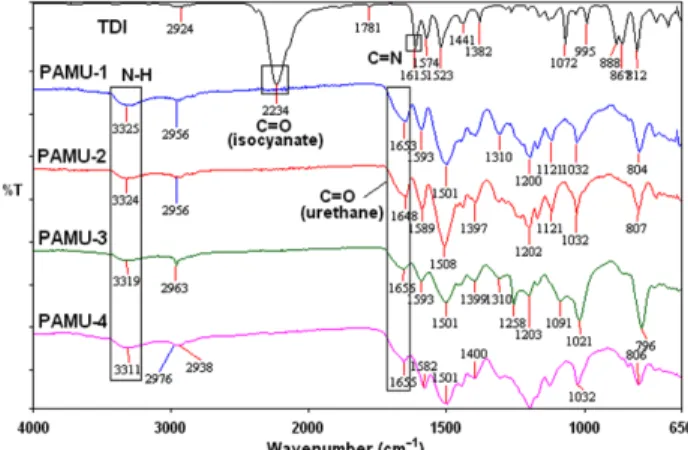
FTIR spectra of TDI and the synthesized PAMUs are given in Figure 1. At the spectrum of TDI characteristic iso-cyanate C=O peak is observed at 2234 cm-1 which agrees
with the literature values.26 However, at the spectra of the
PAMUs this peak disappears as a result of the urethane for-mation. Also, at the spectrum of TDI, imine stretch vibra-tion (C=N) is observed at 1615 cm-1 which disappears at the
other spectra.23 Moreover, at the PAMUs’ spectra the new
peaks appear at 3311-3325 cm-1 and 1648-1656 cm-1 which
could be attributed to the urethane N-H and urethane carbo-nyl (C=O) stretch vibrations, respectively. Azomethine bonds (C=N) in the structures of the PAMUs are observed at 1580-1593 cm-1, which are a bit lower than those of their
prepolymers (PPs). This is probably due to the electron withdrawing effect of the urethane groups in the polymer structures which decreases the electron density of imine car-bon and consequently imine vibration, as observed in the previous studies.23 Some additional peaks including aliphatic
C-H vibration (2938-2976 cm-1) and aromatic C=C stretch
(1501-1508 cm-1) are also shown in Figure 1. The observed
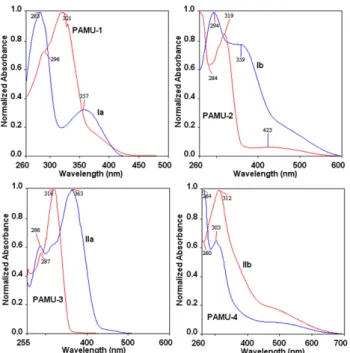
results clearly confirm the polyurethane formation. UV-vis spectra of the synthesized PPs and PAMUs are comparatively given in Figure 2. As seen in Figure 2, lower conjugations of the synthesized PAMUs than the PPs cause a bit blue shift in absorption edges resulting in higher band gaps.27 According to Figure 2 aromatic bands are observed
at 283, 294, 286, and 260 nm for Ia, Ib, IIa, and IIb prepoly-mers due to benzene π→π* transitions, respectively. Simi-larly, at the spectra of PAMU-1, PAMU-2, PAMU-3, and PAMU-4 the same transitions are observed at 296, 284, 287, and 264 nm, respectively. π→π* transitions of the azome-thine bonds observed at 357, 359, 363, and 312 for the
polymers shift into the lower wavelengths (303-320 nm) at the PAMUs’ spectra. The obtained azomethine bands for the synthesized PAMUs agree with those of the previously pre-sented UV-vis results of PAMUs.23
1H and 13C NMR spectra of PAMU-2 are given in Figure 3.
According to Figure 3(a) urethane and imine protons (-NHCO and -N=CH) are observed at 9.36 and 8.79 ppm, respec-tively. The peaks indicating ethoxy substituents (-OCH2CH3)
are seen at 4.02 and 1.36 ppm. Also, methyl and methoxy substituents are observed at 2.24 and 3.41 ppm, respec-tively. 13C NMR spectrum of PAMU-2 is also confirmed the
structure by the peaks observed at 153.85, 152.81, 64.31, 56.45, 18.03, and 15.04 ppm which could be attributed to the urethane, imine, -OCH2CH3, -OCH3, -CH3, and -OCH2CH3
carbons, respectively. The obtained results clearly show that the synthesized PAMUs are obtained with the proposed structures shown in Scheme II.
According to the SEC chromatograms, the calculated num-ber-average molecular weight (Mn), weight average
molecu-lar weight (Mw), and polydispersity index (PDI) values of
the synthesized PAMUs measured using UV detector are
given in Table I. According to the total values PAMU-1, PAMU-2, and PAMU-3 have nearly 3-6 repeated units. However, PAMU-4 has quite higher molecular weight includ-ing nearly 50-60 repeated units. These results indicate that PAMU-4 has polymeric structure whereas the others are likely oligomers (trimer, tetramer, pentamer, etc.). Also, prepolymers IIa and IIb are found to have Mn and Mw values
of 3,500 and 4,500 g mol-1; and 12,000 and 15,000 g mol-1,
respectively, agreed with the literature values.25 The average
molecular weights of the PAMUs show that during the syn-thesis of PAMU-3 prepolymer IIa probably depolymerizes into lower molecular-weighted oligomer chains that results in low molecular weighted PAMU-3. As given above, the yield of 3 is surprisingly higher than that of PAMU-4 while the molecular weight of PAMU-PAMU-4 is quite higher than that of PAMU-3. Kaya et al. previously emphasized that radicalic stability of the Schiff bases with methoxy
sub-Figure 2. UV spectra of the synthesized PPs and PAMUs.
Figure 3. 1H NMR (a) and 13C NMR (b) spectra of PAMU-2.
Table I. SEC Analysis Results of the Synthesized PAMUs
Compounds
Molecular Weight Distribution Parameters
Total Fraction I Fraction II Fraction III Fraction IV
Mn Mw PDI Mn Mw PDI % Mn Mw PDI % Mn Mw PDI % Mn Mw PDI %
PAMU-1 3,650 3,700 1.01 3,650 3,700 1.01 100 - - -
-PAMU-2 1,700 1,800 1.06 1,700 1,800 1.06 100 - - -
-PAMU-3 4,660 5,540 1.19 4,850 5,800 1.14 80 3,900 4,200 1.08 20 - - - -PAMU-4 36,720 46,900 1.28 94,200 118,900 1.27 25 44,950 70,300 1.56 14 14,000 14,800 1.05 48 1,200 1,700 1.42 13
stituents were kept for a long time during the OP and result-antly a higher molecular weighted structure was obtained.25
However, it can be arisen from the yields and the SEC results that IIb copolymerizes by continuously growing polymer chains to form low number/high molecular weighted poly-mer chains and IIa copolypoly-merizes by depolypoly-merization of IIa into lower chains followed by growing high number/low molecular weighted polymer chains. The low molecular weight and depolymerization of IIa could be attributed to the taut structure o-diphenyl substituted phenol ring. The C-C coupling bonds of the phenol and phenylene rings, thus, could be easily broken.
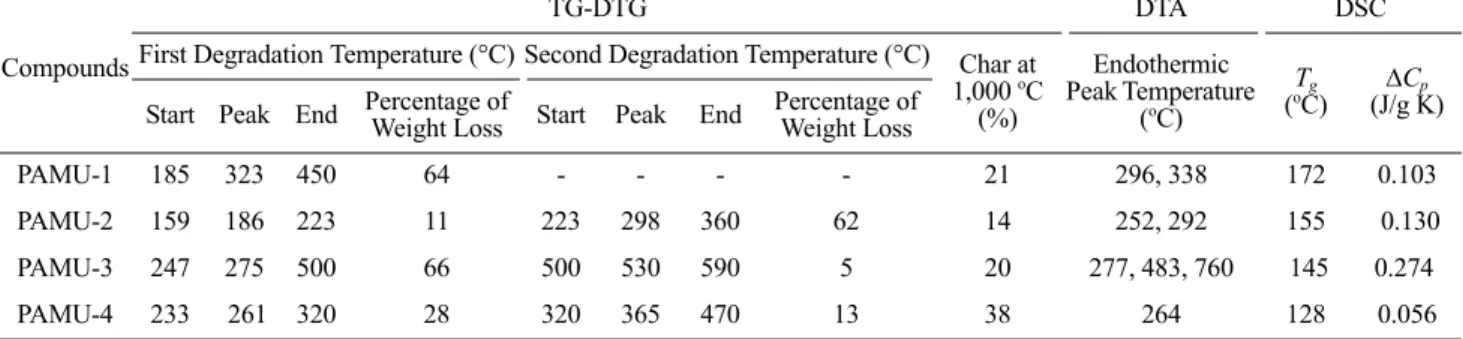
Thermal Characterization. TG-DTG-DTA curves of the PAMUs are given in Figure 4. Thermal degradation values are also summarized in Table II. According to the obtained thermograms with exception of PAMU-1 the other synthe-sized PAMUs decompose in two steps between 20-1,000oC.
Table II indicates that PAMU-3 and PAMU-4 have higher onset temperatures at the first degradation steps those extend from 230 to 500oC. This is probably because of the
pre-polymer structures. The prepre-polymer structures of PAMU-1
and PAMU-2 are the Schiff base compounds while those of PAMU-3 and PAMU-4 are the oligophenol kinds of the cor-responded Schiff bases. Thus, PAMU-3 and PAMU-4 have large side chains and consequently highly resist against thermal degradation. Additionally, the first degradation step of PAMU-3 and PAMU-4 includes the depolymerization of the polymers. As previously emphasized the C-O-C cou-pling rate of IIb is quite higher than that of IIa.25 C-O-C
cou-pling bond is thermally unstable and can be easily broken. Ethoxy group is also thermally unstable. The higher C-O-C rate makes the polymer (PAMU-4) less thermally stable even if it has high molecular weighted-structure than PAMU-3. However, the char residue of PAMU-4 at 1,000oC is quite
higher than that of PAMU-3 which could be attributed to the higher molecular weight. The char residues at 1,000oC are
21, 14, 20, and 38% for PAMU-1, PAMU-2, PAMU-3, and PAMU-4, respectively.
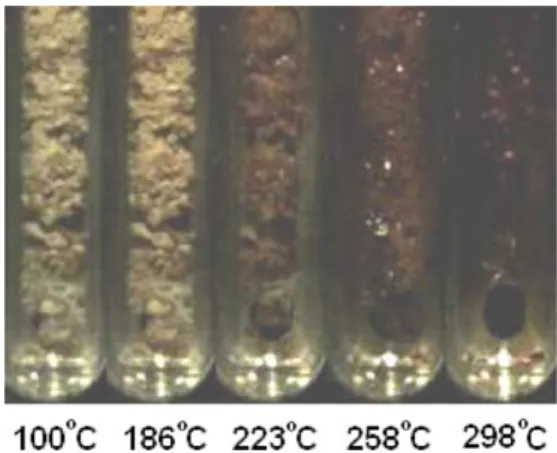
On the other hand, physical changes of PAMU-2 with exposing to the thermal degradation steps are displayed using a “Metler Toledo MP70”. The obtained thermodegra-dation photographs of PAMU-2 at various temperatures are
Figure 4. TG-DTG-DTA curves of the synthesized PAMUs.
Table II. TG-DTG-DTA and DSC Spectral Data of the Synthesized PAMUs
Compounds
TG-DTG DTA DSC
First Degradation Temperature (°C) Second Degradation Temperature (°C) Char at 1,000 oC (%) Endothermic Peak Temperature (oC) Tg (oC) (J/g K)∆Cp
Start Peak End Percentage of Weight Loss Start Peak End Percentage ofWeight Loss
PAMU-1 185 323 450 64 - - - - 21 296, 338 172 0.103
PAMU-2 159 186 223 11 223 298 360 62 14 252, 292 155 0.130
PAMU-3 247 275 500 66 500 530 590 5 20 277, 483, 760 145 0.274
given in Figure 5 indicating a clear colour change from light to dark colours with increasing temperature. At the tempera-tures of 100 and 186 ºC the colour is light brown which becomes darker above 223 ºC indicating the first and sec-ond degradation steps of PAMU-2, as given in Figure 5 and Table II.
According to the obtained DSC curves the glass transition temperatures (Tg) are calculated as 172, 155, 145, and 128 ºC
for PAMU-1, PAMU-2, PAMU-3, and PAMU-4, respec-tively. The broad peaks until 160 ºC could be attributed to the absorbed solvent removal.28 At the first glance into the
obtained results the PAMUs with ethoxy substituents have lower glass transition temperatures. This means the wholly aromatic structured (without ethoxy side groups) PAMUs are highly rigid. Also, the prepolymer structures could affect the Tg values. The PAMUs synthesized from IIa and
IIb have lower Tg values probably due to the formation of
etheric bonds by C-O-C couplings during the OP. Etheric bonds causes lower rigid structures which soften at lower temperatures. DSC results are also shown in Table II.
Thermal Degradation. As known, the thermal degrada-tion of PUs occurs in a two to three-step process.29-34 The
first step is due to the degradation of the hard segment, which results in the formation of isocyanate and alcohol, primary or secondary amine and olefin, and carbon dioxide. The second and third steps are due to the thermal decompo-sition of the soft segment. The thermal stability of PUs depends primarily on the polymerization↔ depolymerization equi-libria of the functional groups in the polymer molecule.35
The isocyanate formed during thermal decomposition may be dimerized to carbodiimide. Carbodiimide can then react with urethane groups to form a crosslinked structure.
Thermodegradation mechanism including the mentioned structures could be also clarified by FTIR spectra of the thermodegradation products. To explain the thermodegrada-tion steps of the synthesized PAMUs FTIR spectra of the products after heating until various temperatures are obtained and given in Figures 6-8, and 9, respectively. At the spectra
of PAMU-1 characteristic carbodiimide (-N=C=N) peak is observed at 1761 cm-1 for 500 oC which agree with the
liter-ature values.35 At the spectrum of PAMU-2, this peak is
observed at 1728, 1755, and 1762 cm-1 for 253, 360, and 470 oC, respectively. Also, Figure 7 shows that the carbodiimide
peak intensity increases from 253 to 360oC followed by a
sharp decrease at 470 oC. This indicates that during the
ther-mal degradation of PAMUs until a certain temperature car-bodiimide bond formation are continuously occurs, reaches a peak amount, and then decreases as a result of the defor-mation of the N=C=N bond to form new volatile products. At the spectrum of PAMU-3, this peak is observed at
1763-Figure 5. Thermodegradation photographs of PAMU-2 in
vari-ous steps.
Figure 6. FTIR spectra of PAMU-1 after heating until various
temperatures.
Figure 7. FTIR spectra of PAMU-2 after heating until various
temperatures.
Figure 8. FTIR spectra of PAMU-3 after heating until various
1766 cm-1 for 300 and 500oC, and 1763 cm-1 for 321oC at
the absorption spectrum of PAMU-4. Additionally, after the depolymerization step with heating up to higher tempera-tures -OH functionalized PAMUs are expected to form new ether-bridged structures with dehydration.35 As seen in
Fig-ures 6-9, when the synthesized PAMUs are heated up to 250-500oC new broad absorption bands appear at
1410-1490 cm-1 indicating the Ar-O-Ar ether bond formation.
Also, the intensities of O-H stretch vibrations at 3330-3370 cm-1 decrease due to the dehydration (Scheme III).
Conclusions
Novel poly(azomethine-urethane)s were synthesized using two biphenol containing Schiff bases and their oligophenol derivatives as the prepolymers. Toluene-2,4-diisocyanate was used as the comonomer agent. The obtained PAMUs and the prepolymers were characterized by UV-vis, FTIR, NMR, and SEC analyses. Thermal characterizations were carried out
by TG-DTA and DSC techniques. Also, thermal degrada-tion steps of the new PAMUs were clarified using the FTIR spectra of the degraded forms at various temperatures. Physical changes of the PAMUs were displayed at various tempera-tures showing that the colours of the PAMUs changed from light to dark forms as a result of the thermal degradation. According to the thermal degradation results the PAMUs synthesized from the oligophenol-structured prepolymers (PAMU-3 and PAMU-4) had higher thermal stabilities than the PAMUs derived from the Schiff base compounds (PAMU-1 and PAMU-2). This is because of the large side chain struc-tures of PAMU-3 and PAMU-4. Moreover, it was clearly determined that during the thermodegradation steps carbo-diimide bonds firstly formed which terminated upon a cer-tain temperature (about 350-360oC) to form new volatile
products. DSC results showed that the new PAMUs had Tg
values between 128-172 oC. Resultantly, because of the fine
thermal properties the synthesized PAMUs, especially PAMU-3 and PAMU-4, can be promising candidates for aerospace applications.
References
(1) C. J. Yang and S. A. Jenekhe, Chem. Mater., 6, 196 (1994). (2) C. G. Wang, S. Shieh, E. LeGoff, and M. G. Kanatzidis,
Mac-romolecules, 29, 3147 (1996).
(3) M. Grigoras and C. O. Catanescu, J. Macromol. Sci. Part
C-Polym. Rev., 44, 131 (2004).
(4) L. Marin, V. Cozan, M. Bruma, and V. C. Grigoras, Eur.
Polym. J., 42, 1173 (2006).
(5) H. Tanaka, Y. Shibahara, T. Sato, and T. Ota, Eur. Polym. J.,
2, 1525 (1993).
(6) S. J. Sun, T. C. Chang, and C. H. Li, Eur. Polym. J., 29, 951 (1993).
(7) C. H. Li and T. C. Chang, J. Polym. Sci. -Chem., 29, 361 (1991). (8) L. Marin, V. Cozan, and M. Bruma, Polym. Advan. Technol.,
17, 654 (2006).
(9) S. Banerjee and C. Saxena, J. Polym. Sci. Part A: Polym.
Chem., 34, 3565 (1996).
(10) C. Gaina, V. Gaina, and M. Sava, High Perform. Polym., 13, 4 (2001).
(11) K. R. Carter and J. L. Hedrick, Macromolecules, 27, 3426 (1994).
(12) A. M. Issam, A. T. Atto, and F. Y. Sara, Iraq Pat., 2508 (1993). (13) . Kaya, A. Bilici, and M. Saçak, Synth. Met., 159, 1914
(2009).
(14) . Kaya, M. Ylldlrlm, and A. Avcl, Synth. Met., 160, 911
(2010).
(15) . Kaya, S. Çulhao lu, and D. enol, Chinese J. Polym. Sci.,
25, 461 (2007).
(16) . Kaya, A. Bilici, and M. Gül, Polym. Advan. Technol., 19, 1154 (2008).
(17) G. T. Howard, Int. Biodeter. Biodegr., 49, 245 (2002). (18) K. K. Jena, D. K. Chattopadhyay, and K. V. S. N. Raju, Eur.
Polym. J., 43, 1825 (2007).
(19) D. K. Chattopadhyay, B. Sreedhar, and K. V. S. N. Raju, J. I·
I·
I· gˇ S¸
I·
Figure 9. FTIR spectra of PAMU-4 after heating until various
temperatures.
Appl. Polym. Sci., 95, 1509 (2005).
(20) S. M. Caki, G. S. Nikoli, and J. V. Stamenkovi, Polym. -Plast.
Technol., 46, 299 (2007).
(21) E. C. Buruiana, M. Olaru, and B. C. Simionescu, Eur. Polym.
J., 38, 1079 (2002).
(22) A. M. Issam and J. Ismail, J. Appl. Polym. Sci., 100, 1198 (2006).
(23) K. R. Reddy, A. V. Raghu, and H. M. Jeong, Polym. Bull., 60, 609 (2008).
(24) K. Tamareselvely, K. Venkatarao, and H. Khothandaraman,
Makromol. Chem., 191, 1231 (1990).
(25) . Kaya, M. Ylldlrlm, and M. Kamacl, Eur. Polym. J., 45,
1586 (2009).
(26) F. Solymosi and J. Rasko, J. Catal., 63, 217 (1980).
(27) J. Xiang, F. S. Rondonuwu, Y. Kakitani, R. Fujii, Y. Watanabe, and Y. Koyama, J. Phys. Chem. B, 109, 17066 (2005). (28) . Kaya and A. Bilici, J. Macromol. Sci. A, 43, 719 (2006). (29) K. Pielichowski, Polym. J., 29, 848 (1997).
(30) L. G. Lage and Y. Kawano, J. Appl. Polym. Sci., 79, 910 (2001). (31) H. K. Lee and S. W. Ko, J. Appl. Polym. Sci., 50, 1269 (1993). (32) N. Grassie and G. A. P. Mendoza, Polym. Degrad. Stabil., 11,
359 (1985).
(33) M. Day, J. D. Cooney, and M. MacKinnon, Polym. Degrad.
Stabil., 48, 341 (1995).
(34) Y. Zhang, S. Shang, X. Zhang, D. Wang, and D. J. Hourston,
J. Appl. Polym. Sci., 58, 1803 (1995).
(35) D. K. Chattopadhyayl and D. C. Webster, Prog. Polym. Sci.,
34, 1068 (2009).
I·