Ankara Ecz, Fak. Derg. J. Fac. Pharm, Ankara 32 (1) 19-29, 2003 32 (1) 19-29, 2003
TOXICITY PROPENSITIES OF SOME MARINE AND FRESH-WATER
ALGAE AS THEIR CHEMICAL DEFENSE
KİMYASAL SAVUNMALARI OLARAK BAZI DENİZ VE TATLI SU
ALGLERİNİN TOKSİSİTE EĞİLİMLERİ
İlkay ORHAN
a*, Puntip WISESPONGPAND
b, Tahir ATICI
C, Bilge ŞENER
aa Department of Pharmacognosy, Faculty of Pharmacy, Gazi University,
06330 Ankara, Turkey.
b
Department of Marine Sciences, Faculty of Fisheries, Kasetsart University,
10900 Bangkok, Thailand
c Department of Biology, Faculty of Education, Gazi University,
06500 Ankara, Turkey
ABSTRACT
Five species of the marine brown-algae, namely Halopteris scoparia (L.) Sauvagau, Padina vickersiae Hoyt, Dictyota dichotoma (Huds) Lam., Scinaia furcellata L., and Sargassum natans (L.) J. Meyer, a species of the marine green-alga, Ulva lactuca L., a species of the sea grass, Posidonia oceanica L., six species of fresh-water green-algae, namely Vaucheria sessilis (Vauch.) De Candolle, Zygnema pectinatum (Vauch.) C.A. Agardh, Maugeotia sp. (C.A. Agardh) Wittrock, Cladophora fracta (Dilw.) Ktitz, C. glomerata (Dilw.) Kiitz, and Spyrogyra gratiana Link, and the aquatic plants, namely Potomogeton perfoliatus L. and Ranunculus trichophyllus Chaix have been assayed for antibacterial, antialgal, piscicidal activities as well as toxicity against brine shrimp Anemia salina and prawn Macrobrachium lanchesteri de Man. Detailed results are given in this study.
Keywords: Algae, aquatic plant, antialgal activity, piscicidal activity, brine shrimp toxicity
ÖZET
Beş deniz kahverengi-alg türü, Halopteris scoparia (L.) Sauvagau, Padina vickersiae Hoyt, Dictyota dichotoma (Huds) Lam., Scinaia furcellata L. ve Sargassum natans (L.) J. Meyer, bir deniz yesil-alg türü, Ulva lactuca L., bir deniz çqyırı türü, Posidonia oceanica L., altı tatlı-su yeşil alg türü, Vaucheria sessilis (Vauch.) De Candolle, Zygnema pectinatum (Vauch.) C.A. Agardh, Maugeotia sp. (C.A. Agardh) Wittrock, Cladophora fracta (Dilw.) Kütz, C. glomerata (Dilw.) Kütz ve Spyrogyra gratiana Link, ve su bitkileri Potomogeton perfoliatus L. He Ranunculus trichophyllus Chaix, tuzlu su karidesi Artemia salina ve deniz tekesi Macrobrachium lanchesteri de Man'a karşı toksisiteleri ile antibakteriyel, antialgal ve pisisidal aktiviteleri yönünden taranmıştır. Bu çalışmada, ayrıntılı sonuçlar verilmektedir.
INTRODUCTION
Marine environment is known to have a rich diversity of living organisms. Because of high competition for survival, particularly sessile aquatic organisms which lack physical means of defense, have produced a variety of bioactive and toxic compounds as their defense strategy (1). The investigations have been focused on the substances of algal origin which are toxic to animals, particularly to fish, and to determine if a relationship exists between toxicity and the latitude where the algae were collected (2-4).
Macroalgae are one of the largest groups of aquatic organisms. Although marine macroalgae have been extensively studied, there has been less interest on bioactivity determinations of fresh-water algae. In order to evaluate ecotoxicological and biomedical potential of macroalgae and some aquatic plants, in connection with our investigation of the marine and fresh-water algae, we have screened five species of the marine brown-algae, namely Halopteris scoparia (L.) Sauvagau, Padina vickersiae Hoyt, and Dictyota dichotoma (Huds) Lam., Scinaia furcellata L., and Sargassum natans (L.) J. Meyer, the sea lettuce, Ulva lactuca L. with a species of the sea grass which is endemic to the Mediterranean Sea, Posidonia oceanica L. and six species of fresh-water green-algae from Chlorophytae, namely Vaucheria sessilis (Vauch.) De Candolle, Zygnema pectinatum (Vauch.) C.A. Agardh, Maugeotia sp. (C.A. Agardh) Wittrock, Cladophora fracta (Dilw.) Kiitz, C. glomerata (Dilw.) Kutz, and Spyrogyra gratiana Link, and the aquatic plants, namely Potomogeton perfoliatus L. and Ranunculus trichophyllus Chaix, collected from Turkish waters. In this paper, we report the results of antibacterial, antialgal, and piscicidal activities as well as toxicity tests against brine shrimp Artemia salina and the prawn Macrobrachium lancesteri of the crude extracts of the aforementioned algae and aquatic plants.
M A T E R I A L S AND M E T H O D S
Collection and identification of the alga and plant materials
The marine brown-algae of the Mediterranean Sea, namely Halopteris scoparia (L.) Sauvagau (GUE 2173), Dictyota dichotoma (Huds) Lam. (GUE 2174), and Padina vickersiae Hoyt (GUE 2175), were collected in August, 1999 from Alanya (the Mediterranean Sea), Turkey. Scinaia furcellata L. (GUE 2233) was gathered from Tekirdağ province located at the coast of the Marmara Sea, in September, 2000. Samples of Sargassum natans (L.) J. Meyer (GUE 2201), Ulva lactuca L. (GUE 2199), and Posidonia oceanica L. (GUE 2200) were collected from Davutlar village, Kuşadası (the Aegean Sea), in August, 2000. The fresh-water
Ankara Ecz. Fak. Derg., 32(1) 19-29, 2003 21
algae, Vaucheria sessilis (Vauch.) De Candolle (GUE 2228), Zygnema pectinatum (Vauch.) C.A. Agardh (GUE 2177), Spyrogyra gratiana Link. (GUE 2180) as well as the aquatic plants Potomogeton perfoliatus L. (GUE 2191) and Ranunculus trichophyllus Chaix (GUE 2193) were collected from Mogan Lake, Ankara, in April, 1999. Cladophora fracta (Dilw.) Kütz (GUE 2179) and C. glomerata (Dilw.) Kütz (GUE 2178) were collected from Beyşehir Lake, Konya, in May, 1999 and from Ceyhan River, Elbistan in April, 1999, respectively. Maugeotia sp. (C.A. Agardh) Wittrock (GUE 2181) was scooped from Sarıyer Damn in May, 1999. All of the algae and plants were identified by Dr. T. Atıcı. Voucher specimens (coded as GUE) are kept in formaldehyde solution at the Department of Biology, Faculty of Education, Gazi University, Ankara, Turkey.
Test organisms
Reference strains of Gram-positive bacteria Staphylococcus aureus (ATCC 25923) and Bacillus subtilis (ATCC 6633), and Gram-negative bacteria Pseudomonas aeruginosa (ATCC 10145) and Escherichia coli (ATCC 35218) used in the antibacterial activity test were obtained from the stocks of culture collections of Department of Microbiology, Faculty of Science, Kasetsart University, Bangkok, Thailand. Eggs of brine shrimp Artemia salina were purchased from the Inve company (Belgium) and the eggs were hatched in the laboratory. Guppy fish (Lebisdes reticulatus) used in the piscicidal activity test and the prawn Macrobrachium lancesteri were scooped from the fish pond maintained by Faculty of Fisheries, Kasetsart University, Bangkok, Thailand.
Preparation of the crude extracts
Each alga and plant material was accurately weighed (5.0 g) and ethanolic (95°) extracts from H. scoparia, P. vickersiae, D. dichotoma, S. furcellata, S. natans, U. lactuca, P. oceanica, Z. pectinatum, P. perfoliatus and R. trichophyllus, methanolic and ethyl acetate extracts from V. sessilis and chloroform extracts from V. sessilis, C. fracta, C. glomerata, S. gratiana and Maugeotia sp. were prepared by maceration. The organic layers of the extracts were filtered and concentrated under vacuum. The crude extracts were employed in the bioassays.
Antibacterial activity assay
The antibacterial activity was carried out by disk diffusion method (5). Each bacterium was cultured in the medium whose ingredients were polypeptone (1%), yeast extract (0.5%), NaCl (1%), agar (1.5%), and distilled-water (100 ml). The extracts were dissolved in the solvent
from which they were obtained. Each extract was applied on a sterile paper disk (6 mm in diameter) at concentrations of 10, 100, and 400 ug/disk. Blank solvent disks were also prepared as control. The disks were air-dried in laminar-flow cabinet before placing on agar plates. Prior to the test, each bacterium was subcultured in semi-solid agar until the medium became turbid. A cotton swap was dipped into the subculture and streaked onto the entire surface of plate to obtain a uniform culture. Plates were allowed to stand for 15 min. before incubation. Chloramphenicol was used as the standard antibiotic at the concentration of 10 iig/disk. Inhibition zones caused by the crude extracts and the standard against the bacteria mentioned previously were measured.
Antialgal activity assay
Disk diffusion method was carried out for antialgal activity using a pennate diatom Nitzschia sp., and green microalga Chlorella sp. as the test organisms. Each microalga was cultured in the medium which consists of agar (1.5%), seawater (100 ml), and Conway's media (6). The crude extracts were dissolved in the solvent which they were prepared with and applied on sterile paper disks (6 mm in diameter) at the concentration of 500 ug/disk. Blank solvent disks were also prepared as control. Disks were air-dried in laminar-flow cabinet before placing on agar plates. After placing the disks, plates were incubated upside-down at 20°C under continuous daylight fluorescent lamps. Inhibition zones around the paper disks impregnated with the extracts were observed after 5 days.
Piscicidal activity assay
The piscicidal activity test is based on the observation of acute toxicity symptoms whether the fish are killed when they are maintained for a fixed period of time in the solution with the extract (7). According to the method, each extract was dissolved in the solvent from which it was obtained and four concentrations from the extracts were prepared at 0.1, 1, 10, and 100 ug/disk concentrations. Each concentration was added to 20 ml of fresh-water in a 100 ml-beaker. Controls with blank solvents used in the extraction of the algae were run simultaneously. As the test organism, the guppy fish Lebistes reticulatus (2-3 cm in length) was used. One fish was put into each beaker. The test was done in triplicate. The number of the dead guppy fish was counted at the first hour to record acute toxicity and was recounted after 24 hours.
Ankara Ecz. Fak. Derg., 32 (1) 19-29, 2003 23
Brine shrimp toxicity test
This assay has been described in elsewhere (8,9). Briefly, 100-200 mg of brine shrimp
cysts were hatched in filtered seawater with strong air bubbling. After 24 hours, free-swimming
nauplii in a flask were hatched out. The upper part of the flask used for hatching was covered
with a black paper. As the nauplii are known to be phototaxis, they swimmed down to the
bottom of the flask and the egg shells floated on the surface. Then the nauplii were collected
easily by using a pasteur pipette. The alga extracts were dissolved in the solvents used in their
own extraction and prepared at the concentrations of 1, 10, and 100 jig/ml. Each concentration
was added to a vial containing 5 ml of seawater. Ten nauplii were put into each vial. After 24
hours, the number of the dead animals was recorded.
Prawn toxicity test
The tropical fresh-water prawn (Macrobrachium lancesteri De Man), which has a
different morphology and a blood pigment from fish, was used in the assay (9). The crude
extracts were prepared at 0.1, 1, 10, and 100 Jig/ml concentrations. The same procedure as
piscicidal activity mentioned above was followed.
RESULTS AND DISCUSSION
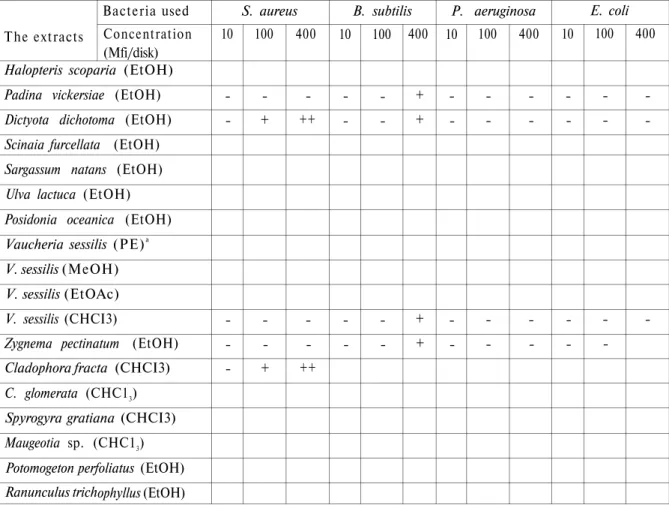
In the evaluation of our results with the alga and plant extracts tested for antibacterial
activity, D. dichotoma and C. fracta had a moderate activity against S. aureus at 100 and 400
Hg/disk concentrations causing 8-10 mm and 11-13 mm inhibition zones in diameter,
respectively. Chloroform extract of V. sessilis, Z. pectinatum, P. vickersiae, and D. dichotoma
were active against B. subtilis at the concentration of 400 jug/disk. None of the extracts showed
activity against P. aeruginosa and E. coli in this assay. Ethanolic extracts of S. furcellata, S.
natans, U. lactuca, P. oceanica, P. perfoliatus and R. trichophyllus did not exhibit any
antibacterial and antialgal activities in these tests. Chloramphenicol, the standard antibiotic used
in the test, caused 16 mm inhibition zone at 10 |xg/disk (Table 1). Blank solvent disks did not
cause any inhibition.
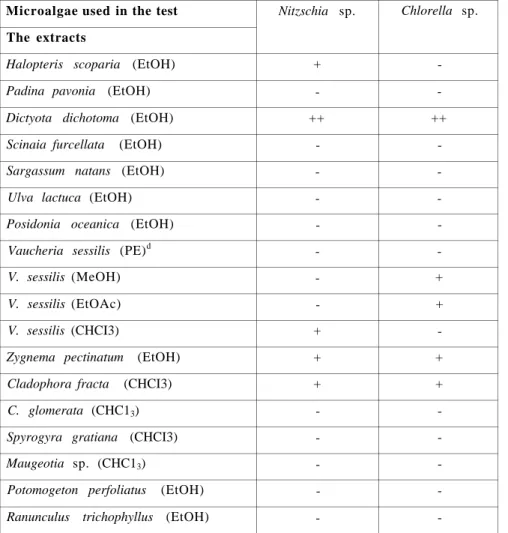
In the antialgal activity test, D. dichotoma had the most potent activity against both
microalgae Nitzschia sp. and Chlorella sp., causing 12-14 mm inhibition zones. Z pectinatum
and C. fracta were also moderately active against both microalgae having 8-10 mm inhibition
zones. In addition to them, while methanolic and ethylacetate extracts of V. sessilis were active
against Chlorella sp., its chloroform extract was found to inhibit the growth of Nitzschia sp.
The extracts
Bacteria used Concentration (Mfi/disk)
Halopteris scoparia (EtOH) Padina vickersiae (EtOH) Dictyota dichotoma (EtOH) Scinaia furcellata (EtOH) Sargassum natans (EtOH) Ulva lactuca (EtOH) Posidonia oceanica (EtOH) Vaucheria sessilis (PE)a V. sessilis (MeOH) V. sessilis (EtOAc) V. sessilis (CHCI3)
Zygnema pectinatum (EtOH) Cladophora fracta (CHCI3) C. glomerata (CHC13) Spyrogyra gratiana (CHCI3) Maugeotia sp. (CHC13) Potomogeton perfoliatus (EtOH) Ranunculus trich ophyllus (EtOH)
S. aureus 10 -100 -+ -+ 400 -++ -++ B. subtilis 10 -100 -400 + + + + P. aeruginosa 10 -100 -400 -E. coli 10 -100 -400
-* Chloramphenicol was used as the standard antibiotic, causing 16 mm inhibition zone. a Petroleum-ether extract of Vaucheria sessilis.
(-)= No inhibition zone observed.
(+ )=8-10 mm inhibition zone in diameter. (++) = 11-13 mm inhibition zone in diameter.
(Table 2). Chloramphenicol was also used in the antialgal activity test as the standard antibiotic, causing 15 mm inhibition zone at 10 |ug/disk.
P. vickersiae was the most active alga extract with acute piscicidal activity in this assay,
killing the guppy fish Lebistes reticulatus after one-hour exposure at 100 ug/ml concentration. The extracts of D. dichotoma, C. fracta, and S. natans were found to possess piscicidal activity at 100 M-g/ml and U. lactuca at both 100 and 300 |j,g/ml. For these extracts, the number of dead fish was observed after 24-hour exposure (Table 3).
* Chloramphenicol was used as the standard antibiotic, causing 15 mm inhibition zone. a Petroleum-ether extract of V. sessilis.
(-)= No inhibition zone observed. (+)= 8-10 mm inhibition zone. (++)= 12-14 mm inhibition zone.
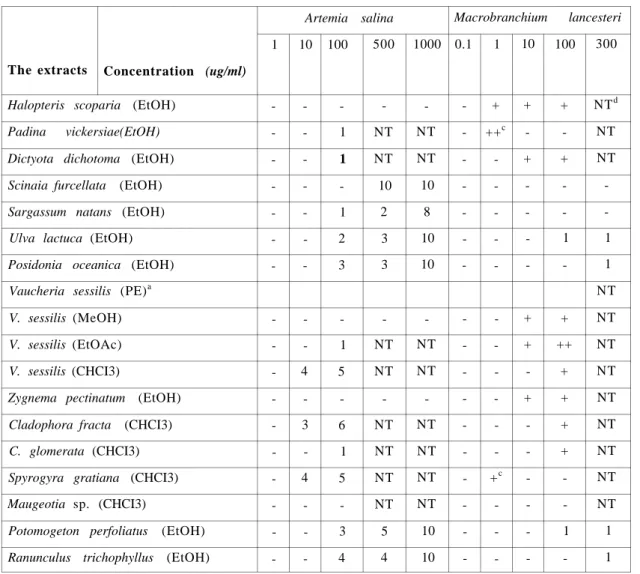
In brine shrimp toxicity test, the concentration that killed 50% of the brine shrimps were observed in chloroform extract of V. sessilis, C. fracta, and S. gratiana. Ethylacetate extract of
V. sessilis as well as ethanolic extracts of P. vickersiae, D. dichotoma, C. glomerata and S. natans were weakly toxic, killing only one brine shrimp at 100 (J-g/ml concentration. S. furcellata killed ten nauplii at 500 ug/ml whereas the extracts of P. perfoliatus, R. trichophyllus, U. lactuca, P. oceanica and S. natans caused to death of 5, 4, 3, 3 and 2 guppy fish,
respectively, at 500 ug/ml. The same extracts given in the previous sentence also exhibited potent toxicity at 1000 ug/ml (Table 4).
Ankara Ecz. Fak. Derg., 32 (1) 19-29, 2003
Table 2. Antialgal activity results of the crude extracts*
Microalgae used in the test The extracts
Halopteris scoparia (EtOH) Padina pavonia (EtOH) Dictyota dichotoma (EtOH) Scinaia furcellata (EtOH) Sargassum natans (EtOH) Ulva lactuca (EtOH) Posidonia oceanica (EtOH)
Vaucheria sessilis (PE)d V. sessilis (MeOH) V. sessilis (EtOAc) V. sessilis (CHCI3)
Zygnema pectinatum (EtOH) Cladophora fracta (CHCI3) C. glomerata (CHC13) Spyrogyra gratiana (CHCI3) Maugeotia sp. (CHC13)
Potomogeton perfoliatus (EtOH) Ranunculus trichophyllus (EtOH)
Nitzschia sp. + -++ -+ + + -Chlorella sp. -++ -+ + -+ + -25
The extracts
Halopteris scoparia (EtOH) Padina pavonia (EtOH) Dictyota dichotoma (EtOH) Scinaia furcellata (EtOH) Sargassum natans (EtOH) Ulva lactuca (EtOH) Posidonia oceanica (EtOH) Vaucheria sessilis (PE)a
V. sessilis (MeOH) V. sessilis (EtOAc) V. sessilis (CHCI3)
Zygnema pectinatum (EtOH) Cladophora fracta (CHCI3) C. glomerata (CHCI3)
Spyrogyra gratiana (CHC13)
Maugeotia sp. (CHC13)
Potomogeton perfoliatus (EtOH) Ranunculus trichophyllus (EtOH)
Concentration (pıg/ml) 0.1 -1 -10 -100 -++ + -+ -+ -300 -++ + -+ + -+ -Table 3. Piscicidal activity results of the crude extracts
a Petroleum-ether extract of V. sessilis.
(-)= No dead fish observed.
(+)= Dead fish observed after 24 hours. (++)= Dead fish observed after 1 hour.
Ankara Ecz. Fak. Derg., 32 (1) 19-29, 2003
Table 4. Brine shrimp and prawn toxicity test results of the crude extracts
a =Petroleum-ethers extract of V. sessilis. b =The number of dead nauplii is given. c =2 |i,g/ml concentration was used.
= No test was carried out due to inadequate sample amount. (-)= No dead nauplii/prawn observed.
(+)=Dead prawn observed after 24 hours. (++)=Dead prawn observed after 1 hour.
In the toxicity test against the prawn M. lancesteri De Man, the most toxic extract to the prawn at 2 fig/ml was P. vickersiae within one hour, while ethylacetate extract of V. sessilis exhibited acute toxicity at 100 ug/ml. H. scoparia had a significant toxicity at 1 Hg/ml within 24 hours. Methanolic extract of V. sessilis, and ethanolic extracts of Z. pectinatum, H. scoparia, and D. dichotoma were also observed to be toxic at 10 p.g/ml concentration. Chloroform
The extracts Concentration (ug/ml) Halopteris scoparia (EtOH)
Padina vickersiae(EtOH) Dictyota dichotoma (EtOH) Scinaia furcellata (EtOH) Sargassum natans (EtOH) Ulva lactuca (EtOH) Posidonia oceanica (EtOH) Vaucheria sessilis (PE)a V. sessilis (MeOH) V. sessilis (EtOAc) V. sessilis (CHCI3)
Zygnema pectinatum (EtOH) Cladophora fracta (CHCI3) C. glomerata (CHCI3) Spyrogyra gratiana (CHCI3) Maugeotia sp. (CHCI3)
Potomogeton perfoliatus (EtOH) Ranunculus trichophyllus (EtOH)
Artemia salina 1 -10 -4 -3 -4 -100 -1 1 -1 2 3 -1 5 -6 1 5 -3 4 500 -NT NT 10 2 3 3 -NT NT -NT NT NT NT 5 4 1000 -NT NT 10 8 10 10 -NT NT -NT NT NT NT 10 10 Macrobranchium lancesteri 0.1 -1 + ++c -+c -10 + -+ -+ + -+ -100 + -+ -1 -+ ++ + + + + -1 -300 NTd NT NT -1 1 NT NT NT NT NT NT NT NT NT 1 1 27
extracts of V. sessilis, and ethanolic extracts of C. fracta, C. glomerata, U. lactuca and P. perfoliatus had a moderate activity at 100 ug/ml (Table 4). At 300 ug/ml, P. perfoliatus, R.
trichopyllus, U. lactuca and P. oceanica were toxic to the prawn M. lancesteri.
As a conclusion, these findings provide additional evidence to the supposition that the assays mentioned above may play the part of useful primary screening in making a survey of bioactive natural products. The high percentage of algal extracts that showed some degree of toxicity suggests that algae might have some kind of defense mechanism that could be noxious, thus being inedible by fish. Consequently, these extracts originated from the alga and plant sources need further investigation with regard to identify the active components that could be developed as potential drugs to be used against diseases which threat the human health.
Acknowledgements
This research was fınancially supported by the Research Foundation of Gazi University, Ankara, Turkey (Project code no: 02/2000-21).
REFERENCES
1. Higa T., "Coral reefs: Mines of precious substances" Tropical Coasts, 4, 3-4 (1997). 2. Delaraisassi, G., "Screening for toxic activity of some marine benthic algae" Food Addit.
Contam., 12, 485-490 (1995).
3. Ciavatta, M.L., Gavagnin, M., Puliti, R., Cimino, G., Martinez, E., Ortea, J. and Mattia, C.A., "Dactyallene: A novel dietary C-15 bromoallene from the Atlantic Anaspidean mollusc Aplysia dactylomela" Tetrahedron, 53, 17343-17350 (1997).
4. Giraspy, D.A.B. and Natarajan P., "Ichthyotoxic propensities of some Indian marine green algae (Chlorophytes)" Ind. J. Mar. Sel, 27, 217-221 (1998).
5. Odland, B.A., Erwin, M.E. and Jones R.N., "Quality control guidelines for disk diffusion and broth microdilution antimierobial susceptibility tests with seven drugs for veterinary applications" J. Clin. Microbiol., 38, 453-455 (2000).
6. DellaGreca, M., Fiorentino, A., Isidori, M., Monaco, P., Temussi, F. and Zarrelli A., "Antialgal Furano-terpenes from Potamogeton natans L." Phytochemistry, 58, 299-304 (2001).
Ankara Ecz. Fak. Derg., 32 (1) 19-29, 2003 29
7. Singh, D. and Singh, A., "Piscicidal effect of some common plants of India commonly used in freshwater bodies against target animals" Chemosphere, 49,45-49 (2002).
8. Lincoln, R.A., Strupinski, K. and Walker, J.M., "The use of Artemia nauplii (brine shrimp larvae) to detect toxic compounds from microalgae cultures" Int. J. of Pharmacognosy, 34, 384-389 (1996).
9. Gunatilleka, A.D. and Poole, C.F., "Models for estimating the non-spesific toxicity of organic compounds in short-term bioassays" Analyst, 125, 127-132 (2000).
Başvuru Tarihi: 25.11.2002 Kabul Tarihi: 24.01.2003