Essential Oil Composition, Antioxidant, Anticholinesterase and
Anti-tyrosinase Activities of Two Turkish Plant Species:
Ferula elaeochytris and Sideritis stricta
Ebru Devecia, Gülsen Tel-Çayanb* and Mehmet Emin DuruaaDepartment of Chemistry, Faculty of Sciences, Muğla Sıtkı Koçman University, 48000 Muğla, Turkey bDepartment of Chemistry and Chemical Processing Technologies, Muğla Vocational School, Muğla Sıtkı Koçman University, 48000 Muğla, Turkey
[email protected], [email protected]
Received: October 25th, 2017; Accepted: December 18th, 2017
The aim of the present study is to characterize chemical compositions and antioxidant, anticholinesterase and anti-tyrosinase activities of Ferula elaeochytris and Sideritis stricta essential oils. The hydrodistilled essential oils were analyzed by GC/FID and GC/MS. A total of thirty-three and twenty-seven compounds representing 99.6 % and 99.4 % were identified in F. elaeochytris and S. stricta, respectively. The main compounds of essential oil of F. elaeochytris were
β-cubebene (21.3 %), caryophyllene oxide (17.5 %) and β-caryophyllene (14.9 %), while the major compounds of S. stricta essential oil were δ-cadinene
(18.3 %), cubenol (17.6 %) and β-caryophyllene (14.4 %). The antioxidant activity was tested by β-carotene-linoleic acid, DPPH free radical scavenging, ABTS cation radical scavenging, CUPRAC and metal chelating assays. The essential oil of F. elaeochytris showed the highest antioxidant activity in all assays. Also, the anticholinesterase and anti-tyrosinase activities of essential oils were performed against acetylcholinesterase (AChE), butyrylcholinesterase (BChE) and tyrosinase enzymes. F. elaeochytris essential oil indicated the highest anticholinesterase and anti-tyrosinase activities as well. This is the first
report describingantioxidant, anticholinesterase and anti-tyrosinase activities of essential oils of F. elaeochytris and S. stricta.
Keywords: Ferula elaeochytris, Sideritis stricta, Essential oil, Antioxidant activity, Anticholinesterase activity, Anti-tyrosinase activity.
Essential oils (EOs) are aromatic and volatile liquids generally extracted by steam or hydro-distillation from flowers, seeds, leaves, stems, bark and roots of plants. The chemical composition of essential oils is generally composed of terpenes and a few classes of phenolic compounds [1]. EOs are considered as secondary metabolites due to their antimicrobial, antifungal, anti-ulcer, anthelminthic, antioxidant, anti-inflammatory, repellent, insecticidal, antifeedant, cytotoxic, antiviral, ovicidal, anesthetic, molluscicidal, immunomodulatory, antinociceptive and larvicidal properties [2-16]. Therefore, EOs have been used in the pharmaceutical, cosmetic and agricultural industries since ancient times. Also, EOs have been served as food additives in the food industry as spices and herbs [17].
The Ferula genus, belonging to Apiaceae family, composed of 170 species and widely distributed in Central Asia and Mediterranean [18]. Ferula species are named as ‘Çakşır’, ‘Çakşır otu’ or ‘Çaşır’ in Turkey [19]. In traditional medicine, the roots and leaves of
Ferula species are used as antispasmodic, diuretic, anticonvulsant,
carminative, aphrodisiac, anthelminthic, anti-hysteric, tonic, laxative and decongestant to treat various diseases [18]. The chemical composition and biological activities of this species were studied by many research groups and sesquiterpenes and sulphur compounds showing anti-inflammatory, anti-tumor, anti-angiogenic and cancer chemopreventive properties have been isolated [20-22]. The Sideritis genus, a member of the Lamiaceae family, consists of more than 150 species in the world. This species is mainly grown in temperate and tropical regions of the Northern Hemisphere and Turkey and Spain which have the highest number of different species [23]. Sideritis species are known as ‘dağ çayı’ and ‘yayla çayı’ and the aerial parts of these species are consumed as the herbal and traditional tea in Turkey [24]. To date, many extracts, essential oils, and compounds such as terpenes, flavonoids,
coumarins, sterols, iridoids and lignans with therapeutic properties such as anti-inflammatory, analgesic, antioxidant, antimicrobial, antiviral and anti-ulcer effects have been reported from Sideritis species [25].
Nowadays, interest in exploring of alternative natural food additives sources such as plant extracts and essential oils has become popular. In this study, chemical compositions of the essential oils of F.
elaeochytris and S. stricta were identified by GC/FID and GC/MS.
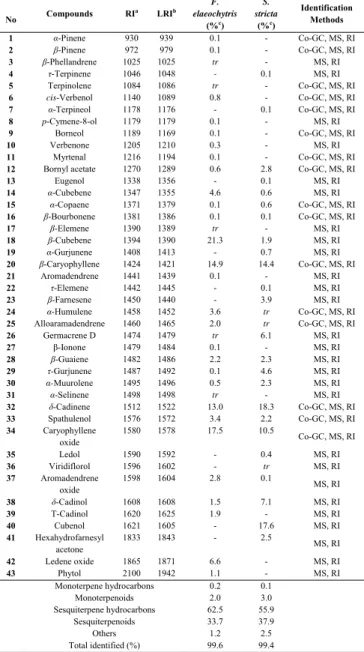
Antioxidant, cholinesterase and tyrosinase enzyme inhibitory activities of essential oils were investigated. This is the first study on the bioactivities of the essential oils in details. GC/FID and GC/MS techniques were used to investigate chemical compositions of the essential oils of F. elaeochytris and S. stricta. The chemical compositions of the essential oils, relative percentages (%) and Kovats index of compounds are presented in Table 1.
A total of thirty-three compounds were found in the essential oil of
F. elaeochytris, representing about 99.6 % of total oil. β-cubebene
(21.3 %), caryophyllene oxide (17.5 %), β-caryophyllene (14.9 %) and δ-cadinene (13.0 %) were major compounds in the essential oil. The highest quantitative classified components were found as sesquiterpene hydrocarbons (62.5 %) and sesquiterpenoids (33.7 %) in the essential oil. In a previous investigation, the essential oil composition of F. elaeochytris collected from Konya was studied and nonane (27.1 %), α-pinene (12.7 %) and germacrene-B (10.3 %) were recorded as main compounds [26].
Twenty-seven components were identified in the essential oil of S.
stricta, representing 99.4 % of the total oil with δ-cadinene (18.3
%), cubenol (17.6 %), β-caryophyllene (14.4 %) and caryophyllene oxide (10.5 %) as major components. The most abundant compounds in the essential oil were sesquiterpene hydrocarbons (55.9 %) and oxygenated sesquiterpenes (37.9 %), respectively. The
NPC Natural Product Communications
2018
Vol. 13
No. 1
101 - 104
Check ro, updalee102 Natural Product Communications Vol. 13 (1) 2018 Deveci et al.
Table 1: Chemical composition of the essential oils of F. elaeochytris and S. stricta
No Compounds RI a LRIb elaeochytris F. (%c) S. stricta (%c) Identification Methods 1 α-Pinene 930 939 0.1 - Co-GC, MS, RI 2 β-Pinene 972 979 0.1 - Co-GC, MS, RI 3 β-Phellandrene 1025 1025 tr - MS, RI 4 τ-Terpinene 1046 1048 - 0.1 MS, RI 5 Terpinolene 1084 1086 tr - Co-GC, MS, RI 6 cis-Verbenol 1140 1089 0.8 - Co-GC, MS, RI 7 α-Terpineol 1178 1176 - 0.1 Co-GC, MS, RI 8 p-Cymene-8-ol 1179 1179 0.1 - MS, RI 9 Borneol 1189 1169 0.1 - Co-GC, MS, RI 10 Verbenone 1205 1210 0.3 - MS, RI 11 Myrtenal 1216 1194 0.1 - Co-GC, MS, RI
12 Bornyl acetate 1270 1289 0.6 2.8 Co-GC, MS, RI
13 Eugenol 1338 1356 - 0.1 MS, RI 14 α-Cubebene 1347 1355 4.6 0.6 MS, RI 15 α-Copaene 1371 1379 0.1 0.6 Co-GC, MS, RI 16 β-Bourbonene 1381 1386 0.1 0.1 Co-GC, MS, RI 17 β-Elemene 1390 1389 tr - MS, RI 18 β-Cubebene 1394 1390 21.3 1.9 MS, RI 19 α-Gurjunene 1408 1413 - 0.7 MS, RI 20 β-Caryophyllene 1424 1421 14.9 14.4 Co-GC, MS, RI 21 Aromadendrene 1441 1439 0.1 - MS, RI 22 τ-Elemene 1442 1445 - 0.1 MS, RI 23 β-Farnesene 1450 1440 - 3.9 MS, RI 24 α-Humulene 1458 1452 3.6 tr Co-GC, MS, RI 25 Alloaramadendrene 1460 1465 2.0 tr Co-GC, MS, RI 26 Germacrene D 1474 1479 tr 6.1 MS, RI 27 β-Ionone 1479 1484 0.1 - MS, RI 28 β-Guaiene 1482 1486 2.2 2.3 MS, RI 29 τ-Gurjunene 1487 1492 0.1 4.6 MS, RI 30 α-Muurolene 1495 1496 0.5 2.3 MS, RI 31 α-Selinene 1498 1498 tr - MS, RI 32 δ-Cadinene 1512 1522 13.0 18.3 Co-GC, MS, RI 33 Spathulenol 1576 1572 3.4 2.2 Co-GC, MS, RI 34 Caryophyllene oxide 1580 1578 17.5 10.5 Co-GC, MS, RI 35 Ledol 1590 1592 - 0.4 MS, RI 36 Viridiflorol 1596 1602 - tr MS, RI 37 Aromadendrene oxide 1598 1604 2.8 0.1 MS, RI 38 δ-Cadinol 1608 1608 1.5 7.1 MS, RI 39 T-Cadinol 1620 1625 1.9 - MS, RI 40 Cubenol 1621 1605 - 17.6 MS, RI 41 Hexahydrofarnesyl acetone 1833 1843 - 2.5 MS, RI 42 Ledene oxide 1865 1871 6.6 - MS, RI 43 Phytol 2100 1942 1.1 - MS, RI Monoterpene hydrocarbons 0.2 0.1 Monoterpenoids 2.0 3.0 Sesquiterpene hydrocarbons 62.5 55.9 Sesquiterpenoids 33.7 37.9 Others 1.2 2.5 Total identified (%) 99.6 99.4
a: Retention indices on DB–5 fused silica column, , b: Retention indices of literature on DB-5 column
[30],c: Percentage concentration, Co-GC: Co-injection with authentic compounds, RI: Retention Index
literature comparison, tr: trace.
chemical composition of the essential oil of S. stricta collected from Antalya, Turkey was studied by Kirimer et al. [27]. β-pinene (30.0 %), α-pinene (12.9 %), β-caryophyllene (9.6 %) and epi-cubebol (9.6 %) were found as major compounds and sesquiterpenoids (26.6 %) were also reported as the most abundant compounds. In a different study, β-pinene (21-48 %) and α-pinene (7-24 %) were identified as the major compounds in the essential oil of S. stricta [28]. Location of collection area, climatic conditions, and genetic factors cause these differences in the essential oil composition of
F. elaeochytris and S. stricta [29].
The antioxidant activities related to the contents of essential oils of
F. elaeochytris and S. stricta were evaluated by β-carotene-linoleic
acid, DPPH free radical scavenging, ABTS cation radical scavenging, CUPRAC and metal chelating assays. The results are summarized in Table 2. The lipid peroxidation inhibition abilities of the essential oils were determined by β-carotene-linoleic acid assay. In the assay, F. elaeochytris essential oil (40.6±0.4 %) showed higher lipid peroxidation inhibition activity than S. stricta essential oil (28.6±0.1 %).
The essential oil of F. elaeochytris exhibited a higher radical scavenging activity (14.3±0.4 % and 23.9±0.7 %) than S. stricta essential oil in DPPH• and ABTS•+ assays, respectively.
According to obtained results in CUPRAC assay, the essential oil of
F. elaeochytris (0.3±0.02 Absorbance) was found to be higher
reductant than the essential oil of S. stricta (0.1±0.00 Absorbance). Both studied essential oils showed low ability to chelate ferrous ions (9.2±0.2 % for F. elaeochytris and 6.8±0.3 % for S. stricta). Although Ferula and Sideritis genus have more than 170 and 150 species in worldwide, respectively, studies on chemical composition and biological properties of their essential oils are limited. Amanzadeh et al. [31] studied the essential composition and antioxidant activity of Lallemanita iberica, cubebene and β-caryophyllene were reported as major compounds. Major compounds (β-cubebene, caryophyllene oxide, β-caryophyllene) and antioxidant properties of F. elaeochytris essential oil are similiar to L. iberica essential oil. Antioxidant activities and major compounds of S. stricta (δ-cadinene, cubenol and β-caryophyllene) and Annona muricata (δ-cadinene, β-caryophyllene) resemble. The results are consistent with the literature. Low or moderate antioxidant activity can be explained by the fact that the essential oils of both species are rich in sesquiterpenes [32]. To the best of our knowledge, no work has been carried out on the antioxidant activities of the essential oils of studied species.
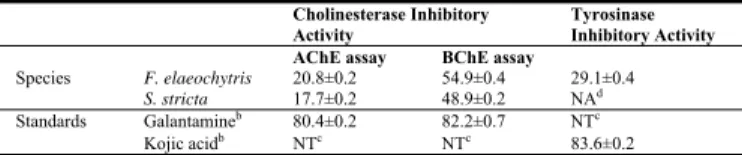
As it seen from Table 3, the essential oil of F. elaeochytris (20.8±0.2 %) and S. stricta essential oil (17.7±0.2 %) showed low inhibitory activity against AChE. Also, F. elaeochytris essential oil exhibited moderate inhibitory activity against BChE (54.9±0.4 % at 200 µg/mL).
Anticholinesterase activities of the essential oils of S. galatica, F.
lutea, and F. communis have been previously studied. AChE (IC50:
0.618 mg/mL) and BChE (IC50: 0.632 mg/mL) inhibition of the
essential oil of S. galatica were found to be weak [33]. F. communis essential oil was reported to show potent inhibitory activity against BChE (64.623 % at 10 mg/mL) [34]. In the study of Znati et al. [35], F. lutea exhibited high inhibitory activity against AChE (IC50:
70.25±5.41 µg/mL). Both essential oils rich in sesquiterpene compounds may cause the moderate anticholinesterase activity. The results are similar to those of our study.
F. elaeochytris essential oil (29.1±0.4 %) indicated mild tyrosinase
enzyme inhibition and S. stricta essential oil showed no activity
Table2:Antioxidantactivities of the essential oils of F. elaeochytris and S. stricta by β-Carotene-linoleic acid, DPPH•, ABTS•+, CUPRAC and metal chelating assays (Inhibition %)a.
Antioxidant Activity
β-Carotene-linoleic acid assay DPPH• assay ABTS•+ assay CUPRAC assayb Metal chelating assay
Species F. elaeochytris 40.6±0.4 14.3±0.4 23.9±0.7 0.3±0.02 9.2±0.2
S. stricta 28.6±0.1 3.5±0.04 10.9±0.2 0.1±0.00 6.8±0.3
Standards α-Tocopherolc 91.6±0.1 96.1±0.1 98.2±0.5 2.2±0.10 NTd
BHAc 92.8±0.04 90.8±0.1 98.1±0.1 3.7±0.20 NTd
EDTAc NTd NTd NTd NTd 94.7±0.6
a:: % inhibition of 200 µg/mL concentration of essential oils represent the means ± SEM of three parallel sample measurements (p < 0.05). b: Absorbancevalues of 200 µg/mL
Bioactivities of essential oil of Turkish plant species Natural Product Communications Vol. 13 (1) 2018 103
Table 3: Cholinesterase and tyrosinase inhibitory activities of the essential oils of F.
elaeochytris and S. stricta (Inhibition %)a.
Cholinesterase Inhibitory
Activity Tyrosinase Inhibitory Activity AChE assay BChE assay
Species F. elaeochytris 20.8±0.2 54.9±0.4 29.1±0.4
S. stricta 17.7±0.2 48.9±0.2 NAd
Standards Galantamineb 80.4±0.2 82.2±0.7 NTc
Kojic acidb NTc NTc 83.6±0.2
a: % inhibition of 200 µg/mL concentration of essential oils represent the means ± SEM
of three parallel measurements (p<0.05).b: Reference compounds c: NT: not tested d:
NA: not active.
(Table 3). There is no study about the anti-tyrosinase activity of the essential oils of Ferula and Sideritis species in the literature. This study can be considered as the first comprehensive investigation about antioxidant, anticholinesterase and anti-tyrosinase activities of the essential oils of F. elaeochytris and S.
stricta. Recent studies have revealed the adverse effects on human
health (oxidative stress related disease) of synthetic chemical additives used in the food industry. Therefore, the use of essential oils is a natural alternative to the synthetic for preservation of foods. It has been found that both essential oils can be used as a promising resource of natural agents for food additives and drugs for the treatment of AD and diseases associated with oxidative stress. Experimental
Plant materials: The aerial parts of S. stricta were collected from
Muğla, F. elaeochytris were collected from Bayburt, Turkey in 2016. The voucher specimen has been deposited at the herbarium of Natural Products Laboratory of Muğla Sıtkı Koçman University with voucher no MUMED1051 (for F. elaeochytris) and MUMED1121 (for S. stricta).
Isolation of the essential oil: The essential oils of dried aerial parts
of F. elaeochytris and S. stricta were hydrodistillated in a Clevenger-type apparatus for 4 h. The oils were dried over anhydrous sodium sulfate and stored under +4°C until analyzed. The essential oil yields were 0.24 % for F. elaeochytris and 0.31 % for S. stricta.
Gas chromatography-flame ionization detector (GC/FID): A
Flame Ionization Detector (FID) and a DB-5 fused silica capillary non-polar column (30 m×0.25 id., film thickness 0.25 μm) were used for GC analyses. The injector temperature and detector temperature were adjusted 250 and 270°C, respectively. Carrier gas was He at a flow rate of 1.4 mL/min. The sample size was 1.0 μL with a split ratio of 20:1. The initial oven temperature was held at 60°C for 5 min, then increased up to 240°C with 4°C/min increments and held at this temperature for 10 min. The percentage composition of the essential oil was determined by the ClassGC10 GC computer program.
Gas chromatography–mass spectrometry (GC/MS): An Ion trap
MS spectrometer and a DB-5ms fused silica non-polar capillary
column (30 m×0.25 mm ID, film thickness 0.25 μm) were used for the GC/MS analyses. The carrier gas was helium at a flow rate of 1.4 mL/min. The oven temperature was held at 60°C for 5 min, then increased up to 240°C with 4°C/min increments and held at this temperature for 10 min. Injector and MS transfer line temperatures were set at 220°C and 290°C, respectively. The ion source temperature was 200°C. The injection volume was 0.2 μL with a split ratio of 1:20. EI–MS measurements were taken at 70 eV ionization energy. Mass range was from m/z 28 to 650 amu. Scan time 0.5 s with 0.1 inter scan delays. Identification of components of the essential oils was based on GC retention indices and computer matching with the Wiley, NIST-2005 and TRLIB Library as well as by comparison of the fragmentation patterns of the mass spectra with those reported in the literature and whenever possible, by co-injection with authentic compounds [30].
Antioxidant activity
β-carotene/linoleic acid assay: The total antioxidant activity was
determined by β-carotene-linoleic acid method based on the measurement of the inhibition of conjugated diene hydroperoxides resulting from linoleic acid oxidation with slight modifications [36].
DPPH free radical scavenging assay: The free radical scavenging
activity was determined spectrophotometrically by the DPPH assay described by Blois with slight modification [36].
ABTS cation radical scavenging assay: The spectrophotometric
analysis of ABTS•+ scavenging activity was determined according
to the method of Re et al. with slight modifications [37].
Cupric reducing antioxidant capacity (CUPRAC) assay: The
cupric reducing antioxidant capacity was determined according to the method of Apak et al. with slight modifications [36].
Metal chelating assay: The chelating activity of the extracts on Fe2+
was measured as reported by Decker and Welch with slight modifications [37].
Enzyme inhibitory activity
Cholinesterase inhibition: Acetylcholinesterase and
butyrylcholinesterase inhibitory activities were measured by the spectrophotometric method developed by Ellman as previously reported [36] with slight modification.
Tyrosinase inhibition: Tyrosinase enzyme inhibitory activity was
measured by the spectrophotometric method as described by Masuda et al. [38] with slight modification.
Statistical analysis: All data on antioxidant and enzyme inhibitory
activity tests were the average of three parallel sample measurements. Data were recorded as mean ±S.E.M. Significant differences between means were determined by student’s-t test, p values <0.05 were regarded as significant.
References
[1] Koul O, Walia S, Dhaliwal GS. (2008) Essential oils as green pesticides: potential and constraints. Biopesticides International, 4, 63-84.
[2] Isman MB, Koul O, Luezynski N. (1990) Insecticidal and antifeedant bioactivity of neem oil and their relationship to azadirachtin content. Journal
of Agricultural and Food Chemistry, 38, 1406-1411.
[3] Singh S, Majumdar DK, Rehan MHS. (1996) Evaluation of anti-inflammatory potential of fixed oil of Ocimum sanctum (Holybasil) and its possible
mechanism of action. Journal of Ethnopharmacology, 54, 19-26.
[4] Singh J, Tripathi NN. (1999) Inhibition of storage fungi of black gram (Vigna mungo L) by some essential oils. Flavour and Fragrance Journal, 14,
1-4.
[5] Ghelardini C, Galeotti N, Mazzanti G. (2001) Local anesthetic activity of monoterpenes and phenylpropanes of essential oils. Planta Medica, 67,
104 Natural Product Communications Vol. 13 (1) 2018 Deveci et al.
[6] Inouye S, Takizawa T, Yamaguchi, H. (2001) Antibacterial activity of essential oils and their major constituents against respiratory tractpathogens
by gaseous contact. Journal of Antimicrobial Chemotherapy, 47, 565-573.
[7] Mediratta PK, Sharma KK, Singh S. (2002) Evaluation of immunomodulatory potential of Ocimum sanctum seeds oil and its possible mechanism
of action. Journal of Ethnopharmacology, 80, 15-20.
[8] Abdollahi M, Karimpour H, Monsef-Esfehani HR. (2003) Antinociceptive effects of Teucrium polium L. total extract and essential oil in mouse
writhing test. Pharmacological Research, 48, 31-35.
[9] Jantan I, Ping WO, Visuvalingam SD, Ahmad NW. (2003) Larvicidal activity of the essential oils and methanolic extracts of Malaysian plants on
Aedes aegypti. Pharmaceutical Biology, 41, 234-236.
[10] Fico G, Panizzi L, Flamini G, Braca A, Morelli I, Tome F, Cioni PL. (2004) Biological screening of Nigella elamascena for antimicrobial and
molluscicidal activities. Phytotherapy Research, 18, 468-470.
[11] Maurya S, Marimuthu P, Singh A, Rao GP, Singh G. (2005) Antiviral activity of essential oils and acetone extracts of medicinal plants against
papaya ring spot virus.Journal of Essential Oil Bearing Plants, 38, 233-238.
[12] Sylvestre M, Pichette A, Lavoie S, Longtin A, Legault J. (2007) Composition and cytotoxic activity of the leaf essential oil of Comptonia
peregrine (L). Coulter. Phytotherapy Research, 21, 536-540.
[13] Dordevic S, Petrovic S, Dobric S, Milenkovic M, Vucicevic D, Zizic S, Kukić J. (2007) Antimicrobial, anti-inflammatory, anti-ulcer and
antioxidant activities of Carlina acanthifolia root essential oil. Journal of Ethnopharmacology, 109, 458-463.
[14] Nedorostova L, Kloucek P, Kokoska L, Stolcova M, Pulkrabek J. (2009) Antimicrobial properties of selected essential oils in vapour phase against
food borne bacteria. Food Control, 20, 157-160.
[15] Pandey AK, Singh P, Tripathi NN. (2011) Impact of essential oils on eggs hatchability and feeding activity of pulse beetles. Journal of the
Entomological Research Society, 35, 221-225.
[16] Najafian S. (2014) Storage conditions affect the essential oil composition of cultivated Balm Mint Herb (Lamiaceae) in Iran. Industrial Crops and
Products, 52, 575-581.
[17] Zhang DY, Yao XH, Duan MH, Wei FY, Wu GH, Li L. (2015) Variation of essential oil content and antioxidant activity of Lonicera species in
different sites of China. Industrial Crops and Products, 77, 772-779.
[18] Sahebkar A, Iranshahi M. (2010) Biological activities of essential oils from the genus Ferula (Apiaceae). Asian Biomedicine, 4, 835-847.
[19] Kılıç Ö. (2015) Essential oil composition of Ferula orientalis L. from different locations of Turkey and a chemotaxonomic approach. Düzce
Üniversitesi Bilim ve Teknoloji Dergisi, 3, 251-257.
[20] Soltani F, Mosaffa F, Iranshahi M, Karimi G, Malekaneh M, Haghighi F, Behravan J. (2010) Auraptene from Ferula szowitsiana protects human
peripheral lymphocytes against oxidative stress. Phythoteraphy Research, 24, 85-89.
[21] Shakeri A, Iranshahy M, Iranshahi M. (2014) Biological properties and molecular targets of umbelliprenin – a mini-review. Journal of Asian
Natural Products Research, 16, 884-889.
[22] Kasaian J, Iranshahy M, Iranshahi M. (2014) Synthesis, biosynthesis and biological activities of galbanic acid - a review. Pharmaceutical Biology,
52, 524-531.
[23] Loğoğlu E, Arslan S, Oktemer A, Şakiyan I. (2006) Biological activities of some natural compounds from Sideritis sipylea Boiss. Phytotheraphy
Research, 20, 294-297.
[24] Guvenç A, Houghton PJ, Duman H, Coşkun M, Şahin P. (2005) Antioxidant activity studies on selected Sideritis species native to Turkey.
Pharmaceutical Biology, 43, 173-177.
[25] Gonzalez-Burgos E, Carretero ME, Gomez-Serranillos MP. (2011) Sideritis spp.: Uses, chemical composition and pharmacological activities-A
review. Journal of Ethnopharmacology, 135, 209-225.
[26] Başer KHC, Özek T, Demirci B, Kürkçüoğlu M, Aytaç Z, Duman H. (2000) Composition of the essential oils of Zosima absinthifolia (Vent.) Link
and Ferula elaeochytris Korovin from Turkey. Flavour and Fragrance Journal, 15, 371-372.
[27] Kirimer N, Tabanca N, Özek T, Baser KHC, Tümen G, Duman H. (2003) Composition of essential oils from five endemic Sideritis species. Journal
of Essential Oil Research, 15, 221-225.
[28] Kirimer N, Baser KHC, Demirci B, Duman H. (2004) Essential oils of Sideritis species of Turkey belonging to the Section Empedoclia. Chemistry
of Natural Compounds, 40, 19-23.
[29] Afoulous S, Ferhout H, Raoelison EG, Valentin A, Moukarzel B, Couderc F, Bouajila J. (2013) Chemical composition and anticancer,
anti-inflammatory, antioxidant and antimalarial activities of leaves essential oil of Cedrelopsis grevei. Food and Chemical Toxicology, 56, 352-362.
[30] Adams RP. (2007) Identification of Essential Oil Components by Gas Chromatography/Mass Spectrometry, Allured Publ. Corp, Carol Stream, IL.
[31] Amanzadeh Y, Khosravi Dehaghi N, Gohari AR, Monsef-Esfehani HR, Ebrahimi SES. (2011) Antioxidant activity of essential oil of Lallemantia
iberica in flowering stage and post-flowering stage. Research Journal of Biological Sciences, 6, 114-117.
[32] Alitonoul GA, Tchobo FP, Sessou P, Avlessi F, Menut C, Sohounhloue DCK. (2013) Chemical composition, antiradical and anti-inflammatory
activities of four Annonaceae from Benin. International Journal of Pharmaceutical, Chemical and Biological Sciences,3, 914-923.
[33] Zengin G, Sarikurkcu C, Aktumsek A, Ceylan R. (2016) Antioxidant potential and inhibition of key enzymes linked to alzheimer's diseases and
diabetes mellitus by monoterpene-rich essential oil from Sideritis galatica Bornm. endemic to Turkey. Records of Natural Products, 10, 195-206.
[34] Nguir A, Mabrouk H, Douki W, Ismail MB, Jannet HB, Flamini G, Hamza MA. (2016) Chemical composition and bioactivities of the essential oil
from different organs of Ferula communis L. growing in Tunisia. Medicinal Chemistry Research, 25, 515-525.
[35] Znati M, Jabrane A, Hajlaoui H, Harzallah-Skhiri F, Bouajila J, Casanova J, Ben Jannet H. (2012)Chemical composition and in vitro evaluation of
antimicrobial and anti-acetylcholinesterase properties of the flower oil of Ferula lutea. Natural Product Communications, 7, 947-950.
[36] Tel G, Apaydın M, Duru ME, Öztürk M. (2012) Antioxidant and cholinesterase inhibition activities of three Tricholoma species with total phenolic
and flavonoid contents: The edible mushrooms from Anatolia. Food Analytical Methods, 5, 495-504.
[37] Çayan F, Tel G, Duru ME, Öztürk M, Türkoğlu A, Harmandar M. (2014) Application of GC, GC-MSD, ICP-MS and spectrophotometric methods
for the determination of chemical composition and in vitro bioactivities of Chroogomphus rutilus: The edible mushroom species. Food Analytical
Methods, 7, 449-458.
[38] Masuda D, Yamashita Y, Takeda Y, Yonemori S. (2005) Screening for tyrosinase inhibitors among extracts of seashore plants and identification of