© Central Fisheries Research Institute (CFRI) Trabzon, Turkey and Japan International Cooperation Agency (JICA)
Aquafeed Industry in Turkey: Its Aquafeed Projections Towards the Year
2015
Introduction
Fish, having superior biological value, containing water and fat-soluble vitamins, not connective tissue, low carbohydrate and fat level, high mineral content, easily digestibility and generally affordable, have an important and rightful place in human nourishment. For many years, fish have been produced for aquaculture.
Nearly 200 species of fish are cultured throughout the world (Chadha, 2002). World aquaculture production reached 48,169,074 tonnes with an increase of 4.8 percent year in 2005. It is currently valued at US$ 78.3 billion annually. China is the largest producer with 32.4 million tonnes (excluding aquatic plants) (FAO, 2007). Contribution of aquaculture provides about 40%, or 48 million metric tonnes to the annual world fisheries production of 157 million metric tonnes.
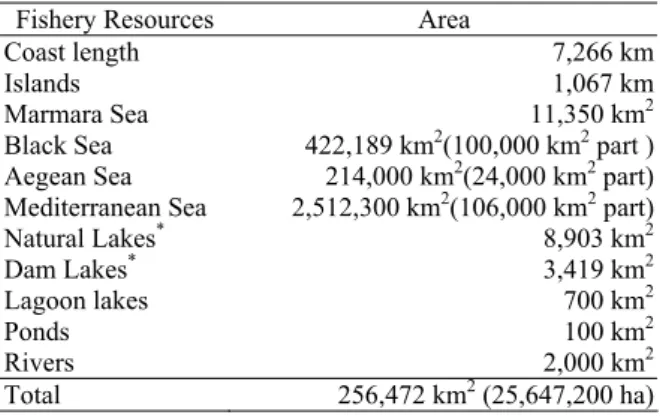
Turkey has very wealthy water reserve potential in both marine and inland waters with 8,333 km of coastline, 175 thousand km of rivers, 1 million hectare of natural lakes, 170 thousand hectares of dams, and 7 hundred small dams used for local needs such as irrigation and the contribution to drinking water for animals (Çelikkale et al., 2003). Overall water resources of Turkey suitable for fisheries and aquaculture are about 25.6 million ha (Table 1). Turkey sits at the junction of two continents, Asia and Europe, surrounded by seas on three sides, the Black Sea in the north, the Mediterranean in the south and the Aegean in the west.
Turkey is becoming an important player in world aquaculture, in such a way that its aquaculture
rates the 24th from a total of 162 in world ranking
with a production of 119,177 tonnes. However, Turkey was on the fifth place amongst the countries of the European Union in 2005. Among Turkey’s priorities in international politics, membership of the European Union takes the first place.
Aquaculture is currently the fastest growing food production sector and will certainly continue to grow in the new millennium (Rosenthal, 2002). As one of the aquaculture sub-sectors, fish feeds or aquafeeds have a fundamental importance in this sector. Fish feed plays a very important role in intensive culture, especially when one considers that feeding expenses range from 40% to 60% of total production costs in fish farming.
Table 1. Marine and Freshwater resources of Turkey
(TURKSTAT, 2006).
Fishery Resources Area
Coast length 7,266 km
Islands 1,067 km
Marmara Sea 11,350 km2
Black Sea 422,189 km2(100,000 km2 part )
Aegean Sea 214,000 km2(24,000 km2 part)
Mediterranean Sea 2,512,300 km2(106,000 km2 part)
Natural Lakes* 8,903 km2 Dam Lakes* 3,419 km2 Lagoon lakes 700 km2 Ponds 100 km2 Rivers 2,000 km2 Total 256,472 km2 (25,647,200 ha)
*: Considering more than 5 km2 surface.
Abstract
Turkey’s ecological and natural conditions are very convenient for aquaculture. During 2005 Turkey’s aquaculture was 24th in world with a production of 119,177 tones. The number of licensed fish farms is 1,369 in total and the capacity is
139,522 tonnes. Turkey has thirteen aquafeed manufacturing mills at present. Seven of these produce only manufactured fish feeds. Both pelleted and extruder fish feeds in Turkey are currently manufactured using feed technology. While manufactured compound feed production reached about 6.8 million tonnes in Turkey, production of aquafeed peaked at 105,058 tonnes in 2005 (approximately 1.5%). In conclusion, Turkey’s aquaculture production projections show 129,532 tonnes, 181,055 tonnes, and 276,082 tonnes for 2006, 2010, and 2015, respectively. Accordingly aquafeed manufacture in Turkey was predicted as 215,579 tonnes, 300,027 tonnes and 454,284 tonnes for 2006, 2010, and 2015, respectively.
Key words: Turkey, aquaculture, aquafeed, feed mill, feed technology, projections.
Önder Yıldırım1,*
1 Muğla University, Faculty of Fisheries, Department of Aquaculture, 48000, Muğla,Turkey.
* Corresponding Author: Tel.: +90.252 2111891, Fax: +90.252 2238475; E-mail: [email protected]
Received 10 January 2007 Accepted 31 January 2008
Fish were fed with the cattle spleens, the by-products of fisheries and slaughterhouses since the end of the nineteenth century, when trout farming commenced. But then, dry pellets, a revolution discovery product, were started to be used in fish farms since the 1960s.
During the 1980s, the introduction of the cooking-extrusion technique constituted another crucial step forward. This technology assures a better physical appearance and a much-improved digestion of food ingredients. The process allows the preparation of feeds of higher energetic content by allowing a higher lipid proportion and an improvement in the food conversion ratio. This leads a considerable saving of the valuable proteins that are destined primarily for the constitution of muscle, and, as a direct result, reduces the nitrogenous waste into the environment (Sabaut, 2002).
Gill (2007) estimates 635 mmt total global in industrial or manufactured feed output in 2006. Estimated global industrial feed production that occurred in poultry was 40%, in pigs 32%, in cattle 22%, in others 3% and in aquaculture 4% in 2004 (Gill, 2007). Total estimated compound aquafeed production in 2003 was 19.5 mmt. If we are to understand this number by species carps 45%, marine shrimp 15%, salmon 8.4%, tilapia 8.1%, marine fish 7.6%, catfish 4.1%, trout 3.7%, freshwater crustaceans 3.4%, milkfish 2.7% and 2% eel (Tacon, 2005). In this paper, aquafeed sector in Turkey was addressed; the current status of aquafeed in Turkey and its projections towards the years of 2006 and 2015 were put forward by using data which include current aquaculture and aquafeed production figures, feed conversion rates and average annual growth projection.
Materials and Methods
Fish feed requirements are based on an assessment of feeding practices (mainly the estimates from the previous researches on dry feed production) and feed conversion rates. The aquafeed and aquaculture statistics are presented from GDPC, GDAPD databases. In addition, data collected trough personnel communications with national and foreign aquafeed firms for the fish feed production were also used.
Pike (2000), Pike and Barlow (2003), and Tacon (2004), who are prominent scientist especially in estimating world fish feed, have made projections in
their scientific researches regarding newly developed aquafeed technologies and feed formulations. They note that FCR is improving well for every fish and crustacean species.
In calculations of the projections used for explaining the rates of aquafeed between the years of 2006 and 2015 in Turkey, the rates of the average feed conversion have been evaluated in regard to the data by Pike (2000), Pike and Barlow (2003), Tacon (2004). In the present study, the Table 2 was formed and the projections were made by revising the FCR values presented in Pike (2000), Pike and Barlow (2003), Tacon (2004). In addition, average annual aquaculture growth rates of Turkey were obtained largely from data in the previous years. The average growth rates were assumed as 10% for trout, 8% for carp, 8% for gilthead sea bream, and for sea bass, 1% for mussel and 5% for others. Projections for the species were done by using Excel programmer.
Results
The Current Status of Aquaculture and Aquafeed Production in Turkey
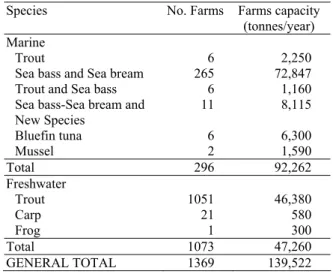
Turkey’s ecological and natural conditions are very convenient for aquaculture of various marine and freshwater species including trout, carp, sea bass and bream, turbot, mussel etc. Main freshwater fish species produced is trout (Onchorynchus mykiss) where raceways and floating cages are employed. Main marine fish species grown are sea bass (Dicentrarchus labrax) and gilthead sea bream (Sparus aurata). The marine fish have been cultured in floating cages, off-shore and earthen ponds. According to current official figures there are 296 marine and 1,073 freshwater farms. Licensed fish farms are 1,396 in total and farms capacity is 139,522 tonnes (Table 3). Brook trout (Salvelinus fontinalis), brown trout (Salmo trutta), turbot (Psetta maxima), red porgy (Pagrus pagrus), and grouper (Epinephelus guaza) are produced in experimental or pilot scales that is to say not commercial in some farms. A recent development took place in fattened bluefin tuna (Thunnus thynnus) caught in the Mediterranean in May and June and subsequently farmed in large cages. The total production of fish and shellfish was 545,673 tonnes in 2005. Capture fisheries production amounted to 426,496 tonnes whilst aquaculture production was 119,177 tonnes in the same year (FAO, 2007). Total aquaculture production for 1986
Table 2. Feed conversion rates values predicted use of dry feed in aquaculture
Pike (2000) Pike and Barlow (2003) Tacon (2004) This study
Species
2000 2010 2002 2010 2002 2006 2010 2015
Carp 2.0 1.5 1.8 1.5 2.0 2.0 1.6 1.5
Marine Fish 2.2 2.0 2.1 2.0 2.0 2.1 2.0 1.8
and 2005 was 3,075 tonnes and 119,177 tonnes, respectively. The contribution of aquaculture production to the total fish supply has also rapidly increased from 0.5% in 1986 to almost 22% in 2005. Trout constituted about 41% of the total aquaculture production followed by sea bass (31.5%), gilthead sea bream (24%), carp (0.5%), mussel (1.3%) and others (1.7%).
The first feed mills in Turkey were established by a government-owned company opening four feed mills during the period between 1956-1960. These were founded in Ankara in August 1958, in Konya in November 1958, in Erzurum in November 1959 and in Istanbul in October 1960. Success of state owned companies encouraged the private sector. A number of feed mills have developed rapidly since 1960. Although the compound feed sector took its first step in 1955, the first fish feed was manufactured in 1978 by the Bilecik Feed Industry. The first aquafeed plant in Turkey is private owned Pinar Feeds (now called Camli Feeds) which was established in 1983 to manufacture fish feed. At present, Turkey has a total of 646 feed mills; 468 of these have carried on production activities (GDPC, 2007). The number of aquafeed mills fluctuated between thirteen and eighteen but currently it is fifteen. Seven of these have only manufactured fish feeds. Other mills have produced both fish feeds and other animal feeds.
Total Turkish production of manufactured compound animal feed exceeded 6.8 mmt in 2005, of which ruminant feed was 53.9% of total, followed by poultry (44.6%) and fish (1.5%) feeds (Figure 1) (GDPC, 2007 ).
Aquafeed production reached 64,970 tonnes in 2004 and 105,058 in 2005 (Table 4). Kilic Feed is the largest aquafeed manufacturer with 18,000 tonnes
Table 3. Number of Turkish fish farms, farm capacities
(GDAPD, 2006).
Species No. Farms Farms capacity
(tonnes/year)
Marine
Trout 6 2,250
Sea bass and Sea bream 265 72,847
Trout and Sea bass 6 1,160
Sea bass-Sea bream and
New Species 11 8,115 Bluefin tuna 6 6,300 Mussel 2 1,590 Total 296 92,262 Freshwater Trout 1051 46,380 Carp 21 580 Frog 1 300 Total 1073 47,260 GENERAL TOTAL 1369 139,522 A qu ac ul tur e 1 .5% R um i na nt 44 .6% P ol utr y 53. 9%
Figure1. Total compound animal feeds in Turkey.
Table 4. Aquafeed manufacturing industries and their fish feed produced from 2004 to 2005 in Turkey (GDPC, 2007; Pers.,
2007)
Production (Tonnes)
Province Plant Name (Tonnes/h) Capacity
2004 2005
Antalya Korkutelim Feed 10 107 70
Aydın* Bagci Food 5 2,006 2,847
Bilecik* Bilyemtas Feed 8 1,679 1,442
Bursa Vaner Food Feed 20 4 -
Denizli Abalioglu Feed 50 10,815 10,575
Erzurum Erzurum Feed 20 289 283
Izmir* Cagatay Feed 5 9,116 13,300
Izmir Camli Feed 40 13,738 16,693
Izmir* Agromarin 12 7,283 9,715
Mugla* Hakan Ltd. Feed 5 657 15,000
Mugla Yatagan Feed 12 487 -
Mugla* Kilic Feed 14 15,194 18,000
Samsun Samsun Feed 40 86 123
Sinop* Black Sea Feed 4 3,500 17,000
Tekirdag Kar Feed 5 9 10
Total 64,970 105,058
(17.13%). Black Sea Feed is second with 17,000 tonnes (16.18%) and Camli Feed is just behind with 16,693 tonnes (15.89%). The following companies use extruder technology: Kilic, Camli, Abalioglu, Cagatay, Black Sea, and Bagci; none of the others do. Expander technology is only used by Agromarin Feeds. The rest of the feed manufacturing companies are using conventional mechanical pressing feed technology. Aquafeeds are produced for trout, gilthead sea bream, sea bass and carp by mills. There are four foreign firms’ representatives that distribute aquafeed world-wide and in Turkey. Around 30,000 (28,000-36,000) tonnes of aquafeed is imported by these foreign companies (Pers., 2007) (Table 5).
Imported feed raw materials amount to 3.2 million tonnes (about 47%); pre- manufacture compound feed about 6.8 million tonnes. Of this, 1.63 million tonnes are soybean products, 0.46 million tonnes bran, 0.33 million tonnes feed additives, 0.27 million tonnes solvent-extracted sunflower seed, 0.11 million tonnes corn and 0.04 million tonnes fish meal (Table 6). Corn, bran, soybean, soybean seed, solvent-extracted sunflower seed, feed additive and fishmeal comprise roughly 88% of total imported feed raw materials. About 18,000 tonnes of fish meal were produced in Turkey in 2004. Because of inadequate fishmeal production, another 40,000 tonnes were imported in 2005. Feed additives constituted 65% of total feed raw material imports as value in 2005 (GDPC, 2007). Fish meal, fish oil, soybean meal, wheat, corn and vitamin-mineral premix were utilized as the main feed ingredients within aquafeed in Turkey.
Projection of Turkey Aquaculture and Aquafeed
Aquaculture production in Turkey has matured since 1986. This production has increased from 3,075
tonnes in 1986 to 119,177 tonnes in 2005, approximately an increase of 27% over the previous year (FAO, 2007). The same year, aquafeed production in Turkey was 105,058 tonnes which is roughly an increase of 62%. Average annual growth in aquaculture predictions are shown in Table 7 and 8. Assumptions about feed conversion rate used for aquafeed production conjecture, similar to those used by Pike (2000), Pike and Barlow (2003) and Tacon (2004).
The projections for Turkish aquaculture production indicate 129,532 tonnes, 181,055 tonnes, and 276,082 tonnes for 2006, 2010, and 2015, respectively. Manufactures of aquafeed in Turkey predicted 215,579 tonnes, 300,027 tonnes and 454,284 tonnes for 2006, 2010, and 2015.
Table 5. Aquafeeds imported by foreign companies in
Turkey in 2005
Name 2005 (Tonnes)
Inve 12,000
Trouw 16,000
Bernaqua (Nektar) 38
Dana feed (Aquamaks) 30
Total 28,068
Table 6. Some feed raw materials portion in total imported
(GDPC, 2007) Year 2004 (%) 2005 (%) Soybean products 17 50.5 Bran 21 14.2 Feed additives 3.3 10.2 Sunflower seed 9 8.4 Corn 26 3.5 Fish meal 1.3 1.2 Others 10.4 12 Total 100 100
Table 7. Predicted production and growth of farmed fish in Turkey (Tonnes)
Species 2005 % Annual Growth (%) 2006 2010 2015
Carp 571 0.5 8 617 839 1233 Trout 49,282 41 10 54,210 79,368 127,825 Seabream 28,334 24 8 30,600 41,632 61,171 Seabass 37,490 31.5 8 40,489 55,085 80,938 Mussel 1,500 1.3 1 1,515 1,577 1,657 Other 2,000 1.7 5 2,100 2,553 3,258 Total 119,177 129,532 181,055 276,082
Table 8. Feed conversion rates values predicted use of aquafeed in Turkey
Feed Use per ton Fish Predicted aquafeed
Produced (Tonnes) Species 2005 2006 2010 2015 2005 2006 2010 2015 Carp 2.0 2.0 1.6 1.5 1,142 1,233 1,678 2,465 Trout 1.2 1.2 1.1 1.0 59,138 65,052 95,243 153,390 Seabream 2.1 2.1 2.0 1.8 59,501 64,262 87,427 128,459 Seabass 2.1 2.1 2.0 1.8 78,729 85,027 115,679 169,970 Total 198,510 215,579 300,027 454,284
In 2005, aquafeed production was previously predicted to be 198,510 tonnes, but production reached only 105,058 tonnes. One of the important reasons which lies behind this difference might be custom-made production (it is also called custom manufacturing) of fish feed. Since 1997, custom-made fish feed has been allowed in Turkey. Fish farmers have had custom-made fish feed manufactured. The second reason, approximately 30,000 tonnes of aquafeed is imported by the representatives of foreign companies. The imported and custom-made fish feed is not seen in the total aquafeed manufacturing.
Discussion and Conclusion
The reduction of FCR has been expected through improving aquafeed technologies and formulations in aquaculture in future. This approach also goes for aquaculture of Turkey. In this paper, FCR are expected to decline in the years to come as mentioned in earlier estimations of New (2001), Tacon (2001; 2004), Pike (2000), Pike and Barlow (2003).
Feed manufacturers have vital responsibility of ensuring that the feed they provide to farmers is nutritionally correct for the intended species and production system. Furthermore, feed manufacturers can contribute to reducing the environmental impact of aquaculture by providing information to encourage efficient husbandry in order to reduce wastage through uneaten food, optimizing nutrient retention, by improving digestibility of nutrients and dietary nutrient equilibrium producing palatable feeds (Tacon, 1997). It was assessed that aquafeeds are 5% of the world’s feed-stuffs produced in 1998, equivalent to almost 29 mmt of aquafeeds (New, 2001). However, estimated global aquafeed output was only 2.3% of total, at 12.3 mmt in 1998. It was reckoned that the global aquafeed production by 2010 would be 25.3 mmt (Tacon, 2001).
Turkey has a rapidly growing aquaculture, as well as an aquafeed industry. There are fifteen aquafeed plants, number of which fluctuates between thirteen and eighteen. Some fish farmers prefer pressed pellet feed rather than extruder feed. Both feed types seem to be are commonly used in fish farming. Production estimates of aquaculture are 129,532 tonnes, 181,055 tonnes, and 276,082 tonnes for 2006, 2010, and 2015, respectively. It is predicted that aquafeed manufacturing will be 215,579 tonnes, 300,027 tonnes and 454,284 tonnes for same years. Imports of feed raw materials have amounted to 3.2 million tonnes (approximately 47%) for corn, bran, soybean products, sunflower seed, feed additives and fishmeal. Following are the most common and important problems for the aquafeed sector: instability of raw materials prices; dependency on foreign exchange rates of these raw materials; on imports for some raw materials and instability in quality of feed
produced. The owners of aquafeed factories have been demanding that 8% tax imposed on compound feed must be pulled down to the level of 1% in addition, fish farmers desire for decreasing the prices of fish feed. Soybean products and feed additives are the major imported feed-stuff for Turkey. So, the people need to be encouraged to produce those crucial feed raw material in the country. Besides, the additional and alternative feed materials (by-catch, trash fish and by products, hazelnut- olive cake) should be developed. The most important factor in determining the ongoing and future success of the aquaculture industry is better communications among stakeholders namely farmers, aquafeed firms, research and administrative institutions.
Acknowledgements
The author thanks to Ismail Hakkı Akyol (The Ministry of Agriculture and Rural Affairs, General Directorate of Protection and Control, Ankara-Turkey), for providing valuable data, and also many thanks to Dr. Eleanor Dow, Ismail Donmez and Akin Otken for redacting the document.
References
Chadha, R.C. 2002. Seminar perspectives, 3rd National
Seminar for popularization of oil meal usage in compound cattle, poultry and aqua feeds, February 2002, Bangalore. Mimeo.
Çelikkale, M.S., Verep, B. and Düzgüneş, E. 2003. The general properties of inland waters, inland fish and inland fisheries of Turkey. In: K. Oray, M.S. Çelikkale and G. Özdemir, (Eds.), Int. Symposium of Fisheries and Zoology, İstanbul: 313-320.
FAO. 2007. The State of World Fisheries and Aquaculture. Rome, Italy.
GDAPD. 2006. Republic of Turkey Ministry of Agriculture and Rural Affairs, General Directorate of Agricultural Production and Development Statistical Records, Ankara, Turkey.
GDPC. 2007. Republic of Turkey Ministry of Agriculture and Rural Affairs, General Directorate of Protection and Control Statistical Records, Ankara, Turkey. Gill, C. 2007. World feed panorama: Bigger cities, more
feed. Feed International, 28(1): 5-9.
Personnel Communication (Pers.) 2007. Personnel communications with native and foreign aquafeed firms.
New, M. 2001. The European aquafeed industry. Fish Farmer, 24(5): 46-48 p.
Pike, I. 2000. The real effect of aquaculture on world fish supplies. Feed International, Sep: 34- 40.
Pike, I.H. and Barlow, S.M. 2003. Impact of fish farming on fish stocks. Fish Farmer, 26(1): 14-16.
Rosenthal, H. 2002. Interactions between coastal resource users: aquaculture, shipping and coastal urban development and their influence on changes in biodiversity. In: M. Eleftheriou and A. Eleftheriou (Eds.), Proceedings of the Asem Workshop Aquachallenge, April 27-30, Beijing, China: 52-62. Sabaut, J.J. 2002. Feeding Farmed Fish. President of the
(CIPA) France. <http://www.feap.info/production/ feeds/sabautcipa_en.asp> (2006, June 24).
Tacon, A.G.J. 1997. Aquafeeds and feeding strategies. In: Review of the State of World Aquaculture, FAO. FAO Fisheries Circular No. 886 (Rev.1), FAO, Rome: 39-44.
Tacon, A.G.J. 2001. Aquatic Feeds and Nutrition: FAO to publish GMP guidelines for aquafeed manufacturing. The Global Aquaculture Advocate, 4(5): 55.
Tacon, A.G.J. 2004. Use of fishmeal and fish oil in aquaculture: a global perspective. Aquatic Resources, Culture and Development, 1(1): 3-14.
Tacon, A.G.J. 2005. State of information on salmon aquaculture feed and the environment. <http:// www.worldwildlife.org/cci/dialogues/salmon.cfm> (2006, July 6).
TURKSTAT. 2006. Fisheries Production Statistics for 2004. Turkish Statistical Institute, Ankara, Turkey.