Original Article
Laparoscopic versus open inguinal
hernia repair on patients over 75 years of age
Fatih CiftciVocational School of Health Services, Istanbul Gelisim University, Avcılar, Istanbul, Turkey
Received March 15, 2015; Accepted May 20, 2015; Epub June 15, 2015; Published June 30, 2015
Abstract: Aim: In this prospective study, we aimed at comparing the laparoscopic and conventional open inguinal hernia repair procedures in the population over 75 years of age. Materials and methods: The medical data of 108 patients over 75 years of age who presented with inguinal hernia and underwent surgical treatment between July 2008 and December 2012 in Safa Hospital, General Surgery Department were prospectively recorded. Results: The mean age of patients in the open procedure group (n=75) and in the laparoscopic group (n=33) was 82 and 81 years, respectively. The mean American Society of Anaesthesiologists score was 2-7 in the open group and 2-4 in the laparoscopic group (P<0.005). There was no statistically significant difference between the groups with respect to perioperative complications. There was no mortality. Conclusion: Similar to the outcome of open procedure, laparoscopic inguinal hernia repair can safely be performed without an increase in morbidity and mortality in the advanced age population.
Keywords: Inguinal hernia, complications, herniorrhaphy, over 75 years of age
Introduction
Whereas the risk of developing an inguinal her-nia is 1.7% in the general population, this risk rises to about 4% after the age of 45 [1, 2]. The incidence of inguinal hernia in the population between the ages of 16 to 24 years is 11/10,000 person-years. This rate rises to above 200/10,000 person-years in the popula-tion aged above 75 years [2, 3]. Elective ingui-nal hernia repair is generally associated with an estimated mortality rate below 0.01% [4]. Elderly patients who present with minimal symptoms that do not affect their daily activi-ties are advised to postpone surgical interven-tion to avoid possible complicainterven-tions [5]. In developed countries, people over the age of 85 comprise 2% of the general population; by the year 2050, it is estimated that this percent-age will double [6]. This implies that the rate of presentation to the hospitals of inguinal herni-as will also increherni-ase [2, 3, 7]. The conventional approach for inguinal hernia repair is open pro-cedure [8, 9]. Since 1993, when Watson and
colleagues first published their report on lapa-roscopic hernia repair and bowel resection, there have been controversial reports concern-ing the advantages and disadvantages of this approach, especially in the elderly age group [9, 10]. Velasco and colleagues advocated a pref-erence for laparoscopic herniorrhaphy for patients above the age of 65 years owing to their findings of associated lowered morbidity, acceptable recurrence rates, shorter hospital stays and an earlier return to normal activities [11]. The aim of the current study is to deter-mine the optimal approach to inguinal hernia repair in the population over 75 years of age by retrospectively comparing the surgical out-comes of patients in this age group who under-went conventional open repair or laparoscopic repair.
Materials and methods
Medical data from patients who underwent inguinal hernia repair in Safa Hospital, General Surgery Department between July 2008 and December 2012 were prospectively recorded. Emergency cases were excluded from the study.
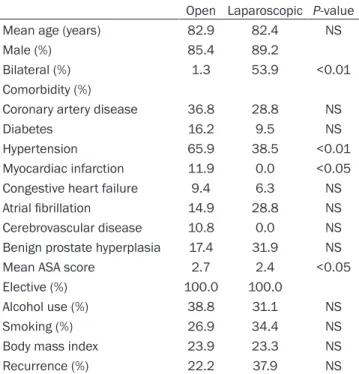
Table 1. Characteristics of patients
Open Laparoscopic P-value Mean age (years) 82.9 82.4 NS Male (%) 85.4 89.2
Bilateral (%) 1.3 53.9 <0.01 Comorbidity (%)
Coronary artery disease 36.8 28.8 NS Diabetes 16.2 9.5 NS Hypertension 65.9 38.5 <0.01 Myocardiac infarction 11.9 0.0 <0.05 Congestive heart failure 9.4 6.3 NS Atrial fibrillation 14.9 28.8 NS Cerebrovascular disease 10.8 0.0 NS Benign prostate hyperplasia 17.4 31.9 NS Mean ASA score 2.7 2.4 <0.05 Elective (%) 100.0 100.0
Alcohol use (%) 38.8 31.1 NS Smoking (%) 26.9 34.4 NS Body mass index 23.9 23.3 NS Recurrence (%) 22.2 37.9 NS
The diagnoses and repairs were confirmed by the operation records.
For each patient included in the study, gender, comorbidity, American Society of Anaesthesio- logists (ASA) score, the use of alcohol and smoking habits, the site of hernia and the body mass index (BMI) were recorded. The mean operation time, mean blood loss during opera-tion, intraoperative intravenous fluid infusion, type of anaesthesia employed and intrative urine output were reviewed from the opera-tive anaesthesia records. Complications and hospital stay time were taken to be clinical out-comes. Postoperative morbidity and mortality within 30 days were reviewed from the emer-gency clinic and outpatient department records. For continuous variables, an analysis of vari-ance was utilised, and for group variables, a chi square test was used for statistical analysis.
All patients that underwent the laparoscopic procedure and 33% of patients that underwent the open procedure received general anaesthe-sia. There was no statistically significant differ-ence in mean operation time between the two groups (72.1±13.3 minutes in the laparoscopic group versus 74.0±5.6 minutes in the laparo-scopic group, P=ns). The laparolaparo-scopic group received a significantly higher mean volume of intraoperative intravenous fluid infusions (lapa-roscopic group 1,150 ml versus 750 ml in the open group, P<0.01) (Table 2).
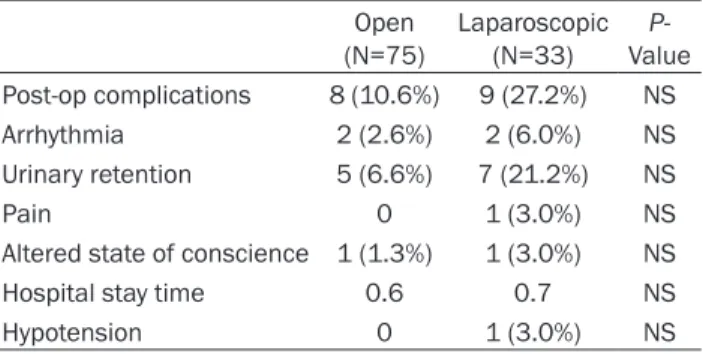
There was no difference in the unadjusted com-plication rates between the groups (10.6% in open group versus 27.2% in laparoscopic group, P=ns). The most frequently encountered complication was urinary retention, which occurred in 6.6% of the open group and 21.2% of the laparoscopic group. Other postoperative Table 2. Operative data
Open Laparoscopic value P-General anaesthesia (%) 33.1 100.0 <0.01 Mean operation time 72.1 77 .0 NS Estimated mean blood loss (ml) 19.9 20.7 NS Mean intravenous (ml) 750.3 1,150.5 <0.01
NS: No significant.
Multivariate linear regression models were used for mean hospital stay times, and logistic regression models were used for the complications. Both back-ward stepwise elimination and forback-ward stepwise inclusion methods were used to include variables into the final model. The Statistical Program for Social Sciences (SPSS) version 15.0 (SPSS, Chicago, Il) was used for data processing and analysis. All probability values were obtained from two-dimensional tests, and values less than 0.05 were recorded as statistically significant.
Results
One hundred and eight patients who underwent elective inguinal hernia repair were included in the study. Of these patients, 75 underwent open repair and 33 underwent laparoscopic repair. In the open and laparoscopic groups, the mean ages were 82 and 81, respectively, and the male patients constituted 85.4% and 89.2%, respectively (P=ns).
The overall comorbidities were similar in both groups (Table 1). In the open and laparoscopic groups, the mean ASA scores were 2.7±0.6 and 2.4±0.08, respectively. Fifty-six per cent of the lap-aroscopic procedures were bilateral.
Table 5. Multivariate linear regression for length of stay Beta P-value Bilateral 0.45 0.13 Open -0.02 0.91 ASA score 0.19 0.18 Benign prostatic hyperplasia -0.2 0.29 Intravenous fluids 0.17 0.13
ASA: American Society of Anesthesiologists.
complications included pain, arrhythmia, changes in the state of consciousness and hypotension (Table 3). There was no statisti-cally significant difference in the unadjusted hospital stay time between the two groups. After adjusting for patient risk factors, inde-pendent variables were tested for postopera-tive outcome relations. Surgical procedure, benign prostate hypertrophy, bilateral repair or other variables were not found to be related to prolonged hospital stay times (Tables 4 and 5). There was no mortality in either group.
Discussion
This study shows that laparoscopic inguinal hernia repair can be safely performed in the advanced age population. Langeveld and col-leagues proposed laparoscopic hernia repair for the general population based on their study of patients with a mean age of 55 years and
and reported no significant difference in gen-eral cost between open and laparoscopic pro-cedures [14].
The majority of the patients in the open repair group had past histories of myocardial infarc-tion and high ASA scores. Between the open and laparoscopic groups, there were no signifi-cant differences in ASA scores and the preva-lence of hypertension. There appeared to be a tendency to choose open surgery in cases with more risk factors. Yet, the above findings did not differ when variables were adjusted for risk factors.
There were no significant differences between the open and laparoscopic groups with respect to the incidence of complications. The most fre-quently encountered complication in the lapa-roscopic group was urinary retention. This find-ing enticed us to analyse in detail the factors that might be affecting this complication. Looking at the intraoperative data, there were significant differences between the two groups with respect to the mean volume of intraopera-tive intravenous fluid infused and the type of anaesthesia employed. In the laparoscopic group, there was a higher rate of urinary reten-tion. This finding may be due to the fact that all patients in this group underwent general anaesthesia, and higher volumes of intraopera-tive intravenous fluid were given. These factors were attributed to urinary retention [15-17]. Bilateral repair was predominantly more fre-quent in the laparoscopic group than in the open repair group. This difference was due to the approach preferred by the surgeon. This preference, in turn, also affected the number of patients receiving general anaesthesia. However, there was no significant difference between the two groups with respect to hospi-Table 3. Postoperative outcomes
Open (N=75) Laparoscopic (N=33) Value P-Post-op complications 8 (10.6%) 9 (27.2%) NS Arrhythmia 2 (2.6%) 2 (6.0%) NS Urinary retention 5 (6.6%) 7 (21.2%) NS Pain 0 1 (3.0%) NS
Altered state of conscience 1 (1.3%) 1 (3.0%) NS Hospital stay time 0.6 0.7 NS Hypotension 0 1 (3.0%) NS
Table 4. Multivariate logistic regression for complications
OR P-value
BPH 1.59 0.47
Open 1.54 0.59 Bilateral 2.77 0.22
OR: Odds ratio. BPH: Benign prostatic hypertrophy.
ASA score [12]. The study shows that the laparoscopic approach led to more favour-able results in terms of less postoperative pain and an earlier return to normal daily activities. A meta-analysis of randomised control studies performed by Schmedt and colleagues advocated the advantages of the laparoscopic approach versus Lichtenstein repair based on local compli-cations and pain-related parameters [13]. Eklund and colleagues performed a cost-reduction analysıs on 5 follow-up cases
tal stay times or complication rates. In our clin-ic, the general policy is that laparoscopic repair is advised for patients with bilateral hernias who desire swift healing. Feliu and colleagues also prosed laparoscopic repair for bilateral inguinal hernias and reported a shorter mean operation time, a shorter mean healing time and fewer complications with this approach [18]. Interestingly, we found no significant dif-ference in the mean operation time between the two groups in our study, which reflects as an advantage for the laparoscopic approach. According to the multivariate analysis, surgical approach, age, gender, hernia site (unilateral or bilateral), ASA score and mean volume of intra-operative intravenous fluid infused were found to have no significant effect on the mean hospi-tal stay time. Even subsequent to adjustment for comorbidities like benign prostate hypertro-phy and other intraoperative characteristics, there was no significant effect on the mean hospital stay time. These findings are consist-ent with those of Koch and colleagues, who did not find an increase in postoperative urinary retention rates, even in patients with benign prostate hyperplasia [15].
The major drawbacks of this study include its small sample size and uneven number of patients in the two groups. Moreover, the vast majority of bilateral repair cases were in the laparoscopic group. This reflects the fact that surgeons tend to stick to the conventional approach. In our study, there was no discrimi-nation with respect to the laparoscopic tech-nique chosen by the surgeon or the employ-ment of mesh. Surgical techniques were up to the surgeons. For this reason, there might have been a bias in the ASA scores and other charac-teristics of the patients. However, to minimise the effect of confounding factors on the two surgical techniques, we focused on the opera-tive techniques from the same institution. All postoperative outcomes were evaluated in a multivariate regression model before and after adjustment for patient risk factors.
There was no mortality, morbidity or significant complication in the elderly patients who under-went open or laparoscopic inguinal hernior-rhaphy. Our study advocates laparoscopic inguinal hernia repair as a safe alternative pro-cedure for patients over 75 years of age, regard-less of whether the case is bilateral. Results
from studies with larger samples and longer durations are still needed.
Acknowledgements
The authors express their gratitude and thanks to all participating patients and clinical staff. Disclosure of conflict of interest
None.
Address correspondence to: Fatih Ciftci, Vocational School of Health Services, Istanbul Gelisim University, Basaksehir Mah., Erciyes Sok. No: 15, Daire 24, Basaksehir, Avcılar, Istanbul 34306, Turkey. Tel: 90 505 616 4248; Fax: 90 212 462 7056; E-mail: [email protected]
References
[1] Rutkow IM, Robbins AW. Demographic, classifi-catory, and socioeconomic aspects of hernia repair in the United States. Surg Clin North Am 1993; 73: 413-426.
[2] Ramanan B, Maloley BJ, Fitzgibbons RJ Jr. Inguinal hernia: follow or repair? Adv Surg 2014; 48: 1-11.
[3] Turrentine FE, Wang H, Simpson VB, Jones RS. Surgical risk factors, morbidity, and mortality in elderly patients. J Am Coll Surg 2006; 203: 865-877.
[4] Kingsnorth A, LeBlanc K. Hernias: inguinal and incisional. Lancet 2003; 362: 1561-1571. [5] Kurzer M, Kark A, Hussain ST. Day-case
ingui-nal hernia repair in elderly: a surgical priority. Hernia 2009; 13: 131-136.
[6] Hernandez-Roza J, Lo CC, Choi JJ, Colon MJ, Boudourakis L, Telem DA. Laparoscopic versus open inguinal hernia repair in octogenarians. Hernia 2011; 15: 655-658.
[7] Purkayasta S, Chow A, Athanasiou T, Tekkis P, Darzi A. Inguinal hernia. BMJ Clin Evid 2008; 2008.
[8] Deeba S, Purkayastha S, Paraskevas P, Athana- siou T, Darzi A, Zacharakis E. Laparoscopic ap-proach to incarcerated and strangulated ingui-nal hernias. JSLS 2009; 13: 327-331.
[9] Woods B, Neumayer L. Open repair of inguinal: an-evidence-based review. Surg Clin North Am 2008; 88: 139-155.
[10] Watson SD, Saye W, Hollier PA. Combined lapa-roscopic incarcerated herniorrhaphy and small bowel resection. Surg Laparosc Endosc 1993; 3: 10-108.
[11] Velasco JM, Vallina VL, Esposito DJ, Theodore S. Laparoscopic herniorrhaphy in the geriatric population. Am Surg 1998; 64: 633-637. [12] Langeveld HR, van’t Riet M, Weidema WF,
Jeekel J. Total extraperitoneal inguinal hernia repair compared with Lichtenstein (the Level-trial): a randomized controlled trial. Ann Surg 2010; 251: 819-824.
[13] Schmedt CG, Sauerland S, Bittner R. Com- parison of endoscopic procedures vs Lichten- stein and other open mesh techniques for in-guinal hernia repair: a meta-analysis of rand-omized controlled trials. Surg Endosc 2005; 19: 188-199.
[14] Eklund A, Carlsson P, Rosenblad A, Montgo- mery A, Bergkvist L, Rudberg C; Swedish Multicentre Trial of Inguinal Hernia Repair by Laparoscopy (SMIL) study group. Long-term cost-minimization analysis comparing laparo-scopic with open (Lichtenstein) inguinal hernia repair. Br J Surg 2010; 97: 765-771.
[15] Koch CA, Grinberg GG, Farley DR. Incidence and risk factors for urinary retention after en-doscopic hernia repair. Am J Surg 2006; 191: 381-385.
[16] Jensen P, Mikkelsen T, Kehlet H. Postherniorr- haphy urinary retention-effect of local, region-al, and general anesthesia: a review. Reg Anesth Pain Med 2002; 27: 612-617.
[17] Aly O, Green A, Joy M, Wong CH, Al-Kandari A, Cheng S, Malik M. Is laparoscopic inguinal her-nia repair more effective than open repair? J Coll Physicians Surg Pak 2011; 21: 291-296. [18] Feliu X, Clavería R, Besora P, Camps J,
Fernández-Sallent E, Viñas X, Abad JM. Bilateral inguinal hernia repair: laparoscopic or open approach? Hernia 2011; 15: 15-8.