Ankara Üniversitesi Tıp Fakültesi Mecmuası 2008, 61(4)
DAHİLİ BİLİMLER / MEDICAL SCIENCES Olgu Sunumu / Case Report
Adult-Onset Subacute Sclerosing Panencephalitis With Biphasic
Course: Case Report
Erişkin Başlangıçlı Bifazik Seyirli Subakut Sklerozan Panensefalit: Olgu Sunumu
Canan Yücesan, Tuncay Çelik, Canan Togay Işıkay, Nermin Mutluer
Ankara Üniversitesi Tıp Fakültesi, Nöroloji Anabilim Dalı
210
Received: 18.02.2008 • Accepted: 25.12.2008 Corresponding author
Doç. Dr. Canan Yücesan
Ankara Üniversitesi Tıp Fakültesi, Nöroloji Anabilim Dalı Phone : +90 (312) 508 22 39
E-mail address : [email protected]
We report a 27 years old man who was admitted to our hospital with progressive dementia that had begun two years ago. In his past medical history, his family reported a transient period of frequent falling and drop attacks of the head without any change of conscious, started when he was at age 18 and continued over three years; then he had a symptom-free period between the ages of 21-25 years. He had neither myoclonus nor periodic sharp and slow-wave discharges on electroencephalography (EEG) during the second phase of the disease that we saw him at age 27. Cerebrospinal fl uid investigation disclosed high anti-measles IgG antibodies titer (1/640) and the patient was diagnosed with subacute sclerosing panencephalitis (SSPE). To our knowledge, this is the first case who had biphasic course without typical EEG findings of SSPE in the later phase of the disease.
Key Words: subacute sclerosing panencephalitis, electroencephalography
Biz 2 yıl önce başlayan ilerleyici demans tablosu ile hastanemize başvuran 27 yaşındaki bir erkek hastayı sunuyoruz. Hastanın ailesi, hastada 18 yaşında başlayıp 3 yıl devam eden, bilinç değişikliği olmaksızın yere düşme ve başta ani düşmeler şeklinde sık ataklar olduğunu, bu dönemi takiben 21-25 yaşları arasında hastanın tamamen normale döndüğünü bildirdi. Hastayı hastalığının ikinci fazında 27 yaşında iken gördüğümüzde, ne myoklonus ne de elektroensefalografisinde (EEG) pe-riyodik keskin ve yavaş dalga deşarjları vardı. Hastanın beyin omurilik sıvısı incelemesinde yüksek titrede anti-kızamık antikorları (1/640) varlığı saptandı ve hastaya subakut sklerozan panensefalit tanısı konuldu (SSPE). Bizim bildiğimiz kadarı ile bu, bifazik seyreden, hastalığın daha ileri evresin-de SSPE’nin tipik EEG bulguları olmayan ilk vaka bildirimidir.
Anahtar Kelimeler: subakut sklerozan panensefalit, elektroensefalografi
Subacute sclerosing panencephalitis (SSPE) is a persistent measles infec-tion of the central nervous system that causes progressive inflamma-tion and gliosis in brain leading to vegetative state followed by death. SSPE usually affects children and adolescents (1). Clinical features are characterized by progressive mental and motor deterioration, and myoclonus (2). Myoclonus can present as difficulty in gait, falling or dropping of the head. The electroencephalogram (EEG) usually reveals periodic complexes consisting of bilateral symmetric synchronous, high voltage bursts of delta waves (2). Brain magnet-ic resonance imaging (MRI) shows
diffuse involvement of subcortical white matter that is usually seen in the occipital region initially. Cere-brospinal fluid (CSF) examination is generally normal except for high protein and IgG levels. The diag-nosis is based on the raised titers of anti-measles antibodies in CSF (2). Although SSPE has usual clin-ical properties in the childhood, adult-onset SSPE is rare and may have atypical course (3-8).
Case History
A 27-year-old male was admitted to our hospital with progressive
de-Journal of Ankara University Faculty of Medicine 2008, 61(4)
211
Canan Yücesan, Tuncay Çelik, Canan Togay Işıkay, Nermin Mutluerdakul mentia, behavioral changes,
uri-nary incontinence and gait distur-bance that had begun two years ago. In his past medical history, his family reported a transient pe-riod of frequent falling and drop attacks of the head without any change of conscious that had start-ed at 18-year-old age and contin-ued over three years; because of the frequent falling attacks he had to quit his job and nursed by his parents. The family reported that although several combinations of antiepileptic agents had been tried for the falling attacks, it had not been seen any influence, and the falling attacks terminated spon-taneously at age 21. Then he re-turned to his job as a seller and even he joined the army as a sol-dier in that period. Moreover, his family described he had had mea-sles infection at age 2.
His physical examination was nor-mal. Neurological examination revealed disorientation to time, place and people, spasticity and hyperactive deep tendon reflexes in all extremities, bilateral Babin-ski sign, spastic and mildly ataxic gait. Myoclonic jerks or drop at-tacks were not present in neuro-logical examination. Mini-Mental State Examination score scale was 5/30. Neuro-psychological exami-nation demonstrated psychomo-tor slowing, blunted affect,
im-paired attention and concentra-tion, verbal perseverations, dysno-mia, dysgraphia, dyslexia, dyscal-culia, clothing and constructional apraxia, right-left confusion, geo-graphical disorientation and fin-ger agnosia..
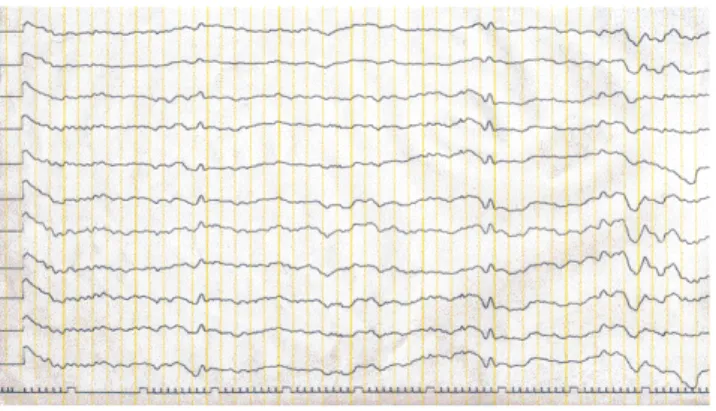
Routine blood chemistry studies re-vealed mildly increased levels of liver enzymes and serum lipids. Blood counts, sedimentation rate, thyroid function tests, and levels of serum B12 and folic acid were all normal. VDRL and anti-HIV an-tibodies were negative. Hepatobil-iary ultrasonography showed mild hepatosteatosis. Hepatolenticular degeneration was excluded based on the normal levels of serum ce-ruloplasmine, urine copper and absence of Kayser-Fleischer ring. Although routine EEG showed only bilateral mild diffuse slow wave activity (a background activ-ity of 7 Hz) without any periodic sharp and slow-wave discharges at admission (Figure 1), bilater-al periodic sharp and slow-wave discharges were seen on EEG per-formed when he was 20-year-old age (that was found in his past medical records) (figure 2). Brain MRI showed diffuse cerebral atro-phy and increased intensity in bi-lateral periventricular and subcor-tical white matter on T2 weighted images. Cerebrospinal fluid (CSF) examination showed high
pro-tein level (73 mg/dl) and IgG in-dex (1.13), and oligoclonal bands. Furthermore, anti-measles IgG an-tibodies titer was high (1/640) in CSF. The patient was diagnosed with SSPE based on the clinical and laboratory findings, and treat-ed with interferon beta 1a 44mcg subcutaneous injections three times in a week and oral inosiplex 100mg/kg/day but did not seen any clinical response over three months.
Discussion
We thought the first signs of SSPE in our patient had begun at 18 years old age based on his past medical history and EEG findings at age 20, and he had spontaneous remission at age 21. Then he had a symp-tom-free period between the ages of 21-25 years. It has been known that spontaneous remission is pos-sible in childhood-onset SSPE cas-es, however, it is rare in adult-on-set SSPE cases. Although around 100 cases of adult onset SSPE cases have been published to date, only a few of them have been reported having spontaneous remission in the disease course (3,5,7,8). In SSPE cases, memory loss and
per-sonality changes usually occur with myoclonus and focal
neuro-Figure 1. Electroencephalogram showing bilateral diffuse slow
wave activity without any periodic sharp and slow-wave discharges at admission in the second phase of the disease.
Figure 2. Electroencephalogram showing bilateral periodic sharp
Ankara Üniversitesi Tıp Fakültesi Mecmuası 2008, 61(4)
212 Adult-Onset Subacute Sclerosing Panencephalitis With Biphasic Course: Case Report
logical deficits. Our patient’s past medical history revealed myoclo-nic jerks in the first phase of the disease, however he had not myo-clonus although he had memory loss and personality changes dur-ing the second phase of the dis-ease that we saw him. It has been known that EEG may be normal or show only moderate non-spe-cific generalized slowing in the early phase of the disease (2, 4). Even though our case had had
typ-ical bilateral periodic sharp and slow-wave discharges on EEG that was performed at age 20, in the first phase of the disease, his EEG showed no typical periodic sharp and slow-wave discharges in spite of progressive deterioration of the clinical picture in the second phase of the disease that we saw him. To our knowledge, this is the first case who had biphasic course without typical EEG findings of SSPE in the later stage of the
dis-ease. Based on the case, we sug-gest that SSPE should be suspect-ed in the cases with early-onset progressive dementia even they do not have myoclonic jerks in the neurological examination and typ-ical periodic sharp and slow-wave discharges in EEG, and CSF exami-nation should be done in that kind of patients.
REFERENCES
1. Onal AE, Gürses C, Direşkeneli GS, Yılmaz G, Demirbilek V, Yentur SP, Özel S, Yapıcı Z, Tümerdem Y, Gökyi-ğit A. Subacute sclerosing panencep-halitis surveillance study in İstanbul. Brain Dev. 2006;28:183-189
2. Garg RK. Subacute sclerosing pa-nencephalitis. Postgrad Med J 2002;78:63-70.
3. Singer C, Lang AE, Suchowersky O. Adult-onset subacute sclerosing panencephalitis: case reports and review of the literature. Movement
Disorders 1997; 12:342-353. 4. Frings M, Blaeser I, Kastrup O.
Adult-onset subacute sclerosing panen-cephalitis presenting as a degene-rative dementia syndrome. J Neurol 2002;249: 942-943.
5. Callebaut DP, Cras P, Martın JJ. Pro-longed and atypical course in some cases of subacute sclerosing pa-nencephalitis. Acta Neurol Belg 1997;97:39-44.
6. Prashanth LK, Taly AB, Ravi V, Sinha S, Arunodaya GR. Adult onset su-bacute sclerosing panencephalitis:
clinical profile of 39 patients from a tertiary care centre. J Neurol Neuro-surg Psychiatry 2006;77:630-633. 7. Ortega-Aznar A, Romero-Vidal FJ,
Castellví J, Ferrer JM, Codina A. Adult-onset subacute sclerosing pa-nencephalitis: clinico-pathological findings in 2 new cases. Clin Neuro-pathol 2003; 22(3):110-118.
8. Santoshkumar B, Radhakrishnan . Substantial spontaneous long-term remission in subacute sclerosing pa-nencephalitis (SSPE). J Neurol Sci 1998;154: 83-88.