Veterinary Faculty, Department of Animal HıısbaTtdıy University of Ankara
Prof. Dr. Emin Antiirk
PREDICTION OF LIVE-WEIGHT FROM CHEST GffiTH
IN FRIESIAN BEEF CATTLE* Rafet Arpacık* *
Holştayn Sığırlannda Göğüs Çevre Ölçüsünden Canlı Ağırlığın Tahrnini
Özet: Göğüs çevre ölçüsünden canlı ağırlı tahmin edebilme imkanını araştırmak için 27 adet Holştayn sığırı bu araştırmada materyalolarak kullanılmıştır. Analizler beş canlı ağırlık periyodunde; 90-173, 173-257, 257-318, 318-379 ve 379-440 kg yapılmıştır. Göğüs çevre ölçüsü ile ean!ı ağırlık arasında yüksek bir korelasyon bulunmuştur. Canlı ağırlığı tah-min etmek için, birinci canlı ağırlık periyodunda (9°-i73 kg) erkek. kastre edilmiş erkek ve dişi sığırlar için müşterek bir regresyon qitliği, ı 73-440 kg arasındaki canlı ağırlık peri-yodlarında ise farklı cinsiyetler için değişik regresyon eşitlikleri kullanmanın uygun olacağı hesap edilmiştir.
Surnrnary: Twenty-seven Friesian catlle, including three sexes, were used to investi-gate passibility of estimating live-weights from chest girth measıırement. The relationsı,ip between live-weight and chest girth measurement was investigated in each of the five-weight periods (9°-173,173-257.257-318,318-379 and 379-440 kg). Chest girth measurement was highly corrclated with live-weighı. For the period 90-173 kg a pooled regression equation (all sexes) satisfactorily represented in the relationship between chest girth and live-weight. For the periods i73-440 kg it was necessary to use separate regressian ",)uations to descriribe the relationship between chest girth and live-weiglıı.
Introduction
The objective of this investigation was to devise regression equ-ations to en abI e live-weight to be predicted from chest girtlı measure-menL This information is already in existence for adult cattle, from the pioncering work of Brody (5). but there is less information
availah-* This research is carried out at the Cniversity of Reading, England
"'* Associate Professor at the Department of Anİmal Husbandry, Veterinary Fa-culty, University of Ankara, Turkey.
530 n"Cct Arpacık
le, perticularly for rapidly growing cattle of different sexes. The usc-fullness of such regressıon equations ıs not stressed ın view of the high eost of purchasing \vcighbridges. Suelı information would be useful when the weighing facilities of catde are not available.
Studies into the relationship betwcen live-weight and chest girth are summarised ın table i.
TabIc ı. Relationslıip Hetween Li\'e-weiglıt (kg) and Chesı Girdı (cm) ın Cattle.
Bre(.d Loeal brecd,!
Sex and Age Fermale 1-12 week, 13-24 week, Mea n
"0.
of Livc Aniınal, Weight 35 i[ 0.9° 0.9' b \ ----._--- _. --- ---- -- - - -- -"- -,,--- ---Hungarian Hrown' Dairy Slıorthorıı' Cows 4/% years ]\Iale and Cema!e ca h'es, 24 hours ancr birtlı 45[ i4 3i 0.7° ___________ •__ • • o .~_ •• _4 __ Friesian' Harİana'Bulls, cows and heifers "'Iixed, -4i4 153 495 0.95 i.58 --- __ o •__ • __ --- ••----
._--'--.lersey' Cows: pregnant old young 36 --i --ii 6[ - - 6.i - - 5.5 _. - 4.4 -- ---- --- ._- - ---_.---- .--- - --- --- ._._-"orvegian Red PoW Bulls, 633 0.92 8.83 _. -_._--_.._.. -_.
__
..-- ---_._- .._-- .._--_.. Aberdeen Angus!" Castrates,[ year 32 39 29 0.32 0.60 0.8i ----._- ". -" - -- -...-- -- -- - --- -- --Hen:fordll Cas t ra t(.s, i year [4 [:, [LJ 0-56 0.57 o.io
The experiments cited show a wide range of breed, age and live-weight. Most invcstigators quated correlation eoeffieients only. The b value of the rcgression equation was given in only 4 of the 9 referen-ees and none of these gave standart errors of the estimation.
Corrclatİon coefficients were high ın calves (I, 3) (90-9i and 0.83)' Carrelatıon eoefficıents \\ClT alsa hıgh ın adult cattk (2,6,9) (0.70, 0.95 and 0.92). In tlıe another data corre1ation coefficients ran-ged from 0.32 to 0.87. According to these results, lighter anİmals ap-peared to give a higlıer corrclation than Iıeavier types (I ı).
Prediction Of Live-Weight From Che st Girtlı ... 531
The pioneering work on estimating live-weight from body mea-surements in cattle was done by Brody and his associates (4). Their investigation involved four breeds: Holstein,
J
ersey, Guernsey and Ayrshire, and data was obtained from Ij, 6ıo animals of widelydif-ferent live-wcights and ages. Chest girth was found to be the measure-ment most closely rclated to live-weight.
The extent to which the relatianship between live-weight and chest girth mcasurement is changed by weight ad age of animals is not docu-mented, as mentioned earlier. The effect of sex during growth upon re-lationship at different live-weights appears to be unknown as judged by the lack ofpublished information. The investigation to be described in this paper was conducted to yield information on these points.
Material and Method
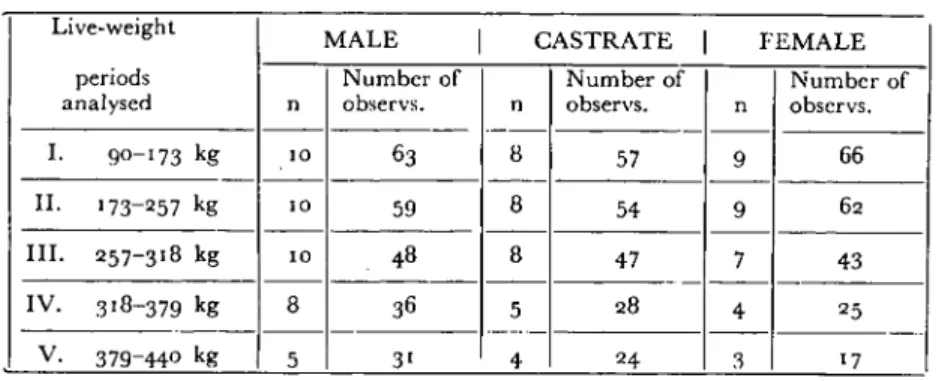
Twenty-seven Friesian cattle, including three sexes, were used in this study. The plan of the experiment from which data for the present study was collected is shown in table 2.
Table 2. Live-weight Periods, Number of Anİmals and Observations Per Period. Live-weight
MALE i CASTRATE i FEMALE
period s Number of Number of Number of
analysed n observs. n observs. n observs. --i. 90-173 kg Lo 63 B 57 9 66 II. 173-257kg ıo 59 8 54 9 62 III. 257-318 kg ıo 48 8 47 7 43 -"- --IV. 318-379 kg 8 36 5 28 4 25 "-- -- ---.. V. 379-440 kg 5 31 4 24 3 17
The weighing of animals was carried out every two weeks at 08.
00h. or as near as possible to that time. Using ahalter, each animal was
taken to the weighbridge (Avery platform scale, weighing to nearest ı
/2
kg). Animals were identified by metal cal' tags.Chest girth measurements (the circumference immediately behind the shoulder blades in apıane perpendicular to the body axis - the smaIlest circumferencc) were taken at fortnightly intervals starting at the beginning of go kg live-weight. Chest girth measurements were taken with a tape measure graduated in mm. In the case of measure-men ts a pocket spring balance was attached on the end of the tape,
532 Rafet Arpacık
tightened to tensions i kg, 1.5 kg. and 2 kg. The measurements using
three different tensions, were repeated four times and observatİons were recorded to the nearest i mm. The mean of these observations
at a given tension was taken as the measurement for that occasion. The animals were measured on level concrete ground, care being . taken to get them standing sq:.rarely on alı four feet, in anatural posi-tion. Measurements were always taken on the right hand side of the animaL. During measuring, animals were tİghtened tO.d gate. As desc-ribed earlier, weighing was carried out at 08.00 h. and measuring
pro-eeeded during the rest of that day.
All animals were fed with a High Plane diet and given on Ad. li-bitum basis. This diet was an all concentrate "barley beef" systEm (In-tensive Cereal Beef, as defined by U. K. Meat and Live-stock Commis-sion).
Results
The relationship between live-weight and chest girth measure-ment was investigated in each of the five live-weİght periods (c. f. tab-le 2) İn an attempt to establish the usefulness of the measurements as methods of predieting live-weight. In the regression equation eompu-ted, live-weight was taken as the dependent variable and chest girth measurement as independent variable.
Girth of chest was measured using different tensions of measu-ring, but the regression equation presented for this measurement in-volve only i kg of tension of tape. Because, this tension yielded
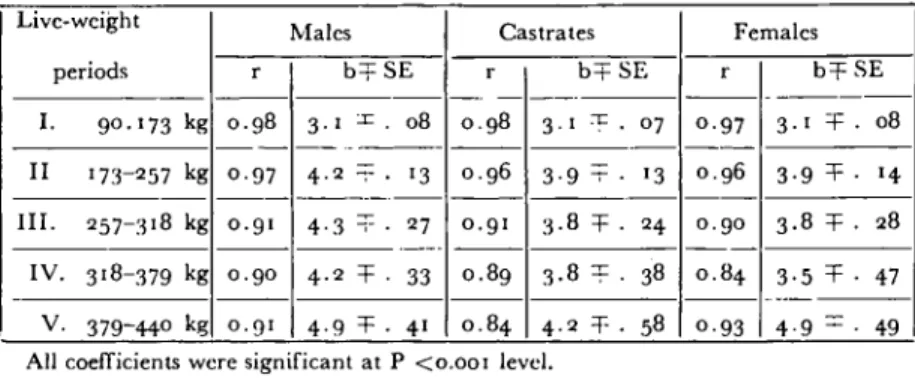
equ-ations with the lowest standard error of the regression coefficient (b). Corrclation and regression coefficients are presented in table 3.
Table 3. Correlation (r) and Rcgrcssion (b) CoelTicients at Five Live-weight Periods. Live-weight
Males Castrates Females
periods r b-t- SE r b-t- SE r b'fSE _. - -_. ---ı. gO.173 kg 0.g8 3.i :ı:: 08 0.g8 3.i cı: 07 0.97 3. i 'f. 08 - -_._~--- --II 173-257 kg 0.97 4.2 :;: . 13 0.g6 3.9 :;: . 13 0.g6 3.9 'f. 14 --
----_.--III. 257-318 kg o.gı 4.3 ::;: . 27 o.gı 3.8 'f. 24 o.go 3.8 'f. 28
----IV. 318-379 kg o.go 4.2 'f. 33 0.8g 3.8 ::;: . 38 0.84 3.5 'f. 47 .. _--V. 379-440 kg 0.91 4.9 'f. 41 0.84 4.2 1- . 58 0.93 4.9 ::: . 49 All coeITicients wc re significant at P<0.001 levcl.
Predietion Of Li,.e.Weight From Chest Girth ..• 533
In colsulting tabı e 3 it is notable that live-weight was significantly related to chest girth measurements throughout the experimental pe-riod (90-440 kg). Casua! observation of the regression coefficients in-dicates a similarity for the different sexes within a given live-weight period. Therefore, the possibility of pooling the regression equation was examined. The va!idity of using one pooled equation for each pe-riod was estab!ished by comparing the residua! sum of squares for the pooled data with the sum of the residuals for sexes, using the method of Snedecor (I o). The failure of the F value to be significant indicates that for the live-weight period 90-i73 kg one regression equation wou!d
satisfactorily represent the relationship bctween live-weight and chest girtlı, thus eliminating the need to considcr the relationship for the sexes separately.
This exercise was repated for the relationship between live-weight and chest girth in each of the live-weight periods 2-5, but in each case the F ratio was highly significant, indicating that a pooled regression equation was unsatisfactory.
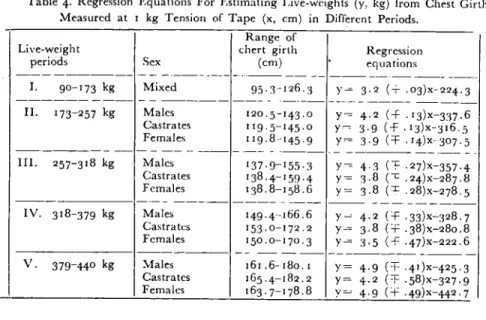
Table 4, therefore, shows a pookd regression equation for period one; but for periods 2-5 equations for the individua! sexes are presen-ted.
Table 4. Regression Equations For Estimating I.ive-weights (y, kg) from Chest Girth Measured at , kg Tensian of Tape (x, cm) in Different Periods.
Range of
Live-weight chert girth Regression
periods Sex (cm) e'luations
. --,-- --- .--- _._-- -_._- _.."._--- -'---- --_.- ---- ----i. 90-'73 kg Mixed 95. ::ı-126. 3 y~ 3.2 (-i- .03)X-224.3 --- --- ---- "---- --_.0-' _ .___ ._ ---II. '73-257 kg Males 120.5-'43.0 y~ 4.2 (-f .13)x-3:n.6 Castrates 119.5-'45.0 y~ 3.9 (-f .13)x-316.5 Females , 19.8--145.9 y= 3.9 (=ı= . '4)X-307.5 -_._--- --- --- -.--- - --- -- --- --- -. ıri. 257-318 kg Males 137.9-155.3 y~ 4.::ı (~ .27)x-357.4 Castrates '38.4-15').4 y= ::ı.8 (-.:.24)X-287.8 Females '38.8-158.6 y7~::ı.8 (CI.28)x-278.5
--- --_.- ---- ...---- -- --_._---ıv. 318-379 kg Males '49.4--166.6 Y~ 4.2 ('f.3::ı)X-328.7 Castrates '53.0-172.2 y-~ 3.8 (T . 38)x-280. 8 Females '5° .0-17°.3 y~ :~.5 (-f .47)x-222.6 _. ---- ---"-- _._-v. 379-44° kg :\fales 16, .6-180. i y= 4.9 (:ı:.4ı)x-425.3 Castrates 165.4-182.2 y= 4.2 (:ı:.58)x-327.9 Females ,63.7-178.8 y= 4.9 ('-f .49)x-442.7 Discussion
Cakulation of correlation and regression coefficients and their standard errors showed that chest girdı was the most reliable for use in
534 Hafet Arpacık
predicting live-weights of animals and this is in agreement with the literature findings (I, 2, 3, 6, 7, 8, 9, iı).
The present investigation also showed that the residual variance was lower when using a measuring tap e tension of i kg rather than 1.5
and 2 kg. There is no publıshed data showing which tenslOn is
prefe-rable. Besides giying the highest correlation with live-weight the chest girth is the simplest measurement to record.
The fact that the data for the sexes could not be pooled for ani-mals in excess of i73 kg means that separate equations would need to
be used for different sexes after this live-weight.
Assuming that chest girth measurement be used to estimate live-weight, the question that needs to be asked before the practical appli-cation İs appreciated is with what confidence could one predict live-weight using the regression equations computed?
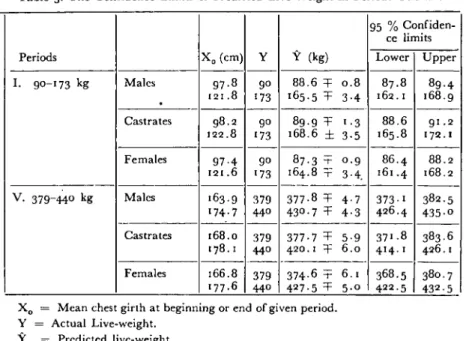
Table 5 shows the confidence limits (ıo) oflive-weight predicted in periods one and five from mean chest girth values at the beginning and end of the live-weight periods.
Table 5. The Confidenee Limits of Predicted Live-Weight in Periods One and Five.
95 % Confiden-cc limits
Periods Xo (em) Y Y (kg) Lowcr Upper
--- ---i. 90-173 kg Males 97.8 9° 88.6 'f 0.8 87.8 89.4 121.8 173 165.5 'f 3.4 162.i 168.9
.
--- ---Castrates 98.2 9° 89.9 'f 1.3 88.6 91.2 122.8 173 168.6 ::i: 3.5 165.8 172.1 ---Females 97.4 9° 87.3 ::;:0.9 86.4 88.2 121.6 173 164.8 ::;:3.4. 161.4 168.2 --- --- -- --- --- ---v. 379-440 kg Males 163.9 379 377.8 'f 4.7 373.i 382.5 174.7 44° 430.7 'f 4.3 426.4 435.0 --- --- --- ---Castrates 168.0 379 377.7 'f 5.9 371.8 383.6 178.i 44° 420.i 'f 6.0 414.i 426.1 ---- ---- ---Females 166.8 379 374.6 ::;:6.i 368.5 380.7 177.6 44° 427.5 'f 5.0 422.5 432.5Xo = Mcan chest girth at beginning or end of given period. Y = Actual Live-weight.
Y = Predicted live-weight.
Table 5 shows that the live-weight in perİods one and five would be estimated with accuracy such that 95
%
of the predicted weight would be within at least 5%
of the true value.Predietion Of Live-Weight From Chest Girtlı ..• 535
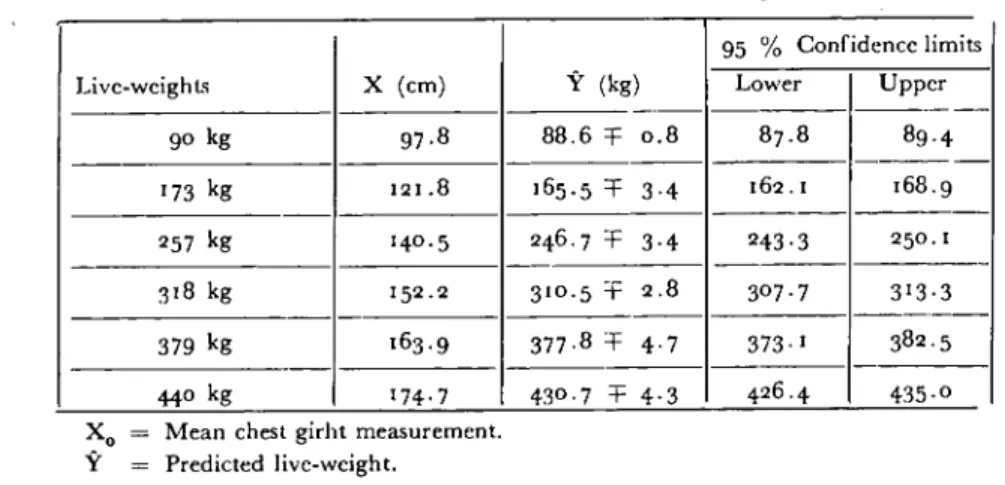
The same picture is shown in tablc 6 for the eonfidenee limits for males at six sueeessive live-weights.
Table 6. The Conridence Limits of Predicted Live-weight of Males 95 % Confidence limits
Live-weighL~ X (cm) Y (kg) Lower Upper
---- --- ---90 kg 97.8 88.6 :ı= 0.8 87.8 89.4 -173 kg 121.8 165.5 :ı= 3.4 162.i 168.9 257 kg 14°.5 246.7 'f 3.4 243.3 250. i 318 kg 152.2 310.5 :ı= 2.8 3°7.7 313.3 ---379 kg 163.9 377.8 :ı= 4.7 373. i 382.5 440 kg 174.7 43°.7 :ı= 4.3 426.4 435.0
Xo Mean chesl girht measurement.
Y Predicted Iive-weight.
There is no data in the literature showing eonfidenee limits of live-weights estimated from ehest girth. it is, therefore, impossible to make any comparison between the present results and published lite-rature.
Acknowledgeınents
i am grcatly indebted to Dr. E. Owen for his valuable adviee, eonstant eneouragement and interest shown throughout the duration of the experiment.
i am also grateful to Professor
J.
C. Bowman for providing exeel-lent faeilities at Oldhouse Farm.For advice with statisties, i wish to thank Mr. R. Mead.
My thanks are due to the staff of the Oldhouse Farm for their as-sistanee with the weighing and measuring of the animals.
References
1- Bhosraker, M. and Daniel, S.
J.
(1965): Estimation of body weights in calves from body measurements. IndianJ.
Dairy Sei., 18,144-148.
2- Bozo, S. (1967): The relation between height at withers, heart girth and body weight for Hungarian Brown Dairy Cows. Allattenyesztes.,
536 Rafct Arpacık
3- Braude, R. and Walker, D. M. (1949): Mortality, weight and body measurements al birtız of Dairy Shorthorn Calves. J. Agrie. Sei., 39, 156-163.
4- Brody, S., Davis, H. P. and Ragsdale, A. C. (1937): Growth and development wıth special reference to domestic animals. XL!. Relation between live-weight and chest girth in daiT.-Ycaltle unknown age. Res. Bul!. Mo. Agric. Exp. Stq., No. 262, 24 pp.
5- Brody, S. (1964): Bionergetics and Growth. New York, Reinhold pubI. Co., 502-507.
6- Hansson, A. (I 926): Dif.ferent methods of determining the live we-ıght ol caltle. Sverig. Aıım. Jordbr. Tidskry, April 1926, 257-263., 275-280 (Abi m Breed. Abstr., 22, 1954) (Quoted by Johannson and Hildeman, 1954).
7- Mullick, D. N. (I 950): Tge estimation of the weight of cattle and buJJalofrom heart girth measurement. IndianJ. Dairy Sei., 3, 52-58. 8- Ostergaard, P. S. (I 950): !nvestigalion into the weight, body
mea-suremenls andyield of Jers~y Cows. Beretn. Forsogslab (kbh): 47 pp. (Anİm. Breed. Abstr., ıg, i\o. 595)'
9- Slagzvold, P. (1949): Calculation of live-weight from chest girth in Norvegian Red Polled Bulls. Nord. Vet. Med., i, 564-569' (Anİm.
Brecd. Abstr., 18, No. 928).
10- Snedecor, G. W. (I 956): Statistıcal methods applied to experimenls in agriculture and biolog)'. The Iowa Statc Coııege Press, Ames. Iowa 11- Wanderstock,