THE RELATIONSHIP OF THE ETHICAL LEADERSHIP AMONG THE ORGANIZATIONAL TRUST, AFFECTIVE COMMITMENT AND JOB SATISFACTION: CASE STUDY OF A UNIVERSITY
Cem GÜÇEL
Turkish Armed Forces Ph.D.
İsmail TOKMAK
Ministry of National Defence Ph.D. [email protected] Hakan TURGUT Başkent University Asst. Prof. Dr. [email protected] Abstract
The aim of this study is to examine the relations of ethical leadership among the organizational trust, affective commitment and job satisfaction. For this aim, firstly, the ethical leadership, secondly organizational trust, thirdly affective commitment and, finally, the job satisfaction are explained. In the application part, a questionnaire including the measures of the ethical leadership, organizational trust, affective commitment and job satisfaction is distributed to employees of one of the leading private universities in Turkey and the data were assessed by
statistical analysis methods. Finally, it is found that there is a positive relationship among ethical leadership, organizational trust, affective commitment and the job satisfaction.
Key Words: Ethical leadership 1, organizational trust 2, affective commitment 3, job satisfaction 4 .
Jel Code : M20
The organizational behavior research has main objectives to understand the role of ethical leadership, organizational trust, affective commitment and job satisfaction of individual, group, and organization (Robbins, 2005:24). So, trust is one of the key success relationships factors in workplace; trust in organization has received considerable attention from both academicians and practitioners. Several studies in organizational behavior filed with social exchange perspective have an
attention in trust (Konovsky & Pugh, 1994:656), commitment and job satisfaction (Kim et al., 2005:171, Pillai et al., 1999:897, Rodriguez et all., 2008:118). Also job satisfaction can be considered as one of the main factors when it comes to efficiancy and effectiveness of business organizations.
2. THEORETICAL FRAMEWORK
2.1. Ethical leadership: Brown and Trevino (2006:597) characterize ethical leaders as “honest, caring, and principled individuals who make fair and balanced decisions.” Ethical leaders develop their followers by modeling behavior [they] “frequently communicate with their followers about ethics, set clear ethical standards and use rewards and punishments to see that those standards are
followed”. Importantly, “ethical leaders do not just talk a good game-they practice what they preach and are proactive role models for ethical conduct” (Lora et all, 2011:415).
2.2. Organizational trust: Organizational trust is defined here as a positive attitude held by an organization’s member towards another member that the other party will act by fair-play rules and will not take an advantage of one’s
vulnerability and dependence in a risky situation (Brenkert,1998:293). The attitudinal understanding of trust allows to perceive trust as a combination of cognitive and affective (emotional) components.
2.3. Affective commitment: According to Allen and Meyer (1991:61,1996:189, Iverson & Buttigieg,1999:307), employees with affective commitment are less likely to quit their job and present lower level of absenteeism, when contrasted, for example, to those with continuance commitment. In other words, there is evidence that the desire of individuals to contribute to organizational goals is influenced by the nature of the psychological ties that bind them to the organization.
2.4. Job Satisfaction: Locke (1969:309) defines satisfaction as an emotionally feeling (Smith et. al.,1969:37) joy to job assessment or goal achievement. Job satisfaction is the employees’ level of feeling positive in their organization.
Mottaz (1988:467) regarded job satisfaction as an affective response resulting from an 46 evaluations of the work situation. It is widely accepted that job satisfaction is a function of work-related rewards and values (Vroom, 1964:99, Kalleberg, 1977:18).
The research model designed is seen in Fig 1. Figure 1: Research Model
The hypotheses to be tested are listed below:
H1 : EL affects AC positively and significantly,
H2: EL affects JS positively and significantly,
H3: EL affects OT positively and significantly,
H4: AC affects JS positively and significantly,
H5: OT affects JS positively and significantly,
H6: : Upon the relationship between EL and JS, AC has a positive and significant intermediary effect,
H7: : Upon the relationship between EL and JS, OT has a positive and significant intermediary effect.
3. METHOD 3.1. Sampling
The samples of the study were 178 administrative and faculty staff at a university in İstanbul. The online questionnaire designed for data collection was sent to 178 participants via e-mail and 52 participants responded by filling it out. A brief look at the demographic figures of the participants reveals that 54% (N=28) of the respondents were female and 46% (N=24) were male. It was observed that 25% (N=13) were either 40 years old or younger, 42% (N=22) were between 40-50 age
H1
H2
H3
Ethical Leadership Job Satisfaction
0rganizational Trust
Affective Commitment H4
range, 33% (N=17) were 51 years old and above, the educational stuations were examined; 6% (N=3) had graduate degrees; 35% (N=18) had MA/MS and 60% (N=31) had Ph.D. degrees. A survey of academic status of the respondents shows that 94% were faculty staff [N=49 (5 Prof., 6 Assoc.Prof., 8 Assist.Prof., 30 Lecturers)], and over 6% (N=3) were administrative staff.
3.2. Research Scale
3.2.1. The Ethical Leadership Scale (ELS): It was created by Brown et all (2005), was developed by the Danube et al. (2012) and was designed to measure the EL perceived by those who were accustomed and translated to Turkish by Tuna et all (2012). This scale consists of 10 phrases. The 5 Likert-type scale used in the study consisted of options ranging from “I do not agree at all=1” to “I certainly agree=5”.
3.2.2. Organizational Trust Scale (OTS): This scale was designed to measure the OT perceived by workers and, was developed by Bromiley and Cummings (1996). It is used short phase which was consist of 12 phrases. It was used and translated to Turkish by İpekçi (2006). This scale consists of 12 phrases. The 7 Likert-type scale used in the study consisted of options ranging from “I do not agree at all=1” to “I certainly agree=7”.
3.2.3. Job Satisfaction Scale (JSS): Minnesota JSS was used to measure to JS of workers. The scale, which was developed by Weiss et all (1967) and were
accustomed and translated to Turkish by Baycan (1985). This scale which was consists of 20 phrases (12 phrases “intrinsic JS” and 8 phrases “extrinsic JS”). The 5 Likert-type scale used in the study consisted of options ranging from “strongly disagree=1” to “strongly agree=5”.
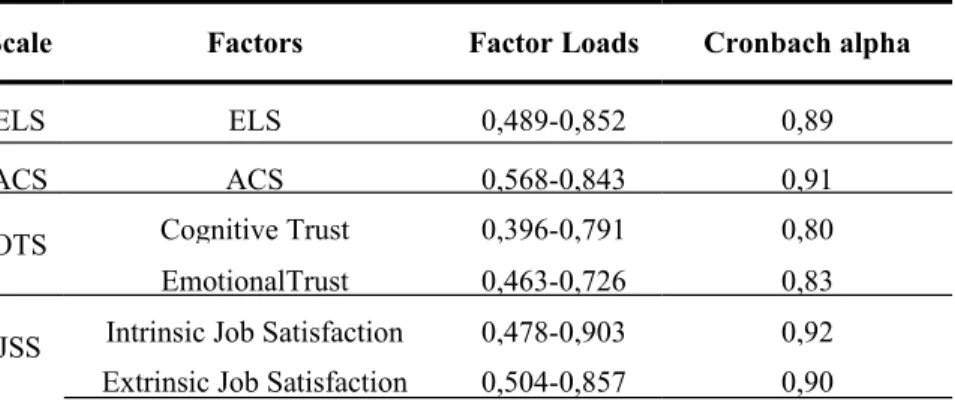
3.2.4. Affective Commitment Scale (ACS): This scale was designed to measure the AC perceived by workers and, was developed by Allen ve Meyer (1990). It was used the part of “AC” of the “OCS” translated to Turkish by Wasti (1999). This scale consists of 9 phrases. The 5 Likert-type scale used in the study consisted of options ranging from “strongly disagree=1” to “strongly agree=5”. The scales of structure in order to determine the validity of the exploratory factor analysis was made, reliability determine the purpose of the cronbach's alpha values were measured. The factor analysis placed ELS and ACS under one factor while it placed OTS under two separate factors: emotional trust and cognitive trust, and finally the last placed JSS under two separate factors: intrinsic and
extrinsic job satisfaction. All of the scales of the factor analysis of obtained by the factor distribution of the original scales were acceptable.
In this study, the intermediary effect of OT and AC upon the relationship between EL and JS has been observed; therefore, the mean of the scores attained from factor analysis was calculated in order to make a general assessment of the relevant concepts. Thus, EL, JS, AC and OT values were obtained for each participant and used in the cause-effect relationship analyses in the following section of the study.
Table.1 Factors Obtained and Factor Loads
Scale Factors Factor Loads Cronbach alpha
ELS ELS 0,489-0,852 0,89
ACS ACS 0,568-0,843 0,91
OTS Cognitive Trust 0,396-0,791 0,80 EmotionalTrust 0,463-0,726 0,83 JSS Intrinsic Job Satisfaction 0,478-0,903 0,92 Extrinsic Job Satisfaction 0,504-0,857 0,90 4. FINDINGS AND HYPOTHESIS TESTS
As seen in Table 2, the findings from regression analyses conducted to test the first three hypotheses prove these hypotheses statistically.
Table 2: Summary of Regression Analyses Independent Variable Dependent Variable Β t R R2 Adj. R2 F p Hyp. Result EL AC 0,137 1,500** 0,208 0,043 0,024 2,251 0,140 H 1 Reject EL JS 0,734 4,662** 0,550 0,303 0,289 21,723 0,000 H 2 Yes EL OT 0,611 2,673** 0,354 0,125 0,107 7,142 0,010 H 3 Yes AC JS 0,742 2,627** 0,348 0,121 0,104 6,901 0,011 H 4 Yes OT JS 0,568 7,692** 0,736 0,542 0,533 59,171 0,000 H 5 Yes * p<0,05, ** p<0,01
A three-step regression analysis suggested by Baron and Kenny (1986) was used to test the intermediary effect AC and OT between EL and JS relationships. According to this method, to be able mention an intermediary effect, the following conditions are expected to be seen:
(1)Independent variable (EL) must have an effect on dependent variable (JS), (2)Independent variable (EL) must have an effect on intermediary variable (AC)/ (OT), (3)Intermediary variable (AC)/(OT) must have an effect on dependent variable (JS), (4)When intermediary variable (AC)/(OT) is involved in a
regression analysis with independent variable (EL), intermediary variable (AC)/ (OT) must have an effect on dependent variable (JS) as the regression coefficient of independent variable (EL) upon dependent variable (JS) drops.
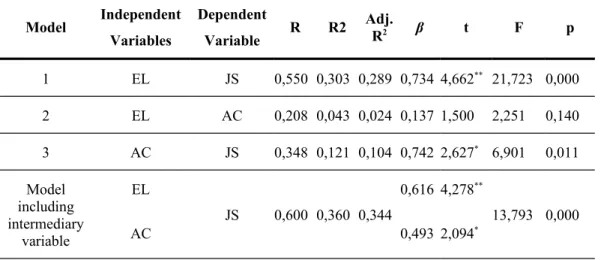
The independent variable coefficient of decline was part of the mediation, this relationship completely, the disappearance of an expression with a statistically significant avoid the situation is exactly the mediating relationship is expressed. The mediating effect of AC of testing for the purpose of regression analysis the results in Table 3 are given. It is observed that the mediating effect of the regarding of the Baron and Kenny (1986) by the requirements set out in the first occur. H6 hypothesis was rejected. In response, the regression analyses EL and AC are independent of each other which are seen on JS the positive and
significant effects.
Table 3: Hierarchical Regression Analysis Results
Model Independent Variables Dependent Variable R R2 Adj. R2 β t F p 1 EL JS 0,550 0,303 0,289 0,734 4,662** 21,723 0,000 2 EL AC 0,208 0,043 0,024 0,137 1,500** 2,251 0,140 3 AC JS 0,348 0,121 0,104 0,742 2,627** 6,901 0,011 Model including intermediary variable EL JS 0,600 0,360 0,344 0,616 4,278** 13,793 0,000 AC 0,493 2,094** * p<0,05, ** p<0,01
The mediating effect of OT of testing for the purpose of regression analysis the results are given in Table 4.
Table 4: Hierarchical Regression Analysis Results
Model Independent Variables Dependent Variable R R2 Adj. R2 β t F p 1 EL JS 0,550 0,303 0,289 0,734 4,662** 21,723 0,000 2 EL OT 0,354 0,125 0,107 0,611 2,673** 7,142 0,010 3 OT JS 0,736 0,542 0,533 0,568 7,692** 59,171 0,000 Model including intermediary variable EL JS 0,799 0,638 0,623 0,442 3,610** 43,220 0,000 OT 0,477 6,738** * p<0,05, ** p<0,01
The mediating effect of regarding the Baron and Kenny (1986) by the
requirements set out in the first three H2, H3 and H5 hypothesis with the adoption has occurred in the last row of the regression model OT be included along with the EL regression coefficient of the decline shown by the OT and, together with the in the model, the effect of significant observed. This conclusion is based on the mediation for the effect of the sought-after in the last circumstance is also occurred, the mediating effect of OT was seen between EL and JS. And H7 hypothesis has been accepted.
5. CONCLUSION
According to the the study of the results achieved, EL affects JS and OT; AC and OT also affect JS positive and significantly. OT has a mediating effect in the relationship between EL and JS. There are no relationship between EL and AC. Individuals developing the affective commitment are more likely to show higher levels of job satisfaction, share organizational values more consistently, and have positive perceptions of justice, particularly in the interactional and/or procedural aspects.
Trust in organization increases job satisfaction in employee. Many studies suggest that the increasing of trust toward those superiors is associated with higher job
satisfaction because of employees’ favorable perceptions (Lau&Sholihin, 2005:389). Trust has a positive influence on organizational communication and commitment (Rodriguez et all., 2008:119, Laschinger et al.,2001:7). Likewise, the study of Pillai et all (1999:897) reveal that trust has a positive effect on
organizational commitment. Trust and job satisfaction are positively correlated (Paillé et all, 2010:41, Gill, 2008:98, Tan & Tan, 2000:241, Rowe & Canlan, 2006:4). Job satisfaction as a significant determinant of organizational commitment has been well documented in numerous studies and the job
satisfaction construct can be considered to be a function of work-related rewards and work values.
Affective commitment is an affective attachment to the organization. In this study, affective commitment also is an important role for dependent construct which is the outcome from trust and job satisfaction.
Managers can apply social exchange theory to describe the relationships among ethical leadership, trust, job satisfaction and commitment. Nowadays, trust in organization provides job satisfaction in short-term relationship of employment. If an employee has job satisfaction in long-term, they would dedicate to their
workplace through affective commitment. Positive attitude of staff are passed to be emotionally committed. This results in positive values towards the organization which creates benefits for the organization voluntarily.
This study aims at examine the relationships among ethical leadership, job
satisfaction, affective commitment, organizational trust in a determined university. It is recommended that the future research direction is to test the other variables or factors.
BIBLIOGRAPHY
Allen, N. J., Meyer, J. P. (1990), “The measurement and antecedents of affective continuance and normative commitment to the organization”, Journal of
Occupational Psychology, 63(1), pp.1-18.
Allen, N. J., Meyer, J. P. (1996), “Affective, continuance and normative commitment to the organization: an examination of interactive effects of outcomes and procedures”, Psychological Bulletin, 2(120), pp.189-208. Baron, R. M., ve Kenny, D. A. (1986), “The moderator-mediator variable distinction in social psychological research: Conceptual, strategic, and statistical considerations”, Journal of Personality and Social Psychology, 51, pp.1173-82.
Bromiley, P. ve L.L. Cummings (1996), “The Organizational Trust Inventory (OTI)”, Roderick M. Kramer ve Tom R. Tyler (Der.), Trust in Organizations, Thousand Oaks: Sage, pp.302-319.
Brown, M. E. ve Trevino, L. K., Harrison, D. A. (2005), “Ethical Leadership: A Social Learning Perspective for Construct Development and Testing”,
Organizational Behavior and Human Decision Processes, 97,pp.117-134. Brenkert, George G. (1998), “Trust, morality and international business”, Business Ethics Quarterly (BEQ), 8(2), pp.293-317.
Brown, M. E. & L. K. Trevino (2006), “Ethical Leadership: A Review and Future Directions”, The Leadership Quarterly, 17, pp.595-616.
Gill, A. S. (2008), “The role of trust in employee-manager relationship”,
International Journal of Contemporary Hospitality Management, 20, pp.98-103. Iverson, R. D., Buttigieg, D. M. (1999), “Affective, normative and continuance commitment: can the ‘right kind’ of commitment be managed?”, Journal of Management Studies, 36(3), pp.307-333.
Kim WG, Leong J. K., Lee Y. (2005), “Effect of service orientation on job satisfaction, organizational commitment, and intention of leaving in a casual dining chain restaurant”, Hosp. Manage., 24, pp.171-193.
Konovsky, M. A., & Pugh, S. D. (1994), “Citizenship behavior and social Exchange”, Academy of Management Journal, 37, pp.656-669.
Laschinger, H.K.S., J. Finegan & J.Shamian (2001), “The impact of workplace empowerment, organizational trust on staff nurses’ work satisfaction and organizational commitment.”, Health Care Manage. Rev., 26, pp.7-23. Lau, Chong M., Sholihin, Mahfud (2005), “Financial and nonfinancial performance measures: How do they affect job satisfaction?”, The British Accounting Review, Volume 37, Number 4, pp.389-413.
Locke, E. A. (1969), “What is job satisfaction?”, Organizational Behavior and Human Performance, Volume 4, Number 1, pp.309-336.
Lora L. Reed, Deborah Vidaver-Cohen, Scott R. Colwell (2011), “A New Scale to Measure Executive Servant Leadership: Development, Analysis, and Implications for Research”, Journal of Business Ethics, 101, pp.415-434.
Meyer, J.P., Allen, N.J. (1991), “A three-component conceptualization of
organization commitment”, Human Resource Management Review,1(1), pp.61-89. Mottaz, Clifford J. (1988), “Determinants of organizational commitment”, Human Relations (HR), 41, pp.467-482.
Paillé, P., Bourdeau, L., & Galois, I. (2010), “Support, trust, satisfaction, intent to leave and citizenship at organizational level: A social exchange approach”, International Journal of Organizational Analysis, 18, pp.41-58.
Robbins, S. (2005), Organisational Behaviour: Concepts, Controversies and Applications, 11th ed. New Jersey: Prentice Hall.
Rodriguez, Nuria Garcia, Perex, M. Jose Sanzo & Guiterrez, Juan A. Trespalacios (2008), “Can a good organizational climate compensate for lack of top
management commitment to new product development”, Journal of Business Research, Volume 61, Number 2, pp.118-131.
Rowe, R., & Calnan, M. (2006), “Trust relations in health care - the new agenda”, European Journal of Public Health, 16, pp.4-6.
Smith, P.C., Kendall, L.M. and Hulin, C.L. (1969), The Measurement of Satisfaction in Work and Retirement, Chicago: Rand McNelly.
Tan, H. H., & Tan, C. S. F. (2000), “Toward the differentiation of trust in supervisor and trust in organization”, Genetic, Social, and General Psychology Monographs, 126, pp.241-260.
Tuna, M., Bircan, H., ve Yeşiltaş, M. (2012), “Etik Liderlik Ölçeğinin Geçerlilik ve Güvenilirlik Çalışması: Antalya Örneği”, Atatürk Üniversitesi İktisadi ve İdari Bilimler Dergisi, Cilt:26 Sayı:2 ss.143-155.
Tüzüncü, İ.K. (2006), “Örgütsel Güven, Örgütsel Kimlik ve Örgütsel Özdeşleşme İlişkisi; Uygulamalı Bir Çalışma”, Basılmamış Doktora Tezi, Gazi Üniversitesi Sos.Bil.Ens., Ankara.