www.turkjans.com
Essential Oil Composition and Potential Usefulness of Two Bupleurum L. Species From
Turkey
Ömer KILIÇ *
* Bingöl University, Technical Science Vocational College Bingöl-Turkey. *Corresponding author: [email protected]
Received: 07.05.2014 Received in Revised Form: 09.10.2014 Accepted: 10.10.2014
Abstract
In this study aerial parts essential oil of Bupleurum gerardii All. and Bupleurum rotundifolium L. were analyzed by HS-SPME/GC-MS. As a result, twenty one and twenty three components were identified representing 90.8% and 91.7% of the oil, respectively. Undecane (38.3%), hexanal (19.9%) and -pinene (15.8%) were detected main compounds of B. gerardii; -pinene (29.7%), spathulenol (25.6%) and germacrene D (18.4%) were detected the major constituents of B. rotundifolium. With this study, studied plants were found to be rich in respect to essential oil content and the results evaluated natural product, renewable resources and chemotaxonomy.
Key words: Apiaceae, Bupleurum, essential oil, HS-SPME/GC-MS
Türkiye’den iki Bupleurum L. Türünün Uçucu yağ Kompozisyonu ve Potansiyel
Kullanılabilirliği
Özet
Bu çalışmada Bupleurum gerardii All. ve Bupleurum rotundifolium L. türlerinin topraküstü kısımları HS-SPME/GC-MS ile analiz edildi. Sonuçta, toplam yağ miktarı olan %90.8 ve %91.7’lik değerlerden sırasıyla yirmibir ve yirmiüç bileşen tespit edildi. Undekan (%38.3), hekzanal (%19.9) ve-pinen (%15.8) B. gerardii’nin; -pinene (%29.7), spathulenol (%25.6) ve germakren D (%18.4) B. rotundifolium ‘un ana bileşenleri olarak tespit edildi. Bu çalışma ile, çalışılan bitkilerin uçucu yağ içerikleri bakımından zengin olduğu bulunmuş, elde edilen sonuçlar doğal ve yenilenebilir kaynaklar ve kemotaksonomi yönünden değerlendirildi.
Anahtar kelimeler: Apiaceae, Bupleurum, uçucuyağ, HS-SPME/GC-MS
Introduction
Umbelliferae (Apiaceae) family is rich in secondary metabolites and includes high economic and medicinal plants which were value yielding flavonoids, coumarins, acetylenes, terpenes and essential oils. In the literature it is well known that occurrence of oleoresins and essential oils is a characteristic properties of Apiaceae family (Kubeczka, 1982). The genus Bupleurum L. which belongs to Umbelliferae family, comprising about 200 species and primarily located in the Northern Hemisphere, Eurasia and North Africa (Pan, 2006).
Bupleurum comprises 49 taxa, of which 21 taxa are endemic in Flora of Turkey (Davis, 1982; Güner et al., 2000). The plants in this genus annual or perennial, always glabrous; collar not fibrous, leaves always undivided, entire or finely serrulate. Bracts present or absent, petals yellow, white or purplish (Davis, 1972).
In Japanese and Korea, the roots of several species from Bupleurum have been frequently used in the prescriptions of oriental traditional medicine for the treatment of common cold with fever inflammation, influenza, malaria, hepatitis and also
TÜRK
TARIM ve DOĞA BİLİMLERİ DERGİSİ TURKISH JOURNAL of AGRICULTURAL and NATURAL TURKISH JOURNAL of AGRICULTURAL and NATURAL SCIENCES
menopausal syndrome in China for 2000 years (Pan, 2006). The member of Bupleurum genus nearly a quarter of which have been subjected to phytochemical investigation and the main constituents are triterpene glycosides, lignans,
flavanoids, coumarins, polysaccharides,
polyacetylenes, phytosterols, phenylpropanoids and essential oils are also reported (Pan, 2006). Biologically active acetylenes and lignans are natural products which are attracting increasing attention. Several biological effects are ascribed to various structures found in these substances (Ayres et al., 1990). Some lignans extracted from B. salicifolium R.Br. have already shown nematostatic activity against potato cyst nematodes (Globodera pallida and G. rostochiensis), and a polyacetylene from the leaves of the same plant has exhibited potent antibiotic activity (Gonzales et al., 1994). Extracts and essential oils of Bupleurum have been largely used in traditional medicine for their antiseptic and anti-inflammatory activity (Nose et al., 1989). Recent researchs have shown that natural products and especially essential oil components display potential as antimicrobial agents for various uses in medical applications (Hammer et al., 1999). In addition essential oils are used in many areas as flavorings, cosmetics and pharmaceutical industry for functional properties (Lubbe et al., 2011). For ages, indigenous plants have been used in herbal medicine for curing various illness and there is a popularity and scientific interest to about essential oils used medicinally all over the world (Cowan, 1999). Many disease are known to be treated with herbal remedies throughout the history of mankind, even today plants continue to play a major role in primary health care as therapeutic remedies in many countries (Zakaria, 1991).
In the literature essential oil composition and medicinal uses different Bupleurum species has been reported (Joshi and Pande, 2008; Li XQ et al., 2007; Ashoura et al., 2009). To the best of our knowledge, there is no previous study on the essential oil B. gerardii and B. rotundifolium with HS-SPME/GC-MS method. Therefore, the aim of this study is to provide essential oil composition of two Bupleurum species, that might be helpful in potential usefulness and chemotaxonomy of these species.
Materials and Methods Plant material
B. rotundifolium was collected from south of
Dikme plateau, steppe, Bingol/Turkey, on 30.06.2013, at an altidude of 1700-1750 m., by O. Kilic, collect no: 5008. B. gerardii was collected
south of Şaban village, slopes and steppe, Bingol/Turkey, on 30.06.2013, at an altidude of 1600-1650 m., by O. Kilic, collect no: 5055. Plant materials were identified with volume 4 of Flora of Turkey and East Aegean Islands (Davis, 1972). The voucher specimens of B. rotundifolium and B.
gerardii kept at the Bingöl University Herbarium
(BIN) with 2923 and 2924 herbarium numbers, respectively.
HS-SPME Procedure
Five grams powder of dried aerial part of plant samples were carried out by a (HS-SPME) head space solid phase microextraction method using a divinyl benzene/carboxen/polydimethylsiloxane fiber, with 50/30 lm film thickness; before the analysis the fiber was conditioned in the injection port of the gas chromatography (GC) as indicated by the manufacturer. For each sample, 5 g of plant samples, previously homogenized, were weighed into a 40 ml vial; the vial was equipped with a ‘‘mininert’’ valve. The vial was kept at 35°C with continuous internal stirring and the sample was lef to equilibratefor 30 min; then, the SPME fiber was exposed for 40 min to the headspace while maintaining the sample at 35°C. Afer sampling, the SPME fiber was introduced into the GC injector, and was lef for 3 min to allow the analytes thermal desorption. In order to optimize the technique, the effects of various parameters, such as sample volume, sample headspace volume, sample heating temperature and extraction time were studied on the extraction efficiency as previously reported by Verzera et al., 2004.
GC-MS Analysis
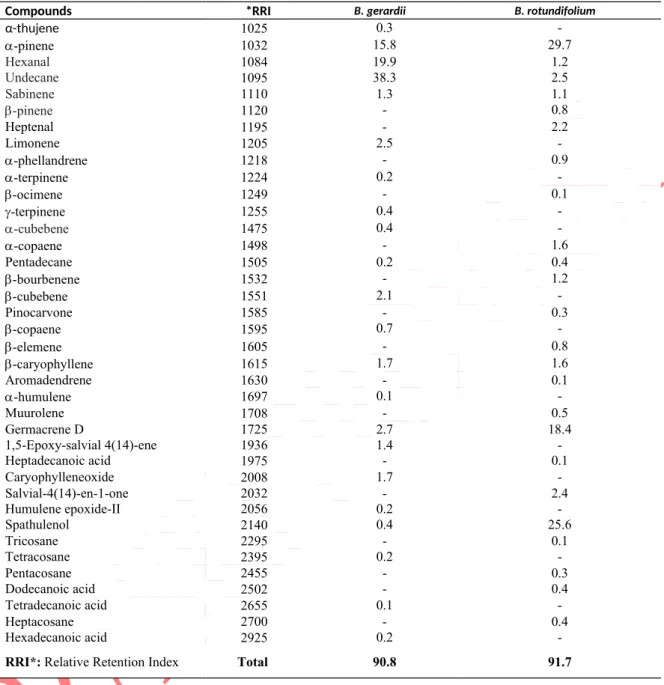
A Varian 3800 gas chromatograph directly inter faced with a Varian 2000 ion trap mass spectrometer was used with injector temperature, 260°C; injection mode, splitless; column, 60 m, CP-Wax 52 CB 0.25 mm i.d., 0.25 lm film thickness. The oven temperature was programmed as follows: 45°C held for 5 min, then increased to 80°C at a rate of 10°C/min, and to 240°C. at 2°C/min. The carrier gas was helium, used at a constant pressure of 10 psi; the transfer line temperature, 250°C; the ionisation mode, electron impact (EI); acquisit ion range, 40 to 200 m/z; scan rate, 1 us-1. The compounds were identified using the NIST library, mass spectral library and verified by the retention indices which were calculated as described by Van den Dool and Kratz (Van Den Dool et al., 1963). The relative amounts were calculated on the basis of peak-area ratios. The identified constituents of studied species are listed in Table 1 and herbarium samples are seen in Figure 1 and 2.
Table 1. Essential oil composition of Bupleurum species (%)
Compounds *RRI B. gerardii B. rotundifolium
α-thujene 1025 0.3 --pinene 1032 15.8 29.7 Hexanal 1084 19.9 1.2 Undecane 1095 38.3 2.5 Sabinene 1110 1.3 1.1 -pinene 1120 - 0.8 Heptenal 1195 - 2.2 Limonene 1205 2.5 --phellandrene 1218 - 0.9 -terpinene 1224 0.2 --ocimene 1249 - 0.1 -terpinene 1255 0.4 --cubebene 1475 0.4 --copaene 1498 - 1.6 Pentadecane 1505 0.2 0.4 -bourbenene 1532 - 1.2 -cubebene 1551 2.1 -Pinocarvone 1585 - 0.3 -copaene 1595 0.7 --elemene 1605 - 0.8 -caryophyllene 1615 1.7 1.6 Aromadendrene 1630 - 0.1 -humulene 1697 0.1 -Muurolene 1708 - 0.5 Germacrene D 1725 2.7 18.4 1,5-Epoxy-salvial 4(14)-ene 1936 1.4 -Heptadecanoic acid 1975 - 0.1 Caryophylleneoxide 2008 1.7 -Salvial-4(14)-en-1-one 2032 - 2.4 Humulene epoxide-II 2056 0.2 -Spathulenol 2140 0.4 25.6 Tricosane 2295 - 0.1 Tetracosane 2395 0.2 -Pentacosane 2455 - 0.3 Dodecanoic acid 2502 - 0.4 Tetradecanoic acid 2655 0.1 -Heptacosane 2700 - 0.4 Hexadecanoic acid 2925 0.2
-RRI*: Relative Retention Index Total 90.8 91.7
Results and Discussion
The chemical composition essential oil of dried aerial parts of B. gerardii and B.
rotundifolium were analyzed by HS-SPME/GC-MS.
21 and 23 compounds were identified in B. gerardii and B. rotundifolium respectively, accounting from 90.8% and 91.7% of the whole oil. The main compounds of B. gerardii were undecane (38.3%), hexanal (19.9%) and -pinene (15.8%), while in the
B. rotundifolium-pinene (29.7%), spathulenol
(25.6%) and germacrene D (18.4%). B. gerardii and
B. rotundifolium included high concentrations of
-pinene (15.8% - 29.7%, respectively). B. gerardii has, undecane (38.3%) and hexanal (19.9%), but
low content of germacrene D (2.7%) and spathulenol (0.4%). B. rotundifolium was described by their lower content of undecane (2.5%) and hexanal (1.2%) (Table 1). Among the monoterpenes, -pinene was found principal constituents of B. gerardii (15.8%) and B.
rotundifolium (29.7%) (Table 1); -pinene also
dominat constituent of umbel rays (17.6%), stems (6.0%), leaves (13.0%), fruits (42.7%) and the whole aerial parts (5.9%) of B. gibraltarium Lam. from Spain (Arturo et al ., 1998). Different parts of some
Bupleurum species were analyzed and the main
D (12.7%) in flowers and undecane (13.0%) in fruits; the main components of B. lancifolium Hornem. were spathulenol (15.4%) in flowers, and hexacosane (13.0%) in fruits; the major components of B. intermedium Poiret in Lam. were methyl linoleat (21.2%) in flowers and germacrene D (25.9%) in fruits; the dominant components of B.
cappadocicum Boiss. were heptanal (46.5%) in
flowers, undecane (50.3%-23.1%) in fruits and roots; the main components of B. gerardii were undecane (36.9%-49.2%) in flowers and fruits; the main components of B. falcatum L. subsp. cernuum (Ten.) Arc., were -pinene (41.2%-42.4%) in flowers and fruits (Saracoglu et al., 2004). In our study with
B. gerardii and B. rotundifolium has different
chemical properties from cited study; B. gerardii producing high concentration of -pinene (15.8%), hexanal (19.9%), undecane (38.3%), and no percentages of hexacosane and amyl furan. B. rotundifolium producing high concentration of
-pinene (29.7%), spathulenol (25.6%), germacrene D (18.4%) and no percentages of methyl linoleat and
heptanal (Table 1). In another research with
Bupleurum species, the oils from the umbel rays,
stems, leaves and fruits of B. gibraltarium Lam. have been examined by GC/MS and the major constituents of the umbel rays oil were: -pinene
(17.6%), sabinene (33.8%),
2,3,4-trimethylbenzaldehyde (8.4%); the stem oil of was characterized by the presence of sabinene (21.8%), 2,3,4-trimethylbenzaldehyde (10.7%); the leaf oil has dominant -pinene (13.0%), sabinene (50.0%) and limonene (10.0%), whereas in the oil from the fruits, -pinene (42.7%), sabinene (28.3%) and limonene (9.0%) were detected the most important ones (Arturo et al., 1998). Whereas in our study B.
gerardii and B. rotundifolium has no percentange
of 2,3,4-trimethylbenzaldehyde and low percentange of sabinene (Table 1).
The main conclusion from the above data, particularly interspecific differences means, might be explain that genetic and environmental factors both play a role in determining the composition of essential oils of the Bupleurum species studied. Inter and intraspecific variations in the essential oils composition of many genera patterns (like
Anthemis L., Nepeta L., Sideritis L., Ziziphora L., Satureja L. etc.) were previously reported,
depending on genetic, environmental factors, ontogeny, season, plant part analyzed and analytical methods (Kilic et al., 2011; Kilic et al., 2013; Kilic 2014; Kilic and Bagci 2013; Kilic 2013). In this study the comparison between two studied
Bupleurum species evidenced a similarity, at least
with reference to the presence of the main constituents: in fact -pinene was among the principal one in both species. Also the percentages
of hexanal, undecane, spathulenol and germacrene Dwere comparable. The only differences between two species were substantially due to undecane (38.3%) and hexanal (19.9%) found high amounts only in B. gerardii; and due to spathulenol (25.6%) and germacrene D (18.4%) found high amounts only in B. rotundifolium. This study demonstrates the occurrence of undecane / hexanal, -pinene chemotypes of B. gerardii and -pinene / spathulenol / germacrene D chemotypes of B.
rotundifolium in Eastern Anatolian region of Turkey
(Table 1). In conclusion, the essential oil results have given some clues on the chemotaxonomy of the genus patterns and usability of these species as natural product. According to these results, B.
gerardii and B. rotundifolium were found to be rich
in respect to essential oils. So these plants can be used different purposes in industry, ethnobotany and can be cultivated to richened natural products. Finally, many plant species are threatened due to overharvesting for medicinal or other use, so there is great need to protect plant diversity in Turkey and in the world. There is also a need to develop more sustainable ways of obtaining industrial products from renewable resources.
Acknowledgements
The authors thank for financial support Bübap (2013-203-129).
References
Arturo, V.N., Jose, M., Alonso, P., 1998. Chemical Composition of the Essential Oils from the Aerial Parts of Bupleurum gibraltarium Lam.
Journal Essential Oil Research, 10: 9-19
Ashoura, M.L., El-Readia, M., Younsb, M., Mulyaningsiha, S., Sporera, F., 2009. Chemical composition and biological activity of the essential oil obtained from
Bupleurum marginatum. Pharmacy and pharmacology, 61: 1079-1087.
Ayres, D.C., Loíke, J.D., 1990. Lígnans Chemícal, Bíological and Clinical Propertíes. Cambrídge Unívcrsity Press, Cambrídge.
Cowan, MM., 1999. Plant products antimicrobial agents. Clinical Microbial Reviews, 12: 564-582.
Davis, P.H., 1972. Flora of Turkey. Edinburgh: Edinburgh University Press, 4.
González, J.A., Estévez-Braun, A., Estévez-Reyes, R., Ravclo, A.G., 1994. Biological activity of metabolites Bupleurum salicifolium. Journal
Chemistry Ecology, 20: 517-521.
Güner, A., Özhatay, N., Ekim, T., Başer, KHC., 2000. Flora of Turkey and the East Aegean Islands.
Hammer, K.A., Carson, J.F., Riley, T.V., 1999. Antimicrobial activity of essential oils and other plant extracts. Journal Application
Microbiology, 86: 985-990.
Joshi, R.K., Pande, C., 2008. Essential oil composition of the aerial parts of
Bupleurum candollii. Natural Product Compound, 3: 1919-1920.
Kilic, O., Kocak, A., and Bagci. E. 2011. “Composition of the Volatile Oils of Two
Anthemis L. taxa from Turkey” Zeithschrif für Naturforschung C, 66: 535-540.
Kilic, O., Behcet, L. and Bagci, E. 2013. Essential oil compounds of three Nepeta L. Taxa From Turkey, and Their Chemotaxonomy. Asian
Journal of Chemistry, 25 (14): 8181-8183.
Kilic, O., 2014. Essential Oil Composition of Two
Sideritis L. Taxa from Turkey: A Chemotaxonomic Approach. Asian Journal
of Chemistry, 26 (8), 2466-2470.
Kilic, O., and Bagci, E. (2013). Essential Oils of Three
Ziziphora L. taxa from Turkey and their
Chemotaxonomy. Asian Journal of
Chemistry, 25: 7263-7266.
Kilic, O. 2013. Chemotaxonomy of Two Satureja L. (Lamiaceae) Species from Different Localities of Turkey. Journal of Agriculture
Science and Technology B, 3: 751-756.
Kubeczka, K.H., 1982. In: Aromatic plants, Basic and applied aspects, Martinus Nijhoff publishers, the Hague, Boston, London, 165, 1982. Li, XQ., He, ZG., Bi, KS., Song, ZH., Xu, L., 2007.
Essential oil analyses of the root oils of 10
Bupleurum species from China. Journal of Essent Oil Research, 19: 234-238.
Lubbe A., Verpoorte, R., 2011. Cultivation of medicinal and aromatic plants for specialty industrial materials. Industrial Crops and
Product, 34: 785-801.
Nose, M., Amagaya, S., Ogihara, Y., 1989. Corticosterone secretion-inducing activity of saikosaponin metabolites formed in the alimentary trac. Chemistry Pharmavcy
Bulletin, 37: 2736-40.
Pan, S.L., 2006. Bupleurum Species Scientific Evaluation and Clinical Application. Taylor & Francis Group Boca Raton, London, New York, pp 1.
Saraçoğlu, H.T., Akın, M., Demirci, B., Başer, K.H.C. 2012. Chemical composition and antibacterial activity of essential oils from different parts of some Bupleurum L. species. African Journal of Microbiology
Research, 6 (12): 2899-2908.
Van Den Dool, H., Kratz, PD., 1963. A generalization of the retention index system including linear temperature programmed gas–liquid partition chromatography. Journal of
Chromatography, 11: 463-471.
Verzera A., Zino, M., Condurso, C., Romeo, V., Zappala, M., 2004. Solid-phase microextraction and GC/MS for the rapid characterisation of semi-hard cheeses.
Analitic Bioanalitic Chemistry, 380: 930-936,
Zakaria, M., 1991. Isolation and characterization of active compounds from medicinal plants.