Procedia - Social and Behavioral Sciences 195 ( 2015 ) 963 – 971
ScienceDirect
1877-0428 © 2015 The Authors. Published by Elsevier Ltd. This is an open access article under the CC BY-NC-ND license (http://creativecommons.org/licenses/by-nc-nd/4.0/).
Peer-review under responsibility of Istanbul Univeristy. doi: 10.1016/j.sbspro.2015.06.274
World Conference on Technology, Innovation and Entrepreneurship
Linking Transformational Leadership to Work Engagement and the
Mediator Effect of Job Autonomy: A Study in a Turkish Private
Non-Profit University
øzlem Gözükara
a*, Omer Faruk ùimúek
aa Istanbul Arel University, Istanbul, Turkey
Abstract
The concept of transformational leadership was introduced by the political scientist J. MacGregor Burns (1978). Within this conceptual framework, a transformational leader motivates his/her followers by promoting their high ideals and goals, and makes them achieve more than expected through inspiration. A transformational leader delegates tasks and allows followers to improve themselves in task-related decision-making through gaining personal experience. In this sense, job autonomy refers to employees’ freedom and independence in decision-making. It is indispensable for an inspiring, supportive and motivating leader to increase work engagement of his/her subordinates (Avery, McKay and Wilson, 2007). Work engagement is a “positive, fulfilling, work-related state of mind” that is characterized by dedication, absorption and vigor (Macey et al., 2009). This concept involves some intrinsic motivations such as job satisfaction, pride, inspiration, working with high energy and focusing on work (Turgut, 2011). In their studies, Zhu, Avolio and Walumbwa (2009) identified the positive effect of transformational leadership – considering the personal traits of subordinates such as initiatives, analytical thinking and moral values – on work engagement. The studies by Tims, Bakker and Xanthopoulou (2011) also demonstrated that a transformational leader increases the work engagement of subordinates. This study examines the effect of transformational leadership on work engagement of academicians through job autonomy. Structural equation modeling as a quantitative research method was used and the data was collected using questionnaires. For data collection, Bass and Avolio’s (1990) ‘Multifactor Leadership Questionnaire’, which examines transformational leader through the dimensions of idealized influence (charisma), intellectual stimulation, inspirational motivation and individualized consideration, was used. Work engagement was measured using Utrecht Work Engagement Scale (UWES) developed by Schaufeli and Bakker (2003) which has three dimensions of vigor, dedication and absorption. The scale by Ilardi et al. (1993) was used to measure job autonomy. The data obtained by this study, which includes the academicians working in a private non-profit university, was analyzed using LøSREL. Results showed that job autonomy fully mediated the effect of transformational leadership on work engagement.
© 2015 The Authors. Published by Elsevier Ltd. Peer-review under responsibility of Istanbul University.
Keywords: Transformational Leadership, Job Autonomy, Work Engagement
Corresponding author.
E-mail address: [email protected]
© 2015 The Authors. Published by Elsevier Ltd. This is an open access article under the CC BY-NC-ND license (http://creativecommons.org/licenses/by-nc-nd/4.0/).
1. Introduction
Leadership is of great interest since corporates achieve their goals through employee motivation and resource circulation, and it is also an integral part of corporate performance, novelty and adjustment. Leadership has been shown to be a valuable asset for corporates, states and units in many researches (Crossan and Apaydin, 2010, Day and Lord, 1988, Flynn and Staw, 2004, House et al., 1991, Jones and Olken, 2005, Waldman and Yammarino, 1999 and Yukl, 2008). As proven by many studies, particular characteristics of leadership enhance job resources such as the extent to decide on the way and time of conducting tasks, performance feedback, social support and the scope of skill utilization (Nielsen & Daniels, 2012; Piccolo & Colquitt, 2006;Purvanova, Bono, & Dzieweczynski, 2006;Tuckey, Bakker & Dollard, 2012). And consequently, such resources positively affect the work engagement of employees (Breevaart, Bakker and Demerouti, 2013). Additionally, several scholars have reported that the potential of motivation contained in job resources (e.g., autonomy; Bakker, 2009 and Halbesleben, 2010) and personal resources (e.g., self-efficacy; Xanthopoulou et al., 2007, Xanthopoulou et al., 2009a and Xanthopoulou et al., 2009b) make them become critical precedents of engagement.
To the best of our knowledge, there is a limited number of studies about the effect of leadership on work engagement. Therefore, this study aimed to investigate the effect of transformational leadership on work engagement through job autonomy.
2. Literature Review
2.1. Transformational Leadership
Transformational leadership is a style of leadership where the leader transforms the followers' basic values, beliefs and attitudes, inspiring followers to exhibit a performance greater than their own expectations (Yukl, 1989). This style of leadership concentrates on making employees more involved in achieving their organizational targets (Bass, 1985). This leadership style is based on the inspirational power of the leader (den Hartog, Koopman, & Van Muijen, 1997). According to Avolio et al. (1999), transformational leaders have charisma and influence to motivate followers to go beyond expectations at work. Similarly, Seltzer and Bass (1990) suggested that transformational leaders ruled through inspiration and encouragement over their followers for developing creative ways of problem solving. In the literature about organizations, transformational leaders have been described using various terms including charismatic, inspirational, generous, motivating, strong, dependable and confident (Bass et al., 1987; Bass, 1985a).
Leaders have critical roles in influencing the followers' perceptions of self-esteem and self-determination (Deci et al., 1989). In general, followers feel sense of authority and determination over the process and outcomes of performing tasks when they are provided with support and guidance, and this enhances the perception of autonomy (Spreitzer, 1996). Followers adopt the job instructions and rules (Gagne & Deci, 2005) and think that they can decide on their own and their activities will gain full support (Alge, Ballinger, Tangirala, & Oakley, 2006) if they are intrinsically motivated and think that they have the authority and independence of conducting their work.
Besides, dedication, involvement, performance and efficiency have been shown to improve when the followers work with transformational leaders (Shamir, House, & Arthur, 1993). Followers tend to feel challenges, involvement and satisfaction at work if they are supported, motivated, inspired and managed effectively, all of which lead to higher levels of engagement in their work.
For instance, Tims, Bakker and Xanthopoulou (2011) have found that transformational leadership and work engagement are positively correlated on day-level basis. The authors have also demonstrated that resources such as autonomy and supervisor coaching (Xanthopoulou et al., 2007) cause improved levels of work engagement in the followers. Similarly, Zhu et al. (2009) has discussed the relationship between transformational leadership and follower engagement in recent times. They have suggested and demonstrated that this type of leadership is
associated with work engagement and this relation becomes prominent especially when the employee is productive, effective and inventive (Tims et al., 2011).
2.2. Work Engagement
Work engagement refers to the relationship of the employees with their work. Engagement was first defined by Kahn (1990) as "the harnessing of organizational members’ selves to their work roles" (p. 694). Kahn (1990) also stated that "in engagement, people employ and express themselves physically, cognitively, and emotionally during role performances" and "in disengagement people withdraw and defend themselves physically, cognitively and emotionally during role performances" (p. 694). Therefore, work engagement is about how the employees think about and how much they want to be involved in their work (Kahn, 1990). Engaged employees show a positive attitude to their job physically, mentally and also cognitively, and they have the desire to invest themselves fully in their tasks (Kahn, 1990, and Maslach and Leiter, 1997). Non-engaged employees, contrarily, do not want to commit themselves in their job physically and feel psychologically unconnected with their colleagues (Kahn, 1990).
Engagement has been defined by several authors (Albrecht, 2010, Bakker and Leiter, 2010 and Macey and Schneider, 2008), however, Schaufeli and Bakker’s (2010) definition of "a positive, fulfilling, work-related state of mind that is characterized by vigor, dedication, and absorption" has become the commonly used one. Although scholars have discussed various aspects of engagement, “there is a growing consensus that engagement can be defined in terms of high levels of energy and high levels of involvement in work” (Bakker, Albrecht, & Leiter, 2011, p. 22).
“Engagement leads to human benefits for the individual who experiences it" as proposed by Jones and Harter (2005, p. 79), and the leaders are the most discussed aspect of leadership because they can inspire followers for motivation and engagement in the workplace as they are in communication with and have effect on followers every working day (Koppula, 2008).
Experimental studies have reported job resources to be significantly associated with work engagement (Mauno et al., 2007; Saks, 2006; Halbesleben, 2009), especially when the work demands are high (Bakker, Hakanen, Demerouti, & Xanthopoulou, 2007). Job resources refer to “those physical, psychological, social, or organizational aspects of the job that may do any of the following: (a) be functional in achieving work goals; (b) reduce job demands and the associated physiological and psychological costs; (c) stimulate personal growth and development” (Demerouti, Bakker, Nachreiner, & Schaufeli, 2001). Job resources promote learning and individual progress, playing an intrinsic motivational role, and offer instrumental aid and particular data for achieving goals, playing an extrinsic motivational role (Schaufeli & Bakker, 2004). Thus, job resources inspire followers for goal attainment. This, in turn, make followers feel fulfillment about their work, which results in enhanced levels of involvement and engagement (Hackman & Oldham, 1980). Given these findings and leadership theory, we formulate our hypothesis as follows:
Hypothesis 1. Transformational leadership has a positive relationship with work engagement.
2.3. Job Autonomy
Job autonomy is a job characteristic and defined as “... the degree to which the job provides substantial freedom, independence and discretion to the individual in scheduling the work and in determining the procedures to be used in carrying it out” (Hackman & Lawler, 1971, p. 265, and Hackman & Oldham, 1975) and it is a leading and significant feature of job design (Fried and Ferris, 1987 and Karasek and Theorell, 1990). It means the degree of freedom and discretion allowed to an individual to establish how his or her job should be performed.
Increased job autonomy provides individuals with the ability to go beyond the ordinary and to come up with the best solution throughout the process (Shalley & Gilson, 2004). When followers are in great need for personal
development, autonomy is a fulfilling factor in essence and it may lead to more motivated individuals (Cleavenger and Munyon, 2013).
Autonomy can also be enhanced by inspiring followers for learning and growth at work, as well as providing with the opportunity to lead themselves (Manz & Sims, 2001). In this regard and given the fact that leadership is usually regarded as a way of having effect on people (Yukl, 2010), several researches have suggested that charismatic leaders, which are also known as transformational leaders, are likely to offer a greater extent of autonomy (Bass & Avolio, 1990) or cause followers to be their own leaders (Yammarino, 1994).
In this sense, transformational leaders inspire employees to be responsible and autonomous (Bass and Riggio, 2006 and Carless et al., 2000), enhancing autonomy, the extent of independence and freedom in the workplace, as defined before (Hackman et al., 1975 and Hackman and Oldham, 1976). Besides, transformational leaders promote followers to seek creative and innovative ways of problem solving, and this improves the sense of control and self-determination that the followers feel over their jobs (Bass and Avolio, 1994 and Conger and Kanungo, 1988).
In terms of engagement, Hakanen et al. (2006), Saks (2006) and Xanthopoulou et al. (2007) have reported a positive relationship between employee engagement and many job resources such as autonomy, feedback, supervisor coaching, career opportunities and social support in their cross-sectional studies.
Salanova et al. (2005) also showed a relationship between enhanced employee engagement and job autonomy, namely job control, and training opportunities in various institutions in their study that was conducted using a multi-level methodology. Furthermore, the study by Bakker and Geurts (2004) reported increased multi-levels of job-related feedback, career opportunities and job autonomy in the workplace, and a sense of absorption in particular. All these studies and evidences led us formulate the following hypothesis:
Hypothesis 2. Job autonomy mediates the relationship between transformational leadership and work engagement.
3. Methodology
3.1. Research Goal
In this study, we aimed to establish the mediating effect of job autonomy on the relationship between transformational leadership and work engagement. Questionnaires were used to test the hypotheses.
3.2. Sample and Data Collection
A convenience sampling method was used in the present study. The participants were 101 academic staff (65 males, 36 females) from a private non-profit university in Istanbul, Turkey. The mean age was 36.67 with a standard deviation of 9.70.
3.3. Instruments
Leadership Questionnaire (MLQ) Form-5X Short (Bass & Avolio, 1995) was used to measure the transformational leadership. This questionnaire consists of 36 descriptive items. Participants were asked to rate how often their executives exhibit the specified behavior on a five-point scale ranging from 1 (“strongly disagree”) to 5 (“strongly agree”). There are twenty questions corresponding to four dimensions of transformational leadership:(1) idealized influence (attributed) (e.g., “My executive acts in ways that build my respect”), and idealized influence (behavior) (e.g., “My executive talks to us about his/her most important values and beliefs”); (2) inspirational motivation (e.g., “My executive expresses his/her confidence that we will achieve our goals”); (3) intellectual stimulation (e.g., “My executive seeks differing perspectives when solving problems”); and (4) individual
consideration (e.g., “My executive spends time teaching and coaching me”). The Cronbach’s alpha for these items was .96 revealing sufficient reliability (alphas > .70).
Work engagement was measured by Utrecht Work Engagement Scale (UWES), which was developed by
Schaufeli and Bakker (2003), and adapted into Turkish by Islamoglu, Birsel, Yurtkoru and Boru (2011).This
instrument consists of 17 items that measure three dimensions of job engagement: (1) vigor (six items) (e.g., “At my work, I feel bursting with energy”), (2) dedication (five items) (e.g., “I am enthusiastic about my job” and (3) absorption (six items) (e.g., “Time flies when I'm working”). The items were rated on a five-point scale ranging from 1 (“strongly agree”) to 5 (“strongly disagree”).
Job autonomy was measured using a 21-item questionnaire (Ilardi et al., 1993) evaluating three intrinsic needs (autonomy, competence and relatedness) of employees about their work. Only the autonomy subscale was used in the present study (e.g., “I feel like I can make a lot of inputs to deciding how my job gets done”). This subscale consists of seven items, to which the participants were asked to respond on a five-point scale ranging from 1 (“strongly disagree”) to 5 (“strongly agree”).
3.4. Analyses and Results
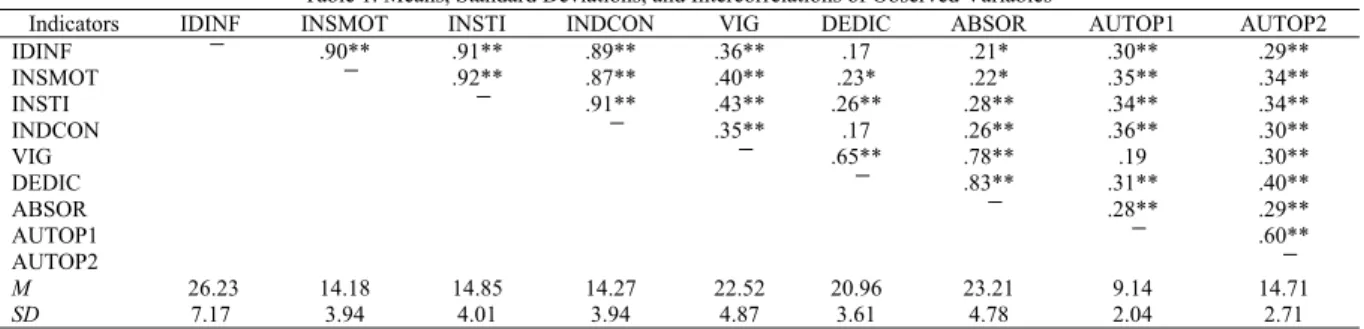
In order to test the hypotheses, a structural equation model was tested using LISREL. Given that a measurement model should be tested before a structural model, three latent variables were created using composite scores of sub-factors or parcels. Since MLQ has four sub-scales, e.g., idealized influence, inspirational motivation, intellectual stimulation, and individual consideration, the composite scores of these sub-factors were used as indicators or observer variables for transformational leadership latent variable. Similarly, work engagement latent variable was created using composite scores of three sub-factors of UEWS, namely vigor, dedication, and absorption. However, we created for two parcels for autonomy latent variable since the scale has only 7 items with one-factor solution. The correlations among these observed variables are shown in Table 1.
Table 1. Means, Standard Deviations, and Intercorrelations of Observed Variables
Indicators IDINF INSMOT INSTI INDCON VIG DEDIC ABSOR AUTOP1 AUTOP2 IDINF ଲ .90** .91** .89** .36** .17 .21* .30** .29** INSMOT ଲ .92** .87** .40** .23* .22* .35** .34** INSTI ଲ .91** .43** .26** .28** .34** .34** INDCON ଲ .35** .17 .26** .36** .30** VIG ଲ .65** .78** .19 .30** DEDIC ଲ .83** .31** .40** ABSOR ଲ .28** .29** AUTOP1 ଲ .60** AUTOP2 ଲ M 26.23 14.18 14.85 14.27 22.52 20.96 23.21 9.14 14.71 SD 7.17 3.94 4.01 3.94 4.87 3.61 4.78 2.04 2.71 Notes: IDINF = Idealized influence, INSMOT = Inspirational motivation, INSTI = Intellectual stimulation, INDCON = Individual consideration, VIG = Vigor, DEDIC = Dedication, ABSOR = Absorption, AUTOP1-2 = Parcels created from the autonomy sub-scale items.
**p<.01 * p<.05
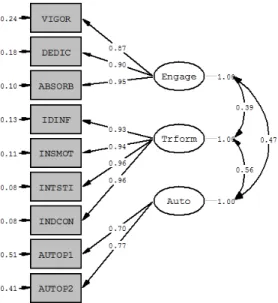
The measurement model created by the abovementioned observed variables was tested and resulted in acceptable goodness of fit statistics: Chi-square = 50.01, Df = 24, Goodness of Fit Index = .90, Standardized Root Mean Square Residual = .050, Comparative Fit Index = .97, Incremental Fit Index = .97. The standardized factor loadings for this measurement model are presented in Figure 1.
Figure 1. Standardized Factor Loadings for the Measurement Model Note: All factor loadings are significant at p = .01.
It is clear from Figure 1, all of the factor loadings of the measured variables on the latent constructs were large and statistically significant, indicating the reliability of the indicators.
Test of the structural model was then performed using Maximum Likelihood estimation method. Although an initial estimation of the model was produced acceptable goodness of fit statistics, it was evident that the path from Transformational Leadership to Work Engagement (ȕ = .17) was non-significant (t = 1.47, p>.05). Indeed, deleting the path from the model resulted in a non-significant chi-square difference test result (2.09, 1: p>.05). The results for the model after model trimming was resulted in the following goodness of fit statistics: Chi-square = 52.10, Df = 24, Goodness of Fit Index = .90, Standardized Root Mean Square Residual = .07, Comparative Fit Index = .97, Incremental Fit Index = .97. Standardized estimates for the paths in the proposed model were shown in Figure 2.
Figure 2. Standardized path coefficients for the structural model.
Notes: Numbers in parentheses refer to coefficients for the measurement model. **p< .01; dashed lines refer to non-significant paths when the mediator variable was included into the equation.
The results indicated a full-mediation model in which the effect of transformational leadership on work engagement was fully mediated by job autonomy. The results also indicated that 26% of the variance in work engagement was accounted for by job autonomy while 36% of the variance in job autonomy by transformational leadership.
4. Conclusion
This study evaluated the effect of transformational leadership on work engagement through job autonomy. The internal consistency of the above-mentioned scales was reviewed as a preliminary analysis and all scales were found to have an adequate level of reliability. The analyses were made using structural equation modeling and revealed moderate relationships for the said variables. Additionally, the mediation analyses showed that job autonomy had a full mediator effect on the relationship between transformational leadership and work engagement.
The results of this study demonstrate, that job autonomy as an important job resource, enhances the effect of transformational leaders on employees’ engagement. For that, it might be sufficiently valuable for organizations to invest in transformational leadership training.
References
Alge, B.J., Ballinger, G.A., Tangirala, S., Oakley, J.L. (2006). Information privacy in organizations: Empowering creative and extra-role performance (pp. 221–232). Journal of Applied Psychology, 91 (1).
Avery, D. R., McKay, P. F., Wilson, D. C. (2007). Engaging the aging workforce: The relationship between perceived age similarity, satisfaction with coworkers, and employee engagement. The Journal of Applied Psychology, 92, 1542í1556.
Avolio, B.J., Bass, B.M. (1995). Individual consideration viewed at multiple levels of analysis: A multilevel framework for examining the diffusion of transformational leadership (pp. 199–218). The Leadership Quarterly, 6.
Avolio B.J., Bass B.M., Jung D.I. (1999). Reexamining the components of transformational leadership and transactional leadership using the multifactor leadership questionnaire. J Occup Organ Psychol., 72: 441–462.
Albrecht, S.L. (2010). Handbook of employee engagement: Perspectives, issues, research and practice. Edward Elgar, Cheltenham, UK. Bakker, A.B., Geurts, S. (2004). Toward a dual-process model of work-home interference (pp. 345–366). Work and Occupations, 31.
Bakker, A.B., Hakanen, J.J., Demerouti, E., Xanthopoulou, D. (2007). Job resources boost work engagement particularly when job demands are high (pp. 274–284). Journal of Educational Psychology, 99.
Bakker, A.B. (2009). Building engagement in the workplace (pp. 50–72). C. Cooper, R. Burke (Eds.). The peak performing organization, Routledge, London.
Bakker, A.B., Leiter, M.P. (Eds.) (2010). Work engagement: A handbook of essential theory and research. Psychology Press, New York. Bakker, A.B., Albrecht, S.L., Leiter, M.P. (2011). Work engagement: Further reflections on the state of play (pp. 74–88). European Journal of
Work and Organizational Psychology, 20.
Bass, B.M. (1985). Leadership performance beyond expectations. Academic Press, New York.
Bass B.M., Avolio B.J., Goodheim L. (1987). Biography and the assessment of transformational leadership at the world-class level. J Manag,
13(1):7–19.
Bass, B.M., Avolio. B.J. (1990). Improving organizational effectiveness through transformational leadership. Sage Publications, Thousand Oaks. Bass, B.M., Avolio, B.J. (1994). Improving organizational effectiveness through transformational leadership. Sage Publications, Thousand Oaks,
CA.
Bass, B.M., Riggio, R.E. (2006). Transformational leadership (2nd ed.). Lawrence Erlbaum Associates, Mahwah, NJ. Burns, J. M. (1978). Leadership. NY: Harper & Row.
Breevaart K., Bakker, A.B., Demerouti, E. (2013). Daily self-management and employee work engagement (pp. 31–38). Journal of Vocational
Behavior. Volume 84, Issue 1, February 2014.
Carless, S.A., Wearing, A.J, Mann, L. (2000).. A short measure of transformational leadership (pp. 389–405). Journal of Business and
Psychology, 14 (3).
Conger, J.A., Kanungo, R.N. (1988). The empowerment process: Integrating theory and practice (pp. 471–482). Academy of Management Review,
13.
Demerouti, E., Bakker, A.B., Nachreiner, F., Schaufeli, W.B.(2001). The job demands–resources model of burnout (pp. 499–512). Journal of
Applied Psychology, 86.
Cleavenger, D.J., Munyon, T.P. (2013). It's how you frame it: Transformational leadership and the meaning of work (pp. 351–360). Business
Horizons, Volume 56, Issue 3, May–June 2013.
Crossan, M.M., Apaydin, M. (2010). A multi-dimensional framework of organizational innovation: A systematic review of the literature (pp. 1154–1191). Journal of Management Studies, 47(6).
Day, D.V., Lord, R.G. (1988). Executive leadership and organizational performance: Suggestions for a new theory and methodology. Journal of
Deci, E.L., Connell, J.P., Ryan, R.M. (1989). Self-determination in a work organization (pp. 580–590). Journal of Applied Psychology, 74. den Hartog, D.N., Koopman, P.L., van Muijen, J.J. (1997). Inspirerend leiderschap in organisaties. Academic Service, Schoonhoven.
Flynn, F.J., Staw, B.M. (2004). Lend me your wallets: The effect of charismatic leadership on external support for an organization (pp. 453–464).
Strategic Management Journal, 25.
Fried, G.R., Ferris (1987). The validity of the job characteristics model: A review and meta-analysis (pp. 287–322). Personnel Psychology, 40. Gagne, M., Deci, E.L. (2005). Self-determination theory and work motivation (pp. 331–362). Journal of Organizational Behavior, 26.
Hackman, J.R., Lawler, E.E., III (1971). Employee reactions to job characteristics (pp. 259–286). Journal of Applied Psychology Monograph, 55. Hackman, J.R., Oldham, G.R. (1975). Development of the job diagnostic survey (pp. 159–170). Journal of Applied Psychology, 60.
Hackman, J.R., Oldham, G.R. (1976). Motivation through the design of work: Test of a theory (pp. 250–279). Organizational Behavior and
Human Performance, 16.
Hackman, J.R., Oldham, G.R. (1980). Work redesign. Addison-Wesley, Reading, MA.
Hakanen, J., Bakker, A.B, Schaufeli, W.B. (2006). Burnout and work engagement among teachers (pp. 495–513). Journal of School Psychology,
43.
Halbesleben, J.R.B. (2009). A meta-analysis of work engagement: Relationships with burnout, demands, resources and consequences. A.B. Bakker, M.P. Leiter (Eds.). Work engagement: The handbook of essential theory and research. Psychology Press, New York.
Halbesleben, J.R.B. (2010). A meta-analysis of work engagement: Relationships with burnout, demands, resources and consequences (pp. 102– 117). A.B. Bakker, M.P. Leiter (Eds.). Work engagement: The essential in theory and research, Psychology Press, New York
House, R.J., Spangler, W.D., Woycke, J. (1991). Personality and charisma and the U.S. presidency: A psychological theory of leader effectiveness (pp. 364–396). Administrative Science Quarterly, 36.
Ilardi, B. C., Leone, D., Kasser, R., & Ryan, R. M. (1993). Employee and supervisor ratings of motivation: Main effects and discrepancies associated with job satisfaction and adjustment in a factory setting. Journal of Applied Social Psychology, 23, 1789-1805.
Islamoglu, G., Birsel, M., Yurtkoru, E.S., Boru, D. (2011). Comparison of Four Job Related Attitudes In Relation to Their Contribution on Organizational Commitment. 7th International Conference on Business. Management and Economics – ICBME’11. October 06-08, 2011, in Cesme / Izmir – Turkey.
Jones, B.F., Olken, B.A. (2005). Do leaders matter? National leadership and growth since World War II (pp. 835–864). Quarterly Journal of
Economics.
Jones, J.R., Harter J.K. (2005). Race effects on the employee engagement-turnover intention relationship. J Leadersh Org Stud., 11(2):78–88. Kahn, W.A. (1990). Psychological conditions of personal engagement and disengagement at work (pp. 692–724). Academy of Management
Journal, 33.
Karasek, R., Theorell, T. (1990). Healthy work. Stress, productivity and the reconstruction of working life. Basic Books, New York.
Koppula R. (2008). Examining the relationship between transformational leadership and engagement. Master’s thesis. San Jose State University. Macey, W.H., Schneider, B. (2008). Engaged in engagement: We are delighted we did it (pp. 76–83). Industrial and Organizational Psychology,
1.
Macey, W.H., Schneider, B., Barbera, K.M., Young, S.A. (2009). Employee Engagement: Tools for Analysis, Practice, and Competitive Advantage. West Sussex: John Wiley & Sons.
Manz, C.C., Sims Jr, H.P. (201). The new superleadership: Leading others to lead themselves. Berrett-Koehler Publishers, San Francisco, CA. Mauno, S., Kinnunen, U., Ruokolainen, M. (2007). Job demands and resources as antecedents of work engagement: A longitudinal study (pp.
149–17). Journal of Vocational Behavior, 70.
Maslach, C., Leiter, M.P (1997). The truth about burnout. Jossey, Bass, CA.
Nielsen, K., Daniels, K. (2012). Does shared and differentiated transformational leadership predict followers’ working conditions and well-being? (pp. 383–397). The Leadership Quarterly, 23.
Piccolo, R.F., Colquitt, J.A. (2006). Transformational leadership and job behaviors: The mediating role of core job characteristics (pp. 327–340).
Academy of Management Journal, 49.
Purvanova, R.K., Bono, J.E., Dzieweczynski, J. (2006). Transformational leadership, job characteristics, and organizational citizenship performance (pp. 1–22). Human Performance, 19.
Saks, A.M. (2006). Antecedents and consequences of employee engagement (pp. 600–619). Journal of Managerial Psychology, 21.
Salanova, M., Agut, S., Peiro, J.M. (2005). Linking organizational resources and work engagement to employee performance and customer loyalty: the mediation of service climate (pp. 1217–1227). Journal of Applied Psychology, 90.
Schaufeli, W.B. & Bakker, A.B., UWES (Utrecht Work Engagement Scale) (2003). Preliminary Manual. Occupational Health Psychology Unit, Utrecht University, The Netherlands.
Schaufeli, W.B., Bakker, A.B. (2004). Job demands, job resources, and their relationship with burnout and engagement: A multi-sample study (pp. 293–315). Journal of Organizational Behavior, 25.
Schaufeli, W.B., Bakker, A.B. (2010). Defining and measuring work engagement: Bringing clarity to the concept, A.B. Bakker, M.P. Leiter (Eds.), Work engagement: A handbook of essential theory and research (pp. 10–24). Psychology Press, New York.
Shalley, C.E., Gilson, L.L. (2004). What leaders need to know: A review of social and contextual factors that can foster or hinder creativity (pp. 33–53). The Leadership Quarterly, 15.
Shamir, B., House, R.J., Arthur, M.B. (1993). The motivational effect of charismatic leadership: A self-concept based theory (pp. 577–594).
Organization Science, 4.
Spreitzer, G.M. (1996). Social structural characteristics of psychological empowerment (pp. 483–504). Academy of Management Journal, 39 (2). Tims M., Bakker, A. B., Xanthopoulou, D. (2011). Do transformational leaders enhance their followers' daily work engagement? The Leadership
Quarterly, 22, 121–131.
Tuckey, M.R., Bakker, A.B., Dollard, M.F.(2012). Empowering leaders optimize working conditions for engagement: A multilevel study (pp. 15–27). Journal of Occupational Health Psychology, 17.
Turgut, T. (2011). ÇalÕúmaya Tutkunluk: øú Yükü, Esnek ÇalÕúma Saatleri, Yönetici Deste÷i ve øú-Aile ÇatÕúmasÕ ile øliúkileri. Atatürk
Üniversitesi øktisadi ve ødari Bilimler Dergisi, 25 (3-4), 155-179.
Waldman, D.A., Yammarino, F.J. (1999). CEO charismatic leadership: Levels-of-management and levels-of-analysis effects (pp. 266–285).
Xanthopoulou, D., Bakker, A.B., Demerouti, E., Schaufeli, W.B. (2007). The role of personal resources in the job demands-resources model (pp. 121–141). International Journal of Stress Management, 14.
Xanthopoulou, D., Bakker, A.B., Demerouti, E., Schaufeli, W.B. (2009). Work engagement and financial returns: A diary study on the role of job and personal resources (pp. 183–200). Journal of Occupational and Organizational Psychology, 82.
Xanthopoulou, D., Bakker, A.B., Demerouti, E., Schaufeli, W.B. (2009). Reciprocal relationships between job resources, personal resources, and work engagement (pp. 235–244). Journal of Vocational Behavior, 74.
Yammarino, F.J. (1994). Indirect leadership: transformational leadership at a distance (pp. 26–47). B.M. Bass, B.J. Avolio (Eds.), Improving organizational effectiveness through transformational leadership, Sage Publications, Thousands Oaks.
Yukl, G.A. (1989). Leadership in organizations. Prentice Hall, Englewood Cliffs, NJ.
Yukl, G.A. (2008). How leaders influence organizational effectiveness (pp. 708–722). The Leadership Quarterly, 19 (6). Yukl, G.A. (2010). Leadership in organizations (7th ed.). Pearson Education, Upper Saddle River, NJ.
Zhu, W., Avolio, B. J., Walumbwa, F. O. (2009). Moderating role of follower characteristics with transformational leadership and follower work engagement. Group and Organization Management, 34, 590í619.