http://communications.science.ankara.edu.tr/index.php?series=B
Received by the editors: October 25, 2017; Accepted: December 22, 2017.
Key word and phrases: Manganese(III) Scetate, 4-Hydroxyquinolinone, Dihydrofuroquinolinone, Thiophene, Radicalic Cyclization.
© 2017 Ankara University Communications Faculty of Sciences University of Ankara Series B: Chemistry and Chemical Engineering. Communications de la Faculté des Sciences de l'Université d'Ankara-Séries B: Chemistry and Chemical Engineering MANGANESE(III) ACETATE MEDIATED SYNTHESIS OF NEW ANGULAR
AND LINEAR DIHYDROFUROQUINOLINONES
MEHTAP ÖZGÜR, MEHMET YILMAZ,AND A.TARIK PEKEL
Abstract. Angular (3) and linear (4) dihydrofuroquinolinone derivatives were prepared in ‘one pot’ reaction of 4-hydroxy-1-methyl-quinoline-2-one (1) with (E)-2-(1-phenylprop-1-en-2-yl)thiophene (2) in the presence of manganese(III) acetate. The structures of the compounds (3 and 4) were determined by MS, FTIR, ID and 2D NMR techniques. A possible reaction mechanism was also described.
1. Introduction
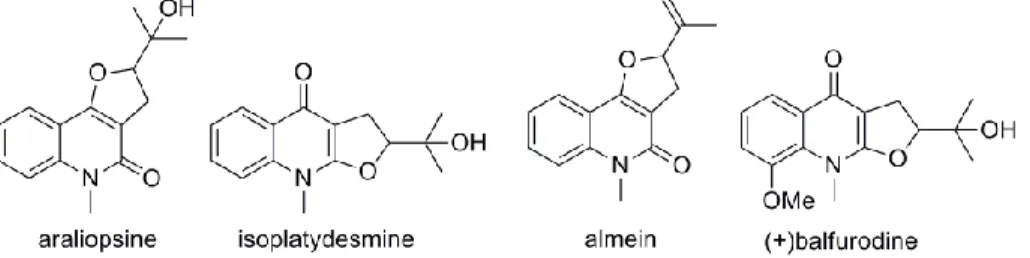
Quinolines are one of the most abundant molecules, naturally occurring compounds and commonly used as versatile intermediates in natural products synthesis [1,2]. Dihydrofuroquinolines are other important compounds that are widely distributed in nature (Fig. 1) and several methods for the synthesis of these compounds are described in the literature [3,4]. A commonly used to obtain dihydrofuroquinolines involves cyclization reactions of carbonyl compounds with alkenes or alkynes in the presence of metal salts [5-7]. Manganese(III) acetate was the most preferred oxidant [8-10] for radical cyclization reactions and naturally occurring araliopsine [11] is synthesized easily by this oxidant.
Previously, we have reported Mn(OAc)3 mediated synthesis of 4,5-dihydrofuran-3-carbonitriles [12], 3-trifluoroacetyl-4,5-dihydrofurans [13] and dihydrofuran [14] derivatives. Moreover, we have described the synthesis of dihydrofurocoumarin and dihydrofuronaphthoquinone derivatives in very good yields [15]. Also, we revealed the superior antibacterial and antifungal activity of 3-cyano-4,5-dihydrofuran derivatives compared with other antibacterial drugs [16].
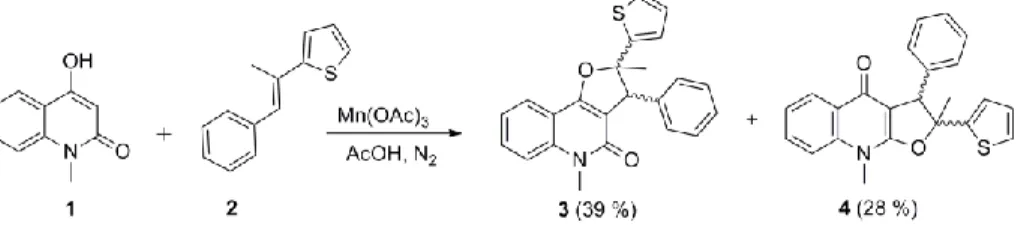
Herein, we report the oxidative cyclization of 4-hydroxy-1-methyl-quinoline-2-one (1) with steric hindered alkene (E)-2-(1-phenylprop-1-en-2-yl)thiophene (2) by using electrochemically synthesized Mn(OAc)3 which afforded 2,5-dimethyl-3-phenyl-2-(thiophen-2-yl)-2,3-dihydrofuro[3,2-c]quinolin-4(5H)-one (3, 39%) as an angular product and 2,9-dimethyl-3-phenyl-2-(thiophen-2-yl)-2,3-dihydrofuro[2,3-b]quinolin-4(9H)-one as a linear product (4, 28%) (Fig. 2).
Figure 2. Reaction of 1 with 2.
2. MATERIALS AND METHODS
Physical measurements
Melting points were determined on a Gallencamp capillary melting point. IR spectra (KBr disc, CHCl3) were obtained with a Matson 1000 FT-IR in the 400-4000 cm-1 range with 4 cm-1 resolution. 1H NMR (400 MHz), and 13C NMR (100 MHz) spectra were recorded on a Bruker Avance DPX-400 MHz and Varian Mercury-400 High performance Digital FT-NMR spectrophotometers. The mass spectra were measured on a Micromass UK LC/MS (APCI, 100-150 eV), and a Shimadzu GC-17A/GC-MS-QP5000 (EIMS, 70 eV) spectrophotometers. Elemental analyses were performed on a Leco 932 CHNS-O instrument. Thin layer chromatography (TLC) was performed on Merck aluminium-packed silica gel plates. Purification of products was performed by column chromatography on silica gel (Merck silica gel 60, 40-60 m) or preparative TLC on silica gel of Merck (PF254-366 nm).
Materials used for syntheses
4-Hydroxy-1-methyl-quinoline-2-one (1) was purchased from Merck and was used without further purification. Manganese(III) acetate dihydrate was used as a radical oxidant was obtained from the bipolar packed-bed reactor by electrochemical method in literature [17].
2.3. Syntheses
2.3.1. Syntheses of the new compounds (3 and 4)
Manganese(III) acetate dihydrate (3 mmol) in 20 mL glacial acetic acid was heated under a nitrogen atmosphere at 80 oC until it dissolved. After Mn(OAc)
3 dissolved completely, a solution of 1 (2 mmol) and alkene 2 (1 mmol) in 5 mL acetic acid was added to this mixture. Reaction was monitored by TLC. When the reaction was complete, H2O was added to the mixture and extracted with CHCl3 (3x20 mL). The combined organic extracts were neutralized with saturated NaHCO3 solution, and dried over anhydrous Na2SO4 and evaporated. The products were purified by column chromatography on silica gel or preparative TLC (20x20 cm plates, 2 mm thickness) using n-hexane/EtOAc (1/1) as an eluent.
2.3.2 2,5-Dimethyl-3-phenyl-2-(2-thenyl)-3,5-dihydrofuro[3,2-c] quinoline-4H-one (3)
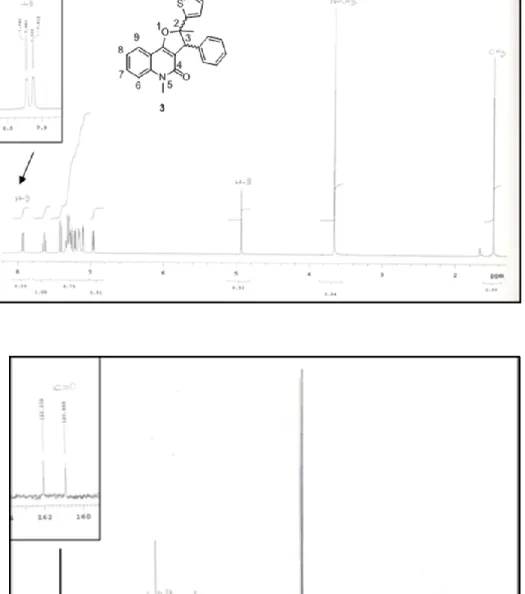
Light yellow solid; mp: 160-161 °C; IR (max, KBr): 3030 (Ar-H), 2927 (R-H), 1656 (C=O), 1637 (C=C), 1595, 1091, 750, 700; 1H NMR (400 MHz, CDCl 3), (ppm): 7.93 (1H, dd, J=8.0, 1.6 Hz, ArH), 7.63 (1H, td, J=8.0, 1.6 Hz, ArH), 7.41 (1H, d, J=8.4 Hz, ArH), 7.34-7.27 (4H, m, ArH), 7.21 (1H, dd, J=5.2, 1.2 Hz, ArH), 7.15 (2H, d, J=6.4 Hz, ArH), 7.11 (1H, dd, J=3.2, 0.8 Hz, ArH), 6.96 (1H, dd, J=5.2, 4.0 Hz, ArH), 4.93 (1H, s, H3), 3.66 (3H, s, N-CH3), 1.47 (3H, s, CH3); 13C NMR (100 MHz, CDCl3), (ppm): 26.32 (CH3), 29.32 (CH3), 59.14 (C3), 94.16 (C2), 110.85, 112.69, 114.86, 121.95, 123.13, 123.73, 124.76, 127.04, 127.83, 128.83 (CH*2), 128.94 (CH*2), 131.61, 137.68, 141.33, 151.17, 160.88 (C4), 162.03 (C9b); LC/MS, (ESI, m/z) : 374.44 (MH+, 100); Anal. Calcd. for (C
23H19NO2S): C 73.97, H 5.13, N 3.75, S 8.59. Found: C 73.90, H 5.60, N 3.92, S 8.32.
2.3.4 2,9-Dimethyl-3-phenyl-2-(2-thenyl)-3,9-dihydrofuro[2,3-b]quinoline-4(2H)-one (4)
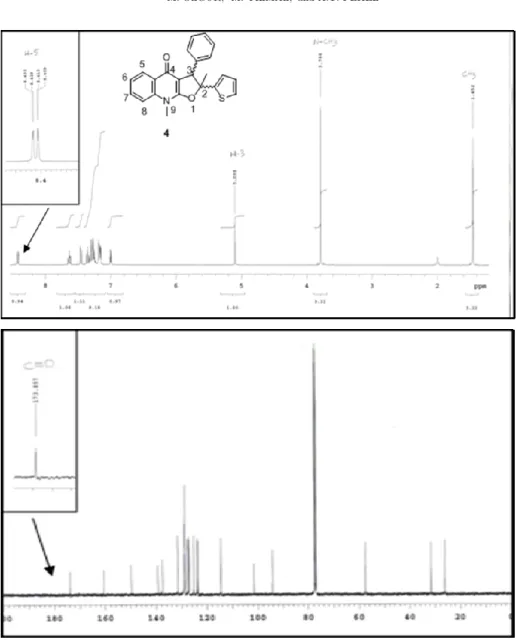
Light yellow solid; mp: 154-155 °C; IR (max, KBr): 3030 (Ar-H), 2927 (R-H), 1616 (C=O), 1585 (C=C), 1537, 1512, 1211, 1060 (C-O-C), 761 cm-1; 1H NMR (400 MHz, CDCl3), (ppm): 8.42 (1H, dd, J=8.0; 1.6 Hz, ArH), 7.63 (1H, td, J=7.8, 1.6 Hz, ArH), 7.45 (1H, d, J=8.4 Hz, ArH), 7.35 (1H, td, J=7.4, 1.2 Hz, ArH), 7.32-7.25 (4H, m, ArH), 7.18 (2H, dd, J=7.2, 2.0 Hz, ArH), 7.15 (1H, dd, J=3.6, 1.2 Hz, ArH), 6.99 (1H, dd, J=5.2, 3.6 Hz, ArH), 5.09 (1H, s, H3), 3.78 (3H, s, N-CH3), 1.45 (3H, s, CH3); 13C NMR (100 MHz, CDCl3), (ppm): 26.17 (CH3), 31.63 (CH3), 57.56 (C3), 94.21 (C2), 101.48, 114.58, 123.54, 123.90, 125.31, 127.04, 127.16, 127.21, 127.69, 128.68 (CH*2), 128.94 (CH*2), 131.52, 137.62, 139.29, 149.76, 160.72 (C9a), 173.85 (C4); LC/MS, (ESI, m/z): 374.76 (MH+, 100); Anal. Calcd. for (C
23H19NO2S): C 73.97, H 5.13, N 3.75, S 8.59. Found: C 73.87, H 5.35, N 3.57, S 8.45.
3. RESULTS AND DISCUSSION
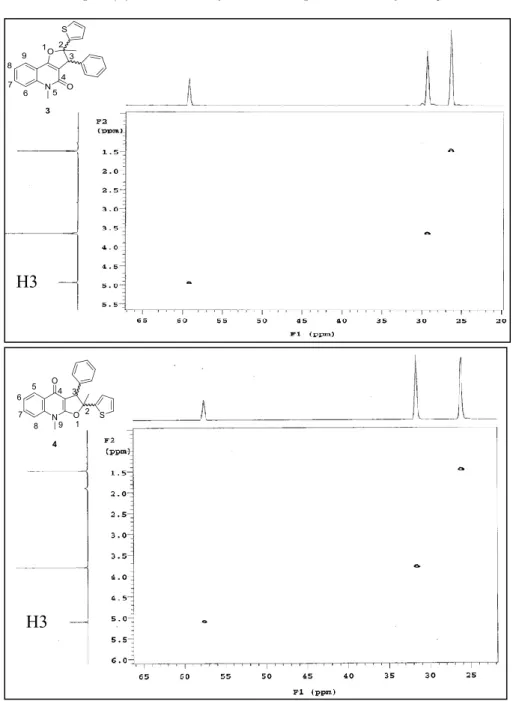
(E)-2-(1-Phenylprop-1-en-2-yl)thiophene (2) were synthesized through Wittig method with benzyltriphenylphosphonium bromide and acetylthiophene [18]. During the radical cyclizations, effect of temperature and the molar ratio of product yield were investigated, and thus, the best results were obtained in glacial acetic acid at 80 C in 20 minutes under nitrogen atmosphere using 2:1:3 molar ratio (1: 2: Mn(OAc)3, respectively). After the work-up procedure, dihydrofuroquinolinones (3 and 4) were purified by column chromatography or preparative TLC and characterized by IR, 1H NMR, 13C NMR, 2D NMR, MS and microanalyses. Two different dihydrofuroquinolinones (3 and 4) were synthesized from the reaction of 4-hydroxy-1-methyl-2H-quinoline-2-one (1) with (E)-2-(1-phenylprop-1-en-2-yl)thiophene (2). When NMR spectra of the compounds were examined, it was determined that 3 was an angular isomer, and 4 was a linear isomer. In the 1H NMR spectrum of 4, 9-H proton resonated as a dd at 7.93 ppm,while 5-H proton in 4 resonated as a dd at 8.42 ppm. Besides, in the 13C NMR spectra of the compounds, settings of carbonyl group were determined at 160.88 and 173.85 ppm for 3 and 4, respectively (Figs. 3 and 4). In the HSQC spectra of the compounds, it was found that thiophene and methyl groups were bound to C2 carbon in both structures (Fig. 5).
Figure 5. HSQC spectra of 3 and 4.
H3
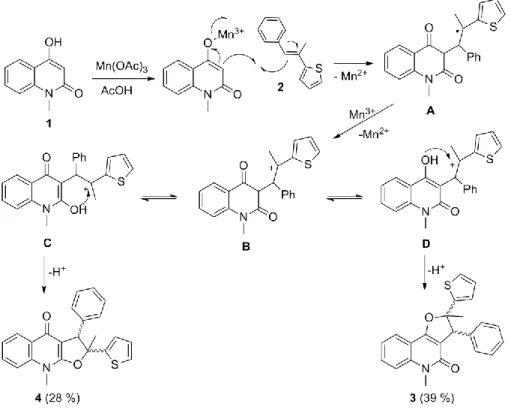
In our previous work, linear products were not obtained in the reactions of 4-hydroxyquinolinone derivatives with non-heteroaromatic alkenes in the presence of manganese(III) acetate [7]. Although Parsons [6] reported the angular and linear dihydrofuroquinolinones from the reactions of 1,1-disubstituted alkenes, the reaction conditions (heat at 60 0 C in an ultrasonic bath in the presence of KMnO
4 as the co-oxidant) and alkene (1,1,2-trisubstituted and heteroaromatic alkene) are different from this study. Therefore, it is obvious that the cyclization is prone to occur at the enolic keto carbonyl group in the cation D and a thermodynamically more stable angular product 3 would be produced more then linear product 4 (Fig. 6).
4. CONCLUSION
In conclusion, angular dihydrofuroquinolinone 3 (3%) and linear dihydrofuroquinolinone 4 (28%) were synthesized as a result of the cyclization reaction of 4-hydroxy-1-methyl-2H-quinoline-2-one (1) with (E)-2-(1-phenylprop-1-en-2-yl) thiophene (2) via Mn(OAc)3. We have synthesized thienyl substituted dihydrofuroquinolinone derivatives, which have biological activity potential. The reaction mechanism was proposed for the formation of these products.
ACKNOWLEDGEMENT. This work was supported by a research grant from the Ankara University BAP (10B4240006).
ÖZET
Açısal (3) ve çizgisel (4) dihidrofurokinolinon türevi, mangan(III) asetat varlığında 4-hidroksi-1-metil-kinolin-2-on (1) ile (E)-2-(1-fenilprop-1-en-2-il)tiyofen (2) nin tepkimesinden elde edildi. Bileşiklerin yapısı, MS, FTIR, ID ve 2D NMR teknikleri kullanılarak aydınlatıldı. Muhtemel bir tepkime mekanizması önerildi.
REFERENCES
[1] J. P. Michael, Quinoline, quinazoline and accordion alkaloids. Natural Product Reports, 21/5 (2004) 650-668.
[2] J. P. Michael, Quinoline, quinazoline and accordion alkaloids. Natural Product Reports, 25/1 (2008) 166-187.
[3] R. Naik, M.V Kulkarni, A. Kumar, and T.N. Guru Row, One pot three component diastereoselective synthesis of tricyclic furoquinolones and furocoumarins. Modern Organic Chemistry Research, 2/4 (2017), 179-188.
[4] J. Su , J. Xiong , S. Liang , G. Qiu , X. Feng , H. Teng , L. Wu, and X. Hu,
Concise synthesis of the angular dihydrofuroquinoline alkaloids via cyclopropane opening in the presence of polyphosphoric acid. Synthetic Communications, 36/6 (2006) 693-699.
[5] A. Ustalar, M. Yılmaz, A. Osmani, and S.A.Keçeli, Synthesis and antifungal activity of new dihydrofurocoumarins and dihydrofuroquinolines. Turkish Journal of Chemistry, 41/1 (2017), 80-88.
[6] G. Bar, A. F. Parsons, and B. Thomas, Manganese(III) acetate mediated radical reactions leading to araliopsine and related quinoline alkaloids. Tetrahedron, 57/22 (2001) 4719-4728.
[7] H. Nishino, R. Kumabe, R. Hamada, and M. Yakut, Mn(III)-based reaction of alkenes with quinolinones. Formation of peroxyquinolinones and quinoline-related derivatives. Tetrahedron, 70/7 (2014) 1437-1450.
[8] H. Nishino, Manganese(III)-Based Peroxidation of Alkenes to Heterocycles. Springer: Berlin, 6 (2006) 39-76.
[9] A. S. Demir, and M. Emrullahoğlu, Manganese(III) acetate: A versatile reagent in organic chemistry. Current Organic Synthesis, 4/3 (2007) 223-237. [10] H. Aslan, A. Oktemer , H. Dal , and T. Hokelek, Synthesis of ferrocene
substituted dihydrofuran derivatives via manganese(III) acetate mediated radical addition-cyclization reactions. Tetrahedron, 73/51 (2017) 7223-7232. [11] G. Bar, A.F. Parsons, and B. Thomas, A radical approach to araliopsine and
related quinoline alkaloids using manganese(III) acetate. Tetrahedron Letters, 41/40 (2000) 7751-7755.
[12] M. Yılmaz, E.V. Burgaz, M. Yakut, and E. Biçer, Synthesis of 4,5-dihydrofuran-3-carbonitrile derivatives with electron-rich alkenes in the presence of manganese(III) acetate. Journal of the Chineese Chemical Society, 61/10 (2014) 1101-1107.
[13] M. Yılmaz, Synthesis of dihydrofurans containing trifluoromethyl ketone and heterocycles by radical cyclization of fluorinated 1,3-dicarbonyl compounds with 2-thienyl and 2-furyl substituted alkenes. Tetrahedron, 67/43 (2011) 8255-8263.
[14] H. Aslan, D.A Akpınar, A Öktemer, M. Yakut, and A. Alagöz, Synthesis of dihydropyrans and dihydrofurans via radical cyclization of unsaturated alcohols and 1,3-dicarbonyl compounds. Helvetica Chimica Acta, 97/5 (2014) 652-663.
[15] M. Yılmaz, M. Yakut, and A.T. Pekel, Synthesis of 2,3-dihydro-4H-furo[3,2-c]chromen-4-ones and 2,3-dihydronaphtho[2,3-b]furan-4,9-diones by the radical cyclizations of hydroxyenones with electron rich alkenes using manganese(III) acetate. Synthetic Communications, 38/6 (2008) 914-927. [16] E. Loğoğlu, M. Yılmaz, H. Katircioğlu, M. Yakut, and S. Mercan, Synthesis and
biological activity studies of furan derivatives. Medicinal Chemistry Research, 19/5 (2010) 490-497.
electrosynthesis of manganese(III) acetate in a bipolar packed-bed reactor.
Chemical Engineering Journal, 99/3 (2004) 257-263.
[18] M. Yilmaz, N. Uzunalioglu, M. Yakut, and AT. Pekel, Oxidative cyclizations of 3-oxopropanenitriles mediated manganese(III) acetate with 2-thienyl substituted alkenes. Turkish Jornal of Chemistry, 32/4 (2008) 411-422.
Current Address: MEHTAP ÖZGÜR (Corresponding author): Department of Chemistry, Ankara University, 06100 Ankara, TURKEY
E-mail Address: [email protected]
ORCID:https://orcid.org/0000-0002-6237-8522
Current Address: MEHMET YILMAZ: Department of Chemistry, Kocaeli
University, 41380 Kocaeli, TURKEY’’.
E-mail Address: [email protected] ORCID: https://orcid.org/0000-0001-7179-4045
Current Address: A.TARIK PEKEL: Department of Chemistry, Ankara University, 06100 Ankara, TURKEY
E-mail Address: [email protected]