Effects of Nutritional Status and Habits During Pregnancy on
Term and Preterm Births
Address for correspondence: Halime Pulat Demir, MD. Saglik Bilimleri Fakultesi, Beslenme ve Diyetetik Bolumu, Istanbul Gelisim Universitesi, Istanbul, Turkey Phone: +90 212 422 70 00 E-mail: [email protected]
Submitted Date: November 27, 2017 Accepted Date: January 01, 2018 Available Online Date: February 05, 2018 ©Copyright 2018 by Eurasian Journal of Medicine and Oncology - Available online at www.ejmo.org
I
ncreasing need for energy, protein, vitamins, and miner-als during pregnancy, which is a physiological condition, increases the importance of nutrition for the mothers.[1] Nutrition during pregnancy is very important for healthy and smooth pregnancy course, prevention of complica-tions that may arise, and for the fetus to attain sufficient weight, complete organ development, especially the brain and be born in time. Therefore, nutritional habits should be observed during pregnancy, and sufficient nutritionaltraining should be given to pregnant women for increased awareness.[2]
There are frequent changes in body weight during preg-nancy. Gestational weight gain should be monitored[3, 4] because any increase or decrease in the weight during this time may lead to pathological changes in the birth weight of the baby, thereby resulting in significant consequences for the baby. The World Health Organization (WHO) rec-ommends that gestational weight gain should be deter-Halime Pulat Demir,1 Cemile Idiz,2 Hatice Merve Bayram,1 Seda Yıldırım1
1Department of Nutrition and Dietetics, College of Health Sciences, Istanbul Gelisim University, Istanbul, Turkey 2Department of Nutrition and Dietetics, Istanbul University Faculty of Medicine, Istanbul, Turkey
Abstract
Objectives: This study was designed to explore nutritional status and behaviors in pregnancy and investigate the
effects on preterm and term births.
Methods: The study was conducted with 120 mothers who gave birth (60 preterm and 60 term deliveries) in a private
hospital between November 2015 and December 2015 in Istanbul. A questionnaire to record the demographic charac-teristics of patients, smoking and alcohol use, nutritional habits, and food consumption frequency was administered in a face-to-face interview.
Results: In all, 65% of the births were by cesarean section and 35% were vaginal delivery; 41.7% of the preterm
deliv-eries were in women aged ≥35 years, whereas only 5% of term delivdeliv-eries were in women aged ≥35 years. Statistically significant differences were found in terms of education, work status, income level, smoking, pregnancy nutrition, and psychological status between preterm and term delivery mothers (p<0.05). Gestational weight gain was ≤8 kg in 36.7% of mothers with preterm deliveries and ≥12 kg in 36.7% of mothers and 8-12 kg in 68.3% of the mothers with term deliveries. Compared with preterm delivery mothers, term delivery mothers had fewer nutritional problems during pregnancy and more regular meal consumption (p<0.05).
Conclusion: Weight gain and nutrition in pregnancy are variables that affect preterm birth. Hence, nutritional
train-ing should be provided regularly to pregnant women, and their weight should be monitored.
Keywords: Nutrition, pregnancy, preterm, term
Cite This Article: Pulat Demir H, Idiz C, Bayram H, Yıldırım S. Effects of Nutritional Status and Habits During Pregnancy on Term and Preterm Births. EJMO. 2018; 2(2): 84-90
mined using maternal pre-pregnancy body mass index (BMI) (Table 1).[5]
There are comprehensive and valid arguments that bio-logical, metabolic, and social factors are determinants of maternal body weight gain. It has been suggested that the proposed low weight gain in pregnancy is associated with intrauterine growth retardation (IUGR), low birth weight (SGA), and perinatal mortality; high maternal weight gain (LGA) is associated with frequent complications related to pelvic noncompliance in the birth process.[6]
Dietary habits need to be rescheduled before and during pregnancy to maintain a healthy gestational course, achieve the ideal weight of the fetus, and have adequate nutrient storage. In prepregnancy and particularly during the gestation period, deficient and unbalanced nutrition with protein, vitamin, and mineral deficiencies may lead to miscarriage risk, premature birth risk, low birth weight, mental retardation, and congenital disorders.[7, 8]
This study was conducted to determine the nutritional status and behaviors in pregnancy and investigate their ef-fects on preterm and term births.
Methods
The study was conducted on 120 mothers (60 preterm and 60 term deliveries) who delivered in a private hospital in Is-tanbul. The study was conducted between November 2015 and December 2015 with selected participants among vol-unteers by random sampling method.
The questionnaire was administered to participants, includ-ing demographics, smokinclud-ing status, alcohol use, eatinclud-ing hab-its, and frequency of food consumption. The questionnaire was administered using the face-to-face interview method. Prepregnancy body weight and length were examined us-ing patient files, postpartum weight was measured by the investigator with precision scales, and BMIs were calculat-ed by investigator. Preterm infants were classificalculat-ed accord-ing to the WHO classification based on infant birth weeks: <28 weeks, extremely preterm birth; 28–32 weeks, moder-ate preterm birth; and 32–37 weeks, preterm birth.[9]
Statistical Evaluation of Data
The evaluation of the data was perfomed using SPSS 23.00 statistical program. Descriptive statistical methods (mean, standard deviation) were used for evaluating the study data. Normality assumption for continuous variables was tested using the Kolmogorov–Smirnov test. In a normal distribution, averages were compared using the Student’s t-test. The chi-square method was used to compare per-centages and ratios. The results were evaluted at 95% con-fidence interval, and significance was set at p<0.05.
Results
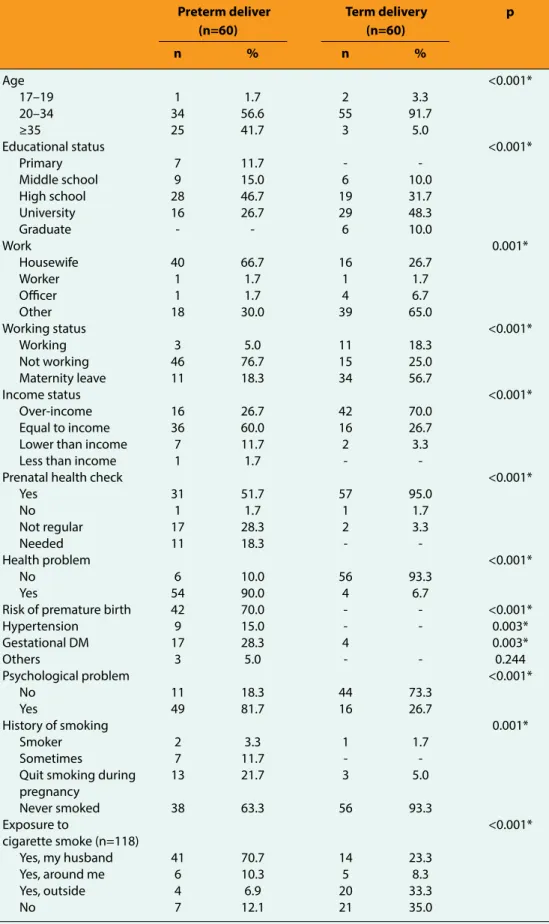
In our study, 91.7% of mothers who have term delivery and 56.6% of mothers who underwent preterm delivery were aged 20–34 years. Furthermore, 58.3% of mothers who have term deliveries were university graduates, and 66.7% of mothers who underwent preterm deliveries were housewives. It was observed that 51.7% of preterm delivery mothers and 95% of term delivery mothers went to prenatal health control programs (p<0.05). Additional-ly, 90% of preterm delivery mothers had health problems, and the risk of preterm delivery was found to be approxi-mately 70%; 93.3% of term delivery mothers did not have any health problems. Psychological problems were expe-rienced by 81.7% of preterm delivery mothers and 26.7% of term delivery mothers (p<0.05). Furthermore, 63.3% of preterm mothers never smoked and 21.7% quit during pregnancy; 93.3% of term delivery mothers did not smoke at all and 5% quit during pregnancy (p<0.001). Regarding exposure to cigarette smoke, 70.7% of preterm delivery mothers were exposed to cigarette smoke by their husband (70.7%); 33.3% of term delivery mothers were also exposed to cigarette smoke, but 35% of term delivery mothers were not (p<0.05) (Table 2).
Weight gain was ≤8 kg in 36.7% and >12 kg in 36.7% of preterm delivery mothers during the gestational period; 35% of term delivery mothers had a weight gain between 10 and 12 kg and 33.3% between 8 and 10 kg (p<0.001). It was observed that 88.3% of preterm delivery mothers and 25% of term delivery mothers experienced nutritional problems during pregnancy (p<0.05). The most common nutritional problems in pregnancy for preterm delivery mothers were stomach discomfort in 46.7%, flatulence in 45%, constipation in 43.7%, and nausea and vomiting in 43.7%, and in the term, delivery was fear of weight gain by 16.7%. Regarding meal consumption during pregnan-cy, 73.3% of preterm delivery mothers and 100% of term delivery mothers had breakfast every day, 65% of preterm delivery mothers and 96.7% of term delivery mothers had lunch every day, and 98.3% of term delivery mothers and Table 1. BMI categories (5)
BMI categories Recommended Recommended
weight gain (kg) weight gain (kg/month)
Underweight 12.5-18 2.3 Normal weight 11.5-16 1.8 Overweight 7-11.5 1.2 Obese <7 0.9
Table 2. General characteristics of individuals with respect to demographics and gestational term
Preterm deliver Term delivery p
(n=60) (n=60) n % n % Age <0.001* 17–19 1 1.7 2 3.3 20–34 34 56.6 55 91.7 ≥35 25 41.7 3 5.0 Educational status <0.001* Primary 7 11.7 - -Middle school 9 15.0 6 10.0 High school 28 46.7 19 31.7 University 16 26.7 29 48.3 Graduate - - 6 10.0 Work 0.001* Housewife 40 66.7 16 26.7 Worker 1 1.7 1 1.7 Officer 1 1.7 4 6.7 Other 18 30.0 39 65.0 Working status <0.001* Working 3 5.0 11 18.3 Not working 46 76.7 15 25.0 Maternity leave 11 18.3 34 56.7 Income status <0.001* Over-income 16 26.7 42 70.0 Equal to income 36 60.0 16 26.7 Lower than income 7 11.7 2 3.3 Less than income 1 1.7 - -
Prenatal health check <0.001* Yes 31 51.7 57 95.0 No 1 1.7 1 1.7 Not regular 17 28.3 2 3.3 Needed 11 18.3 - -Health problem <0.001* No 6 10.0 56 93.3 Yes 54 90.0 4 6.7
Risk of premature birth 42 70.0 - - <0.001* Hypertension 9 15.0 - - 0.003* Gestational DM 17 28.3 4 0.003* Others 3 5.0 - - 0.244 Psychological problem <0.001* No 11 18.3 44 73.3 Yes 49 81.7 16 26.7 History of smoking 0.001* Smoker 2 3.3 1 1.7 Sometimes 7 11.7 - -Quit smoking during 13 21.7 3 5.0 pregnancy Never smoked 38 63.3 56 93.3 Exposure to <0.001* cigarette smoke (n=118) Yes, my husband 41 70.7 14 23.3 Yes, around me 6 10.3 5 8.3 Yes, outside 4 6.9 20 33.3 No 7 12.1 21 35.0
83.3% of preterm delivery mothers had dinner every day (p<0.05) (Table 3).
According to prepregnancy BMI examination, 43.3% of preterm delivery mothers were normal, 25% were over-weight, 20% were obese; 28.3% became overweight and 45% obese after pregnancy. In addition, 76.7% of term de-livery mothers were normal, 8.3% were overweight, and 1.7% were obese before pregnancy, whereas 66.7% were normal, 25% were overweight, and 8.3% were obese after pregnancy; the BMI values found to be statistically different between groups (p<0.05) (Table 4).
Discussion
Many risk factors leading to premature birth have been identified, including advanced age, low education level, unemployment, socioeconomic status, smoking habit or cigarette smoke exposure, alcohol consumption, drug con-sumption, chronic health problems, medication use, and inadequate and unbalanced nutrition. Most women nowa-days delay their pregnancy plans due to late start of family life and more prominent economic freedom. However, ad-vanced age is a very important factor in terms of pregnan-cy progress and birth prognosis. Due to increased age, the risk of chronic diseases, such as hypertension and diabetes, Table 3. Weight gain and nutrition characteristics of pregnant women
Preterm delivery Term delivery p
(n=60) (n=60) n % n % Weight gain <0.001* <8 kg 22 36.7 9 15.0 8.1-10.0 kg 10 16.7 20 33.3 10.1-12.0 kg 6 10.0 21 35.0 >12.1 kg 22 36.7 10 16.7 Nutritional problem <0.001* No 7 11.7 45 75.0 Yes 53 88.3 15 25.0 Which nutritional problem
Fear of weight gain 13 21.7 10 16.7 0.643 Nausea, vomiting 26 43.3 4 6.7 <0.001* Stomach diseases 28 46.7 4 6.7 <0.001* Constipation 27 45.0 1 1.7 <0.001* Daily meal consumption
Breakfast <0.001*
Everyday 44 73.3 60 100.0 Every other day 15 25.0 - - 1-2 times a week 1 1.7 - - 1-2 times a month - - - -
Never - - - -
Lunch <0.001* Everyday 39 65.0 58 96.7
Every other day 14 23.3 2 3.3 1-2 times a week 6 10.0 - - 1-2 times a month - - - - Never 1 1.7 - -
Dinner 0.038*
Everyday 50 83.3 59 98.3 Every other day 5 6.7 1 1.7 1-2 times a week 4 6.7 - - 1-2 times a month 1 1.7 - -
Never - - - -
are increasing.[10] In the study of Harlow et al.,[11] it was ob-served that there was an increased risk of premature birth in mothers aged ≥30 years. In this study, 41.7% of preterm delivery mothers were aged ≥35 years. The increased risk of diseases prevalence with advanced age can harm the baby and lead to premature birth.
Socioeconomic status is also a factor directly related to preterm birth. A poor socioeconomic status may lead to premature birth. Between 1996 and 2006, births in nine countries were examined, and mothers with poor socio-economic status had a higher rate of preterm delivery.[12] In another study, the socioeconomic status of preterm delivery mothers was examined, and it was found that infants from low- and middle-income families were born with a higher preterm birth rate and low birth weight.[13] In our study, most preterm delivery mothers (66.7%) and only 26.7% of term delivery mothers were housewives. In addition, incomes and expenditures of preterm delivery mothers (60%) were equal, whereas the outcomes were higher than the expenditures in most term delivery mothers (70%).
From the beginning of pregnancy, medical controls are important for healthy pregnancy for both the mother and baby and aimed at determining the presence of any disease in mothers and preventing possible harms to the mothers and baby. In a study conducted in Turkey (n=200), the frequency of antenatal care differed according to so-cioeconomic status, monthly income, social security, edu-cational status, and number of pregnancy; also, there was a remarkable finding that some women with high economic status and education did not receive antenatal care.[14] In this study, 51.7% of preterm delivery mothers and 95% of term delivery mothers attended prenatal care (p<0.05), which was possibly because term delivery mothers had
high educational and socioeconomic status and were more conscious.
In addition, presence of diseases in the mother can lead to premature birth. In this study, 90% of preterm delivery mothers had health problems. Mood disorders after and during pregnancy affect many mothers.[15] In one study, 3.8% of mothers had psychological disorders,[16] whereas in another study, 54% of females experienced anxiety and 37.1% experienced depression.[17] Furthermore, another study found that psychological disorder and preterm deliv-ery were moderately related.[18] In our study, preterm deliv-ery mothers had more psychological problems than term delivery mothers.
The mechanism via which cigarette smoking affects preg-nancy remains unclear. Theoretically, carbon monoxide reduces fetal hypoxia, leads to calcium signal degradation, changes steroid hormone production, degrades prosta-glandin synthesis, and changes the response to oxytocin, which leads to premature birth.[19] Studies have shown that females exposed to cigarette smoke may also under-go preterm delivery. In a study on 164.905 people, those exposed to cigarette smoke were found to have prema-ture births.[20] In another study (n=102), the preterm de-livery rate of mothers with smoking habit was found to be higher.[21] Another study conducted on 922 premature and 965 late birth mothers found that 38% of premature births were in females who smoked during pregnancy. [22] In this study, 21.7% of preterm delivery mothers quit smoking during gestation, 11.7% were occasional smokers, and 3.3% were smokers during pregnancy; 93.3% of term delivery mothers did not smoke at all. Regarding smoke exposure without smoking, it was found that preterm de-livery mothers were generally exposed to cigarette smoke Table 4. Pre-and post-pregnancy BMI categories of individuals
BMI categories Preterm delivery Term delivery p
(n=60) (n=60) n % n % Pre-gestational <0.001* Underweight 7 11.7 8 13.3 Normal weight 26 43.3 46 76.7 Overweight 15 25.0 5 8.3 Obese 12 20.0 1 1.7 Post-gestational <0.001* Underweight - - - - Normal weight 16 26.7 40 66.7 Overweight 17 28.3 15 25.0 Obese 27 45.0 5 8.3
by their husband (70.7%), whereas 33.3% of term delivery mothers were exposed to cigarette smoke from outside (p<0.05). Smoking and smoke exposure rates in preterm delivery mothers were higher than those of term delivery mothers, which were consistent with the data in literature. Compared with the condition 60 years ago, currently, there have been many radical changes in the proposals made to increase the body weight of women during pregnancy. It was suggested in the 1920s that the body weight gain of pregnant woman should be not more than 6.8 kg for easier delivery and protection of physical structure after pregnan-cy.[23] During the 1940s, restriction of body weight gain in pregnancy was frequently resorted to, believing in the exis-tence of a close relationship between overweight and pre-eclampsia.[24] It has been postulated that after 1970 years, neonatal mortality with low body weight gain in pregnan-cy and low birth weight in infants which is the most import-ant effect for morbidity.[25] Weight gain during pregnancy was also associated with premature birth. For example, in a study conducted on 102 patients, gestational weight gain of ≥12 kg, cigarette use, and low educational status caused preterm birth.[26] In this study, 36.7% of preterm de-livery mothers had weight gain of ≥12 kg. Majority (68.3%) of term delivery mothers had weight gain between 8 and 12 kg, and the difference was significant (p<0.05). Our re-sults emphasized the importance of balanced weight gain during pregnancy for term and preterm deliveries, similar to the literature.
Studies have shown that body weight gain in pregnancy depends on sociodemographic and maternal characteris-tics, such as BMI at the start of pregnancy, age, education level, and ethnicity.[27] In addition, maternal anthropometry varies between populations.[28] Many studies support the association between BMI and preterm birth. In particular, increased BMI leads to premature birth.[29] In a study ex-amining the relationship between BMI and preterm birth, the prevalence of BMI <19.8 in pregnancy was associated with preterm birth.[30] In another study, obese women were examined, and a relationship between increased BMI and preterm delivery was observed.[31] In addition, in another study, increased BMI correlated with preterm birth.[32] The increase in BMI reduces the cervical length to <25 mm, leading to preterm birth.[33] It was observed that 11.7% of preterm delivery mothers were thin, and 45% of them had a risk of obesity; 13.3% of term delivery mothers were thin and 76.7% were normal (p<0.05). The results showed that prepregnancy BMI is in the normal range as well as weight gain at term and preterm birth at gestation.
Conclusion
The proportion of preterm delivery mothers aged ≥35 and 20-34 years is similar, and most term delivery mothers are aged 20-34 years. Preterm delivery mothers have lower so-cioeconomic status, and most are not working at all. The vast majority of mothers who give normal birth regularly visit healthcare systems and have no health problems. The vast majority of preterm delivery mothers have health and psychological problems. Preterm delivery mothers have a high rate of cigarette smoke exposure, although not many of them are smokers. The prevalence of preterm delivery is higher in mothers with high BMI during prepregnancy phase. Term delivery mothers pay more attention to nutri-tion and regular meal consumpnutri-tion and change their di-etary habits.
Preterm births are influenced by many factors, including mother’s weight gain and nutrition during pregnancy. The rate of preterm births with high mortality and morbidity can be reduced with regular weight follow-up and healthy nutrition training provided to pregnant women.
Disclosures
Ethics Committee Approval: Our study was approved by the
Ethics Committee of Istanbul Gelisim University with the letter dated 28.09.2015 and numbered 2015-2016.
Peer-review: Externally peer-reviewed. Conflict of Interest: None declared.
Authorship contributions: Concept – H.P.D., C.I., H.M.B., S.Y.;
De-sign – H.P.D., C.I., H.M.B., S.Y.; Supervision – H.P.D., C.I., H.M.B., S.Y.; Materials – H.P.D., C.I., H.M.B., S.Y.; Data collection &/or processing – H.P.D., C.I., H.M.B., S.Y.; Analysis and/or interpretation – H.P.D., C.I., H.M.B., S.Y.; Literature search – H.P.D., C.I., H.M.B., S.Y.; Writing – H.P.D., C.I., H.M.B., S.Y.; Critical review – H.P.D., C.I., H.M.B., S.Y.
References
1. Yenal K, Aluş TM, Serçekuş FP. Nutrition in Pregnancy. Birth Preparation. 1st ed. İzmir: Deomed: 2009. p. 44–59.
2. Köksal G, Gökmen H. Nutrition in Children's Diseases. 1st ed. Ankara: 2013.
3. McCormick MC. The contribution of low birth weight to infant mortality and childhood morbidity. N Engl J Med 1985;312:82–90. [CrossRef]
4. Spellacy WN, Miller S, Winegar A, Peterson PQ. Macroso-mia-maternal characteristics and infant complications. Obstet Gynecol 1985;66:158–61.
5. Institute of Medicine (US) Committee on Nutritional Status During Pregnancy and Lactation. Total Amount and Pattern of Weight Gain: Physiologic and Maternal Determinants. In: Nutrition During Pregnancy: Part I Weight Gain: Part II Nutri-ent SupplemNutri-ents. Washington, DC: National Academy Press;
1990. p. 1–233.
6. Viswanathan M, Siega-Riz AM, Moos MK, Deierlein A, Mum-ford S, Knaack J, et al. Outcomes of maternal weight gain. Evid Rep Technol Assess (Full Rep) 2008:1–223.
8. Demir L. Women's Health Diseases and Care Book. Ankara-Tur-key; 2009.p.84-85.
9. Blencowe H, Cousens S, Oestergaard M, Chou D, Moller AB, Narwal R, Adler A, Garcia CV, Rohde S, Say L, Lawn JE. National, regional and worldwide estimates of preterm birth. The Lan-cet, June 2012. 9;379(9832):2162-72 (Cited 02.02.2017). Avail-able from: URL: http://www.who.int/mediacentre/factsheets/ fs363/en/
10. Kıran H, Kıran G, Güven M. Effects of Maternal Age on Preg-nancy and Fetal Prognosis. Arşiv Kaynak Tarama Dergisi 2014;12:90.
11. Clausson B, Cnattingius S, Axelsson O. Preterm and term births of small for gestational age infants: a population-based study of risk factors among nulliparous women. Br J Obstet Gynae-col 1998;105:1011–7. [CrossRef]
12. Dadvand P, Parker J, Bell ML, Bonzini M, Brauer M, Darrow LA, et al. Maternal exposure to particulate air pollution and term birth weight: a multi-country evaluation of effect and hetero-geneity. Environ Health Perspect 2013;121:267–373. [CrossRef]
13. Katz J, Lee AC, Kozuki N, Lawn JE, Cousens S, Blencowe H, et al. Mortality risk in preterm and small-for-gestational-age infants in low-income and middle-income countries: a pooled coun-try analysis. Lancet 2013;382:417–25. [CrossRef]
14. Kılıç S, Uçar M, Temir P. Prenatal care in pregnant women and the factors effecting it. TAF Preventive Medicine Bulletin 2007;6:91–7.
15. Cebeci SA, Aydemir Ç, Göka E. Depression symptom preva-lence in the puerperal period: obstetric risk factors, anxiety level and relation to social support. Crisis 2002;10:11–8. 16. Arslan B, Arslan A, Kara S, Öngel K, Mungan MT. Risk factors for
pregnancy anxiety and depression: assessment in 452 cases. Tepecik Eğit Hast Derg 2011;21:79–84. [CrossRef]
17. Lee AM, Lam SK, Sze Mun Lau SM, Chong CS, Chui HW, Fong DY. Prevalence, course, and risk factors for antenatal anxiety and depression. Obstet Gynecol 2007;110:1102–12. [CrossRef]
18. Dole N, Savitz DA, Hertz-Picciotto I, Siega-Riz AM, McMahon MJ, Buekens P. Maternal stress and preterm birth. Am J Epide-miol 2003;157:14–24. [CrossRef]
19. Ion R, Bernal AL. Smoking and Preterm Birth. Reprod Sci 2015;22:918–26. [CrossRef]
20. Le HQ, Batterman SA, Wirth JJ, Wahl RL, Hoggatt KJ, Sadegh-nejad A, et al. Air pollutant exposure and preterm and term small-for-gestational-age births in Detroit, Michigan: long-term trends and associations. Environ Int 2012;44:7–17. [CrossRef]
21. Kramer MS, McLean FH, Eason EL, Usher RH. Maternal nu-trition and spontaneous preterm birth. Am J Epidemiol 1992;136:574–83. [CrossRef]
22. Smith LK, Draper ES, Evans TA, Field DJ, Johnson SJ, Mank-telow BN, et al. Associations between late and moderately preterm birth and smoking, alcohol, drug use and diet: a pop-ulation-based case-cohort study. Arch Dis Child Fetal Neona-tal Ed 2015;100:F486–91. [CrossRef]
23. Slemmons JM, Fagan RH. A study of the infant's birth weight and the mother's gain during pregnancy. Am J Obstet Gyne-col 1927;14:159. [CrossRef]
24. Chesley LC. Weight changes and water balance in normal and toxic pregnancy. Am J Obstet Gynecol 1944;48:565–91. [CrossRef]
25. Copper RL, DuBard MB, Goldenberg RL, Oweis AI. The rela-tionship of maternal attitude toward weight gain to weight gain during pregnancy and low birth weight. Obstet Gynecol 1995;85:590–5. [CrossRef]
26. Brawarsky P, Stotland NE, Jackson RA, Fuentes-Afflick E, Esco-bar GJ, Rubashkin N, et al. Pre-pregnancy and pregnancy-re-lated factors and the risk of excessive or inadequate gesta-tional weight gain. Int J Gynaecol Obstet 2005;91:125–31. 27. Kelly A, Kevany J, de Onis M, Shah PM. A WHO Collaborative
Study of Maternal Anthropometry and Pregnancy Outcomes. Int J Gynaecol Obstet 1996;53:219–33. [CrossRef]
28. Luke B, Brown MB, Stern JE, Missmer SA, Fujimoto VY, Leach R; SART Writing Group. Female obesity adversely affects assisted reproductive technology (ART) pregnancy and live birth rates. Hum Reprod 2011;26:245–52. [CrossRef]
29. Hickey CA, Cliver SP, McNeal SF, Goldenberg RL. Low pregravid body mass index as a risk factor for preterm birth: variation by ethnic group. Obstet Gynecol 1997;89:206–12. [CrossRef]
30. Hendler I, Goldenberg RL, Mercer BM, Iams JD, Meis PJ, Moawad AH, et al. The Preterm Prediction Study: association between maternal body mass index and spontaneous and in-dicated preterm birth. Am J Obstet Gynecol 2005;192:882–6. 31. Torloni MR, Betrán AP, Daher S, Widmer M, Dolan SM, Menon
R, et al. Maternal BMI and preterm birth: a systematic review of the literature with meta-analysis. J Matern Fetal Neonatal Med 2009;22:957–70. [CrossRef]