A. O. Vet. Fak. Der!! 33 (3) : 452-463; 1986
COMBINEO EFFECT OF G-lEMICAL TREATMENT AND RADURIZATION ON THE EXTENSION OF STORAGE LIFE OF ANCHOVY (EngI'aulis encrasica1us)!
ı.Öztaşıran?, B.Dinçer.', B.Mutluer2, S.Ersen2, B.Kaya2
Kimyasal işlem \'e radurizasyonun birlikte uygulanmasının hamsi balığının dayanma süresi üzerine etkisi
Özet: Bu araştırma, kimyasal katkı maddeleri (sodyum klorür ve sodyum tripol(losfat), raduriza!)yon ve bu kimyasal katkı maddeleri ile radurizasyonun birlikte tatbik edilmesinin, hamsi baltğtnın kim-yasal, mikrobiyolojik ve organoleptik niteliklerine etkilerini belirle-mek amacıyla yürütülmüştür. Kimyasalolarak toplam uçucu baz-nitro-jen (total volatile base-nitrogen: TVB-N), tiyobarbütirik asit (TBA)
ve peroksik değeri (PV) saptanmış; mikrobiyelolarak aerobik mesofi-lik, aerob ik psikrofimesofi-lik, S. aureus, kolifornı ve E. coli say ilm ış ; ve ayrıca organoleptik muayene yapiımıştır.
Hamsi baltğtnııı sodyum klorür ve sodyum tripolifosfat çözeltilerinde (lO
%)
sırasıylaı
5ve 60'şar dakika bekletilmesi hem kimyasal, hem de mikrobiyolojik kalitelerini çok az derecede etkilemiş ve dayanma süre-sini artırmamıştır. Hamsi baltğının düşük ısı derecesindeı
kGy dozla ışınlanması mikroorganizmalann üremelerini büyük ölçüde önlemiş ve buna bağlt olarak bozulma süresi belirli derecede artmıştır. Araştmna bulguları, hamsi baltğının sodyum tripolifosfat ile birlikte radurizasyona tabi tutulmasınl11 diğer uygulamalara kıyasla daha etkin olduğunu ortaya koymuştur. Bu uygulamaya tabi tutulan hamsi baltğı numunelerinden en yüksek organoleptik puanlar elde edilmiştir. Böylece, hamsi baltğtnl1l dayanma süresinin, radüriza!)yonun sodyum tripolifosfat ile birlikte tatbiki sonucundaı
2 gün kadar uzatilabileceği saptanmıştır.ıReseareh Supported by The Turkish Atoınİe Energy Authority and the IAEA under Contraet No: 3774/ RB.
2 Lalahan Nuclear Researeh Institute in Animal Health, Ankara.
3 Doç.Dr., Department of Food Hygiene and Technology, Faculty of Veterinary Seience, University of Ankara, Ankara.
COMBINED EFFECT OF CHEMICAL TREATMENT... 453
Sunımary: This investigatioıı was undertaken to study the effect"of
chemical treatment (sodium chloride and sodium tripolyphosphate), radurization and combine treatment of anchovy with chemieals and ra-durization on the ehemical, microbial and organoleptic properties of anchovy fish. For this purpose, total volatile base-nitrogen (TVB-N), thiobarbutiric acid (TBA) and peroxide value (PV) were determined as chemieally. For microbiologically, aerobic mesoplıilic, aerobic psyc-hrophilic, S. aureus, coliforms and E. coU were counted and in adition to the organoleptic attributes were also evaluated.
The dip treatment of anchovy in sodium chloride and sodium tri-polyphosphate did not effect much both clıemieal and microbiological attributes and therefore did not increased the storage life. Radurization itself 1 kGy dose (at 0-3 OC) retarted the growt/ı of microorganisms, only small extent. The experimental results showed that anchovy treated with botlı radurization and sodium tripolyphosplıate was more effective than the other treatments. Andıovy treated with combination of raduri-zation and sodium tripolyphosphate gaye higher sensory scores tlıan the others. It was observed that treating anchovy in this way could extend the sheef-life of fresh anchovy for approximately 12 days.
Introduction
Seafoods have always been prefered by consumer in fresh state. For this reason, preservation by so me means is absolutely essential for prolonging the self-life and for storage of all seafoods. The most common methods for prolonging the shelf-1ife of seafoods are the use of icing, refrigeration, freezing and irradiation. Eventhough, the sea-foods are preserved by the se methods, deterioration of them is a frequent problem in most of the countries (3,11,15).
Turkey has high fish catching and producing capacity. The seas around Turkey contain various types of fish, particularIy anchovy -(in Turkish called as hamsi) in planty amount. In 1984, the amount of
anchovy harvested was over 330.000 tons at the Black Sea Region of Turkey (1). Fish including anchovy are stored mostly in ice during the distribution and marketing in Turkey, the length of shelf-life of anchovy stored in ice (3-4 days) is not enough for transportation of anchovies to the some parts of Turkey for away from the anchovy harvesting areas, such as the interior and the eastem part s of Anatolia.
Deteriora-454 J. ÖZTASIRAN - B. DİNÇER - B. MUTLUER. S. ERSEN. B. KAYA
tive changes and spoilage are therefore mostly occurred in anchovy during the trasportation and marketing (10).
The length of the stürage time during which optimum acceptabi-lity is maintained depends upon the preservative methods used. Over the past several decates, much attention has been given to application of ionising radiation as a methods of meat preservation including fish. Ionising radiation destroys microorganisms in and on fish without raising the temperature of the products. it is therefore referred to as cold sterilization (5, i5).
lonising radiation applied at higher doses and temperatures causes a number of undesirable changes in fish including discoloration and the production of very objectionable odours and f1avors (3). However, recent studies have indicated that ionising radiation at lower deoss and temperatures (radurization) in conjuction with other measures, such as chemicals, spices and controlled atmosphore has led the fresh meat and fish for about three weeks shelf-life. Such a long shelf-life for fresh fish is adequate for transfering and marketing. Radurization process with chemical treatment such as predip treatments in salt solu-tions like sodium chloride, sodium polyphosphate is presently in the experimental development stage (3,6,7,14).
The objective of this study was to investigate the possible combi-ned effect of radurization and chemical treatment on chemical, micro-bial, organoleptic properties and shelf-life of anchovy.
Materials and Methods
Preparation oj sanıp/es: The samples of fresh anchovy were ob-tained from the fish market in Samsun which is a city in the Middle Part of Black Sea Region of Turkey. The anchovy samples were transported on the catching date in ice to the food lrradiation Laboratory at Lala-han Nuclear Research Institute in Animal Health, Lalahan, Ankara. The samples were first separated into three groups; one of the m was chosen as a control; second group was dipped in
Lo
%
sodium tri-polyphospate (NaTPP) solution for 15 minutes; and third group \Vas dipped inLo
%
sodium chloride (NaCl) solution for one hour. After that the samples including control group were divided into two parts and then packed into poJyethylene bags in thickness of 0,05 mm. One of the bag from each group of samples was irradiated withı
kGy dose inCOMBINEDEFFECT OF CHEMICAL TREATMENT. . . 455
the CS137 source (Mark 1-22 Irradiator, 10.000 Ci J.L. Sheppard and
Associates) at a dose rate of 1,86 x 10³Gy / h measured by the Fricke
Dosimeter. The temperature was maintained at 1-4 Co during the ir-radiation. Both the irradiated and unirradiated anchovy samples were stored at 0-3 oC during the 15 days experimental period. The samples were appIlied to aech analysis shown below on the days of the 0,5,8,12 and 15 th respectively.
ehemical analysis: Changes in Ieves of total volatile
base-nitro-gen (mg TVB-N %); Thiobarbituric acid (TBA as mg
malonalde-hyde / kg samples); and the peroxide value (PV) were determined with
the methods of Mwansyemala (8).
Microbiological analysis: From each samples, LO gr of muscle tissue was weighted under the sterile conditions and homogenized af ter addition of peptone (0,1
%)
and sodium chloride (0,85%)
solu-tion so as to form a LO%
solution in a stomacher for 2 minutes. From this homogenized samples, a series of dilutions (102 to 107) werepre-pared. The number of colony forming units (cfu / g) was determined for microflara as follows:
Aerobic mesophilic count was obtained by using plate count agar (PCA) (Oxoid CM 325) with soId (0,5
%).
Incubation was done at 30°C for 72 hours (13). Aerobic psychrophilic plate count was also determined on plate count agar (PCA) (Oxoide 325) including 0,5%
sold and incubating at 4-6oc.
For total coliforms and Escherichia coli were detectedby using the 3-tube MPN procedure (4). Staphyloc-cus aureus was examined by the 3-tube MPN method using Trypticase Soy Broth (Oxiod CM 129) and Baird Parker Medium (Oxoid CM 275) (4). Selected colonies were tested for cuagulase activitiy (2).Sensory evaluation: The sensory or organoleptic evaluation was done with the sIight modification of the method used by Nanyora and Bon .(9).
The co lo ur, odour of raw anchovy samples and the odour, texture and flavor of cooked samples were judged by the 5-6 trained panelists and scored on a tenpoint scale on which 5 was taken as acceptable li-mit.
Statistical analysis: Two-way analysis of variance was carried out to determine the statistical differences among the treatment gr.oups (l2).
456
ı.
ÖZTAŞIRAN - B. DıNÇER. B. MUTLU ER - S.ERSEN o°B. KAYAResults
The mean effeets of ehemieal treatments and radurization on ehe-mieal examinations of anchovy during the storage time are presented İn Table
ı.
The TVB-N values of all anehovy samples increased as the storage time was inereased. However, the inerease in these values was greater and faster in untreated anehovy than treated with ehemieals, radurized and ehemieals-radurized of anehovy samples. The untreated anehovy showed the highest TVB-N value (76,33 mg N%)
on the 8 thday of storage, while anehovy treated with both NaTPP-raduriza-tion showed the lowest value (18,24 mg N%).
The redueing effeet of NaTPP was higher than NaCL. Radurization itself redueed the TVB-N formation of anehovy more than the chemieals. The eombined treat-ment of radurization and NaTPP was found more effective than the others and it signifieantly redueed the TVN-B formation in anchovyo during the storage time.
TBA and PV values in both untreated and treatedanehovy samp-les markedly increased during the first 5 days of storage, thereafter they showed slightly fluetuations. TBA and PV values in the combine treated samples with radurization-NaCI and NaTPPshowed signifi-eant inerease after the 8 days of storage.
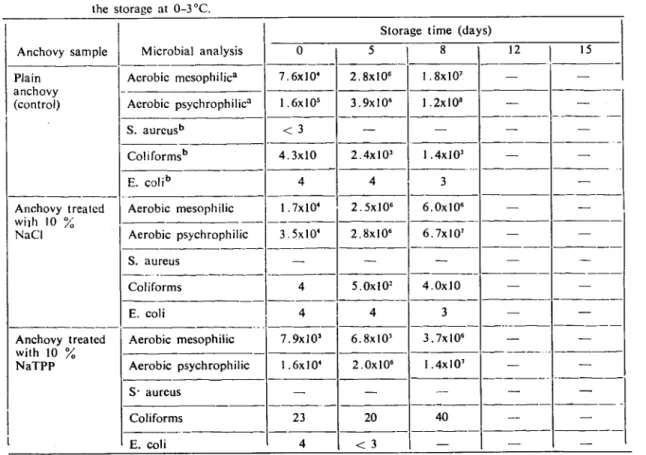
The mierobiological results obtained from untreated and treated anehovies with both ehemieal and radurization are shown in Table 2. The initial aerobic mesophilie and psyehrophilie counts of the plain anehovy increased almost to spoilage levels (I .8 x i07 and 1.2 x 10⁸ respeetiveııy) after the 8 days of storage. Tn these sampleseoliform group, E.eoli were present until the 8 days of storage .. However, S. aeureus were present only at the beginning of the storage time. NaCl and NaTPP did not reduce mueh the microbial eounts. Radurization of fresh anchovy with 1 kGy dose extend a little more the mierobial quality than the ehemieals. Coliforms and E. eoli were destroyed after the applieation of radurization. The combined treatment of anehovies with radurization and ehemieals partieularIy with NaTPP destroyed eoliforms and E. eoli and redueed in large extent the aerobic and psyc-hrophilie eounts and aııowed the storage for 12 days. During thesto-rage time, the aerobic mesophilie and aerobiepsyehrophilie counts increased from 1.3 x 10² and 2.3 x LO' to 1.6 X 10³ and 1.6,( 107İn
samples treated NaTPP-radurised respeetively.
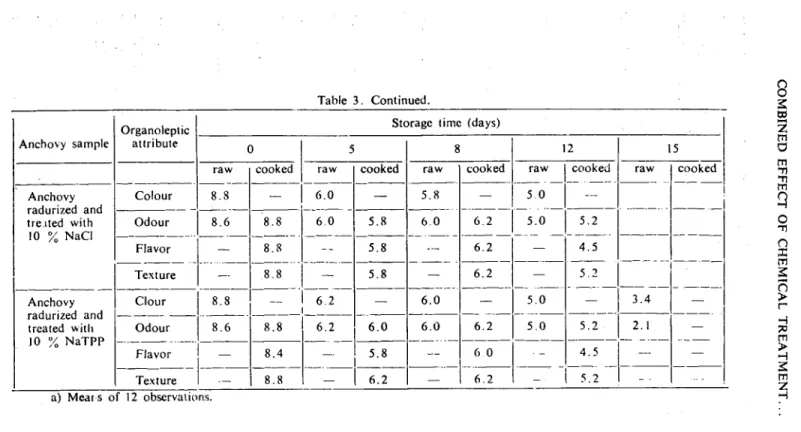
The results of sensory assesments of the ehemieal treatments and radurization of the raw and eooked anehovy samples are summarized
Tablc 1. The effect of chemical treatn~eııt and radurization (i kGy) on chemical properties of anchovy during the stürage al 0-3"C •.
_______ r . .• . _ ---_.- ---
--- ---
--- --- ..-_._- ._---.•.. tl> -ı8
a::
tı:ıZ
(Tlcı
iıı""
(Tl n -io
"
n :: (Tla::
() ;> ı-'. -i,.,.
(Tl .~a::
(Tlz
-i 40.43 :l: 5.01 3.01 :1: 1.42 7.08 :+: 1.66 28.90 :J: 3.57 5.28 :J: 0.37 12.80 J: 1.96 30.32 .L 1.28 41.051- 9.07 2. 68 ::'. O.34 6. 30 TL. 09 4.40 :ı 0.56 JO. 76 j. 1.21 1981:i'-i~
1.61-;1:'58
J-9.03 ~7-::!:-9~Ö3
3.09.1. 0.55 5.81 cc. 0.84 5.62' 2.07 5.oo::!: 0.61,11.30:l, 1.43 11.50 + !.97 18.24 :J: 0.90 2.68 .. 0.42 9.60 :L 1.25 62.89 ,1. 3.47 2.97 :' 0.53 8.20 -L 0.99 --- -1-- __ o--- -- - -.---54.43 -:- 4.19 2.76 :t 035 8.50 .-: 0.04 ----_.- -'--.- - -- ---"--- -14.44 :i: 1.58 3.70 ::!: 0.43 3.40 :i: 0.31 17.40 ::!: 1.40 3.85 :J: 0.98 6.40 ::!: 0.57 13.93 :i: 1.39 2.91 T: 0.94 5.30 :J: 0.24 30.02!c 2.52 3.16 -L 0.67 5.40 le 0.52 10.70 ::!: 0.35 0.56 :J: 0.02 0.40 J: O. 16 13.i2 -i. 0.32 0.71 ::: 0.08 0.40 :l 0.16 12.Lo .t: 0.30 ı.05 ::1.:0.08 3.00 + 0.29 10.75 ::!: 0.20 0.77 :!: 6.08 2.80=:
0.27 TVB-N TBA PV TVB-N TBA PV TVB-N TBA PV TVB-N TBA PV .-.--- ---Allchovy radurized Anchovy treated wirh LO% NaTPP Anchovy raduriz::d and treated with LO /'~ NaTPPa) Means and standart deviations of 8 ob~ervations b) Total volatile Base-Nilrogcn as mg N %)
c) Tiobarbituric acid as. ug ınalonaldchydc (%) Allclıovy
radurized and i treatcd with 10 %
NaCl
Chemical Sıoraı;e time {days)
Anchovy samplt: a_n_al_ys_i~__.__ ~ '. 5 ~_._J_._._J_2 ..1: _
.---Plain ancho'y TVB-Nb jO.78:', 0.29 34.27 cl: 3.39 76.33 + 6.88 (control) TBN 0.33 ol: 0.02 2.JO 0.40 3.19:Tc 0.33 PV 0.50 i- 0.27 4.60:1: 0.47 8.00::i: 0.93
---_.-.-.1--_. _
i
Anchovy treated TVB-N 13.44:i: 0.17 31.21 +: 2.62 with LO ~~ TBA 0.52 1: 0.05 3.66 ci 0.84 NaCl PV 1.20 :+: 0.24 3.70 i: 0.36Table 2. Effcct of chemica\ ır~tment and radurization (i kGy) on microflora of anchovy during the storage at 0-3 oc.
--- -- --- --- ---
---.--1--- ---1---1--- ---- ---15
6.7x10' Starage time (days)
5 8 12 2.8x10⁶ 2.8x10⁶ i .8x1O' 3.9x10⁶ i .2xI0' -_..--- .--- -2.4xlO' i .4xlO' .--~---- ----4 3 ----2.5x10⁶ 6.0xl06 4 i .7xI0' 3.5xlO' ---1--- --- ---- ---Aerobic psychrophilic E. colib Aerobic mesophilic S. aureus Anchovy treatcd wi)h iO :;~ NaCl
Anchovy samp\e Microbia\ ana\ysis O pJain Aerobic mcsophilica 7.6xI0' anchovy
(control) Aerobic psychrophilica \.6xIO'
---S. aurcusb <3 Coliformsb 4.3xlO --- ---E. coli 4 4 3 ---!---.--- .1_---1---1--- --- ---S' aureus 1--- --- --- ---1-- ---- .._- ---40 f.4xlO' 3.7xl06 4.0xlO 20 2.0x10⁶ 5.0xI0' 6.8xI0' 4 _---1--- _---1---_ .._ --.----23 ı_6xlO' 7_9xI0' Coliforms Aerobic mesophilic Aerobic psychrophilic Coliforms 1--- --- ---1--- --- ---1---1--- --1---1--- --- ---Anchovy treated wiıh Lo % NaTPP --- ---1--- --- --- ---E. coli 4 <3
12 15 -.- ---i.Ox108 --- ----9.2xlO' --- ---" - ----,.'.- _. ...
-_.
_. - --- --- ---- ---i.5xIO' i.3x108 --- ---9.8xI0' i.7xlO' --'- ---- - ---.. --- ._---6.5xI0. i.6xI0' ---- ---8.5xlO. i.5xlO' --- --- --'."-- --- -- -5 !l ---_
.. _-1.9xl0' i.lxIO. ---- ---i.4xlO' 1.7xI0.----
_._--- --~--- --.----._-- --- -",.-._--_0_--
--- ---2.2xl0' 2.2xIO. ---2.8xlO" 2 8xlO. - -. ._-- --- ----"-- -_O-o" -- '-2.lxlO< 4.7x1O' --1.8xlO< 5.0xI0'-
----
-<3 2.3xlO' 1.3xlO' 2.0xI0' 6.0xl0' 7.2xl0' E. coli E. coli Aeıobic psychrophilic Aerobic psychrophilic Coliforms Aerobic mesophilic S. aur~us E. coli Coliforms S. aııreus Aerobic psychrophiiic Aerobic mesophliic S. aureus C)jifcrms Anchovy radurized and treated wİth LO %NaTPP Anchovy radurized and treated with 10 % NaCl Tabl~ 2. Continued.I
.
1---,,---- Stnrag~ time (day s'Aııchovy sample Microbial ana1ys:s O
--- ---_ ..
_-
--_.~------Anchovy Aerobic mesophilic 4.1 xiO' radurized ---- --- --.--
-a) Count/ g. b) MPN /g.
Table 3. The effect of chemical treatment and radurization (I kGy) on the organoleptic quality of the raw and cooked anchovy during the storage at (}-3OC".
Organoleptic Starage time (days) ._- i
Anchovy sample attribute
i
o~k,d1-',,
5 8 12 ı5
cooked cooked
___ o
cooked
raw raw raw raw C'ooked
--- ---- --- --'- --
._-Plaİn anchovy Colour 8.6 -- 4 o - 2.0 (control) --- --- ---- ----
----
___ o --- --- ---._- ----Odour 8.8 8.8 4.8 4.3 1.0 -.._------
--- ____ o ---Flavor -- 8.8 - 4.0-
---. -- ---- -'-._-- ----_.-
___ o -Texture - 8.8 - 4.3 - -------
--- -- -Anchovy Colour 8.8 - 5.2 - 2.0 -treated with --- --- ---- ____ o -- -LO % NaCl Odour 8.6 8.8 4.8 5.3 2.1--_
..._--- -----_.- ---
"--- ---- ---- _.----Havor - 8.8 _. 4.7 - --- ---- ____ o---
---
---- --- ---- --- ._---Texlurc -. 8.8 - 5.0 - -_.--,---- ------ -- ---- --- --- --_.- ----Anchovy Colour 8.8 - 5.5 - 3.4 -treated with --- --- --- --- ---lO 0/ NaTPP Odour 8.6 8.8 5.2 5.5 2. I -. /0 --- ---_.. ---- --.-- ---- --- ---- ---- ~---Flavor - 8.4 - 4.7 - --- ----_.- -"-_ .. .- ___ o. ---_._-". ---- ---- ---Texture - 8.8-
5.0 - --- --- ---- --- ---- ---- ---- --- ---- _.----Anchovy Colour 8.6 - 5.8 - 5.2 - 3.0 -radurized ---"---- ---. ----_. ._- ____ o._
.._--_.----
--_.- _._---_... Odour 8.2 8.8 6.0 5.8 5.5 2.2 --- -_0--- ---- ---o ---. --- ..._-----"-i
Flavor-
8.6 - 5.0 - 5.98-
-__ o. ----Texture-
8.8-
5.5-
5.8 --o: N ~ til
...
;tl ;l> Z !il m ;tl til m Z "Table 3. Continued.
Storage time (days)
8
~ t:ııZ
m O m "Tl "Tl mQ
O "Tl () :ı:: m ~n
:> r -ı ;i:ı m :> -ı ~ m Z -ı462 i. ÖZTAŞIRAN. B. DINÇER - B. MUTLUER - S. ERSEN.~ B .. KAYA
in Table 3. There was not any significant changes amoung the colour, odour, flavol' and texture of all samples on the first day of storage. In the unterated anchovy sampJes, spoilage was observed on the 5 th day of storage. However, anchovy treated eve n with NaCl and NaTPP were still acceptable at the 5 th day. Radurization improved the sen-sorial quality only smail extenL Radurization conjucted with NaCl and NaTPP got the highest sensorial scores than the others even on the 12 and 15 days of storage respectively.
Dİscussion and Conclusİon
The present study shows that two different chemicals (sodium chloride and sodium tripolyphasphate), radurization and combi na-tion of radurizana-tion with these chemicals influenced in various degrees of the quality and shelf-life of anchovy during the storage at 0-3
cc.
The reliable results were obtained when the radurization used with particularly NaTPP. This treatment reduced microbial count signifi-cantly and extended the life of anchovy. For instance, the shelf-life was observed as 5 days for untreated anchovy samples, 12 days for
NaTPP-radurized anchovy samples. .
The data obtained in this study were in agrement with several in-vestigations (3,7,10). TVB-N vaJues of both the untreated and treated samples gaye significant correlation with organoleptic changes during the storage. The TBA and PV values in the NaTPP-radurized samples and NaCI-irradiated samples showed increase when a rancid flovor and odour was tasted by the panelists after the 12 days of storage. Be-cause of the high fat content of anchovy (15. 3 /~).
Based on the results, the TVB-N would be a useful indicator for spoilage monitoring in the irradiated and unirradiated anchovy. At the borderline of acceptability, TVB-N value was approximately 35 mg / 100 g. of sample. The TBA and PV values may not be used to determine the 10ss of acceptability or the end of shelf-life of anchovy. It was observed that if the TBA was above 3-4 mg malonaddehyde / kg. and the PV value was over 8-10 mg. equ / kg. in anchovy fish it was possible to taste the rancid flavor and odour.
As a result, it can be concluded that the results obtained by the treatment of anchovy with NaTPP-radurization at 1 kGy dose seems quite reliable to prolong the shelf-life, but more study is needed to give a right decision for consumption to be safe.
COMBINED EFFECT OF CHEMICAL TREATMENT ...
Referenct's
463
ı.Başbakanlık Devlet Istatistik Enstitüsü (1985). Tı/rkiye /stati5tik ytlltğı, Devlet Ista-tistik Enstitüsü Matbaası. Ankara.
2. Buchanan, R.E. and Gibbons, N.E. (1974). Berge/s Mwıııa/ of Detel'l1liııatil'e Bacte-ri%gy, 8 ıh ed., Williams and Wilkinvs Co., Baltimare.
3'. Elias, P.S. (1985). Irradiatioıı preserl'lltioıı of meat aııd meal prodaeıs. In "Th.: Deva-Iepments in Meat Seienee". Ed. Ralston Lawrie, Vol. 3. p. ı15. EIsevier Applied Scienee Publishers, London,
4. Food and Drug Administration (i978). Bacteri%gica/ Aııa/ytica/ Malı/ııı/ fal' Foods. Associatian of Offieial Analytieal Chemists, Washington,
5. Forest,
J.e.
(1975). "Pri'lcip/es of Meal Science". p. 190,W.H. freeman and Com-pany, San Francisco.6. Gore. M.S. and Kumta. U.S. (I 970). Sfudies of texti/ra/ sfahi/ity of irradiofed Bombay Duet, Food Techno!., 24: 286.
7. Kumta, V.S. and Gore. M.S. (ı970). Chemicai and plıysiea/ chaııges iııirradiated aııd frozeıı Bombay DUl't, J. Food Sei., 35: 456.
8. Mwansyemala, N.A.K.G. (1973). "Report Studies of Rouliııe Ana/ysis fal' Food Che-misıry", Institute for Fishery Produets TNIO. Rep. No: 1-145. Ijmuiden, Holland. 9. Nanyora, G.F. and Bon, J. (ı977). "The Spvilage Pat/em of Pikeperch in Me/ting
Ice". Institute for Fishery Products TNO. Rep, No: 1-145. Ijmuiden, Holland. 10. Öztaşıran, I., Aksüt, G., Ersen, S. anı! Kargıcı, B. (1982). The effeet o{ radurization
on ıhe exlension of slorage life hO/'se mackere/ (Trac/ıurus fraclıurus), Turkish .ı. Nuc-lear Sei., i O: 124.
1ı. PoUer, N.N. (1968) ..• Food Science". The Avi Publishing Company, Ine., Wcstport. 12. Remington, R.D. and Schork, M.A. (1970). "Slalislics wiıh Applicatioıı lo Bi%gica/
aııd Hea/th Science". Prentice, Hall, Ine. New Jersey.
13. Speck, M.L. (1976). "Compendiııııı of Method.ı' for the Mierobi%giea/ Exaıııiııatioıı of Foods". American Publie Helath Assoeiation, Washington.
14. Tanikawa, E., Akiba, M. and Shitamori, A. (1963). Co/d sıorage of cad Iil/ets ıreated ıvith po/yphosp/ıates. Food Techno!.. ı7: 1425.
15. Urbain, W.M. (1971). Meat preservalioıı. In "The Seience of Meat and Mcat Produets". Ed . .ı.F. Price. and B.S. Sehweigert. p. 402. W.H. Freeman and Company, San Fran-cisco.