T.C. DOĞUS UNIVERSITY
INSTITUTE OF SOCIAL SCIENCES
MASTER OF ARTS IN PSYCHOLOGY (CLINICAL)
Graduation thesis
Dilara Fatma Alcan 201280010
Supervisor:
Assist. Prof. Dr. C. Ekin Eremsoy
İstanbul, January 2015
AN ANALYSIS OF THE ROLE OF DISGUST IN FIVE MORAL DOMAINS WITH RELATION TO GENDER, RELIGIOSITY, RIGHT-LEFT POLITICS, OBSESSIVE
T.C. DOĞUS UNIVERSITY
INSTITUTE OF SOCIAL SCIENCES
MASTER OF ARTS IN PSYCHOLOGY (CLINICAL)
Graduation Thesis
Dilara Fatma Alcan 201280010
Supervisor:
Assist. Prof. Dr. C. Ekin Eremsoy
Istanbul, January 2015
AN ANALYSIS OF THE ROLE OF DISGUST IN FIVE MORAL DOMAINS WITH RELATION TO GENDER, RELIGIOSITY, RIGHT-LEFT POLITICS,
iii PREFACE
This thesis is written for clinical psychology master programme in Doğuş University, Istanbul. It is about the relationship between moral foundations and disgust which are discussed in the context of religion, rightist and leftist politics, gender and obsessive compulsive tendencies. Below, subjects which were mentioned in current study were explained briefly.
Morality sets rules in which norms are based on explanations for how the world is should be (Prinz, 2007). Moral behaviors and thoughts, attitudes, beliefs, all of these are formed by communities and change from culture to culture, from one belief system to another. There are various conceptions of morality which gives diverse meanings to justice, welfare, fairness and equality. In addition, those issues are discussed in psychology by various domains, echoless and schools. In this paper, it is argued that morality is induced or influenced by emotions according to social intuitionist approach (Prinz, 2007; Rozin et al., 1994; Haidt, 2001). That approach states that a variety of emotions is elicited when people transgress morality of others. Disgust, the main emotion of this study is elicited when a person’s action contaminates the situation. The person who is the main actor in that
situation is also contaminated by the action itself. In current study, it is studied through that feeling ‘disgusted’ changes preferences of moral foundations. Inbar and Avramova (2013) indicated that moral judgments are affected by disgust which increases sensitivity to moral issues. In current study, disgust and moral foundations were examined to find out which moral foundations are related to the emotion of disgust. Some moral foundations are found to be more related to disgust. For instance, disgust is found to be more related to purity, loyalty and authority foundations. (Haidt & Herch, 2001). In this research, it is aimed to find out how moral foundations that generated by purity, authority and loyalty are connected to disgust.
Moreover, cultural institutions such as religion, rightist and leftist politics, social rules established on religion and norms shape morality. These kinds of structures have different explanations, viewpoints, beliefs, attitudes and practices over morality. While some parties are supporters of equalities for every man, some of them support the importance of
authority. Besides, Helzer and Pizarro (2012) assert that conservatives are more disgusted toward moral domains than liberals.In current study, it is also investigated whether rightist - leftist politics influence moral decisions regarding the emotions. Furthermore, just because religion is inclined to emphasize purity, loyalty and authority more, so it is believed that religious people who considers purity as an important issue have more inclinations toward disgust sensitivity (Fincher & Thornhill, 2012). In this study, I tried to study the influence of religion on moral foundations which determine moral preferences and tendency to react toward the preferences of others.
iv
Lastly, it is aimed to find information about obsessive and compulsive tendencies related to emotion of disgust. Disgust is assumed to have role over obsessive and compulsive
tendencies (Berle & Phillips, 2006; Mancini et al., 2001; Olatunji et al., 2004; 2008; 2014). If a connection will be found in this study between disgust and obsessive- compulsive tendencies, there can be a chance to improve symptoms of obsessive compulsive disorder.
This study will be a contribution to literature which supports to find origin of morality and its influence on culture. I hope that this study puts emotions as the basis of morality which explains how polarization in culture, conflicts and anomalies are emerged. This study can enlarge the scope of understanding of moral beliefs, attitudes, and behaviors culturally and individually.
v ABSTRACT
AN ANALYSIS OF THE ROLE OF DISGUST IN FIVE MORAL DOMAINS WITH RELATION TO GENDER, RELIGIOSITY, RIGHT-LEFT POLITICS, OBSESSIVE
BELIEFS, AND CLEANING COMPULSIONS
Alcan, D. F.
M.A., Department of Psychology Supervisor: Assist. Prof. Dr. C. Ekin Eremsoy
January, 2015
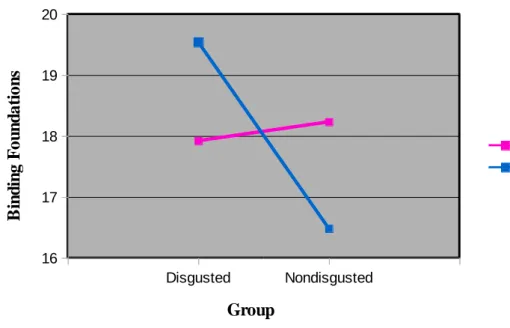
One purpose of this study is to investigate the differences between reactions of disgusted and non-disgusted groups with respect to moral foundations (authority, sanctity, loyalty, fairness, and care). The second purpose is to indicate the gender differences among groups and moral foundations. 255 university students, 83 males and 172 females participated in this study. A series of questionnaires that differed in manipulation tactics were given to two participant groups (Looming of Disgust Questionnaire Form A to disgusted group & Form B to non-disgusted group, Moral Foundations Questionnaire, Padua Inventory, Disgust Scale, Contamination and Cognitions Scale, Obsessive Beliefs Scale, and Demographic Information Form). According to the Turkish version of Moral Foundations Questionnaire, merging foundations into two factors gave high alpha values for internal consistencies. Thus, the analysis was conducted in two moral foundations groups: binding foundations (authority, purity, and loyalty) and individualizing foundations (fairness and care). In variance analysis, participants in disgusted groups preferred the binding foundations. Gender informed the differences interacted with groups (disgusted and non-disgusted) and
vi
moral foundations. In general, females were more inclined toward individualizing foundations than were males. Males were more inclined to binding foundations than were females. One significant finding was that males were more affected by disgust manipulation, which made them sensitive to the binding foundations. Furthermore, regression analyses were conducted that found relationship between moral foundations and religion, rightist-leftist politics, disgust sensitivity, obsessive beliefs, contamination cognitions, and cleaning compulsions. Religion, disgust sensitivity, obsessive beliefs, and contamination cognitions significantly predicted binding foundations. Disgust sensitivity and gender also predicted individualizing foundations significantly. This study supports the claim that group differences, gender, contamination cognitions, and cleaning compulsions are predictors of disgust sensitivity. Lastly, disgust influenced moral foundations that contain gender factors. Religion, contamination cognitions, disgust sensitivity, and obsessive beliefs were predictors of binding foundations. Disgust sensitivity was also related to contamination cognitions, gender, group differences (disgusted and non-disgusted), and cleaning compulsions. These results are discussed as the main portion of this study.
Keywords: disgust, disgust sensitivity, moral foundations, gender differences, individualizing moral foundations, binding moral foundations, obsessive beliefs, religiosity and right left politics.
vii ÖZ
TİKSİNME DUYGUSUNUN BEŞ AHLAKİ BOYUT ÜZERİNDEKİ ROLÜ VE KİŞİLERİN CİNSİYET, DİNDARLIK, SAĞ SOL SİYASİ YÖNELİM, OBSESİF iNANÇ
VE TEMİZLENME KOMPULSİF EĞİLİMLERİ DEĞİŞKENLERİ İLE ANALİZİ
Alcan, D. F. Yüksek Lisans, Psikoloji
Danışman: Yrd. Doç. Dr. C. Ekin Eremsoy
Ocak, 2015
Bu çalışmanın amacı tiksinme duygusunun manipüle edildiği ve manipüle edilmediği gruplar arasındaki ahlaki temellerin farkını araştırmaktır (Otorite, bağlılık, saflık, dürüstlük ve itina temelleri). Aynı zamanda, bu çalışmada cinsiyet farklarının tiksinmeye bağlı olarak ahlaki karar verme üzerindeki etkisinin araştırılması amaçlanmıştır. Araştırmadaki örneklem 255 üniversite öğrencisinden oluşmaktadır. Bu örneklemin 83'ü erkek, 172'si kadından oluşmaktadır. Örneklemin manipüle edildiği ve edilmediği gruplara bağlı olarak bir grup envanter seti katılımcılara verilmiştir (Abartılmış Tiksinme Algısı Ölçeği Form A- iğrendirme & Form B-nötr, Ahlaki Temeller Ölçeği, Padua Envanteri, Tiksinme Duyarlılığı Ölçeği-Revize Edilmiş Form, Bulaşma / Kirlenme Bilişleri Ölçeği, Obsesif İnanışlar Ölçeği ve Demografik Bilgi Formu). Ahlaki Temeller Ölçeğinin Türkçe versiyonu üzerinde yapılan güvenirlik ve faktör analizi çalışmalarına göre, bu temelleri iki grupta toplamak yüksek alfa değerleri sağladığından dolayı regresyon ve varyans analizleri ikili ahlak temelleri üzerinden yapılmıştır: bireyselleştirici ahlaki temeller (dürüstlük ve itina)
viii
ve bağlayıcı ahlaki temeller (otorite, bağlılık ve saflık). Yapılan varyans analizinde cinsiyet değişkeninin analize katılmasıyla birlikte tiksinen ve tiksinmeyen gruplar arasında ahlaki temeller açısından anlamlı farklılıklar bulunmuştur. Tiksinen gruptaki katılımcıların bağlayıcı ahlaki temelleri daha çok tercih ettiği görülmüştür. Ayrıca manipülasyonun katılmadığı durumlarda, kadınların bireyselleştirici ahlaki temelleri, erkeklerin ise bağlayıcı ahlaki temelleri daha çok tercih ettiği görülmüştür. Bunun yanında, erkek katılımcıların deneysel tiksinme senaryoları sonucunda kadın katılımcılara göre bağlayıcı ahlaksal temellere daha çok eğilim gösterdiği bulunmuştur. Ek olarak, dindarlık, sağ sol politik yönelimi, grup farklılıkları, cinsiyet, tiksinme hassasiyeti, obsesif inançlar, kirlenme bilişi ve temizlenme kompulsiyonlarının ahlakın iki ayrı temel boyutunu yordayıp yordamadığını ölçmek için regresyon analizi uygulanmıştır. Dindarlık, tiksinme hassasiyeti, obsesif inançlar ve kirlenme bilişinin bağlayıcı ahlaki temelleri anlamlı bir şekilde yordadığı bulunmuştur. Tiksinme hassasiyeti ve cinsiyet değişkenlerinin bireyselleştirici ahlaki temelleri anlamlı bir şekilde yordadığı da görülmüştür. Bu bulgulara ek olarak, dindarlığın, sağ sol politik farkların, obsesif inançların, kirlenme bilişlerinin ve temizlenme kompulsiyonlarının tiksinme hassasiyetini anlamlı bir şekilde yordayıp yordamadığına bakılmıştır. Deneysel tiksinmenin, cinsiyetin, kirlenme bilişinin ve temizlenme kompulsiyonlarının tiksinme hassasiyetini anlamlı bir şekilde yordadığı bulunmuştur. Bu sonuçlar araştırmanın amacına göre tartışılmıştır.
Anahtar Kelimeler: tiksinme, tiksinme hassasiyeti, ahlaki temeller, cinsiyet farklılıkları, bireyselleştirici ahlaki temeller, bağlayıcı ahlaki temeller, obsesyonlar, dindarlık ve muhafazakar-liberal politik yönelimi.
ix
ACKNOWLEDGEMENT
I am so grateful all that make me comfort to start process and finish this thesis. Firstly I am very lucky to have such a supervisor, Cemile Ekin Eremsoy in my thesis. She is not only a supervisor; she also relaxes and cares for me to finish this thesis. Besides, she took all responsibility in clinical psychology department alone, and she never left her students until graduation ends. I had some difficulties but, she had a great role on me not to give up my goals. I am so appreciating her effort for teaching and caring for my problems. Her dedication, overcoming problems and resiliency will be a great compass for my life to continue. I will never forget her leading and caring role in my life.
Another appreciation is for Hasan Bahçekapılı who also leads my thesis and makes me feel less anxious about my thesis too. He is a researcher that made me inspired by his knowledge, his views and his benevolence. His kindness to his students and his advices to them also inspired me a lot.
I am also so grateful to TUBITAK (The Technological Research and Council of Turkey) that gave scholarship to me to continue my education. If TUBITAK does not give me a support, this thesis is not possible to be written. Thanks to their support for researchers that even includes my undergraduate level, I continue to be enlightened and increase my knowledge to serve back to science that makes people more developed, more human and more enlightened.
I also appreciate my thesis committee included Engin Arık, Cemile Ekin Eremsoy and Hasan Bahçekapılı.
I also wanted to thank my beloved ones who are always supportive in my life, my mother Aynur Alcan and my father Mehmet Cemil Alcan. Thanks to my mother and father, I do not feel alone in this world and they always motivate me to overcome all difficulties. Thanks to their belief on me, I am here. Always they are sacrifying themselves to my
x
works and my life. Words are not enough to be grateful for their efforts and their cares on me. I can only say this thesis is dedicated to them; I love them with all my heart.
Then, my best friend Göksu Çağıl Çelikkol listens all of my effort in this study. She endures all my complains, makes me comfortable and warmth. She believes in me that I would finish my thesis. She also supports me to collect my data. All my graduate level is progressed well in accord with her friendship and her support. Then I wanted to thank to my beloved friend Duygu Cansu Dönmez, she always believes in me that I can be successful in my adventure of education. She makes me feel safe in terms of her trusted character and friendship. Thousands of times, she offers me help if I needed; I thank her so much to be supportive to me when I needed. Next, I am so grateful my friend Selda Kantar. She gives me support of her experiences that let me know this process.
I am thankful to also to whom help my thesis to collect my data and make me relaxed in this process, Süreyya Elif Aksoy, Aslı Vatansever in Doğuş University and Mehmet Harma. They gave me their hours and thanks to their tolerance and support for science I progress my works. Their guide and tolerances took big parts for my thesis. I am also thankful to Engin Arık who helps to form last structure of my thesis. Without his helps, this thesis is supposed to be incomplete. Also my cousin Elvin Ergin and her best friend Dilara Seyhun gave aid to collect my data and supported my works that I am very grateful to them.
My uncle Nuri Alcan and his groom also supports me financially for my education, I am also grateful for their helps. I want to thank to my mother's friend Çiğdem. She makes me believe in myself, and I appreciate for her advices about life and her experiences.
I am very grateful to also my graduate friends Sinem Doğu Karademir who supports me so much, Ezgi Tan who shares my emotions and makes me relaxed, Aşkım Nur Uysal who makes me feel safe and Gamze Gültekin who helps my data collection process. And my other friends, Merve Yılmaz, Buket Yaşar, Seha Ata and Yağmur Gözde Yerlikaya all contributes lots of things to my viewpoints about my life. I thank all of them that we
xi overcome lots of difficulties together.
Finally, I am also grateful to all my teachers in Bilgi University in undergraduate and Doğuş Univesity in graduate who motivate me to go on my education and provide me to think differently in my life, Aytan Zara Page, Ryan Wise, Diane Sunar, Ümit Akırmak, Berrak Karahoda, Kaan Atalay, Gülin Güneri, Ahmet Tosun and Aylin Koçkar and to all that I did not name.
I am thankful to my little tiny cat Himhim. She supports me with her love, her friendship and her warmth.
xii TABLE OF CONTENTS PREFACE...III ABSTRACT...V ÖZ...VII ACKNOWLEDGEMENT...IX TABLE OF CONTENTS...XII LIST OF FIGURES...XVI LIST OF TABLES...XVII LIST OF ABBREVIATION...XIX LIST OF SYMBOLS...XX CHAPTER 1. INTRODUCTION...1
1.1. Emotion based morals and moral intuitions...1
1.2. Moral foundations, gender differences and their influences over political domain from moral intuitionist perspectives...7
1.3. Emotions as part of moralization process…...………...………....……...11
1.3.1. Disgust as a moral emotion and its origins...16
1.3.2. Disgust as a moral emotion...21
1.3.3. Disgust, disgust sensitivity, moral transgressions and purity...22
1.3.3.1. Disgust sensitivity and influences on the moral domain... 24
1.3.4. Disgust in the political domain, religiosity and outgroup prejudice as part of purity...26
xiii
1.4.1. Relationship between disgust and Obsessive-compulsive disorder...33
1.5. Study...36 2. METHOD...40 2.1.Participants...40 2.2 Materials...41
2.2.1 Looming of Disgust Questionnaire (LODQ)...41
2.2.2. Moral Foundations Questionnaire (MFQ)...42
2.2.3. Padua Inventory- Washington State University Revision (PI-WSUR)...43
2.2.4. Disgust Scale- Revised (DS-R)...44
2.2.5. Contamination and Cognitions Scale (CSS)...45
2.2.6. Obsessive Beliefs Questionnaire (OBQ). ...46
2.2.7 Demographic Information Form...47
2.3 Procedure...47
2.4. Design...48
3. RESULTS...49
3.1. Examination of pretext conditions and differences between groups before experimental manipulation...49
3.2. Examination for efficacy of manipulation across disgusted and nondisgusted groups...50
3.3. Correlations coefficients of moral foundations and other variables correlated to them ...51
3.4. Comparisons of groups and gender differences across binding moral foundations and individualizing moral foundations...53
xiv
3.5. Regression analysis for disgust sensitivity including prediction of imagination of
disgust reaction, feeling unpleasantness related to disgust situation,
feeling nauseous and likelihood that threat happened...56
3.5.1 According to imagination of disgust reaction... 56
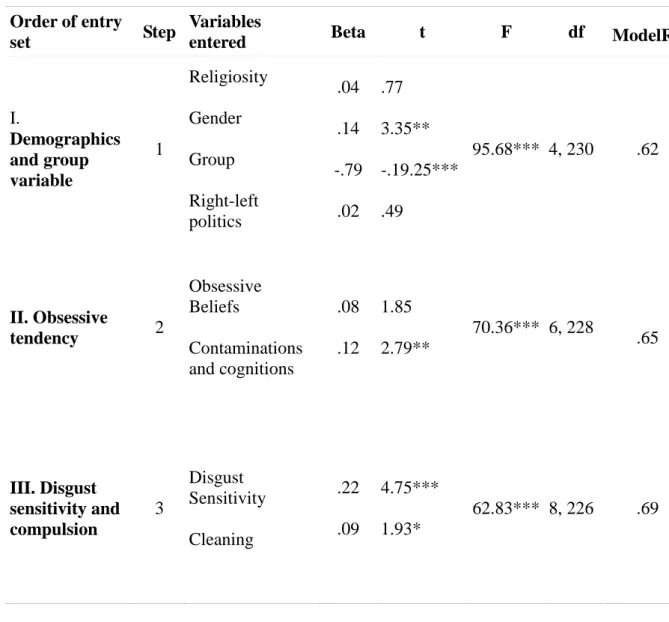
3.5.2. According to imagination of feeling unpleasantness related to disgust situation...59
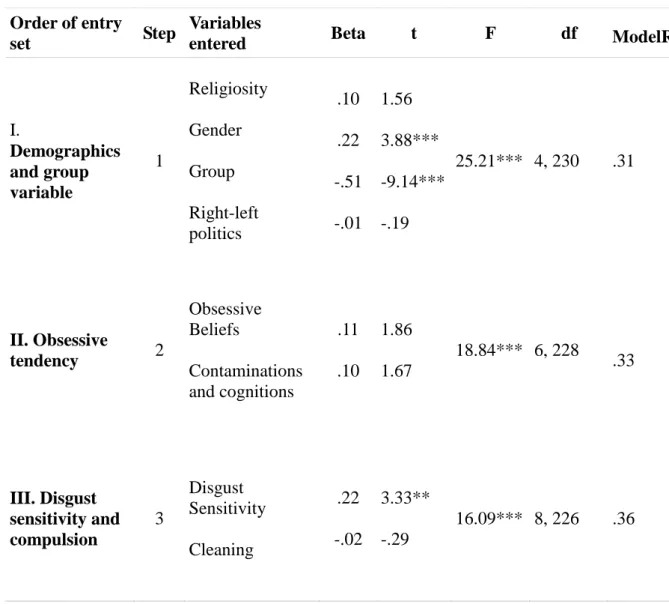
3.5.3. According to imagination of feeling nauseous...60
3.5.4. According to imagination of likelihood that threat happened...62
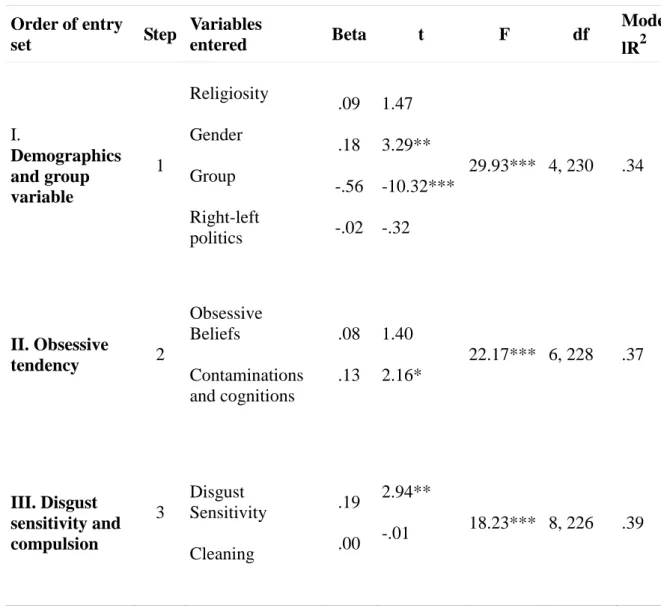
3.6. Regression analysis for prediction of two moral foundations : binding and individualizing foundations...64
4.DISCUSSION...68
4.1. Conclusion...73
4.2. Limitations of study...74
4.3. Clinical implications and future directions…...………...….….76
REFERENCES...78
APPENDICES...88
A. Looming of Disgust Questionnaire (Abartılmış Tiksinme Algısı Ölçeği) Form A...88
B. Looming of Disgust Questionnaire (Abartılmış Tiksinme Algısı Ölçeği) Form B-Neutral...93
C. Moral Foundations Questionnaire (Ahlak Temelleri Ölçeği)...98 D. Padua Inventory- Washington State University Revision
xv
(Padua Envanteri)...100 E. Disgust Scale- Revised
(Tiksinme Duyarlılığı Ölçeği - Revize Edilmiş Form) …...103 F. Contamination and Cognitions Scale
(Bulaşma / Kirlenme Bilişleri Ölçeği)...105 G.Obsessive Beliefs Questionnaire
(Obsesif İnanışlar Ölçeği)...106 H.Demographic Information Form
(Demografik Bilgi Formu)...109 I.Participants Approval Form
(Katılımcı Onay Formu)...112 J.Curriculum Vitae...114
xvi
LIST OF FIGURES
Figure 3.1 Individualizing foundations across group and gender
differences...55
Figure 3.2 Binding foundations across group and gender
xvii
LIST OF TABLES
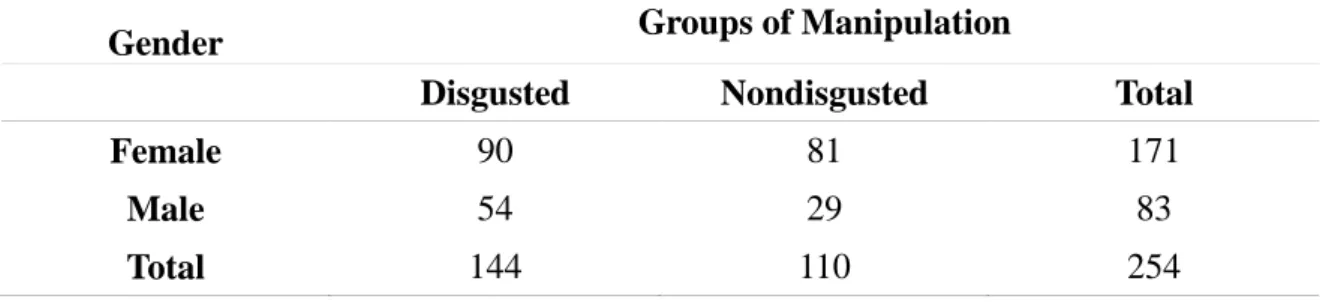
Table 2.1 Distribution of Gender according to experimental
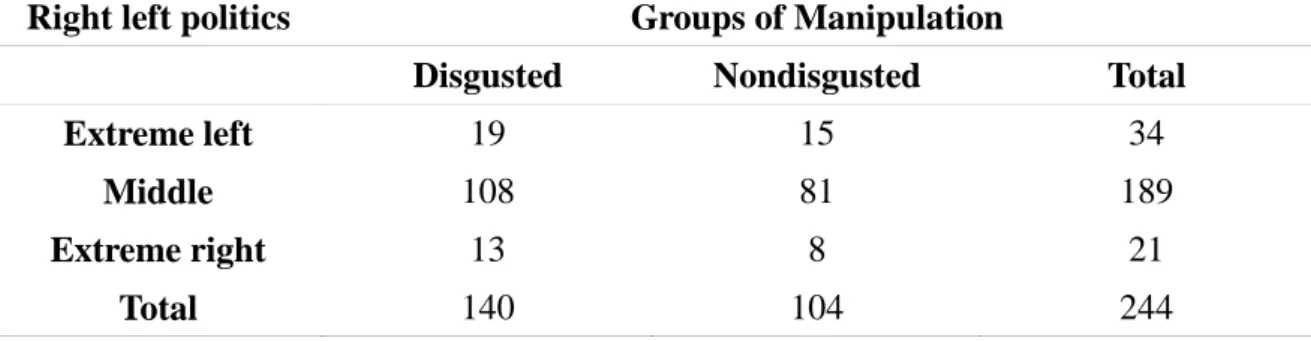
manipulation...40 Table 2.2 Distribution of participants according to right left
politics...41 Table 3.1 Differences between groups of disgusted and nondisgusted groups before
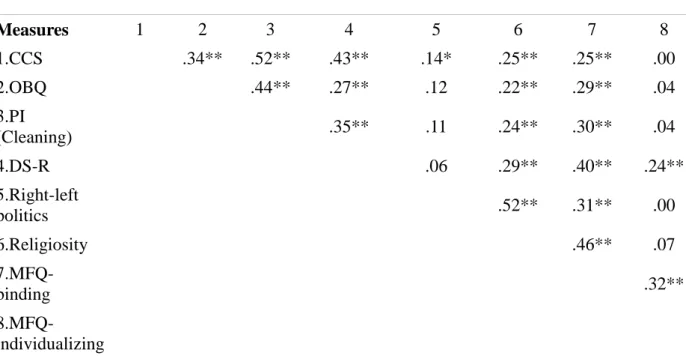
manipulation...50 Table 3.2 Comparison for experimental conditions across disgust manipulations of imagination of disgust reaction, feeling unpleasantness related to disgust situation, feeling nauseous, increase for disgust sensitivity and likelihood that threat happened...51 Table 3.3 Coefficient values between variables in the study
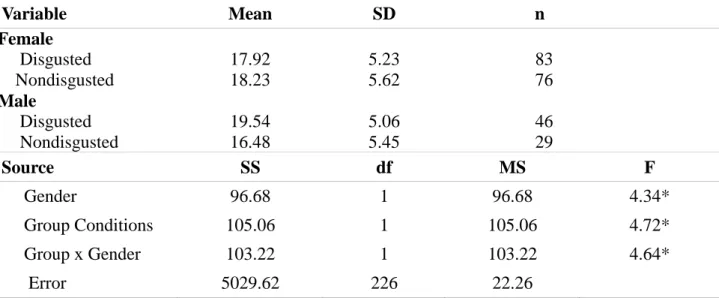
...53 Table 3.4 ANOVA results and descriptive statistics for binding foundations by gender differences and group conditions...54 Table 3.5 ANOVA results and descriptive statistics for individualizing
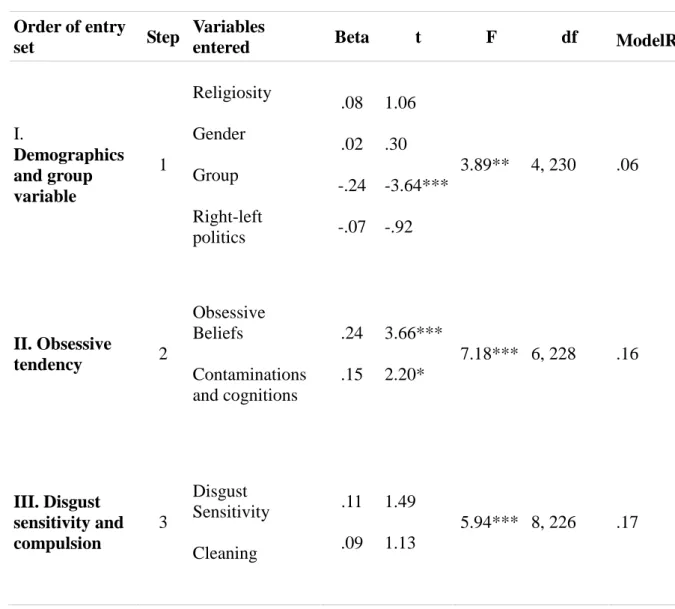
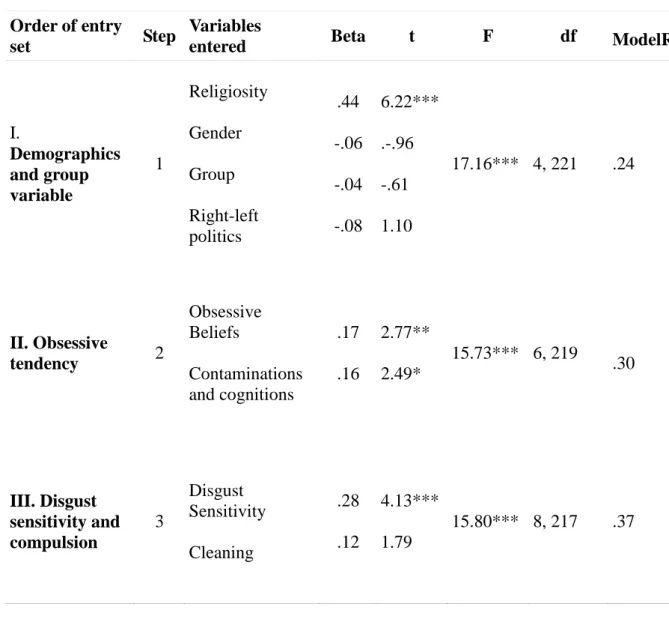
foundations by gender differences and group conditions...55 Table 3.6 Multiple Regression analysis for predictors of
imagination for disgust reaction...58 Table3. 7 Multiple Regression analysis for predictors of
imagination of feeling unpleasantness related to
disgust...60 Table 3.8 Multiple Regression analysis for predictors
of imagination of feeling nauseous related to
disgust...62 Table 3.9 Multiple Regression analysis for predictors of likelihood that threat happened...64 Table 3.10 Multiple Regression analysis for predictors of binding
xviii
Table 3.11 Multiple Regression analysis for predictors of individualizing foundations...67
xix
LIST OF ABBREVIATIONS
OCD: Obsessive Compulsive Disorder CAD: Contempt Anger Disgust
SES: Socioeconomic Status
fMRI: Functional Magnetic Resonance Imaging BII: Blood Injury Injection Phobia
PI- WSUR: Padua Inventory- Washington State University Revision CCS: Contamination Cognitions Scale
OCCWG: Obsessive Compulsive Cognition Working Group OBQ: Obsessive Beliefs Questionnaire
DS-R: Disgust Scale- revised
LODQ: Looming of Disgust Questionnaire MFQ: Moral Foundations Questionnaire ANOVA: Analysis of Variance
xx LIST OF SYMBOLS SD: Standard Deviation M: Mean F: F statistics df: Degree of freedom t: t value r: Pearson correlation p: p value
β: Beta for regression coefficient α: Cronbach alpha
CHAPTER
1. INTRODUCTION
Moral psychology deals with the moral judgments on issues such as justice, rights, and welfare (Turiel, 1983 as cited in Graham, Haidt & Nosek, 2009). According to Prinz (2007), morality sets rules that are enforced through norms. Haidt assumes (2001) that moral judgment is based on virtues in a society where “good” morals are praised and “bad” ones are criticized. Those judgments form grounds from which the culture judges a person's actions or personality. In relation to those definitions and explanations, moral judgments are analyzed from different perspectives with different methods. Some perspectives include rational reasoning and some include moral intuitions that contain emotional entities (Prinz, 2007). Hume, in his book Treatise of Human Nature (1738), argued that humans’ moral judgments have an emotional essence (as cited in Prinz, 2007). This is based on the perspective that emotions determine the moral domains. An intuition model, a social functionalist model, and other views about the role of emotion among moral domains are discussed. Those models are the basis of this research, which aims to look into the scope of the morality. Disgust is identified as the main motivational moral emotion and its origins, types, and development (“from oral to moral”) are summarized (Rozin, Haidt, & Fincher, 2009). The core of this paper, the idea that disgust is a moral emotion, is studied in the context of moral transgressions. In addition, disgust is examined as a part of both culture and gender. The effects of disgust on the political and moral domains, as well as religion and ingroup-outgroup dynamics will be discussed as well. Lastly, I explore the glimpses of neuroticism in relation to disgust which can be explained as an entity of obsessions and compulsions.
1.1. Emotion-Based Morals and Moral Intuitions
Prinz (2007) explained that reactive moral emotions are emotions that are stimulated when a person or group either violates moral rules or conforms to them. Reactive moral emotions
emerge as a result of different kinds of moral violations. Moral indignation is a reactive moral emotion that is triggered by anger (Prinz, 2007). It is a reaction to the violation of care and justice. Indignation and anger are substantially similar emotions and are aroused by immoral acts. However, moral anger is aroused by harm-activated actions. In other words, moral transgressions that pose a threat to and/or harm someone's rights evoke anger (Prinz, 2007). The other stimulating moral emotion is disgust, aroused by objects contaminated by germs and other microorganisms. Contaminated objects that elicit disgust can be bodily fluids, non-human creatures, dead things, or refuse (Prinz, 2007). In addition, sexual violations evoke moral disgust, often because they transfer one organism's bodily fluids to another organism, which may lead to the transmission of a disease. Furthermore, moral disgust originates from physical disgust, which incites similar bodily reactions and reacts against similar way of appraisals like being contaminated
Prinz also discusses emotions and categorizes them according to the CAD (contempt, anger, and disgust) model (Rozin, Lowery, & Ebert, 1994; Rozin, Lowery, Imada, & Haidt 1999; Prinz, 2007). CAD is an emotion-based model that categorizes emotions according to moral judgments. According to the CAD model, morality is a sum of emotions. Rozin et al. (1999) divide emotions into groups described by emotions of morality. The first group of emotions is guilt, embarrassment, and shame, which are related to moral judgments. Those emotions are associated with self-motivation and consciousness. The second group of emotions is contempt, anger, and disgust and they are associated with others who do not belong to an ingroup (Rozin et al., 1994; 1999). Anger appears when a person is frustrated and blocked. This leads to aggressive behaviours. It is also a moral emotion and is stimulated when a transgression of rights occurs. In addition, core disgust as a moral emotion is generated when a violation of sanctity occurs. Core disgust reminds people that they share the same origins as animals. In addition to core disgust, another type of disgust, called sociomoral disgust, is aroused when a violation of dignity occurs. Violations of dignity include hypocrisy, cruelty, frowning, and betrayal violations related to the others. Moreover, contempt as a moral emotion is elicited when individuals are considered to be negative components by ingroup members. According to Rozin et al. (1994; 1999),
contempt is associated with a hierarchy in which superiority relations are determined. Three different ethics (autonomy, community, and divinity) are associated with those moral emotions. The ethic of autonomy is related to actions against the individual’s freedom and rights. The ethic of community is related to actions against community and hierarchy, whereas the ethic of divinity is related to actions against divinity and purity. Rozin et al. (1999) discusses which of these three moral emotions are associated with violations of those three groups of ethics. It is assumed that contempt results from a violation of community while disgust is related to violation of divinity. Anger comes from the violation of autonomy. In addition, Rozin et al. (1999) aimed to prove that there are similarities between cultures that evoke similar emotions when similar ethical violations occur.
Rozin et al. (1999) conducted a study to verify the CAD model. They established their experiment conditions by considering the correlation between moral violations and facial expression of moral emotions. They aimed to find a relationship between moral emotions and the specific ethicsof moral violations connected to those emotions. Rozin et al. (1999) found that ethics and moral emotions were related to each other. Of those relationships, the connection between contempt and community happens to be more visible when the face selections are examined. In another study, Rozin et al. (1999) examined this relationship, again but this time ethics were explained to participants before the study. As a result of this explanation, all participants gave answers compatible with categories of moral emotions and ethics. In addition, there were similar results across both cultures, (Japanese and American) which provide support for the CAD hypothesis.
Rozin et al. (1999) evaluated a study to support the CAD model. They designed their experimental conditions according to the correlation between moral violations and facial expression of moral emotions. They aimed to express the relationship between moral emotions and the specific ethics of moral violations connected to those emotions. Rozin et al. (1999) found that ethics and moral emotions were related to each other. The connection between contempt and community was more visible in examination of face selection. In another study, Rozin et al. (1999) examined the same relationship, but this time, ethics
were explained before the study. As a result of this, all participants gave answers compatible with categories of moral emotions and ethics. In addition, there were similar results between the two cultures (Japanese and American), which supports the CAD hypothesis.
In addition to the CAD model, the social functionalist model (Hutcherson & Gross, 2011) explains emotion-based morality by assuming that emotional entities are important for moral judgments. It explains the roles of emotions from a functional perspective. The social functionalist model asserts that contempt, disgust, and anger are adaptive and include appraisals, gestures, physiological responses, and action tendencies. Moreover, they are specific to the context of the violations (Hutcherson & Gross, 2011).
According to this model, anger is a defensive emotion that leads to attack/approach behaviour when the self is endangered (Hutcherson & Gross, 2011). Threats are resolved by either active or passive behaviours (e.g. conservative tactics or attacks). Hutcherson and Gross (2011) assumed that anger is a moral emotion, whereas it is much more related to the behaviour than the threat. Moreover, when danger is not present, avoidance behaviour emerges as a result of the experience of danger in the past. The aim is not to take risks, but rather to minimize them. In addition, disgust and contempt are motivator emotions that evoke those kinds of avoidance behaviours (Hutcherson & Gross, 2011). Disgust is aroused when a person faces a malicious behaviour, even if s/he faced good-willed actions in the past. Contempt is cognitively related to the appraisal of incompetence. The urge to help an incompetent person is a waste of time and it elicits contempt (Hutcherson & Gross, 2011). Once the interaction with people who cannot give support to a group has ended, contempt abates. Anger is an immediate threat signal, whereas contempt and disgust are structured by long-lasting attributions. Thus, anger, disgust and contempt are categorized according to their specific appraisals in relation to the nature of their triggers.
Hutcherson and Gross (2011) aimed to differentiate anger, disgust, and contempt from each other using the social functionalist approach. Participants read vignettes that included
autonomy, community, and divinity violations. Hutcherson and Gross (2011) found that moral disgust is visible on all violations. These findings contradict the CAD theory.
Hutcherson and Gross (2011) repeated their experiments in order to verify the social functionalists approach. They aimed to differentiate contempt and disgust from each other. They assumed that disgust is associated with appraisals of benevolence or malicious intentions, whereas contempt is associated with the incompetence. While rating competent and benevolent behaviours, Hutcherson and Gross (2011) found that violations of community aroused contempt in study participants. Otherwise, they verified that violations related to community are strongly connected to moral disgust (Hutcherson & Gross, 2011). Contempt was often found to be related to incompetence at a task. Moreover, Hutcherson and Gross (2011) examined the consequences of three moral emotions. They considered disgust to be a motivator in order to construct a judgment about the worth of an agent. Contempt was considered a motivator of the judgments about a person's characteristics and incompetence. Anger was considered a motivator that does not trigger long-lasting behaviour; rather it’s a result of the detection of a threat signal. They proved the social functionalist approach with the results they found in their research (Hutcherson & Gross, 2011). Disgust was found to be the most damaging emotion to feel towards a person because it triggers judgments about a person's character that are hard to forget. Anger is the least dangerous because it is temporary and can happen easily as a result of misperceiving. Contempt is in the middle of the spectrum because it leads to a harmful impression of a person.
In the same way, Haidt (2001) assumes that emotions are important contributions to moral judgments. He mentions the concept of intuitions, which are based on emotion-related explanations for moral judgments. According to Haidt, moral intuition determines moral judgments, which is a kind of cognition but is not a reason-based mechanism. David Hume (1738) says, “Reason is like a slave that obeys passions of the body” (as cited in Haidt, 2001). Reasoning about a moral issue depends on a process that involves finding evidence, verifying its accuracy, comparing it with other views, and making a judgment (Haidt,
2001). Those processes can happen consciously and unconsciously at the same time. However, intuitions are processed unconsciously in a quick and effortless way. Intuition is a method of reasoning that triggers emotions.
The social intuitionist model assumes that moral intuitions have a direct impact on moral judgments (Haidt, 2001). In a moral intuitive process, moral outcome is not processed reasonably and consciously. Emotions that take part in the moral decision-making process give way to conflicts. According to Haidt (2001) there are some links that construct the basis of moral intuitions. The first link is the intuitive judgment link in which moral judgments are processed swiftly, mechanically, and unconsciously. The second link is the post hoc reasoning link in which moral judgment is processed after the moral decision is made. In other words, the conscious process follows the intuitive judgment. The social persuasion link is the third link mentioned by Haidt. According to this link, there is no need for reasoning, because it is not important which group is empowering the judgments to conform the rules, norms, and beliefs without conscious reasoning. Another link, the reasoned judgment link, follows decisions made to persuade others. Lastly, in the private reflection link, a person may commence a reaction that conflicts with the first judgment.
According to this model, intuitions are similar to persuasion, which allows an easy way of reaching conclusion about events or people (Haidt, 2001). According to Haidt (2001), reasoning is caused by relatedness that is connected to impression management and interaction. The other motive that directs reasoning is a coherence motive that is related to the resonance of cultural views and self-view. Being persuaded and having the same opinions as a friend are fallacies for judgments. In other words, people are eager to be manipulated in order to fulfill their goals (Haidt, 2001). According to Haidt (2001), people change their beliefs to avoid feeling threatened and isolated from relationships. People use self-defense motivations to live in a safe and fair world. According to the social intuitionist model, people have nearly no proof to prove their theories about their moral judgments. That is why they use evidence to defend their rights just like lawyers. In addition, people need to have an explanation about their moral judgments to support their theories (Haidt,
2001). In the social intuitionist model, the reasoning process is applied unconsciously so that the interpreter module of mental construction is able to fill the gaps and interpret the reasoning while providing evidence for it. Those interpretations are based on the first moral constructions, which are cultivated by the culture itself. Thus, people have an illusion that their moral judgments depend on their moral reasoning processes (Haidt, 2001). People also try to change other people’s moral judgments if they don’t like them. This happens because of subjective reasoning though people have illusions that they are objective decision-makers. Thus, the one who disagrees with the established reasoning is considered immoral (Haidt, 2001).
In this model, the moral action comes from willpower (Haidt, 2001). Those who have the best self-regulatory systems are the best at moral reasoning. In addition, morality evolution is part of the basis for cooperation and commitment. In human development, language makes those processes viable and creates an avenue for communication (Haidt, 2001). Some intuitions are lost when a child develops a more complex sense of morality, for example, losing loyalty in a fairness-based culture. This process occurs to prevent people from forming ambivalent moral intuitions. According to this model, immersion in complex customs, which include norms, values, and beliefs, has elements of affective, cognitive, motoric, and propositional knowledge. Peer socialization shapes the judgments that are culturally intuitive. They are imitated and practiced according to cultural norms, values, and beliefs. This period of development appears between ages 9 and 15.
1.2. Moral Foundations, Gender Differences and Their Influences Over Political Domain From A Moral Intuitionist Perspective
According to the social intuitionist model, morality is divided into categories called foundations (Graham, Nosek, & Haidt, 2012; Graham-Haidt et al., in press; Graham-Nosek et al., 2010). Those foundations are associated with the differences between political orientations, religions, and ideologies (Haidt, Graham, & Joseph, 2009). In addition, moral foundations are related to emotions, which evoke moral judgments.
Graham et al. (2012; 2010; in press) argue that moral foundation theory is based on the idea of pluralistic moral values. According to Graham et al. (2012; 2010; in press), morality consists of different foundations, which cannot be limited to care and justice. Their foundations rely on the theories that feed evolutionary psychology. The first of the requirements is based on the nativistic viewin which the mind is a first draft that is shaped by experience. The second one is the culture, which is shaped by the first moral draft of the mind in order to adapt different cultural values. The third claim they express is that moral evaluations are rapid and constructed mechanically. The last claim of this theory is pluralism.
The foundations are care/harm, fairness/cheating, loyalty/betrayal, authority/subversion and sanctity/degradation (Graham et al., 2012). The care/harm foundation includes care, nurturing, and protection, which can be seen in mother-child relationship. It meets the survival needs of the weak infant. This basic moral foundation is motivated by suffering, distress, and need and is expressed by children, animals, and suffering people. The care/harm foundation may evoke compassion for the victims and anger towards the offenders. This foundation can also change from society to society. Nazi culture, or reversely, Buddhist culture, can be good examples for this. The fairness/cheating foundation is an emotional exchange in relationships. It is associated with the virtues of justice and fairness. The loyalty/betrayal foundation deals with competition between different groups to gain rank and power. Graham et al. (2012) describe it as forming groups that provide avenues through which to gain power and status. In consumer cultures, brand loyalty and sports teams are one of the main motivators of this foundation. The authority/subversion foundation deals with firm relationships with chiefs and good relationships with subordinates to benefit the ingroup (Graham et al., 2012). In modern cultures, law courts and police departments are places where people obey the rules and decisions made by those authorities. The sanctity/degradation foundation includes the emotion of disgust, which is related to the behavioral immune system that determines mate selection, friend selection, and food selection (Graham et al., 2012). In some cultures this manifests itself as people believing their body is pure or a temple.
Furthermore, moral foundations influence political affiliations and moral goals in different political groups. Political preferences, especially right-left differences, determine voting behaviour (Graham et al., 2009). Liberal views advocate individual freedom. Liberals also consider people to be free agents who are open to development (Graham et al., 2009). However, conservative views are authoritative and institution-based. People are considered to be selfish and imperfect creatures. Conservatives also defend the view that people must be constrained in order to live together. According to those views, liberals are more open to new experiences and change, while conservatives keep what’s familiar around them (Graham et al., 2009).
Graham et al. examined (2009; 2012) people’s moral concerns and how to make a bridge between their political ideologies and moral foundations. They found that liberals are more prone to giving importance to care and fairness foundations while conservatives are more prone to emphasize divinity, sanctity, authority, and loyalty foundations in their ideologies. According to these data, conservatives emphasize authority, order, loyalty to country, hard work, and purity. On the other hand, liberals choose care, fairness, justice, and equality. This difference is not absolute in political spectrum, but extremists polarized those factors on their giving moral judgments (Graham et al., 2009). In another study, Graham et al. evaluated (2009) answers toward different moral virtues and reactions toward moral violations associated with different foundations. They had feedback from participants like “even if a soldier does not agree with his officer, he has to obey those rules,” or “chastity is important for teenagers.” They also proved that conservatives are more inclined to defend binding moral judgments. Graham et al. (2009) also tested sacred values and how people react once they are violated. The aim was to change participants’ values with money, which can cause strong reactions in conservative and liberal participants considering their moral concerns. Questions like “How much money would someone have to pay you to kick a dog in the head? To renounce your citizenship? To get a blood transfusion from a child molester?” were asked to participants. Liberals refused to exchange values with money, whereas they were more willing to exchange binding factors separate from their values. Similarly, conservatives refused to exchange particular values for money: purity, authority,
and ingroup moral values.Lastly, Graham et al. (2009) tried to prove the relation between foundations and political studies. They evaluated moral foundations among sermons written by liberals and conservatives. Those sermons were taken from the speeches among Unitarian Universalists (a mostly liberal church) and from speeches from Southern Baptists, which is a mostly conservative church. Unitarian leaders used words mostly related to harm and fairness while Baptist leaders used words mostly related to loyalty and sanctity in their sermons.
Leeuwen and Park (2009) examined emotions and political orientations in their studies. They argue that political conservatism is an orientation that is constructed by the need to be certain and avoid threats. This structure is related to the moral foundations of loyalty, respect for authority, and spiritual-body purity. In their research, Leeuwen and Park (2009) assume that anxiety and fear are motivatoremotions that lead to moral intuitions of purity, authority, and loyalty. Those moral intuitions are the background for conservatism. Leeuwen and Park (2009) examined moral foundations, political orientations and perception of social dangers. The results showed that political conservatism is related to the perception of social danger, which is influenced by the moral intuition of purity, authority, and loyalty.
Garvey and Ford (2014) studied differences between binding and individualizing factors in relation to intuition. They conducted a research on whether rationality or intuition constructs moral decisions. They assumed that binding factors are related to authority, loyalty, and purity, which are also related to intuitions and intuition-based judgments, while individualizing factors such as harm and justice are related to rationality. Moral foundations, disgust sensitivity, rationality, and political orientation were used as factors in the study. The results supported the claim that binding factors are all related to moral intuitions, whereas individualizing factors are all related to a rational way of thinking.
Religions and foundations are related to each other. Gladden, Welch, Figueredo and Jacobs (2009) assumed that religious concerns include moral judgments, which are constructed by
moral intuitions and harm-based moral emotions. Those moral intuitions are the outcome of disgust sensitivity, which feeds religious conservatism. Conservatives’ religious moralizations, as opposed to liberals’ are constructed against homosexual relations, masturbation, and incest without harm. The idea of divinity is what is behind these moralizations. Moralizations against purity violations mechanically evoke disgust in religious moral issues (Gladden et al., 2009). In other words, people who have higher disgust sensitivity are more inclined to moralize those domains of ethics with regard to religious rules (Gladden et al., 2009). Gladden et al. (2009) show that religion is related to moral intuitions, moral disgust, and the ethics of community and divinity. Those intuitions evoke anger, contempt, and disgust.
Although a few research studies have been done about the relation between gender differences and moral foundations, Iyer (2010) studied samplesize of political attitudes in relation to moral foundations and gender differences. He found little difference between females and males. He detected small effect for sample sizes in which gender differences were not attainable for whole population. He claimed that empathy and universalist constructs are indicative of female characteristics, which are detected more among liberals. According to his assumption, it follows that females, compared to males, prefer individual foundations, which include harm/care and justice/fairness. Males, especially conservative males, think in a utilitarian way, which may explain their inclination for authority, loyalty, and sanctity (Iyer, 2010). He found that females are more emotionally reactive than males. In addition, Eagly, Schmidt and Koenig (2005) found that females are more compassionate to inequality against women, gays, and lesbians.
1.3. Emotions As Part of Moralization Process
Moral foundations, political ideologies, and religions are all explained in a moral intuitionist perspective in which emotions have important roles. In this paper, it will be explained that emotions have an effect on moral judgments, political attitudes, and religions. Emotions have a major role in moral judgments that are directly connected to
political ideologies (Mechler, 2010; Avromova & Inbar, 2013; Haidt, Koller, & Dias, 1993). Haidt et al. (2009) assumed that emotions are motivations that trigger morality-based judgments. Haidt asserted that emotions are basic motivational forces that affect moral judgment processes. Greene-Cushman et al. (2009) conducted a trolley experiment by simulating a train accident. In it, they describe one person tied to a railway and a group of people in another railway. Participants have to choose to save one or the other. According to fMRI results, brain activations show that emotion-related regions of the brain are activated when making decisions about moral dilemmas (Greene-Cushman et al., 2009).
The role of emotion in the political spectrum is obvious in literature. Conservatism as a politic ideology carries the meanings of “resistance to change,” feeling strong bounds for conventions, and social norms such as authoritarian parenting, patriarchal gender norms, and orthodoxy (Mechler, 2010). In addition, fear reduction and a need for certainty lead to conservative assumptions. This view is based on the evidence that conservatives are intolerant of new experiences, unfamiliar views, and anomalies. These abstractions are also determined by right and left sides’ severity. Mechler (2010) examined relations between emotions and political issues. She manipulated participants with political ideas and pictures of the politicians in affective poses (positive, negative, and neutral). Participants were asked a bunch of questions that revealed their voting choices. She asked their political views and rated their level of being a liberal, moderate, or conservative. Their emotions and their political choices were also evaluated. At the end of her study, she found that emotion is related to political decisions and moral judgment. Negative effects made severe political ideation that may divide groups into two partisan sides. Moreover, more complex reasoning of political choices included less effective intensity and less effective conflicts. In Melcher’s study, conservatives show higher negative affect than liberals. Mechler (2010) found that people who process less complex moral reasoning are influenced by negative emotion and burdened stimuli. They are more influenced by conditional factors than people who use more complex reasoning. She induced that if a person processes less complex reasoning about a moral issue, he/she might be more affected by negative
affective or situational factors. She found that people who defend purity, loyalty, and authority could more easily accept affectively driven norms and values. Therefore, conservatives defending those kinds of values tend to be influenced by negative affects more than liberals.
Haidt, Koller and Dias (1993) conducted a study to explore the relationship between cultures and affect. They investigated two cultures with regard to non-harmful moral violations. The main concerns of their research were socio-economic status and Western culture moralizations. The study included harmless moral violations and harm-based moral violations. The harmful violation was taking a boy from stage while he dances. The non-harmful violation dealt with a boy wearing regular clothes in a school where there is a dress code. And the third violation deals with a man who eats food with his hands. The other stories are about a housekeeper cleaning toilet with flag and a boy who promises to visit his mother every week but does not keep his promise. There are other stories about different violations. The first is about a dog eaten by the family that owned it once it is dead, a brother and sister kissing each other, and a man who has intercourse with a chicken he bought to eat. After giving all stories, participants were asked to evaluate the acts as moral or immoral. They were also asked if they were bothered, if these examples are universal, if the guilty one in those stories should be punished, and if these acts are harmful. People from high SES and from Philadelphia (individualistic culture) used moral judgements to rate these behaviours when the action harmed someone. They did not evaluate the disgusting or disrespectful situations as immoral. People from Brazil and from low SES saw both as immoral according to harming, disgusting, and disrespectful moral judgments.
According to Avromava and Inbar (2013) morality is attuned to the principle of reward and punishment. They examined role of emotions on morality. They claimed that emotions come after moral judgments. This suggests that negative emotions, such as disgust, anger, and contempt are generated by immoral scenes. This applies to positive emotions like awe, gratitude, and elation, which follow moral actions. Another claim made by the duo is that
those emotions are inclined to increase in intensity of moral or immoral actions. Immoral actions may seem worse than they really are because of negative emotions. It is like how being angry with someone may turn moral judgments into harsher judgments toward a badly dressed person (Avromova & Inbar, 2013). This negatively burdened action is only viable for moral transgressions. They lastly propose that emotions can make an action seem moral even if it is not. For instance, feeling disgust before a moral action may create a negative effect about a moral issue like homosexuality or smoking (Avromova & Inbar, 2013).
The first claim is evaluated according to effects of emotions over moral judgments (Avromava & Inbar, 2013). In other words, Avromova and Inbar assumed (2013) that it is not an inevitable explanation that emotions are the motivators or causes of moral judgments. They presented this idea in an ultimatum game. Participants’ fMRI results show brain activation in areas that are also related to emotions when participants judge moral issues or they think they are being cheated in the game. In Royzman’s et al. (2001) hypothesis, moral dyspepsia, immoral behaviours may activate the physiology that may cause an oral inhibition like nausea, or diminished appetite (as cited in Inbar & Amranova, 2003). In addition, disgust is the most obvious indicator of moral transgressions. Royzman et al. (2001) concluded that disgust directly triggers oral inhibition in the same place in the brain where moral transgression is placed. Chapman and Anderson (2012) showed that being exposed to bad tasting drinks and contaminated views made people more disgusted in the ultimatum game compared with non-exposed conditions. Furthermore, Chapman and Anderson (2012) assume that different moral transgressions can cause various emotional responses. For instance, immoral acts toward purity and fairness evoke disgust, but harming someone triggers anger. In addition, Russell and Sorolla (2011) proposed that moral anger includes more complex moral reasoning than disgust. Anger may disappear when a violation is processed without any intention. Hutcherson and Gross (2011) assume that threats may be followed by anger and approach behaviour, but violations of purity and incompetence may be followed by disgust and avoidance behaviour. In the light of this evidence, Avromova and Inbar (2012) induce that moral violations can co-exist with
emotions, but they are not necessarily the cause or motivation for moral judgments. Instead, they are inclined to explain the relationship between emotion and moral judgment as one of sources or predictors of morality.
Furthermore, Chapman and Anderson (2012) assume that emotions change and create moral judgments. This claim is mostly viable for moral dilemmas such as helping a group of people in danger instead of helping one person or violating moral norms at the same time (Greene-Cushman et al., 2009). The trolley problem is about sacrificing a person on the railway in the name of saving five people (Greene-Cushman et al., 2009). In this problem, anger changes the course of moral judgments. It is a dilemma that leads to judgment of individuals’ moral actions, which can cause the death of a person. In this dilemma, the medial frontal gyrus and posterior cingulate gyrus are activated when the answer to this dilemma is sacrificing one person (Greene-Cushman et al., 2009). In addition, the brain scans of people who have decided to save five people instead of one show physiological stress. Conditions that include moral transgressions force people to make decisions about moral issues and evoke disgust as a result of the decision (Chapman & Anderson, 2012). On the other hand, in the trolley problem, people who watch amusing film clips perceive one person’s death as a reasonable trade for the sake of five people’s safety (Greene-Cushman et al., 2009). In addition, emotions influence moral transgressions positively (Chapman & Anderson, 2012). Disgusting stimuli, all of which evoke disgust, induce tough moral judgments when the violations occur (Avromava & Inbar, 2013).
Moreover, Inbar, Pizarro and Bloom (2009) assumed that conservatives are more inclined to disgust, which affects their moral judgment harshly. In addition, Inbar, Pizarro, Konobe and Bloom (2009) showed that both liberals and conservatives show disgust against homosexuals. This evidence proves that disgust increases the strength of moral judgments.
Another claim made is that emotions moralize issues that may not belong to the moral domain(Avramova & Inbar, 2013). Wheatley and Haidt (2005) conducted a study that was supposed to give an illusion of disgust. They exposed participants to words to make them
feel disgusted. Then, they gave some vignettes. There were stories about moral issues inside them. Those vignettes included words that were associated with disgust. Disgust-inducing words affected participants’ judgments about moral violations. Participants in the hypnotized group made harsher moral judgments about moral violations (Wheatley & Haidt, 2005). Words that elicit disgust are also effective even when the vignettes are not about moral violations. According to the social intuitionist model, Wheatley and Haidt (2005) proposed that people’s decisions on moral issues are influenced by the disgusting stimuli. In regard to emotions, Nichols (2002) assumed that moral judgments depend on two connected systems. One of them is “a system of rules (norms) prohibiting certain actions” and the other is an “independent affective mechanism that is activated by witnessing suffering in others” (as cited in Amrova & Invar, 2013). In general, emotions change a person’s opinion about an issue and direct him/her to decide wrongness or rightness of a moral issue.
1.3.1. Disgust As a Moral Emotion and Its Origin
Disgust is a basic evolutionary adapted emotion that is triggered by feces, dead bodies, and sexual fluids (as they may carry disease-induced pathogens) (Rozin & Fallen, 1987; Tybur, Lieberman, & Griskevicius, 2009; Tybur, Lieberman, Kurzban, & DeScioli, 2013). Prototypical disgust is an affect against bitter foods that include toxic ingredients (Chapman & Anderson, 2012). When an organism feels disgust a sputter follows, which helps to remove toxins from the body. This is a defense system that prevents organisms from ingesting poisonous food. According to Chapman and Anderson (2012), disgust is a defense that protects plants from predators. This protection is a means of survival for both plants and predators. It is difficult to detect diseases and avoid being infected by bacteria and viruses. That’s why eleven forms of disgust prevent species from getting infected (Chapman & Anderson, 2012). Thus, diseases are easily detectable from their odours, and from tactile and visual cues. Disgust is also similar to distaste, which is aroused when intoxicated foods are available. Compared to distaste, disgust is a more developed mechanism that easily detects diseases. Although distaste is similar to disgust in terms of
oral rejection, disgust is explained as a defense to avoid being contaminated. Furthermore, there are multiple disgusting objects, behaviours, beliefs, and attitudes that people developed.
Haidt, McCauley and Rozin (1994) evaluated a model that explains other types of disgust behaviours in addition to pathogen disgust. They named pathogen-based disgust as a core disgust against poisonous foods and helps people to differentiate themselves from animals. In animal reminder disgust, human beings are denying their animal characteristics, which are sex, death, body envelope, and bodily violations (Haidt et al., 1994). Furthermore, interpersonal disgust and moral disgust are other types of disgust. Interpersonal disgust is incited by others or enemies, while moral disgust is aroused by the breaking of social rules. Chapman and Anderson (2012) proposed that interpersonal disgust can also prevent from diseased surface or organisms. In addition, interpersonal disgust is connected to mate selection and helps show whether mate fits to the subject. Body envelope violations are also similar to sexual disgust because they spread diseases by blood and injury contact (Chapman & Anderson, 2012). However, Haidt et al. (1994) termed sexual disgust “animal reminder disgust” which reminds humans of their connection to animals. Tybur et al. (2013) evaluated different types of disgust that evolved into new evolutionary functions. They purported three domains for disgust: pathogen disgust, sexual disgust, and moral disgust.
First of all, pathogen disgust is the main defense mechanism for humans, which protects them from fatal illnesses (Tybur et al., 2013). It was also named core disgust by Rozin, Lowery, & Ebert (1994). However, Tybur et al. (2013) named this kind of disgust pathogen disgust. Pathogen disgust can be evoked by disgust-inducing materials such as feces, corpses, rotten food, and blood. Touching, seeing, or sensing those kinds of objects causes disgust sensitivity, which leads to avoidant behaviours to prevent getting infected.
Secondly, Tybur et al. (2009; 2013) proposed that sexual disgust is provoked when human beings select inappropriate sexual partners for themselves. Pathogen disgust also includes
sexual disgust, which adds the damage of social threats during and after sexual activities. It is also important for mating selection, which means reproduction. Thus, the selection of a weak sexual partner for reproduction evokes disgust that causes avoidance behaviour.
Lastly, either pathogen disgust or sexual disgust can be adapted toward moral disgust (Tybur et al., 2013). In some cultures, incest, masturbation, pedophilia, and homosexuality may be seen as morally wrong. This incites moral disgust. Moral disgust is related to the dimension of purity/sanctity (Haidt, 2001). Moral rules have to be adaptive to the society. When rules are broken, punishment is inevitable (Tybur et al., 2013). However, human beings are also inclined to develop disgust when resisting a rule that may cause more costs than benefit. As such, human beings feel disgust when they are faced with prohibition, which is what keeps the society together, as a natural course of rules. Possessing pathogen and sexual disgust affects moral decision-making which gives way to secondary processes called moral disgust (Tybur et al., 2013).
Moral disgust is a signal that moral rules are broken (Tybur et al., 2013). It gives a chance to compromise between two opposite sides when those two groups are in conflict. Moral disgust is also detectable for all cultures that give a sign of caution (Haidt, Rozin, McCauley, & Imada, 1997; Tybur et al., 2013). Those signals can easily be detected from the facial expressions so that the opposite side can understand the cost of the immoral action. Furthermore, moral disgust gives an opportunity to choose one’s side. In addition, it is an alarm for the requirement of punishment (Tybur et al., 2013). In case of punishment, disgust is not only a source for the avoidance behaviour, it also gives a licence to punish morally wrong behaviour (Tybur et al., 2013). When deciding to punish someone, it is helpful to decide whether his or her action was morally wrong. Furthermore, disgust stimulates behaviours that are caused by sexual disgust induced and pathogen disgust induced organisms without blocking their survival (Tybur et al., 2013). Authorities can use moral disgust to ensure punishment and consensus across groups that an action is morally wrong (Haidt, 2001). Anderson and Chapman (2012) mentioned that moral disgust develops only in human species because of social norm violations. It is a benefit provided
strategy that leads to withdrawal and avoidance.
There are differences between types of disgust for reactions and neural circuits (Chapman & Anderson, 2012). While core disgust happens after nausea and stomach contractions, blood and injury disgust is associated with light-headedness and fainting. Furthermore, those two kinds of disgust are related to different psychological disorders. While core disgust is related to obsessive and compulsive disorder, blood and injury disgust is brought by blood and injection injury phobia (Chapman & Anderson, 2012). In addition to those features, some specific disgust behaviours and types are not as various as they are in other species. Eating habits are the reason for different reactions. In addition, species that have a rich social life are more prone to diseases. That way, different types of disgust and behaviours are developed in those species (Chapman & Anderson, 2012).
Facial expressions of disgust are as follows: wrinkling nose, raising upper lip, lowering brows, and gaping mouth (Rozin, Lowery, & Ebert 1994; Chapman & Anderson, 2012; Tybur et al., 2013). The function of wrinkling the nose and raising the upper lip is to decrease air exposure. Lowering brows is a protection for eyes against contaminated agents. Gaping mouth means that an agent who has been exposed to contaminated organisms is ready to vomit or spit. Those expressions are basic ones that are intrinsically available for human species. According to Anderson and Chapman (2012), facial disgust expressions are related to the anterior insula in the brain. In their study, they argue that the very same area in the brain is activated whether a person sees a facial disgust expression or they actually experienced disgust. This was supported by more research that Anderson and Chapman (2012) conducted. Participants smelled disgusting odours and watched videos of people tasting disgusting meals. Anderson and Chapman (2012) found that the anterior insula was activated when disgust occurs. Rozin et al. (1994) predicted that different disgust elicitors like oral, olfactory, and visual elicitors, would cause different facial expressions. They also predicted that upper lip retraction is induced by moral disgust in relation to anger, which is one of the central moral emotions. In another experiment, participants completed questionnaires according to pictures of faces (Rozin et al., 1994).