T.C.
YAŞAR UNIVERSITY
GRADUATE SCHOOL OF SOCIAL SCIENCES DEPARTMENT OF TOURISM MANAGEMENT
MASTER’S THESIS
MARKETING AZERBAIJAN:
POSITIONING IN NEIGHBOURING AND REGIONAL MARKETS
Lachin NAMAZ
Thesis advisor Gokce Ozdemir
ii
TEZLİ YÜKSEK LİSANS TEZ JÜRİ SINAV TUTANAĞI ÖĞRENCİNİN
Adı, Soyadı :
Öğrenci No :
Anabilim Dalı :
Programı :
Tez Sınav Tarihi : ……/…../201….. Sınav Saati : Tezin Başlığı:
Adayın kişisel çalışmasına dayanan tezini ………. dakikalık süre içinde savunmasından sonra jüri üyelerince gerek çalışma konusu gerekse tezin dayanağı olan anabilim dallarından sorulan sorulara verdiği cevaplar değerlendirilerek tezin,
BAŞARILI olduğuna (S) OY BİRLİĞİ 1 EKSİK sayılması gerektiğine (I) ile karar verilmiştir.
2 BAŞARISIZ sayılmasına (F) OY ÇOKLUĞU
3 Jüri toplanamadığı için sınav yapılamamıştır. 4 Öğrenci sınava gelmemiştir.
Başarılı (S) Eksik (I) Başarısız (F) Üye : İmza : Başarılı (S) Eksik (I) Başarısız (F) Üye : İmza : Başarılı (S) Eksik (I) Başarısız (F) Üye : İmza :
iii
DECLARATION IN LIEU OF OATH
I declare and honestly confirm that my study, titled “MARKETING OF
AZERBAIJAN: POSITIONIN IN NEIGHBOURING AND REGIONAL
MARKETS” and presented as a Master’s Thesis, has been written without applying to any assistance inconsistent with scientific ethics and traditions, that all sources from which I have benefited are listed in the bibliography, and that I have benefited from these sources by means of making references.
/05/2015
Lachin NAMAZ
iv
ABSTRACT
The key point of this research was to identify the importance of a destination brand positioning in neighbouring and regional markets and to suggest effective positioning strategy. Azerbaijan is not well known country in the World, consequently tourism opportunities of the country can be viewed as insignificant. Therefore, enhancing the image of the country along with carrying out promotion campaign that informs potential tourists is essential. The objectives of current research were following: 1) to evaluate the perception of Azerbaijan among neighbouring and regional countries, 2) to explore obstacles that prevent potential tourists in regional markets from visiting the country, 3) to suggest positioning strategy that based on positive perception of Azerbaijan in neighbouring countries, 4) to suggest which measures can be taken to enhance tourist flow from neighbouring and regional countries to Azerbaijan.
The research outcomes reveal a lack of information concerning the touristic offerings of destination Azerbaijan. Other obstacles that prevent development of incoming tourism in Azerbaijan are price policy of local stakeholders, limited number of offerings within the country. It is recommended to consider the importance of regional markets in context of incoming tourism, to enhance touristic propositions, and by reconsidering the price policy make visiting of Azerbaijan affordable for larger number of tourists.
Keywords: Destination Marketing, Destination Branding, Destination Brand Positioning
v
ACKNOWLEDGEMENTS
I would like to thank to my thesis advisor Assoc. Prof. Gokce Ozdemir who throughout this period helped and guided me to complete this work. Thanks to the staff of participating organizations who could arrange a time for me during working hours, and helped by providing me with comprehensive views concerning the study.
Special thanks to my parents for their support during all this time. Thank you, your patience and understanding inspired me to work hard and finish this work.
vi
CONTENTS
RECORD OF THESIS DEFENSE ii
DECLARATION IN LIEU OF OATH iii
ABSTRACT iv
ACKNOWLEDGEMENTS v
TABLE OF CONTENTS vi
INDEX OF FIGURES ix
INDEX OF TABLES x
INDEX OF SYMBOLS AND ABBREVIATIONS xi
INTRODUCTION xii CHAPTER ONE LITERATURE REVIEW 1.1. Marketing 1 1.2.Service Marketing 3 1.2. Destinations 5 1.3. Brand 7
1.4. Segmentation and Targeting Consumers 10
1.5. Brand Positioning 13
CHAPTER TWO
CONCEPT OF DESTINATION MARKETING
2.1. BRANDING DESTINATIONS 16
vii 2.1.2. Destination Branding Challenges
20
2.1.3. Measuring Destination Celebrity 20
2.1.4. Establishing the Destination Brands 23
2.1.5. Consumer Based Brand Equity 25
2.2. DESTINATION POSITIONING 26
2.2.1. Main Success Factors for a Destination Brand 26
2.2.2. Brand Identity vs. Brand Image 27
2.2.3. Implementation of Positioning 27
2.3. DESTINATION MARKETING IMPLEMENTATION 30
2.3.1. Identifying Target Markets 30
2.3.2. Classification of Visitor Segments 31
2.3.3. SWOT Analysis and Objectives 32
2.3.4. Marketing Mix for Destinations 33
2.3.5. E-Destinations 35
CHAPTER THREE
METHODOLOGY AND RESEARCH
3.1. RESEARCH APPROACH 37
3.1.1. Research Method 37
3.1.2. Research Design 37
3.1.3. Data Collection and Interview Methods 38
3.1.4. Limitations 39
3.2. DESTINATION AZERBAIJAN 39
3.2.1. Geography 39
3.2.2 Well-known Destinations in the Country 44
viii
3.2.4. Azerbaijan’s Tourism in Figures From Past Till Now 53
3.2.5. Segmentation and Targeting for Destination Azerbaijan 62
3.2.6. Destination Azerbaijan: SWOT Analysis 63
3.2.7. Developing Destination Azerbaijan and Sustainability aspect 66
3.2.8. Potential for Development and Current Issues 68
3.3. FINDINGS 70
3.3.1. Azerbaijan’s Image and Destination Brand Awareness 70
3.3.2. Competition and Needs of Target Market 70
3.3.3. Positioning a Brand in The Target Market 71
CONCLUSION 75
REFERENCES 78
ix
INDEX OF FIGURES
Figure 1.1: Four Service Characteristics 3
Figure 2.1: The Destination Celebrity Matrix
21
Figure 2.2:The Destination Brand Positioning Map 22
Figure 2.3:The Destination Brand Fashion Curve 23
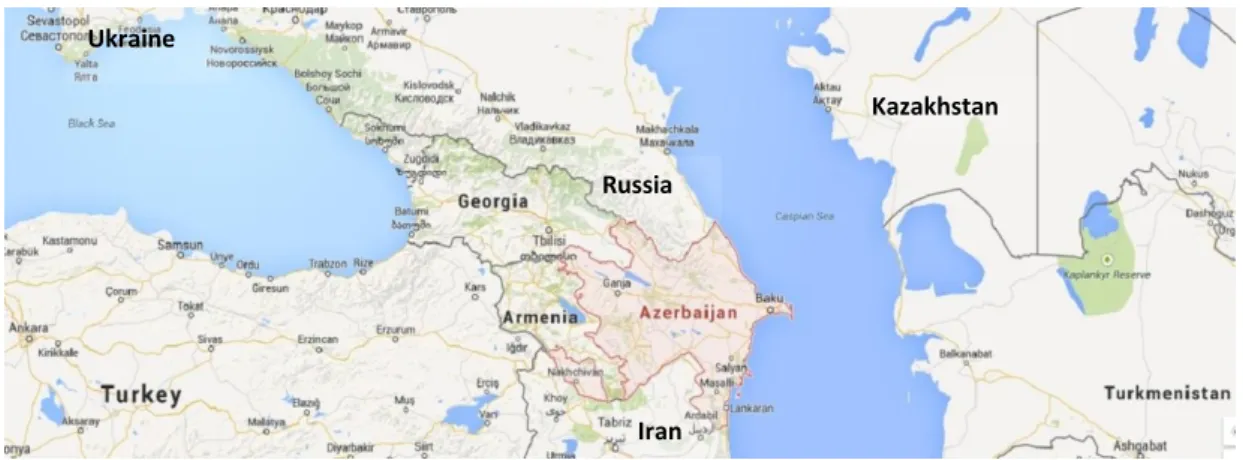
Figure 3.1: Azerbaijan’s Location in the Region 39
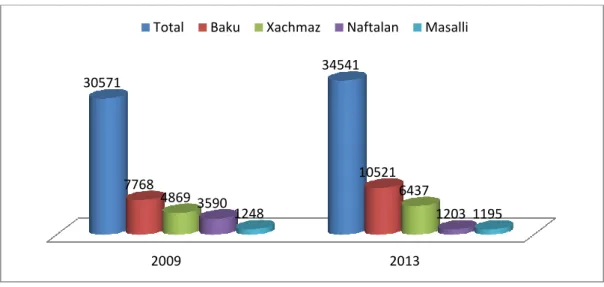
Figure 3.2: Number of Beds in the Country 56
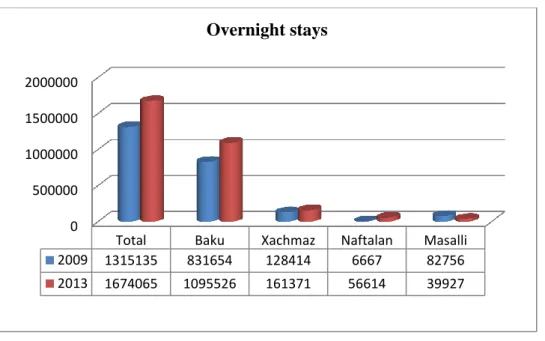
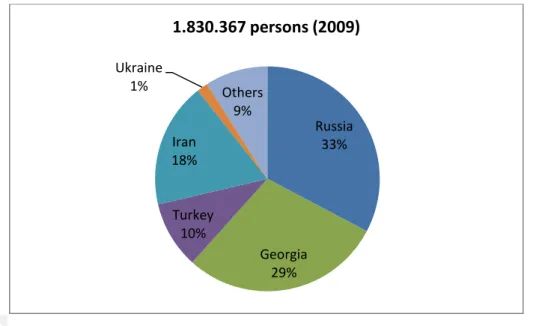
Figure 3.3: Overnight Stays in the Accommodation Facilities 57 Figure 3.4: Share of Foreign Visitors by Countries in 2009 58 Figure 3.5: Share of Overnight Stays by Countries in 2009 59 Figure 3.6: Share of Foreign Visitors by Countries in 2013 59 Figure 3.7: Share of Overnight Stays by Countries in 2013 60 Figure 3.8: Overnights Stays by Countries of Origin 60
x
INDEX OF TABLES
Table 2.1: The Five Phases in Destination Brand Building 24 Table 3.1: Determining POPs and PODs in Target Markets 73
xi
INDEX OF SYMBOLS AND ABBREVIATIONS
AZPROMO Azerbaijan Export and Investment Promotion Foundation AZSTAT Azerbaijan State Statistical Committee
DMO DMO- Destination Management Organizations
MCTAR Ministry of Culture and Tourism of Azerbaijan Republic MENRAR Ministry of Ecology and Natural Recourses of Azerbaijan
Republic
n.d. No Date
POD Points of Difference
POP Points of Parity
RTB Reasons to Believe
SWOT Strengths Weaknesses Opportunities Threats T&T Travel and Tourism
UNWTO United Nation World Tourism Organization
UNESCO United Nations Educational, Scientific, and Cultural Organization
UK United Kingdom
xii
INTRODUCTION
Today, every country, city and region on earth must establish a positive reputation in order to be successful in different aspects of international relations. Many destinations are now actively marketing themselves through adapting methods which normally suggested for products. One of those methods is brand image which provide the information concerning the brand, and countries with positive brand image have high expectation of quality and competence. From this aspect, the reputation of a country plays an essential role in its economic, social, cultural relations with the rest of the World (Anholt, 2009:8). Especially developing countries need to create a positive image for economic growth, and tourism, because of they have not achieved desirable progress level yet. Particularly in tourism industry national image of the country is critical. In order to achieve desired results countries need to convince not only potential tourists but also decision influencers like tour operators, tour agencies and government bodies. Thus, enhancing or maintaining (already positive) the destination brand image is main task for authorities and national tourist boards. This thesis draws attention to the problems of Azerbaijan’s tourism sector development. Destination Azerbaijan is a place with huge but in same time undervalued potential for tourism. In order to attract tourists destination brand should be developed and promoted by considering several aspects. One of the key aspects is proximity and geographical location. Thus current study provides insight into the perspectives of brand positioning in neighbouring and regional markets.
This research addressed two primary research questions:
1) Why neighbouring and regional markets need to be chosen as a main target markets in Azerbaijan's marketing strategies?
2) What measures can be taken to draw more tourists to Azerbaijan from neighbouring and regional markets?
Recognizing the fact that neighbouring countries as a main source of tourists are extremely important in tourism’s prosperity is a basic task. Reports by UNWTO prove mentioned suggestion. Moreover, some scholars (Weaver & Lawton 2009:86) describe this in their study as because of higher transportation costs and longer
xiii
travelling time, the number of visitors from the origin country will decrease as distance to the destination country increases. Consequently, geographical proximity and accessibility of the destinations becomes more important over the years. Therefore, efficient factor of positioning in neighbouring markets will be higher. Especially it is a key issue in tourism marketing for new destinations, no doubt that countries are firstly known regionally then in global scale. Level of infrastructural availability plays a major role in developing prosperous tourism destinations. Although it demands considerable costs, undoubtedly that proximity makes it cost effective in shorter time period than it would be with other distant origins. Due to mentioned reasons and opportunities it is more efficient to position Azerbaijan in neighbouring markets: Russia, Turkey, Iran and nearby countries (with considerably big markets) of former USSR – Ukraine and Kazakhstan.
The purpose of this study is to evaluate the effectiveness of Azerbaijan’s marketing efforts and describing perspectives of the destination positioning in the nearby countries. To achieve these objectives, it was decided to conduct qualitative research through semi-structured interviews. The interview was held with the representatives of the tourism industry in neighbouring countries and regions. At the same time, secondary data – that collected through books, academic journals, official industry reports and web pages were used to enrich understanding of main issues of the topic. The reason for adapting both qualitative and secondary data is to better understand research problem by combining numeric trends with qualitative views. This mixed method could enhance the validity of findings and better ground suggested solutions. Moreover, gained knowledge is aimed to have contribution for Azerbaijan’s marketing practitioners and scholars as well as provide suggestions to draw more tourists to the country.
1
1. Literature review 1.1 Marketing
“Marketing is the activity, set of institutions, and processes for creating, communicating, delivering, and exchanging offerings that have value for customers, clients, partners, and society at large” (American Marketing Association dictionary, 2013). In other words marketing allows individuals and groups obtain what they want and need through creating and exchanging the values (Armstrong & Kotler, 2005:6). According to the same authors marketing process can be described as follows: marketers have to determine market place and investigate needs and wants ; then construct communication strategy that delivers superior value; build profitable relationship with customers and create “customer delight” (Armstrong & Kotler, 2005:6), and finally receive value from customers.
The five core marketplace concepts can be described as follows (Armstrong & Kotler, 2005:7):
1.Needs wants, and demands;
Well established marketing campaigns make great efforts to understand their customer’s needs, wants and demands. To achieve it they conduct consumer research and analyse tons of data.
2. Marketing offers (products, services and experiences)
Marketing offers includes not only variety range of products and services but also information, experience, activities or benefits (Armstrong & Kotler, 2005:7) that offered to the market in order to satisfy needs and wants of the customers. Marketing offers can also include places, ideas and persons.
3.Value and satisfaction; exchanges
Acording to Armstrong & Kotler (2005, p.8) customers often do not calculate product values and costs precisely but they favourable react on products with high perceived value. “They select the company that offers greatest perceived value. Customer satisfaction is a perceived performance of a product relative to a buyer's expectations”.
Consequently when performance matches the expectation the customer is satisfied when performance does not fit the expectation customer is dissatisfied. When
2
performance exceeds the expectations then customer is highly satisfied, make repeat purchases and share their positive experience with others.
4. Transactions and relationships
The main task for marketer receives a positive response on a marketing offer. Marketing involve building and maintaining desirable exchange relationships with target audiences through product, service and experience (Armstrong & Kotler, 2005:8). The objective of the marketers is to retain customers and as a result contribute to company's growth. Delivering superior value to the customers is a key element in development of a strong economic and social relationship with them. Customer satisfaction creates an emotional relationship with a product or service.
5. Markets
Exchange and relationship describe the concept of a market. A market is a set of actual and potential buyers of a product or service. The size of a market depends on the number of people who exhibit the need, have resources and are willing to exchange these resources. Activities like product development, research, communication, distribution, pricing and service are core marketing activities.
Creating, communicating and delivering value for customers are the main tasks of marketing. Related activities classified as marketing –mix by McCarthy, which he called the four Ps of marketing product - price, place and promotion (Kotler & Keller, 2011:22). Marketing mix is powerful tool for influencing consumers. After choosing the target segment marketers determine the offering, arrange a price that indicates real value of the proposed offer, choose the delivering channels and inform the customers about offering. Implementation of integrated marketing is the main theme that demands special attention. It involves communicating the value through diverse ways and maximizing the effect by coordinating all marketing efforts of organizations. Each communication must also deliver a consistent brand image to customers at every brand contact (Kotler & Keller, 2011:22). Thus ensuring that marketing activities can complement and reinforce each other will be result in increased effectiveness of whole marketing strategy.
3
1.2 Service Marketing
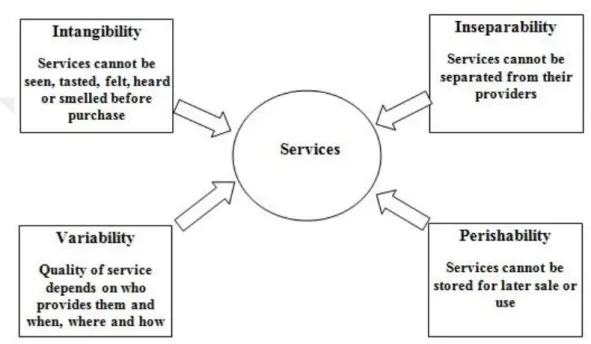
Tourism marketing as a part of Service marketing differs from product marketing. Service cannot be identified or measured by feelings, vision or hearing before buying, however gained experience from provided services exists in forms of memories. Prosperous marketing campaigns recognize this feature of services and make serious efforts to generate positive customer experiences.
Figure 1.1 Four service characteristics (source: Kotler, Bowen & Makens, 2003:42)
There are 4 features that separate service marketing from product marketing: intangibility, variability, inseparability, perishability.
- Intangibility
Marketers have to reduce intangibility that causes uncertainty and offer some tangible evidence of their services. The level of tangibility in the service offerings can be measured through “tangible goods which are included in the service, the physical environment and tangible evidence of service performer” (Palmer, 2011:8). Thus all information that fully describes the service, for example in hospitality sector the pictures and videos of exterior, interior of the building where services are provided will be extremely useful.
4 - Inseparability
In most cases the service provider and the customer need to present for a deal. Employees that contact directly the customers are part of a service. Thus if poor attitude of the employee takes place it consequently influence the customer satisfaction in a negative way. Inseparability defines the customer as a part of a product. As without interaction between customer and service provider the benefits of the service cannot be realized.
- Variability
This feature is a greatest concern to the service organizations. Because of services are customer-contact oriented it is obvious that skill’s and performance of the service provider impacts overall quality. Variability results in difficulty to present a persistent quality. Thus for service companies maintaining brand consistency is more difficult than for product manufacturers. Thus in order to reduce negative consequences of variability service organizations try to train, motivate and control the staff, and where it is possible to replace customer-employee interaction with the machine provided services (e.g banks, electron government services). However, to create superior value there is a need in well performed interaction, and variability can be used as a differentiating tool in delivering services (Palmer, 2011:10).
- Perishability
This is a disability of services to be stored or kept for subsequent sales in the future. Demand for services varies through time and particularly in hospitality sector it is called seasonality. Resort hotels and dependent services can make sales with highest profit only in peak seasons, either in winter or summer depending on geographical location. Thus management of supply and demand is crucial in handling the problem. Pricing and promotion are useful tools to decrease perishability effect (Palmer, 2011:13).
Tourism and hospitality sector is a well-known pattern of intercultural relationships. Thus it is critical to understand international service marketing rules. International
5
service marketing differs in some aspects from domestic service marketing, these include:
1) Marketing activities that take place in more than one country
2) International marketing considers government control and foreign cultures.
To accomplish international marketing goals marketers need to take into consideration that services are inseparable and variable, and they are customer-contact oriented. Thus customer sensitivity is a basis for success. Some researchers define international services as following “International services are deeds, performances, efforts, conducted across national boundaries in critical contact with foreign cultures” (Clark, Rajaratnam, Smith, 1996:15). Understanding of local needs is a key for marketers. Particularly companies need to recognize the possibility of providing the same offer in variety range of markets or they need to adapt to the local market characteristics. The manner in which brand values are communicated in advertisements is a reflection of the cultural values of a society (Palmer, 2011:501). Therefore, promotional messages need to include perceived values of the different markets. In other words, despite offering the same service promotion, it is vital to adapt to the desire of several foreign markets. In some cases, countries with the similar cultural values can be grouped as a single target audience.
1.3 Destination
Destinations offer variety range of experience to visitors. Traditionally, destinations are regarded as well-defined geographical areas. However, Buhalis (2000) mentions that nowadays “destination is something with a perceptual concept, which can be interpreted in different ways by tourists” and it depends on their educational level as well as cultural background. Kotler, Bowen & Makens (2003:718) gives the definition of destination as “Destinations are places with some form of actual or perceived boundary, such as the physical boundary of an island, political boundaries, or even market created boundaries”. However, Buhalis (2000) looks more into details and describe it as:
6
“Destinations offer an amalgam of tourism products and services, which are consumed under the brand name of the destination. They can be regarded as a combination (or even as a brand) of all products, services and ultimately experiences provided locally. It also enables us to assess the impact of tourism regionally, as well as manage demand and supply in order to maximise benefits for all stakeholders”. There is six A’s framework that is suggested to describe destination by Buhalis’s (2000):
Attractions (natural, man-made, artificial, purpose built, heritage, special events)
Accessibility (entire transportation system comprising of routes, terminals and vehicles)
Amenities (accommodation and catering facilities, retailing, other tourist services)
Available packages (pre-arranged packages by intermediaries and principals) Activities (all activities available at the destination and what consumers will
do during their visit)
Ancillary services (services used by tourists such as banks, telecommunications, post, newsagents, hospitals, etc)
On the other hand, Hudson in his work (2008:392) classifies destinations as follows:
Major international destinations. These destination that are top destinations in terms of visitor numbers and there is a common desire among tourists in visiting them.
Classic destinations. The destinations with cultural, natural and historical sites that encourage the visitors to stay longer.
Human made destination resorts. Here tourists are not tend to go outside the resort which in most cases is all-inclusive resorts.
Natural landscape or wildlife. The destinations with rich and diversify flora and fauna attract appropriate type of tourists.
Alternative destinations. The destinations that provides nowadays popular attractions and activities like theme parks, shopping malls, cruise adventures
7
Business tourism destinations. The destination that attracts business people as well as other type of tourists that are either participants or visitors of variety range of events (MICE travellers).
Stopover destinations. Destinations that situated between tourist origin places and final point of travelling.
Short break destinations. Day trip destinations. 1.4 Brand
The American Marketing Association (AMA 2014) define, a brand as a “name, term, design, symbol, or any other feature that identifies one seller's good or service as distinct from those of other sellers”. In other words establishing a name, logo, or sign for a new product describes the branding process, and these elements that are used to distinguish the product or service are brand elements. Consequently a definition of a brand is something more than simply a product but a product plus set of features that can characterize it from others in the same group. These characteristics may be tangible, related to product performance of the brand or can involve symbolic, emotional, and intangible features (Keller, 2013, p.31). “Brands, especially strong ones, carry a number of different types of associations, and marketers must account for all of them in making marketing decisions” (Keller, 2013:32).
According to Kapferer (1992) a brand is complex of six levels of meaning (as it cited in Kotler, 2003:418:419):
1. Attributes: A brand defines a certain attributes
2. Benefits: Attributes must be translated into functional and emotional benefits
3. Values : A brand illustrates the producers values
4. Culture: A brand represents a particular culture
5. Personality: Assignment of a brand to a set of human characteristics in order to
8
6. User: A brand defines the portrait of consumer that uses this brand.
There is also another definition that describes brands: the corporate brand defines organization that delivers and stands behind offering and the number, power and credibility of organizational associations are greater for a brand that represents corporate organization (Aaker, 2004). The corporate branding construct can be applied not merely to corporations, but also to nation states and cities (Balmer, 2010). Thus country brands are like corporate brands and successful nation branding depends on positive associations related to the country.
Branding is about ability to create divergent product or service. One of the pivotal definitions in measuring brand power is brand equity. According to Kotler & Keller (2011 :238) Brand equity is the added value endowed on products and services. It indicates a brand’s power that derives from well recognition and having positive associations. Customer based approach of studying brand equity is critical in understanding consumers feelings and behaviour towards the brand. Thus customer based brand equity is critical in branding.
“A brand has positive costumer based brand equity when consumers react more favourably to a product and the way it is marketed when the brand is identified, and vice versa” (Kotler & Keller, 2011:240). The main objective here is to give the customers the right type of experience with products and services, thus as a result, to create desired brand knowledge in order to build strong brands.
According to Kotler & Keller, (2011 :244:245) there are different models of brand equity. Aaker’s one is among the most established ones. Thus according to Aaker’s model the brand equity includes the brand awareness, brand loyalty, and brand associations which take place in forming of product or service value. Aaker’s also mentions that one of the critical elements in brand management is brand identity “brand identity is the unique set of brand associations that represent what the brand stands for and promises to customers, aspirational brand image” and the process of brand management actually starts from it.
According to Kotler & Keller (2011:245) there are three main sets of brand equity drivers:
9
1. Choices of brand elements and determining the brand identity – brand names, URLs, logos, symbols, characters, spokespeople, slogans, jingles, packages, and signage.
2. The product, service and all accompanying marketing activities as well as supporting marketing programs
3. Other associations indirectly transferred to the brand by linking it to some other entity (a person, place, or thing)
Important to realize the right choice of brand elements is crucial for building positive brand equity. According to Kotler & Keller (2011:246) there are six criteria to choose brand elements: memorable, meaningful, likable, transferable, adaptable, and protectable. Brand elements are playing essential role in brand building and they should be easily recognizable, descriptive and convincing. Building brands does not depend only on advertising. In order to enhance brand equity marketers must take into consideration experiences that gained through using the branded product or service and develop appropriate promotion campaign.
Tourism is a considerable part of service economy thus service branding approach is applied for branding tourism and hospitality. Using of brands in service sector becoming increasingly important, one of the advantages is that branding limits the search activities of potential buyers (Palmer, 2011:260). On the other hand, branding allows to address intangibility problem the obstacle that occurs in marketing of service sector. So, brand symbols make the service more tangible and concrete. Branding services helps to organize and label the variety range of new offerings in easily communicated manner (Keller, 2013:42).
Branding has been found to simplify the decision making process by providing sense of security and consistency (Palmer, 2011:260). Consumers instantly react on the reputation of the company especially in the situations where getting appropriate service is under risk and physical evidence of the service is low. Reputation of service firm can be especially vital in simplifying the choice for buyers, who may have little understanding of services that are newly presented (Palmer, 2011:266). Brands can help identify and provide meaning to the different services provided by a firm (Keller, 2013:42). Not to mention companies not only brand its premium business but also communicate to the budget consumer segment
10
(i.g. airline’s regular passengers) that they are also special in some way (Keller, 2013:43).
One of the most important aspects in branding is delivering a consistent standard of service. Consistency focuses on relatively abstract concepts such as integrity, honesty and reliability (Palmer, 2011:267). Therefore it is crucial to maintain the quality of product or service otherwise it can be result in a perception of poor service and in consequence damage the brand’s reputation. In such cases that are consequent of service failure, organization has to consider some measures to prevent its image from further damaging.
1.5 Segmentation and Targeting Consumers
Market segmentation can be defined as the process of dividing a market into distinct subsets of consumers with common needs or characteristics with the aim of subsequent targeting these subsets (Schiffman & Kanuk, 2004 :50). The strategy of segmentation enhances ability to compete effectively by differentiating product and service offerings. Differentiation can be carried out through styling, packaging, promotion, distribution channels, excellent service and price.
Schiffman & Kanuk (2004 :52) describes segmentation as a basis in implementing the three-stage marketing strategy which involves three components: segmentation, targeting and positioning. Segmentation studies are designed to discover the needs and wants of specific groups of consumers and provide the products that match each group’s needs. This statement makes sense also for Tourism and Hospitality sector. Well recognized hotel chains like Hilton, Hyatt, Intercontinental and others implement market segmentation. It is based on needs and wants of travellers ranging from price-sensitive tourists to full service business travellers. Sometimes there is a need to define the consumer groups more precisely. Thus marketers divide the segments into sub segments called niches. Forming a niche has got several advantages; customers will pay a premium to the firm that best satisfies their needs, the niche is small but have a defined size, the growth is potential and it is unlikely to attract many other competitors, and it is possible for organization gain certain economies because of specialization (Kotler & Keller, 2011:209).
11
To develop new products or service offerings that satisfy different consumer segments, marketers conduct segmentation research. Defining the most efficient media for advertisements is among the main tasks of segmentation research. “There are nine categories of consumer characteristics that provide base for market segmentation. They are “geographic factors, demographic factors, psychological factors, and psychographic characteristics, sociocultural, use related, use situation factors, benefit sought and forms of hybrid segmentation” (Schiffman & Kanuk, 2004:53).
Geographic segmentation divides market by location. The needs and wants of consumers who lives in the same area more or less are the same, than people who living outside this area. Mentioned statement also applicable for tourism industry, for instance people who lives in the countries with cold or cloudy weather desires to travel to the destinations with warm weather and vice versa.
According to Schiffman & Kanuk (2004:55) another factor of segmentation is demographic data. This includes: age, sex, income, occupation, education etc. Additional psychological and sociocultural characteristics used to identify the way of thinking the members of the particular market. However the “demographic information is often the most accessible and cost-effective way to identify the target market” (Schiffman & Kanuk, 2004:55). Demographic variables reflect the trends in market and help to plan the marketing mix more precisely. For example increasing numbers of aging population in Europe and Russia requires specific products and services that in most cases not affordable for young generation. Bargaining power of mature adults is of course bigger. Sociocultural variables are among most important sources for market segmentation. As the members of the same culture share the same values, beliefs and customs it is vital to segment market through using this cultural proximity.
Use related segmentation is very demanded among marketers. It describes the rate of usage of a specific product or service among the consumers. According to this segmentation method there are three groups of differentiated consumers: heavy users, medium users, light users and nonusers. Most marketers prefer address their promotion to the small percentage of heavy users as they consume more than others (Schiffman & Kanuk, 2004:64).
12
In many cases brand loyalty considered as a powerful base for segmentation. Therefore marketers stimulate and reward the consumers that prefer their brand to others. This practice is widely used by service organizations (e.g., hotels, airlines , banks).
According to (Schiffman & Kanuk, 2004:68) psychographic and demographic profiles are highly efficient when they can be combined. Identifying selected demographic and psychographic profile helps to tailor advertisements for these specific groups. Combining several segmentation variables is also the way by which marketer can achieve their tasks.
The next challenge for the market is to select one or more segments to target with an appropriate marketing mix. According to Kotler, Wong, Saunders & Armstrong (2005:418) target market consists of a set of buyers who share common needs or characteristics that the company decides to serve. For effective targeting a market segment should follow several criteria:
1) Identifiable. Marketers must be able to identify common or shared needs or characteristics that are relevant to the product or service.
2) Sufficient. Sufficiency is very important for successful results of targeting. Marketers often use secondary demographic data or employ a profitability survey to have a real prediction of the segments’ size.
3) Stable. Marketers prefer to target stable segments in terms of demographic and psychological factors and needs.
4) Accessible. Marketers must be able to implement economically efficient way to reach the market segments they want to target.
If company decides to target market segments, several marketing methods can be implemented. From this context, differentiated marketing is common used strategy. The organization that applies this strategy sets a separate offer for each market segment. For smaller companies it can be difficult to serve the larger segments because of lack in skills, resources and competition (Kotler et.al, 2005:416). These companies can consider smaller and less attractive segments which can be more
13
profitable for them. Another factor of targeting is choosing the segment relatively to their bargaining power.
1.6 Brand Positioning
Aaker (1996:21) defines brand position as “the part of the brand identity and value proposition that is to be actively communicated to the target audience and that demonstrates an advantage over competing brands. In other words, brand positioning is a tool that helps to create favourable opinion about the organization’s image and offer in the target consumers’ minds”.
Having positive thoughts concerning the offerings help to maximize company’s benefits. To have a successful brand positioning marketers have to know how the brand is unique, who is the main competitors of the brand, which similarities and differences does exist between the brand and its competitors.
Choosing right competitive advantage is a basis for successful brand positioning. According to Reeves (by Kotler et al., 2005:443) a company should develop a Unique Sales Proposition (USP) for each brand and stick to it. There is a need in identifying ‘number 1’ attribute. Thus consumers tend to remember the leader in position. The most significant ‘number 1’ positions are best quality, best service, lowest price, best value, most advanced technology (Kotler et al., 2005:443).
The product may be similar to competitors one but can have unique associations for consumers – this is the so called Emotional Selling Proposition (ESP). When choosing the differentiation factors to provide, marketers should focus on: Importance, distinction, superior feature, affordability, profitability, communicability, feature of being pre-emptive (Kotler et al., 2005:443).
There are several criteria of brand frames of references that help consumers to perceive a product or service which the brand represents. To form a basis for positioning marketers need to set up appropriate competitive frame of references that define consumer target market and competition (Keller, 2013:82). Establishing efficient positioning strategy requires having appropriate Points-of-Difference
14
(PODs) and Points-of-Parity (POPs) associations. “Points-of-difference (PODs) are formally defined as attributes or benefits that consumers strongly associate with a brand, positively evaluate, and believe that they could not find to the same extent with a competitive brand (Barwise & Meehan 2004, by Keller, 2013:83). Perceptions of consumers concerning uniqueness of brand associations determine their choice. PODs can be also created from imagery associations. For instance, some organizations use luxury image to target consumers with higher status, while others make offerings to the low cost segment. Thus, choosing several PODs are possible”. They can describe several beneficial features of an offering for consumers. These benefits often have important underlying ‘proof points’ or reasons to believe (RTBs) . Moreover it is critical to have these reasons to believe as they enhance deliverability feature of PODs. These proof points can be for example key attributes, key ingredients or key endorsements (Keller, 2013:84).
Points-of-parity associations (POPs), on the other hand, are not necessarily unique to the brand but may in fact be shared with other brands. POPs distinguish into three categories: category, competitive, and correlational. In case of having lots if competitors it would be better to create positioning at the categorical level for relevant categories. Category points of parity represent necessary but not necessarily sufficient conditions for brand choice (Keller, 2013:84). Category POPs exist in generic level, so consumers perceive a company’s product category according to its offerings. Competitive points of parity designed to neutralize competitors’ points of difference. If company can categorize itself in the areas where competitors are trying to offer an advantage for consumers, the brand should probably be in unbeatable position. Correlational points-of-parity are those potentially negative associations that arise from the existence of other, more positive associations for the brand (Keller, 2013:84). Consumers tend to believe into one attribute of offering thus it makes difficult to deliver several defining or differentiating factors of a brand in a same time. Additionally, each individual attributes can have both positive and negative effects. Therefore, for overall success marketers have to use some technics to negate unwanted effects.
PODs are critical in positioning; actually they are a basis for further differentiation of a brand. They cannot be set up until product or service is not seen in particular category by consumers. Thus PODs have to be created after having
15
strong POPs. The brand should not simply copy the competitors brand attributes. However, POPs are needed for consumer recognition of claimed attributes whether they are sufficient enough for the offering or not. Points of parity are easier to establish, while achieving clear points of difference need demonstration of distinctive features that only exists for the positioned brand. Keller (2013:84) states:
“The key to positioning is not so much achieving a POD as achieving necessary, competitive and correlational POPs. Defining and communicating the competitive frame of reference and having points of parity and points of difference are key issues of brand positioning”.
Distinguishing clearly category membership is a basic task for marketers. It allows informing consumers which need of them can be satisfied through using this product or service, as well as allow defining competitors.
According to Keller (2013:87) “a brand must offer a compelling and credible reason for choosing it over the other options. In determining whether an attribute or benefit for a brand can serve as point-of-difference, there are three key considerations. The brand association must be seen as desirable, deliverable, and differentiating. Desirability is an attitudes of consumers towards the brand, deliverability is based on company’s resources that help to deliver the promise, and differentiation is based on need to have a distinct offer that differs from competitors one”.
Another criterion that needs to be satisfied is deliverability. Deliverability depends on ability of the company to offer claimed product or service with claimed attributes, as well as effectively communicate this offerings. Communicability is ability to convince the consumers to buy an offering. To do this and to make them believe to the brand promise, organization have to show trusted ‘proof points’, which in its turn can enforce brand image in the eyes of potential buyers (Keller , 2013:87). To have success in positioning the target segment have to recognize the distinctiveness of offered product or service. It needs to be mentioned that having defensible positioning that can be strengthened over time is a priority objective for the brand managers.
16
2. Concept of Destination Marketing 2.1 Branding Destinations
Nowadays the importance of tourism to the World’s economy is increasingly growing. From this context, in order to achieve desired results in recruiting of international tourists destinations have to adapt advanced strategies. One of these strategies that previously used for product and service offerings is branding. Today branding is a core activity for national tourism boards in establishing prosperous tourism destination.
2.1.1 Country Brand
According to Morgan, Pritchard & Pride (2009:41) associations related to the country names can increase either decrease perceived value of manufactured products and services. Consequently, it gives consumers some ideas about the products and helps to make further decisions. Potential consumers usually have images of countries despite the fact that not every country establishes its name as a brand. It is related to national stereotypes, thus, people have some though and beliefs concerning particular countries. However many countries are less known or not known at all. Therefore DMOs in this group of countries have to make much more efforts to encourage tourists and attract them to the country. According to Kotler et al., (1993, by Morgan et al.,2009:42) country image is about:
“The sum of beliefs and impressions people holds about places. Images represent a simplification of a large number of associations and pieces of information connected with a place. They are a product of the mind trying to process and pick out essential information from huge amounts of data about a place”.
A country’s image comes from its geography, history, economic development, culture and etc. Morgan et al. (2009:42) mentions that mass media plays a major role in designing the perceptions of people. Especially perceptions can be easily formed through authentic facts about the place that are shown in mass media. The key is to find niche in marketplace, in other words being competitive and trying to satisfy the needs of target market, as well as provide impressionable product
17
that has no any alternatives. Here the term of authenticity and uniqueness need be mentioned as well. The first one is related with the “sense of place” which helps to distinguish a particular destination from all others, and uniqueness is most valuable at the global scale and encourage tourists even from distant places come to see and feel that destinations.
From this aspect, geographical location of the country makes Azerbaijan unique destination. It is an advantage that country is situated in Caucasian region, as well as on the shore of Caspian sea. Uniqueness of location is that Caspian sea is the biggest lake (so big that it is called sea) in the world and Caucasian mountains are the highest mountains of Europe (with the Elbrus's peak 5642 meters). These geographical areas represent authenticity and can be realized in marketing activities to increase tourist flow into Azerbaijan, along with other regional countries.
It is also vital to know that different people in different societies hold different stereotypes of nations. Yet in some cases beliefs and stereotypes are common across particular group. These include social cognitions, mental representations shared by members of a given society (Morgan et al., 2009:42). Beliefs and stereotypes is a sort of reaction to the image of the country.
Another point described by Usakli & Baloglu in their study (2011) “destination personality has a positive impact on intention to return and intention to recommend. The greater the match between destination personality and tourist’s self-concept, the more likely is that the tourist will have a favorable attitude toward that destination, resulting in intention to return and word of mouth”. Subsequently, today it is critical to develop strategies that highlight the image and personality of country brand.
To be competitive and well known destination as well as to find markets for export there is a need for adequate marketing and branding strategy (Morgan et al., 2009:46). According to Kotler (2011:240) power of brand lies in what customers have seen, read, heard, learned, thought and felt about the brand over time. Thus the destination brand should be as much positively informative and appealing as it can be.
“Besides, tourists in their turn mostly seeking for lifestyle fulfilment and experience, and do not want to measure differentiation among most tangible attributes of
18
destination like accommodation and attractions. In simple saying they need to be
satisfied with emotional side of the tourism activity” (Morgan et al., 2009:60). Nowadays, tourists can pick up the information about the destination and facilities
provided there very quickly. Thus they quite informed about the standards in the industry, and know what they can expect from accommodation and services, attractions or cultural environment. Consequently, destinations need a differentiator in order to be competitive.
According to Morgan et al.,(2009:61) “the selection of the vacation is turning to important lifestyle attribute, and the decision making process mainly influenced by conversational and celebrity value of the potential destination. The battle for consumers in tomorrow’s destination marketplace will be fought not over price but over hearts and minds” Accordingly strategies previously adapted by consumer brands will be more frequently used by destination brands. However, positive emotions are not enough, the essential point here is to build a strong brand that have exceptional associations which plays a role of differentiation from the competitors. There is also another aspect that Morgan et al.,(2009:61) mention, brand positioning can be done differently for the same destination in order to respond on different target market’s needs. Especially it can be applied in case of Azerbaijan, as the country surrounded with three big and culturally different tourist origins like Russia, Turkey and Iran. For all three countries different positioning strategies should be implemented.
On the other hand, Hudson & Ritchie (2008) in their study mentions that destinations have realized that the brand promise needs to move beyond defining the physical aspects of a destination, and create an expectation of experience once the visitor arrives. Moreover, it needs to be mentioned that in order to have success and consequently draw more tourists a country needs to have clear picture of which offer is preferable for which market segment Morgan et al. (2009:48). Undoubtedly, countries which have impressive natural attractions, distinct cultural characteristics, and rich with historical sites are in most cases among leading tourist destinations. However, there are some destinations for example Dubai that attract tourist with new built attractions. Another way to draw more tourists can be using the power of festivals and huge sport events like Olympic Games, the World or continental championships in leading sport disciplines. These events attract not only athletes and
19
other sport’s people but also significant number of fans of the sport competitions. In case of Azerbaijan we can see that government have been using this strategy through European Games 2015, Chess Olympiad 2016, Formula-1 2016-2023, Islamic Solidarity Games 2017 and Football Euro 2020 to build a positive image and promote the country in the global scale, and surely it is used for popularization of the destination within the region. In this context to organize European Games the country have spent totally 1.3 billion AZN ≈ 1.4 EUR (before devaluation of AZN) since 2012, according to the state law “about the state budget of Azerbaijan Republic in 2015” (Ministry of Finance of Azerbaijan Republic, 2015).
On the other hand, Azerbaijan’s destination managers have to conduct a research to analyse the current trends and motives which determine tourists’ choice in favour of Azerbaijan over another destination. It is essential to understand which values are more encouraging and can result in sales. According to Morgan et al.(2009:48) the values that need to be considered are: social, emotional, convenience and personalization and a price. Because of consumers have great number of destination options, it is extremely important to have a clear picture of competitive offers. This is a fact that tourists are drawn to the place which offers more advantages and more values with less price and easily accessible. In this regard, strategic place marketing helps to achieve mentioned missions and to enhance country’s position in the global marketplace (Morgan et al.,2009:46). Moreover, for successful results government, local communities and stakeholders, must be all involved in the process, and cooperate closely. The process requires managing the aspects that influence the image of the destination and encourage consumers to make a decision in favour of the marketed destination.
There are several tasks for country brand management and managing the image is a basis for further achievements. According to Morgan et al.,(2009:46) country's marketing strategy requires determining a brand's image and comparison of that to the competitors’ one. According to Morgan et al., (2009:43) the image itself can be dated, based on exceptions rather than on patterns, as well as based on , impressions, rather than on facts, and also widespread. The images are mostly used as an introduction to that describe destinations and also to stimulate consumer concern. However consumers tend to resist changing their opinions and perceptions towards the country. People are more likely to attend information that confirms their
20
expectations. They disregard information that challenges their knowledge structures, in a process known as confirmation bias”. Hence, images can be held for a long time in the minds. That is why they need to be measured and used for destination marketing purposes. Moreover, the current economic circumstances determine new rules that nations need to comply with in order to create competitive advantage.
The terms brand image and brand identity are sometimes confusing however there is a distinction between them. Identity is the way a company aims to identify or position itself or its product, and image is the way the public actually perceive them
(Kotler & Keller, 2011:249). The image formed by organic, induced, and
autonomous sources of information is basically one perceived before experiencing a destination, which Phelps (1986) (by Beerli & Martin, 2004) calls secondary image. In contrast, the primary image is formed by actually visiting the resort in question. Therefore, to enhance effectiveness the desired image has to reflect the reality and be original. Additionally to strengthen a country’s image it is better to design new positive associations than trying to improve older ones (Morgan et al., 2009:47).
2.1.2 Destination Branding Challenges
There are some challenges for destination marketers. One of the main issues is a limited budget. Also Tourism destination image can be heavily affected by political instability, economic decrease, terrorism, and ecological problems. DMOs have almost no control over these aspects of destination environment. In addition to achieve better marketing results there is a need for collaboration with variety number of businesses such as tour operators, accommodation providers etc. Furthermore, DMOs in charge of representing all national and business interests within the destination. “These vary from local and national government agencies, through environmental groups and trade bodies, to tour operators and airlines” (Morgan et al, 2009:63) .
21
2.1.3 Measuring Destination Celebrity
Image of the destination is an essential influential factor in attracting tourists and as a result this is the key for further success in the whole marketing strategy. Destination branding can help to bridge any gaps between destination strengths and potential visitor’s perceptions. There is a need in defining the term ‘celebrity destination’.
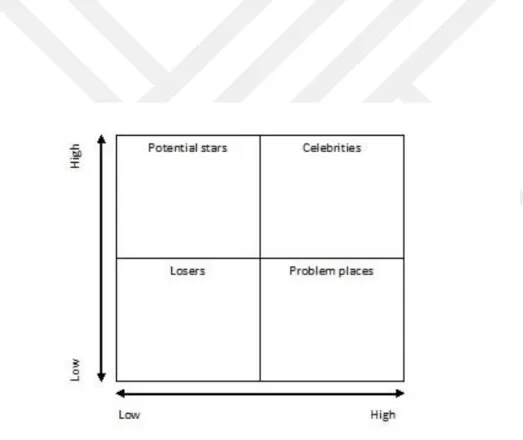
According to Morgan et al., (2009:66) people’s attitudes towards the place are of course subjective, and based on individual characteristics, educational background, or enthusiasm thus such positioning maps must be used in conjunction with psychographic analyses of key market segments (see Figure 2.1)
Figure 2.1 The destination celebrity matrix (Morgan, Pritchard & Pride 2009:66)
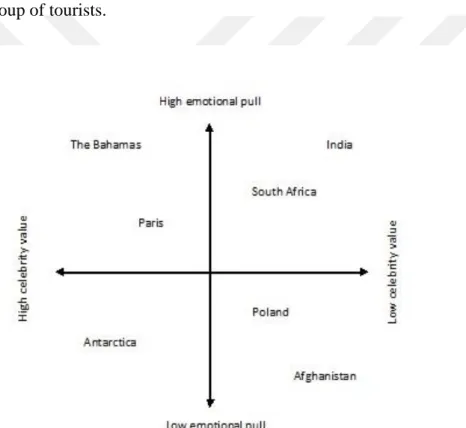
Indeed, brand winners are those destinations that caused desire and excitement and deliver great conversational value. In contrast brand losers have no expectation for tourists. Problem places are those destinations that far from holding an emotional appeal, actively repel potential tourists see. Other destinations that have high
22
emotional pull but still remain undiscovered ... have limited (although growing) celebrity value also hold huge untapped potential and can be tomorrow’s winner destinations (see Figure 2.2).
Morgan et.al.,(2009:67), proposes that instead of thinking in terms of the traditional product or brand life cycle, brand managers need to take into consideration the S-curve, which outlines the different phases for brand’s development through birth, growth, maturity, decay and death (see Figure 2.3). When it comes to implementation of the given concept through the tourism aspect we can describe the destination brand fashion curve as following: we can see in the beginning that market is small so places are seen as exclusive destination for a small group of tourists.
Figure 2.2The destination brand positioning map (Morgan et al, 2009:67)
Once the destinations become more popular opinion makers move on to the next undiscovered destination since they do not want to remain in popular place. Being in the famous phase indicates that visitors are satisfied and loyal to the destination’s brand however they can switch to another one if destination remains unchangeable and not interesting anymore.
23
Figure 2.3The destination brand fashion curve (Morgan et al, 2009:69)
Being in well-known or familiar zone can lead to a decline in visiting of the place by tourists with high purchasing power. This is the fact that some destinations which could not maintain their image become not attractive for tourists. This situation can derive from the lack of promotion efforts either by changed external environment (political, economic etc.). Thus destination marketers have to recognize the right time to implement changes, and make the destination contemporary again.
2.1.4 Establishing the Destination Brands
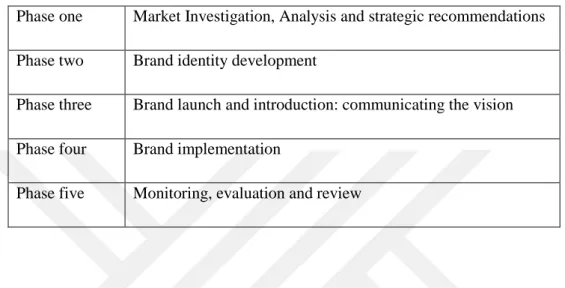
The application of brand theory to practice is quite challenging process. (Pike, 2012:180) suggests destinations are far more multidimensional than other types of services and goods. As an introduction to the process of establishing the brands it is essential to describe main attributes of the destination brand. According to Morgan et al. (2009:68) these should be durable, relevant, communicable and be noticeable for potential tourists (Table 2.1).Other key issue here is identification of brand relevance to the target audience, and know to what extent beneficial the brand over the competitors. Pike (2012:180) suggests that in order to attract minds of consumers there is a need in a brief message focusing on main brand associations. Furthermore, it is important and difficult to create a slogan that includes all factors concerning
24
destination a diverse natural environment, built attractions, intangible heritage, traditions, welcoming and hospitable atmosphere within the country.
Table 2.1 The five phases in destination brand building (Morgan et.al., Pride R.,
2009:69)
Phase one Market Investigation, Analysis and strategic recommendations
Phase two Brand identity development
Phase three Brand launch and introduction: communicating the vision
Phase four Brand implementation
Phase five Monitoring, evaluation and review
Also it should be mentioned that another difficult matter here, is coordinating the interests of all members of community from businesses to ordinary citizens within destination from the one side and targeting needs of different markets from the other. Determining the brand theme and how it should be realized is also essential. Moreover, Hudson & Ritchie (2008) suggest that “the first stage in building a destination brand is to establish the core values of the destination and its brand. This stage should consider how contemporary or relevant the brand is to today’s tourist and how it compares with key competitors”. Destination marketers’ work depends on investigation of current trends in the market, so, brand building process starts from this. They need to conduct several researches and learn the opinion, requests and inquiries of the current and potential consumers as well as local stakeholders (see Table 2.1). Essentially, DMOs cannot directly control implementation and delivering of the brand promise by the local tourism community. Hence, without agreement from these communities the brand strategy cannot be successful. Consequently, there is a need for close cooperation between DMOs and stakeholders in adapting these strategies. In the 2nd phase when the research conducted and analysed, developing brand identity can start.
25
Hudson (2008:405,406) suggests that brand launch and introduction this is about announcement of a brand and communicating it to the target audience, different promotional tools can be used for this purpose. Brand implementation phase involves delivering the messages of brand personality and proposition like a logotype, brand signature etc. Finally, the last phase of the brand building is the monitoring, evaluation and review for assessing and controlling the brand performance in the marketplace.
In this context DMOs visitor monitoring can be effective measuring tool which would help to increase brand loyalty.
2.1.5 Consumer Based Brand Equity
“Consumer- based brand equity comprises the following assets: brand awareness, brand associations, brand resonance and brand loyalty” (Pike, 2012:181).
Brand awareness
Brand awareness is a foundation of all sales activity. Hierarchy of needs proposed by Lavidge & Steiner (by Pike, 2012:181) states that, awareness aims to attract attention, stimulate preference, persuading and finally ends in purchase. According to Aaker (1996:10) brand awareness is a measure that evaluates to what extent brand exists in the consumers’ mind. He also suggests that Awareness is measured according to the different ways in which consumers remember a brand, ranging from recognition to recall, to top of mind, to dominant.
Brand associations According to Kotler & Keller (2011:165) brand associations consist of all brand
related thoughts, feelings, perceptions, images, experiences, beliefs, attitudes, and so on that become linked to the brand node. Furthermore, Aaker (1996:25) explains that a brand association is a link that represents the brand in the customers’ mind. Keller argues that (2013) “brand associations may be either brand attributes or benefits. Brand attributes are those descriptive features that characterize a product or service. Brand benefits are the personal values and meanings that help consumers to perceive the brand. Keller (2013:77) in his work suggests the ways for this: “to choose which favourable and unique associations to link to the brand, marketers need to carefully
26
analyse the consumer and the competition to determine the best positioning for the brand”.
Brand resonance
Brand resonance represents a willingness to engage with the destination. This can be explained by actions like “previous visitation”, or mentally, like intention of visiting place in the future Pike (2012:181).
Brand loyalty
One of the most important concepts within consumer based brand equity model, is brand loyalty, which is determined by commitment and repeated preferences. Due to increasing substitutability of destinations, the critical factors of brand loyalty are “lower marketing costs and word of mouth referrals. Brand loyalty is an essential factor in terms of profitability as “It is simply much less costly to retain customers than to attract new ones” Aaker (1996:21). Different factors influence tourists and make them return to a familiar destination. According to Gitelson and Crompton (1984, by Pike, 2012:182) these factors are:
“reduced risk of unsatisfactory experience
knowledge that they would find their own kind of people there emotional or childhood attachment to experience
opportunities to visit aspects of the destination not previously experienced to expose others for a previously satisfying experience.”
2.2 Destination Positioning
2.2.1 Main success Factors for a Destination Brand
Having appropriate and actual brand over a long period is the principal challenge for all destinations, as well as staying persistent despite changes in demand and travel preferences. Firstly it is essential to realize financial support for product improvements to achieve stable development, and to provide relevant destination
27
experience. The second is the influence of the development of new attractions and facilities by stakeholders to make them fitted to the original destination brand character (Pike, 2012:182).
The pricing strategy is based on consumer’s perceptions of value (Pike, 2012:182). Consequently, there is a need in efficient allocation of prices grounded on real perceptions of value. Hence it is another matter to solve in order to create right and advantageous perceptions in the target market. On the other hand, communication with the consumers has to show all features of the brand’s value. The brand managers have to take into consideration what the brand means to audience. This highlights the need of creating and controlling strategy of brand positioning for the destination (Pike, 2012:184).
2.2.2 Brand Identity vs. Brand Image
Brand identity has an internal focus on issues such as self-image and a vision for motivating stakeholders, while brand image represents the actual image held in market (Pike, 2012:186). Brand positioning forms a connection between them. However, destination brand identity development takes into consideration mainly four aspects (Pike, 2012:188): Determining of brand manager (‘brand-champion’); Identification of the brand community – destination brand must represent local residents’ sense of place which reflects the values of the community; A destination audit; Production of a brand charter” which provide information and guidance to stakeholders.
2.2.3 Implementation of Positioning
Kotler, Bowen &Makens (2003:285) describe the positioning task as consisting of three steps: identifying a set of possible competitive advantages upon which to build a position, selecting the right competitive advantages, and effectively communicating and delivering the chosen position to a carefully selected target market. Kotler et al., (2003:286) suggest that destination can differentiate itself from competitors by physical attributes, service, location, or image. Some destinations successfully differentiate themselves on service. For example service quality in the Turkish