395
http://journals.tubitak.gov.tr/agriculture/ © TÜBİTAK
doi:10.3906/tar-1812-84
Determination of essential oil components, mineral matter, and heavy metal content of
Salvia virgata Jacq. grown in culture conditions
Belgin COŞGE ŞENKAL1,*, Tansu USKUTOĞLU1, Cüneyt CESUR2, Volkan ÖZAVCI3, Hülya DOĞAN4
1Department of Field Crops, Faculty of Agriculture, Yozgat Bozok University, Yozgat, Turkey 2Faculty of Engineering, Karamanoğlu Mehmetbey University, Karaman, Turkey
3Veterinary Faculty, Yozgat Bozok University, Yozgat, Turkey
4Vocational School of Technical Science, Yozgat Bozok University, Yozgat, Turkey
* Correspondence: [email protected]
1. Introduction
Most members of the family Lamiaceae have considerable importance in areas such as medicine, food, cosmetics, and perfumery, as they are rich in essential oils, aromatic oils, and secondary metabolites. Sage, a member of this family, is the generic name for species in the genus Salvia, which has approximately 900 species worldwide (Dweck, 2000). There are 99 species of the genus Salvia L. in Turkey; 51 of these species are endemic. Turkey is one of the important gene centers for Salvia species (Güner et al., 2012). These species include annual, perennial, and biennial plants in bush form. As important medical plants since ancient times, the leaves, flowers, shoot tips, and partial stems of
Salvia species are all utilized. In folk medicine, sage leaves
are valued for the treatment of many disorders and have been used for their soothing properties, for pain relief and prevention of colds and coughs, for lowering blood pressure, and for sweat-breaking; they have been used as expectorants, disinfectants, and muscle pain relievers, and as a part of midwifery practice (Sarı et al., 2012; Bayram
et al., 2016). Consumption of these species as herbal teas is quite common, as well. Salvia species appeal to a wide range of consumer groups due to their characteristics, and because they are used in the food, pharmaceutical, and chemical industries their market potential is quite high.
The S. virgata species belonging to the genus Salvia is a perennial and herbaceous plant that can grow up to 30–100 cm high with an erect and highly branched structure. The leaves are simple, usually scattered on the body, sometimes collected on the base. The flower is a compound cluster. The petals are violet, blue, or mauve, rarely white, and it favors a wide variety of habitats such as shrubland, forests, meadows, low fields, limestone and volcanic rocks, and roadsides (Doğan et al., 2008; Karabacak, 2009; Arslan, 2015). It spreads from sea level up to 2300 m. The blooming period is between May and September. The species spreads through Crimea, the Balkans, Italy, the Caucasus, Northern Iraq, Iran, Afghanistan, and Central Asia and is found all over Turkey (Figure 1) (Karabacak, 2009). The local name of S. virgata is “yılancık” or “fatmanaotu” in Turkey, and Abstract: Most members of the family Lamiaceae are of considerable importance in areas such as medicine, food, cosmetics, and
perfumery, as they are rich in essential oils, aromatic oils, and secondary metabolites. Sage, a member of this family, is the generic name for species of the genus Salvia. The genus Salvia has approximately 900 species worldwide. There are 99 species of the genus
Salvia L. in Turkey; 51 of these species are endemic. The local name of S. virgata is “yılancık” or “fatmanaotu” in Turkey, and it is used
for the treatment of wounds and various skin diseases. In addition, a decoction prepared by using aerial parts of this species is used to prevent blood cancer. In this study, essential oil composition and heavy metal and nutrient element contents (aluminum, cadmium, cobalt, chrome, nickel, phosphorus, potassium, calcium, sulfur, iron, copper, zinc, manganese, boron, and sodium) of S. virgata grown in Yozgat, Turkey, under local ecological conditions were determined using standard analytical processes. The essential oil content in the aerial parts of S. virgata harvested during full flowering was 0.01% (w/w). The principal constituents of the essential oil were pentacosane (20.09%), caryophyllene oxide (6.90%), phytol (6.83%), spathulenol (6.09%), and nonacosane (5.15%). The highest macro- and micromineral contents were Ca and K, and Fe and Na, respectively. The accumulated concentrations of the three metals found were lower than the maximum allowed for human consumption without health risks.
Key words: GC/MS, heavy metal, mineral content, Salvia spp.
Received: 21.12.2018 Accepted/Published Online: 14.05.2019 Final Version: 05.08.2019 Research Article
it is used for the treatment of wounds and various skin diseases. A decoction prepared with aerial parts of this species is used to prevent blood cancer (Baytop, 1999; Poyraz and Koca, 2006; Sarı et al., 2012). In addition, it is reported that this plant is consumed as a strong tea in Iran (Hatipoğlu et al., 2016) and has several biological activities (antimicrobial, antioxidant, alpha-amylase, GSH-Px, antinociceptive, antiinflammatory, peroxidase, polyphenol oxidase, and acetylcholinesterase activities) (Alizadeh, 2013; Jeshvaghani et al., 2015).
It is crucial to detect the contents of Salvia species because the genus is rich and of medical importance. Therefore, a large number of studies have been conducted to determine the essential oil compounds and secondary components of Salvia species, and studies are ongoing both in Turkey and in the rest of the world.
The proximity of agricultural lands to cities, distorted urbanization, domestic and industrial wastes, and heavy metals emitted by motor vehicle exhaust and/or chimney fumes negatively affect all living things. In addition, heavy metals taken in high doses through the food chain have a negative effect on human health. The medicinal and aromatic plants that provide us with nutritional trace elements and chemicals of medicinal value are collected from natural and cultivated areas that are exposed to various pollution factors. This situation causes toxic element accumulation in the vegetative organs of plants, especially the leaves of plants. Toxic elements such as lead, cadmium, aluminum, and mercury can cause serious health problems. For this reason, the mineral matter contents of medicinal and aromatic plants should be controlled.
The current study was carried out to detect the essential oil composition and heavy metal and nutrient elements of
S. virgata, which is locally collected and widely used in
Turkey.
2. Materials and methods 2.1. Plant material
Salvia. virgata seeds collected from a natural area were
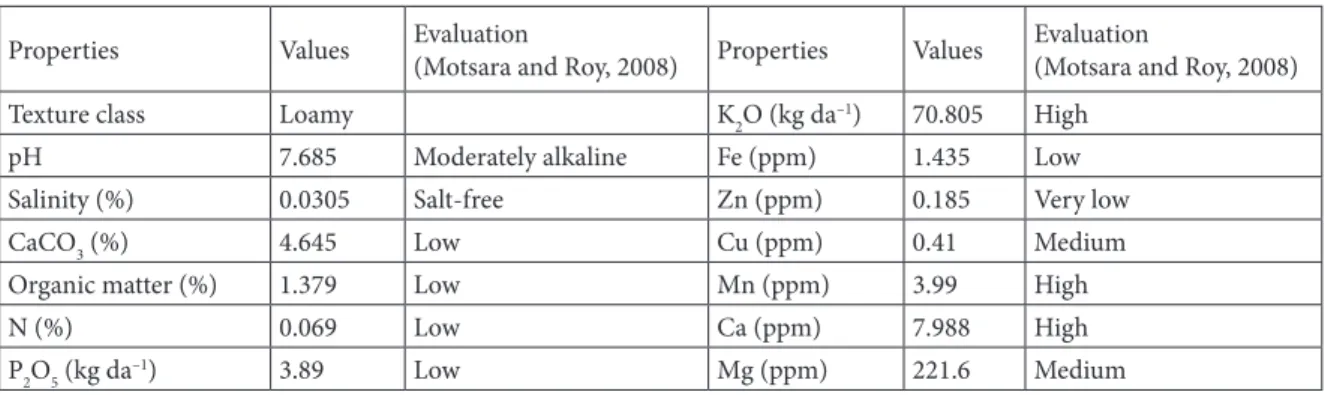
sown into vials containing a 3:1 mixture of peat and soil. The vials in the greenhouse were regularly irrigated with tap water. Seedlings of 10–15 cm in height were planted with 60 × 70 cm spacing in the collection plot during the last week of April 2016. Information on sourcing of plant material used in the research is presented in Figure 2. Some physical and chemical properties and the values of heavy metals in the collection plot are shown in Tables 1 and 2, respectively. Analyses were carried out by the Science and Technology Application and Research Center (Yozgat Bozok University, Turkey).
2.2. Analysis
2.2.1. Determination of essential oil content
After the plants were collected, the aerial parts were allowed to dry in a shady environment not exceeding room temperature. The amount of essential oil in the dried plants was determined by Clevenger distillation device. An average of 50 g of dried plant sample was distilled in 700 mL of water for 3 h. Essential oil values (%, v/w) were calculated as volume over dry matter. The obtained essential oils were placed in dark-colored flasks and stored at 4 °C in a refrigerator until they were analyzed (Oke et al., 2009; Baj et al., 2015).
2.2.2. Gas chromatography–mass spectroscopy analysis (GC/MS)
The compounds of the essential oil were detected with GC/MS (Shimadzu, QP2010 ULTRA) in the Science and Figure 1. The distribution area in Turkey of S. virgata (from www.tubives.com).
Technology Application and Research Center of Yozgat Bozok University (Turkey). The chromatographic method is given in Table 3. The essential oil compounds were identified by comparing their mass spectra, retention times, and retention indices with the values of reference samples, the FFNSC 1.2 mass spectral library, and the literature (Babushok et al., 2011).
2.2.3. Determination of ash, heavy metal, and nutrient contents
Plant samples were dried in the shade. From each sample, 1 g was weighed and put into a porcelain crucible. The samples were burned at a maximum of 550 °C until gray ash was obtained, and 3 N HCl was added to these samples. Then they were filtered using filter paper (Whatman No. 1), and distilled water was added up to a final volume of 10 mL (Kaçar and İnal, 2010). The heavy metals and nutrients (aluminum, cadmium, cobalt, chrome, nickel, phosphorus, potassium, calcium, sulfur, iron, copper, zinc, manganese, boron, and sodium) in the samples were detected using an iCAP-Qc ICP-MS spectrometer (Thermo Scientific)
at the Science and Technology Application and Research Center (Yozgat Bozok University, Turkey). The ICP-MS conditions were as follows: microflow PFA nebulizer, plasma power of 1550 W, quartz cyclonic, Peltier cooled spray chamber, 2.5-mm quartz injector; monitoring of
197Au; argon as the nebulizer gas at 0.98 L min–1; argon as
the auxiliary gas at 0.80 L min–1; argon as the cooling gas at
14.00 L min–1; and an analysis time of 60 s. The numerical
data calculated by considering plant dry weight are the average of three replications and are presented as mean ± SD. The calibration curve is drawn between 1 ppb and 1 ppm, totaling 11 points (Yetim, 2002; Başaran et al., 2017).
3. Results and discussion
3.1. Compounds and contents of the essential oil
The amount of essential oil in the aerial parts of S. virgata collected in full flowering stage was 0.01% (w/w) in our study. Essential oil of 0.48% (w/w) was obtained by steam distillation from herbage of S. virgata collected during flowering (July–August) near Tabriz (northwestern Iran) Figure 2. Salvia virgata used in this research.
(Sefidkon and Mirza, 1999). Light yellow essential oil (0.57%, w/w) was taken from the dried flowers of S. virgata collected from Mazandaran, Iran, in July 2004 (Morteza-Semnani et al., 2005). In another study, the aerial parts of
S. virgata were gathered from Fars, Iran, at approximately
1700 m, in 2014, and the essential oil yield was 1.6% (v/w) (Golparvar et al., 2017). In another study, the aerial parts of S. virgata were collected at 1700 m, before flowering
and during 100% flowering stages, in April and June in the Estahban district of Fars Province. The pale yellow essential oils were isolated by hydrodistillation of the aerial parts, and the ratio of essential oil obtained before flowering (0.32%) was lower than in the full flowering stage (0.55%) (Ramakrishna and Ravishankar, 2011). The essential oil content that we obtained in the current study is quite low compared to other studies. Since wild plants are exposed to Table 2. The values of heavy metals detected at 15 cm (A), 30 cm (B), and 45 cm (C) depths of the collection parcel.
Heavy metals (ppm) Cr Co Cu A B C A B C A B C 0.244 0.211 0.216 0.082 0.100 0.074 0.079 0.068 0.052 Permissible limit
European Union Standards (ppm)a 50 150 140
Republic of Turkey Ministry of Environment and
Urbanization Standards (ppm)b 100 Not available 100
a Sahoo et al. (2018), b www.sgb.gov.tr.
Table 1. Some physical and chemical properties of the collection plot’s soil surface layer (at 0–30 cm).
Properties Values Evaluation(Motsara and Roy, 2008) Properties Values Evaluation(Motsara and Roy, 2008)
Texture class Loamy K2O (kg da–1) 70.805 High
pH 7.685 Moderately alkaline Fe (ppm) 1.435 Low
Salinity (%) 0.0305 Salt-free Zn (ppm) 0.185 Very low
CaCO3 (%) 4.645 Low Cu (ppm) 0.41 Medium
Organic matter (%) 1.379 Low Mn (ppm) 3.99 High
N (%) 0.069 Low Ca (ppm) 7.988 High
P2O5 (kg da–1) 3.89 Low Mg (ppm) 221.6 Medium
Table 3. Chromatographic method for GC/MS.
GC parameters MS parameters
Oven temperature
Rate
(°C/min) Final temperature(°C) Hold time (min) Scan rate 50–550 (m/z)
- 70 1 Interface temperature 250 °C
20 180 1 Ion source temperature 200 °C
10 280 10
Column Rxi-5ms (30 m × 0.25 mm × 0.25 µm) MS database: FFNSC 1.2
Carrier gas Helium
Injection temperature 250 °C
Split ratio 10
more stress factors and strict competition than cultivated plants, they keep the secondary metabolite synthesis constantly active. Thus, the effective substance content and diversity of wild-collected drugs are generally higher than those grown in culture conditions (Baydar, 2013). The reason for the low essential oil content in our study may be that the plant samples were not collected from a natural area. In addition, the amount of bioactive substances composed of secondary metabolites varies significantly according to plant organ (morphogenetic variability), life cycles of the plant (ontogenetic variability), and the time of collection (ontogenetic variability) (Ramakrishna and Ravishankar, 2011; Baydar, 2013).
A total of 26 compounds (73.31%) were determined in GC/MS analyses. The identified components in the essential oil are given in Table 4.
The major compounds of the essential oil were pentacosane (20.09%), caryophyllene oxide (6.90%), phytol (6.83%), spathulenol (6.09%), and nonacosane (5.15%). The essential oil composition results from other studies on S. virgata are shown in Table 5.
In almost all studies, α- and β-caryophyllene and caryophyllene oxide were some of the principal constituents, but the other main compounds were different. Different main components such as borneol (Hatipoğlu et al., 2016), estregole, and α-amorphene (Yılar et al., 2017) were also recorded in the essential oil of S. virgata. In our study, pentacosane was recorded as the highest value component. This component was not detected in previous studies. Pentacosane is one of the major compounds of essential oils obtained from the leaves of Malus domestica (Walia, 2012), the dried flowers of Malva sylvestris L. (Usami et al., 2013), the aerial parts of Satureja avromanica (Abdali et al., 2017), and Aerva javanica (Burm.f.) Juss. ex Schult seed (Samejo et al., 2013).
Research has shown that the major compounds of S.
virgata essential oil have significant biological activity.
Pentacosane and nonacosane exhibited antibacterial activity (Mihailovi et al., 2011; Yogesvari et al., 2017). Phytol, an acyclic diterpene alcohol, is used extensively in the synthesis of vitamins E and K1 by the food and cosmetic industries. Phytol, which has antioxidant, anticancer, and cytotoxic activities, has a favorable effect on insulin and enzyme production and blood cholesterol reduction (Yu et al., 2005; Song and Cho, 2015; Kostik and Bauer, 2017). Diterpenes may have anticancer effects when used alone or together with other diterpenes or medicaments having anticancer properties (Islam, 2017). Germacrene D has an antioxidant and cytotoxicity effect on tumor cells (Casiglia et al., 2017), as well as an insecticidal (Bruce et al., 2005; Kiran and Devi, 2007; Casiglia et al., 2017) and a repellent effect (Birkett et al., 2008). Spathulenol has antibacterial activity and a repellent effect (Durán-Peña et al., 2015).
Caryophyllene oxide exhibits an antiinflammatory (Chao et al., 2005) and antiviral effect (Frag et al., 2004). When the results obtained from this study are compared with the literature, there are significant differences in the essential oil components. This may be attributed to factors such as the plant part used in the analysis, the development period of the plant, the harvest or collection time, differences in climate and ecological conditions, and the distillation and analysis conditions used (Bingol et al., 2009).
3.2. Ash content
Ash generally indicates the nonorganic part of the plant. Ash is a residue formed by oxides of inorganic substances Table 4. The chemical compounds of essential oil from the dried
flowering aerial parts of S. virgata.
Peak Compound RT(min) RI Area(%)
1 β-Pinene 4.146 1033 0.28 2 Borneol 5.833 1134 0.81 3 Caryophyllene 8.112 1384 1.96 4 β-Farnesene 8.218 1428 0.78 5 α-Humulene 8.439 1430 1.03 6 Germacrene D 8.686 1458 3.23 7 β-Selinene 8.764 1463 0.51 8 Bicyclogermacrene 8.836 1525 1.85 9 Cadinene 9.017 1526 0.44 10 Germacrene B 9.483 1535 0.49 11 Palustrol 9.620 1562 1.52 12 Spathulenol 9.677 1564 6.09 13 Caryophyllene oxide 9.766 1568 6.90 14 β-Copaen-4-α-ol 9.810 1578 1.16 15 Viridiflorol 9.854 1598 0.94 16 α-Humulene epoxide 10.030 1612 1.37 17 Isospathulenol 10.265 1619 3.81 18 α-Cadinol 10.415 1662 1.04 19 Valeranone 10.707 1668 1.19 20 Phytol 14.849 2074 6.83 21 Docosane 15.595 2192 0.45 22 Tetracosane 17.388 2381 4.25 23 Pentacosane 18.282 2494 20.09 24 Octacosane 19.965 2773 0.28 25 Squalene 22.325 3066 0.86 26 Nonacosane 23.295 3119 5.15 Total 73.31
that are produced as a result of the burning of organic matter. In our study, the ash value of S. virgata was 8.48%. In a 2002 study, the ash value was 7.32% in S. tomentosa and 9.68% in S. dichroantha (Er, 2012). The amount of ash remaining after the burning of plant material changes significantly according to the organ and age of the plant, cultivation techniques, etc. (Vermani et al., 2010).
3.3. Macro- and microminerals and heavy metal content
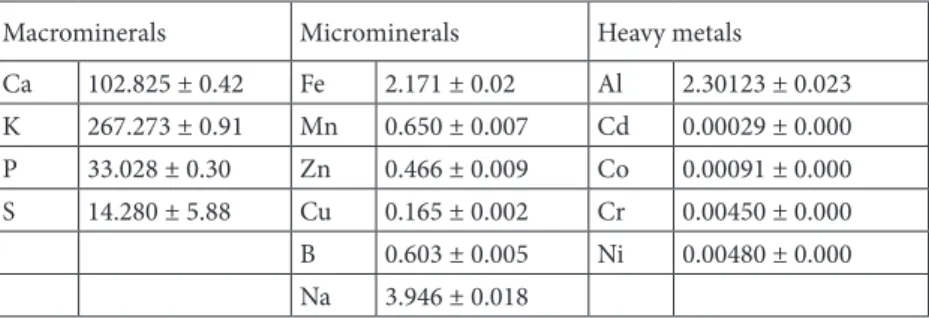
The proportion of essential plant nutrients, the toxic heavy metals investigated, and Al in the aerial parts of S. virgata are shown in Table 6.
Major dietary minerals include calcium, phosphorus, potassium, sulfur, sodium, chlorine, and magnesium; minor elements are iron, cobalt, copper, zinc, manganese, iodine, bromine, and selenium (Yadav et al., 2017). The basic nutrients required for the production of plants are also necessary for the growth and development of all living things (Esetlili et al., 2014). Minerals, which constitute 4%–6% of the human body, are critical in nutrition (Özcan, 2004a, 2004b; Kızıl et al., 2010). A lack or excess
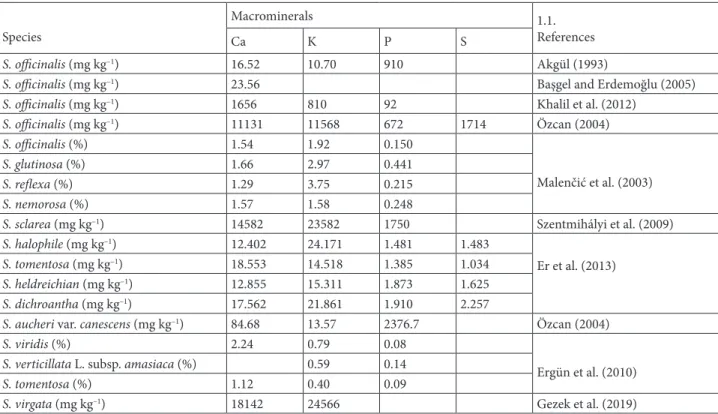
of minerals in the human body may be the source of many diseases (Kızıl et al., 2010). Salvia species are widely used as an herbal tea and spice. Salvia species are rich in both major and minor dietary minerals with nutritional properties. Herbal products can make important contributions towards meeting the daily mineral needs of the human body. Knowing the nutritional content and pharmacological functions of herbal teas is important in determining dosage (Queralt et al., 2005). The findings obtained from this study showed that the highest macro- and micromineral contents are Ca and K, and Fe and Na, respectively. In the literature we found only one study about the mineral content of S. virgata (Gezek et al., 2019). However, the mineral contents of different Salvia species from other studies are summarized in Tables 7 and 8. As the tables illustrate, the mineral content of Salvia species shows wide variation. The mineral composition of S. virgata collected from Erzincan Province, Turkey, in 2014 is considerably higher than the values obtained in our study (Gezek et al., 2019). On the other hand, Table 5. The main components of S. virgata essential oil.
Main components (%) References
β-Caryophyllene (46.6), β-caryophyllene epoxide (13.2), fermacrene B (13.9) Sefidkon and Mirza (1999) Caryophyllene oxide (34.4), spathulenol (25.6), 1-docosanol (9.3), geranyl acetone (5.6) Morteza-Semnani et al. (2005)
α-Caryophyllene (24.58–42.54), caryophyllene oxide (10.25–19.88), sabinene (8.64–19.58),
1-octen-3-ol (7.54–8.59), terpinene-4-ol (4.25–6.64), α-thujene (3.74–6.46) Alizadeh (2013)
(E)-Caryophyllene (37.0), caryophyllene oxide (15.2), Phytol (6.1), spathulenol (5.0), germacrene
D (4.0), sabinene (3.9) Moadeli et al. (2013)
Borneol (23.41), trans-pinocarvyl acetate (5.06) Hatipoğlu et al. (2016)
Caryophyllene oxide (30.23), β-caryophyllene (22.63), sabinene (11.82), 1-octen-3-ol (6.64),
thujene (6.28) Golparvar et al. (2017)
β-Pinene (10.74), estregole (22.01), copaene (18.35–22.07), β-bourbonene (6.37), isocaryophyllene
(13.22–38.21), α-caryophyllene (10.88), γ-muurolene (6.33), α-amorphene (8.38–25.61), eremophilene (12.76), γ-cadinene (16.31), germacrene D (5.01–6.01), caryophyllene oxide (6.94–
24.82), γ-gurjunene (6.78) Yılar et al. (2017)
Table 6. Essential plant nutrients and heavy metal concentrations of S. virgata (ppm).
Macrominerals Microminerals Heavy metals
Ca 102.825 ± 0.42 Fe 2.171 ± 0.02 Al 2.30123 ± 0.023 K 267.273 ± 0.91 Mn 0.650 ± 0.007 Cd 0.00029 ± 0.000 P 33.028 ± 0.30 Zn 0.466 ± 0.009 Co 0.00091 ± 0.000 S 14.280 ± 5.88 Cu 0.165 ± 0.002 Cr 0.00450 ± 0.000 B 0.603 ± 0.005 Ni 0.00480 ± 0.000 Na 3.946 ± 0.018
Table 7. Macromineral concentrations of some Salvia species. Species Macrominerals 1.1. References Ca K P S S. officinalis (mg kg–1) 16.52 10.70 910 Akgül (1993)
S. officinalis (mg kg–1) 23.56 Başgel and Erdemoğlu (2005)
S. officinalis (mg kg–1) 1656 810 92 Khalil et al. (2012)
S. officinalis (mg kg–1) 11131 11568 672 1714 Özcan (2004) S. officinalis (%) 1.54 1.92 0.150 Malenčić et al. (2003) S. glutinosa (%) 1.66 2.97 0.441 S. reflexa (%) 1.29 3.75 0.215 S. nemorosa (%) 1.57 1.58 0.248
S. sclarea (mg kg–1) 14582 23582 1750 Szentmihályi et al. (2009)
S. halophile (mg kg–1) 12.402 24.171 1.481 1.483
Er et al. (2013)
S. tomentosa (mg kg–1) 18.553 14.518 1.385 1.034
S. heldreichian (mg kg–1) 12.855 15.311 1.873 1.625
S. dichroantha (mg kg–1) 17.562 21.861 1.910 2.257
S. aucheri var. canescens (mg kg–1) 84.68 13.57 2376.7 Özcan (2004)
S. viridis (%) 2.24 0.79 0.08
Ergün et al. (2010)
S. verticillata L. subsp. amasiaca (%) 0.59 0.14
S. tomentosa (%) 1.12 0.40 0.09
S. virgata (mg kg–1) 18142 24566 Gezek et al. (2019)
Table 8. Micromineral concentrations of some Salvia species.
Species Microminerals References
Fe Mn Zn Cu B Na
S. officinalis (mg kg–1) 280 50
-S. officinalis (ppm) 379.27 35.02 Tercan et al. (2016)
S. officinalis (mg kg–1) 297.4 32.6 48.4 35.8 Başgel and Erdemoğlu (2005)
S. officinalis (mg kg–1) 44 3 6 1 95 Khalil et al. (2012)
S. officinalis (mg kg–1) 565 38.8 28.7 4.67 37.8 Özcan (2004)
S. officinalis (ppm) 453.77 39.25 64.46 25.10
S. glutinosa (ppm) 508.26 49.47 93.75 59.75 Malenčić et al. (2003)
S. reflexa (ppm) 350.54 46.53 18.84 34.18
S. nemorosa (ppm) 167.62 46.26 34.25 36.70
S. sclarea (mg kg–1) 189.5 9.46 18.32 128.2 16.3 158.9 Szentmihályi et al. (2009)
S. halophile (mg kg–1) 214 15.72 22 6.15 36.58
S. tomentosa (mg kg–1) 782 42.42 30.78 4.39 27.97 Er et al. (2013)
S. heldreichian (mg kg–1) 179 29.79 23.53 4.99 32.71
S. dichroantha (mg kg–1) 442 38.89 21.91 6.86 45.31
S. aucheri var. canescens (mg kg–1) 108.48 12.36 33.27 82.4 474.5 Özcan (2004)
S. viridis (%) 0.21
S. verticillata L. subsp. amasiaca (%) 0.06 Ergün et al. (2010)
S. tomentosa (%) 0.21
when considering the results of research conducted with different Salvia species, S. virgata had low values in terms of microminerals, but it showed average values in terms of macrominerals.
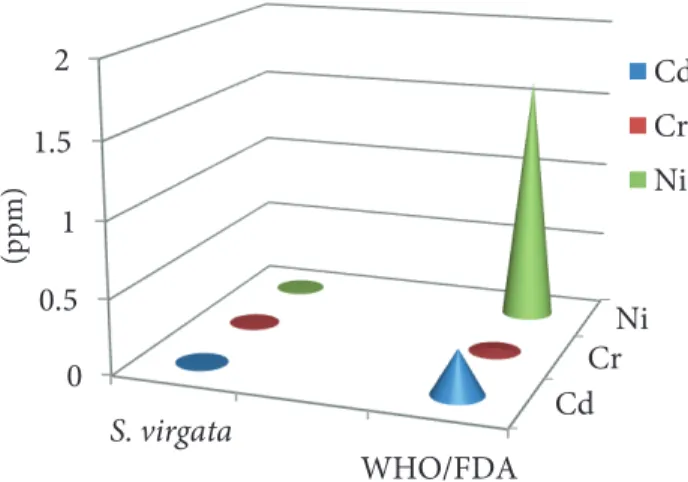
Today, analytical determination of heavy metals in medicinal and aromatic plants is among the most important quality parameters in determining the purity, safety, and efficacy of these plants (Baranowska et al., 2002).When considering the analysis results, the heavy metal content in the aerial parts of S. virgata was determined as follows: Al > Ni > Cr > Co > Cd. The limit values for Cd, Cr, and Ni determined by the WHO/FDA are 0.3, 0.02, and 1.63 ppm, respectively (Lone et al., 2003). The amounts of the three metals detected in the current study were lower than the maximum permissible values determined by the WHO/ FDA (Figure 3).
Generally, plants are exposed to heavy metal contamination during growth through water used in irrigation, polluted soils, fertilizers, pesticides, etc., as well as during harvesting and postharvest applications (Dghaim et al., 2015). In our study, only three heavy metals (Co, Cr, and Cu) were detected in the heavy metal analysis of the collection plot. No other heavy metals (Pb, Cd, Ni, Zn, or Hg) were found. It was observed that the heavy metals detected were well below the accepted limit values (Table 2).
The macro- and micromineral and heavy metal contents of the S. virgata used in this study are generally consistent with the literature data. Factors such as plant species, growing or cultivating conditions, environmental features, and analytical methods and equipment used all affect the elemental content of plants (Er et al., 2013).
3.4. Conclusions
Numerous studies have been conducted on the chemical components of essential oil in S. virgata samples obtained from natural areas. The current study used plants that
were obtained from seeds collected from a natural area. The essential oil obtained from the flowering aerial parts of S. virgata is rich in some components (pentacosane, caryophyllene oxide, phytol, spathulenol, and nonacosane) exhibiting various biological activities. Although the micronutrient element content of the plant was very low, it contains macronutrients that have positive effects on human health, and toxic heavy metal concentrations did not exceed their respective maximum allowed concentrations. In the literature we found only one study on the elemental content of S. virgata. For this reason, our findings are of great importance and will provide a resource for future studies.
Acknowledgment
This work is part of a project supported by the Yozgat Bozok University Scientific Research Projects Unit (BAP; Project Code: 6602c-ZF/17-87, Yozgat, Turkey).
Cd CrNi 0 0.5 1 1.5 2 S. virgata WHO/FDA (p pm ) Cd Cr Ni
Figure 3. Comparison of Cd, Cr, and Ni levels of S. virgata with
WHO/FDA limit levels. WHO: World Health Organization; FDA: Food and Drug Administration (USA).
References
Abdali E, Javadi S, Akhgari M, Hosseni S, Dustan D (2017). Chemical composition and biological properties of Satureja awromanica Maroofi. Journal of Food Science and Technology 4: 727-734. doi:10.1007/s13197-017-2512-0
Akgül A (1993). Baharat Bilimi ve Teknolojisi. Ankara, Turkey: Gıda Teknolojisi Derneği Yayını (in Turkish).
Alizadeh A (2013) Essential oil constituents, antioxidant and antimicrobial activities of Salvia virgata Jacq. from Iran. Journal of Essential Oil Bearing Plants 16: 172-182. doi: 10.1080/0972060X.2013.793974
Arslan N, Gürbüz B, Gümüşçü A (2015). Açıklamalı Tıbbi ve Aromatik Bitkiler Rehberi. Ankara, Turkey: Ankara Üniversitesi Ziraat Fakültesi Yayınları (in Turkish).
Babushok VI, Linstrom PJ, Zenkevich IG (2011). Retention indices for frequently reported compounds of plant essential oils. Journal of Physical and Chemical Reference Data 40: 1-47. doi: 10.1063/1.3653552
Baj T, Sieniawska E, Kowalski R, Wesolowski M, Ulewicz-Magulska B (2015). Effectiveness of the Deryng and Clevenger-type apparatus in isolation of various types of components of essential oil from the Mutelina purpurea Thell. flowers. Acta Poloniae Pharmaceutica 72: 507-515.
Baranowska I, Srogi K, Włochowicz A, Szczepanik K (2002). Determination of heavy metal contents in samples of medicinal herbs. Polish Journal of Environmental Studies 11: 467-471.
Başaran U, Akkbik M, Mut H, Gülümser E, Çopur Doğrusöz M et al. (2017). High-performance liquid chromatography with refractive index detection for the determination of inulin in chicory roots. Analytical Letters 51: 83-95. doi: 10.1080/00032719.2017.1304952
Başgel S, Erdemoğlu SB (2005). Determination of mineral and trace elements in some medicinal herbs and their infusions consumed in Turkey. Science of the Total Environment 359: 82-89. doi: 10.1016/j.scitotenv.2005.04.016
Baydar H (2013). Tıbbi ve Aromatik Bitkiler Bilimi ve Teknolojisi. Isparta, Turkey: Süleyman Demirel Üniversitesi Yayınları (in Turkish).
Bayram M, Yılar M, Özgöz E, Kadıoğlu I (2016). Adaçayı (Salvia
virgata Jacq.) tohumlarının bazı fiziksel özelliklerinin
belirlenmesi. Nevşehir Bilim ve Teknoloji Dergisi 2016: 325-331 (in Turkish). doi: 10.17100/nevbiltek.05774
Baytop T (1999). Therapy with Plants in Turkey. İstanbul, Turkey: İstanbul University Publications.
Bingol U, Coşge B, İpek A, Gürbüz B, Geven FG (2009). Identification of essential oil components of Salvia cryptantha Montbret&Aucher ex Bentham, growing wild in Turkey. Asian Journal of Chemistry 21: 3836-3840.
Birkett MA, Al Abassi S, Krober T, Chamberlain K, Hooper AM et al. (2008). Antiectoparasitic activity of the gum resin, gum haggar, from the East Africa plant, Commiphora
holtziana. Phytochemistry 69: 1710-1715. doi: 10.1016/j.
phytochem.2008.02.017
Bruce TJ, Birkett MA, Blande J, Hooper AM, Martin JL et al. (2005). Response of economically important aphids to components of
Hemizygia petiolata essential oil. Pest Management Science 61:
1115-1121. doi: 10.1002/ps.1102
Casiglia S, Bruno M, Bramucci M, Quassinti L, Lupidi G et al. (2017). Kundmannia sicula (L.): a rich source of germacrene D. Journal of Essential Oil Research 29: 437-442. doi: 10.1080/10412905.2017.1338625
Chao LK, Hua KF, Hsu HY, Cheng SS, Liu JY et al. (2005). Study on the anti-inflammatory activity of essential oil from leaves of
Cinnamomum osmophloeum. Journal of Agricultural and Food
Chemistry 53: 7274-7278. doi: 10.1021/jf051151u
Dghaim R, Al Khatib S, Rasool H, Khan MA (2015). Determination of heavy metals concentration in traditional herbs commonly consumed in the United Arab Emirates. Journal of Environmental and Public Health 4: 1-6. doi: 10.1155/2015/973878
Doğan M, Pehlivan S, Akaydın G, Bagcı E, Uysal I et al. (2008). Türkiye’de Yayılış Gösteren Salvia L. (Labiatae) Cinsinin Taxonomik Revizyonu. Ankara, Turkey: TÜBİTAK Project No.104 T 450 (in Turkish).
Durán-Peña MJ, Ares JMB, Hanson JR, Collado IG, Hernández-Galán R (2015). Biological activity of natural sesquiterpenoids containing a gem-dimethylcyclopropane unit. Natural Product Reports 32: 1236-1248. doi: 10.1039/c5np00024f
Dweck AC (2000). Sage, the Genus Salvia. Amsterdam, the Netherlands: Harwood Academic Publishers.
Er M (2012). Konya’da yetişen bazı Salvia L. (adaçayı) türlerinin biyokimyasal ve biyoaktif özellikleri. MSc, Konya Selçuk University, Konya, Turkey (in Turkish).
Er M, Tugay O, Özcan MM, Ulukuş D, Al-Juhaimi F (2013). Biochemical properties of some Salvia species. Environmental Monitoring and Assessment 185: 5293-5198. doi: 10.1007/ s10661-012-2935-z
Ergün N, Yolcu H, Karanlık S, Dikkaya E (2010). Amanoslar’da (Hatay) yetişen bazı bitki türlerinde ağır metal birikimi ve mineral içerik üzerine bir çalışma. Biyoloji Bilimleri Araştırma Dergisi 3: 121-127 (in Turkish).
Esetlili BC, Pekcan T, Çobanoğlu O, Aydoğdu E, Turan S et al. (2014). Essential plant nutrients and heavy metals concentrations of some medicinal and aromatic plants. Journal of Agricultural Science 20: 239-247. doi: 10.15832/tbd.73408
Frag RS, Shalaby AS, El-Baroty GA, Ibrahim NA, Ali MA et al. (2004). Chemical and biological evaluation of the essential oils of different Melaleuca species. Phytotherapy Research 18: 30-35. doi: 10.1002/ptr.1348
Gezek G, Hashemi P, Kalaycıoğlu Z, Kaygusuz H, Sarıoğlu G et al. (2019). Evaluation of some Turkish Salvia species by principal component analysis based on their vitamin B2, mineral composition, and antioxidant properties. Journal of Food Science and Technology 100: 287-293. doi: 10.1016/j. lwt.2018.10.066
Golparvar AR, Hadipanah A, Gheisari MM, Naderi D, Rahmaniyan S et al. (2017). Chemical composition and antimicrobial activity of essential oil of Salvia officinalis L. and Salvia virgata Jacq. Journal of Herbal Drugs 8: 71-78. doi: 10.18869/JHD.2017.71 Güner A, Aslan S, Ekim T, Vural M, Babaç MT (2012). Türkiye
Bitkileri Listesi (Damarlı Bitkiler). İstanbul, Turkey: Nezahat Gökyiğit Botanik Bahçesi ve Flora Araştırmaları Derneği Yayını (in Turkish).
Islam MT (2017). Diterpenes and their derivates as potential anticancer agents. Phytotherapy Research 31: 691-712. doi: 10.1002/ptr.5800 PMID:28370843
Kaçar B, İnal A (2010). Plant Analysis. Ankara, Turkey: Nobel Yayıncılık (in Turkish).
Karabacak E (2009). Türkiye’nin Avrupa-Sibirya fitocoğrafik bölgesindeki Salvia L. (Lamiaceae) cinsinin revizyonu. PhD, Çanakkale Onsekiz Mart University, Çanakkale, Turkey (in Turkish).
Khalil E, Esoh R, Rababah T, Almajwali AM, Aludatt MH (2012). Minerals, proximate composition and their correlations of medicinal plants from Jordan. Journal of Medicinal Plants Research 6: 5757-5762. doi: 10.5897/JMPR10.022
Kiran SR, Devi PS (2007). Evaluation of mosquitocidal activity of essential oil and sesquiterpenes from leaves of Chloroxylon
swietenia DC. Parasitology Research 101: 413-418. doi:
10.1007/s00436-007-0485-z
Kızıl S, Hasimi N, Tolan V, Kılınç E, Yüksel U (2010). Mineral content, essential oil components and biological activity of two
Mentha species (M. piperita L., M. spicata L.). Turkish Journal
Kostik V, Bauer B (2017). Determination of phytol content in some vegetables and fruits. In: Proceedings of the MESMAP-3, Abstract Book, Girne, Turkish Republic of Northern Cyprus, p. 133.
Lone MI, Saleem S, Mahmood T, Saifullah K, Hussain G (2003). Heavy metal contents of vegetables irrigated by sewage/ tubewell water. International Journal of Agriculture and Biology 5: 533-535.
Malenčić DR, Jevrešan ŽS, Popović MT (2003). Mineral composition of selected Salvia species growing wild in the Vojvodina province. Matica Srpska Proceedings for Natural Sciences 105: 25-33. doi: 10.2298/ZMSPN0305025M
Mihailovi V, Vukovi N, Niforovi N, Soluji S, Mladenovi M et al. (2011). Studies on the antimicrobial activity and chemical composition of the essential oils and alcoholic extracts of
Gentiana asclepiadea L. Journal of Medicinal Plants Research
5: 1164-1174.
Moadeli NS, Rowshan V, Abotalebi A (2013). Comparison of the essential oil components in wild and cultivate population of
Salvia virgata. International Research Journal of Applied and
Basic Sciences 4: 337-340.
Morteza-Semnani K, Saeedi M, Changizi S, Vosoughi M (2005). Essential oil composition of Salvia virgata Jacq. from Iran. Journal of Essential Oil Bearing Plants 8: 330-333. doi: 10.1080/0972060X.2005.10643461
Motsara MR, Roy RN (2008). Guide to Laboratory Establishment for Plant Nutrient Analysis. Rome, Italy: FAO Fertilizer and Plant Nutrition Bulletin.
Oke F, Aslım B, Öztürk S, Altundağ S (2009). Essential oil composition, antimicrobial and antioxidant activities of
Satureja cuneifolia Ten. Food Chemistry 112: 874-879.
Özcan M (2004a). Determination of mineral contents of Turkish herbal tea (Salvia aaucheri var. canescens) at different infusion periods. Journal of Medicinal Food 8: 110-112. doi: 10.1089/ jmf.2005.8.110
Özcan M (2004b). Mineral contents of some plants used as condiments in Turkey. Food Chemistry 84: 437-440. doi: 10.1016/S0308-8146(03)00263-2
Poyraz IE, Koca F (2006). Eskişehir’de yetişen bazı tıbbi Salvia türleri üzerinde morfolojik araştırmalar. Anadolu Üniversitesi Bilim ve Teknoloji Dergisi 7: 443-450 (in Turkish).
Queralt L, Ovejero M, Carvalho ML, Marques AF, Llabres JM (2005). Quantitative determination of essential and trace element content of medicinal plants and their infusions by XRF and ICP techniques. X-Ray Spectrometry 34: 213-217. doi: 10.1002/xrs.795.
Ramakrishna A, Ravishankar GA (2011). Influence of abiotic stress signaling on secondary metabolites in plants. Plant Signaling & Behavior 6: 1720-1731. doi: 10.4161/psb.6.11.17613
Sahoo HB, Gandre DK, Das PK, Karim MA (2018). Geochemical mapping of heavy metals around Sukinda-Bhuban area in Jajpur and Dhenkanal districts of Odisha, India. Environmental Earth Sciences 34: 1-17. doi: 10.1007/s12665-017-7208-2
Samejo MQ, Memon S, Bhanger MI, Khan KM (2013). Comparison of chemical composition of Aerva javanica seed essential oils obtained by different extraction methods. Pakistan Journal of Pharmaceutical Sciences 26: 757-760.
Sarı A, Kürşat M, Civelek S (2012). Determination of MDA levels in the plant (some Salvia L. taxa growing in Turkey). Journal of Drug Metabolism and Toxicology 3: 1-2. doi: 10.4172/2157-7609.1000117
Sefidkon F, Mirza M (1999). Chemical composition of the essential oils of two Salvia species from Iran, Salvia virgata Jacq. and
Salvia syriaca L. Flavour and Fragrance Journal 14: 45-46. doi:
10.1002/(SICI)1099-1026(199901/02)14:13.3.CO;2-J
Song Y, Cho SK (2015). Phytol induces apoptosis and ROS-mediated protective autophagy in human gastric adenocarcinoma AGS cells. Biochemistry and Analytical Biochemistry 4: 211. doi: 10.4172/2161- 1009.1000211
Szentmihályi K, Héthelyi É, Virág V, Then M (2009). Mineral elements in muscat sage plant (Salvia sclarea L.) and essential oil. Acta Biologica Szegediensis 53: 35-38.
Tercan HS, Ayanoğlu F, Bahadırlı NP (2016). Determination of heavy metal contents and some basic aspects of widely used herbal teas in Turkey. Revista de Chimie 67: 1019-1022.
Usami A, Kashimo Y, Marumoto S, Miyazawa M (2013). Characterization of aroma-active compounds in dry flower of
Malva sylvestris L. by GC-MS-O analysis and OAV calculations.
Journal of Oleo Science 62: 563-570. doi: 10.5650/jos.62.563 Vermani A, Prabhat N, Chauhan A (2010). Physico-chemical analysis
of ash of some medicinal plants growing in Uttarakhand, India. Nature and Science 8: 88-91.
Walia M, Mann TS, Kumar D, Agnihotri VK, Singh B (2012). Chemical composition and in vitro cytotoxic activity of essential oil of leaves of Malus domestica growing in Western Himalaya (India). Evidence-Based Complementary and Alternative Medicine 2012: 649727. doi: 10.1155/2012/649727 Yadav A, Joshi A, Kothari SL, Kachhwaha S, Purohit S (2017).
Medicinal, nutritional and industrial applications of Salvia species: a revisit. International Journal of Pharmaceutical Sciences Review and Research 43: 27-37.
Yetim H (2002). Enstrümental Gıda Analizleri. Erzurum, Turkey: Atatürk Üniversitesi Yayınları (in Turkish).
Yılar M, Kadıoğlu I, Telci İ (2017). Essential oil compositions of Salvia
virgata Jacq. and Salvia candidissima subsp. candidissima Vahl.
growing in natural habitats of Tokat province. Turkish Journal of Weed Science 20: 70-77.
Yogeswari S, Ramalakshmi S, Neelavathy R, Muthumary J (2012). Identification and comparative studies of different volatile fractions from Monochaetia kansensis by GCMS. Global Journal of Pharmacology 6: 65-71.
Yu F, Gapor A, Bender W (2005). Evidence for the preventive effect of the polyunsaturated phytol side chain in tocotrienols on 17β-estradiol epoxidation. Cancer Detection and Prevention 29: 383-388. doi: 10.1016/j.cdp.2005.03.003