Int. J. Inventory Research, Vol. 1, No. 2, 2010 125
Contracting under uncertain capacity:
a generalisation
Zied Jemai* and Yves Dallery
Ecole Centrale Paris, Department of Industrial Engineering, Grande Voie des Vignes, 92295 Chatenay Malabry, France E-mail: [email protected] E-mail: [email protected] *Corresponding author
Nesim Erkip
Department of Industrial Engineering, Bilkent University, 06800 Ankara, Turkey E-mail: [email protected]
Abstract: In this paper, we develop a two-stage supply chain model consisting
of a supplier with uncertain capacity and a retailer facing an uncertain demand. We consider that the payment of the retailer to the supplier has two steps: a prepayment based on the quantity ordered by the retailer and a final payment based on the quantity actually delivered by the supplier. We first consider the centralised version of this model and determine the optimal policy analytically. We investigate the effects of the prepayment and capacity restriction. We then consider a decentralised version and characterise optimal decisions of both the supplier and the retailer in the framework of Stackelberg equilibrium. We analyse the efficiency loss of the described decentralised system compared to the centralised system. We discuss different contracting alternatives and propose a generalised contract structure that enables coordination of the decentralised system to achieve the performance of the centralised one.
Keywords: uncertain capacity; contracting; coordination; Stackelberg
equilibrium.
Reference to this paper should be made as follows: Jemai, Z., Dallery, Y. and
Erkip, N. (2010) ‘Contracting under uncertain capacity: a generalisation’, Int. J. Inventory Research, Vol. 1, No. 2, pp.125–149.
Biographical notes: Zied Jemai is an Assistant Professor in the Department of
Industrial Engineering at Ecole Centrale Paris. He received his PhD from ECP in 2003. His research interests are stochastic models and supply chain management.
Yves Dallery is a Professor of Industrial Engineering at Ecole Centrale Paris. His research interests are in production management, supply chain management and service operations management, with a special emphasis on modelling and optimisation.
Nesim K. Erkip is a Professor of Industrial Engineering at Bilkent University, Ankara Turkey. His main research interests are multi-echelon inventory theory, issues in supply chain management and operations management.
126 Z. Jemai et al.
1 Introduction
1In a classical newsvendor problem a retailer, who faces a stochastic demand, orders a single product from the supplier before the beginning of the selling season. The retailer has no additional replenishment opportunity, then if the order quantity is less than the demand, excess demand is lost; on the other hand, if this quantity exceeds the demand, the retailer will have to salvage the excess at a salvage value generally below the wholesale price.
The newsvendor model represents the basic stochastic inventory model for more than a century and many extensions are studied and solved in the literature (see for example, Porteus, 1990; Silver et al., 1998). The newsvendor model has important applications in style-goods products (fashion, apparel, toys, etc.) as well as in services (booking on hotels, airlines, etc).
The growth of the supply chain management notion in the last decade resulted in the review of the most inventory and production/inventory models. Supply chains are often composed of several entities that are not generally a part of the same organisation. Entities usually make their decisions individually – we name this as decentralised, only considering local criteria. As a result, this leads to a loss of efficiency for the whole supply chain. In this study, we consider the simplest supply chain, where there are two entities, namely the supplier and the retailer.
The modelling of decentralised supply chains (mostly the retailer-supplier system structure considered in this study) has been investigated in several papers (see for example, Cachon and Lariviere, 1999a, 1999b) and many approaches are proposed to improve the supply chain performances such collaborative planning and forecasting (for example, Aviv, 2001) and information sharing (for example, Gavirneni et al., 1999). Most of these studies for newsvendor problems are emphasising the coordination by transfer payments so that local optimal actions taken by the retailer and the supplier correspond to the integrated supply chain optimisation. In the coordinating newsvendor problem, generally the retailer decides on the order quantity to optimise her objective function. On the other hand, the supplier decides on transfer payments that optimise her objective function. If the optimal performance is similar to the one obtained by the integrated supply chain optimisation, than the contract (that includes the specification of the transfer payment between the supplier and the retailer) coordinates the supply chain
Tsay et al. (1999), Cachon (2003) and Lariviere (1999) proposed an overview on the most supply chain contracts used for the newsvendor model. Some of these contract structures (to name a few buy-back, revenue sharing and quantity discount contracts) coordinate the supply chain under symmetric information, i.e., each player has full information on demand distribution, costs, parameters and rules. Cachon (2003) carried out an extended review of literature on contracts with asymmetric information, as well.
Generally, authors assume no additional cost for the administration of the contracts. In practice, some contracts are simpler to administer than the others. For example, the quantity discount contract does not necessitate an additional cost to administer, whereas the buy-back contract requires the transportation of the remaining units back to the supplier and the revenue sharing contract imposes the supplier to have information about the retailer sales.
Two points are interesting to mention for studies that consider coordinating the newsvendor model:
Contracting under uncertain capacity 127 1 In most studies, the supplier is assumed to follow a make-to-order policy with
infinite capacity. Ehrhardt and Taube (1987) study a newsvendor model where the received order possibly contains defective units. Ciarallo et al. (1994) introduce a random capacity with known distribution, but they limit their analysis to the
determination of the cost function. Jain and Silver (1995) study a similar model and assume a reservation capacity cost. Capacity notions in a newsboy like model are mentioned in Anupindi and Bassok (1999) who propose a total minimum
commitment contract to the retailer that allow the supplier to invest in capacity. 2 Most papers that consider the supplier capacity are only interested in a multi-retailer
environment with competition among retailers and the objective of the supplier is to allocate optimally her capacity between retailers. Lee et al. (1997) consider a single period capacitated supply problem with a proportional allocation mechanism applied in case when supply is insufficient. Cachon and Lariviere (1999b) propose other allocation mechanisms. These studies show that the retailers’ order quantities are amplified under several allocation mechanisms. Bakal et al. (2005) are interested in the Nash equilibrium in a similar model with proportional allocation and analyse the effects of information asymmetry. Some motivational examples from practice where prepayment may exist are discussed. In their construction the prepayment contract obliges the retailers a rational behaviour in the choice of order quantities.
The unlimited capacity models imply the use of additional assumptions, particularly on the various costs, which generally doesn’t correspond to realistic settings. In this study, we propose a model that considers the following two features:
1 A supplier with a limited capacity and a single retailer. Actually, our environment can be considered to mimic a more well-known environment where there are more than one retailer and a pre-announced allocation rule that will be applied in case total orders exceed the available capacity. The phenomenon is typical in some sectors where the capacity is almost equal to long-term demand and when demand fluctuates the sector is confronted with the limitation. Some suppliers in electronics sector will exhibit the properties of the limited-capacity supplier in the proposed model.
2 A contract structure – we name as the prepayment contract – for coordinating newsvendor model that well-adapts to situations with capacity limitation. The prepayment contract is observed in industries like iron and steel industry that requires long lead times for manufacturing. In these industries, some preparation is needed long before the actual manufacturing with respect to some raw materials that force the suppliers to charge some amount when the order is given. However, the supply is uncertain for many well known reasons and hence the initial quantity that is planned may not be fulfilled. Hence, by charging to the quantity ordered the supplier may have a chance to recover a part of the preparation costs incurred. Additional amount is then charged for the quantity actually manufactured.
Several contract structures are proposed for the coordinated newsvendor. A few studies try to determine the equivalence between these contracts. Cachon and Lariviere (2005) show equivalence between a buy-back contract and a revenue sharing contract in a newsvendor model with exogenous demand. Pasternack (2002) studies a single retailer newsvendor model in which the retailer can purchase some units with revenue sharing and other units with a wholesale price contract. Tirole (1988) proposes a franchise
128 Z. Jemai et al.
contract that combines the revenue sharing contract and a two-part tariff contract (the retailer purchase the order quantity at a wholesale price but the supplier gives the retailer a fixed fee).
In this study, we propose a general contract structure that encompasses some of the known contracting schemes under a newsvendor setting with capacity limitation.
The setting of a contract mostly requires a certain sequence of decision actions followed by the supplier and the retailer. These actions depend on the power structure in the supply chain. Game theory gives precious tools such as such Nash equilibrium and Stackelberg equilibrium to determine these actions (see, Cachon and Netessine, 2004) for game theory applications to supply chain analysis). In this study, we are interested in Stackelberg equilibrium with supplier as the leader to analyse particular cases of the proposed contract structure and determine actions that coordinate the model studied.
The outline of this paper is as follows: In Section 2 we introduce the prepayment contract and treat a newsvendor problem under capacity limitation with prepayment contract. In Section 3, we analyse a decentralised newsvendor problem under capacity limitation in the framework of Stackelberg equilibrium. In Section 4, we discuss several contract structures and propose a general contract structure. We apply particular cases of the proposed contract to investigate related coordination issues for the decentralised newsvendor problem under capacity limitations. We conclude with Section 5.
2 Classical newsvendor problem under limited capacity
2.1 Modelling assumptions and notation
We consider a single period model consisting of one retailer who faces a newsvendor problem with stochastic demand.
In the beginning of the selling season, the retailer requests an order quantity from the upstream supply chain stage (without loss of generality, we refer to this stage as a supplier) and incur an ordering cost that is a percentage of the unit cost for each ordered item (prepayment). The supplier has a limited capacity modelled by an exogenous random variable (independent of the order quantity) and then satisfies the retailer’s order quantity within the limit of her capacity. The retailer incurs the remaining percentage of the wholesale cost only for the items she receives. If any quantity remains at the end of the season, it is sold or disposed for a salvage price. There is a penalty cost associated with each unit of unsatisfied demand.
It’s important to mention the regime compliance of the supplier in such a model. We suppose that the supplier operates under forced compliance i.e., she doesn’t try to manipulate her capacity limitation announced in the prepayment contract and known by the retailer.
Let us define the following notation: X random variable denoting demand fd(x) probability density function of demand
Fd(x) cumulative distribution function of demand
Contracting under uncertain capacity 129 fs(y) probability density function of supplier’s capacity
Fs(y) cumulative distribution function of supplier’s capacity
w unit wholesale price
α percentage of prepayment, then w0 = αw is the amount paid in advance for each
unit ordered and w1 = (1 – α)w the amount paid for each unit received r unit-selling price
s unit salvage price p unit shortage penalty cost Q order quantity.
Figure 1 depicts financial, physical, and information flows that exist in the system. Figure 1 Classical newsvendor model under capacity limitation
2.2 Optimisation
Let
R(Q ) min(Y, Q) the received quantity S(Q) min(X, R(Q)) the quantity sold
I(Q) (R(Q) –X)+ the quantity remaining at the end of the season
B(Q) (X – R(Q))+ the lost sales
where the operator (Z)+ is defined as max(Z, 0).
The expected profit as a function of the order quantity is written as follows:
[ ( )]r [ ( ) ( ) ( ) (1 ) ( )]
Eπ Q =E rS Q +sI Q −pB Q −αwQ− −α wR Q Similarly, one can write
[ ( )] [ ( ) ( ) and [ ( )] [ [ ( )]. E I Q =E R Q +S Q E B Q =E X E S Q− Then
[ ( )] (r ) [ ( )] ( (1 ) ) [ ( )] [ ]
Eπ Q = − +r s p E S Q + − −s α w E R Q −αwQ pE X−
Note that the retailer is paying an expected total cost of [αwQ + (1 – α) wR(Q)] for the units received, as a result of the prepayment contract. In practice, of course, the realised
Supplier Customer Q α.w.Q r.min(X,min(Y, Q)) s.(min(Y, Q) –X)+ (1 – α).w. min(Y, Q) min(Y, Q) Financial flows Physical and information flows p.(X-min(Y, Q))+ Retailer
130 Z. Jemai et al.
cost per unit (for the received items), [αwQ + (1 – α)wR (Q)]/R(Q), should be comparable to w, so that the retailer would comply with the contract. Of course, under very tight supply capacity, this might occur and the realised cost might not be acceptable for the retailer. However, in this study we assume that as a result of the application for such a contract, the resulting per unit cost realised is tolerable by the retailer. A possible extension for the prepayment contract could be to include a limit on the realised unit cost, so that no compliance case is eliminated.
Lemma 1: The expected quantity sold E[S(Q)] is given by:
0 0 0
[ ( )] (1 ( ))( ( ) ) ( ( ) ) ( )
Q Q y
s d d s
E S Q = −F Q Q−
∫
F x dx +∫ ∫
y− F x dx f y dy (1)Proof: Let Y be the supplier capacity. When Y is greater than the order quantity, for a given Q, the quantity sold is:
if Q < D then S(Q) = Q if Q ≥ D then S(Q) = D where D is the demand.
Then, the expected quantity sold can be written as:
0 [ ( )] . ( ) . ( ) Q D D Q E S Q x f x dx Q f x dx ∞ =
∫
+∫
Then 0 [ ( )] ( ) . Q D E S Q = −Q∫
F x dxIn the other case, when Y is less than Q, the expected quantity sold is obtained similarly by substituting Q by Y. Then, for a given Y:
0 [ ( )] ( ) Y D E S Q = −Y
∫
F x dx And finally, 0 0 0 [ ( )] (1 ( ))( ( ) ) ( ( ) ) ( ) Q Q y s d d s E S Q = −F Q Q−∫
F x dx +∫ ∫
y− F x dx f y dy Lemma 2: The expected received quantity E[R(Q)] is given by:0
[ ( )] ( )
Q s
E R Q = −Q
∫
F y dy (2)Proof: For a given Q the quantity received is: if Y < Q then R(Q) = Y
Contracting under uncertain capacity 131 where Y is the supplier capacity.
The expected received quantity is then:
0 [ ( )] . ( ) . ( ) Q S S Q E R Q x f x dx Q f x dx ∞ =
∫
+∫
Then 0 [ ( )] ( ) . Q S E R Q = −Q∫
F x dxProposition 1: The optimal order quantity for the retailer, Q* is given by:
* * (1 ) ( ) ( ) s d w r p w F Q F Q r p s α α + − − − = + − (3) where F Qs( ) 1= −F Qs( ). Proof: [ ( )] (r ) [ ( )] ( (1 ) ) [ ( )] [ ] Eπ Q = + −r s p E S Q + − −s α w E R Q −αwQ pE X−
Then Q* should verify dE[ ( )]r Q 0 dQ π = [ ( )] [ ( )] [ ( )] ( ) ( (1 ) ) r dE Q dE S Q dE R Q r s p s w w dQ dQ dQ π α α = + − + − − − where dE S Q[ ( )] (1 F QS( ))(1 F QD( )) dQ = − − and [ ( )] (1 S( )) dE R Q F Q dQ = − Then dE[ ( )]r Q 0 dQ π = when * * (1 ) ( ) ( ) s . d w r p w F Q F Q r p s α α + − − − = + −
Proposition 1 gives the optimal order quantity in a newsvendor problem under capacity limitation. Differences when compared with the uncapacitated newsvendor problem are discussed below.
First, let us remind the order quantity of the classical newsvendor problem with no capacity limitation. For F Qs( ) 1,= the optimal order quantity is given by:
* 0 (1 ) ( ) d r p w w F Q r p s α α + − − − = + −
We obtain the classical newsboy formula (see, Khouja, 1999), independent of α, as
* 0 ( ) d r p w F Q r p s + − = + − (4)
132 Z. Jemai et al.
The uniqueness of Q0* necessitate that Fd(x) is continuous and strictly increasing. We
take up this condition for Fd(x) and Fs(y) (see Figure 2).
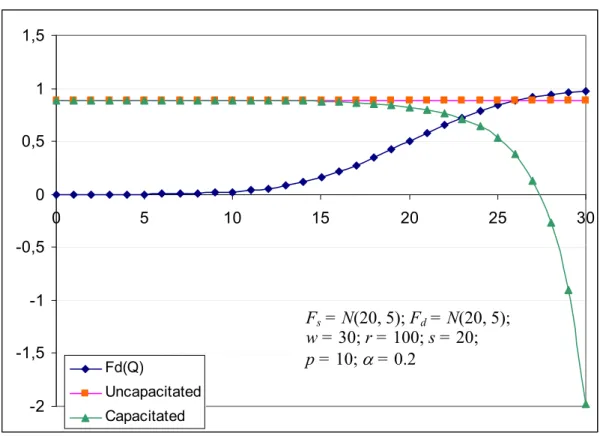
Figure 2 Optimal order quantity for uncapacitated and capacitated model (see online version for
colours)
The uncapacitated curve is the ratio in the right hand side (RHS) of the equation (4), then the intersection with the Fd(Q) curve is the uncapacitated optimal Q0*. The capacitated
curve is the RHS of the equation (3), then the intersection with the Fd(Q) curve is the
capacitated optimal Q*.
As shown in Figure 2, the order quantity in a capacitated model is less or equal to the order quantity of the uncapacitated model: Q* ≤ Q
0*. The equality is obtained for α = 0,
i.e., the case without any prepayment.
In general, as expected, the order quantity decreases when α increases, as illustrated in Figure 3. Note that in the example, the variability induced by the capacity uncertainty is as large as the demand uncertainty. Nevertheless, the figure one would obtain is typical. We think that in the environments we consider, the variability can be arbitrarily large, depending on the size of the market and the size of the retailer under consideration. The retailer considered can be a low priority one, meaning that the capacity left for it might be very volatile. This is the reason why one should consider coordinating such environments with contracts, as the risk that a retailer is taking can be large. Additionally note that, when the distribution of supply uncertainty is less variable than the demand distribution, the resultant effect on the value of Q will be less (one can see the effect in equation (3) more explicitly). However, we believe that our proposed model is applicable in environments where the supply uncertainty is considerable. One can go even further and perform a similar analysis when the demand uncertainty is negligible, but supply uncertainty is relatively larger.
-2 -1,5 -1 -0,5 0 0,5 1 1,5 0 5 10 15 20 25 30 Fd(Q) Uncapacitated Capacitated Fs= N(20, 5); Fd= N(20, 5); w = 30; r = 100; s = 20; p = 10; α = 0.2
Contracting under uncertain capacity 133 Figure 3 Optimal order quantity for different values of α (see online version for colours)
The existence of Q0* requires that s < w. This condition implies that the salvage price is
less than the wholesale price and then the retailer doesn’t profit more from the leftover inventory. In practice, this condition may not hold (in the apparel industry, for example), Note that the condition is in accordance with the strong assumption that the retailer can sell the entire leftover inventory (or the supplier can supply a large quantity). Note that, in a capacitated newsvendor model this condition (s < w) is not necessary as shown in the Lemma 3 below.
Lemma 3: The optimal order quantity for the retailer, Q* exists when the unit salvage price is greater than the unit wholesale price.
Proof: From equation (3):
* * ( 1 ) ( )( ) ( ) d s w r p F Q r p s F Q α α + − = + − + − Then ( * 1 ) . ( ) s s w r p F Q α α ≤ + − ≤ + Note that * 1 ( ) s F Q
α + − varies between 1 and infinity. Hence w can be less than s. α
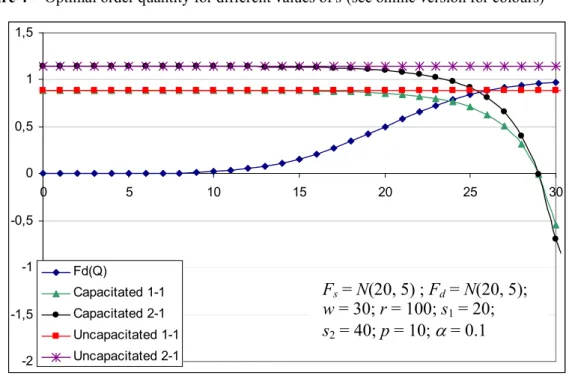
See Figure 4 for the optimal order quantities versus different values of s, given the other parameter values. As shown in Figure 4, the uncapacitated optimal Q0* can be not
finite when s > w (intersection between the Fd(Q) and the uncapacitated 2–1 curves)
when, for the same parameters, the capacitated model gives finite optimal Q*
(intersection between the Fd(Q) and the capacitated 2–1 curves) -2 -1,5 -1 -0,5 0 0,5 1 1,5 0 5 10 15 20 25 30 Fd(Q) Capacitated 1-1 Capacitated 2-1 Capacitated 3-1 Fs= N(20, 5) ; Fd= N(20, 5); w = 30; r = 100; s = 20; p = 10; α1 = 0.1;α2= 0.3; α3= 0.5
134 Z. Jemai et al.
Figure 4 Optimal order quantity for different values of s (see online version for colours)
Finally, we present a useful result in Lemma 4:
Lemma 4: Let Y(1) and Y(2) two random variables with respective cumulative distribution
functions Fs(1) and Fs(2). Let Q1* and Q2* the optimal order quantities for similar
newsvendor models with supplier limited capacity modelled by Y(1) (respectively Y(2)).
If Fs(1)( )y ≤Fs(2)( ) y ∀ capacity random variables are said to be stochastically y, ordered. Let the notation Y(1) ≤st Y(2) denote stochastic ordering. If Y(1) ≤st Y(2), then Q1* ≤ Q2*. Proof: Let ( ) ( ) (1 ) ( ) ( ) , i i s w r p w F x RHS x r p s α α + − − − = + −
then for Y(1) ≤st Y(2), RHS(1)( )x ≤RHS(2)( )x for all x > 0.
Let Q1* the optimal order quantity for the model with capacity Y(1), then
* (2) *
1 1
( ) ( ).
d
F Q ≤RHS Q
Fd(x) is increasing and RHS(2)(x) is decreasing then Q2* (F Qd( 2*)=RHS(2)(Q2*)) is
greater than Q1*
3 Decentralised
newsvendor
problem under limited capacity
In the decentralised newsvendor problem the retailer decides on the order quantity to optimise her objective function. On the other hand, in general, the supplier decides on the wholesale price w and the prepayment parameter α to optimise her objective function. In
-2 -1,5 -1 -0,5 0 0,5 1 1,5 0 5 10 15 20 25 30 Fd(Q) Capacitated 1-1 Capacitated 2-1 Uncapacitated 1-1 Uncapacitated 2-1 Fs= N(20, 5) ; Fd= N(20, 5); w = 30; r = 100; s1 = 20; s2 = 40; p = 10; α = 0.1
Contracting under uncertain capacity 135 this section, we develop a decentralised newsvendor model with capacity limitation. We specify a more general production cost function for the supplier. We additionally assume that the wholesale price, w is set by market conditions, and hence α is the decision variable regarding the supplier’s operation. We study the efficiency of the capacitated newsvendor problem under a prepayment contract with respect to the centralised model.
3.1 Modelling assumptions and additional notation
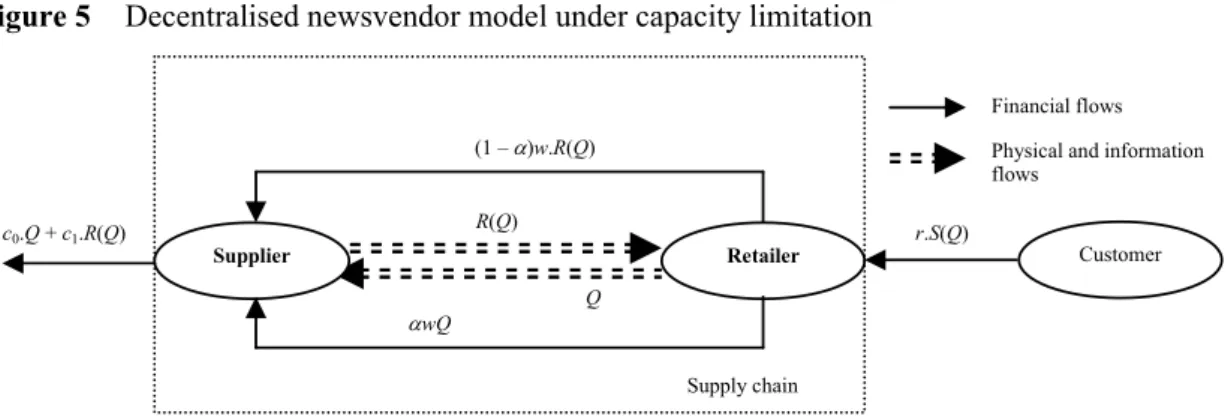
In the beginning of the selling season, the retailer orders a quantity from the supplier and pays a prepayment cost αw per unit ordered. The supplier satisfies the retailer’s order quantity within the limit of her capacity and incurs a wholesale price (1 – α)w per unit received. The supplier’s costs are c0 per unit ordered and c1 per unit produced. Demand
occurs and is satisfied by the retailer at a unit price r (see Figure 5 for description). We consider, for more clarity, that there is no additional cost for lost sales and no salvage price for the quantity remaining.
Figure 5 Decentralised newsvendor model under capacity limitation
The adopted cost structure of the supplier, c0Q + c1R(Q) as a general structure that
permits to distinguish investments engaged for the order quantity (raw material bought, etc.) and those engaged for the realised quantity (resources consumed, etc.). For example, c0 = 0 corresponds to a special case that can be applied when the supplier faces
competition between many retailers and then divide his capacity with respect to a defined policy.
3.2 Optimisation
3.2.1 Centralised system
The benchmark performance for the decentralised supply chain is the centralised system where both the supplier and the retailer belong to the same organisation and take their decisions to optimise expected total system profit.
Expected supply chain profit as function of Q is given by:
0 1
[ C( )] [ ( ) ( )]
Eπ Q =E rS Q −c Q c R Q− ,
where S(Q) is the quantity sold and R(Q) is the received quantity.
The centralised optimisation is similar to the classical newsvendor problem with limited capacity described in Section 3 and with a prepayment unit price w0 = c0 and a
Customer Q r.S(Q) (1 –α)w.R(Q) R(Q) Financial flows Physical and information flows Retailer Supplier c0.Q + c1.R(Q) Supply chain αwQ
136 Z. Jemai et al.
wholesale unit price w1 = c1. Then, the centralised optimal order quantity Qc* is obtained
from equation (3): 0 1 * * ( ) ( ) s c d c c r c F Q F Q r − − = (5)
3.2.2 Decentralised system
In a decentralised structure, the supplier and the retailer make decisions individually. More specifically, the supplier determines the prepayment parameter α and the wholesale price w whereas the retailer determines an order quantity. Both the retailer and the supplier try to optimise their respective expected profit functions. In this study, we are interested particularly on the prepayment parameter i.e., we suppose that the wholesale price is determined for example by the market and the supplier determines α that optimise her expected profit function. (Jemai et al., 2006) are interested on the optimisation of the wholesale price of a decentralised newsvendor model under uncertain capacity without prepayment.
Retailer optimisation
The retailer faces a classical newsvendor problem with capacity limitation. The retailer’s expected profit function is then:
[ ( )]r [ ( ) (1 ) ( ) ]
Eπ Q =E rS Q − −α wR Q −αwQ And the optimal retailer’s order quantity is:
* * (1 ) ( ) ( ) s d w r w F Q F Q r α α − − − = (6)
Supplier optimisation
For the decentralised model, we include the supplier problem that respond to the retailer request by producing the quantity ordered within the capacity limitation and with the cost structure described before. When the retailer orders a quantity Q, the supplier’s expected profit function is then:
0 1
[ ( )]s [( ) ((1 ) ) ( )]
Eπ Q =E αw c Q− + −α w c R Q−
The supplier optimises the prepayment parameter α that maximises her expected profit. However, πs is dependent on Q the order quantity of the retailer that that in turn depends
on α. Then, the supplier’s decision action is dependent on the retailer’s decision action and vice versa, the retailer’s decision action is dependent on the supplier’s decision action. We consider Stackelberg equilibrium situation.
Stackelberg equilibrium requires a leader, the Stackelberg leader, and then, the leader selects her strategy before the other one. In this study, we are interested in Stackelberg equilibrium with the supplier as the leader to determine actions selected by the players. This equilibrium is intuitive and more suitable for the newsvendor model because,
Contracting under uncertain capacity 137 generally, the supplier proposes a prepayment contract as a take-it or leave-it proposition and if the retailer accepts this proposition, she determines the optimal order quantity as a function of the prepayment parameter proposed.
Accordingly, the supplier will choose α* that maximises her expected profit with the
knowledge that the retailer will select Q* that maximises her expected profit:
* * * * * arg max( ( , ( ))) and ( ) s Q Q Q α α π α α α = =
Then for our model α* maximises:
* * *
0 1
[ (s )] [( ) ((1 ) ) ( )]
Eπ Q =E αw c Q− + −α w c R Q−
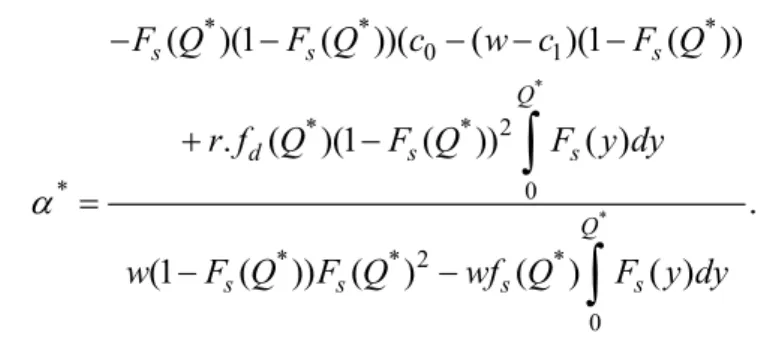
where Q* is given by equation (6). The following lemma is constructed to find α*.
Lemma 5: The optimal prepayment parameter α satisfies the following implicit equation:
* * * * * 0 1 * * 2 * 0 * * 2 * 0 ( )(1 ( ))( ( )(1 ( )) . ( )(1 ( )) ( ) (1 ( )) ( ) ( ) ( ) s s s Q d s s Q s s s s F Q F Q c w c F Q r f Q F Q F y dy w F Q F Q wf Q F y dy α − − − − − + − = − −
∫
∫
(7)Proof: Note that
* * * 0 1 ( , ) ( ) ((1 ) ) ( ) s Q w c Q w c R Q π α = α − + −α − Then * * * * * 0 1 1 ( , ) ( ) ( ( )) ( ) ((1 ) ) s Q w Q R Q w c Q w c R Q w π α α α α α ∂ = − + − ∂ + − − ∂ ∂ ∂ ∂ where * * * ( ) (1 S( )) R Q Q F Q α α ∂ ∂ = − ∂ ∂ and * * * * * 2 * ( )(1 ( ) ( )(1 ( )) ( ) s s D s s wF Q F Q Q rf Q F Q wf Q α α − − ∂ = ∂ − + Hence, * * 0 * * * * 0 1 * * * 2 ( , ) ( ) ( )(1 ( )( ( ) ( )(1 ( ))) . ( ) ( )(1 ( )) Q s s s s s s s D s Q w F y dy wF Q F Q wF Q c w c F Q wf Q rf Q F Q π α α α α ∂ = ∂ − − + − − − + −
∫
* ( , ) 0 s Q π α α ∂ = ∂ implies that138 Z. Jemai et al. * * * * * 0 1 * * 2 * 0 * * 2 * 0 ( )(1 ( ))( ( )(1 ( )) . ( )(1 ( )) ( ) . (1 ( )) ( ) ( ) ( ) s s s Q d s s Q s s s s F Q F Q c w c F Q r f Q F Q F y dy w F Q F Q wf Q F y dy α − − − − − + − = − −
∫
∫
3.3 Efficiency of the Stackelberg solution
The centralised optimal order quantity, Q0*, in the classical newsvendor model with
unlimited capacity (uncapacitated model) is given by equation (4) by replacing the wholesale price w by the supplier’s production costs c = c0 + c1 for s = p = 0. In the
uncapacitated newsvendor model the decentralised optimal order quantity Q* is less than the centralised optimal order quantity Q0*. The equality between Q0* and Q* occurs when
the wholesale price is equal to the supplier’s production costs and then, the supplier earns no profit.
In the capacitated model, the centralised optimal quantity Qc* is given by
equation (5), Qc* increases when c0 or/and c1 decreases. For a given c = c0 + c1, Qc*
reaches its maximum value when c0 = 0 and then Qc* = Q0* the optimal uncapacitated
order quantity.
On the other hand, the decentralised optimal order quantity Q* is determined by
equation (6). Note that Q* increases as α decreases. In Figure 6, we plot the ordering
quantities for both centralised and decentralised solutions.
Figure 6 Centralised versus decentralised optimisation (see online version for colours)
-2 -1,5 -1 -0,5 0 0,5 1 1,5 0 5 10 15 20 25 30 Fd(Q) Centralized alpha=0,2 alpha=0,8 Fs= N(20, 5) ; Fd= N(20, 5); w = 30; r = 100; c0 = 26; c1 = 2
Contracting under uncertain capacity 139 The capacitated curve is the ratio in the RHS of the equation (5), then the intersection with the Fd(Q) curve is the centralised capacitated optimal Qc*. The intersections between
Fd(Q) and the other curves is the decentralised Q* for different values of α. From the
figure, it is not easy to detect that Q* is less the centralised optimal order quantity Q c*.
Lemma 6 shows that when supplier optimises α, the optimal order quantity Q* is always less than Qc*.
Lemma 6: The decentralised order quantity Q* is less than the centralised order quantity
Qc*.
Proof: Let αc be the value of alpha to satisfy Q* = Qc*. Hence, equating the RHS of
equation (5) and equation (6), we obtain the following relation for αc:
0 1 * (1 ) * 1 ( ) 1 ( ) c c s c s c w c w c F Q F Q α α + − = + − − * 0 1 * ( )(1 ( ) ( ) s c c s c c w c F Q wF Q α = − − − (8)
Using equation (7), α* < αc as the additional terms given in the following equation
* * * * * 0 1 * * 2 * 0 * * 2 * 0 ( )(1 ( ))( ( )(1 ( )) . ( )(1 ( )) ( ) (1 ( )) ( ) ( ) ( ) s s s Q d s s Q s s s s F Q F Q c w c F Q r f Q F Q F y dy w F Q F Q wf Q F y dy α − − − − − + − = − −
∫
∫
are non-negative. Specifically,
* * * 2 0 . ( )(1 ( )) ( ) 0 Q d s s r f Q −F Q
∫
F y dy > and * * 0 ( ) ( ) 0 Q s s wf Q∫
F y dy> The proof is complete as α* < αc implies that Q* <Qc*.Therefore, Lemma 6 proves that the prepayment parameter α obtained from equation (8) does not correspond to a supplier’s decision strategy specified by equation (7). Hence, the decentralised solution is always less efficient than the centralised solution for the capacitated supplier problem.
4 Coordination issues under a general contract structure
The preceding section established that the decentralised system is not coordinated except in particular, trivial circumstances. For the uncapacitated newsvendor problem, many solutions are proposed to improve the supply chain performance. One of them is coordination with transfer payments such that actions chosen locally by the retailer and the supplier correspond to the centralised system.
140 Z. Jemai et al.
In this section, we propose an overview of the existing contracts in the literature. Then we discuss a contract with a more general structure that encompasses some known common contracts. Finally, we propose a contract that coordinates the newsvendor problem with capacity limitation.
4.1 Overview of existing contracts in the literature
Tsay et al. (1999), Cachon (2003) and Lariviere (1999) studied most of the supply chain contract structures used for the newsvendor model. We overview these contracts below. • The wholesale price contract: With a wholesale price contract the retailer pays w per
unit purchased to the supplier (see, Lariviere and Porteus, 2001, for more details). • The quantity discount contract: With a quantity discount contract the retailer pays a
wholesale price w(Q) dependent on Q. We differentiate the all unit quantity discounts when w(Q) is applied to all units and the incremental quantity discount when the discount price is applied only on the quantity greater than the price breakpoint Qi (see, Tomlin, 2003, for more details).
• The total minimum quantity commitment contract: Anupindi and Bassok (1999) studied a contract in which the retailer is committed to buy a minimum quantity Q0
from the supplier with a wholesale price w. This type of contract is used to make sure that the supplier invests in capacity. Some varieties of this contract exist: the total minimum quantity commitment with flexibility contract, for example, imposes an upper bound on the order quantity that can be purchased at the discounted price. • The two-part tariff contract: With a two-part tariff contract the supplier charges the
retailer a wholesale price and a fixed fee L independent of Q. A negative L can be interpreted as a franchise fee while a positive L is considered as a slotting fee. Corbett et al. (2004) propose different versions of this contract.
• The quantity forcing contract: The supplier eliminates the retailer’s choice and offer the retailer a wholesale price w and an order quantity QS (see, Lariviere, 1999 for
details).
• The buy-back contract: In a buy-back contract, the retailer pays a wholesale price w per unit ordered but can return the excess order quantity at a partial refund b at the end of the selling season (Pasternack, 1985). This contract is more complex when the excess stock can be salvaged physically or not to the supplier. This depends on the retailer’s and the supplier’s salvage value, but it is easily shown that the retailer optimisation problem is not affected (for a detailed discussion, see, Tsay, 2001). • The quantity flexibility contract: With quantity flexibility contract the supplier
charges the retailer a wholesale price w per unit purchased but accepts a total refund on the quantity remaining up to a threshold δQ. The rest is salvaged at the salvage price s (Tsay, 1999).
• The revenue sharing contract: In a revenue sharing contract, in addition to the wholesale price w, the retailer gives the supplier a percentage of her revenue (1 – θ). The revenue considered can be the sum of all different revenues (regular revenue and salvage revenue) or only the regular revenue (Cachon and Lariviere, 2005).
Contracting under uncertain capacity 141 • The sales rebate contract: With a sales rebate contract, the retailer pays a wholesale
price w per unit purchased but receives a rebate u per unit sold above a threshold S0.
Taylor (2002) distinguishes the target rebate as described before and the linear rebate is applied for all the units sold.
• The penalty contract: With this contract, the supplier charges the retailer a wholesale price w per unit purchased and a payment p per unit for any missed sales (Lariviere, 1999).
Other contracts, including the combination of some of the above contracts are studied in the literature. A franchise contract, for example, combines a revenue sharing contract and a two-part tariff contract (Tirole, 1988). Pasternack (2002) considers a contract that allows for outright sales to the retailer on some units and revenue sharing on other units. The revenue sharing contract as described by Cachon (2004) considers an all revenue share (we refer to it as an all-revenue sharing contract) that is a combination of a regular-revenue sharing contract (the retailer share is only from the regular revenue) and a buy-back contract.
Under supplier’s capacity limitation, we consider the prepayment contract in which the retailer pay to the supplier an advance payment w0 for each unit ordered and a
wholesale price w per unit received (Bakal et al., 2005).
Discussion
The aim of contracts is to improve supply chain performance by acting on system parameters. Three notions are important about the supply chain contracts: coordination, flexibility and simplicity.
A contract coordinates the supply chain when it acts on the supplier and retailer optimal actions so that they do correspond to the optimal centralised action. A flexible coordinating contract allows an arbitrary distribution of the supply chain benefits to the partners (see, Cachon 2004, for more discussion).
The simplicity of a contract implies two notions:
1 administration costs i.e. resources to allocate to institute the contract (logistics, system information…)
2 institutional convenience, i.e., contracts must facilitate long-term relationship that can reduce transactions costs.
This implies that the contract must be represented explicitly by exogenous parameters of the system in order to limit contract modifications under change of parameters. Accordingly, the two-part tariff contract when the fee L is fixed doesn’t verify this condition and so it’s not a simple contract (see, Tsay et al., 1999).
There are five exogenous parameters in the coordinated newsvendor problem under limited capacity: the order quantity Q, the received quantity R(Q), the quantity sold S(Q), the quantity remaining I(Q) and the lost sales B(Q). The contracts studied before combine one or more of those parameters and use linear or general transfer payments in order to coordinate the supply chain.
The wholesale price contract uses the received quantity (equivalent to the order quantity for an uncapacitated supplier setting) with a linear transfer payment, whereas the quantity discount contract uses a general transfer payment structure. A minimum quantity
142 Z. Jemai et al.
commitment contract can be considered to belong to the second case, as the unit wholesale price w1 is greater than r if Q is less than Q0 and equal to w elsewhere (not
linear).
The buy-back and the quantity flexibility contracts use the received quantity and the quantity remaining with a linear transfer payment for the first and a general transfer payment for the second (scale function).
The regular revenue sharing contract and the sales rebate contracts use the received quantity and the quantity sold with a linear transfer payment for the first and a general transfer payment for the second. The revenue sharing contract uses three parameters: the received quantity, the quantity sold and the quantity remaining
Penalty contracts uses the received quantity and the lost sales amount with linear transfer payments as described by Lariviere (1999), but it is easy to consider penalty contracts with more general transfer payments.
Finally, in a prepayment contract, we use the ordered quantity and the received quantity with linear transfer payments.
Equivalence between contracts is possible as one can write an important relation that links two of those parameters: the quantity remaining is determined from the received quantity and the sold quantity:
( ) ( ) ( )
I Q =R Q −S Q
From this equation, it is easy to show, for example, the equivalence between a buy-back contract and a revenue sharing contract (see, Cachon, 2004, for details).
4.2 A generalised contract
Even if contracts seem to have similar structures, their implementation differs because of varying degree of difficulty to determine exogenous parameters. The order and the received quantities are simple to determine for the supplier and the retailer whereas only the retailer knows the quantity sold and the supplier must have access to the retailer information system to obtain this information. Obtaining the quantity remaining has a similar difficulty, unless the retailer is asked to return the remaining quantity physically. The lost sales quantity is hard to determine both for the supplier and the retailer and may require use of tools that don’t guarantee accuracy. On the other hand, the difficulties may vary according to types of industries, relationship between the supplier and the retailer.
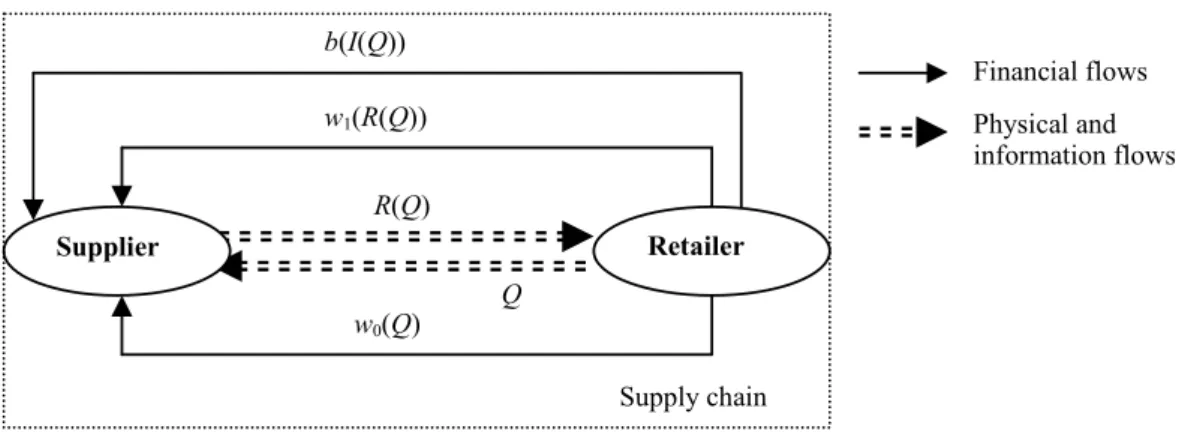
A generalised contract structure that encompasses some of the contracts mentioned above necessitates, in theory, a transfer payment with five parameters. In view of the difficulty of the determining the lost sales quantity, we eliminate penalty type contracts from further consideration in this study. On the other hand, the relation between the quantity sold and the quantity remaining allows us to eliminate another parameter. Hence, a generalised contract structure necessitates only three parameters as shown in Figure 7: a prepayment w0(Q) for the order quantity, a wholesale price w1(R(Q)) for the received
quantity and a buy-back payment b(I(Q)) for the leftover inventory where w0, w1 and b
can be defined as general (rather than linear).
The general contract structure proposed encompasses some of the contracts mentioned above, which constitute special cases of the transfer payment functions w0(Q), w1(R(Q)) and b(I(Q)). For example a buy-back contract considers no prepayment
Contracting under uncertain capacity 143 (w0(Q) = 0) and linear costs as function as the order quantity (w1.Q) and the quantity
remaining (b.I(Q)). The sales rebate contract with a rebate of u per unit sold above a threshold t considers no prepayment (w0(Q) = 0), linear cost as function as the order
quantity (w1.Q) and a general cost function on quantity remaining (if I(Q) < (Q – t) then b(I(Q)) = u.(Q – t) – I(Q) else b(I(Q)) = 0).
Figure 7 Transfer payments for a generalised contract structure for the coordinated newsvendor
model under capacity limitation
4.3 Coordination under capacity limitation and linear costs
In this section, we develop a special case of the generalised contract with linear costs that coordinates the newsvendor problem with capacity limitation. This contract generalises the wholesale price, the buy-back, the revenue sharing and the prepayment contracts.
4.3.1 Modelling assumptions and notation
In the beginning of the selling season, the retailer orders a quantity from the supplier who, in return, satisfies this order within the limit of her capacity. The supplier’s costs are c0 per unit ordered and c1 per unit produced. Season demand occurs and is satisfied by the
retailer at a unit price r. At the end of the season, the quantity remaining is returned to the supplier and linear transfer payments are made between the two firms as described in Figure 8. Note that for simplicity, we do not consider any additional cost for lost sales and return for salvage opportunities. In addition, we don’t consider a goodwill penalty cost for the supplier that can be included in the prepayment and in the payment costs. Figure 8 General contract structure with linear payments for the coordinated newsvendor model
under capacity limitation
Q w0(Q) b(I(Q)) w1(R(Q)) R(Q) Financial flows Physical and information flows Retailer Supplier Supply chain Customer Q αw.Q r.S(Q) b.I(Q) (1 –α)w.R(Q) R(Q) Financial flows Physical and information flows
Retailer Supplier
c0.Q + c1.R(Q)
144 Z. Jemai et al.
This contract generalises the wholesale price contract (w0 = 0, b = 0), the buy-back
contract (w0 = 0), the revenue sharing contract with parameters {w1’,φ}such that (w0 = 0, w1 = w1’+(1 – φ).r, b = (1 – φ).r), and the prepayment contract (b = 0) where w0 = αw and w1 = (1 – α)w.
4.3.2 Optimisation of the decentralised system under a typical decision
framework
The coordinated newsvendor problem with capacity limitation necessitates four decision variables to be determined: the prepayment parameter α, the wholesale price w, the buy-back payment b and the order quantity Q*.
It’s obvious that there exist many possible combinations with respect to who is determining which decision variables. Extreme cases occur when the supplier or the retailer decides on all variables. Lariviere (1999) presents a quantity-forcing contract that eliminates the retailer’s choice. If such a contract allows coordinating performances for the supply chain, the profits share is generally not impartial.
In practice, the determination of one or more of α, w and b by the retailer is not interesting. Indeed, the retailer tends to maximise b or to minimise α and w to optimise her objective function that will most probably yield to inefficient supply chain solutions and/or non-interesting solutions for the supplier.
A more realistic case is when the supplier determines α, w and b and the retailer determines Q*. In certain cases, the market may impose certain values of some of these variables (such as type of competition, etc.). In a newsvendor setting, the imposed variable is generally, the wholesale price w. In what follows, we concentrate on the optimisation of the advance payment for a given wholesale price and buy-back payment, following the logic that monetary quantities might be exogenous.
Under the Stackelberg equilibrium, the supplier who is the leader proposes the retailer a contract (α, w, b). If the retailer accepts the contract, she returns an order quantity Q*
and incurs an advance payment αw per unit ordered. The supplier satisfies the retailer’s order quantity within the limit of her capacity and the retailer, then pays a wholesale price (1 – α)w per unit received. At the end of the season, the supplier gives the retailer a buy-back payment b per unit not sold in the regular season.
Retailer’s problem
With the general contract, the retailer faces a classical newsvendor problem with capacity limitation, a linear prepayment and a linear wholesale cost and a linear salvage value b for leftover inventory. Similar to the presentation made in Section 3, the retailer’s expected profit function is:
[ ( )]r [ ( ) ( ) (1 ) ( )]
Eπ Q =E rS Q +bI Q −αwQ− −α wR Q or
[ ( )]r [( ) ( ) ((1 ) ) ( )]
Eπ Q =E r b S Q− −αwQ− −α w b R Q−
Contracting under uncertain capacity 145 * * (1 ) ( ) ( ) s Dc d Dc w r w F Q F Q r b α α − − − = − (9)
Supplier’s problem
When the retailer orders a quantity Q, the supplier’s expected profit function is:
0 1 [ ( )]s [( ) ((1 ) ) ( ) ( )] Eπ Q =E αw c Q− + −α w c R Q− −bI Q or 0 1 [ ( )]s [( ) ((1 ) ) ( ) ( )] Eπ Q =E αw c Q− + −α w b c R Q− − +bS Q
For a given w and b, the supplier must determine prepayment parameter α* that maximises her profit function. The optimal order quantity is completely determined by the supplier’s choices and then, with full information, the supplier knows the retailer’s choice exactly.
The Stackelberg equilibrium
Lemma 7: For given w and b, the retailer order quantity Q* is equal to the centralised optimal quantity Qc* for the following value of αc, the prepayment parameter:
* * 0 1 * ( ( ))( ) ( ) ( ) (1 ( )) s c s c c s c c c F Q r b r w b F Q rw F Q α = + − − − − (10)
Proof: If Q* = Qc*, then, using equations (5) and (9):
0 1 * (1 ) * ( ) ( ) s c s c c w r w r c F Q F Q r b r α α − − − − − = −
αc value that verifies the above equation is given by:
* * 0 1 * ( ( ))( ) ( ) ( ) (1 ( )) s c s c c s c c c F Q r b r w b F Q rw F Q α = + − − − −
To coordinate the system, the set (αc, Qc*) given w and b must be a Stackelberg
equilibrium and then the vector (αc, w, b) forms supplier’s decision as a response to the
choice Qc* of the retailer.
Proposition 2: For a given w and b, (αc, Qc*) is a Stackelberg equilibrium.
Proof: The pair (αc, Qc*) is a Stackelberg equilibrium as it maximises the supplier’s
profit. To prove this, it is sufficient to compute the optimal order quantity for the supplier Qs* and to verify that Qs* = Qc* for α = αc.
146 Z. Jemai et al. 0 1 [ ( )] ((1 ) )) ( ) ( ) ( ) s s s D dE Q w c w b c F Q bF Q F Q dQ π =α − + −α − − + Then Qs* satisfying [ ( )] 0 s dE Q dQ π
= is given by the following equation:
0 1 * (1 ) ( ) ( ) s D s w c w c F Q F Q b α − + −α − = (11)
For α value given by equation (10), equation (11) becomes
0 1 * ( ) ( ) s D s c r c F Q F Q r − − =
Hence, (αc, Qc*) is a Stackelberg equilibrium
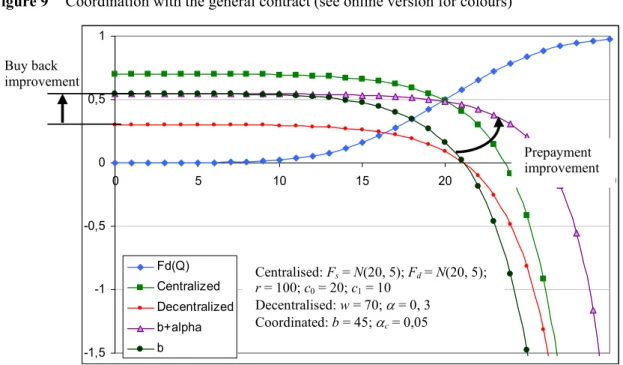
Figure 9 illustrates on an example how the general contract acts to coordinate the decentralised model.
Figure 9 Coordination with the general contract (see online version for colours)
The intersection of the Fd(Q) curve with the centralised (respectively decentralised) curve give the centralised optimal Qc* (respectively the decentralised optimal Q*).
Figure 9 shows that the contract (αc, w, b) coordinates the decentralised model (the
intersection between the Fd(Q) and (b + alpha) curves coincides with the centralised optimal Qc*. The buy-back payment increases the decentralised optimal order quantity
(equation (6)) by multiplying the RHS with r/(r – b) (the b curve). In addition, the prepayment parameter αc adjusts Q* to have Q* = Qc* as mentioned in Figure 9.
-1,5 -1 -0,5 0 0,5 1 0 5 10 15 20 25 30 Fd(Q) Centralized Decentralized b+alpha b Prepayment improvement Buy back improvement Centralised: Fs= N(20, 5); Fd= N(20, 5); r = 100; c0 = 20; c1 = 10 Decentralised: w = 70; α = 0, 3 Coordinated: b = 45; αc = 0,05
Contracting under uncertain capacity 147
5 Conclusions
In this paper, we have developed a two-stage supply-chain in which a supplier with uncertain capacity sells to a retailer facing an uncertain demand. The cost setting considered in this environment consists of a two-step payment of the retailer to the supplier: a prepayment based on the quantity ordered by the retailer and a final payment based on the quantity actually delivered by the supplier. Under this prepayment cost structure, we analytically determine the optimal policy of the centralised system where decisions are made to optimise the expected system wide profit. We then analyse a decentralised system where the supplier decides the wholesale price and the prepayment parameter and the retailer decides the order quantity. We show that, in the framework of as Stackelberg equilibrium, in the decentralised model, the retailer orders less than she does in the centralised model, and hence, the decentralised expected total system wide profit is less than the centralised counterpart. We discuss coordination issues in the given environment and propose a generalised contract structure that coordinates the decentralised system by introducing a payback payment. This contract gives an incentive to the retailer to order more. More precisely, we show that under this contract the quantity ordered by the retailer is the same as that on the centralised scheme and hence this generalised contract coordinates the decentralised system.
Suppliers with capacity restriction often create bottlenecks for the efficient operation of supply chains. We believe that a detailed analysis of the system performance under such situations is important. It is also crucial to come up with specific contractual arrangements that will be realistic in such environments. This work represents an attempt towards that direction.
Several aspects of the problem such as analysis of the effects of information asymmetry and analysis of different supply chain structures with multiple suppliers and/or multiple retailers remain for future research.
Acknowledgements
The authors thank the anonymous referees for their suggestions which led to improvement on the contents and the presentation of the article. Nesim Erkip was at the Middle East Technical University and Technische Universiteit Eindhoven when parts of this research were carried out.
References
Anupindi, R. and Bassok, Y. (1999) ‘Supply contracts with quantity commitments and stochastic demand’, in R. Ganeshan, M. Magazine and S. Tayur (Eds.): Quantitative Models for Supply Chain Management, Chapter 7, pp.301–336, Dordrecht, Kluwer Academic Publishers.
Aviv, Y. (2001) ‘the effect of collaborative forecasting on supply chain performance’, Management Science, Vol. 47, No. 10, pp.1326–1343.
Bakal, I.S., Erkip, N. and Güllü, R. (2005) ‘Value of supplier’s capacity information in a two-echelon supply chain’, Working paper.
Cachon, G.P. and Lariviere, M.A. (1999a) ‘An equilibrium analysis of linear, proportional and uniform allocation of scarce capacity’, IIE Transactions, Vol. 31, pp.835–849.
148 Z. Jemai et al.
Cachon, G.P. and Lariviere, M.A. (1999b) ‘Capacity choice and allocation: strategic behavior and supply chain performance’, Management Science, Vol. 45, No. 8, pp.1091–1108.
Cachon, G.P. (2003) ‘Supply chain coordination with contracts’, S. Graves, T. de Kok (Eds.): The Handbook of Operations Research and Management Science: Supply Chain Management, Kluwer, Amsterdam, the Netherlands.
Cachon, G. P. (2004) ‘The allocation of inventory risk in a supply chain: push, pull and advance purchase discount contracts’, Management Science, Vol. 50, No. 2, pp.222–238.
Cachon, G. and Netessine, S. (2004) ‘Game theory in supply chain analysis’, in David Simchi-Levi, S. David Wu and Zuo-Jun (Max) Shen (Eds.): Handbook of Quantitative Supply Chain Analysis: Modeling in the eBusiness Era, Kluwer.
Cachon, G.P. and Lariviere, M.A. (2005) ‘Supply chain coordination with revenue sharing contracts: strengths and limitations’, Management Science, Vol. 51, No. 1, pp.30–44.
Ciarallo, F.W., Akella, R. and Morton, T.E. (1994) ‘A periodic review, production planning model with uncertain demand-optimality of extended myopic policies’, Management Science, Vol. 40, pp.320–332.
Corbett, C.J., Zhou, D. and Tang, C.S. (2004) ‘Designing supply contracts: contract type and information asymmetry’, Management Science, Vol. 50, No. 4, pp.550–559.
Ehrhardt, R. and Taube, L. (1987) ‘An inventory model with random replenishment quantity’, International Journal of Production Research, Vol. 25, pp.1795–1803.
Gavirneni, S., Kapuscinski, R. and Tayur, S. (1999) ‘Value of information in capacitated supply chains’, Management Science, Vol. 45, No. 1, pp.16–24.
Jain, K. and Silver, E.A. (1995) ‘The single period procurement problem where dedicated supplier capacity can be reserved’, Naval Research Logistics, Vol. 42, pp.915–934.
Jemai, Z., Erkip, N. and Dallery, Y. (2006) ‘Contracting under uncertain capacity’, Proceedings of the ILS Conference, Lyon, France, May, Vol. 2, pp.1005–1014.
Khouja, M. (1999) ‘The single-period (news-vendor) problem: literature review and suggestions for future research’, The international journal of Management Science, Vol. 27, pp.537–553. Lariviere, M.A. (1999) ‘Supply chain contracting and coordination with stochastic demand’, in
R. Ganeshan, M. Magazine and S. Tayur (Eds): Quantitative Models for Supply Chain Management, Chapter 8, pp.301–336, Dordrecht, Kluwer Academic Publishers.
Lariviere, M.A. and Porteus, E.L. (2001) ‘Selling to the newsvendor: an analysis of price-only contracts’, Manufacturing and Service Operations Management, Vol. 3, No. 4, pp.293–305. Lee, H., Padmanabham, V. and Whang, S. (1997) ‘Information distortion in a supply chain: the
bullwhip effect’, Management Science, Vol. 43, No. 4, pp.546–558.
Pasternack, B. (1985) ‘Optimal pricing and return policies for perishable commodities’, Marketing Science, Vol. 4, No. 2, pp.166–176.
Pasternack, B. (2002) ‘Using revenue sharing to achieve channel coordination for a newsboy type inventory model’, in J. Geunes, P. Pardalos and H.E. Romeijn (Eds.): Supply Chain Management : Models, Applications and Research, Kluwer Academic Publishers.
Porteus, E.L. (1990) ‘Stochastic inventory theory’, in D.P. Heyman and M.J. Sobel (Eds.): Handbook in Operations Research and Management Science, Vol. 2, pp.605–652, Stochastic Models, Elsevier Science Publishers B.V.
Silver, E.A., Pyke D.F. and Peterson R.P. (1998) Inventory Management and Production Planning and Scheduling, 3rd ed., New York, John Wiley.
Taylor, T.A. (2002) ‘Supply chain coordination under channel rebates with sales effort effects’, Management Science, Vol. 48, No. 8, pp.992–1007.
Tirole, J. (1988) The Theory of Industrial Organization, Cambridge, MIT Press.
Tomlin, B. (2003) ‘Capacity investments in supply chain: sharing-the-gain rather than sharing-the pain’, Manufacturing Service Operations Management, Vol. 5, No. 4, pp.317–333.
Tsay, A.A. (1999) ‘The quantity flexibility contract and supplier-customer incentives’, Management Science, Vol. 45, No. 10, pp.1339–1358.
Contracting under uncertain capacity 149
Tsay, A.A., Nahmias, S. and Agrawal, N. (1999) ‘Modeling supply chain contracts: a review’, in R. Ganeshan, M. Magazine and S. Tayur (Eds.): Quantitative Models for Supply Chain Management, Chapter 10, pp.301–336, Dordrecht, Kluwer Academic Publishers.
Tsay, A.A. (2001) ‘Managing retail channel overstock: markdown money and return policies’, Journal of Retailing, Vol. 77, pp.457–492.
Notes
1 A preliminary version of this study for a particular case is presented at the ILS Conference (Lyon, France, May 2006) and published in the proceedings of the conference Jemai et al. (2006).