See discussions, stats, and author profiles for this publication at: https://www.researchgate.net/publication/271901574
Comparing the anatomic single-bundle versus the anatomic double-bundle
for anterior cruciate ligament reconstruction: A prospective, randomized,
single blind, clinical study
Article · September 2013 DOI: 10.1007/s12570-013-0231-1 CITATION 1 READS 51 4 authors:
Some of the authors of this publication are also working on these related projects:
Transtibial repair in medial meniscus root avulsions; 2 years clinical results View project
Article The effect of anterior cruciate ligament graft rotation on knee biomechanics View project Murat KOKEN
MEDICALPARK ANKARA HOSPITAL, Ankara,Turkey
10PUBLICATIONS 2CITATIONS SEE PROFILE Burak Akan Ufuk Üniversitesi 25PUBLICATIONS 120CITATIONS SEE PROFILE Alper Kaya
Acıbadem Mehmet Ali Aydınlar Üniversitesi
30PUBLICATIONS 227CITATIONS SEE PROFILE Mehmet Armangil Ankara University 28PUBLICATIONS 89CITATIONS SEE PROFILE
All content following this page was uploaded by Murat KOKEN on 12 November 2015.
ORIGINAL ARTICLE
Comparing the anatomic single-bundle versus the anatomic
double-bundle for anterior cruciate ligament reconstruction:
a prospective, randomized, single blind, clinical study
Murat Koken&Burak Akan&Alper Kaya& Mehmet Armangil
Received: 18 January 2013 / Accepted: 17 October 2013 # EFORT 2013
Abstract
Purpose The aim of this study was to compare the early results of anatomic single bundle versus double-bundle ante-rior cruciate ligament (ACL) reconstruction.
Methods We conducted a prospective randomized study of anatomic single-bundle versus double-bundle ACL recon-struction using the hamstring tendons of 67 patients with unilateral ACL deficiency. The subjects were randomized into two groups. The single-bundle group consisted of 37 patients and the double-bundle group 30 patients. We used the follow-ing evaluations: clinical examination, KT-1000 arthrometry, Tegner knee score, modified Cincinnati score, Knee Injury and Osteoarthritis Outcome Scale (KOOS), International Knee Documentation Committee (IKDC) score. Two sur-geons performed all operations, and a blinded independent author conducted the clinical follow-up assessments. Results The mean follow-up period was 25.8 months. The differences between the preoperative and postoperative clini-cal examinations and the KT-1000 measurements were statis-tically different in both groups (p <0.05). There were no statistically significant differences between the groups. Tegner knee scores, modified Cincinnati scores, and KOOS and IKDC scores showed statistically significant improvement in both groups (p <0.05). There were no statistically significant differences between the groups.
Conclusions This prospective study found no difference be-tween the outcomes of the anatomic single-bundle and the anatomic double-bundle ACL reconstructions.
Level of evidence II.
Keywords ACL reconstruction . Double bundle . Single bundle . Anatomic
Introduction
Traditional transtibial single-bundle anterior cruciate liga-ment (ACL) reconstruction is considered the gold stan-dard for ACL surgery. Clinical studies, however, have demonstrated that transtibial ACL reconstruction often produces vertical grafts that result in loss of motion and
residual laxity [1]. That is, the transtibial technique fails
to restore normal knee function and does not prevent
osteoarthritis in a high percentage of patients [2–4]. At
the same time, a cadaveric study showed the inability of single-bundle reconstruction produced by conventional
transtibial drilling to restore normal laxity [5]. Opponents
of transtibial single-bundle ACL reconstruction suggest that this approach does not restore the native anatomy and may therefore not provide normal knee kinematics, which they hypothesized could lead to early osteoarthritic
changes over time [4]. It has been shown that the ACL
consists of two functional bundles: an anteromedial (AM) bundle and a posteromedial bundle. Anatomic reconstruc-tion has been developed to prevent early degenerareconstruc-tion. In
this context,“anatomic” means that the tunnels are placed
in the native ACL insertion site regardless of how many
M. Koken
:
B. Akan (*):
A. Kaya Ufuk University, Ankara, Turkey e-mail: [email protected] M. ArmangilAnkara University, Ankara, Turkey Eur Orthop Traumatol
DOI 10.1007/s12570-013-0231-1
bundle are used [6]. The purpose of this prospective, randomized clinical study was to evaluate the clinical out-comes of arthroscopic anatomic single-bundle ACL recon-struction versus arthroscopic anatomic double-bundle ACL reconstruction.
Patients and methods
The local ethics committee approved this study (ID number: 08087). We obtained written informed consent from all of the patients in the study.
A total of 67 patients with ACL deficiency were included in our study (from June 2006 to January 2011). The actual number of ACL operations was nearly 300 during the same time interval. Patients with partial ACL rupture, meniscal pathology, chondral lesions, misalignment of the lower tremity, and/or previous surgery to the same knee were ex-cluded from the study to obtain homogeneous group. Patients were also excluded from the study if they did not give their consent, complete the rehabilitation program fully, or attend regular checkups. Randomization was performed according to the patients’ date of birth. Patients whose date of birth ended with an odd number comprised group 1 and patients whose date of birth ended with an even number comprised group 2. Arthroscopic reconstruction with the anatomic single bundle was performed in the group 1 patients, and arthroscopic reconstruction with the double bundles was done in the group 2 patients. Group 1 consisted of 37 patients and group 2 of 30 patients. If we did not perform the double-bundle reconstruc-tion for any reason in a group 2 patient, that patient was not included in the study.
There were 65 male and two female patients, with an average age of 27.6 years (range 16–56 years). In all, two patients were injured in a work accident and 65 had sports injuries. The latter were related to volleyball in two patients (2.9 %) and soccer in 63 patients (94.0 %). The affected extremity was the right knee in 64 % of the patients and the left knee in 36 %. The average interval between the injury and the operation was 7 weeks (range 3–24 weeks). The mean follow-up was 25.8 (range 18–72)months.
Two independent examiners performed the clinical and functional evaluations, including the Lachman test, pivot-shift test, anterior drawer test, and KT-1000 arthrometry (MEDmetric, San Diego, CA, USA). Each patient was eval-uated with non-weight-bearing lateral and anteroposterior (AP) radiography and magnetic resonance imaging to rule out evidence of osteoarthritis or misalignment at the time of surgery. The functional evaluation was performed using the Tegner, modified Cincinnati, and Knee Injury and Osteoar-thritis Outcome (KOOS) scores prior to the operation in both groups of patients.
Surgical procedure
Two consultant surgeons performed all of the surgical proce-dures. The patients underwent general anesthesia or spinal anesthesia and a tourniquet. The Lachman test, pivot-shift test, and anterior drawer test were performed in all patients under anesthesia.
Generally, the operation began by harvesting the graft. If we were unsure if the ACL had ruptured, diagnostic arthroscopy was first applied. An accessory anteromedial port was used with a standard anteromedial port plus an anterolateral port if necessary. The femoral side was prepared via an anteromedial or auxiliary anteromedial port (not transtibially) with a free-hand technique without guidance. We created the femoral and tibial bone tunnels at the original position of the AM bundle footprint for the single and double-bundle reconstructions. We added a bone tunnel at the posterolateral bundle (PL) footprint in the double-bundle group and at the central position between these two bundles in the single-bundle group. The tibial tunnel guide angle was 55° in the single-bundle group. Both tibial tunnel guide angles were 45° in the double-bundle group.
Autogenous hamstring grafts were used for all single- and double-bundle reconstructions. Graft fixation in all cases was performed using the Loop Endobutton CL® (Smith & Neph-ew, Mansfied, MA, USA) for the femoral fixation. Tibial fixation was performed with an oversized bioabsorbable screw (Bio-RCI HA®; Smith & Nephew) and a U-pin. In 20 patients, the fixation was reinforced with a staple. In the single-bundle group, the tibial fixations were performed at 30° flexion of the knee. During tibial fixation in the double-bundle group, the knee flexion angles were 45°
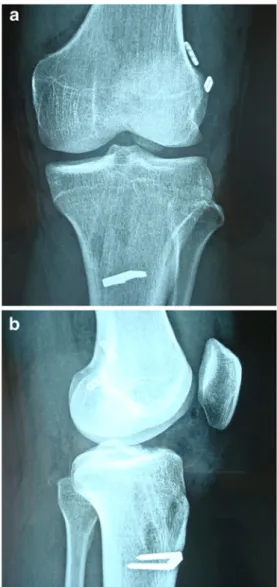
for the AM bundle and 15° for the PL bundle (Figs.1and2).
Rehabilitation
The same rehabilitation program was applied to both groups. Quadriceps strengthening movements began on the first day after the operation. Passive exercises were performed twice a day during the patients’ hospitalization using a continuous passive motion (CPM) device. The patients continued active exercises on the edge of the bed throughout the day by adjusting the flexion and extension values to the last value available on the CPM device. Walking with crutches and partial weight bearing were allowed without a brace or splint for the first 3 weeks. Six weeks after surgery, the patients returned to performing activities of daily living. Noncontact sports were permitted after 3 months and contact sports at 1 year after surgery.
Statistical analysis
SPSS version 20.0 for Windows software (SPSS, Chicago, IL, USA) was used for statistical analysis. The quantitative
Eur Orthop Traumatol
variables were shown as the means, standard deviations, me-dians, numbers, and percentages. The differences between the preoperative and postoperative values were evaluated using a Wilcoxon test and paired t test, depending on the normal distribution. The Kolmogorov–Smirnov test was used for separation of parameters, and an independent T test was used for discrepancy analysis. The Mann–Whitney U test was used to determine the equality of variances and if the data were statistically accepted as meaningful. The significance level was set at p <0.05.
Results
The mean follow-up period was 25.8 (range 18–72)months. No patients experienced distress or loss of control. Swelling and minimal pain were detected after forced activity in eight patients (11.9 %). The Lachman test and pivot-shift test
fol-lowing the operation were negative in all patients (Table1).
Patients’ preoperative AP instability was determined by
KT-1000 arthrometry (Table2), which revealed statistically
sig-nificant differences between preoperative and postoperative measurements in the two groups, but there were no statistical-ly significant differences between the groups.
In group 1, the mean preoperative Tegner knee score was 52.6 (range 31–65). At 6 months after surgery, it was 82.2 (range 51–100), and at 1 year, it was 84.1 (range 49–100). In group 2, the mean preoperative Tegner knee score was 55.3 (range 41–63). At 6 months after surgery, it was 80.8 (range 59–95), and at 1 year, it was 79.9 (range 62–96). There were statistically significant differences between the preoperative and postoperative measurements in both groups (p <0.05), but there were no statistically significant differences between the groups.
Fig. 1 a A 26-year-old male patient that underwent single bundle ACL reconstruction anterior–posterior view. b Lateral view
Fig. 2 a A 27-year-old male patient that underwent double-bundle ACL reconstruction. b Lateral view
Eur Orthop Traumatol
In group 1, the mean preoperative modified Cincinnati score was 50.2 (range 33–68). At 6 months after surgery, it
was 82.2 (range 50–100), and at 1 year, it was 83.2 (range 60–
100). In group 2, the mean preoperative modified Cincinnati score was 49.0 (range 32–70). At 6 months after surgery, it
was 80.4 (range 40–98), and at 1 year, it was 81.3 (range 50–
100). There were statistically significant differences between the preoperative and postoperative measurements in both groups (p <0.05), but there were no statistically significant differences between the groups.
In group 1, the mean preoperative KOOS score was 52.0
(range 36.5–72.0). At 6 months after surgery, it was 79.4
(range 60.5–93.6), and at 1 year, it was 80.3 (range 60.7–95.0). In group 2, the mean preoperative KOOS score
was 56.8 (range 37.4–73.2). At 6 months after surgery,
it was 81.7 (range 50.9–95.5), and at 1 year, it was 83.5 (range 50.6–95.0). There were statistically significant differ-ences between the preoperative and postoperative measure-ments in both groups (p <0.05). At 1 year after surgery, the KOOS scores of group 2 were better than those of group 1, a difference that was statistically significant (p <0.05).
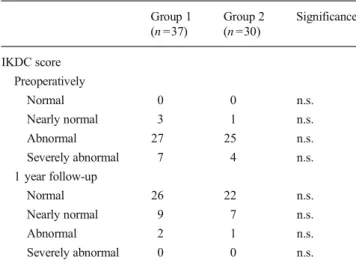
Preoperative and postoperative International Knee Documentation Committee (IKDC) scores for both groups
are shown in Table 3. There were statistically significant
differences between the preoperative and postoperative
measurements in both groups (p <0.05), but there were no statistically significant differences between the groups.
Discussion
The most important finding of this study was that the out-comes of anatomic double-bundle ACL reconstruction were not superior to the outcomes of anatomic single-bundle ACL reconstruction.
Single-bundle reconstruction is the technique most com-monly used for ACL injuries as it provides clinical results that are acceptable in most cases. There is, however, an apprecia-ble failure rate that may necessitate revision surgery, and some cases are only partially successful including a group of
pa-tients who have residual“pivot–glide,” which is reported to
occur in 14–30 % of patients [7].
Several anatomic studies have shown that the ACL consists
of two major bundles: the AM and PL bundles [8,9]. When
the knee flexes, the AM bundle is tight, and the PL bundle is loose. During knee extension, the AM bundle is loose, and the PL bundle is tight. The PL bundle contributes more to rota-tional stability [9,10].
Previous research has shown that the native ACL foot-print shows a large variation in size [11,12]. The tibial and
femoral insertions are most commonly 12–16 mm [13].
However, typical graft sizes for autograft single-bundle reconstruction are 7–9 mm for soft tissue grafts and 9– 11 mm for bone–tendon grafts. The native footprint can
therefore be filled only partially [14]. Hence, in theory,
double-bundle ACL reconstruction is thought to yield bet-ter results than single-bundle reconstruction. Whether single-bundle or double-bundle reconstruction is better
for treating ACL ruptures is thus controversial [9]. Some
studies have shown no difference between these recon-struction techniques, whereas others have shown that
Table 1 Evaluation results for first and second groups at preoperation and postoperation Group 1 (single-bundle) preoperation Group 1 (single-bundle) postoperation Group 2 (double-bundle) preoperation Group 2 (double-bundle) postoperation Lachman test 0 0 35 0 30 (+) 6 2 5 0 (++) 17 0 14 0 (+++) 14 0 11 0 Pivot-shift test Negative 11 37 6 30 Positive 26 0 24 0
Table 2 Translation differences between the two knees of patients in groups 1 and 2 with KT-1000 device
Group 1 preoperation Group 1 postoperation Group 2 preoperation Group 2 postoperation <3 mm 5 35 1 29 Between 3–5 mm 20 2 16 1 >5 mm 12 0 13 0
Table 3 IKDC scores
Group 1 (n =37) Group 2 (n =30) Significance IKDC score Preoperatively Normal 0 0 n.s. Nearly normal 3 1 n.s. Abnormal 27 25 n.s. Severely abnormal 7 4 n.s. 1 year follow-up Normal 26 22 n.s. Nearly normal 9 7 n.s. Abnormal 2 1 n.s. Severely abnormal 0 0 n.s. Eur Orthop Traumatol
double-bundle ACL reconstruction is better than
single-bundle ACL reconstruction [9,15–23]. For example, some
retrospective studies have reported significantly better an-terior stability in patients with the double-bundle ACL reconstruction along with more negative Lachman and pivot-shift tests. Recent publications emphasize the impor-tance of rotational laxity after ACL surgery which double bundle reconstruction may be superior to single bundle
[23–26]. On the other hand, instrumented manual devices
and some robotic testing systems developed for rotational measurements are not available worldwide and are not used in this clinical trial. [25–28]. Three studies reported decreased pivot-shift after double-bundle ACL reconstruc-tion, but these studies included nonanatomic positions for
the femoral tunnel [29–31]. Another study reported that
anterior stability is significantly better after double-bundle reconstruction based on the results of objective tests, but no difference was found based on subjective tests. Gold-smith et al. reported no significant differences were found between anatomic single bundle and double-bundle recon-structions for simulated pivot shift or anterior tibial loading
[23,32]. Suomalainen et al., in a prospective randomized
study, reported that single-bundle ACL reconstruction is associated with more graft failures than double-bundle ACL reconstructions after 5 years. They also found no difference in the stability measurements between the two
groups [33]. A meta-analysis performed by Meredick et al.
failed to prove the superiority of the double-bundle meth-od, but they lacked long-term follow-up times and needed
a better study plan [34]. Xu et al. reported that a
meta-analysis of randomized controlled trials revealed that double-bundle ACL reconstruction resulted in significantly better anterior and rotational stability and higher IKDC
objective scores than single-bundle reconstruction [24].
Our study design was prospective, randomized, and blinded. The results of our study were similar in the two groups in regard to anterior and rotational stability. It is known that double-bundle ACL reconstruction provides good anteri-or and rotational stability, but we showed that anatomic single-bundle ACL reconstruction provides equal anterior and rota-tional stability.
The main limitation of this study was the short follow-up time and a low number of patients. We excluded from the study patients with associated meniscal pathologies, chondral lesions, collateral ligament injuries, misalignment of the lower extrem-ity, and previous surgery on the same knee to lower bias in the statistical analysis. If a patient in the double-bundle group did not undergo double-bundle reconstruction for any reason (e.g., narrow notch, insufficient autograft) that patient was not in-cluded in the study. Patients were also exin-cluded from the study if they did not give their consent, complete the rehabilitation program fully, or attend regular checkups. Also, patients on whom an allograft was used were not included.
Optimal ACL reconstruction is still an important clinical issue in orthopedic research. In particular, longer follow-up times are needed for assessment of osteoarthritis and to deter-mine the optimal technique for ACL reconstruction.
Conclusion
This prospective study found no difference between the out-comes of anatomic single-bundle and anatomic double-bundle ACL reconstruction. Both reconstruction techniques were capable of restoring AP and rotational stability of the knee. Restoring normal anatomy via ACL reconstruction provides a good outcome, which is of utmost importance to the patient.
References
1. Howell SM, Gittins ME, Gottlieb JE, Traina SM, Zoellner TM (2001) The relationship between the angle of the tibial tunnel in the coranal plan and loss of flexion and anterior laxity after anterior cruciate ligament reconstruction. Am J Sports Med 29:567–574
2. Biau DJ, Tournoux C, Katsahian S, Schranz P, Nizard R (2007) ACL reconstruction: a meta-analysis of functional scores. Clin Orthop Relat Res 458:180–187
3. Fithian DC, Paxton EW, Stone ML, Luetzow WF, Csintalan RP, Phelan D, Daniel DM (2005) Prospective trial of a treatment algo-rithm for the management of the anterior cruciate ligament-injured knee. Am J Sports Med 33:335–346
4. Tasman S, Kolowich P, Collon D, Anderson K, Anderst W (2007) Dynamic function of the ACL reconstructed knee during running. Clin Orthop Relat Res 454:66–73
5. Woo SL, Kanamori A, Zeminski J, Yagi M, Papageorgiou C, Fu FH (2002) The effectiveness of reconstruction of the anterior cruciate ligament with hamstring and patellar tendon: a cadaveric study comparing anterior tibial and rotational loads. J Bone Joint Surg 84: 907–914
6. VanEck CF, Kopf S, Irrgang JJ, Bhandari M, Fu FH, Poolman RW (2012) Single-bundle versus double-bundle reconstruction for ante-rior cruciate ligament rupture: a meta-analysis- does anatomy matter? Arthroscopy 3:405–424
7. Colombet P, Robinson J, Jambou S, Allard M, Bousquet V, Lavigne C (2006) Two-bundle, four-tunnel anterior cruciate ligament recon-struction. Knee Surg Sports Traumatol Arthrosc 14:629–636 8. Amis AA, Dawkins GP (1991) Functional anatomy of anterior
cru-ciate ligament. Fibril bundle actions related to ligament replacements and injuries. J Bone Joint Surg 73:260–267
9. Park SJ, Jung YB, Jung HJ, Jung HJ, Shin HK, Kim E, Song KS, Kim GS, Cheon HY, Kim S (2010) Outcome of arthroscopic single-bundle versus double single-bundle reconstruction of the anterior cruciate ligament: a preliminary 2-year prospective study. Arthroscopy 26: 630–636
10. Mochizuki T, Muneta T, Nagase T, Shirawasa S, Akita KI, Sekiya I (2006) Cadaveric knee observation study for describing anatomic femoral tunnel placement for two- bundle anterior cruciate ligament reconstruction. Arthroscopy 22:356–361
11. Harner CD, Baek GH, Vogrin TM, Carlin GJ, Kashiwaguchi S, Woo SL (1999) Quantitative analysis of human cruciate ligament inser-tions. Arthroscopy 15:741–749
Eur Orthop Traumatol
12. Kopf S, Musahl V, Tashman S, Szczodry M, Shen W, Fu FH (2009) A systematic review of the femoral origin and tibial insertion morphology of the ACL. Knee Surg Sports Traumatol Arthrosc 17:213–219 13. VanEck CF, Lesniak BP, Schreiber VM, Fu FH (2010) Anatomic
single- and double-bundle anterior cruciate ligament reconstruction flowchart. Arthroscopy 26:258–268
14. Cross MB, Musahl V, Bedi A, O’Loughlin P, Hammoud S, Suero E, Pearle AD (2012) Anteromedial versus central single-bundle graft position: which anatomic graft position to choose? Knee Surg Sports Traumatol Arthrosc 20:1276–1281
15. Aglietti P, Giron F, Losco M, Cuomo P, Ciardullo A, Mondanelli N (2010) Comparison between single- and double-bundle anterior cru-ciate ligament reconstruction: a prospective, randomized, single-blinded clinical trial. Am J Sports Med 38:25–34
16. Araki D, Kuroda R, Kubo S, Fujita N, Tei K, Nishimoto K, Hoshino Y, Matsushita T, Matsumoto T, Nagamune K, Kurosaka M (2011) A prospective randomised study of anatomical single-bundle versus double-bundle anterior cruciate ligament reconstruction: quantitative evaluation using an electromagnetic measurement system. Int Orthop 35:439–446
17. Ibrahim SA, Hamido F, Al Misfer AK, Mahgoob A, Ghafar SA, Alhran H (2009) Anterior cruciate ligament reconstruction using autologous ham- string double bundle graft compared with single bundle procedures. J Bone Joint Surg Br 91:1310–1315
18. Sastre S, Popescu D, Nunez M, Pomes J, Tomas X, Peidro L (2010) Double-bundle versus single-bundle ACL reconstruction using the horizontal femoral position: a prospective, randomized study. Knee Surg Sports Traumatol Arthrosc 18:32–36
19. Song EK, Oh LS, Gill TJ, Li G, Gadikota HR, Seon JK (2009) Prospective comparative study of anterior cruciate ligament recon-struction using the double-bundle and single-bundle techniques. Am J Sports Med 37:1705–1711
20. Tiamklang T, Sumanont S, Foocharoen T, Laopaiboon M (2012) Double-bundle versus single-bundle reconstruction for anterior cru-ciate ligament rupture in adults. Cochrane Database Syst Rev. doi:10. 1002/14651858
21. Zaffagnini S, Bruni D, Marcheggiani Muccioli G, Bonanzinga T, Lopomo N, Bignozzi S, Marcacci M (2011) Single-bundle patellar tendon versus non-anatomical double-bundle hamstring ACL reconstruction: a prospective randomized study at 8-year minimum follow-up. Knee Surg Sports Traumatol Arthrosc 19: 390–397
22. Zaffagnini S, Bruni D, Russo A, Takazawa Y, Lo Presti M, Giordona G, Marcacci M (2008) ST/G ACL reconstruction: double strand plus extra-articular sling vs double bundle, randomized study at 3-year follow-up. Scand J Med Sci Sports 18:573–581
23. Goldsmith MT, Jansson KS, Smith SD, Engebretsen L, Laprade RF, Wijdicks CA (2013) Biomechanical comparison of anatomic single-and double-bundle anterior cruciate ligament reconstructions: an in vitro study. Am J Sports Med 41(7):1595–1604
24. Xu M, Gao S, Zeng C, Han R, Sun J, Li H, Xiong Y, Lei G (2013) Outcomes of anterior cruciate ligament reconstruction using single-bundle versus double-single-bundle technique: meta-analysis of 19 random-ized controlled trials. Arthroscopy 29(2):357–365
25. Branch TP, Mayr HO, Browne JE, Campbell JC, Stoehr A, Jacobs CA (2010) Instrumented examination of anterior cruciate ligament injuries: minimizing flaws of the manual clinical examination. Arthroscopy 26(7):997–1004
26. Mayr HO, Hoell A, Bernstein A, Hube R, Zeiler C, Kalteis T, Suedkamp NP, Stoehr A (2011) Validation of a measurement device for instrumented quantification of anterior translation and rotational assessment of the knee. Arthroscopy 27(8):1096–1104
27. Muneta T, Koga H, Morito T, Yagishita K, Sekiya I (2006) A retro-spective study of the midterm outcome of two-bundle anterior cruciate ligament reconstruction using quadrupled semitendinosus tendon in comparison with one-bundle reconstruction. Arthroscopy 22:252–258 28. Yasuda K, Kondo E, Ichiyama H, Tanabe Y, Tohyama H (2006) Clinical evaluation of anatomic double- bundle anterior cruciate ligament reconstruction procedure using hamstring tendon grafts: comparisons among 3 different procedures. Arthroscopy 22:240–251 29. Jarvela T (2007) Double-bundle versus single-bundle anterior cruci-ate ligament reconstruction: a prospective, randomize clinical study. Knee Surg Sports Traumatol Arthrosc 15:500–507
30. Muneta T, Koga H, Mochizuki T, Ju YJ, Hara K, Nimura A, Yagishita K (2007) A prospective randomized study of 4-strand semitendinosus tendon anterior cruciate ligament reconstruction comparing single-bundle and double-single-bundle techniques. Arthroscopy 23:618–628 31. Streich NA, Friedrich K, Gotterbarm T, Schmitt H (2008)
Reconstruction of the ACL with a semitendinosus tendon graft: a prospective randomized single blinded comparison of double bundle versus single-bundle technique in male athletes. Knee Surgery Sports Traumatol Arthrosc 16:232–238
32. Siebold R, Dehler C, Ellert T (2008) Prospective randomized com-parison of double-bundle versus single–bundle anterior cruciate lig-ament reconstruction. Arthroscopy 24:137–145
33. Suomalainen P, Jarvelä T, Paakkala A, Kannus P, Jarvinen M (2012) Double-bundle versus single-bundle anterior cruciate ligament recon-struction: a prospective randomized study with 5-year results. Am J Sports Med 40:1511–1518
34. Meredick RB, Vance KJ, Appleby D, Lubowitz JH (2008) Outcome of single- bundle versus double-bundle reconstruction of the anterior cruciate ligament: a meta-analysis. Am J Sports Med 36:1414–1421 Eur Orthop Traumatol
Author's personal copy
View publication stats View publication stats