Comparison of Some Biological Characterizations of the
Entomopathogenic Nematodes, Steinernema weiseri and S.
feltiae
(Rhabditida: Steinernematidae), Isolated in Turkey
Alper SUSURLUK1Geliş Tarihi: 29.06.2006
Abstract: The entomopathogenic nematodes, Steinernema weiseri, was firstly isolated in Beytepe
Campus of Hacettepe University, in Ankara, Turkey and S. feltiae (Rhabditida: Steinernematidae), which was found in Ankara University Campus. In the present study, reproduction capacities and effectiveness of the both entomopathogenic nematodes were compared in variable conditions. The reproduction capacities were examined at the following temperatures; 10, 15 and 20 ºC and the doses of 10, 50 and 100 infective juveniles-dauer juveniles (DJs) in the last instar larvae of greater wax moth, Galleria mellonella L. (Lep: Pyralidae). New generation DJs of each species, which produce within the host larvae and emerging from cadaver were counted and the results showed that S. weiseri was more productive than S. feltiae in all experimental conditions. Effectiveness of the both species on the last instar G. mellonella larvae as LD50 was calculated 48 h after
penetration. According to the results, S. weiseri is more effective than S. feltiae. The present results indicated that S. weiseri can be more useful for biological control.
Key Words: Effectiveness, reproduction capacity, entomopathogenic nematodes, Steinernema weiseri, S.
feltiae, Turkey
Türkiye’den İzole Edilen Entomopatojen Nematodlar, Steinernema
weiseri
ve S. feltiae (Rhabditida: Steinernematidae)’nin Bazı Biyolojik
Özelliklerinin Karşılaştırılması
Öz: Türkiye’de ilk kez entomopatojen nematod Steinernema weiseri Ankara, Hacettepe Üniversitesi
Beytepe Kampüsünden ve S. feltiae (Rhabditida: Steinernematidae) Ankara Üniversitesi kampüsünden izole edilmiştir. Bu çalışmada her iki entomopatojen nematodun değişik koşullarda etkinlik ve üreme kapasiteleri karşılaştırılmıştır. Üreme kapasiteleri Balmumu Güvesi, Galleria mellonella L. (Lep: Pyralidae) ‘nın son dönem larvaları üzerine 10, 15 ve 20 ºC sıcaklıklarda 10, 50 ve 100 adet infektif larva nematodun uygulanması ile belirlenmiştir. Konukçu larva içerisinde üreyerek kadavradan dışarı çıkan her iki nematoda ait yeni generasyon jüvenilleri sayılmıştır. Tüm deneme koşullarında S. weiserii’nin S. feltiae’ye göre daha fazla üreme kapasitesine sahip olduğu belirlenmiştir. G. mellonella’nın son dönem larvaları üzerinde her iki nematodun etkinliği penetrasyondan 48 saat sonra LD50 olarak belirlenmiştir. Bu sonuçlara göre S. weiseri’nin, S. feltiae’ye göre
daha etkili olduğu ve biyolojik mücadelede kullanımının daha yararlı olabileceği bulunmuştur.
Anahtar Kelimeler: Etkinlik, üreme kapasitesi, entomopatojen nematodlar, Steinernema weiseri, S. feltiae,
Türkiye
Introduction
Entomopathogenic nematodes, steinernematids and heterorhabditids, are safe biocontrol agents that are used to manage soil-borne insect pests as recorded in several studies (Gaugler and Kaya 1990, Gaugler 2002). When the dauer juveniles (DJs) of the entomopathogenic nematodes enter the host hoemocoel, they exist from this stage, release their symbiotic bacteria, which multiply and kill the host within only few days. The nematodes feed on the
cells of their symbiotic bacteria in the host body. After approximately 2 weeks, the DJs emerge from the insect cadaver and search for new host insects (Gaugler and Kaya 1990, Poinar 1990, Kaya and Gaugler 1993, Gaugler 2002). This unique mutualistic relationship with the bacteria Xenorhabdus and Photorhabdus has been the subject of host-parasite interactions, evolution of mutualism and etc. (Fenton and Hudson 2002,
1Institute for Phytopathology, Department of Biotechnology and Biological Control, Christian-Albrechts-University Kiel, Raisdorf
SUSURLUK, A., “Comparison of some biological characterizations of the entomopathogenic nematodes, 341
Steinernema weiseri and S. feltiae (Rhabditida: Steinernematidae), isolated in Turkey”
Fenton and Rands 2004). The broad host range and high virulence of entomopathogenic nematodes make them amenable for inundative insect pest control (Gaugler 1988, Hui and Webster 2000). They have a high control potential and can be mass produced in liquid culture economically reasonable costs (Ehlers 1996). Entomopathogenic nematode isolates have been recovered from soil samples and insect bodies. Hundreds of different laboratories explore Steinernema and Heterorhabditis nematodes and their bacterial symbionts in more than 60 countries (Gaugler 2002). In Turkey, Steinernema feltiae (Filipjev 1934) (Rhabditida: Steinernematidae) has been recorded for the first time from the soil samples of Black-sea coasts (Özer, et al. 1995) and then the same species was also isolated in Ankara and identified by PCR-RFLP (Susurluk et al. 2001). Then, Heterorhabditis
bacteriophora (Poinar 1976) (Kepenekçi et al. 1999,
Susurluk et al. 2001) and Steinernema anatoliense (Hazır et al. 2003) have been isolated in Turkey. The species S. weiseri is the last record for Turkey. This species was identified by morphological characterizations, cross-breeding experiment and molecular technique PCR-RFLP (Unlu et al. unpublished). In the present study, reproduction abilities and activity of S. weiseri and S. S. feltiae on
Galleria mellonella L. larvae were evaluated, in order to determine differences between the both species.
Materials and Methods
Nematodes: Steinernema feltiae and S. weiseri
species were reared at 25oC by using of last instar G.
mellonella larvae. Dauer Juveniles (DJs) harvested
from White traps were stored in deionized water at 4–8 oC till using.
Insect: The greater wax moth, Galleria mellonella
L., was reared on a mixture of 900 g of liquid honey, 900 g of glycerin, 200 g of bees wax, 400 g of yeast flakes and 1300 g of whole meal at 25 oC. The insect culture was reared in 1,500 ml volume glass containers (11 cm diameter and 15 cm height) at 30-32 °C on an artificial medium according to Wiesner (1993).
Determination of the infectivity: Single last
instar of G. mellonella larva of an average weight of 0.20–0.25 g was placed in multiwell plates covered with a lid during the experiment. G. mellonella larvae were trapped individually in sand and exposed to different nematode concentrations of 10, 25, 50, 100, 150, 300 DJs. One hundred G. mellonella larvae were used for each concentration. The wells were kept in the dark at 25ºC. Insect mortality caused by each
nematode species was recorded after 48 h. All experiments were repeated three times and the LD50 values were also calculated.
Reproductive potential at different temperatures and doses: In order to evaluate the
reproductive potential of S. weiseri and S. feltiae, the number of nematode offspring per insect was evaluated. Experiments were carried out as described in the infectivity bioassays using the concentrations of 10, 50 and 100 DJs per G. mellonella larva at the following temperatures; 10, 15 and 20 °C. Each concentration of DJs was tested on 10 numbers G.
mellonella larvae. This experiment was repeated three
times. After 48 h incubation the infected cadavers recognized by their yellowish color, were removed from the sand, rinsed, transferred to water traps and incubated in the dark at 25°C. All emerged DJs from a single host insect were recovered over a period of 10 days and stored in a 50 ml flask (Boff et al., 2000). The content of each flask (nematode suspension from individual cadavers) was mixed thoroughly using air bubbles. Eight samples of 10 µl from each suspension were examined under a stereomicroscope and the total number of DJs per cadaver was calculated.
Statistical analysis : Reproductive capability of
S. feltiae and S. weiseri at the following doses
and temperatures; 10, 50 and 100 DJs; 10, 15 and 20 °C was analyzed by analysis of variance (F-test) ANOVA (breakdown one way Anova) and followed by a Least Significant Difference (LSD) test as post-hoc comparisons of the reproduction means. The minimum level of significance was taken as p<0.05 (Statistica, 1991). LD50 for each nematode was estimated by Probit analysis according to Finney (1971).
Results
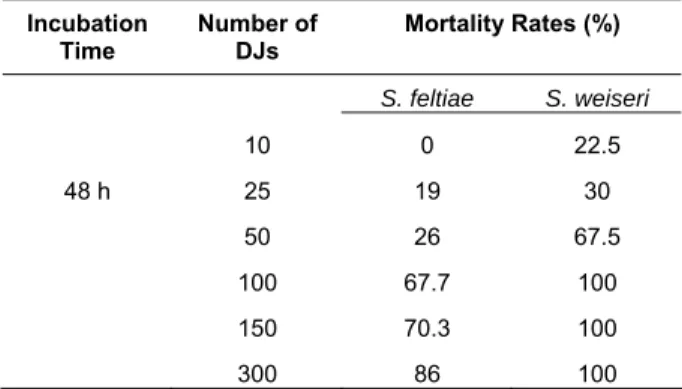
The results indicated that S. weiseri showed higher infectivity than S. feltiae for densities used in the study, especially at 10 DJs dose, although no infection caused by S. feltiae was detected, 22.5 % mortality by
S. weiseri was recorded (Table 1). LD50 values of S.
weiseri and S. feltiae were calculated as 25.68 and
80.70 DJs, respectively (Table 2). The reproductive experiments showed that the species of S. weiseri more productive than S. feltiae at the temperature and doses used in the study. It was found that the differences of reproduction rates between the both species were statistically significant at all temperatures and doses used in the study (Fig. 1. A, B and C).
Table 1. Mortality rates of Galleria mellonella larvae by
Steinernema feltiae and S. weiseri.
Incubation Time Number of DJs Mortality Rates (%) S. feltiae S. weiseri 10 0 22.5 48 h 25 19 30 50 26 67.5 100 67.7 100 150 70.3 100 300 86 100
Table 2. LD50 values of Steinernema feltiae and S. weiseri
calculated for Galleria mellonella larvae
Species Incubation Time (h) LD50
S. feltiae 48 80.70
S. weiseri 48 25.68
Especially, the differences at 10 ºC were detected statistically different at doses used (Fig. 1.A; F=768.63; df=5, 174; p=0.00). But the differences of reproduced juveniles at a dose of 50 DJs for S. weiseri and at a dose of 100 DJs for S. feltiae were not significant at the temperatures; 15 and 20 ºC (Fig. 1. B and C; F=348.87; df=5, 174; p=0.000 and F=571.54; df=5, 174; p=0.000, respectively). This result showed that S.
feltiae could reach the statistically same mortality level at the half of the dose for S. weiseri used. It was also expectedly observed that the rate of reproduction also increased, when the temperatures increased. Therefore, max. DJs were obtained as approximately the number of 35000 per larva at 20 ºC (Fig. 1. C).
Discussion
The biogeography of entomopathogenic nematodes was comprehensively assessed by Hominick et al. 1996. In the broader sense, they are widespread (Griffin et al. 1990). A large number of unknown species also exist in laboratories around the world (Hominick 2002). The first record coming from Turkey was S. feltiae, in terms of entomopathogenic nematodes. Then, H. bacteriophora (Kepenekçi et al. 1999) and then, S. feltiae and H. bacteriophora isolated in Ankara-Turkey were identified by cross-breeding and molecular technique, PCR-RFLP (Susurluk et al. 2001). S. anatoliense (Hazir et al. 2003) have been isolated during the surveys in Turkey. Hazir et al. (2003) reported S. feltiae has been isolated as most common species from 10 sites in 6 regions in
the most extensive survey study carried out in different regions of Turkey. The last record in Turkey, S. weiseri firstly reported for Europe by Mracek et al. 2003 from a road side with apple trees near Ceske Budejovice, Czech Republic (Mracek et al. 2003). Steinernema
weiseri was seen as the most similar to S. feltiae that
is the most prevalent species in the world. Present experiment is the first study on biological properties of
S. weiseri Turkish isolate.
Figure 1. Mean±SE of the reproduced number of S. feltiae and S. weiseri per G. mellonella larva at the following concentrations: 10, 50, and 100 DJs and at temperatures: 10 (A), 15 (B) and 20 ºC (C). Bars followed by the same letter are not significantly different from each other. (P<0.05).
SUSURLUK, A., “Comparison of some biological characterizations of the entomopathogenic nematodes, 343
Steinernema weiseri and S. feltiae (Rhabditida: Steinernematidae), isolated in Turkey”
S. weiseri and S. feltiae seem similar to each
other as recorded in Mracek et al. (2003) study. For this reason, the both nematode species were chosen in this experiment. Infectivity and temperature relations have been the subject in many studies. Temperature affects morphology, behavior and many biological processes in ecology. Biological control agents generally act more active at the temperature that is similar to where they were isolated from. Boff et al. (2000) studied on a reproduction examination of H.
megidis (strain NLH-E87.3) at different doses (10, 30, 100, 300, 1000 and 3000 DJs) and indicated that total production of the species nearly 28000 and 30000 DJ per larva at the doses of 10 and 100 DJs, respectively. But the present study, the both species S. feltiae and
S. weiseri were less productive than H. megidis at a
dose of 10 DJs and at the temperatures used, however, the production rate was similar at a dose of 100 DJs at the temperatures, although they might be statistically significant. However, Molyneux et al. (1983) stated that DJs of Heterorhabditis spp. were only able to reproduce in Lucilia cuprina larvae subjected to low dosages of DJs, whereas
Steinernema spp. were not able to reproduce at any
dosage. We found that S. feltiae and S. weiseri were able to reproduce on G. mellonella at all doses and temperatures. With the same agreement, Boff et al. (2000) indicated that H. megidis produced well at all doses. In addition to the differences of reproduction rate between two different species in the study, Susurluk (2005) reported that it can be even observed reproduction differences between in vivo and in vitro culture of the same species. The number of DJs emerged from the host cadaver does not always show the success of their biological control effort, establishment and persistence in applied area. But high numbers of DJs can create more chances to catch the potential hosts (Susurluk 2005). There are some LD50 studies of entomopathogenic nematodes, but the results vary very much. It was found that LD50= 80.70 and 25.68 DJs for S. feltiae and S. weiseri respectively, even the both species belong to same genus. But, for S. weiseri, 10, 25, 50 and 100 DJs of doses were accepted to Probit analyse. Since the doses of 150 and 300 had the same effect on mortality. Aguillera (1992) stated that LD50 of S. scapterisci to the pest Scapteriscus spp. was 4000 DJs, whereas the LD50 to a field cricket, Gryllus rubens, and the lubber grasshopper, Romalea guttata, was 1000 DJs. Akhurst (1982) found LD50 for S. kraussei as 16.5 DJs on G. mellonella. Bhatnagar et al. (2004) reported that lower
doses of H. bacteriophora were necessary to kill the host Maladera insanabilis (LD50= 14 DJs; after 72 hours). In addition to insect studies, infectivity of some entomopathogenic nematodes on tick, Boophilus
annulatus (Arachnida: Ixodidae) also was examined by
Samish and Glazer (1992). They used two strains of S.
carpocapsae and the results varied each other. LD50
and LD90 of S. carpocapsae “DT” were 15 and 165 DJs, respectively. However, for S. carpocapsae “All strain”, LD50= 372 and LD90= 9251 DJs. These results were agreement with the present study in this paper. LD value can vary largely even in same species. According to the LD50 values in present results, using of S. weiseri in biocontrol program might be more effective than S. feltiae isolated in Turkey.
References
Aguillera, M. M. 1992. Steinernema scapterisci Nguyen and Smart, 1990: Bacterial associates, cultures and pathogenicity. Dissertation to the Graduate Scholl of the University of Florida in Partial Fulfillment of the Required for the Degree of Doctor of Philisophy, Florida, USA:
Akhurst, R. J. 1982. A Xenorhabdus sp. (Eubacteriales: Enterobacteriaceae) symbiotically associated with
Steinernema kraussei (Nematoda: Steinernematidae). Revue Nematol. 5 (2): 227-280.
Bhatnagar, A., V. Shinde and S. S. Bareth. 2004. Evaluation of entomopathogenic nematodes against whitegrub,
Maladera insanabilis Brenske. Int. J. Pest Manag. 50 (4): 285-289.
Boff, M. I. C., G. L. Wiegers and P. H. Smits. 2000. The influence of storage temperature and time on infectivity and reproduction of Heterorhabditis megidis (strain NLH-E87.3). IOBC WPRS Bull. 23(2): 53-60.
Campbell, J. F. and R. Gaugler. 1993. Nictation behaviour and its ecological implications in the host search strategies of entomopathogenic nematodes (Heterorhabditidae and Steinernematidae). Behaviour. 126: (3-4).
Caroli, L., I. Glazer and R. Gaugler. 1996. Entomopathogenic nematode infectivity assay: comparison of penetration rate into different hosts. Biocontrol Sci. Technol. 6:227-233.
Ehlers, R. U. 1996. Current and future use of nematodes in biocontrol: practice and commercial aspects with regard to regulatory policy issues. Biocontrol Sci. Technol. 6: 303-316.
Fenton, A. and P. J. Hudson. 2002. Optimal infection strategies: should microparasites hedge their bets? Oikos. 96: 92-101.
Fenton, A. and S. A. Rands. 2004. Optimal parasite infection strategies: a state-dependent approach. Inter. J. Parasit. 34: 813-821.
Finney, D. J. 1971. Probit Analyse. Cambridge Univ. Press, London, England.
Gaugler, R. and H. K. Kaya. 1990. Entomopathogenic nematodes in biological control, CRC Press, Boca Raton, FL.
Gaugler, R. 1988. Ecological considerations in the biological control of the soil inhabiting insects with entomopathogenic nematodes. Agric. Ecosyst. Environ.
24: 351-360.
Gaugler, R. 2002. Entomopathogenic nematology. CABI Publishing, Wallingford, UK.
Griffin, C. T., M. J. Downes and W. Block. 1990. Tests of antarctic soils for insect parasitic nematodes. Antarct. Sci. 2: 221-222.
Hazır, S., S. P. Stock and N. Keskin. 2003. A new entomopathogenic nematode, Steinernema anatoliense n. sp. (Rhabditida: Steinernematidae), from Turkey. Syst. Parasitol. 55: 211-220.
Hominick, W. M. 2002. Biogeography Entomopathogenic nematology (ed R. Gaugler). CABI Publishing, Wallingford, UK.
Hominick, W. M., A. P. Reid, D. A. Bohan, B. R. Briscoe. 1996. Entomopathogenic nematodes: biodiversity, geographical distribution and the convention on biological diversity. Biocontrol Sci. Technol. 6: 317-331. Hominick, W. M., A. P. Reid, D. J. Hunt and B. R. Briscoe.
2000. Systematics and biogeography of entomopathogenic nematodes pp. 17-28. Ed.: Griffin, C. T., A. M. Burnell, M.J. Downes and R. Mulder. COST 819 Developments in Entomopathogenic Nematode/Bacterial Research. European Commission, DG XII, Luxembourg.
Hui, E. and J. M. Webster. 2000. Influence of insect larvae and seedling roots on the host-finding ability of
Steinernema feltiae (Nematoda: Steinernematidae). J. Invertebr. Pathol. 75: 152-162.
Kaya, H. K. and R. Gaugler. 1993. Entomopathogenic nematodes. Annu. Rev. Entomol. 38: 181-206.
Kepenekçi, İ., N. E. Barbaroğlu, G. Öztürk and S. Halıcı. 1999. Türkiye için yeni bir entomopatojen nematod;
Heterorhabditis bacteriophora Poinar 1976 (Rhabditida: Heterorhabditidae). Türkiye 4. Biyolojik Mücadele Kongresi Bildirileri, Entomoloji Derneği Yayınları: 9. Molyneux, A. S., R. A. Bedding and R. J. Akhurst. 1983.
Susceptibility of the sheep blowfly Lucilia cuprina to various Heterorhabditis spp., Neoplactana spp. and an undescribed steinernematid (Nematoda). J. Invertebr. Pathol. 42: 1-7.
Mracek, Z., D. Sturhan and A. Reid. 2003. Steinernema
weiseri n. sp. (Rhabditida, Steinernematidae), a new entomopathogenic nematode from Europe. Syst. Parasitol. 56: 37-47.
Nguyen, K. B., D. I. Shapiro-Ilan, R. J. Stuart, C. W. McCoy, R. R. James and B. Adams. 2004. Heterorhabditis
mexicano n. sp. (Heterorhabditidae: Rhabditida) from Tamaulipos, Mexico with morphological studies of bursa of Heterorhabditis spp. Nematol. 6: 231-244.
Özer, N., N. Keskin and Z. Kırbaş. 1995. Occurence of entomopathogenic nematodes (Steinernematidae: Heterorhabditidae) in Turkey. Nematologica 41: 639-640.
Phan, K. L., N. C. Nguyen and M. Moens. 2001a.
Steinernema sangi sp. n. (Rhabditidae, Steinernematidae) from Vietnam. Russ. J. Nematol. 9:1-17.
Phan, K. L., N. C. Nguyen and M. Moens. 2001b.
Steinernema loci sp. n. and Steinernema thanhi sp. n. (Rhabditidae, Steinernematidae) from Vietnam. Nematol. 3: 503-514.
Poinar, G. O. 1990. Biology and taxonomy of Steinernematidae and Heterorhabditidae. (R. gaugler and H. K. Kaya eds), Entomopathogenic nematodes in biological control, CRC Press, Boca Raton, FL, p. 23-58.
Qiu, L., Y.U. Fang, Y. Zou, Y. Pang and K. B. Nguyen. 2004.
Steinernema guangdongense sp. n. (Nematoda:
Steinernematidae), a new entomopathogenic nematode from southern China with a note on S. serratum (nomen nudum). Zootaxa 704: 1-20.
Samish, M. and I. Glazer. 1992. Infectivity of entomopathogenic nematodes (Steinernematidae and Heterorhabditide) to female ticks of Boophilus annulatus (Arachnida: Ixodidae). J. Med. Entomol. 29 (4): 614-618.
Statistica, 1991. Complete Statistical System by StatSoft, Inc. 2325 East 13th Street, Tulsa, OK.
Susurluk, A., I. Dix, E. Stackebrandt, O. Strauch, U. Wyss and R. U. Ehlers. 2001. Identification and ecological characterisation of three entomopathogenic nematode-bacterium complexes from Turkey. Nematol. 3 (8): 833-841.
Susurluk, I. A. 2005. Establishment and persistence of the entomopathogenic nematodes, Steinernema feltiae and
Heterorhabditis bacteriophora. Dissertation zur
Erlangung des Doktorgrades der Agrar-und Ernährungswissenschaftlichen Fakultät der Christian-Albrechts-Universität zu Kiel-Germany.
Wiesner, A. 1993. Die Induktion der Immunabwehr eines Insekts (Galleria mellonella, Lepidoptera) durch synthetische Materialien und arteigene Haemolymphfaktoren. PhD Thesis. Berlin.
İletişim Adresi:
Alper SUSURLUK
Turkish Ministry of Agriculture and Rural Affairs, Plant Quarantine Service, Department of Nematology, Liman Str. No: 11, 35230 Alsancak/İzmir-Turkey
Fax: + 90 232 463 0994