www.bjorl.org
Brazilian
Journal
of
OTORHINOLARYNGOLOGY
CASE
REPORT
Septorhinoplasty
in
sickle
cell
anemia:
a
case
report
夽
Rinosseptoplastia
em
anemia
falciforme:
relato
de
caso
Can
Alper
C
¸a˘
gıcı
a,∗,
Süheyl
Asma
b,
Mesut
¸ener
S
caGazipas¸aMahallesiBarajCaddesi,BaskentUniversityAdanaSeyhanHospital,OtorhinolaryngologyDepartment,Adana,Turkey bGazipas¸aMahallesiBarajCaddesi,BaskentUniversityAdanaSeyhanHospital,HematologyDepartment,Adana,Turkey cGazipas¸aMahallesiBarajCaddesi,BaskentUniversityAdanaSeyhanHospital,AnesthesiologyDepartment,Adana,Turkey
Received31May2016;accepted9August2016
Availableonline23August2016
Introduction
Sickle cell anemia is a hereditary disease caused by the presenceofhemoglobinS,anabnormaltypeofhemoglobin. Hemolyticandvaso-occlusivecrisesarethemain manifes-tationsofsicklecellanemia.1Deoxygenationofhemoglobin
S may result in intracellular hemoglobin polymerization, which changes the cell morphology and flexibility. The loss of red blood cell flexibility results in occlusion of thecapillariesandsubsequentvaso-occlusivecrises. Vaso-occlusive crises are experienced as severe pain attacks. Recurrentvaso-occlusivecrisesmayresultinstroke, renal dysfunction,pulmonary hypertension,retinaldisease, and avascular necrosis.1,2 Infection,hypoxia, dehydration,
aci-dosis, overexercise, psychological stress, trauma, cocaine use, cold exposure, and high altitude are the predispos-ingfactorstovaso-occlusivecrises.1 Mostof thesefactors
may be seen during general anesthesia and may be con-trolled by antibiotic prophylaxis, oxygenation, hydration, maintenanceofbodytemperature,andpostoperativepain
夽 Please cite this article as: C¸a˘gıcı CA, Asma S, S¸ener M.
Septorhinoplastyinsicklecellanemia:acasereport.BrazJ Otorhi-nolaryngol.2020;86:815---9.
∗Correspondingauthor.
E-mail:[email protected](C.A.C¸a˘gıcı).
PeerReviewundertheresponsibilityofAssociac¸ãoBrasileirade OtorrinolaringologiaeCirurgiaCérvico-Facial.
control.3---5 As withother types of estheticsurgery,
rhino-plastyisanelectiveprocedureandmightbeavoidedinthis high-riskpatientgroup.Thisprobablyexplainswhywefound noreportsonthistopicintheliterature.The currentcase is believed tobe the firstesthetic operation in apatient withsicklecellanemia,whichmakesanysurgicalprocedure requiringanesthesiaahigh-riskprocedure.
Case
report
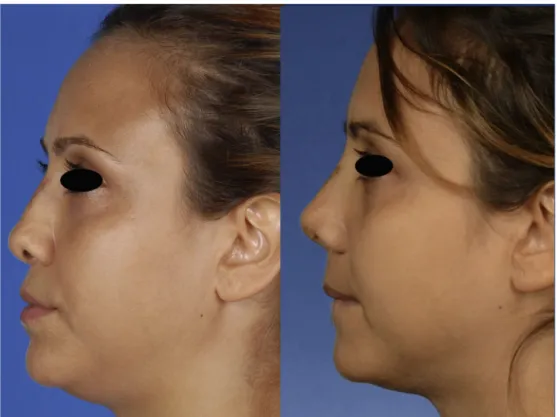
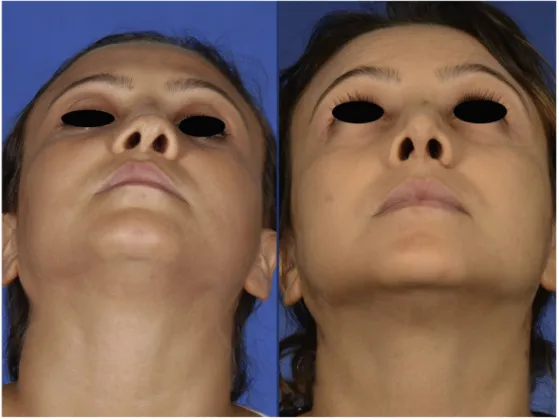
A29-year-oldwomanpresentedwithnasalobstruction.The septumwasdeviatedtotheleft.Herinternalvalvewas nar-row onthe left side. She desired to breathe throughthe noseeasilyandrequestedcorrectionoftheexternal defor-mity(Figs. 1---3) at the time of surgical correction of the septumdeviation.Shehadahistoryofseptoplastyandwas beingfollowedby thehematologydepartment becauseof sicklecellanemia.Thepatientprovidedwrittenpermission forthepublicationofherphotographs.
Laboratory examination revealed a serum sodium concentrationof138mEq/L,potassiumof4.81mEq/L, cal-ciumof9.19mg/dL,phosphorusof3.63mg/dL,bloodurea nitrogen of 10mg/dL, serum creatinine of 0.44mg/dL, and uric acid of 3.32mg/dL. The red cell count was 1.87×106mm3, white blood cell count was 5960mm3, hemoglobinconcentrationwas8.4g/dL,andhematocritwas 25.7%.Heractivatedpartialthromboplastintimewas<26s, prothrombintimewas13.8s,andinternationalnormalized
https://doi.org/10.1016/j.bjorl.2016.08.001
1808-8694/©2016Associac¸˜aoBrasileiradeOtorrinolaringologiaeCirurgiaC´ervico-Facial.PublishedbyElsevierEditoraLtda.Thisisanopen accessarticleundertheCCBYlicense(http://creativecommons.org/licenses/by/4.0/).
Figure1 Frontalviewofthepatient,preoperatively(left)and1monthpostoperatively(right).
Figure2 Lateralviewofthepatient,preoperatively(left)and1monthpostoperatively(right).
ratiowas1:1.Heraspartateaminotransferaseconcentration was 35IU/L, alanine aminotransferase was 20IU/L, alka-line phosphatase was 55IU/L, and ␥-glutamyltransferase was25IU/L.Herserumlacticdehydrogenaseconcentration washighat346IU/L(normalrange,90---240).HerC-reactive
proteinconcentrationwas<3mg/L,andhererythrocyte sed-imentationratewashighat61mm/h.
Thehematologydepartmentevaluatedthepatient pre-operatively. We administered two bags of erythrocyte suspension 3 days before surgery, and her hematocrit
Figure3 Basalviewofthepatient,preoperatively(left)and1monthpostoperatively(right).
and hemoglobinconcentrations increasedfrom 25.7% and 8.4g/dLto32.0%and11.0g/dL,respectively.Shewas eval-uated by the anesthesiology department and determined tohave an American Society of Anesthesiologistsphysical statusofII.
Weenteredtheseptumthroughatransfixionincision.The septumwasdeviatedtotheleft.WeobservedawideLstrut thathadbeenleftinplaceduringthepreviousseptoplasty. Althoughitwassufficientinwidth,theLstrutwasnotstrong enoughtosupportthedorsumandhadtobeenhanced.We tookcartilagegraftsfromtheseptum byliftingtheintact Lstrut,whichwas1cmwide.Weenhancedtheseptumby suturingthe cartilage graftsto theL strutfromthe right side.
The lower lateral cartilages were delivered from the infracartilaginousandintercartilaginousincisions.We per-formedminimalcephalicresectiononbothsides.Wesutured thedomesfromthecephalicsides.Thedomeswere approx-imatedbyinterdomalsutures.Werequiredacapandlateral cruralstrutgraftsanddecidedtotakethegraftsfromthe auricularcartilage.Wetookaconchalcartilagegraftfrom the right side. The donor side was closed primarily. The capgraftwassuturedtothetipusing5/0polyglycolicacid suture.Alateralcruralstrutgraftwasplacedundertheleft lowerlateralcartilage.
Weraspedthehumpandtheconvexityontherightnasal bone.The cartilageframeworkwasclosed using5---0 poly-dioxanone sutures. Two layers of crushed cartilage were placedonthesupra-tiparea.Alarbaseresectionwas per-formedontheleftside.Doylesplintswereintroducedinthe nasalpassages.Anexternalthermalnasalsplintwasapplied. Theoperationwasterminatedwithoutcomplication.
The septorhinoplasty procedure was performed under generalanesthesia.Wecloselyfollowedthepatient’s oxy-gensaturation,adecreaseinwhichmaytriggerasicklecell crisis.Theminimumoxygensaturationwas99%.Thepatient washeatedperioperativelywithapatient-warmingsystem. Wedidnotuseepinephrinetoavoidapossiblevaso-occlusive crisis,andweusedonly2% lidocainehydrochloride asthe localanesthetic.Additionally, wedidnotplaceanicebag ontheface,whichweroutinelyuseinpatientsundergoing rhinoplasty.
The postoperative period was uneventful without any majorhemorrhage. We didnot administer additional ery-throcytesuspension.Onpostoperativeday1,thehematocrit and hemoglobin concentration were 25.2% and 8.9g/dL, respectively.Therewerenocirculationproblemsinthenasal skin in either the early or late postoperative period. At thetime ofthis writing, the patientwasbreathing easily throughhernoseandwashappywithherexternal appear-ance(Figs.1---3).
Discussion
Septorhinoplastyisthemostfrequentlyperformedesthetic operation. However, there are no data in the literature aboutestheticsurgeryinpatientswithsicklecellanemia. Weperformed septorhinoplastyby a closedapproachin a patientwithsickle cell anemia, andthis case is believed tobethefirstestheticoperationinthispatientgroup.The closedapproachisourpreferenceforthisprocedure.
Hemoglobin S, which is less flexible than normal hemoglobin, causes occlusion of the capillaries and sub-sequent vaso-occlusive crises. A decreased hemoglobin S
ative blood transfusion lowers the risk of postoperative complicationsinpatientswithsicklecelldisease.6Patients
with sickle cell anemia may undergo either simple or exchangetransfusion.Insimpletransfusion,thehemoglobin level increases secondary to the blood transfusion. In exchangetransfusion, the hemoglobin S is removed from the patient’s blood and replaced by a blood transfusion fromahealthyindividual.Thegoaloftheexchange transfu-sionistodecreasethehemoglobinSconcentrationto<30%. Theexchangetransfusionhastheadvantagesofdecreasing thehemoglobin S level without increasingthe hematocrit and viscosity of blood.3 On the one hand, a Cochrane
reviewreportednodifferencebetweensimpleandexchange transfusionintermsofpreventingcomplicationsofsurgery or sickle cellanemia; however, the review’sevidence for this lack of difference was insufficient.7 On the other
hand,bloodtransfusionisassociatedwithseriouspotential complicationssuchastransmissionofinfection,iron over-load,andtransfusion reactions.7 Although the transfusion
maybeperformedwithin2weeksbeforesurgery,itshould beperformed24hbeforesurgerytomaintainahighoxygen transportcapacity.7
Thesicklingoferythrocytesinsicklecellanemiaresults invaso-occlusivecrises,whichmaycauseorgandamageand pain.Thesecrisesmaybetriggeredbyinfection,acidosis, trauma, cocaine use, exposure to cold, stress, dehydra-tion,andhypoxia.1 Mostofthese predisposingfactors for
vaso-occlusivecrisesmaybeseen duringgeneral anesthe-siaandmustbeavoided.Hypothermia,whichmayresultin sicklingoferythrocytes,shouldbeavoided.Thismaybe eas-ilyachievedbyheatingoftheoperationroomorpatient.3
Applicationof a cold packtothe face,which is routinely appliedpostoperativelyinrhinoplasty,mustalsobeavoided. Perioperativehydration of the patient is important, as is keepingthepatientwarm.Hypoxiamayalsotriggersickling. Generalanesthesiatemporarilylowers theoxygenlevelin theblood,whichcouldbedangerousforpatientswithsickle cellanemia.Therefore,theoxygensaturationmustalsobe closely monitored. Furthermore, some medications (e.g., decongestantssuchaspseudoephedrineorepinephrine)can causevasoconstriction and make it moredifficult for the sicklecellstomovefreelythroughthebloodvessels.Alocal anestheticsolutionthatdoesnotcontainepinephrineshould be used in patients with sickle cell anemia. With proper care,operations undergeneral anesthesiamaybe safein patientswithsicklecellanemia.Avoidanceofdehydration, alowbodytemperature,andoxygendesaturationaswellas theuseofa localanestheticsolutionwithoutepinephrine shouldbeensured.3 Alloftheseprecautionsarealsovalid
forestheticsurgery.
Physiologically, it is important to breathe through the nose. Nasal obstruction and breathing throughthe mouth isnot healthy, disturbsthequalityof thelife, andhas to becorrected.Septaldeviationisthemostfrequentlyseen etiologicalfactor ofnasal obstruction, which is corrected byseptoplasty.In thepresent case, thepatienthadweak septalcartilage that deviated caudally. We corrected the deviationandenhancedtheseptum usingcartilage grafts. The patient alsohad internal nasal valvecollapse, which servedasanothercauseofnasalobstruction.Herleftlower cartilagewashypoplasticandcorrectedwithalateral
cru-pocketunderthelateralcrustosupportthesidewall. Vis-ibilityofthecephalicedgeofthecartilagegraftmightbe apotentialdrawbackofthistechnique;however,itwasnot encounteredin thepresent case,andnasalbreathingwas successfullyachieved.
Whatis theimportance of estheticsurgery in patients with a chronic disease such as sickle cell anemia? Living withachronicdiseasecancauseanxietyandstress,which oftenleadstodepression.Aswithcosmetics,feelingmore attractive improves the patient’s mood, and feeling bet-terhelps thepatienttolivewiththe chronic diseaseand increasestheirqualityof life.Thisis especiallyimportant for patients with a chronic disease. Our patient did not seek pure esthetic rhinoplasty. We added esthetic rhino-plastytotheseptoplastyoperation.Beforethepresentcase, we would not normallyhave accepted a request for pure rhinoplastyfromapatientwithsicklecellanemia.Our per-spectivechangedafterseeingthatrhinoplastywaspossible inapatientwithsicklecellanemiawithproper periopera-tivecare,butwearestillundecided.Ononehand,esthetic surgeryiselectiveandshouldbeavoidedinhigh-riskpatient groups. Ontheother hand,webelievethatimproving the outlookofpatientsduringmanagementofchronicdiseases isasimportantastreatingthedisease.
Conclusion
With proper perioperative care, septorhinoplasty may be performedinpatientswithsicklecellanemia.
Ethical
approval
Thisarticledoesnotcontainanystudieswithhuman parti-cipantsperformedbyanyoftheauthors.
Informed
consent
Informedconsentwasobtainedfromthepatient.
Funding
Thisresearchdidnotreceiveanyspecificgrantfromfunding agenciesinthepublic,commercial,ornot-for-profitsectors.
Conflicts
of
interest
Theauthorsdeclarenoconflictsofinterest.
References
1.KaulDK,FabryME, NagelRL. Thepathophysiologyofvascular obstructioninthesicklesyndromes.BloodRev.1996;10:29---44.
2.ChienS.TheBenjaminW.ZweifachAwardLecture. Bloodcell deformabilityandinteractions:frommoleculesto micromechan-icsandmicrocirculation.MicrovascRes.1992;44:243---54.
3.Moutaouekkilel M, Najib A, Ajaja R, Arji M, SlaouiA. Heart valvesurgeryinpatientswithhomozygoussickle celldisease: amanagementstrategy.AnnCardAnaesth.2015;18:361---6.
4.MuroniM,LoiV,LionnetF,GirotR,HouryS.Prophylactic laparo-scopic cholecystectomy in adult sickle cell disease patients with cholelithiasis: a prospective cohort study. Int J Surg. 2015;22:62---6.
5.Bakri MH,Ismail EA,GhanemG, Shokry M.Spinal versus gen-eralanesthesiaforCesareansectioninpatientswithsicklecell anemia.KoreanJAnesthesiol.2015;68:469---75.
6.HowardJ,MalfroyM,LlewelynC,ChooL,HodgeR,JohnsonT, etal.Thetransfusionalternativespreoperativelyinsicklecell
disease(TAPS)study:arandomised,controlled,multicentre clin-icaltrial.Lancet.2013;381:930---8.
7.EstcourtLJ,FortinPM,TrivellaM,HopewellS.Preoperativeblood transfusionsforsicklecelldisease.CochraneDatabaseSystRev. 2016;4:CD003149.
8.Gunter JP,Friedman RM.Lateral cruralstrut graft: technique and clinical applications in rhinoplasty. Plast Reconstr Surg. 1997;99:943---52,discussion953-5.