
MNEs’ Location Strategies and Labor Standards: The Role of
Operating and Reputational Considerations Across Industries
Daniela Maggioni, Grazia D. Santangelo, and Seda Koymen-Ozer
Journal article (Accepted version*)
Please cite this article as
:
Maggioni, D., Santangelo, G. D., & Koymen-Ozer, S. (2019). MNEs’ Location Strategies and Labor Standards:
The Role of Operating and Reputational Considerations Across Industries. Journal of International Business
Studies, 50(6), 948-972. https://doi.org/10.1057/s41267-019-00231-x
This is a post-peer-review, pre-copyedit version of an article published in Journal of International Business
Studies
.
The final authenticated version is available online at:
DOI:
https://doi.org/10.1057/s41267-019-00231-x
* This version of the article has been accepted for publication and undergone full peer review but
has not been through the copyediting, typesetting, pagination and proofreading process, which may
lead to differences between this version and the publisher’s final version AKA Version of Record.
MNEs’ location strategies and labor standards
The role of operating and reputational considerations
across industries
Daniela Maggioni
Department of Economics Ca’ Foscari University of Venice
Cannaregio 873, Fondamenta San Giobbe, 30121 Venezia - Italy
Grazia D. Santangelo*
Department of Strategy and innovation Copenhagen Business School
Kilevej 14a, 2000 Frederiksberg, Copenhagen - Denmark
Seda Koymen Ozer
Department of Economics Baskent University
Fatih Sultan Mah. Eskisehir Yolu 18.km 06790, Etimesgut, Ankara - Turkey
Abstract
We investigate the role of local labor standards on MNEs’ location decisions across differ-ent sectors and sub-national regions within a developing country. We suggest that foreign investors adopt selective location strategies in connection with specific labor standards as a result of reputational and operating considerations. Foreign firms in more hazardous sec-tors prefer locations with higher occupational health and safety standards because they are more exposed to reputational risks. Those in sectors with less reversible investments prefer locations with lower degrees of unionization because their lower bargaining power increases their sensitivity to operating costs. We test our arguments across 26 sub-national Turkish re-gions over the period 2005-2011.
Keywords: Location choice, Labor standards, Reputational costs, Liability of foreignness,
Industry specificities
INTRODUCTION
The recent backlash against globalization has drawn attention to the costs versus the benefits of this phenomenon for, among others, workers (Contractor,2017). In addition to job losses, globalization skeptics often warn of pernicious effects on labor standards such as safe and health working conditions and unionization (Rodrik,2017).
A recurrent critique of multinational enterprises (MNEs) is that they select low- versus high-standard locations, favoring a competitive downward spiral of labor standards across developing countries, which traditionally are eager to attract FDI (Davies and Vadlaman-nati,2013). The great heterogeneity in the enforcement of national regulations across sub-national regions in these countries (Meyer and Nguyen,2005;Narula,2015) offers opportuni-ties to foreign investors to discriminate between locations, with potential detrimental effects on labor conditions and the within-country cross-region development divide.
This skepticism toward multinationals’ location decisions introduces uncertainty to the future viability and profitability of investments (Kobrin,2017), and forces MNEs to carefully evaluate labor standards across sub-national locations when making their location choices within developing countries. In particular, MNEs consider not only issues strictly related to their location-specific operations, but also the consequences that their location decisions may have on their corporate image and reputation.
Research on FDI and labor standards has explained MNEs’ location decisions mainly in terms of operating costs, productivity gains and benefits or additional revenues related to local human capital (e.g.,Javorcik and Spatareanu,2005;Gorg,2005;Olney,2013;Bhagwati,
2004;Brown et al.,2013). However, in the current phase of globalization and, in connection
with labor standards especially, MNEs, compared to domestic firms, increasingly face rep-utational costs, as a consequence of the widespread dislike and suspicion directed toward their operations, and, thus, strive to build reputation in order to gain legitimacy (Scherer and
Palazzo,2007). While reputational concerns have become central in MNEs’ location choices,
their importance compared to operating considerations varies across industries (Roberts
and Dowling,2002;Olney,2013). Yet, our knowledge on the role that reputational
labor standards, which involve different types of cost and benefit considerations, influence the location decisions of domestic and foreign firms across sectors within a developing coun-try, remains an open question.
Drawing on liability of foreignness (Zaheer, 1995) and industry specificities arguments
(Barham et al.,1998), we suggest that foreign firms tend to tailor their location decisions to
specific labor standards. To this end, we develop a framework that jointly accounts for firms’ ownership and industry characteristics. We argue that foreign firms in industries where work conditions are more hazardous are more likely to locate in sub-national regions with higher occupational health and safety conditions than their domestic industry peers and domestic and foreign firms active in less hazardous industries. Also, foreign firms in industries with lower relocation flexibility (i.e., lower investment reversibility) are less likely to locate in sub-national regions with higher degrees of unionization than their domestic industry peers and domestic and foreign firms active in industries with higher relocation flexibility. We explain this in terms of the relative importance of operating and reputational costs associated with distinct labor standards across different industries and ownerships. More specifically, haz-ardous industries’ work conditions draw media and non-governmental organizations’ (NGO) attention, and increase foreign firms’ sensitivity to the reputational costs associated with oc-cupational safety because foreign firms in these sectors are typically placed under the spot-light. Instead, limited industry relocation flexibility lowers foreign firms’ bargaining power and increases their sensitivity to the operating costs associated with the degree of workers’ unionization because foreign investors in these sectors have limited exit options.1
To test our arguments, we operationalize industries’ investment reversibility and haz-ardousness by exploiting the specificities of manufacturing and extractive sectors. We inves-tigate the location decisions of domestic and foreign plants across 26 sub-national Turkish regions over the period 2005-2011, relying on data from the Turkish Statistical Office (Turk-Stat). Turkey is an ideal test bed for our analysis. Despite the country’s rapid economic growth, it is still classified by theUnited Nations(2016) as a developing country, and is char-acterized by uneven institutional and economic development across sub-national regions
(Ozaslan et al.,2006). The country has also come under the spotlight of national and
inter-national media and NGOs for a number of fatal accidents related to poor health and safety working conditions as well as for violations of unionization rights.
Our study contributes to research on MNEs’ location choices by drawing attention to the non-economic drivers of these decisions. In particular, we suggest the relevance of reputa-tional, in addition to operating considerations, in MNEs’ location choices and identify spe-cific contingencies in terms of the nature of industries’ activities. The study also advances international business research by answering the call for a deeper understanding of MNEs’ responses to greater pressures for social responsibility and sustainability in their global op-erations (Buckley et al., 2017). Finally, we contribute to the debate on the specific role of labor standards in MNEs’ location decisions by pointing to the multidimensional nature of these standards and suggesting that firms adopt selective strategies in response to distinct standards.
THEORETICAL FRAMEWORK
The debate on labor standards and MNEs’ location choices
The determinants of firms’ location choice and FDI in particular have been traditionally investigated in terms of pure economic factors, institutions, industry agglomeration and, more recently, in connection with global cities (Dunning, 1998; Lamin and Livanis, 2013;
Myles Shaver and Flyer,2000; Chang and Park, 2005; Ma et al.,2013; for a review see e.g.,
Nielsen et al., 2017). The raising of societal expectations in terms of the respect shown by
business actors toward basic civil, social, and political rights (Scherer and Palazzo, 2007) have fueled an increasingly lively debate on workers’ rights and, especially, on labor stan-dards, as critical determinants of MNEs’ location decisions. Three closely related research gaps emerge from this debate.
First, there are conflicting arguments about the role labor standards play in MNEs’ loca-tion decisions. The central point of the debate is whether these decisions are driven by lower labor standards, which entail lower labor costs (e.g., Javorcik and Spatareanu, 2005; Gorg,
2005;Olney, 2013) or whether MNEs prefer locations with higher labor standards in order
to benefit from the associated higher labor productivity and human capital (e.g.,Bhagwati,
2004;Brown et al.,2013;Rodrik,1996;Kucera,2002;Berman et al.,2003).
la-bor standards, which arise either from greater lala-bor flexibility or lower employment protec-tion, or from the use of more productive workers due to more stringent labor protection. The debate seems to have so far missed reputational considerations related to labor standards. Poor labor standards in the host location allow a reduction of operating costs and maximiza-tion of firms’ output (Daly,1993), but they also expose firms to damage to their corporate image, raising reputational costs (Spar,1998); with negative consequences in terms of firms’ long-term profits (Artuso and McLarney,2015). These costs relate to the boycotting of prod-ucts and operations as a result of negative media coverage, and activists’ and NGOs’ cam-paigns. Wal-Mart’s global business, for instance, was severely impacted by negative media coverage and follow-up campaigns run by activists after a deadly fire in November 2012 in a Bangladeshi factory that supplied a supplier of the US retailer.2 At the same time, higher
labor standards in the host location may increase operating costs, but may also help the firm to build reputation locally.
Third, there are multiple dimensions of labor standards and some of these have been left out of the debate. In particular, occupational health and safety conditions and industrial relations are two distinctive issue categories identified by the International Labor Organi-zation (ILO) 1977 Tripartite Declaration, which provides direct guidance to enterprises on social policy and inclusive, responsible and sustainable workplace practices.3 Unionization, and occupational health and safety conditions are not necessarily positively associated with one to another, and high rates of occupational fatalities may be observed in locations where unions are strong (Morantz,2009) becasue unionized workers can be compensated for rela-tively poor occupational health and safety conditions by higher wage differentials (Duncan
and Stafford,1980;Bacow, 1982).4 This is especially the case in developing countries. The
uneven institutional and economic development across sub-national regions yields great heterogeneity across the two labor standards in developing countries, especially. Working conditions are traditionally determined by institutional frameworks that are enacted at the national level, but the enforcement of the law is usually delegated to local authorities, which are responsible for conducting administrative and safety inspections. While in developed countries local authorities traditionally ensure a more uniform compliance with national regulations, developing countries are often characterized by weak local law enforcement of working conditions (Boeri et al., 2008) due to poorly functioning sub-national institutions as well as a large informal sector (Peng et al.,2008;Meyer and Nguyen,2005;Narula,2015).
Also, the uneven economic, social and cultural conditions in these countries are reflected in the different propensities of workers to join local unions across sub-national locations.
We address these three closely related gaps to advance research on the role of workers’ rights and, specifically, of labor standards in MNEs’ location choices. To do so, we bring reputational considerations into the discussion and relate them to the nature of industries’ activities and firms’ ownership to explain the role of different labor standards in MNEs’ loca-tion decisions.
Bringing in reputational considerations
We suggest that reputational and operating considerations are associated with specific labor standards to differing extents.
Poor occupational health and safety conditions, which are reflected in high fatality rates, have a greater impact on firms’ reputational costs than on their operating costs (
Fernandez-Muniz et al.,2009). Occupational fatalities have massive repercussions in the MNE home
country as well as in the global context, and are less likely to be overlooked by the host coun-try media than disputes and conflicts with unions. For instance, between 2008 and 2010, Glencore, the Anglo-Swiss mining company, suffered dozens of fatalities and international media paid great attention to these accidents, which had drastic repercussions on the com-pany’s reputation. Similarly, the operations of Vedanta, a London-listed mining company with large Indian interests, come under heavy fire from protesters when 41 workers died in a single accident in September 2009 (Guardian,2011).
Unions typically negotiate wages and economic benefits (e.g., severance pay, holiday pay) in developing countries (Morantz,2009;Duncan and Stafford,1980;Bacow,1982), and tend to influence operating costs more than reputational costs. Disputes and conflicts with unions typically have limited media coverage by MNEs’ home country and global media, but in-crease operating costs in host developing countries, where the media coverage of these events is less extensive. The series of union protests (i.e. strikes, unrest and work slowdown) in the Indian automotive industry between 2009 and 2011 is a typical example. These protests dras-tically affected the productivity of local plants of large foreign corporations such as Honda, General Motors and Ford (Galib et al.,2011). The strike at the Honda Motorcycles and Scoot-ers Ltd. (HMSL) factory near Gurgaon in the Haryana state reduced production by nearly
50%. Demanding wage increases, nearly 800 workers at the Halol unit of General Motors India went on strike, forcing the company to stop production. At the Ford factory located near Chennai a 15-day strike due to a refused request to increase workers’ economic benefits harmed the multinational’s market share in India. At the same time, these unions’ protests had relatively limited coverage by global as well as Indian media.
Given the varying relevance of reputational and operating costs across different types of labor standards, we expect that occupational safety and unionization have different impacts on firms’ location decisions depending on firms’ sensitivity to operating and reputational considerations.
Ownership and industry specificities
Ownership and industry specificities are critical factors determining firms’ sensitivity to op-erating and reputational considerations.
Reputational costs associated with labor standards are typically more severe for foreign than domestic investors, which “are expected [..] to do more than local companies in build-ing their reputation and goodwill” (Kostova and Zaheer,1999). Foreign investors tend to be more in the spotlight due to their liability of foreignness in cases such as occupational ac-cidents and fatalities (Zaheer,1995). They have to face reputational costs in the home and international context as a result of negative spillover effects, as well as in the host country where their operations may be at risk (Kostova and Zaheer,1999;Spencer and Gomez,2011). In addition, foreign firms, compared to domestic industry peers, tend to be more sensitive to operating considerations associated with labor standards. Due to their liability of foreign-ness, foreign investors face greater challenges in acquiring the knowledge necessary to oper-ate locally compared to domestic firms, and are likely to face greoper-ater operating costs when, for example, meeting unions’ requests because of their more limited understanding of local industrial relationships.
The sensitivity of firms to operating and reputational costs also varies across industries depending on the extent to which industry activities are more or less hazardous and geo-graphically mobile (i.e. require more or less reversible investments) (Ederington et al.,2005;
Ottaviano and Pinelli,2006).
dangerous,5 such as the extractive industry. For firms in these sectors the reduction of the
reputational risks of local operations is a priority already at time of entry. Activities in these industries are hazardous for workers and tend to negatively affect the well-being and welfare of local communities. Thus, firms in hazardous industries need to provide evidence that they are minimizing their negative impact, and maximizing the social and economic development gains for the local community, while exploiting host country resources (Spence and Mulligan,
1995;Gifford et al.,2010;Santangelo,2018). Also, they are more exposed to negative spillovers
arising from the activities of co-located firms, which may not comply with labor regulations. Thus, firms in these sectors, compared to those in others, are more sensitive to reputational costs.
Firms in industries with lower investment reversibility are vulnerable to hold up by local stakeholders because, once the investment has been made, none or very little of it can be re-covered (Rivoli and Salorio,1996). For example, high dependence on natural resources and land drastically limits relocation flexibility. Thus, firms in these industries have lower bar-gaining power with local stakeholders and are forced to conduct a careful ex ante evaluation of the operating costs related to, in particular, local labor and environmental standards at time of entry, once the local endowment is controlled for (Tole and Koop, 2011;Duanmu,
2014). The extractive and agriculture sectors are typical examples of these types of indus-tries. In contrast, firms in industries with higher investment reversibility can relocate more easily. They can simply close down existing operations and move their activities to new lo-cations if operating costs in the current location become prohibitive. Location decisions in these industries are thus less binding as firms in these industries can easily exercise their exit options.
As a result, the relevance of distinctive labor standards for firms’ location decisions criti-cally depends on the firm’s sensitivity to reputational and operating costs, reflecting the in-terplay between the nature of industry activities and firm ownership.
HYPOTHESIS DEVELOPMENT
In the following we develop testable hypotheses on the role of occupational health and safety standards, and the degree of unionization as critical location determinants of new plants of
foreign and domestic firms across industries within a developing country.
Occupational health and safety standards
Foreign firms in more hazardous sectors are exposed to harsher public scrutiny than their do-mestic industry peers, especially in developing countries, because they suffer from a liability of foreignness. Although they have superior capabilities compared to their domestic indus-try peers, they are regarded as exploiters of domestic resources by local communities because their activity may have potentially damaging effects on social welfare (Spence and Mulligan,
1995;Baran,1957;Kapelus,2002;Santangelo,2018;Cotula et al.,2009). Due to weak
institu-tional conditions, the profit taxes and royalties that these firms pay to nainstitu-tional governments often fail to reach the local communities, who are the people that need them the most, and those that bear the highest health and safety costs associated with the exploitation of natural resources (van der Ploeg,2011;World Bank,2010). This skepticism about MNEs is reinforced by the questionable reputation for social responsibility that foreign firms in more hazardous sectors have in developing countries (Dowell et al.,2000). Allegations of environmental dis-asters, complicity in the violation of the human rights of local communities, and occupation fatalities due to poor labor standards are recurrent against these foreign firms (Collins and
Fleischman, 2013; GRAIN, 2012). As a consequence, foreign investors in more hazardous
sectors are expected to have human rights obligations to affected communities (Caplan and
Silva,2005;Cotula,2014) to a greater extent than their domestic peers. These expectations
require foreign firms to acquire legitimacy in the host country (Gifford et al.,2010;Moffat and
Zhang,2014). The decision to locate their plants in sub-national locations with higher
occu-pational health and safety standards is thus a strategy that helps foreign investors in more hazardous industries to signal a responsible conduct and gain a social license to operate.
The pro-humanitarian expectations on foreign firms in these industries expose the opera-tions of these firms to massive coverage by the global and local media and NGOs that closely watch the impact of these firms’ operations on local communities’ rights and development
(Spar,1998;Zaheer,1995;SIGWATCH,2016). This explains why foreign firms in more
haz-ardous sectors are typically more in the spotlight than their industry peers, and thus more sensitive to reputation. Also, unlike their domestic industry peers, foreign firms have to face reputational costs in the home and international context, as well as in the host country where their operations may be at risk (Kostova and Zaheer,1999;Spencer and Gomez,2011).
Repu-tation takes longer to build than to lose (Zhang and Luo,2013), and may be costly to restore. The greater media exposure of foreign versus domestic firms in more hazardous sectors in-creases the likelihood of negative media coverage associated with poor occupational health and safety standards, which severely damages the image of, and thus raises the reputational costs of foreign investors.
These reputational costs are sizeable when poor health and safety working conditions cause occupational deaths. Fatal accidents usually have larger repercussions than the in-fringements of other workers’ rights do and may also have relevant spillovers effects on co-located firms. In regions with low occupational safety, foreign firms in more hazardous sec-tors face potential reputational risks even if they implement high safety and occupational standards at their plants. First, they are likely to be exposed to negative reputation spillovers arising from accidents occurring in other firms in the region. These accidents generate neg-ative publicity for co-located foreign firms and especially for those in more hazardous indus-tries, which are under close scrutiny due to the nature of their activities. For instance, BP was not directly involved in the fatalities caused by the 2015 fire at Platform no.10 of the Gu-nashil oilfield operated by the Azerbaijani state oil company SOCAR, but, as it ran operations in the vicinity of the accident, the workers’ health and safety conditions of the British multi-national came under the spotlight of the media and NGOs (Reuters,2015). Second, firms in more hazardous sectors could face negative spillovers of reputational damage arising from poor occupational health and safety standards in the plants of local partners, and poor stan-dards of first- or second-tier suppliers for which they would be held accountable by the press. An illustrative example of this type of negative spillover of reputational damage are the fa-talities related to forced labor in Nestlé’s supply chain in Thailand, which spurred the Swiss company to commission and publicly share an investigation with an independent non-profit organization, and then confront the media on the investigation’s outcomes (Guardian,2015). Thus, the greater scrutiny foreign firms in more hazardous sectors are exposed to engenders higher reputational costs compared to those of their domestic industry peers.
Plants’ location in regions with low occupational health and safety standards also exposes foreign firms to potential reputational costs as a result of specific organizational and incen-tive structures. In particular, the headquarters (HQ) may not be able to fully control the occupational health and safety standards adopted at the subsidiary plant because of, for
in-stance, greater subsidiary autonomy or limited HQ-subsidiary communication (seeRabbiosi
and Santangelo,2018). If the subsidiary managers are evaluated on local profits, they might
be tempted to cut costs by relaxing health and safety standards in the attempt to increase their short-term performance within the multinational network at the expense of long-term reputational damage to the entire multinational. In regions with high health and safety oc-cupational standards foreign firms in more hazardous sectors can use local stakeholders to control operations in their own subsidiaries. While monitoring these standards might be difficult for the HQ due to the specific organization of HQ-subsidiary relationships in these regions, local authorities and/or NGOs may effectively take over part of the monitoring tasks. In addition, in these regions the lower regional incidence of occupational accidents reduces the expected costs associated with negative reputation spillovers due to the behavior of local actors. Based on these arguments, we posit:
Hypothesis 1: Foreign firms in more hazardous sectors are more likely to locate their plants in host sub-national regions with higher occupational health and safety standards than their domestic industry peers are.
Foreign firms in more hazardous sectors also face harsher public scrutiny than domes-tic and foreign firms in sectors where activities are less hazardous (Kapelus,2002). Workers in more hazardous industries are exposed to severe health risks, and the rates of death and injury in these sectors are traditionally high. Thus, reputational costs associated with poor health and safety occupational standards are more prohibitive for foreign firms in these sec-tors than for domestic and foreign firms in less hazardous secsec-tors due to the frequency and gravity of fatal events and labor rights violations that more hazardous sectors tend to record
(Patten,1992;Wesseling et al.,1995).
Being more in the spotlight, foreign firms in more hazardous sectors are exposed to a greater risk of damage to their corporate image in case of occupational fatalities than do-mestic and foreign firms in less hazardous industries. In addition, they suffer from a liability of foreignness compared to domestic firms in less hazardous sectors because they need to provide evidence that they have minimized the negative impact of their activity and have maximized social and development gains for local communities (Gifford et al.,2010;Fiedler
and Karlsson,2016). Thus, the impactful nature of activities in these sectors creates a greater
firms operating in sectors whose activities are less hazardous.
To avoid high reputational costs, foreign investors in more hazardous sectors are more likely than firms in less hazardous sectors to locate in sub-national regions with higher oc-cupational health and safety standards. They tend to avoid locations where media attention is typically greater and the reputational risks higher, to limit the risk of negative spillovers stemming from domestic industry peers’ and/or local suppliers and customers’ violations of health and safety standards. In contrast, in sub-national regions with higher occupational health and safety standards, negative reputational spillovers are less likely and foreign firms in more hazardous sectors have greater opportunities to acquire local legitimacy and gain a social license to operate. Therefore, we posit:
Hypothesis 2: Foreign firms in more hazardous sectors are more likely to locate their plants in host sub-national regions with higher occupational health and safety standards than (a) foreign and (b) domestic firms in less hazardous sectors are.
Degree of Unionization
Firms in sectors with lower investment reversibility have low bargaining power with local stakeholders, such as unions, because of their difficulties in relocating. In addition, foreign firms in these industries face a liability of foreignness (Zaheer,1995) because they lack knowl-edge of local industrial relations and are exposed to more compelling demands from local unions (Kostova and Zaheer,1999). Thus, they have to address the double challenge of lim-ited exit options as well as being outsiders. This disadvantage is especially severe in develop-ing countries. The lax institutional environment, the predominance of informal institutions and the uneven economic, social and cultural conditions in these contexts contribute to the heterogeneity of industrial relations across sub-national regions (Boeri et al., 2008). Such heterogeneity requires the acquisition of location-specific knowledge to effectively manage industrial relations and learn how to relate with local unions. Being outsiders, foreign firms in sectors with lower investment reversibility need to make greater investments than their domestic competitors to acquire this knowledge (Johanson and Vahlne,2009). At the same time, being perceived as outsiders, these foreign investors are exposed to more compelling demands from local stakeholders and to greater pressure from local trade unions compared to their domestic industry peers.
In sub-national regions where the degree of unionization is higher, local unions tend to be stronger, industrial relations are more complex, and negotiations more elaborated and on-going. Thus, when deciding upon the location of their plants across different regions within a developing country, foreign firms in sectors with lower investment reversibility evaluate the location’s degree of unionization more carefully than their domestic industry peers do because of their more limited knowledge of local industrial relations and their exposure to more demanding local requests, which in these sectors are hardly negotiable. As a result, they will select locations with lower degrees of unionization than their domestic industry peers do in order to limit the operating costs that their liability of foreignness together with their limited exit options yield. Based on this reasoning, we pose:
Hypothesis 3: Foreign firms in sectors with lower investment reversibility are less likely to locate their plants in host sub-national regions with higher degrees of unionization than their domestic industry peers are.
The limited relocation flexibility of foreign firms active in sectors with lower (versus higher) investment reversibility makes their location decisions more binding (Ederington et al.,2005). Investments in these sectors are site- and time-specific, and they also involve high transac-tion costs related to the acquisitransac-tion of informatransac-tion on, for example, the quality and quan-tity of natural resources, contract negotiations, operations establishment, and industrial re-lations (Barham et al., 1998; World Bank, 2010). Usually, investments in these industries take place in remote but resource-rich locations. As a result, the costs of the original in-vestments rise because of the need for supplementary infrastructure (e.g., railways), and the salvage value of the investments lowers when these infrastructures are sold by the investing company or by its competitors. Thus, the asset-specificity of investments, high transaction costs, remoteness, and price instability drastically affect the location decisions of these firms
(Barham et al.,1998), which need to carefully evaluate where to set up their plants from the
outset as their exit options are limited. Firms in sectors with lower (versus higher) invest-ment reversibility are more likely to avoid regions with a high degree of unionization when deciding where to locate their plants because their lower bargaining power increases their sensitivity to the demanding conditions that highly unionized workers may impose. In con-trast, foreign firms in sectors with higher investment reversibility enjoy a higher bargaining power at time of entry because exit is a viable option if the management of local industrial
relationships becomes too demanding. Thus, the lower relocation costs these firms face en-able them to locate in sub-national regions with higher degrees of unionization in order to gain and benefit from local legitimacy, and exploit the associated productivity advantages for their local operations (Gifford et al.,2010;Kostova and Zaheer,1999). They can then exploit these advantages while limiting the costs of highly unionized workers.
The same reasoning applies to domestic firms in sectors with higher investment reversibil-ity, which in addition will enjoy the advantage of being insiders and will not suffer from lia-bility of foreignness. In particular, domestic firms in these sectors have the necessary local knowledge to manage local industrial relations and typically receive less demanding requests because they are not perceived as exploiters of the local context. Based on this reasoning, we posit:
Hypothesis 4: Foreign firms in sectors with lower investment reversibility are less likely to locate their plants in host sub-national regions with higher degrees of unionization than (a) foreign and (b) domestic firms in sectors with higher investment reversibility are.
METHOD
Sectoral classification
To test our arguments, we identify industries which are characterized by different levels of investment reversibility and hazardousness based on the juxtaposition between the extrac-tive and manufacturing sectors.6 The choice to focus on these industries builds on extant research and is corroborated by several indicators we gathered from different data sources both at aggregate and firm level.
Extant work suggests that the extractive sector is more hazardous than the manufactur-ing sector, and manufacturmanufactur-ing enjoys higher investment reversibility than extractive. More specifically, ILO classifies non-manufacturing industries, and the extractive sector in particu-lar, as more hazardous. Furthermore, existing research has identified manufacturing as being less dependent on natural resources, and thus a sector with higher investment reversibility
(Ottaviano and Pinelli,2006). The extractive sector, instead, is highly dependent on
relocation flexibility, forcing extractive firms to conduct a careful ex ante evaluation of the operating costs related to, for example, local labor and environmental standards, once the local natural resource endowment is controlled for (Tole and Koop,2011;Duanmu,2014).
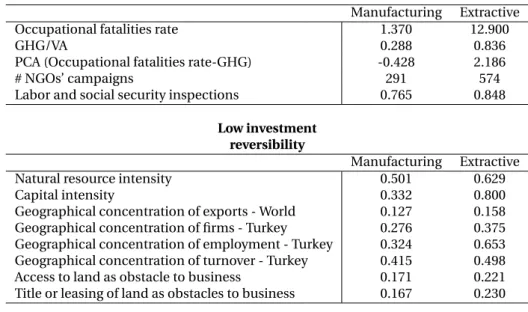
Data from different sources and levels of aggregation also corroborates this juxtaposition, as illustrated in Table1.
[Table1about here]
In the upper panel of the table, Eurostat data on the number of occupational fatalities per 100,000 employees for EU287 confirms the more hazardousness nature of extractive com-pared to manufacturing industries, with the extractive sector recording a significantly higher rate of occupational fatalities. Extractive activity also displays a larger amount of greenhouse gas emissions per unit of value added (GHG/VA). This evidence is confirmed when consid-ering a synthetic indicator obtained by means of a principal component analysis of the two indicators above (PCA), which we use as a proxy for industry’s hazardousness in our empirical analysis.8 The higher hazardousness of the extractive sector is also reflected in harsher public
scrutiny. Extractive firms are more in the spotlight of media and NGOs than manufacturing firms are, as the number of NGO campaigns by sector across the world illustrates (source: SIGWATCH9). The higher probability of facing NGO campaigns increases the potential rep-utational risk extractive firms are exposed to. Finally, extractive compared to manufacturing firms have a higher probability of undergoing labor and social security (e.g., fire and build-ing safety, sanitation and compliance with environmental regulations) inspections (source: Business Environment and Enterprise Performance Surveys- BEEPS).10 BEEPS data shows that in the countries surveyed, 85% of extractive firms undergo these inspections, compared with 77% of manufacturing firms.
In the lower panel of the table, the indicators reported in the lower panel of Table 111
confirm that activities in the extractive sector require less reversible investment. The UNC-TAD indicator of the natural resource intensity of products12shows that extractive activities depend more on land endowment than manufacturing activities do. Based on EUKLEMS industry data for European countries, the extractive sector also presents higher capital in-tensity (measured as the industry’s ratio between capital compensation and value added). This evidence suggests the need for firms active in this sector to undertake a larger amount of investments, which proxy for the higher incidence of sunk costs that reduce a firm’s ease
of relocation. The lower investment reversibility of the extractive sector is also reflected in a higher spatial concentration, as illustrated by the Herfindahl index of export concentra-tion across countries (source: BACI dataset) than that of the manufacturing sector.13Similar evidence on spatial concentration was retrieved from TurkStat Structural Business Statistics (SBS) firm-level data, which shows a higher regional concentration in terms of number of firms, employment and turnover in the extractive sector compared to manufacturing.14 Fi-nally, BEEPS firm-level data shows that a higher percentage of extractive compared to man-ufacturing firms perceive access to land as well as the title and leasing of land as major ob-stacles for the operation and growth of their business. This evidence further supports the argument for the higher location dependence of extractive firms.
Extant research and the above evidence make us confident about our decision to jux-tapose extractive firms as our benchmark for a sector which is more hazardous and en-joys lower investment reversibility, with manufacturing firms as our benchmark for a sector which is less hazardous and enjoys higher investment reversibility.
Context of the Study
We frame our study in Turkey over the period 2006-2011. The country is an excellent labora-tory for our analysis because it provides substantial sub-national variation in our explanalabora-tory variables.
Like other developing countries, Turkey is characterized by weak local law enforcement of working conditions (Boeri et al.,2008). In all sectors, health and safety inspections in the country are divided between different authorities, and although many EU directives’ health and safety standards have been translated into Turkish, they have not yet been harmonized with local regulations, leading to confusion (The Telegraph, 2014).15 Furthermore, Turkey
has restrictive legislation on trade unions, and in 2015 the ILO’s Committee of Freedom of Association officially reiterated to the Turkish government to amend its current labor leg-islation (case no. 3084). Despite the poor legleg-islation, trade unions are active in both the manufacturing and extractive sectors, but their roles vary across regions.
Over the period of our analysis, both the Turkish extractive and manufacturing sectors attracted substantial amounts of FDI, with a stock increase of 54% in the extractive sector, and 41% in manufacturing (Turkish Ministry of Economy, 2014). In Turkey, firms in both
sectors face a number of challenges in terms of labor standards, and compliance with them has followed a divergent evolution across the two sectors. The extractive sector has recently been in the spotlight of national, international media and NGOs for its poor labor health and safety conditions and violation of unionization rights. The number of occupational injuries and work-related diseases in the sector recorded an increase of about 37% from 2006 to 2011, and is still very high. After the accident in the Soma coal mine, which killed over 300 people and injured nearly 100 in 2014, the Turkish government ratified the ILO Safety and Health in Mining Convention in 2015 under increasing pressure from civil society, NGOs and ILO. Despite this important step, safety is still an issue in the sector due to the lax enforcement of existing regulations and the existence of important territorial differences in the compliance with them. In contrast, the manufacturing sector has recorded a 31% decrease of occupa-tional fatalities (source: Social Security Institution, Sosyal Guvenlik Kurumu). This divergent evolution reveals the differing conditions faced by potential entrants to different sectors.
By focusing on the period prior to the ratification of the 2015 ILO Safety and Health in Mines Convention, and the 2015 reiteration of the Committee of Freedom of Association’s request to the Turkish government to conform the country’s legislation to the ILO 87 and 98 Conventions, we are able to investigate whether the country’s lack of respect for labor rights, allowed by lax regulations, represented and could represent either an incentive or a deterrent as an MNE location, and has had a different influence in the extractive compared to the manufacturing sector. In addition, in terms of extractive plant locations, the richness of mineral resources across the Turkish territory offers different location options to extractive firms. Finally, the focus on a single country enables us to hold constant a number of country-level unobservable factors such as gender inequality, which is among the issues listed in the ILO Tripartite Declaration, and national labor market regulations.
Data and Sample
To test our hypotheses, we use data from the TurkStat SBS database, which records plant-level information of firms with more than 20 employees operating in both sectors. Foreign plants are defined as those belonging to firms with more than 10% of foreign capital share, based on the IMF definition of FDI. We consider all new plants which were created during the period 2006-2011, and retrieve information on a number of location determinants at regional level for the period 2005-2010 from different statistical sources. To identify sub-national
re-gions, we draw on the Nomenclature of Territorial Units of Statistics (NUTS) by Eurostat and focus on 26 NUTS2-level administrative regions. Ultimately, in the period under analysis we were able to identify 125 new plants in the extractive sector, belonging to 52 foreign firms; 2,176 new extractive plants belonging to 953 domestic firms; 1,873 new manufacturing plants belonging to 771 foreign firms; and 27,520 new manufacturing plants belonging to 15,166 do-mestic firms.
Variables
Our dependent variable (new_plant) is a binary variable equal to 1 for the region where the new plant is located in year t, and to 0 for all the remaining regions. Foreign extractive plants are spread across 22 of the 26 regions, while the other three groups (i.e., domestic extractive, foreign and domestic manufacturing) cover the whole national territory. Substantial cross-regional variation is then available for meaningful analysis of FDI determinants across both sectors’ and firms’ ownership.
To measure the occupational health and safety standards of Turkish regions, we use a re-scaled measure of the occurrence of occupational fatalities in the region. More specifically, we first compute the yearly rate of occupational fatalities as the number of work-related deaths over thousands of workers employed in the region in any sector of activity (source: Turkish Social Security Institution). We then re-scale this measure by taking for each region-year dyad the difference between the maximum rate of occupational fatalities recorded in Turkey over the period under analysis and the rate of occupational fatalities recorded in the region-year. We thus obtain a proxy of occupational health and safety standards that takes higher (lower) values in regions experiencing a lower (higher) rate of occupational fatalities (sa f etyr t−1).16
We measure the degree of unionization in each region (unionr t−1) using the regional share
of unionized workers over the total regional employment (source: Turkish Ministry of Labor and Social Security). For both types of labor standards, we consider aggregated region-level rather than region-industry specific measures. In regions which record a high rate of occupa-tional fatalities, stakeholders’ scrutiny tends to be stronger and any accident may negatively affect and engender high reputational costs to all co-located firms regardless of the indus-try where the event occurred. In particular, negative externalities may originate through
value-chain linkages with local partners adopting poor labor health and safety standards. Also, irrespective of the sector, strong regional trade unions reflect a strong local unioniza-tion culture, which may favor the development of new workers’ organizaunioniza-tions and stronger bargaining power across established unions and newly created organizations as a result of local imitative behaviors and synergies.
To account for firm ownership and industry, which are the firm-level characteristics mod-erating the role of labor standards in the firm’s plant location decision, we use two binary variables: f orittakes a value of 1 for foreign-owned firms and 0 for domestic firms; extrit takes
a value of 1 for extractive firms and 0 for manufacturing firms.
To single out the importance of occupational health and safety standards and union-ization, based on the literature on location choices in manufacturing (for a review see e.g.
Nielsen et al.,2017) together with some recent contributions on the extractive sector (Tole
and Koop, 2011; Duanmu, 2014), we estimate a single model for both sectors, including a
large set of determinants, which may be either common conditions affecting the profitability of any kind of activity across the two sectors, or sector-specific factors, such as the regional natural resources endowment, influencing the location decisions of extractive firms. This comprehensive strategy also helps limit omitted variable bias. In particular, we control for the following region-specific location determinants:
i) Regional labor market conditions. We proxy labor costs with the region-level average wage paid by firms active in the sector, wager t−1 (source: SBS data).17 We also control
for the regional unemployment rate, unemploymentr t−1(source: Turkstat), which could
reflect both a higher labor supply and higher local labor market rigidity.
ii) Regional demand conditions. We consider the size of the internal market by means of the regional gross value added (GVAr t−1), and the access to foreign markets by means
of regional trade openness (trade_openr t−1), computed as the sum of regional exports
and imports over production (source: TurkStat).
iii) Regional technological conditions and human capital endowment. We account for the cumulated regional experience in the sector of activity with the existing 2-digit sectoral production (production2d
r t−1) (source: TurkStat Annual Production database). For the
resources.18 We also control for regional sectoral specialization by using the revealed
comparative advantage index (RCA2d
r t−1) (source: TurkStat Foreign Trade Statistics) and
we include the gross value added per capita (GVA_pcr t−1) as a more general
indica-tor of regional productivity and technology endowment. Regional human capital en-dowment is proxied by the share of the labor force with at least secondary education, sh_educationr t−1(source: TurkStat).
iv) Regional market structure and supply conditions. We include the regional number of plants active in the 2-digit sector, split between domestic (dom_plants2d
r t−1) and foreign
plants ( f or_plants2d
r t−1) (source: Turkstat SBS), to control for the degree of competition
as well as expectations of higher profits or Marshallian externalities.
v) Quality of regional business and natural environment. The political risk of undertaking an economic activity in the region is accounted for by the occurrence of terrorist attacks over the last three years (source: Global Terrorism database) (terror_attacksr t−1). We
capture potential local requests for a social license to operate with the regional number of non-profit organizations (NPO) per capita, NPOr t−1(source: Department of
Associ-ation of the Turkish Ministry of Interior). Infrastructural quality is proxied by the total length of provincial roads and highways crossing the region normalized by the regional surface, roadsr t−1 (source: Turkstat). We also test for local environmental stringency
using the municipalities’ investments in wastewater, wastewatermunicipalr t−1 (source: Turk-Stat), and control for natural risks with the occurrence of natural disasters in the region over the past three years, natural_disastersr t−1(source: International Disaster Database
of the Centre for Research on Epidemiology of Disasters).
In addition to these region-level controls, we include the number of plants in region r be-longing to firm i (plantsir t−1) to account for the firm’s experience in the region. We add five
geographical macro-region dummies to control for any further unobserved regional time-invariant condition.19Table2reports the correlation matrix and descriptive statistics. GVA_pc presents a fairly high correlation with a number of other controls. To assess the robustness of our results to collinearity, we ran our baseline model excluding GVA_pc and had our re-sults confirmed. Also, the mean value of the variance inflation factors equals 3.22, suggesting collinearity is not an issue.
Empirical Model
We estimate the location choice of firms with a conditional logit analysis (McFadden,1984), which models the decision of firm i to locate a new plant in region r at time t, with r=1,.., 26 and t=2006,..., 2011. Following the literature on location choice (Carlton, 1983; Bartik,
1985;Devereux et al.,2007), equation1illustrates the location choice function we estimate
in terms of profits, although our theory is based on costs:
Pr(FDIirt = 1) = Pr(πirt> πikt) r6= k and r, k = 1, .., 26 (1)
where πirt(πikt) represents the profit of firm i associated with the location of a new plant in
region r (region k). This profit function can be expressed as follows:
πirt= β sa f etyrt−1+ βFsa f etyrt−1∗ f orit+ βEsa f etyrt−1∗ extrit+
+βFEsa f etyrt−1∗ f orit∗ extrit+ δ unionrt−1+ δFunionrt−1∗ f orit+
+δEunionrt−1∗ extrit+ δFEunionrt−1∗ f orit∗ extrit+ γXrt−1+ χZirt−1+ εirt
(2)
where superscript F indicates foreign and E extractive. We model the profits a firm can obtain from the location in region r as a function of the regional degree of unionization (unionr t−1) and the rate of occupational health and safety standards (sa f etyr t−1). To test
whether these effects differ across firms’ ownership and sectors, we include a full set of the interactions of our measures of labor standards with the dummy variables denoting foreign ownership ( f or) and extractive (versus manufacturing) sector (extr), as well as the two triple interaction terms sa f ety* f or*extr and union* f or*extr.20These two interactions reveal the joint role of ownership and industry in moderating the impact of labor standards on firms’ loca-tion decisions. The model in equaloca-tion2gives us the flexibility to allow for the different roles played by unionization and occupational safety depending not only on firms’ ownership and industry of activity, but also on their combination. We thus derive a heterogeneous effect for each labor standard across groups of firms that have different sensitivity to reputational and operating costs due to their ownership and sector of activity.
The model also includes location-specific characteristics (Xr t−1), and firm-region specific
factors (Zir t−1). It accounts for plant-specific unobserved heterogeneity by means of
ex-planatory variables are time-variant within the period 2005-2010 and refer to the one-year lag from the year of entry in order to account for simultaneity issues. As we control for macro-region fixed effects, the role of local labor standards is identified by exploiting time-macro-region variations of variables within macro-regions. To account for firms’ multiple entries with dif-ferent plants in the same region, either in one specific year or in difdif-ferent years, we cluster standard errors by firm.
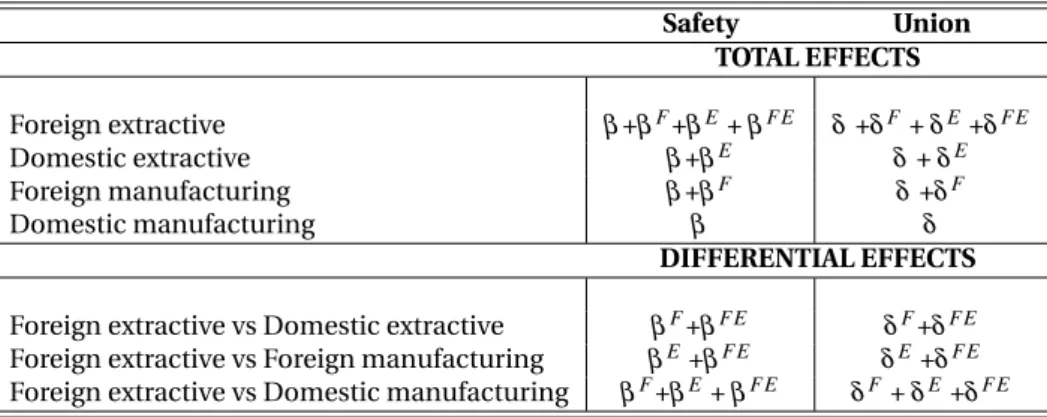
To obtain the total and differential effects of occupational health and safety standards, and the degree to which unionization affects the plant location decisions of the four groups of firms identified based on ownership and industry, we compute the linear combinations of the coefficients obtained from the estimation of equation1, as illustrated in Table3. The test of our hypotheses rests on the differences in the effects across firm groupings (lower panel in Table3).21
[Table3about here]
RESULTS
Table4reports the results of the conditional logit estimations. In columns 1 and 2, our inde-pendent variables are tested one-by-one. Column 3 reports the full model, where the controls yield results consistent with extant research.
[Table4about here]
Table5reports the total effects of regional occupational health and safety standards, and the degree of unionization in the plant locations of the different groups of firms (upper panel) and the differential effects across groups (lower panel) for all the three models in Table4.
[Table5about here]
In the full model, the total effects reported in column 3 of the upper panel of Table 5
show that foreign extractive firms are more likely to locate in regions with higher occupa-tional health and safety standards, and less likely to locate in regions with a higher degree of unionization. The plant location of domestic extractive firms is not affected by regional occupational health and safety standards, and is deterred by high regional degrees of
union-ization. Occupational health and safety standards seem not to influence the location de-cisions of manufacturing firms regardless of firm ownership. Foreign manufacturing firms tend to locate more in regions with a higher degree of unionization. In contrast, unioniza-tion does not significantly influence the locaunioniza-tion decisions of domestic manufacturing firms. The magnitude of the effects does not substantially differ across the three columns of Table5, thus corroborating the argument that high degrees of unionization, and occupational health and safety standards are not associated in developing countries (Duncan and Stafford,1980;
Bacow,1982).
Our hypotheses are tested in the lower panel of Table5.
Occupational safety turns out to be more relevant for the location of plants of foreign ex-tractive firms compared to the plant locations of domestic industry peers (the difference is significant at p=0.029).22We thus find that in highly hazardous industries, such as extractive,
occupational safety is a significant location determinant, and is more important for MNEs than domestic firms. Hypothesis 1 is supported. Also, foreign extractive firms are more likely to locate their new plants in regions with higher occupational health and safety standards compared to both domestic and foreign manufacturing firms (the differences are significant at p=0.028 and 0.056, respectively). This finding corroborates the argument that the rele-vance of occupational safety as a location factor is greater for foreign firms in more (versus less) hazardous industries. Hypotheses 2a and b are supported. Specifically, our results show a slightly lower significance for the comparison between foreign extractive vs domestic man-ufacturing firms (Hypothesis 2b) than for the comparison of foreign extractive with the other two groups of firms (Hypotheses 1 and 2a). These results speak for the argument that foreign firms are more in the spotlight than domestic firms because of their liability of foreignness. They are also more in the spotlight than domestic and foreign firms in less hazardous sectors because of the impactful nature of their activities.
As for unionization, foreign extractive firms are more significantly deterred by high de-grees of unionization compared to their domestic industry peers (difference significant at p=0.015). Thus, in industries with lower investment reversibility, unionization matters more for the location of MNEs than for domestic firms because foreign investors lack knowledge of local industrial relationships and are exposed to more demanding requests by local unions due to their lower bargaining power. Hypothesis 3 is supported. Foreign extractive plants
are also less likely to be located in regions with higher degrees of unionization than both do-mestic and foreign manufacturing plants are (the differences are significant at p=0.000 and 0.003, respectively). Thus, firms in industries with lower relocation flexibility tend to avoid locations with high degrees of unionization, which may turn in high operating costs. Hy-potheses 4a and b are supported. Specifically, these two hyHy-potheses are verified at a higher level of significance than Hypothesis 3.
Identification of the mechanisms
In our theoretical framework, we suggest that, compared to manufacturing, i) the more haz-ardous work conditions in the extractive sector make firms in this industry more sensitive to reputational considerations associated with local labor standards; and ii) the lower in-vestment reversibility of extractive firms’ activities reduces their bargaining power with lo-cal stakeholders, thus making them more sensitive at time of entry to operating consider-ations associated with local labor standards. The higher hazardousness of extractive activ-ities would then explain the greater positive role of occupational safety, which raises im-portant reputational issues, and the lower investment reversibility of extractive activities would explain the higher deterrent effect of unionization, which engenders relevant operat-ing costs. However, as the extractive sector is both more hazardous and has lower investment reversibility, the role of labor standards across sectors needs further investigations to single out the mechanisms we theorized (i.e., hazardousness driving the role of occupational safety and investment reversibility driving the role of unionization). Thus, we undertake further analyses aimed to corroborate our arguments related to industry specificities.
By exploiting the heterogeneity within the manufacturing sector, we classify manufac-turing firms into two groups. The first group consists of manufacmanufac-turing firms operating in sectors that are more hazardous and with higher investment reversibility. These would be more similar to extractive firms in the relevance they attach to reputational considerations and, thus, more inclined to locate where occupational health and safety standards are higher. They would differ from extractive firms in their sensitivity to operating considerations, and thus more inclined to locate where the degree of unionization is higher. The second group consists of manufacturing firms in a sector which is less hazardous and with lower invest-ment reversibility. These firms would differ from extractive firms in the relevance they attach to reputational considerations and, thus, less inclined to locate where occupational health
and safety standards are higher. However, they would be more similar to extractive firms in their sensitivity to operating considerations, and thus less inclined to locate where the degree of unionization is higher.23
To classify manufacturing firms based on their degree of hazardousness, we rely on the ILO definition of hazardous industries and consider the danger and environmental impact of these sectors. In particular, among the indicators we report in Table 1, we use the syn-thetic indicator PCA. We employ this indicator at a disaggregated level24rather than for the whole manufacturing sector as in Table1. Based on this indicator, we classify manufacturing sectors as more hazardous if they score above the median of the sectors in the sample and as less hazardous if they score below the median. In a similar way, to classify manufacturing sectors as sectors with greater or lower investment reversibility, we use the UNCTAD indica-tor on the natural resource intensity of products reported in Table1and take the median for each manufacturing sector we study. We then classify manufacturing sectors as sectors with lower investment reversibility if this measure is above the sample median of sectors, and as sectors with higher investment reversibility if it is below the median. Based on these two classifications, we group manufacturing firms into two mutually exclusive groups: group 1 if they are classified as sectors both more hazardous and with higher investment reversibility,25 and group 2 if they are classified as less hazardous and with lower investment reversibility.26
We then re-estimate the model in equation1by first considering the sample of extractive firms together with manufacturing firms in group 1, and then the sample of extractive firms together with manufacturing firms in group 2.27 In both cases, we compute the
differen-tial effects of occupational health and safety standards, and degree of unionization, on the location decisions across groups of firms in different sectors, as illustrated in Table6.
[Table6about here]
As for the role of occupational health and safety standards, the differences between for-eign extractive firms and (forfor-eign and domestic) manufacturing firms in group 2 (column 2) are larger than the differences between foreign extractive firms and (foreign and domestic) manufacturing firms in group 1 (column 1). Also, the differences in column 2 are statistically significant, while the differences in column 1 are either non-significant when comparing for-eign extractive with forfor-eign manufacturing firms, or marginally significant when comparing foreign extractive with domestic manufacturing firms. We thus corroborate our argument
that the hazardous nature of an industry’s activities, and the associated sensitivity to rep-utational considerations, affect the relative importance of occupational health and safety standards for plant location.
In relation to the role of the degree of unionization, we find that the differences in the effect of unionization are higher when extractive firms are compared to (foreign and domes-tic) manufacturing firms in group 1 (column 1), than when they are compared to (foreign and domestic) manufacturing firms in group 2 (column 2). Thus, we find confirmation for our ar-gument that the investment reversibility nature of an industry’s activities, and the associated sensitivity to operating considerations, affect the importance of the degree of unionization for plant location.28
In sum, firms in more hazardous industries are more sensitive at time of entry to labor standards, which raise reputational considerations, and firms in sectors with lower invest-ment reversibility are more sensitive at time of entry to labor standards, which raise operat-ing considerations.
To further support the identification of the mechanisms, we replicate the identification analysis by first classifying manufacturing sectors on the basis of each industry’s hazardous-ness without considering investment reversibility, and then by classifying them on the basis of investment reversibility without considering hazardousness. This analysis confirmed the mechanisms we suggested.29
Robustness tests
To validate our findings, we ran a number of robustness tests and all these alternative esti-mations confirmed our main results.30
First, in different sets of estimations of equation1we tested for the presence of an omit-ted variable bias by adding further varying regional covariates and we captured time-invariant regional heterogeneity by controlling for NUTS 2-region dummies. Region dum-mies also absorbed the influence of differences in the mineral endowment, which can be considered time-invariant, especially when focusing on a limited time-span as in our anal-ysis. The inclusion of NUTS2 fixed effects also helped removing any potential bias associ-ated with the violation of the independence of irrelevant alternatives (IIA) assumption in the baseline model (Hilber and Voicu,2010;Defever,2012).
In a second set of estimations we checked the robustness of our results against alternative sample definitions in terms of sample composition and size. In particular, to rule out the possibility that the large size of our sample biased our results upward and confirm that our results were effectively driven by firm heterogeneity in terms of industry and ownership, in a robustness check we focused on a smaller sample by implementing a single nearest-neighbor propensity score matching.
In a third set of estimations, we changed our empirical strategy and estimated separate models for the four groups of firms and tested the existence of a significant difference in the effects associated with labor standards across groups.
In a further set of estimations, we sought to address potential reverse causality biases as FDI inflows may impact on occupational health and safety standards, and degree of union-ization. We, thus, ran additional estimations, where we included the relevance of foreign production in each region in the extractive and manufacturing sectors as well as the total foreign production in each region. The results we obtained show a significant and positive effect associated with foreign output shares, and corroborate our main findings.
Finally, we estimated a mixed logit model (McFadden and Train, 2000) that allowed us both to corroborate empirically the juxtaposition between extraction and manufacturing, and validate our hypotheses by explicitly modeling firms’ heterogeneity. More specifically, the mixed logit accounts for the existence of firms’ heterogeneous preferences over the la-bor standards by allowing the coefficients associated with sa f etyr t−1 and unionr t−1 to vary
randomly across firms, and enabling the comparison of the average effects of occupational health and safety standards, and degree of unionization among the four groups of firms. Fur-thermore, the mixed logit model enabled us to dig further into the mechanisms we theorized. In particular, we classified manufacturing firms into the two groups defined above. Group 1 concerns sectors that are more hazardous and display a higher investment reversibility, and group 2 concerns sectors that are less hazardous and display a lower investment reversibility. We then compared the distribution of the coefficients associated with the two labor stan-dards across the groups of firms in the extractive and the two groups in the manufacturing sectors. The results again confirmed that foreign extractive firms bear, on average, coeffi-cients associated with occupational safety that are more similar to the ones estimated for (foreign and domestic) manufacturing firms in group 1 than in group 2. Also, foreign
extrac-tive firms bear, on average, coefficients associated with unionization that are more similar to the ones estimated for (foreign and domestic) manufacturing firms in group 2 than in group 1. The differences in the coefficients with respect to foreign extractive firms are significant for all groups. Furthermore, foreign manufacturing firms in group 1 are, on average, more sensitive to occupational safety in their location decisions than those in group 2 are. And, foreign manufacturing firms in group 2 are, on average, more sensitive to unionization in their location decisions than those in group 1 are.
DISCUSSION AND CONCLUSIONS
The recent backlash against globalization has drawn MNEs’ attention to corporate reputa-tion, and to the consequences that reputational costs and benefits may have on their cor-porate competitiveness (Scherer and Palazzo,2007). In particular, severe reputational risks may be associated with labor standards and, thus, MNEs need to carefully assess the conse-quences that these risks have on their expected profitability in a region when making their location decisions.
Different labor standards vary in the extent to which they engender reputational and oper-ating costs. The accidents and fatalities poor occupational health and safety standards may cause have massive repercussions. In contrast, workers’ protests and requests associated with high unionization are often overlooked by international and national media, and tend to influence companies’ operating costs more than reputational considerations. Sensitivity to the reputational and operating costs associated with different labor standards varies criti-cally across firm ownerships and industries and the interplay of these two dimensions is key to fully understanding MNEs’ location choices. Yet, reputational considerations have been largely overlooked by extant literature, as have the contingencies that make firms more sen-sitive to these considerations over traditional operating costs-related considerations (
Dun-ning,1998;Lamin and Livanis,2013;Myles Shaver and Flyer,2000;Chang and Park,2005;Ma
et al.,2013). Our study fills this gap by suggesting that MNEs in more hazardous industries
prefer to locate where occupational health and safety standards are higher to limit reputa-tional risks and avoid the related costs. These firms are more in the spotlight of the media and NGOs compared to their domestic industry peers, who do not suffer from a liability of
foreignness, and compared to (foreign and domestic) firms in less hazardous industries due to the more impactful nature of their activities. Also, we argue that MNEs in sectors with lower investment reversibility avoid locating where the degree of unionization is higher to limit operating costs after entry. These firms are more sensitive to labor standards, which entail relevant operating costs, because they are less knowledgeable about local industrial relations compared to their domestic industry peers, and they have lower bargaining power with unions, making them more vulnerable to the more demanding requests they are likely to face. The location decisions of MNEs in sectors with lower investment reversibility are also more binding compared to those of (foreign and domestic) firms in sectors with lower investment reversibility.
Our study contributes to different research streams.
First, we advance research on MNEs’ locations choice by drawing attention to non-economic location determinants such as reputation-related factors. This research has traditionally in-vestigated MNEs location decisions in terms of economic drivers such as productivity gains yielding lower operating costs, higher benefits or additional revenues related to local human capital (Javorcik and Spatareanu,2005;Gorg,2005;Olney,2013;Bhagwati,2004;Brown et al.,
2013;Rodrik,1996;Kucera,2002;Berman et al.,2003). We add to this literature by focusing
on non-economic drivers which bear long-term strategic consequences. In particular, we shed light on the impact of the reputational considerations associated with labor standards on MNEs’ competitiveness, and thus on their location decisions. We suggest that preserving corporate intangibles such as reputation and image is a strategic priority in MNEs’ location decisions in order to achieve long-term competitiveness, which is as relevant as operating considerations. When choosing where to locate their activities, MNEs carefully evaluate the reputational hazard that this decision may engender and decide accordingly. Failing to ad-dress reputational considerations engenders the risk of only a partial understanding of firms’ location decisions. This risk is substantial today because MNEs are increasingly requested to meet societal expectations when designing their strategies, including location strategies
(Scherer and Palazzo,2007). Thus, by elaborating theoretical arguments on the role of
rep-utational hazard in MNEs’ location decisions we suggest that a more comprehensive and up-to-date understanding of how companies choose where to locate their activities requires us to take into account non-economic factors. We further suggest that the relevance of these
![Table 4: Conditional logit estimations [1] [2] [3] sa f ety r t−1 (β ) 0.265 0.18 [0.331] [0.334] sa f ety r t−1 * f or (β F ) -1.780** -1.335 [0.900] [0.986] sa f ety r t−1 * extr (β E ) -1.222* -1.102 [0.718] [0.710] sa f ety r t−1 * f or * extr (β FE )](https://thumb-eu.123doks.com/thumbv2/9libnet/3967010.52158/39.892.269.625.194.1029/table-conditional-logit-estimations-ety-ety-extr-extr.webp)
