YAŞAR UNIVERSITY
GRADUATE SCHOOL OF NATURAL AND APPLIED SCIENCES MASTER THESIS
VEHICLE AND CREW SCHEDULING PROBLEM IN
PUBLIC BUS TRANSPORTATION
Hande ÖZTOP
Thesis Co-Advisor: Prof. Dr. Levent KANDİLLER Thesis Co-Advisor: Assoc. Prof. Dr. Deniz TÜRSEL ELİİYİ
Department of Industrial Engineering
Presentation Date: 12.08.2016
Bornova-İZMİR 2016
iii ABSTRACT
VEHICLE AND CREW SCHEDULING PROBLEM IN PUBLIC BUS TRANSPORTATION
ÖZTOP, Hande
MSc in Industrial Engineering
Co-Supervisor: Prof. Dr. Levent KANDİLLER Co-Supervisor: Assoc. Prof. Dr. Deniz TÜRSEL ELİİYİ
August 2016, 73 pages
In this thesis, the vehicle and crew scheduling phases of the transportation planning process are studied, motivated by the real problem of a public bus transportation authority. The objective is to determine the optimal number of different types of vehicles and crew members (drivers) to cover a given set of trips and deadheads, regarding working and spread time limitations of drivers at minimum cost. Binary programming models are formulated for each subproblem. In crew scheduling, an iterative valid inequality generation scheme is developed for eliminating task sequences violating the working time constraints. Performances of the developed solution methodologies for the subproblems are investigated through detailed experimentations, and the results show that the proposed optimal-seeking solution procedures are quite effective in terms of solution times. Furthermore, sequential and integrated approaches are proposed for the whole problem. As an integrated approach, a binary programming model is formulated and optimally solved for small-sized problem instances. However, larger instances cannot be solved within reasonable time limits due to exponentially increasing solution times. Therefore, a sequential approach is proposed. The performance of the developed approach is investigated through detailed experimentation and the results show that our approach is quite efficient for instances with up to 120 trips. Additionally, the sequential approach is compared with the integrated one for small-sized instances and found to be quite effective in finding near optimal solutions within very reasonable computation times.
Keywords: Vehicle Scheduling, Crew Scheduling, Public Transportation, Time Limitations, Eligibility Constraints, Fixed Job Scheduling.
iv ÖZET
TOPLU TAŞIMADA ARAÇ VE SÜRÜCÜ ÇİZELGELEME PROBLEMLERİ
Hande ÖZTOP
Yüksek Lisans, Endüstri Mühendisliği Bölümü Tez Danışmanı: Prof. Dr. Levent KANDİLLER Tez Danışmanı: Doç. Dr. Deniz TÜRSEL ELİİYİ
Ağustos 2016, 73 sayfa
Bu tezde, toplu taşıma operasyonlarının araç ve sürücü çizelgeleme aşamaları, bir toplu taşıma idaresinin gerçek hayat probleminden esinlenilerek çalışılmıştır. Problemde amaç önceden belirlenmiş seferleri ve araç atamalarından kaynaklanacak ölü kilometre seferlerini, sürücülerin toplam çalışma ve vardiya sürelerini dikkate alarak taşımacılığı minimum maliyetle karşılamak için gereken farklı tipteki araç ve sürücülerin sayısını optimal şekilde belirlemektir. Her iki alt problem için tamsayılı programlama modelleri geliştirilmiştir. Sürücü çizelgelemede, toplam çalışma süresini aşan görev sıralamalarını elemek üzere tekrarlamalı geçerli eşitsizlik yaratma yöntemi geliştirilmiştir. Her alt problem için geliştirilen çözüm yöntemlerinin performansları detaylı deneylerle araştırılmıştır ve sonuçlar önerilen optimal arama çözüm yöntemlerinin çözüm süreleri açısından oldukça etkili olduğunu göstermiştir. Bunun yanında, bütüncül problem için sıralı ve entegre olmak üzere iki yaklaşım önerilmiştir. Entegre yaklaşımda tamsayılı bir programlama modeli geliştirilmiş ve küçük boyutlu örnek problemler optimal olarak çözülmüştür. Ancak üstel artan çözüm süreleri nedeniyle büyük boyutlu problemler makul süreler içerisinde çözülememiştir. Bu nedenle araç ve sürücü çizelgeleme problemleri için geliştirilmiş olan tamsayılı programlama modellerinin sırayla çözüldüğü bir sıralı yaklaşım önerilmiştir. Bu yaklaşımın performansı kapsamlı sayısal deneyle araştırılmıştır ve sonuçlar sıralı yaklaşımın en fazla 120 sefere sahip örnekler için oldukça etkin ve verimli olduğunu göstermiştir. Ayrıca sıralı yaklaşım küçük boyutlu örnekler üzerinden entegre yaklaşım ile kıyaslanmıştır ve sonuçlar sıralı yaklaşımın çok makul sürede optimale yakın sonuçlar bulmada oldukça etkin olduğunu göstermiştir.
Anahtar sözcükler: Araç Çizelgeleme, Sürücü Çizelgeleme, Toplu Taşıma, Zaman Kısıtlamaları, Uygunluk Kısıtları, Sabit İş Çizelgeleme.
v
ACKNOWLEDGEMENTS
I would like to express my sincere gratitude to my supervisors Prof. Dr. Levent Kandiller and Assoc. Prof. Dr. Deniz Türsel Eliiyi for their support on my thesis, for their motivation and immense knowledge. Their guidance helped me very much during this thesis study.
I am indebted to all jury members for their valuable comments. I would like to thank to Dr. Uğur Eliiyi especially, for his support and insightful comments on operational planning processes in public transportation companies.
Finally, I would like to thank to my parents. They were always there supporting me and encouraging me with their best wishes.
Hande ÖZTOP İzmir, 2016
vi
TEXT OF OATH
I declare and honestly confirm that my study, titled “Vehicle and Crew Scheduling Problem in Public Bus Transportation” and presented as a Master’s Thesis, has been written without applying to any assistance inconsistent with scientific ethics and traditions, that all sources from which I have benefited are listed in the bibliography, and that I have benefited from these sources by means of making references.
Hande ÖZTOP İzmir, 2016
vii TABLE OF CONTENTS Page ABSTRACT iii ÖZET iv ACKNOWLEDGEMENTS v TEXT OF OATH vi
TABLE OF CONTENTS vii
INDEX OF FIGURES x
INDEX OF TABLES xi
INDEX OF ABBREVIATIONS xii
1 INTRODUCTION 1
2 PUBLIC TRANSIT-OPERATION PLANNING PROCESS 4
2.1 Terminology 5
2.2 Problem Definitions 10
2.2.1 Timetabling 10
2.2.2 Vehicle Scheduling (Bus Scheduling) 11
2.2.3 Crew Scheduling (Bus Driver Scheduling) 11
viii
3 LITERATURE REVIEW 13
3.1 Vehicle Scheduling Problem 13
3.1.1 Transportation (Quasi-Assignment) Model 15
3.1.2 Network Flow Model 16
3.2 Crew Scheduling Problem 17
3.2.1 Set Covering / Set Partitioning Model 18
3.2.2 Resource Constrained Shortest Path Problem 19
3.3 Vehicle and Crew Scheduling Problem 21
3.4 Tactical Fixed Job Scheduling Problem 24
3.5 Discussion 25
4 THE VEHICLE SCHEDULING PROBLEM 28
4.1 Assumptions and Notation 28
4.2 Formulation 31
4.3 Computational Study 32
5 THE CREW SCHEDULING PROBLEM 35
5.1 Assumptions and Notation 35
5.2 Formulation 37
ix
6 THE VEHICLE AND CREW SCHEDULING PROBLEM 43
6.1 An Integrated Approach for the VCSP 43
6.1.1 Assumptions and Notation 43
6.1.2 Formulation 47
6.2 A Sequential Approach for the VCSP 54
6.2.1 Computational Study 54 6.2.2 Computational Results 56 6.3 Comparison 59 7 CONCLUSION 63 REFERENCES 66 CURRICULUM VITAE 73
x
INDEX OF FIGURES
Figure 2.1 The Transit Operation Planning Process. 4
Figure 2.2 Partition of a Vehicle Block into Tasks. 8
Figure 2.3 Crew Shift Generation from Vehicle Blocks. 9
xi
INDEX OF TABLES
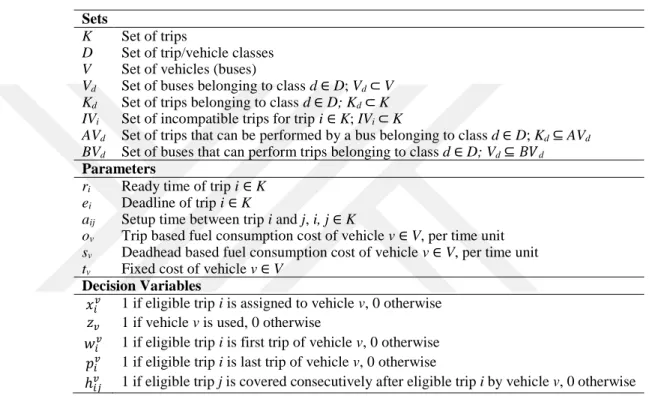
Table 4.1 VSP Notation. ... 29
Table 4.2 Computational Results for the VSP model. ... 34
Table 5.1 CSP Notation. ... 36
Table 5.2 Valid Inequality Generation Example for the CSP. ... 39
Table 5.3 Computational Results for the CSP. ... 41
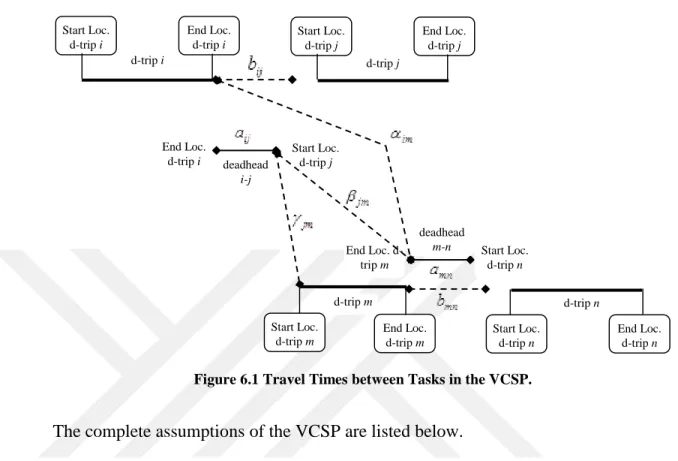
Table 6.1 VCSP Notation. ... 44
Table 6.2 Crew Scheduling Problem Data Analysis. ... 55
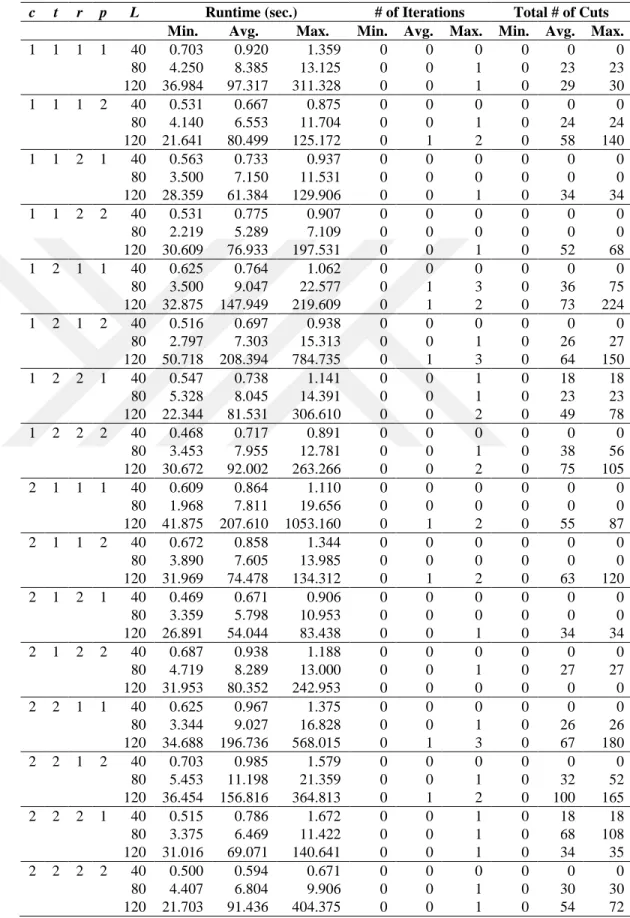
Table 6.3 Computational Results (sequential) for K = 20, 40 and 80. ... 57
Table 6.4 Computational Results (sequential) for K = 120. ... 58
Table 6.5 Comparison of the models for K = 12. ... 61
xii
INDEX OF ABBREVIATIONS
BDSP Bus Driver Scheduling Problem CRP Crew Rostering Problem CSP Crew Scheduling Problem FJSP Fixed Job Scheduling Problem
GA Genetic Algorithm
GRASP Greedy Randomized Adaptive Search Procedure ISP Interval Scheduling Problem
IVCSP Integrated Vehicle and Crew Scheduling Problem MD-VSP Multiple Depot Vehicle Scheduling Problem
MVT-VSP Vehicle Scheduling Problem with Multiple Vehicle Types OFJSP Operational Fixed Job Scheduling Problem
PMMLCG Prime Modulus Multiplicative Linear Congruential Generator
POW Piece of Work
RCSSP Resource Constrained Shortest Path Problem REF Resource Extension Function
SD-VSP Single Depot Vehicle Scheduling Problem TFJSP Tactical Fixed Job Scheduling Problem
TS Tabu Search
VCSP Vehicle and Crew Scheduling Problem VJSP Variable Job Scheduling Problem VSP Vehicle Scheduling Problem
1 1 INTRODUCTION
Public transportation companies are faced with difficulties in the transportation planning process by reason of population growth, the requirements for quality service and the need for efficient usage of the resources. Hence, the impact of planning systems in public transportation has been increasing, since significant cost savings are possible if the available resources such as crew and vehicles are used efficiently. As a consequence, the need for planning decision support systems that potentially reduce costs subject to specific operational restrictions has been increasing in operating public transportation.
In this thesis, the main cost incurring phases of the transportation planning process, namely the vehicle and crew scheduling activities are studied, inspired from the real life problem of the public bus transportation authority in Izmir. As of February 2016, the authority runs 316 bus lines with 1,401 buses and 4,092 employees among which 2,405 are bus drivers (Eshot, 2016). The daily passenger demand is approximately one million passengers. Regarding the authority’s large vehicle fleet and crew, it can be said that if the vehicles and crew are scheduled efficiently, the operator can make considerable cost savings.
There are some operational restrictions for vehicles and drivers that should be taken into account. The trips require different types of vehicles having different characteristics such as capacity, average speed, fuel consumption, etc. Therefore, there are several vehicle classes based on the characteristics required to perform certain trips. When the operational constraints for the crew are concerned, each driver has a spread time limit from the start time to the end time of his/her shift, including the idle times. Furthermore, a driver cannot exceed the maximum total working time limit. The processing times of the tasks assigned to each driver are included in his/her working time as well as the sequence-dependent setup times, as the drivers must travel between the start and end locations in order to perform the assigned tasks. Since the trips require different types of vehicles, different types of crew with different capabilities are required. Therefore, there are several crew classes required to use certain vehicle types based on individual competencies. These vehicle and crew classes complicate the problem together with the time limitations.
2
In the literature, vehicle scheduling problem is studied for single/multiple depot, multiple vehicle types and vehicle classes extensions, commonly with the objective of minimizing both fixed vehicle costs and variable operational costs. Network flow, transportation and multi-commodity formulations are commonly used in order to model these extensions of the vehicle scheduling problem. In this thesis, a fixed job scheduling approach is proposed for the vehicle scheduling problem.
Regarding crew scheduling, column generation approach is commonly used in the literature, where the master problem is a set partitioning/covering problem and the subproblem is a resource constrained shortest path problem. In studies using this approach, different crew types are considered with respect to work day type such as part-time, full time, etc., with a set of operator rules and relevant regulations such as working time limit, number/length of breaks, maximum driving time limit, spread time limit, etc. In this thesis, a fixed job scheduling approach is also proposed for the crew scheduling problem having different crew classes with dissimilar capabilities and time limitations.
In the literature, most of the studies deal with crew scheduling and vehicle scheduling individually. There are new studies considering both problems, using a sequential or an integrated approach. In the sequential approach, vehicle and crew scheduling problems are solved sequentially whereas they are solved simultaneously in the integrated one. In these studies, homogenous/heterogeneous vehicle fleet and single/multiple depots are considered as well as a set of operator regulations and different crew types differing with respect to work day type, generally using a column generation approach. However, vehicle and crew classes are not considered together in these studies. In this thesis, a fixed job scheduling-based sequential approach and an integrated formulation are proposed for the vehicle and crew scheduling problem, considering vehicle and crew classes collectively, regarding crew working and spread time limitations. We claim that the vehicle and crew scheduling problems studied in this thesis can be applied to real life problems of public transportation companies, as many realistic operational constraints such as different vehicle/crew classes and crew time limitations are taken into account.
The complete public transportation process is explained in Chapter 2 together with the related terminology. General problem descriptions are also given in this chapter in order to provide a better understanding of the whole planning process.
3
Thereafter, a detailed literature review for the vehicle and crew scheduling problems and the integration approaches are provided in Chapter 3. As the vehicle and crew scheduling problems are formulated as tactical fixed job scheduling problems (TFJSP) in the thesis, a literature review for TFJSP is also included in Chapter 3. The contribution of this thesis to the existing literature is elaborated as well.
In Chapter 4, the proposed formulation for the vehicle scheduling problem is presented together with the necessary assumptions and notation. Consecutively, a computational study is described in order to evaluate the performance of the proposed formulation on its own. Similarly in Chapter 5, the proposed approach for the crew scheduling problem is presented together with its necessary assumptions and notation. Thereafter, the computational study is presented for evaluating the performance of the proposed formulation and approach.
In Chapter 6, both of the vehicle and crew scheduling problems are considered together. In Section 6.1, a binary programming model is presented for the integration of vehicle and crew scheduling problems, as well as the necessary assumptions and notation. In Section 6.2, a sequential approach is employed using the computational results of the vehicle scheduling problem in Chapter 4. The computational study and results for the sequential approach are presented in the same section. Thereafter, the sequential approach is compared with the integrated one for small-sized instances in Section 6.3.
Finally, the general results of the proposed approaches are discussed in Chapter 7 as well as the contribution of this thesis to the existing literature. Furthermore, potential future research topics are addressed.
4
2 PUBLIC TRANSIT-OPERATION PLANNING PROCESS
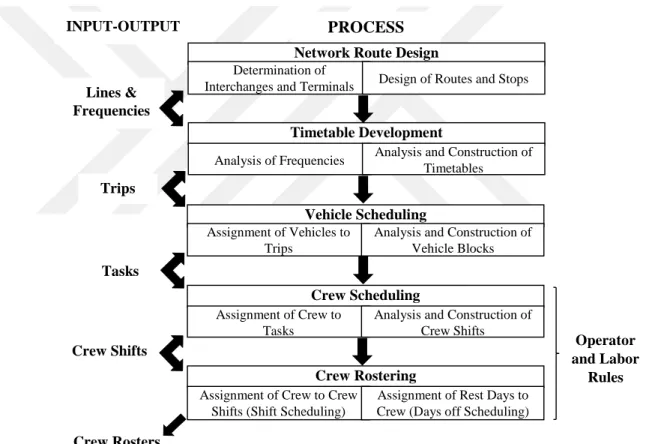
The public transit operation planning process includes five basic activities, usually performed in sequence: network route design, timetable development, vehicle scheduling, crew scheduling and crew rostering (Ceder, 2007). As shown in Figure 2.1, these activities are interrelated with each other; usually, the output of an activity at a higher level is an input for the activity at the subsequent level. In this thesis, the vehicle and crew scheduling activities are considered for public bus transportation and the definitions are made accordingly. The detailed terminology is given in Section 2.1.
Figure 2.1 The Transit Operation Planning Process.
The public bus transportation service is composed of a set of bus lines, commonly defined by a number, which correspond to a bus traveling between two locations in the city. In network route design stage, the bus stops, terminals and interchanges are determined, as well as the route of each bus line. Then, the frequency of each bus line is determined based on public demand. Consequently, timetables are constructed, which lead to trips having start and end termini along with departure and destination
Lines & Frequencies INPUT-OUTPUT Trips Tasks Crew Shifts Crew Rosters Operator and Labor Rules PROCESS
Network Route Design
Determination of
Interchanges and Terminals Design of Routes and Stops
Timetable Development
Analysis of Frequencies Analysis and Construction of Timetables
Vehicle Scheduling
Assignment of Vehicles to Trips
Analysis and Construction of Vehicle Blocks
Crew Scheduling
Assignment of Crew to Tasks
Analysis and Construction of Crew Shifts
Crew Rostering
Assignment of Crew to Crew Shifts (Shift Scheduling)
Assignment of Rest Days to Crew (Days off Scheduling)
5
times. In vehicle scheduling problem (VSP), the vehicles are assigned to trips. Each daily vehicle schedule known as a vehicle block is defined as a bus journey starting at a depot and returning to the same or a different one.
The crew scheduling problem (CSP) is a short term crew planning where the daily shifts are formed for the crew, covering all vehicle blocks. There is a set of tasks corresponding to vehicle blocks, and the aim is to define the sequence of these tasks as
shifts in such a way that each task must be assigned to a shift without any overlaps. The
feasibility of a crew shift depends on a set of operator and labor rules such as maximum driving time limit, break time duration, etc. The crew rostering problem (CRP) includes long term crew planning, where crew rosters are generated from crew shifts. This stage consists of days off scheduling and shift scheduling. Days off scheduling deals with the assignment of rest days to the crew over a planning horizon while shift scheduling deals with the assignment of the crew to constructed shifts.
Several software have been developed for transit operation planning process such as HASTUS (Rousseau and Blais, 1985), IMPACTS (Smith and Wren, 1988), HOT (Daduna and Mojsilovic, 1988), TRACS II (Kwan et al., 1999), GIST Decision Support System (Lourenço et al., 2001), GoalBus (GOAL Systems, 2016) and IVU Suite (IVU Traffic Technologies AG, 2016). These systems include the aforementioned planning activities at different levels.
2.1 Terminology
The relevant public bus transportation definitions used in the thesis are given below. It should be noted that vehicle and bus terms are used as substitutes, as well as
crew and driver.
(Bus) Line: It is defined by a start location, an end location and a set of intermediate stops. It is commonly identified by a number.
Vehicle (Bus): There are several types of buses such as mini bus, solo bus, articulated bus, etc.; having different capacities and fuel consumptions.
Crew (Driver): There are several types of drivers that have different capabilities and driving licences.
6
Timetable: Time schedule of each bus line over a day. It contains a set of trips that are characterized by a start and end location as well as a start and end time.
Trip: A bus journey between two locations. It is represented by its start time, end time, start location, end location and arrival times at intermediate stops. Each trip must be performed by one vehicle.
Vehicle Block: The sequence of trips performed by a vehicle that start and end at the depot. It is daily schedule for a single vehicle.
Relief Point (Relief Opportunity, Relief Location): The planned locations and times where and when a change of driver may happen. Common relief points are start and end location of the bus line. However, intermediate stop on a line can be a relief point. Depot: A parking garage with limited space for vehicles to stay overnight. It is a relief point.
D-trip: The portion of a trip which is created by dividing trips at relief points. Each d-trip must be served by a single vehicle and a single driver.
Deadhead: Driving of a vehicle without passengers. It can be a pull out (depot to start location of a trip), a pull in (end location of a trip to depot) and between two trips (from an end location of the trip to a start location of another trip).
Task: Activity performed on single vehicle by single driver without an interruption. It can be a d-trip or deadhead.
Piece of Work (POW): A sequence of tasks performed by a single driver on same vehicle without a break or walking activity. The feasibility of a piece of work is usually restricted by a minimum and maximum length.
Break: The rest time between two pieces of work. It can be long break or short break. It can be taken at any relief point.
7
Walking (Driver Movement): Crew movement without driving a vehicle. It can be movement from depot to a relief point, from a relief point to depot or between two relief points.
Shift (Duty): A daily work shift of a driver. It is generated by a set of pieces of work and breaks. The feasibility of a shift is usually restricted by number of piece of works, break duration, working time and spread time limits. Common shift types are early, late, night according to its beginning and ending time; and straight, split based on the duration of shift and the included number of pieces of works.
Spread Time: The total time between the start time and end time of the shift including the idle times.
Working Time: Sum of the duration of tasks and walking times in a shift, excluding idle times.
Sign on/off Time: Preparation time for a work shift. Shifts starting at the depot start with a sign on time. Consecutively, shifts ending at the depot end with a sign off time. Round-Trip: Two consecutive trips from location A to B and then back to A.
Full Time (Straight) Shift: A work shift including one or two pieces of work with a short break between two pieces of work.
Split Shift: A work shift including two or more short pieces of work. It has a long break between two pieces of work such that a driver can go home during this break. Roster: A work schedule for a driver over the long planning horizon which is composed of daily shifts and rest days.
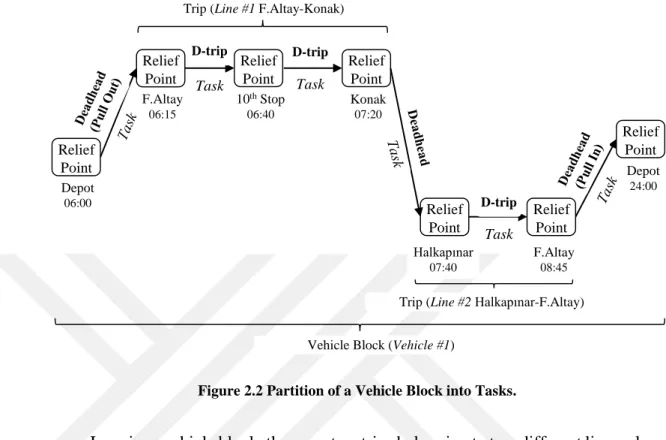
The task definitions (d-trips and deadheads) are shown with an illustrative example in Figure 2.2.
8
Figure 2.2 Partition of a Vehicle Block into Tasks.
In a given vehicle block, there are two trips belonging to two different lines, along with their start/end times and locations. As shown in the figure, start/end locations of the trips are relief points. Additionally, intermediate stop (10th stop) of the trip belonging to Line #1 is a relief point and the arrival time to this stop is known. The departure time from depot is determined according to the earliest departure time from the depot. Similarly, the arrival time to depot is determined as the latest arrival time to the depot. In this example, the vehicle returns to the depot earlier than the latest arrival time. This vehicle block can be summarized as follows: the vehicle leaves the depot at 6:00 and performs a deadhead task to reach the start location of its first trip (Line #1). After performing this trip, it performs another deadhead task to reach the start location of its second trip (Line #2). Subsequently, it performs a deadhead task to return to the depot. The trip belonging to Line #1 includes two d-trip tasks. Thus, this trip can be performed by at most two crew members. On the other hand, the trip belonging to Line
#2 includes only one d-trip task, indicating that it must be served by only one crew
member.
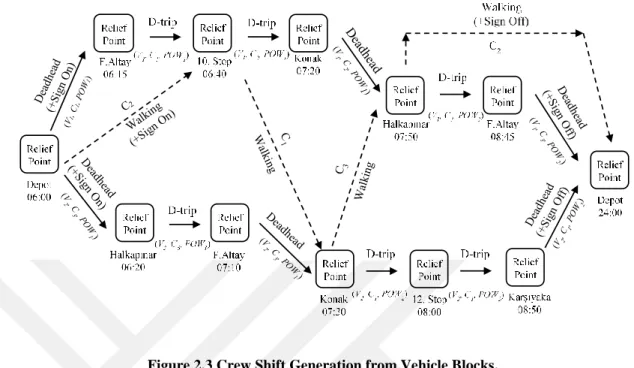
Crew shift generation from the vehicle blocks is shown with an illustrative example in Figure 2.3. As shown in the figure, there are two vehicle blocks and three crew shifts. Relief Point Relief Point Relief Point Relief Point Relief Point Relief Point Relief Point Task Task Task D-trip D-trip D-trip Depot 06:00 F.Altay 06:15 10th Stop 06:40 Konak 07:20 Halkapınar 07:40 F.Altay 08:45 Depot 24:00
Trip (Line #2 Halkapınar-F.Altay) Trip (Line #1 F.Altay-Konak)
9
Figure 2.3 Crew Shift Generation from Vehicle Blocks.
Crew #1 starts his shift with a deadhead from the depot to the start location of its
first trip (F.Altay) with Vehicle #1. After performing the d-trip with same vehicle, he leaves the vehicle at the relief point (10th stop), walks to the start location of its next trip (Konak) and performs the trip with Vehicle #2. Finally, he ends his shift with a deadhead from the end location of his final trip (Karşıyaka) to the depot with Vehicle
#2. Meanwhile, Crew #2 starts his shift by walking to the relief point of his first trip
(10th stop), takes Vehicle #1 and performs the d-trip from the relief point to the end location of the trip (Konak). After performing the d-trip, he performs a deadhead from the end location of the trip (Konak) to the start location of his next trip (Halkapınar) on same vehicle and leaves the vehicle there. Finally, he ends shift by walking from Halkapınar to the depot. In the example, Crew #3 starts shift with a deadhead from the depot to Halkapınar with Vehicle #2. After performing the whole trip with the same vehicle, he performs a deadhead from the end location of the trip (F.Altay) to the start location of the next trip (Konak) on the same vehicle, leaves the vehicle there and walks to start location of his next trip (Halkapınar). He then performs the whole trip with
Vehicle #1 and ends shift with a deadhead from F.Altay to the depot. As it can be seen,
a crew shift may start/end with a walking or a deadhead activity, and the crew can take/leave the bus at any relief point. All crew shifts start with a sign on time and end with a sign off time. These sign on and sign off times are included in the corresponding deadhead or walking activity.
10
The piece of works (POWs) can be extracted from Figure 2.3 as follows. Based on the definition, a deadhead from the depot to F.Altay, and a d-trip from F.Altay to 10th stop, is POW1 for Crew #1 (C1) performed on Vehicle #1 (V1). The other POW are
listed as:
• (V1, C2, POW1): d-trip (10th Stop - Konak) and deadhead (Konak - Halkapınar)
• (V1, C3, POW2): d-trip (Halkapınar - F.Altay) and deadhead (F.Altay - Depot)
• (V2, C3, POW1): deadhead (Depot - Halkapınar), d-trip (Halkapınar - F.Altay)
and deadhead (F.Altay - Konak)
• (V2, C1, POW2): d-trip (Konak – 12th Stop), d-trip (12th Stop - Karşıyaka) and
deadhead (Karşıyaka - Depot)
The crew shifts are constructed using these POWs by connecting them with walking or break activities.
2.2 Problem Definitions
The main problem definitions are provided in this section for the public bus transportation planning process.
2.2.1 Timetabling
The timetabling activity determines alternative frequencies and timetables in order to meet public transport demand. The demand fluctuates during the hours of the day or the days of the week due to changes in the transportation needs of the community. Therefore, the day is usually divided into time intervals, and the frequencies are determined for each time interval. Additionally, the days of the week are commonly considered separately as weekdays and weekends.
The purpose of timetabling is to establish alternative timetables for each line in order to meet variations in public demand. Alternative timetables are determined based on public demand regarding the service quality constraints (Ceder, 2007). During the construction of alternative timetables, several objectives are considered including the minimization of the waiting time of passengers, balancing vehicle utilizations, or minimization of the resources used. The common inputs of the timetabling activity are the routes, the times of first and last trips, average vehicle utilizations (number of passengers onboard the transit vehicle) between adjacent stops, the desired vehicle
11
utilization, the boarding/alighting rate estimates for each stop, available resources and average running times between stops. The output of this activity are the trips, which correspond to the start and end locations as well as start and end times.
2.2.2 Vehicle Scheduling (Bus Scheduling)
Vehicle scheduling involves scheduling a fleet of vehicles to cover a set of trips at minimum cost. The trips are given by specified time intervals as well as start and end termini. The vehicles are grouped into depots according to their locations, and classified by their types in these depots. If there is a single depot, the problem is referred as a Single Depot Vehicle Scheduling Problem (SD-VSP). On the other hand, it is referred as Multi-Depot Vehicle Scheduling Problem (MD-VSP) if there is more than one depot. SD-VSP is relatively easier to solve than MD-VSP.
Another complicating extension is the case of non-identical vehicles. This problem is referred as the Vehicle Scheduling Problem with Multiple Vehicle Types (MVT-VSP). The common vehicle types are midi bus, solo bus and articulated bus. These vehicle types differ in their capacities, average speeds, fuel consumptions, etc. Therefore, not all vehicle types may be able to serve all trips.
In VSP, the vehicle blocks are constructed using a minimum number of vehicles, where each trip is assigned exactly to one vehicle block. The common objectives are minimizing service costs by minimizing the number of vehicles used and minimizing traveling costs by avoiding unnecessary deadheads in vehicle blocks. The problem is solved daily, and the output is the set of vehicle blocks, which are the sequence of trips served by one vehicle that starts and ends in a depot. A detailed problem description will be given in Chapter 4.
2.2.3 Crew Scheduling (Bus Driver Scheduling)
The Crew Scheduling Problem (CSP) consists of the short term scheduling of the crew with the aim of generating a set of daily shifts covering all vehicle blocks. There is a set of tasks (d-trips and deadheads) arising from the vehicle blocks, and the aim is to define a sequence of these tasks as shifts in such a way that every task is assigned to a shift without any overlaps.
12
The feasibility of a crew shift depends on a set of operator rules and relevant regulations such as the working time limit, the number and length of breaks, the maximum driving time limit, the spread time limit, etc. Additionally, there can be distinct types of crew members having different capabilities and driving licences. In this case, the feasibility of a task-crew shift assignment depends also on crew capabilities. The commonly used solution methodology involves dividing the vehicle block into POWs that start and finish at relief points, and forming a feasible shift through a sequence of POWs satisfying all constraints. A detailed problem description will be provided in Chapter 5.
2.2.4 Crew Rostering (Driver Rostering)
The Crew Rostering Problem (CRP) consists of the long term scheduling of the crew with the aim of generating a set of crew rosters to cover the daily crew shifts. It assigns crew members to constructed shifts over a long planning horizon, generally a month or a half year. It includes days-off scheduling and shift scheduling. Days-off scheduling deals with the assignment of the rest days between working days to the crew over a planning horizon, while shift scheduling deals with the assignment of the crew to shifts. When days-off and shifts are made simultaneously, the procedure is called tour scheduling.
The shifts are usually grouped in morning, day and night shifts. Additionally, the shifts can be grouped according to required crew capabilities. In this case, the shift types are considered during the generation of rosters. Crew rosters can be cyclic or noncyclic. In cyclic schedules all crew members have the same basic schedule starting with a different day, whereas noncyclic schedules are individual. In CRP, there are some hard constraints and soft constraints, where the hard constraints consist of coverage and regulatory requirements and the soft constraints include operational and personal preferences. The coverage requirements guarantee that there are adequate number of crew members on shift at all times. The regulatory requirements ensure that the crew’s work agreement and government rules are regarded. The operational and personnel preferences are also considered for a greater crew and operator satisfaction (Nurmi, 2011).
13 3 LITERATURE REVIEW
The detailed literature review for the vehicle and crew scheduling problems and the integration approaches for these two problems are provided in the following three sections. Since, both vehicle and crew scheduling problems are formulated as tactical fixed job scheduling problems (TFJSP) in Chapters 4 and 5 respectively, a literature review for this problem is given in Section 3.4. Finally, the contribution of this thesis to existing literature is discussed in Section 3.5.
3.1 Vehicle Scheduling Problem
Daduna and Paixão (1995), discussed modeling approaches and their complexities for several variations of VSP such as using single depot, multiple depot and fixed number of vehicles. Bunte and Kliewer (2009) provided a detailed literature review on VSP and presented the modeling approaches for the basic single depot case and further practical extensions, including multiple depots, multiple vehicle types, time windows and route constraints.
The Single Depot Vehicle Scheduling Problem (SD-VSP) is well known to be solvable with polynomial time algorithms. Freling et al. (2001b) provided a comparison of these algorithms in terms of computational times and complexities. Commonly, this problem has been formulated as a transportation problem or a network flow problem in the literature. These two basic formulations are given in Sections 3.1.1 and 3.1.2, respectively.
VSP is extended with multiple depot and/or multiple vehicle type considerations where each trip must be performed by a subset of depots and/or vehicle types. Bertossi et al. (1987) proved that the Multi-Depot Vehicle Scheduling Problem (MD-VSP) is NP-Hard and Lenstra and Kan (1981) showed that the single depot Vehicle Scheduling Problem with Multiple Vehicle Types (MVT-VSP) is NP-Hard. Obviously, it can be concluded that the combination of these two extensions is also NP-Hard. There are many studies considering these two extensions in the literature.
Common modeling approaches for the MD-VSP are single-commodity model formulations (Carpaneto et al., 1989; Fischetti et al., 1999; Mesquita and Paixão, 1992), multi-commodity model formulations (Forbes et al., 1994; Löbel, 1998; Haghani and
14
Banihashemi, 2002; Mesquita and Paixão, 1999), multi-commodity model formulations based on time-space network (Kliewer et al., 2006; Gintner et al., 2005) and set partitioning model formulations (Riberio and Soumis, 1994; Hadjar et al., 2006). In multi-commodity models, a multi-graph is generated including independent networks for each depot, while all depots are modeled with a single graph in single-commodity models. Multi-single-commodity models based on time-space network differ from other multi-commodity models, as they aggregate possible connections between groups of compatible trips and avoid the disadvantage of explicit consideration of all possible connections between compatible trips. Set partitioning models generate all feasible schedules for vehicles usually through a column generation approach.
A common modeling approach for single depot MVT-VSP uses a multi-graph with subnetworks for each vehicle type, which is introduced by Bodin et al. (1983). This approach is also used later by Costa et al. (1995). Hassold and Ceder (2014) considered the same problem and proposed a minimum cost network flow model utilizing a set of Pareto efficient timetables. Gintner et al. (2005) considered the MVT-VSP with multiple depot for public transport bus operators as well as depot capacity restrictions. They proposed a multi-commodity model including time-space networks for each depot and vehicle-type combination, and considered the case that a vehicle may return into another depot than its source depot.
As another approach, Eliiyi et al. (2009) developed a mixed integer programming model and several heuristics for the MVT-VSP, using a TFJSP formulation with spread time limitations while considering the sequence dependent setup times (deadheads) and vehicle capacity restrictions. Furthermore, if there are restrictions on trips such as certain type of trips must be performed with a subset of all vehicle types, problem is further extended including the concept of vehicle type groups. Forbes et al. (1994) and Löbel et al. (1997) also considered this extended problem for multiple depot case but within a multi-commodity modeling approach, while Kliewer et al. (2006) and Kliewer et al. (2008) studied the multi-commodity modeling approach based on time-space networks.
15
3.1.1 Transportation (Quasi-Assignment) Model
Gavish and Shlifer (1979) formulated the SD-VSP as a transportation problem. A mathematical formulation by Freling et al. (2001b) is presented here.
Let N = {1,2,…,n} be the set of trips, numbered due to increasing start times, and
E = {(i, j) | i < j compatible, i ∈ N, j ∈ N} be the set of arcs that correspond to deadhead trips. Trips i and j are compatible, if trip j can be served directly after trip i by the same vehicle without any overlaps. Depot is represented by two nodes s and t. The network is defined as an acyclic directed network G= (V, A) with nodes V= N ∪{s, t} and arcs
A= E ∪ (s x N) ∪ (N x t). A path from s to t in the network forms a feasible vehicle schedule for a single vehicle, and a complete feasible vehicle schedule is a set of disjoint paths from s to t such that each node in N is covered. The objective function minimizes operational costs where 𝑐𝑖𝑗 represents the operational cost of serving trip j after trip i, and commonly a function of travel durations. Additionally, fixed cost of a vehicle can be considered in the objective function. It can be incorporated into the cost of arcs (s, j) or (i, t) for all i, j ∈ N. Therefore, SD-VSP can be formulated by using the binary decision variable 𝑥𝑖𝑗 , which represents whether a trip j is directly covered after trip i: ( , ) Minimize ij ij i j A c x
(3.0) s.t. :( , ) 1 ij j i j A x
i N (3.1) :( , ) 1 ij i i j A x
j N (3.2)
0,1 ij x ( , )i j A (3.3)The objective (3.0) minimizes the total operational costs. Constraints (3.1) and (3.2) are the flow conservation constraints, ensuring that exactly one deadhead is performed before each trip and one deadhead is performed after each trip. Since they define a totally unimodular restriction matrix, binary variables 𝑥𝑖𝑗 are commonly relaxed to 𝑥𝑖𝑗 ≥ 0 (Freling et al., 2001b).
16
The problem above is a transportation problem, where the demand/supply of each trip node is one unit. This formulation can be extended for fixed number of vehicles v through the following constraints:
sj j N x v
(3.4) it i N x v
(3.5)Both the demand/supply amounts of depot nodes s and t are taken as v units as stated in constraints (3.4) and (3.5). In that case, in order to allow a vehicle being idle, an arc between the depot nodes s and t should be inserted with cost zero. In the literature, Paixão and Branco (1987) referred to this transportation model as a quasi-assignment model, since this model corresponds to a linear quasi-assignment model by not considering the nodes s and t, and the corresponding arcs.
3.1.2 Network Flow Model
Bodin et al. (1983) formulated the SD-VSP as a network flow problem. A network flow model described in Bunte and Kliewer (2009) is presented here. In this model, each trip is represented by two nodes, a start and end node, and these nodes are connected with a trip arc. The depot is represented by two nodes s and t. Arcs from the depot to trips only have operational costs. The fixed costs are modeled by a single arc leading back from t to s. A feasible flow from node s to t is also a feasible vehicle schedule.
Let AT be the set of trip arcs, A the set of arcs and N be the set of nodes. The parameter 𝑐𝑖𝑗 is the operational cost of serving trip j after trip i that is usually a function of travel durations. The decision variable 𝑥𝑖𝑗 represents the flow on the arc (i, j). Thus, SD-VSP can be formulated as a minimum cost flow problem as follows:
( , ) Minimize ij ij i j A c x
(3.6) s.t. :( , ) :( , ) 0 ij ji i i j A i j i A x x
j N (3.7)17
1xij 1 ( , )i j AT (3.8) 0
ij
x ( , )i j A (3.9)
Objective (3.6) minimizes the total operational costs. Constraint (3.7) states that all nodes are transshipment nodes. In constraint (3.8), the lower and upper bounds on the trip arcs are equal to one in order to ensure that all trips are served. Additionally, this formulation can be extended for the case of fixed number of vehicles by setting the upper bound on the arc leading back from t to s, to the number of vehicles available (Bunte and Kliewer, 2009).
3.2 Crew Scheduling Problem
Fischetti et al. (1987) proved that the fixed job scheduling problem (FJSP) with spread time constraints is NP-Hard. In a later study, Fischetti et al. (1989) proved that the FJSP with working time constraints is also NP-Hard. As these two basic variants of the CSP with spread and working time constraints are NP-Hard, it can be concluded that the CSP is also NP-Hard. Wren and Rousseau (1995) provided an overview of the Bus Driver Scheduling Problem (BDSP), which is a kind of CSP for public bus transportation, and its several variants. The authors presented constraints and conditions in different environments and proposed various solution approaches for the BDSP. Ernst et al. (2004) provided a detailed bibliography about crew scheduling and crew rostering problems. They classified the studies related to these two problems according to the problem type, application area and solution methodology.
In the literature, one of the most used approaches to the CSP is the column generation that is introduced by Desrochers and Soumis (1989), where the master problem is a set partitioning/covering problem and the subproblem is a Resource-Constrained Shortest Path Problem (RCSPP) (Carraresi et al., 1995; Desrochers et al., 1992; Freling et al., 1999; Freling et al., 2001a, 2003; Friberg and Haase, 1999; Haase et al., 2001; Mesquita and Paias, 2008; Rousseau and Desrosiers, 1995). With this approach, the feasible shifts are generated by solving the RCSPP, where the feasibility constraints such as the maximum working time limit, the number and the length of breaks, the maximum driving duration without a break, etc. are handled as different resources. Then, a crew schedule covering all tasks is determined from the given feasible shifts by solving a set partitioning/covering problem. In some of these studies,
18
different crew types are also considered which differ with respect to shift type such as part-time, full time, etc. Basic formulations for these approaches are given in the following sections.
Furthermore, Boschetti et al. (2004) extended the CSP with multiple depots. They considered the problem of determining the optimal shifts for a set of identical crews divided into several depots, in order to cover a set of trips regarding the working time (total duration of tasks assigned to a duty) and spread time limitations. They proposed an exact method based on a set partitioning formulation with additional constraints, as well as a bounding procedure based on Lagrangian relaxation and column generation. Their model is an extension of MD-VSP, since it corresponds to the MD-VSP when no time limits are imposed on duty duration.
Various heuristic approaches are also proposed in literature for the CSP. Shen and Kwan (2001) proposed a tabu search algorithm for the BDSP, whereas Lourenço et al. (2001) presented multi-objective metaheuristics for the same problem. The authors proposed a Greedy Randomized Adaptive Search Procedure (GRASP), a Tabu Search (TS) and a Genetic Algorithm (GA) as metaheuristics. They integrated these methods in a decision support system. Dias et al. (2002) studied on a GA implementation for the BDSP, through extending the traditional approach of set covering/partitioning formulations by considering several additional criteria. De Leone et al. (2011) proposed a mathematical formulation under special constraints forced by restrictions due to Italian transportation regulations, applied to small- or medium-sized problem instances. For larger instances, the authors proposed GRASP. Kecskeméti and Bilics (2013) proposed an integer programming and evolutionary hybrid algorithm for the BDSP. Toth and Kresz (2013) presented an efficient algorithm based on cut and join approach for the BDSP. The proposed method is divided into two phases. In the first phase, rough shifts are generated that contain only the trips and the travelling activities of the driver. In the second phase, complete shifts are generated which contain all the obligatory activities and the idle activities.
3.2.1 Set Covering / Set Partitioning Model
A set covering formulation of Desrochers and Soumis (1989) is presented below. In this formulation, global constraints such as limitations on number of shift types are also considered as well as covering all tasks. Let M = {1,2,…,m}be the set of tasks, N
19
= {1,2,…,n} be the set of feasible shifts and K = {1,2,…,k} be the set of shift types. The parameter 𝑐𝑗 is the cost of shift j, which is a function of travel time and paid breaks. The parameter 𝑓𝑖𝑗 = 1 if feasible shift j covers the task i, 𝑓𝑖𝑗 = 0 otherwise. The parameter 𝑔𝑘𝑗 = 1 if feasible shift j has shift type k, 𝑔𝑘𝑗 = 0 otherwise and ℎ𝑘 is the upper bound for shift k. The decision variable 𝑥𝑗 = 1 if feasible shift j is selected, 𝑥𝑗 = 0 otherwise. The master problem of the CSP can be formulated as a set covering formulation as follows: 1 Minimize n j j j c x
(3.10) s.t. 1 1 n ij j j f x
i M (3.11) 1 n kj j k j g x h
k K (3.12)
0,1 j x j N (3.13)As shown above, the objective is to minimize the total crew costs. Constraint (3.11) ensures that each task i is covered by at least one shift. Constraint (3.12) limits the number of shift types and constraint (3.13) says that all 𝑥𝑗 decision variables are binary. Constraint set (3.12) is called as global constraints or sometimes base constraints, and minimum/maximum limitations on shift types (full time, split, etc.) are modeled in these constraints. In the set partitioning formulation, inequalities at constraint (3.11) are replaced with equalities (Desrochers and Soumis, 1989).
3.2.2 Resource Constrained Shortest Path Problem
The Resource Constrained Shortest Path Problem (RCSPP) is a special case of the shortest path problem formulated on a graph G = (N, A), where N is the set of nodes including source s and sink t, A is the set of arcs. Additionally, there is a set of resources, R. The parameter 𝑐𝑖𝑗 is the cost of each arc (i, j) ∈ A and 𝑑𝑖𝑗ℎ is the consumption of resource h along each arc (i, j) ∈ A based on the resource extension function (REF) of resource h. Irnich (2008) provides a detailed REF descriptions for real life applications.
20
Let 𝑊𝑗ℎ be the amount of the hth resource accumulated along the path from source node s to node j. Let the interval [𝑎𝑗ℎ, 𝑏𝑗ℎ] with 𝑎𝑗ℎ < 𝑏𝑗ℎ be the resource window for each node j ∈ N. A path from node s to node j is feasible, if and only if 𝑎𝑗ℎ ≤ 𝑊𝑗ℎ ≤ 𝑏𝑗ℎ. Two types of constraints can be modeled with resource windows: time window constraints when h represents time, and capacity constraints when h corresponds to the quantity of resource. Time window constraints can be defined as hard or soft. In hard time window constraints, if node j is visited before 𝑎𝑗ℎ, waiting is allowed without incurring a cost, where all arrival times after 𝑏𝑗ℎ are forbidden. In soft time window case, a penalty cost is employed when node j is not visited within the given time window (Pugliese and Guerriero, 2013).
Given a source node s and sink node t, RCSPP aims to find the minimum cost path such that 𝑊𝑗ℎ respects the feasibility window [𝑎𝑗ℎ, 𝑏𝑗ℎ] for all nodes of the path and all resources. The decision variable 𝑦𝑖𝑗= 1 if node j is visited after node i, 𝑦𝑖𝑗 = 0 otherwise. ( , ) Minimize ij ij i j A c y
(3.14) s.t. :( , ) :( , ) 1, if 1, if 0, otherwise ij ji j i j A j j i A i s y y i t
i N (3.15) ( h h) h ij i ij j y W d W ( , )i j A h, R (3.16) h h h i i i a W b i N h, R (3.17)
0,1 ij y ( , )i j A (3.18)In the objective function (3.14), total cost of arcs is minimized. Constraint (3.15) indicates that the flow between the source node s and the sink node t must be equal to one by conserving the network flow between other nodes. Constraint (3.16) ensures that, if there is a positive flow between nodes i and j, the value of resource h at node j must be greater than or equal to the sum of the amount of the hth resource accumulated along the path from source node s to node i and the consumption along arc (i, j) of resource h. Constraint (3.17) enforces the resource windows of resource h for all nodes. Finally, constraint (3.18) ensures that all decision variables are binary.
21
Many of the conditions on crew shifts can be formulated through resources and the constraints regarding the consumption of these resources in a shift. Common resource constraints for crew shifts are spread time, working time, break duration, number and length of piece of works. Pugliese and Guerriero (2013) provided a survey of resource constrained shortest path problems and exact solution approaches.
3.3 Vehicle and Crew Scheduling Problem
In the literature, most of the studies deal with crew scheduling and vehicle scheduling individually, as in the aforementioned review of the VSP and CSP. However, there are studies on vehicle and scheduling problem (VCSP) considering both problems at the same time either by using a sequential approach or an integrated approach. In the sequential approach, VSP and CSP are solved sequentially, while they are solved simultaneously in the integrated one.
Freling et al. (1995) introduced the first exact formulation for integrated vehicle and crew scheduling problem (IVCSP), as well as an optimization-based heuristic approach. Their formulation includes a quasi-assignment structure for vehicle scheduling, set partitioning constraints for crew scheduling and a set of linking constraints between vehicle and crew scheduling. They proposed a column generation algorithm combined with Lagrangian relaxation as a solution approach. The proposed formulation and solution methodology including the computational results for the real world problems can be found in Freling et al. (1999).
Freling et al. (2003) studied on the relaxations and algorithms for the integrated approach to solve the single depot VCSP. They discussed the potential benefits of integration and provided an overview of the literature that considers partial integration. They proposed a mathematical formulation and a solution methodology based on column generation combined with Lagrangian relaxation of the IVCSP. Furthermore, they applied their techniques to real life problems of a public transport operator. According to Freling et al. (2003), three main approaches are pursued for the integration of vehicle and crew scheduling in the literature. The first one is the scheduling of vehicles by a heuristic approach, which is designed by Ball et al. (1983) for the crew scheduling problem. The second approach for the integration is determining the vehicle schedules by taking crew costs into consideration, which is
22
proposed by Darby-Dowman et al. (1988). The third approach is the complete integration of vehicle and crew scheduling, which is proposed by Freling et al. (1995).
Freling et al. (2001a) studied on a practical application of the single depot IVCSP. They considered the bus lines of a public transport operator, where particular constraints on shifts and breaks should be taken care of. They proposed both the sequential and integrated approaches for the VCSP and compared them with each other. As for the sequential approach for the vehicle scheduling, they developed a transportation model where nodes are trips, and the objective is to find the set of disjoint paths between two depots respecting the operator-specific roundtrip condition. They solved this model using subgradient optimization and Lagrangian relaxation of roundtrip condition. After solving this model, they proposed a two-step procedure for the crew scheduling. In the first step, they generated shifts by defining all relief points and generating all feasible pieces of works, sequentially. In the second step, they selected the optimal shifts by solving a set covering model. They proposed a column generation method for solving this problem. As an integrated approach for the VCSP, they proposed a formulation which is the combination of the quasi-assignment formulation for vehicle scheduling and a set partitioning formulation for crew scheduling. The quasi-assignment part assures the feasibility of vehicle schedules, while the set partitioning assures that each trip and deadhead is assigned to a shift if its corresponding deadhead is part of the vehicle schedule. They proposed a column generation algorithm for the integrated model. Furthermore, they investigated the impact of allowing drivers to change vehicle during a break. According to their current operational rules, these changeovers are only allowed in split duties. They compared the sequential and integrated approaches with different variants of allowing changeovers. According to their computational results, the integrated approach gave better results than the sequential approach for all the variants.
Friberg and Haase (1999) introduced the first exact solution approach for the IVCSP, which combines the crew scheduling approach of Desrochers and Soumis (1989) and the vehicle scheduling approach by Riberio and Soumis (1994). They proposed a branch-price-and-cut algorithm, where a column generation is performed for generating both vehicle and crew schedules in order to obtain optimal solutions. However, only small instances including up to 20 trips could be solved to optimality within 3 hours. Later, Haase et al. (2001) proposed an exact approach for the single depot IVCSP with homogenous fleet, which relies on a set partitioning formulation for
23
the CSP that combines side constraints for the vehicle schedules. In their approach, column generation integrated into a branch and bound scheme is applied only for the generation of crew schedules. The side constraints on vehicles guarantee that optimal schedules can be derived afterwards in polynomial time. They also proposed a heuristic approach for larger instances.
Based on the integrated approach of Freling et al. (1995), Huisman (2004) and Huisman et al. (2005) introduced the first formulation for the multiple depot IVCSP. Later, Mesquita and Paias (2008) presented an integer linear programming formulation combining a multi-commodity network flow model with a set partitioning/covering model for the same problem. They proposed a four-step solution approach for the problem. In the first two steps, the set of tasks are defined and initial set of shifts is generated. In the third step, linear programming relaxation of the model is solved using a column generation scheme. In the fourth step, if the resulting solution is not integer, branch and bound techniques are used over the set of generated shifts in order to obtain a feasible solution. Later, Mesquita et al. (2009) developed and compared additional branching strategies for solving the model proposed by Mesquita and Paias (2008). Gintner et al. (2006), Steinzen (2007) and Steinzen et al. (2010) developed a time-space network structure for the multiple depot IVCSP and used the general solution scheme proposed by Freling (1997) in order to solve the model.
Kliewer et al. (2012) extended the multiple depot IVCSP with time windows for scheduled trips. They developed a mathematical model based on a time-space network and solved this model with column generation combined with Lagrangian relaxation. As another extension, Mesquita et al. (2013) studied on the vehicle-crew-roster problem with days-off pattern, which simultaneously determines the minimum cost vehicle and daily crew schedules that cover all trips, and the minimum cost roster that cover all daily crew shifts according to the given predetermined days-off pattern. They proposed an integer linear programming formulation and a heuristic solution approach based on Bender’s decomposition, which iterates between the solution of the IVCSP and the solution of the rostering problem. Gintner et al. (2008) presented a partially integrated approach for the multiple depot VCSP. Contrary to the traditional sequential approach, the crew scheduling in their method is based on a set of optimal vehicle schedules instead of only one optimal schedule. They used a multi-commodity flow formulation based on a time-space network for the MD-VSP, and a column generation approach combined with Lagrangian relaxation for the CSP.
24
3.4 Tactical Fixed Job Scheduling Problem
As for the studies on the FJSP, Kolen et al. (2007) provided a detailed survey on the Interval Scheduling Problem (ISP), such that each job is started at or after its ready time and completed before its deadline. If the job can be started after its ready time, the problem is defined as the Variable Job Scheduling Problem (VJSP). Conversely, if the job cannot be started after its ready time, the problem is referred as the FJSP. Kovalyov et al. (2007) provided a more recent review on models, applications and algorithms for the FJSP. The problem has two variants according to the objective functions: Operational Fixed Job Scheduling Problem (OFJSP) and Tactical Fixed Job Scheduling Problem (TFJSP). In the OFJSP, the objective is to maximize the weighted number of processed jobs with a given number of processors where each job has a weight. Conversely, in the TFJSP, the objective is the minimization of the total cost of machines required to cover all jobs. Eliiyi and Azizoğlu (2009, 2010, 2011) proposed solution techniques for the OFJSP with eligibility, working time and spread time limitations.
Many studies exist in literature on the TFJSP variants. Fischetti et al. (1989) studied the TFJSP with working time constraints. The authors dealt with the BDSP with working time constraints, where the objective is to find the minimum number of crew required to cover all daily tasks. They proposed a polynomial algorithm for the preemptive version of the problem, and developed a branch and bound algorithm. They also provided some lower bounds and dominance criteria for the problem. Fischetti et al. (1987) studied on the TFJSP with a constraint on the spread time of the bus drivers where each driver has a spread time limit from the start time to the end time of his shift, including the idle times. They proposed polynomial procedures to obtain some lower bounds, as well as dominance criteria and reductions in problem size. They also developed a branch and bound algorithm for the problem.
As another extension for the TFJSP, eligibility constraints are considered where each job can be processed only by a subset of the machine classes. Arkin and Silverberg (1987) showed that the FJSP with eligibility constraints is NP-Complete. Kroon et al. (1997) studied on the TFJSP with eligibility constraints, where the objective is to determine the minimum number of non-identical parallel machines in such a way that each machine can process only jobs from a subset of the job classes and preemption is not allowed. They provided exact and approximation algorithms for the problem. Eliiyi
25
et al. (2009) developed a mixed integer programming model and several heuristics for the vehicle scheduling problem, using a TFJSP formulation with spread time limitations while considering the sequence dependent setup times and vehicle capacity restrictions. Zhou et al. (2014) developed a branch and price algorithm for the TFJSP with spread time and eligibility constraints. Krishnamoorthy et al. (2012) studied on the shift minimization personnel task scheduling problem which is similar to the TFJSP with eligibility constraints, except that the machines have also availability limitations. They provided mathematical formulations and a heuristic approach.
3.5 Discussion
As it has been elaborated in Section 3.1, VSP is commonly formulated as a network flow or transportation model. In the multiple depot and multiple vehicle type cases, multi-commodity model formulations are generally used, where a multi-graph is generated including subnetworks for each depot/vehicle type. In this thesis, a fixed job scheduling approach is proposed for the VSP by considering multiple vehicle types as eligibility constraints.
Furthermore, as discussed in Section 3.4, the common objective of the TFJSP formulations is to minimize the total fixed cost of machines required to cover all jobs. In this thesis, variable cost minimization is also handled within the fixed job scheduling framework. Thus, the proposed formulation is different from the existing fixed job scheduling literature.
In summary, the approach for the VSP in this thesis is different from the existing vehicle scheduling and tactical fixed job scheduling studies in literature due to:
(1) The fixed job scheduling approach to the vehicle scheduling problem, (2) The consideration of eligibility constraints (multiple vehicle types), and (3) Minimization of both fixed and variable costs.
As mentioned in Section 3.2, column generation approach is commonly used for the CSP, where the master problem is a set partitioning/covering problem and the subproblem is RCSPP. In studies using this approach, different crew types are
26
considered that differ with respect to shift types such as part-time, full time, etc. However, different crew types with different capabilities are not considered, namely the cases where each task can be assigned to certain subset of crew types. In this thesis, a fixed job scheduling approach is proposed for the CSP considering different crew types with different capabilities as eligibility constraints.
Furthermore, as discussed in Section 3.4, the working time constraint is not considered with sequence dependent setup times in the TFJSP formulations. In this thesis, this constraint is handled by using a TFJSP based approach that includes the sequence dependent setup times, since the drivers must travel between the start and end locations of the tasks in order to fully perform the assigned tasks.
In summary, the approach for the CSP in this thesis is different from the existing crew scheduling and tactical fixed job scheduling studies in the related literature due to:
(1) The fixed job scheduling approach to the crew scheduling problem,
(2) The consideration of many realistic constraints such as working time, spread time and eligibility constraints, and
(3) The handling of the working time constraint in the existence of sequence-dependent setup times.
As stated in Section 3.3, column generation algorithms combined with Lagrangian relaxation are commonly used for the VCSP as a solution approach. Furthermore, multiple vehicle types (eligibility constraints for vehicles) are employed in some of these studies on the multiple depot VCSP (Huisman, 2004; Huisman et al., 2005; Gintner et al. 2006; Steinzen, 2007; Steinzen et al. 2010; Kliewer et al. 2012), by referring to vehicle type as depot. However, all of these studies assume that each crew belongs to a specific depot and can only cover tasks performed by the vehicles from this certain depot. According to this assumption, crew member can be assigned to only one type of vehicle/depot. Thus, eligibility constraints are not considered for crew members in these studies, where each crew member can be assigned to more than one type of task (vehicle) based on his capabilities.
27
In this thesis, a sequential approach and an integrated formulation are proposed for the VCSP that is different from the existing vehicle and crew scheduling studies in literature due to:
(1) The fixed job scheduling based sequential approach for the VCSP, (2) A binary programming model for the integrated VCSP,
(3) The consideration of eligibility constraints for both vehicles and crew members, and
(4) The consideration of realistic constraints including working time and spread time for the crew.