Vol. 11(11), pp. 1008-1024, 10 June, 2016 DOI: 10.5897/ERR2016.2812
Article Number: 086EBEE58880 ISSN 1990-3839
Copyright © 2016
Author(s) retain the copyright of this article http://www.academicjournals.org/ERR
Educational Research and Reviews
Full Length Research Paper
Effect of Leadership Styles of School Principals on
Organizational Citizenship Behaviors
i
Ahmet AVCI
Department of Education Sciences, Faculty of Education, Fatih Sultan Mehmet Vakıf University, Turkey. Received 11 April, 2016; Accepted 16 May, 2016
The aim of this research is to investigate the relationship between the leadership styles of principals and organizational citizenship behaviors of teachers according to teachers' perceptions. In this research, a relational survey model was used. Data for the research were obtained from 1,723 teachers working in public and private schools which were subject to Ministry of National Education in the Kadikoy district of Istanbul province in 2014. In this research, data were collected through "Personal Information Form" developed by the researcher, and "Effects of Leadership Styles of Principals on Organizational Citizenship" inventory consisting of "Leadership Styles Scale" and "Organizational Citizenship Scale". The inputs of data obtained from respondents were entered via SPSS 17.0; data of the research were analyzed by "average", "standard deviation", "Pearson correlation coefficient moments" and "regression analysis". According to the analysis results obtained in the research, teachers' average perceptions regarding the transformational and transactional leadership characteristics of principals and the average of acting in organizational citizenship behavior were high. There was a positive highly significant relationship between the transformational and transactional leadership characteristics of principals and the organizational citizenship. Transformational leadership positively affects the level of organizational citizenship more than transactional leadership.
Key words: Leadership styles, organizational citizenship behavior, school culture.
INTRODUCTION
Change is an inevitable fact of life, and the only thing that does not change is change itself. Change is a law, and it is an obvious fact the basic starting point of all changes is progress and "development". Along with this rapid change, individuals who can choose what is needed from within a complex range of information sources, can join parts together, have developed an intuition, empathy and understanding, and have gained a social, cultural and political identity needed at the present time. In this
change, development and information age, raising innovative and entrepreneurial individuals with a spirit of leadership who know themselves well, can use their capacity in the most efficient manner by being aware of their facilities and capabilities and who have a solid character structure have now become the most important issue of today (Avcı, 2015c: 87). At this point, the critical need for effective leadership styles and organizational citizenship behaviors is obvious for the efficient
E-mail: [email protected] or [email protected].
Authors agree that this article remain permanently open access under the terms of the Creative Commons Attribution License 4.0 International License
functioning of the education and training system, the creation of a healthy school climate and the achievement of an atmosphere in which people make extra efforts and sacrifices are made in educational institutions. The leadership characteristics of school principals directly and very significantly affect the organizational citizenship behaviors felt in the school especially those working in the school, organizational trust, commitment, school culture and climate and the quality of education and training.
The presence of charismatic, virtuous, well-informed, visionary, entrepreneurial, principled and hardworking manager-principals is vital in the formation of an understanding that can organize individuals showing maximum effort. These are individuals who are motivated beyond normal expectations to achieve the objectives of the organization, are successful, efficient, innovative and entrepreneurial, can renew themselves according to the existing conditions and make, progress towards achieving the same goal with all employees as members of a team and through fostering a team spirit (Leithwood and Jantazi, 2006: 204; Barnett et al., 1999: 25) in educational institutions. As in the functioning of all institutions (Leithwood, 1992: 9; Bogler, 2001: 663 as cited in Avcı, 2015b: 2759), "Organizational Citizenship Behavior" is the most important issue which is considered and investigated concerning the high-performance of the organizations, and their capacity to exert extra effort by working beyond expectations and being able to demonstrate an organizational behavior committed to the organization's vision, mission, values and goals by creating the culture of "we are a big family" among employees (Bateman and Organ, 1983; Podsakoff et al., 1997; DiPaola and Tschannen-Moran, 2001; DiPaola and Hoy, 2005; Nguni et al., 2006; Burns and Carpenter, 2008; Bogler and Somech, 2005 as cited in Avcı, 2015a: 719).
When viewed from this aspect, the importance of the leadership styles and organizational citizenship behaviors topromotethesuccessofschools,educational institutions and the education system in the country and in being able to give what is needed becomes clear.
THEORETICAL FRAMEWORK
Leadership styles
Leadership is a process in which the individual affects other group members to achieve the defined success or organizational objectives (Lunenburg and Ornstein, 2013: 100). Burns and Bass evaluated leadership in two main topics including transactional leadership which is dependent on more traditional styles, in which there is a mutual exchange between leader and the followers, and a rewarding principle is executed (Yukl, 1989: 271; Bass, Avolio, Jung and Berson, 2003: 208), and transfor-mational leadership in which the leader establishes a
connection between followers and employees, affects the employees, is role model for them, encourages them to work faithfully beyond their performance, and exerts efforts to achieve the objectives of the organization in unity and solidarity acting with a team spirit (Yukl, 1989: 272; Bass, 1997: 131; MacKeinzce et al., 2001: 116; Avolio et al., 1999: 460).
In general, the sub-dimensions of transformational leadership are evaluated under four headings: 1) Idealized influence-charisma: Leader is a person who is admired, respected and trusted. 2) Motivation with suggestion: Leader motivates and encourages the followers about the organization's aims and objectives. 3) Intellectual stimulation: Leader encourages the followers to approach events, situations and problems with a new and different perspective. 4) Individual attention: Leader pays regard to individual differences and needs of the employees and gives the necessary importance to them, (Bass, 1997: 133; Bass and Steidlmeier, 1999: 187; Bass et al., 2003: 208). The sub-dimensions of transactional leadership are evaluated under three headings: 1) Conditional rewarding: Leader clearly informs followers about the expectations of the organization from them, and states that they will be rewarded in the event that these expectations are met. 2) Management with exceptions: Management with exceptions is divided into two in itself as active and passive: a) Management with active exceptions: Leader intervenes in and corrects the mistake in case of deviation from the standards and rules. b) Management with passive exceptions: Leader does not intervene in the system until problems become serious. 3) Leadership giving full freedom: Leader is motionless, ineffective, indecisive and reluctant. Leader avoids taking responsibility (MacKeinzce et al., 2001: 116; Bass, 1997: 133; Bass et al., 2003: 208).
Transformational leadership has a very important place for educational institutions (Leithwood, 1992: 10; Pounder et al., 1995: 586). Transformational school principals act in unity and solidarity with all employees in the school especially teachers, are role model to teachers with their visionary and charismatic personalities for the achievement of the objectives of the school, support teachers not to have feelings of anxiety, stress and burnout but to be strong and enthusiastic (Leithwood, 1992: 9; Barnett et al., 1999: 26; Decker, 1989: 48). Transformational school principals are entrepreneurial, innovative, respectful of ethical values, fair, principled and virtuous, they follow technology and scientific developments and renew, modify and improve their schools within the frame of these data, and they lead teacherseducationally(Larsen,1985:21;Hoyand Tarter, 2004: 254; Greenfield Jr, 2004: 180; Anderson, 1991: 22). Transformational school principals have expectations according to teachers' facilities and capabilities by paying attention to their individual differences, make an effort for the personal and institutional developments of teachers for the school and students to be more efficient, and create the learning organization culture (Leithwood and
1010 Educ. Res. Rev.
Jantazi, 2006: 204; Silins and Mulford, 2004: 445). Investigationshavebeenmadeconcerningmany issues associated with the leadership styles in educational management as well as in almost all areas of management science (Hoy and Miskel, 2010; Lunenburg and Ornstein, 2013). Especially when we look at investigations examining transformational and trans-actional leadership styles, investigations on the effect of transformational transactional leadership characteristics on job satisfaction (Bogler, 2001), the effect of transformational leadership characteristics on teacher behaviors and student achievement (Leithwood and Jantezi, 2006), the effect of transformational leadership characteristics on teachers' trust and working characteristics (Geisel et al., 2003), the effect of transformational leadership characteristics on teachers' job satisfaction, school culture and students' achievements (Barnett et al., 2001), the effect of transformational leadership characteristics on teachers' burnout (Leithwood et al., 1996), the effect of transformational leadership characteristics on teacher behaviors and student performance (Koh et al., 1995) draw the attention.
Many studies and research studies have been made regarding the leadership characteristics of school principals and the associated variables within a country’a education system: School principals' leadership styles and learning organization (Korkmaz, 2008), leadership and performance (Korkmaz, 2005b), leadership roles of school principals (Tahaoğlu and Gedikoğlu, 2009), leadership and burnout in teachers (Cerit, 2008), leadership and job satisfaction in teachers (Yılmaz and Ceylan, 2011), leadership, endogenous school variables and student outcomes (Korkmaz, 2006), leadership and organizational commitment (Buluç, 2009a), leadership and organizational citizenship (Oğuz, 2011; Özdemir, 2010), leadership tendencies and learning styles (Arslan and Uslu, 2014), leadership styles in terms of different variables (Cemaloğlu, 2007b), leadership behaviors, opinions of managers and teachers (Özdemir et al., 2015), leadership styles and intimidation (Cemaloğlu, 2007a), leadership and organizational culture (Şahin, 2011b; Koşar and Çalık, 2011), school principals' leadership behaviors and organizational trust (Kürşad, 2004), leadership and bureaucratic school structure (Buluç, 2009b), leadership styles and organizational commitment (Buluç, 2009), instructional leadership and school culture (Şahin, 2011a; Şahin, 2011c). There are also studies that particularly focus on the transformational and transactional leadership characteristics of school principals: Transformational and transactional leadership and organizational commitment (Ceylan et al., 2005), transformational and transactional leadership styles (Şahin, 2005), transformational leadership, strength and team effectiveness (Özaralli, 2002), transformational leadership, organizational citizenship and organizational justice (Arslantaş and Pekdemir, 2007), core values with
transformational and transactional leadership (Ergin and Kozan, 2004), transformational leadership characteristics (Çelik and Eryılmaz, 2006; Akbaba-Altun, 2003 as cited in Avcı, 2015e: 170).
Organizational citizenship behaviors
Organizational citizenship behavior is defined as discretionary individual extra role behavior that is not directly involved or defined within the formal reward system and which contributes to the efficiency of the functions of the organization as a whole (Bateman and Organ, 1983: 588). Although, there are different view-points, Organ grouped the dimensions of organizational citizenship behavior under five headings (Podsakoff et al., 1990: 115-116; Podsakoff et al., 1996: 279-280; Podsakoff et al., 2000: 516-517; DiPaola and Tschannen-Moran, 2001: 431-432 as cited in Avcı, 2016: 320): 1) Altruism: The individual helps workmates and beginners voluntarily and willingly; 2) Courtesy: The prevention of potential problems that may arise through informing, reminding, the transmission of useful information, the fulfillment of the tasks more efficiently by the efficient use of time and facilities; 3) Conscientiousness: The individual fulfills the duties in a volunteer attitude beyond the role behaviors expected from him; 4) Sportsmanship: Fulfilling duties enthusiastically without complaining against the difficulties and problems encountered in the organization; 5) Civic Virtue: is expressed as the active and voluntary participation to the organizational activities and life by keeping the interests of the organization at the highest level.
Organizational citizenship behavior plays a critical role for schools to be effective and successful. (DiPaola and Tschannen-Moran, 2001: 425; DiPaola and Hoy, 2005: 37). In schools with organizational citizenship behaviors, teachers continuously develop themselves personally and professionally to be able to be more helpful to the students and to achieve the objectives of the school more effectively and rapidly (DiPaola and Hoy, 2005: 38); pay attention for course hours to be efficient, make an effort for courses, programs and social activities to be more quality and efficient in the school, offer ideas and suggestions related to this (Allison et al., 2001: 287). Teachers in this kind of school support their teacher colleauges voluntarily, even if not within their job descriptions formally, take care of students even at breaks and outside school hours (Nguni et al., 2006: 171 as cited in Avcı, 2015d: 11). Such organizational citizenship behaviors exhibited in educational institutions support the personal, academic and social developments of the students by creating an efficient and effective education and training environment, and also prepare the environment required for raising more successful and happy students (DiPaola and Tschannen-Moran, 2001: 441; DiPaola and Hoy, 2005: 42; Bogler and Somech,
2005: 430 as cited in Avcı, 2015f: 16).
According to Boone and Kurtz (2013: 255), an institution is as good as its employees. According to this conception, workers should be supported so as to exhibit more effective, participatory behaviors independent of the formal reward system. At this point, organizational citizenship behaviors are the most interesting concepts (Celep et al., 2005: 1; Koçel, 2013: 668; Erşahan, 2011: 153). This situation is exactly valid for educational organizations. Indeed, many studies have been carried out regarding the organizational citizenship behaviors and the variables that are associated with this concept: Organizational citizenship behaviors and school climate (DiPaola and Tschannen-Moran, 2001), organizational citizenship behaviors with school and career success of students (Allison et al., 2001), organizational citizenship behaviors and student achievements and success (DiPaola and Hoy, 2005; Burns and Carpenter, 2008), organizational citizenship behaviors and teacher attitudes (Bogler and Somech, 2005 as cited in Avcı, 2016: 319).
Many studies and researches have been made regarding the organizational citizenship behaviors and the associated variables in educational institutions within the country: Organizational citizenship behaviors and organizational health (Buluç, 2008), organizational citizenship behaviors and educational organizations (Sezgin, 2005; Acar, 2006), organizational citizenship behaviors and organizational learning (Taşçı and Koç, 2007),organizationalcitizenshipbehaviors, organizational commitment and burnout (Celep et al., 2005), organizational citizenship behaviors and organizational trust (Yücel and Samancı-Kalaycı, 2009), organizational citizenship behaviors and student success (2003), organizational citizenship behaviors and organizational justice (Taştan and Yılmaz, 2008), organizational citizenship behaviors and teacher opinions (Titrek et al., 2009; Çetin et al., 2003; Yılmaz, 2010), organizational citizenship behaviors, organizational justice and organizational trust (Baş and Şentürk, 2011; Polat and Celep, 2008), organizational citizenship behaviors and personalitycharacteristicsofteachers(Yüceland Kaynak-Taşçı, 2007).
Leadership styles and organizational citizenship behaviors
Along with all these, interest in the relationship of leadership and organizational citizenship behaviors has gradually increased, especially in recent times. The increasingly competitive conditions, along with the globalization, have significantly increased the importance of leadership styles to achieve more efficient and effective management of the institutions, and promote organizational citizenship behaviors for employees who will, consequentially, work more and make sacrifices for the objectives of the organization by exerting extra effort. There are many studies revealing the relationship
between leadership styles and organizational citizenship (Podsakoff et al., 1996; Purvanova et al., 2006). The majority of these studies show that positive leadership behaviors contribute to the development of organizational citizenship behaviors (Smith et al., 1983; Podsakoff et al., 1990; Piccolo and Colquitt, 2006). In particular, studies and researches about transformational leadership and organizational citizenship behaviors have an important place in literature: Transformational leadership and organizational citizenship performance (Purvanova et al., 2006), transformational leader behaviors and trust in leader, job satisfaction and organizational citizenship behaviors (Podsakoff et al., 1990), transformational leader behaviors and job satisfaction, organizational trust and organizational citizenship behaviors (Podsakoff et al., 1990), transformational leader behaviors, job performance and organizational citizenship behaviors (Piccolo and Colquitt, 2006), leader-member exchange and organizational citizenship behaviors (Deluga, 1994). There are also studies including the relationship of leadership and organizational citizenship behaviors within the country: transformational leadership, organizational citizenship behavior and organizational justice (Arslantaş and Pekdemir, 2007), charismatic leadership and organizational citizenship behaviors (Aslan, 2009), empowering leader behavior and organizational citizen-ship behaviors (Bolat et al., 2009).
Therearealsoimportantresearchandstudies examining the leadership styles, organizational citizenship behaviors and teachers' attitudes in educational institutions: transformational and transactional leadership with organizational commitment and organizational citizenship behaviors(Ngunietal.,2006),transformational leadership, teacher behaviors and student success (Koh et al., 1995), leadership styles, teacher behaviors and job satisfaction (Bogler, 2001), transformational leadership, teacher and student behaviors (Leithwood and Jantazi, 2006), transformational leadership, teacher performance and commitment (Geijsel et al., 2003), transformational leadership, restructuring of the school and elimination of teacher burnout (Leithwood et al., 1996), instructional leadership and development of teachers (Blase and Blase, 1999), leadership, teachers' professionalization, organizational cohesion and trust (Tschannen-Moran, 2009). There are also a few, studies that include leadership and organizational citizenship behaviors in educational institutions within the country: leadership styles and organizational citizenship behaviors (Oğuz, 2011), manager’s support and organizational citizenship behaviors (Özdemir, 2010).
Purpose and importance of the research
In this study, the relationship between school principals' transformational and transactional leadership styles and organizational citizenship behaviors according to the perceptions of teachers is investigated. Through this
1012 Educ. Res. Rev.
research, an attempt to explain the leadership styles school principals, from the viewpoints of teachers, and how these leadership styles predict the organizational citizenship behaviors that are evident. The research resultsareimportantforrevealingdataonwhich leadership styles school principals have; the determination of how leadership styles affect the organizational citizenship behavior in school; the establishment of an efficient education and training system with a healthy school management; and the development of organizational citizenship behaviors with positive leadership characteristics.
When domestic sources in the literature are analyzed and these are compared with international exemplar studies, the relationship of leadership and organizational citizenship behaviors in educational institutions in the country that is the subject of this study will be seen to be quite limited. However, as it is noted, leadership styles of school principals and organizational citizenship behaviors exhibited by teachers have vital importance in the achievement of the objectives of education and training system and revealing a healthy school climate. Therefore, the lack of studies on this topic is a major deficiency for the education and training system in this country. This study was carried out to contribute to the literature regarding such an important issue.
In the light of this information, the main purpose of the research is to investigate the relationship between leadership styles of school principals and the organizational citizenship behaviors exhibited by teachers according to the perceptions of these teachers. The main question of the research: What is the level of the relationship between leadership styles of school principals and the organizational citizenship behaviors exhibited by teachers according to the perceptions of teachers, and how leadership styles predict the organizational citizenship behaviors? Answers were sought for the following questions within the frame of the research (sub-problems-objectives): What are the leadership styles and levels of school principals according to the teachers' perceptions? What are the organizational citizenship behaviors and levels of teachers? What are the effect and level of the leadership styles of school principals on organizational citizenship behaviors according to the teachers' perceptions?
METHODOLOGY Research model
This research is both a descriptive study (qualitative) and a quantitative investigation into the effect of leadership styles of school principals on organizational citizenship behaviors according to the teachers' perceptions. The relational screening model was used in the research. The screening model is a research approach aiming to indicate a situation which is in the past or is existing currently. The event, person or object discussed in the research is defined by conditions and no attempt to change made to change these conditions (Karasar, 2007: 77). The relational screening
models are research models aiming to determine the presence or degree of the change between two or more number of variables (Karasar, 2007: 81). The independent variable of this research, which was carried out to investigate whether leadership styles of school principals have effect on organizational citizenship, is the leadership styles of school principals, and the dependent variable is the organizational citizenship behaviors.
Population and sample of the research
Teachers working in public and private schools of Ministry of National Education within the borders of Kadıköy district of İstanbul province in 2014 constituted the population of the research. The research population consists of 4785 teachers. A web-based, unique Survey Information Management System (SIMS) was developed for the research. Owing to the facilities and opportunities provided by this system, a complete inventory sampling model was used to reach all of the schools in the district. A complete inventory sampling model requires the collection data from all units of the target audience related to research (Şenol, 2012: 35). The data of 1723 teachers with the necessary qualifications were used in the research. 496 (28.8%) of 1723 people were females, and 1227 (71.2%) of them were males. A total of 582 (33.8%) people consisting of 171 (9.9%) females and 411 (23.9%) males from the state elementary school, a total of 375 (21.8%) people consisting of 99 (5.7%) females and 276 (16.0%) males from the state secondary school, a total of 321 (18.6%) people consisting of 138 (8.0%) females and 183 (10.6%) males from the state high school, a total of 137 (18.6%) people consisting of 14 (8.0%) females and 123 (7.1%) males from the private elementary school, a total of 166 (9.6%) people consisting of 30 (1.7%) females and 136 (7.9%) males from the private secondary school, and a total of 142 (8.2%) people consisting of 44 (2.6%) females and 98 (5.7%) males from the private high school participated in the research. The number of males participating in the research is more than females, and likewise the number of those participating in the research from the government institutions is more than the number of those participating in the research from the private institutions.
Data collection and analysis
Thedatainthisresearchwerecollectedby the "Effect of Leadership Styles of School Managers on Organizational Citizenship" inventory consisting of a "Personal Information Form", a "Leadership Styles Scale" and an "Organizational Citizenship Scale" developed by the researcher. The input of the data obtained from the participants was made via SPSS 17.0, and the research data were analyzed by "mean", "standard deviation", "Pearson moment correlation coefficient" and "regression analysis".
Personal information form
The closed-ended questions addressing the individual and professional characteristics of teachers within the scope of application were included in the Personal Information Form.
Leadership styles scale
Firstly, the review of literature was performed to determine the general framework of the scale and to create a measurement tool in accordance with the objectives of the research. In this context, subject headings, sub-dimensions, content, style and format of questions regarding the scale which was desired to develop were analyzed by reaching the domestic and international sources and
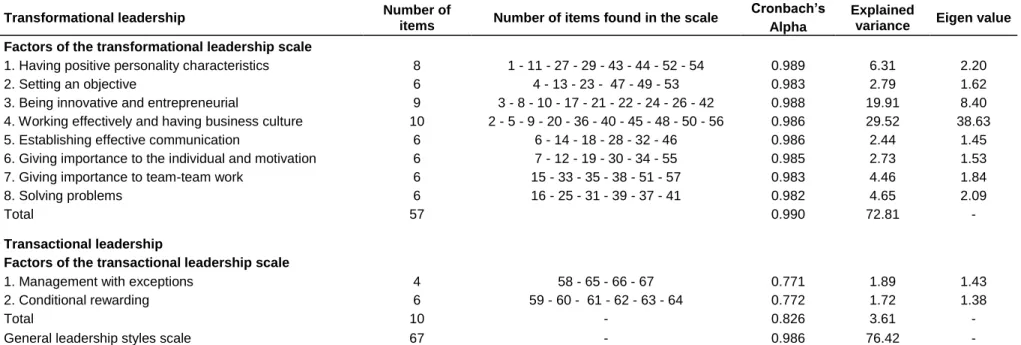
researches.Therawformwascreatedbasedon the most prominent characteristics regarding the dimensions of leadership styles because it was not possible to separate the dimensions of leadership styles by certain boundaries. The scale form was reduced to have 82 questions by eliminating some questions within the frame of the analyses and evaluations carried out and the opinions and suggestions received from educational managers and teachers. An 82-question form was examined by three faculty members who are experts in the field of educational management, two experts who graduated from Department of Turkish Language and Literature and a Turkish teacher, and the number of questions was reduced to 71. Then, the scale was applied to 30 teachers to determine whether there was any question which was incom-prehensible or difficult to understand. As a result of this application, the scale was reduced to 67 questions in accordance with the teachers' opinions and suggestions. The sample items regarding the dimensions of the leadership styles scale are shown in Table 1.
The leadership styles scale was designed as 5 point likert scale and scored as strongly disagree (1), disagree (2), neutral (3), agree (4), strongly agree (5) (Tavşancıl, 2006). Due to the fact that answers representing the points of minimum 1 and maximum 5 were given to the questions and a total of one index was formed, grading was performed as following starting from 1 in the point range of 4/5 = .80: 1) 1.00 – 1.80 = Very low level; 2) 1.81 - 2.60 = Low level; 3) 2.61 – 3.40 = Medium level; 4) 3.41 – 4.20 = High level; 5) 4.21 – 5.00 = Very high level (İslamoğlu and Alnıaçık, 2013).
By receiving expert opinions to ensure the scope and the evident validity of the scale, the validity was examined to analyze which characteristics was measured by the scope and scale to represent the subjects that judgment items aimed to measure evenly (Tavşancıl, 2006: 35). The exploratory factor analysis was carried out to ensure the validity of the scale and to form the subscales. Factor analysis is a statistical technique which aims to measure by bringing together the variables that measure the same structure or the quality, and to explain with few factors (Tavşancıl, 2006; Özdemir, 2013). The criteria regarding the fact that items to be included in each factor would be consistent in terms of meaning and content, factor eigenvalues would be 1 or above 1, and an item would have a factor load of “.40” and more in the factor it would be included were taken into consideration while performing the exploratory factor analysis (Ira and Şahin, 2011; Büyüköztürk, 2002). The SPSS 17.0 program was used in the analysis of data, the arithmetic mean, percentage, KMO, Bartlett test, factor analysis and reliability analyses were performed. The construct validity of the scale was tested by factor analysis, and its internal consistency was tested by Cronbach's alpha reliability coefficient. The pre-assessment of the scale was performed by applying the scale to 150 teachers who were willing and eager on this subject. As a result of this application, the overall Cronbach's α coefficient of the leadership styles scale was found to be 0.986, the Cronbach's α coefficient of transformational leadership was found to be 0.990, and the Cronbach's α coefficient of transactional leadership was found to be 0.826. To conform with the protocol in relation to the factor analysis, the adequacy of the data was investigated with Kaiser-Meyer-Olkin (KMO test), and the fact that data come from the multivariate normal distribution was investigated with Barlett Test of Sphericity. The fact that the value found as a result of the KMO test gets close to 1 is evaluated as perfect, where, if it remains below 0.50 it is evaluated as unacceptable, and the fact that Barlett Test is significant shows the significance level of the data (Tavşancıl, 2006). As a result of the analysis: 1) Leadership styles scale KMO value 0.926 and Barlett Test of Sphericity (p: 0.000) were found to be significant. 2) Transformational leadership styles scale KMO value 0.906 and Barlett Test of Sphericity (p: 0.000) were found to be significant. 3) Transactional leadership styles scale KMO value 0.773 and Barlett Test of Sphericity (p: 0.000) were found to be significant. These results obtained show
that there was sufficient correlations between items to be able to perform factor analysis (Büyüköztürk, 2002).
The Principal Component Analysis Method and Varimax Rotation were used to determine the construct validity of the scale (İra and Şahin, 2011; Gülbahar and Büyüköztürk, 2008; Usluel and Vural, 2009; Kılıçer and Odabaşı, 2010). As a result of the factor analysis carried out, the factor loads of the items resulted between 421 and 795. The factor loads of the items in the scale are above the desired level (Şanslı, 2012; Özdemir, 2013; İslamoğlu and Alnıaçık, 2013). As a result of the analysis, a 10-factor structure that explained 76.42% of the total variance and had an eigenvalue of above 1.00 was obtained. These factors were evaluated in two sub-categories including transformational leadership (8 sub-dimensions) and transactional leadership (2 sub-dimensions) in accordance with the literature (Bass, 1997a; Bass and Avolio, 1993). The data regarding the leadership styles scale which was obtained as a result of the application of the leadership styles scale to the target audience, the sub-dimensions of the scale, reliability values, variances and eigenvalues are shown in Table 2:
Organizational citizenship behaviors scale
The subject headings, sub-dimensions, content, style and format of questions regarding the scale which was desired to develop were analyzed by reaching the domestic and international sources and researches.Theraw formwascreated based on the most prominent characteristics regarding the dimensions of organizational citizenship behaviors because it was not possible to separate the dimensions of organizational citizenship behaviors by certain boundaries. The scale form was reduced to have 109 questions by eliminating some questions within the frame of the analyses and evaluations carried out and the opinions and suggestions received from educational managers and teachers. 109-question form was examined by three faculty members who are experts in the field of educational management, two experts who graduated from Department of Turkish Language and Literature and a Turkish teacher, and the number of questions was reduced to 92. Then, the scale was applied to 30 teachers to determine whether there was any question which was incomprehensible or difficult to understand. As a result of this application, the scale was reduced to 88 questions in accordance with the teachers' opinions and suggestions. The sample items regarding the dimensions of the organizational citizenship behaviors scale are given in Table 3.
Similar steps in the leadership styles scale were followed and applications were carried out while developing the organizational citizenship behaviors scale. The five point likert scale was used in the organizational citizenship behaviors scale (Tavşancıl, 2006), and the required index was created by the question scoring ranging between 1 and 5 (İslamoğlu and Alnıaçık, 2013). The expert opinions were received to ensure the scope and the face validity of the scale (Tavşancıl, 2006: 35); the exploratory factor analysis was carried out to ensure construct validity and to form the subscales (Tavşancıl, 2006; Özdemir, 2013; Ira and Şahin, 2011; Büyüköztürk, 2002). SPSS 17.0 program was used in the analysis of data, the arithmetic mean, percentage, KMO, Bartlett test, factor analysis and reliability analyses were performed. The construct validity of the scale was tested by factor analysis, and its internal consistency was tested by Cronbach's alpha reliability coefficient. The pre-assessment of the scale was performed by applying the scale to 150 teachers who were willing and eager in relation to this subject. As a result of this application, reliability of organizational citizenship behavior scale Cronbach's α coefficient was found to be.949. In conformance with the data to the factor analysis, the adequacy of the data was investigated with KMO test, and the fact that data come from the multivariate normal distribution was investigated with Barlett Test of Sphericity (Tavşancıl, 2006). As a result of the analysis, KMO value 0.953 and Barlett Test of Sphericity (p: 0.000)
1014 Educ. Res. Rev.
Table 1. Sample items regarding the dimensions of the leadership styles scale.
Sample items regarding the dimensions of the transformational leadership scale
1. Having Positive Personality Characteristics
My manager has high self-confidence. My manager is helpful.
2. Setting an objective
My manager has applicable objectives.
My manager does strategic planning in line with the objectives set.
3. Being Innovative and Entrepreneurial
My manager can rapidly adapt to the innovation and changes required by the time. My manager supports new ideas.
4. Working Effectively and Having Business Culture
My manager is a model for the employees in terms of personal and institutional aspects. My manager works depending on the institution's mission and values.
5. Establishing Effective Communication
My manager shows that he values employees while communicating with them. My manager carefully listens to the answerer.
6. Giving Importance to the Individual and Motivation
My manager treats employees by considering individual differences.
My manager rapidly appreciates the successful efforts and rewards when needed.
7. Giving Importance to Team-Team Work
My manager includes those people with whom he works into the management process. My manager makes an effort for the formation of unity and solidarity among employees.
8. Solving Problems
My manager does not give sudden and impulsive decisions related to the problems encountered. My manager gives confidence to the group by maintaining his calmness against problems.
Sample items regarding the dimensions of the transactional leadership scale
1. Management with exceptions
My manager does not intervene in the management unless it is necessary.
My manager intervenes in processes when things go wrong or standards are not met.
2. Conditional rewarding
My manager gives clear information about the rewards and punishments that employees will receive in achieving or failure to achieve the objectives.
My manager performs rewarding and punishing within the framework of the rules established.
were found to be significant. This shows that there was sufficient correlations between items (Büyüköztürk, 2002) to be able to perform factor analysis. Principal Component Analysis Method and Varimax Rotation were used to determine the construct validity of the scale (İra and Şahin, 2011; Gülbahar and Büyüköztürk, 2008; Usluel and Vural, 2009; Kılıçer and Odabaşı, 2010). As a result of the factor analysis, the factor loads of the items resulted between 457 and 835. The factor loads of the items in the scale are above the desired level (Şanslı, 2012; Özdemir, 2013; İslamoğlu and
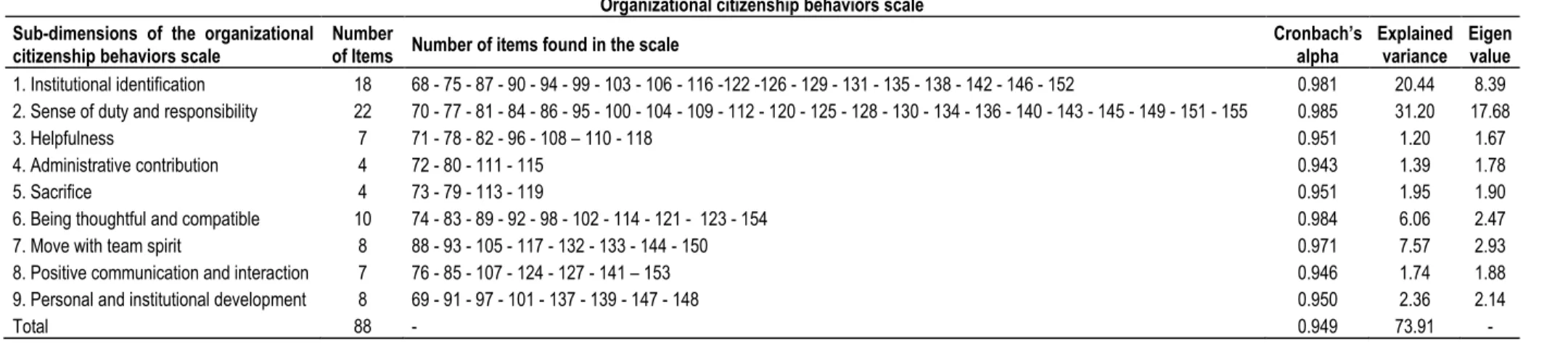
Alnıaçık, 2013). As a result of the analysis, a 9-factor structure that explained 73.91% of the total variance and had an eigenvalue of above 1.00 was obtained. These factors were evaluated in 9 sub-dimensions in accordance with the literature (Bateman and Organ, 1983; Podsakoff et al., 1997; DiPaola and Tschannen-Moran, 2001; DiPaola and Hoy, 2005). The data regarding the organizational citizenship behavior scale which was obtained as a result of the application of the organizational citizenship behavior scale to the target audience, the sub- dimensions of the scale, reliability values,
Table 2. Dimensions, number of items, Cronbach's Alpha values, explained variance values and Eigenvalues of the leadership styles scale.
Transformational leadership Number of
items Number of items found in the scale
Cronbach’s Alpha
Explained
variance Eigen value Factors of the transformational leadership scale
1. Having positive personality characteristics 8 1 - 11 - 27 - 29 - 43 - 44 - 52 - 54 0.989 6.31 2.20
2. Setting an objective 6 4 - 13 - 23 - 47 - 49 - 53 0.983 2.79 1.62
3. Being innovative and entrepreneurial 9 3 - 8 - 10 - 17 - 21 - 22 - 24 - 26 - 42 0.988 19.91 8.40
4. Working effectively and having business culture 10 2 - 5 - 9 - 20 - 36 - 40 - 45 - 48 - 50 - 56 0.986 29.52 38.63
5. Establishing effective communication 6 6 - 14 - 18 - 28 - 32 - 46 0.986 2.44 1.45
6. Giving importance to the individual and motivation 6 7 - 12 - 19 - 30 - 34 - 55 0.985 2.73 1.53
7. Giving importance to team-team work 6 15 - 33 - 35 - 38 - 51 - 57 0.983 4.46 1.84
8. Solving problems 6 16 - 25 - 31 - 39 - 37 - 41 0.982 4.65 2.09
Total 57 0.990 72.81 -
Transactional leadership
Factors of the transactional leadership scale
1. Management with exceptions 4 58 - 65 - 66 - 67 0.771 1.89 1.43
2. Conditional rewarding 6 59 - 60 - 61 - 62 - 63 - 64 0.772 1.72 1.38
Total 10 - 0.826 3.61 -
General leadership styles scale 67 - 0.986 76.42 -
Table 3. Sample items regarding the dimensions of the organizational citizenship behaviors scale.
Sample items regarding the dimensions of the organizational citizenship behaviors scale
1. Institutional Identification
The vision, mission and values of my institution are important for me. There is a strong bond between my institution and me.
2. Sense of Duty and Responsibility
I completely fulfill my duties and responsibilities for the success of my institution. I make use of working hours in the most efficient way, I do not waste time.
3. Helpfulness
When someone asks me for help, I gladly fulfill it. I help beginners about adaptation to the institution.
4. Administrative Contribution
1016 Educ. Res. Rev.
Table 3. Cont’d
I support the management for the continuation of unity and solidarity and avoiding damage to the positive atmosphere in the institution.
5. Sacrifice
I will be happy to work additionally for the success of the institution.
When my personal preferences are confronted with the interests of the institution, I act in accordance with the interests of the institution by sacrificing my personal preferences.
6. Being Thoughtful and Compatible
I know that being thoughtful and compatible is important in institutional success. I avoid attitudes and behaviors that will damage the working atmosphere.
7. Move with Team Spirit
I try to fulfill works and duties with the understanding of team spirit. I try to act in unity and solidarity with all employees in the institution.
8. Positive Communication and Interaction
I am always careful to be positive and compatible in relationships I establish with my environment. I try to create a compromising environment which is far from the conflict in the institution.
9. Personal and Institutional Development
I know that the more I develop myself, the more I will contribute to my institution.
I fondly participate in in-service trainings courses and programs organized for the individual and institutional development.
variances and eigenvalues are shown in Table 4.
FINDINGS
Theperceptionofaverageofteachers participating in the research regarding the transformational and transactional leadership characteristics of school principals and the average of exhibiting organizational citizenship behaviors is high. There is a positive highly significant relationship between the transformational and transactional leadership characteristics and organizational citizenship behaviors of school principals. Transformational leadership affects the level of organizational
citizenship more positively compared to transactional leadership. The results obtained from the statistical analyses carried out in accordance with the research problem are shown in tables.
The perception levels of teachers regarding the leadership styles of school managers are seen in Table 5.
The perception average of teachers regarding the transformational leadership is ( = 3.94), their perception average regarding the transactional leadership is ( = 3.77), their perception average regarding the general leadership styles scale is
( = 3.92); and the answers given to the items in the scale vary between the highest ( = 4.11) and the lowest ( = 3.61). Teachers’ perceptions on the general leadership, transformational and transactional leadership of the school principals are high.
The perception levels of teachers regarding the organizational citizenship behaviors are seen in Table 6.
Teachers' average of exhibiting organizational citizenship behavior is ( = 4.36), and the answers given to the items in the scale vary between the
Table 4. Dimensions, number of items, Cronbach's alpha values, explained variance values and Eigen values of the organizational citizenship scale.
Organizational citizenship behaviors scale Sub-dimensions of the organizational
citizenship behaviors scale Number of Items Number of items found in the scale Cronbach’s alpha Explained variance Eigen value
1. Institutional identification 18 68 - 75 - 87 - 90 - 94 - 99 - 103 - 106 - 116 -122 -126 - 129 - 131 - 135 - 138 - 142 - 146 - 152 0.981 20.44 8.39 2. Sense of duty and responsibility 22 70 - 77 - 81 - 84 - 86 - 95 - 100 - 104 - 109 - 112 - 120 - 125 - 128 - 130 - 134 - 136 - 140 - 143 - 145 - 149 - 151 - 155 0.985 31.20 17.68
3. Helpfulness 7 71 - 78 - 82 - 96 - 108 – 110 - 118 0.951 1.20 1.67
4. Administrative contribution 4 72 - 80 - 111 - 115 0.943 1.39 1.78
5. Sacrifice 4 73 - 79 - 113 - 119 0.951 1.95 1.90
6. Being thoughtful and compatible 10 74 - 83 - 89 - 92 - 98 - 102 - 114 - 121 - 123 - 154 0.984 6.06 2.47
7. Move with team spirit 8 88 - 93 - 105 - 117 - 132 - 133 - 144 - 150 0.971 7.57 2.93
8. Positive communication and interaction 7 76 - 85 - 107 - 124 - 127 - 141 – 153 0.946 1.74 1.88
9. Personal and institutional development 8 69 - 91 - 97 - 101 - 137 - 139 - 147 - 148 0.950 2.36 2.14
Total 88 - 0.949 73.91 -
Table 5. Perception levels of teachers regarding the leadership styles of school managers.
Leadership styles S
Transformational leadership 3.94 61.91
Transactional leadership 3.77 9.80
General leadership styles scale 3.92 70.42
Table 6. Perception levels of teachers regarding the organizational citizenship behaviors.
Organizational citizenship behaviors S
Organizational citizenship behaviors 4.36 73.65
highest ( = 4.54) and the lowest ( = 3.96). Teachers' average of exhibiting organizational citizenship behavior is high.
The relationship between the leadership styles
and the organizational citizenship behaviors of school principals according to teachers' perceptions is shown in Table 7.
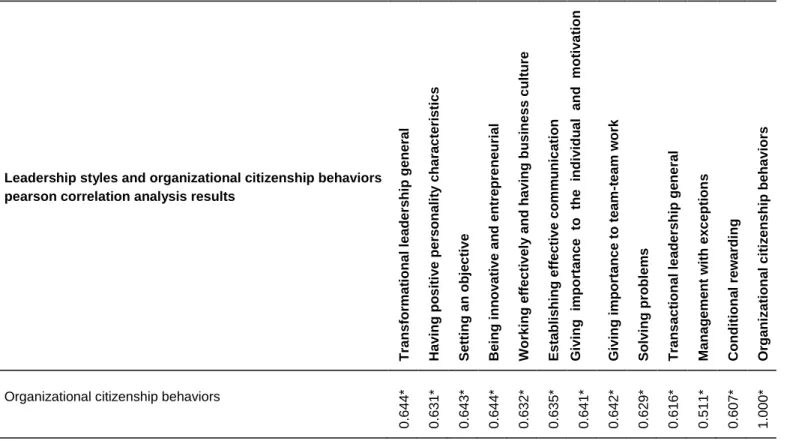
According to the Pearson correlation analysis carried out to determine the degree and direction
of the relationship between the variables, there was a significant positive relationship between Leadership styles and its sub-dimensions and the organizational citizenship behaviors. There was a strong, positive and significant relationship
1018 Educ. Res. Rev.
Table 7. Pearson correlation analysis explaining the relationship between the leadership styles and the organizational citizenship.
Leadership styles and organizational citizenship behaviors pearson correlation analysis results
Tra ns form a tio na l l e a d e rsh ip g e ne ral Hav in g po s iti v e p e rs on a li ty c ha rac te ri s tic s Se ttin g a n o bj e c tiv e Bei ng i nn ov a ti v e a n d e ntre p re ne uria l Wo rki ng e ffe c ti v e ly a nd h a v ing b us ine s s c ul ture Es ta bl is hi ng e ffe c ti v e c om m un ic a tio n G iv in g im po rtan c e to the ind iv id u a l a nd m oti v a tio n G iv in g im p orta nc e to te a m -t e a m work Sol v in g pro bl e m s Tra ns a c tio na l le a d e rsh ip ge ne ral M a na g e m e nt w ith e x c e pti on s Cond iti on a l rew a rdin g O rga ni z a tio na l c iti z e ns hi p b e ha v io rs
Organizational citizenship behaviors
0 .6 4 4 * 0 .6 3 1 * 0 .6 4 3 * 0 .6 4 4 * 0 .6 3 2 * 0 .6 3 5 * 0 .6 4 1 * 0 .6 4 2 * 0 .6 2 9 * 0 .6 1 6 * 0 .5 1 1 * 0 .6 0 7 * 1 .0 0 0 * *P < .05.
between the transformational leadership and the organizational citizenship behavior(r=0.644, p<0.05). There are relationships between the transformational leadership sub-dimensions and organizational citizenship behavior; these are; (1) Having Positive Personality Characteristics (r=0.631, p<0.05), (2) Setting an objective (r=0.643, p<0.05), (3) Being Innovative and Entrepreneurial (r=0.644, p<0.05), (4) Working Effectively and Having Business Culture (r=0.632, p<0.05), (5) Establishing Effective Communication (r=.635, p<.05), (6) Giving Importance to the Individual and Motivation (r=0.641, p<0.05), (7) Giving Importance to Team-Team Work (r=0.642, p<0.05), (8) Solving Problems (r=0.629, p<0.05). These data show us that there are also strong, positive and significant relationships between the transformational leadership sub-dimensions and the organizational citizenship behavior. The strongest relationship between dimensions is the 3rd Dimension-Being Innovative and Entrepreneurial (r=0.644, p<0.05); the lowest relationship is 8th Dimension-Solving Problems (r=0.629, p<0.05). There is a lower but strong positively significant relationship transactional leadership and organizational citizenship behavior (r=0.616, p<0.05) compared to transformational leadership. Between the sub-dimensions of transactional leadership and organizational citizenship behavior, there is; a strong
positively significant relationship in the 1st Dimension-Management with exceptions (r=0.511, p<0.05), a strong positively significant relationship in the 2nd Dimension – Conditional rewarding (r=0.607, p<0.05). When relationship values are examined, it is seen that all of these values are lower than transformational leadership and sub-dimensions. Hence, it can be concluded that transformational leadership and its sub-dimensions affect organizational citizenship behavior more positively and significantly compared to transactional leadership and its sub-dimensions. Increasing the transformational leadership characteristics of school principals will further affect organizational citizenship behavior in school to be robust and strong.
The regression analysis regarding the fact that leader-ship styles of school principals predict the organizational citizenship behaviors according to teachers' perceptions is seen in Table 8.
Theregressionmodelestablishedissignificant because the significance level is p<0.05. According to the results of the analysis carried out for the prediction of the relationship, it was seen that there was positively moderate significant relationship between leadership styles and organizational citizenship behavior. R2 value which is stated as the explanatory power of the model was calculated as 0.429 (R= 0.655; R2 = 0.429; p<0.05).
Table 8. Regression analysis regarding the fact that leadership styles predict the organizational citizenship.
Model B Std. Error β t p
Transformational leadership 0.438 0.438 0.360 12.142 0.00
Transactional leadership 1.397 0.238 0.212 6.595 0.00
R = 0.655, R2 = 0.429, F = 645.958. р < 0.05. aIndependent Variable: Leadership Styles (Transformational Leadership - Transactional Leadership). bDependent Variable: Organizational Citizenship.
This value shows that 43% of organizational citizenship variable (variance) was explained by the independent variables in the model, that is, leadership styles. For the independent variables included in the regression model; Transformational Leadership Beta coefficient= 0.360; Transactional Leadership Beta coefficient= 0.212 (p<0.05). Accordingly, Transformational Leadership and Transactional Leadership are p<0.05, they have a significant effect on organizational citizenship behavior. These coefficients can be interpreted as follows: a one-unit increase in transformational leadership causes a 0.360-unit increase on organizational citizenship behavior when the effect other variables in the model are fixed (Because the sign of the standardized beta coefficient is positive and p<0.05). Similarly, a one-unit increase in transactional leadership causes a 0.212-unit increase on organizational citizenship behavior (Because the sign of the standardized beta coefficient is positive and p<0.05).
DISCUSSION
This research was carried out to determine the relation-ship between the transformational and transactional leadership characteristics of school principals and teachers' organizational citizenship behaviors according to the teachers' perceptions. According to the result of this research, the perception averages of teachers regarding the general leadership styles of the school principals, both for the transformational leadership and the transactional leadership is high. These results concur with the research results of Oğuz (2011), Şahin (2005, 2011), Buluç (2009), Tahaoğlu and Gedikoğlu (2009), Cerit (2008), Ceylan et al. (2005), Cemaloğlu (2007a), Ergin and Kozan (2004), Çelik and Eryılmaz (2006) and Akbaba-Altun (2003). This situation is quite important for the education and training system in Turkey. Since the researchfindingssupporttheassertionthatthe leadership skills and capacity of school principals are perceived to be very important, these will strongly support the current training and education activities in schools, will contribute to the formation of a healthy school climate and should have a consequential positive effect upon the student success (Şahin, 2011c: 131). There are significant connections between the transformational leadership and transactional leadership with structures and the success or failure of institutions (Şahin, 2005: 46). Transfor-mational leadership and transactional leadership have
separateeffectsoninstitutionalstructuresand institutional culture (Tahaoğlu and Gedikoğlu, 2009: 293). The stronger the transformational leadership characteristics of school principals are, the higher organizational trust, commitment exhibited by teachers (Buluç, 2009: 26), organizational citizenship behavior (Oğuz, 2011: 395), job satisfaction (Yılmaz and Ceylan, 2011: 291); positive and healthy organizational structure, climate and culture (Şahin, 2004b: 383; Şahin, 2010: 566; Şahin, 2011: 1919; Korkmaz, 2005: 412; Cemaloğlu, 2007a: 83; Koşar and Çalık, 2011: 596), learning and constantly self-improving organization characteristics (Arslan and Uslu, 2014: 351; Korkmaz, 2008: 91) and performance and success indices of the organization (Korkmaz, 2006: 520) are.
Based on all these research results, it is evident that the leadership characteristics of school principals directly and very significantly affect the organizational trust, commitment and citizenship felt in the school especially those working in the school, school culture and climate and the quality of education and training. The personal and professional characteristics of the school principals, the communication and management styles they use significantly determine the material and spiritual characteristics of the school and the physical and psychological structure of all staff in the school. The leadership characteristics of school principles are evidently a source of inspiration for teachers that serves to guide and inspire them.
Besides this, the research findings support the assertion that the leadership characteristics of school principals are the driving force of institutional change and provide the means to solve the problems in the fastest and most efficient way. The leadership characteristics of successful and effective school principals bring together all material and spiritual elements of the school like cement and these form a coherence and integrity for the learning community. The transformational leadership style exhibited by school principals working in educational institutions positively affects the school and all related stakeholders. This situation is positively reflected on teachers and employees and supports the success of education and training.
According to these research results, teachers' capacity to exhibit organizational citizenship behavior is strong, when they are well led. This result shows similarity with the research results of Oğuz (2011), Polat and Celep (2008), Özdevecioğlu (2003), Taştan and Yılmaz (2008), Buluç (2008), Akyüz (2012), Arlı (2011), Yıldırım (2012),
1020 Educ. Res. Rev.
Polat (2009), Korkmaz (2011) and Dilek (2005). The high level of organizational citizenship behavior in institutions is extremely important and necessary for institutional success and productivity (Konovsky and Organ, 1996; MacKeinzce et al., 1998).
The organizational citizenship behaviors exhibited in educational institutions positively affect the healthy functioning and success of the institutions (Avcı, 2015f; 19). When viewed from this aspect, the importance and necessity of promoting and increasing organizational citizenship behaviors in educational institutions for more productive education system becomes clear, in order to work towards increasing the quality of education and for the establishment of quality and success-oriented school culture (Çetin et al., 2003; Özdevecioğlu, 2003; Sezgin, 2005; Polat and Celep, 2008; Buluç, 2008; Yılmaz and Taşdan, 2009; Titrek et al., 2009; Yılmaz, 2009).
However, with all these, it should not be forgotten that leadership is very important for the creation of a healthy education and training climate in educational institutions. Because school management and leaders are key determinants in establishing and maintaining the organizational citizenship and the positive organizational culture in institutions (Oğuz, 2011), establishing organi-zational citizenship behaviors in institutions is not easy without effective leadership of the school principal and school management, and likewise the continuation of the established organizational citizenship behaviors seems impossible. When the issue is considered from this point of view, effective leadership is virtually the locomotive, guide,directorandtheshaperoforganizational citizenship behaviors (Arslantaş and Pekdemir, 2007; Bolat et al., 2009; Aslan, 2009; Oğuz, 2011). The job satisfaction, leadersupport,organizationaljustice,organizational trust, organizationalcommitment,positiveorganizational culture and positive organizational communication in institutions make significant contributions to the formation and sustainability of organizational citizenship behaviors (Smith et al., 1983; Organ and Ryan, 1995; Konovsky and Organ, 1996; Netemeyer et al., 1997; MacKeinzce et al., 1998). These data suggest that all institutions in our country especially educational institutions should better recognize and understand the organizational citizenship behaviors, antecedents and consequences of these behaviors. Nevertheless, these data suggest that the critical role of organizational citizenship behaviors in the success of the institution should be realized and they play a key role on achieving institutional objectives. Along with all these, we see that the main point that should be pointed out that the organizational citizenship behaviors is the importance of the implementation of efficient and effective leadership styles in institutions.
According to this research result, there is a high, positive and significant relationship between the transfor-mational and transactional leadership characteristics of school principals and organizational citizenship behaviors of teachers. Teachers' level of organizational citizenship
behavior increases as their transformational and transactional leadership perceptions increase. The perceived transformational leadership positively affects more organizational citizenship levels compared to transactional leadership. According to the result of the analysis carried out for the prediction of the relationship betweenthetransformationalandtransactional leadership characteristics of school principals and the organizational citizenship, it is seen that there is a positive and moderate significant relationship between leadership styles and organizational citizenship behavior. R2 value which is stated as the explanatory power of the model was calculated as 0.429. This value shows that 43% of organizational citizenship variable (variance) was explained by the independent variables in the model, that is, leadership styles. These results show similarity with the research results of Oğuz (2011) examining the transformational and transactional leadership styles and organizational citizenship behaviors, of Arslantaş and Pekdemir (2007) examining the transformational leader-ship styles and organizational citizenleader-ship behaviors, of Aslan (2009) examining the charismatic leadership and organizationalcitizenshipbehaviors,ofBolatand Seymen (2009) examining the empowering leadership behaviors and organizational citizenship behaviors, of Nguni et al. (2006) examining the transformational and transactional leadership and organizational citizenship behaviors, of Koh et al. (1995) examining the transformational leadership and teacher behaviors, of Bogler (2001) examining the leadership styles and teacher behaviors, and of Leithwood and Jantazi (2006) examining the transformational leadership and teacher behaviors.
Transformational leadership is vitally important for the accurate guidance and support of teachers who are the most valuable resources of educational institutions, the establishment of organizational citizenship, the creation of a positive organizational culture and the establishment of healthy school climate. Today, leadership and organizational citizenship behavior are the most significant actors in the management of institutions. Leadership ensures the management of the human factor in the institution, and the organizational citizenship behavior ensures the guidance and control of them. The fact that teachers perceive school principals as transformational leaders at high levels directly affects the level of organizational citizenship. The higher the transformational leadership characteristics of school principals are, the higher the level of organizational citizenship behavior exhibited by teachers, the positive and healthy organizational structure and the performance and success indices of the organization are. The opposite of this determination is also true; in other words, the low level perception of the transformational leadership nega-tively affects the organizational citizenship, decreases the level of organizational citizenship, damages to the positive and healthy organizational structure and reduces the performance and success indices of the organization.