Sending Date / Gönderim Tarihi: 11/11/2019 Acceptance Date / Kabul Tarihi: 13/03/2020
DOI Number:https://doi.org/10.21497/sefad.755495
Giving up or Pursuing Translation? The Impact of Strategic Competence
on Motivational Persistence
Dr. Ayşe Işık Akdağ
Istanbul University, School of Foreign Languages
Abstract
This study aims to analyse the strategic competence that Translation Studies students develop during the translator training process according to some variables and to explore its impact on the pursuit of translation goals. Research data was collected using the Metacognitive Learning Scale developed by Namlu (2004) and the Motivational Persistence Scale adapted into Turkish by Saricam et al. (2014). Research is conducted with 214 students enrolled in the English, French and German departments of Translation Studies in a public university using the relational screening model and correlational survey method. Results show that trainee translator’s strategic competence does not vary by department or class but by gender, age and academic achievement. General strategic competence and planning strategies of female translator candidates were higher than males and students’ strategic competence mean is slightly above the average. Another result was that when strategic competence increases, motivational perseverance increases accordingly. Furthermore, students using planning strategies or organizational strategies are more likely to pursue current and distant translation goals. Students using supervision or evaluation strategies on the other hand, can return to unresolved past goals in addition to going after current and long-term translation goals.
Keywords: Strategic competence, BA level translator training, Translation Studies, metacognition, motivational persistence.
Çeviriye Tamam mı Devam mı? Stratejik Edincin Motivasyonel Kararlılığa
Etkisi
Öz
Bu çalışma Çeviribilim Bölümlerinde okuyan öğrencilerin çeviri eğitimi süresince geliştirmekte oldukları stratejik edinci çeşitli değişkenlere göre incelemeyi ve stratejik edincin çeviri kararlarına etkisini incelemeyi amaçlamaktadır. Araştırma verileri Namlu (2004) tarafından geliştirilen Biliş Ötesi Öğrenme Stratejileri Ölçeği ve Saricam et.al (2014) tarafından Türkçeye uyarlanan Motivasyonel Kararlılık Ölçeği kullanılarak toplanmıştır. Bir devlet üniversitesinin Almanca, Fransızca ve İngilizce Mütercim Tercümanlık bölümlerine kayıtlı 214 Çeviribilim öğrencisinin katıldığı araştırmada ilişkisel tarama ve korrelasyonel tarama modelleri kullanılmıştır. Sonuçlar öğrencilerin stratejik edinçlerinin cinsiyet, yaş ve akademik başarıya göre değiştiğini ancak, sınıf ya da bölüme göre değişmediğini
göstermektedir. Kadın çevirmen adaylarının genel stratejik edinç ortalamaları ve planlama stratejileri erkek adaylara göre daha yüksektir ve tüm öğrencilerin stratejik edinç düzeyleri ortalamanın biraz üzerindedir. Bir başka sonuçsa stratejik edinç yükseldiğinde motivasyonel kararlılığın da yükseldiği yönündendir. Ayrıca, planlama ya da düzenleme stratejileri kullanan öğrenciler mevcut ve uzun vadeli çeviri hedeflerini takip etmeye daha yakındırlar. Öte yandan, denetleme ve değerlendirme stratejilerini kullanan öğrenciler mevcut ve uzak çeviri hedeflerini takip etmenin yanı sıra geçmişteki çözüme kavuşmamış çeviri hedeflerine de geri dönebilmektedirler.
Anahtar Kelimeler: Stratejik edinç, lisans düzeyinde çeviri eğitimi, Çeviribilim, üstbiliş, motivasyonel kararlılık.
INTRODUCTION
One of the objectives of translator training is to help students acquire translation competence (Akdağ, 2016; Esen-Eruz, 2011). Several researchers have examined translation competence [TC henceforth], and many have considered it as a categorical notion composing of several sub-competences (Angelelli, 2012; Beeby et al., 2009, 2011; EMT, 2007; Göpferich, 2009; Göpferich & Jääskeläinen, 2009). Thus, they have proposed various TC models most of which include strategic competence. Strategic competence may be qualified as a chef d’orchestre of the translation process since it ensures the completion of the translation task despite many problems. Motivational persistence, on the other hand, is one’s determination to achieve goals. In short, it is the motivational attitude required to obtaining desired ends (Constantin, Holman, & Hojbotă, 2011). This study aims to explore the development of strategic competence and its interaction with motivational persistence among 214 students enrolled in the English, French; German departments of Translation Studies in a public university. It tries to answer the research question “Does the development of the strategic competence have an impact on the pursuit of translation goals?”. To do so, it seeks answers to the following sub-reserach questions:
1. What are the strategic competence levels of translator trainees?
2. Does the strategic competence of translator trainees vary according to gender, age, class and department, (i.e. English, French; German Translation Studies departments)?
3. Does the strategic competence of translator trainees predict their motivational persistence?
This study is important since no interdisciplinary research focusing on both motivational persistence and translation competence has been done before. The research has a twofold contribution to Translation Studies: First, it applies the motivation concept to translator training and investigates a possible link between strategic competence and motivational persistence. Second, it provides a thorough examination of strategic competence and exhibits its metacognitive nature.
The article begins with a literature review on strategic competence and shows its metacognitive nature and then, proceeds to motivational persistence. Next, the research model as well as data collection tools and data analysis are explained along with the findings and conclusion.
Strategic Competence in Translator Training
Being the most privileged of the sub-competences that forms the TC, strategic competence has its place in various TC models: Angelelli, PACTE research group and TransComp research group place explicitly strategic competence as a separate sub-competence in their TC models (Angelelli & Jacobson, 2009; Beeby, 2000; Beeby et al., 2003,2009,2011; Göpferich, 2009; Göpferich & Jääskeläinen, 2009). In Angellelli’s model (Angelelli & Jacobson 2009), strategic competence deals with the strategies used by translators in solving problems or with the way they approach to translation. Furthermore, strategic competence helps the translator identify the information flow in a text, establish relations between concepts, prevent interference, plan the translation task, self-edit and assess the translation. Angelelli also addresses the technical and social skills, such as recognizing and using translation tools, managing human resources, obtaining the necessary information from third parties, and working as a group member in strategic competence.
Thus, for Angelelli “strategic competence is the ability to exercise conscious control over linguistic, cultural, field, and instrumental knowledge” (Angelelli & Jacobson; 2009, p.37).
According to the PACTE research group (Process of Acquisition of Translation Competence and Evaluation), strategic competence is the procedural knowledge that ensures the successful completion of the translation process. It helps to identify and solve translation problems and to distinguish between the ideas in a text. Moreover, it controls the translation process by supervising the other sub-competences in the PACTE’s TC model and compensates for deficiencies. The acceptance of the translation task, planning of the process, evaluation of the outcome are all related to strategic competence. PACTE considers it to be the most important competence (Beeby, 2000; Beeby et al., 2003,2009, 2011).
The strategic competence of the TransComp group (This research group investigates the development of translation competence in a longitudinal study) is in the midst of its TC model, along with motivation. It controls the use of other sub-competences; establishes a hierarchy among competences and evaluates the appropriateness of small-scale translation decisions with large-scale translation strategies. Therefore, TransComp considers it to be a metacognitive competence (Göpferich, 2009).
A literature review showed that apart from the above-mentioned researchers who explicitly inserted strategic competence into their TC models, some others inserted the abilities pertaining to strategic competence in other competences. As an example, Schaffner (Schäffner & Adab, 2000) placed the problem-solving ability, an indicator of strategic competence, within the research sub-competence. She also included in her model the transfer competence that integrates all the other sub-competences. Vienne (1998, 2000) mentions the abilities related to strategic competence in almost all steps of his model: Identifying the appropriate translation strategy in the first step called “the ability to analyse various translation situations”, reviewing the research strategy, evaluating and exploiting the necessary resources for the execution of translation task in the step “ability to manage and process information” and finally explaining translation decisions in “ability to argue”. Likewise, EMT (2009, 2011) distributes abilities related to strategic competence in “Intercultural Competence” and in “Translation Provision Competence”: A translator can describe, evaluate translation problems and produce solution strategies; identify culture specific uses and shape the translation taking into account the text traditions; and justify the translation decisions and choices.
Strategic Competence as a Metacognitive Competence
In fact, when the definitions of the researchers are examined, it is possible to say that strategic competence is implicitly or explicitly present in TC models and is basically composed of planning, organization, supervision and evaluation processes, all of which require the effective use of metacognitive skills. Therefore, as properly put by TransComp and Angelelli, strategic competence appears to be a metacognitive competence and enables translators to exercise conscious control over the translation process. To produce a functioning text in the target culture, translators plan the translation process and plan the translation task. They use organizational strategies to establish relations between the concepts and to activate relevant sub-competences. They supervise the conformity of small-scale translation strategies to the large-small-scale translation decisions and the conformity of translation decisions with the skopos of the overall translation project. They evaluate whether a specific translation unit is a translation problem and also the appropriateness of
their translation decisions. In order to predict the development of strategic competence, we used the Metacognitive Learning Strategies Scale also consisting of planning, organizing, controlling and evaluation stages.
Researchers define metacognition as thinking beyond the cognitive level. While cognitive processes help to process, retain, and recall information, metacognitive processes presume to reflect on the act of thinking and to direct the cognitive processes. An example of a metacognitive experience is when students sense that they do not know enough about the course, make use of the cognitive strategies to learn the related course content, and ask themselves to test whether they have learned their course after the study (Flavell, 1979). While “what“ and “how” questions are being sought in cognitive learning, it is important to use “why “and “when” strategies in metacognitive learning (Levin, 1988, p. 196).
Metacognitive skills are one's ability to evaluate one's own endeavours as an observer, critic or commentator by taking a step back from activities that require intensive efforts such as learning, problem solving and communication (Goh, 2018, p. 2). Thanks to the metacognition, individuals can control, regulate or direct their cognitive processes (Flavell, Miller, & Miller, 1985). Therefore, it is clear that the metacognition plays a key role in the effective use of strategic competence.
Motivational Persistence and Translator Training
Do translator trainees equipped with a well-developed strategic competence behave the same as those with low levels of strategic competence to achieve their translation objectives? Do students demonstrate a specific pattern of behaviour in achieving the translation objectives as their strategic competence develops? One of the possible answers to these questions may be explained by the concept of motivational persistence.
Motivation theories investigate what motivates people, and to which activities this motivation drives individuals (Schunk, D. H.; Pintrich, P. R.; Meece, 2008). Individuals may be more persistent or insistent in some subjects than others, and therefore they exhibit different behaviours in determining and achieving goals. Motivational persistence is defined as the tendency of the individual to pursue targeted activities despite difficulties, obstacles, fatigue, long-term disappointment or low perception of self-sufficiency (Constantin et al., 2011). Motivational persistence is one of the most important factors that affect individuals in reaching the determined targets and solve the possible problems that may arise (Argon, İsmetoglu, Çelik Yılmaz, & Erbaş, 2015; Demir & Peker, 2017; Pintrich & Schunk, D. H., 2002; Pintrich, 2003). In this context, based on Constatin et al. (2011), motivational perseverance may be adapted to translation training as “the tendency of pursuing translation goals despite the difficulties, obstacles, and other problems in the translation process and despite the long-term disappointment or low perception of self-sufficiency”.
METHOD
In this section the research design, population and data collection tools of the study are explained.
Research Model
The present study is a quantitative study. To determine the relationship between the development of strategic competence and variables, a relational screening model was used since relational screening models are "research models aiming to determine the presence and
/ or degree of mutual exchange between two or more variables"1 (Karasar, 2017, p. 114). To
determine the relationship between motivational persistence and the strategic competence correlational survey method was used since predictive correlational studies based on one variable, try to predict the other variable in question (Büyüköztürk, Çakmak, Akgün, Karadeniz, & Demirel, 2017, p. 193).
Participant (subject) Characteristics
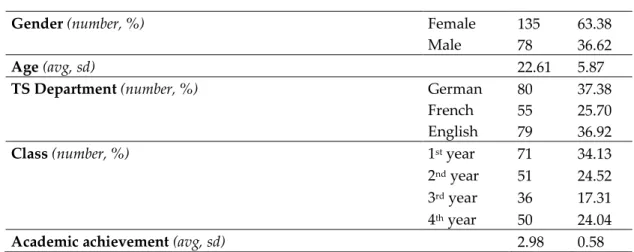
In the 2018-2019 academic year, 214 students enrolled in the Translation Studies Department of a public university participated in the research. Students were chosen by simple random sampling. Table 1 shows the age, gender and class variables of the participants.
Table 1. Participants’ Characteristics
Gender (number, %) Female 135 63.38
Male 78 36.62
Age (avg, sd) 22.61 5.87
TS Department (number, %) German 80 37.38
French 55 25.70
English 79 36.92
Class (number, %) 1st year 71 34.13
2nd year 51 24.52
3rd year 36 17.31
4th year 50 24.04
Academic achievement (avg, sd) 2.98 0.58
As can be seen in the table, 63. 38 % of the participants are female translator trainees and 36.62% are male. The average age is calculated as 22.61. Of the 214 participants 37.38 % study in German; 36. 92% in English and 25.70% in French. 34.13% of the students are in their first year; 24. 52% in the second year; 17.31 in the third year and 24. 04 % in their final year. Their last semester average is calculated as 2,98 out of 4.
Data Collection Tools
Two different data collection tools were used in the study. The Metacognitive Learning Strategies Scale was used to predict the strategic competence of the translator trainees while motivational persistence levels were determined by the Motivational Persistence Scale.
Metacognitive Learning Strategies Scale: The Metacognitive Learning Strategies Scale (MLSS) developed by Namlu (2004) consists of 21 items that measure 4 factors: planning strategies, organization strategies, supervision strategies and evaluation strategies. The researcher conducted the validity and reliability studies of the scale. Accordingly, the Kaiser-Meyer-Olkin (KMO) value was .83 and the Bartlett test result was 2715.141 (p <0.0001). Cronbach ∝ internal consistency coefficient for the whole scale .8164; for sub-factors, respectively .6909, .7397, .6748 and .4850. The scale is in the 4 response Likert model. __________
The translator trainees were asked to grade items from “1 - never” to “4- always”. The lowest score that may be taken is 21 and the highest score is 84.
Motivational Persistence Scale: The Motivational Persistence Scale (MPS) was developed by Constantin et al. (2011) and adapted into Turkish by Saricam et al. (2014). The researchers conducted the scale's validity and reliability studies. Accordingly, the linguistic equation coefficient was .88, KMO coefficient was .87 and the Bartlett Sphericity test χ was 611.798 (p <.001, sd = 78). The scale is in the 5 response Likert model and has 13 questions aiming to measure 3 dimensions: long-term purposes pursuing, current purpose pursuing and recurrence of unattained purposes. Cronbach's alpha internal consistency coefficients were calculated as .69 for the whole scale, and for the 3 dimensions .72, .70. and .71, respectively. Translator trainees were asked to grade items from “1 -I strongly disagree” to “5- I strongly agree”. The points which can be taken from the scale are in the range of 13-65.
Data Analysis
Descriptive statistics were summarized as mean, standard deviation and minimum- maximum for continuous variables (age, last semester average, scale general and sub-dimension scores). The categorical variables (gender, department and class were summarized in numbers and percentages.
The normality test of numerical variables (age, last semester average, general and sub-dimension scale scores) was checked by the Kolmogorov Smirnov test.
In the comparison of two independent groups, the Independent Samples t-test was used when the numerical variables showed normal distribution, i.e. in the comparison of scale scores (scale as general and with its sub-dimensions) with respect to gender.
In the comparisons of more than two independent groups, the One-Way ANOVA test was used to compare the general and sub-dimension mean scores of scales with respect to department and grade levels in cases where numerical variables showed normal distribution.
The Pearson Correlation Coefficient was used for the analysis of the relationships between numerical variables, i.e., age and last semester average, and the general and dimension scores of the scales, as well as the relationships between the general and sub-dimensions of the scales when there is normal distribution. Spearman’s Rho Correlation Coefficient was used in cases where the variables are not normally distributed.
Statistical analyses were performed with Jamovi project Computer Software (2019) and statistical significance was taken as 0.05 (p-value).
FINDINGS
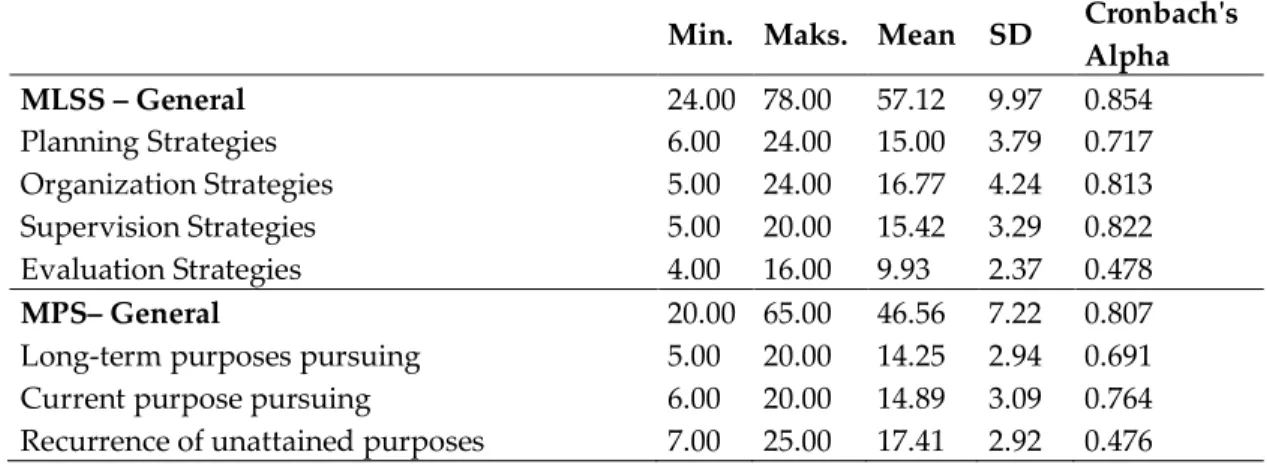
Table 2 shows the reliability coefficients with the minimum, maximum, average, standard deviation distributions of the scores obtained from the MLSS and MPS both as general and as their sub-dimensions. When the reliability analysis of the scales used in the research are evaluated (Cronbach's Alpha), it can be said that the scales are reliable.
Table 2. Distributions of the Scales and their Cronbach's Alpha value
Min. Maks. Mean SD Cronbach's
Alpha MLSS – General 24.00 78.00 57.12 9.97 0.854 Planning Strategies 6.00 24.00 15.00 3.79 0.717 Organization Strategies 5.00 24.00 16.77 4.24 0.813 Supervision Strategies 5.00 20.00 15.42 3.29 0.822 Evaluation Strategies 4.00 16.00 9.93 2.37 0.478 MPS– General 20.00 65.00 46.56 7.22 0.807
Long-term purposes pursuing 5.00 20.00 14.25 2.94 0.691
Current purpose pursuing 6.00 20.00 14.89 3.09 0.764
Recurrence of unattained purposes 7.00 25.00 17.41 2.92 0.476
Table 2 shows that the strategic competence mean of trainee translators is (X ̅=57,12) out of 84. It can be inferred that, students are apt to learn organizational strategies (X ̅=16,77). Then come supervision strategies (X ̅= 15,42) and planning strategies (X ̅=15,00). Evaluation strategies appear to be the most difficult strategy to learn (X ̅=9,93).
Table 2 also indicates the motivational persistence of translator trainees. With reference to Table 2, students have the highest mean in the recurrence of unattained purposes (X ̅=17,41) followed by current purpose pursuing (X ̅=14,89). The least preferred goal appears to be related to the pursuit of long-term purposes (X ̅=14,25).
Does the strategic competence of translator trainees vary according to gender, age, class, department and last semester average?
Table 3. MLSS according to gender Gender t p F (n=135) M (n=78) Mean SD Mean SD MLSS – General 58.27 9.41 55.17 10.69 2.185 0.030* Planning Strategies 15.71 3.55 13.81 3.93 3.586 <0.001* Organization Strategies 17.06 4.06 16.26 4.54 1.135 0.190 Supervision Strategies 15.34 3.27 15.55 3.38 -0.425 0.671 Evaluation Strategies 10.16 2.29 9.56 2.48 1.775 0.077
Not. Descriptive statistics are given as mean and standard deviation. *. p<0.05 and Independent Samples t test was used.
Table 3 shows a statistically significant difference between gender and the mean scores of general MLSS as well as planning strategies (t = 2.185 p = 0.030 and t = 3.586, p <0.001, respectively). Accordingly, the mean scores of MLSS-general and planning strategies of female translator candidates were significantly higher than males.
For other sub-dimensions of the scale namely, organizational strategies, supervision strategies and evaluation strategies no significant difference was found regarding gender (p>0.05 for each).
Table 4. MLSS according to age r p Age - MLSS- General 0.106 0.126 - Planning Strategies 0.060 0.386 - Organization Strategies 0.042 0.545 - Supervision Strategies 0.075 0.281 - Evaluation Strategies 0.163 0.019*
*. p<0.05 and Spearman’s Rho Correlation Coefficient was used.
Table 4 indicates a statistically meaningful, linear, positive, and weak relationship between the age scores of translator trainees and evaluation strategies (r=0.163 p=0.019). Accordingly, it can be said that as the age increases, the evaluation strategies scores increase as well.
On the other hand, no relation was found between the general scale scores and planning strategies, organizational strategies and evaluation strategies (p>0.05)
Table 5. MLSS according to Class
Class F p Freshman (n=71) Sophomore (n=51) Junior (n=36) Senior (n=50) 𝑿𝑿� SD 𝑿𝑿�. SD 𝑿𝑿� SD 𝑿𝑿� SD MLSS– General 57.14 8.58 58.37 9.91 57.06 11.15 55.62 10.87 0.630 0.597 Planning Strategies 15.41 3.72 15.35 3.79 14.76 3.77 14.13 3.84 1.305 0.274 Organization Strategies 16.58 3.91 17.43 3.84 16.94 4.89 16.26 4.52 0.719 0.542 Supervision Strategies 15.54 2.95 15.49 3.25 15.56 3.44 14.83 3.76 0.536 0.658 Evaluation Strategies 9.62 2.02 10.1 2.35 9.79 2.76 10.4 2.55 1.156 0.328 No statistically meaningful relationship was found between class variable and MLLS scores (p>0.05 for each).
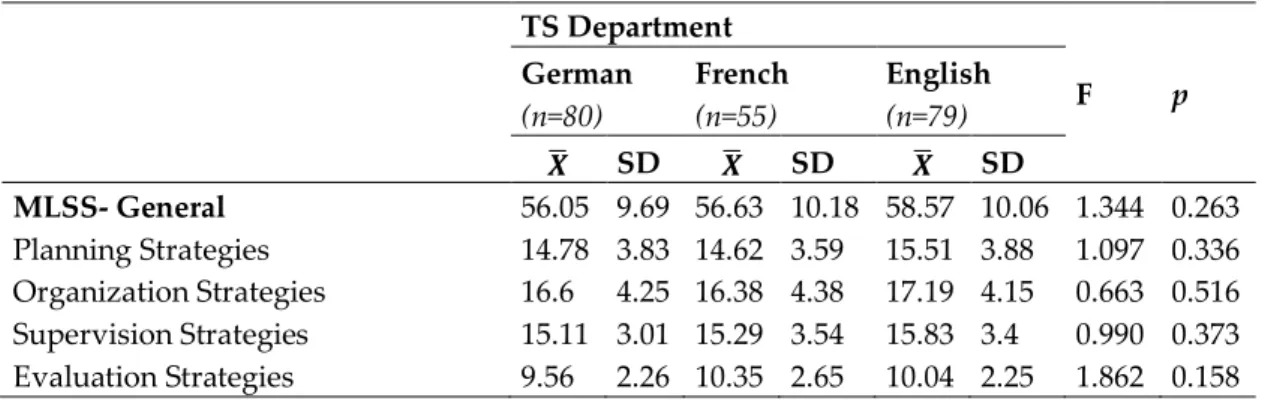
Table 6. MLSS according to Department
TS Department F p German (n=80) French (n=55) English (n=79) 𝑿𝑿� SD 𝑿𝑿� SD 𝑿𝑿� SD MLSS- General 56.05 9.69 56.63 10.18 58.57 10.06 1.344 0.263 Planning Strategies 14.78 3.83 14.62 3.59 15.51 3.88 1.097 0.336 Organization Strategies 16.6 4.25 16.38 4.38 17.19 4.15 0.663 0.516 Supervision Strategies 15.11 3.01 15.29 3.54 15.83 3.4 0.990 0.373 Evaluation Strategies 9.56 2.26 10.35 2.65 10.04 2.25 1.862 0.158 As can be seen in Table 6, strategic competence does not change according to the department of translator trainees.
Table 7. MLSS according to last semester average
r p
Last semester average
- MLSS – General 0.300 <0.001*
- Planning Strategies 0.312 <0.001*
- Organization Strategies 0.261 0.003*
- Supervision Strategies 0.162 0.072
- Evaluation Strategies 0.104 0.249
Table 7 shows a statistically meaningful, linear, positive and weak relationship between the last semester average of translator trainees and general MLSS, planning strategies and organizational strategies (respectively r=0.300 p<0.001, r=0.312 p<0.001 and r=0.261 p=0.003). Accordingly, it can be said that as the last semester average increases, strategic competence, planning and organizational strategies scores increase as well.
As far as evaluation strategies and supervision strategies are concerned no statistically meaningful difference was found.
Does the strategic competence of translator trainees predict their motivational persistence?
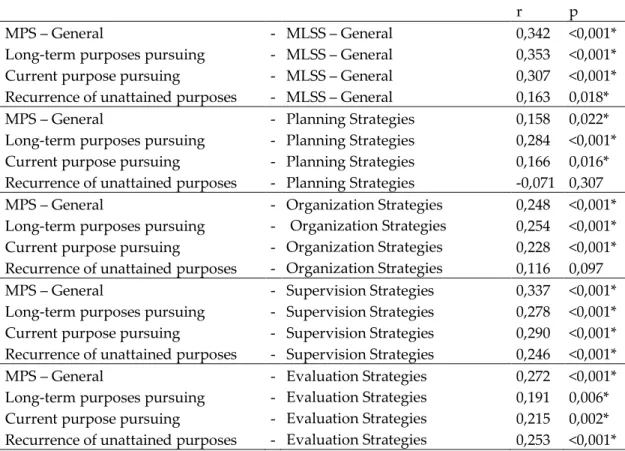
Table 8. Correlation between MLLS and MPS
r p
MPS – General - MLSS – General 0,342 <0,001*
Long-term purposes pursuing - MLSS – General 0,353 <0,001*
Current purpose pursuing - MLSS – General 0,307 <0,001*
Recurrence of unattained purposes - MLSS – General 0,163 0,018*
MPS – General - Planning Strategies 0,158 0,022*
Long-term purposes pursuing - Planning Strategies 0,284 <0,001*
Current purpose pursuing - Planning Strategies 0,166 0,016*
Recurrence of unattained purposes - Planning Strategies -0,071 0,307
MPS – General - Organization Strategies 0,248 <0,001*
Long-term purposes pursuing - Organization Strategies 0,254 <0,001* Current purpose pursuing - Organization Strategies 0,228 <0,001* Recurrence of unattained purposes - Organization Strategies 0,116 0,097
MPS – General - Supervision Strategies 0,337 <0,001*
Long-term purposes pursuing - Supervision Strategies 0,278 <0,001* Current purpose pursuing - Supervision Strategies 0,290 <0,001* Recurrence of unattained purposes - Supervision Strategies 0,246 <0,001*
MPS – General - Evaluation Strategies 0,272 <0,001*
Long-term purposes pursuing - Evaluation Strategies 0,191 0,006*
Current purpose pursuing - Evaluation Strategies 0,215 0,002*
Recurrence of unattained purposes - Evaluation Strategies 0,253 <0,001* Table 8 shows a significant, linear, positive and weak relationship between general MLSS and general MPS, long-term purposes pursuing, current purpose pursuing and recurrence of unattained purposes. This means that when strategic competence increases motivational perseverance increases as well.
Likewise, planning strategy has a significant, linear, positive and weak relationship with motivational persistence, long-term purposes pursuing and current purpose pursuing (respectively r=0.158 p=0.022, r=0.284 p<0.001 and r=0.166 p=0.016). This finding shows that if the planning strategy scores increase, motivational perseverance increases accordingly. Specifically, the higher the planning strategy scores the higher the long-term purposes pursuing and the current purpose pursuing. There was no relationship between planning strategies and recurrence of unattained purposes.
Like the planning strategy, organization strategy has a significant, linear, positive and weak relationship with motivational persistence, long-term purposes pursuing and current purpose pursuing (respectively r=0.248 p<0.001, r=0.254 p<0.001 and r=0.228 p<0.001). That is to say any rise in organization strategies’ scores brings also a rise in motivational persistence, long-term purposes pursuing and current purpose pursuing. However, organizational strategies are not statistically related to recurrence of unattained purposes.
As for the supervision strategies, a significant, linear, positive and weak relationship was observed with the metacognitive learning scale itself and all its sub-dimensions respectively r=0.337 p<0.001, r=0.278 p<0.001, r=0.290 p<0.001 and r=0.246 p<0.001). Therefore, it is possible to say that when supervision strategy scores increase, the motivational perseverance, long-term purposes pursuing, current purpose pursuing and recurrence of unattained purposes scores also increase.
Just as the supervision strategies, evaluation strategies have a significant, linear, positive and weak relationship with the metacognitive learning scale itself and all its sub-dimensions (respectively r=0.272 p<0.001, r=0.191 p=0.006, r=0.215 p=0.002 and r=0.253 p<0.001), which means that in cases where evaluation strategies score rises, motivational perseverance, long-term purposes pursuing, current purpose pursuing and recurrence of unattained purposes scores rise accordingly.
DISCUSSION
When the findings of this study were compared to other studies, some consistiences and differences were found: When metacognitive strategies forming the strategic competence of trainee translators are compared to those of teacher candidates, it can be said that the finding “female translator candidates have higher levels of strategic competence than males” is supported by other national and international studies (see Demir & Kaymak Özmen, 2011; İflazoğlu Saban & Bal, 2010; Leutwyler, 2009; Pajares ve Graham, 1999; Peklaj & Pečjak, 2002).
As for the sub-dimensions, the finding “female students are successful in planing strategies” is consistent with some studies (Karimpour, Sayad, Taheri & Aerab Sheibani, 2019; Kartal, Kayacan & Selvi, 2013; Küçük Kılıç, Cihan & Öncü, 2015) while it shows diferences with others (see Ağbuğa 2017; Okçu & Kahyaoğlu, 2007). The possible reason for this may source from different participant groups. Studies focusing on pre-service teachers have reached to similar finding with the present research while findings of the research focusing on students from different faculties or professional teachers have differentiated.
The relationship between ages scores and evaluation strategies was statistically meaningful, linear, positive and weak. This finding means that evaluation strategies are more effectively used as age increases. This result is almost consistent with the national and
international previous work stating that metacognitive abilities increase with the age and improves significantly with years of experience (see Akın & Abacı, 2011; Miles & Stine-Morrow, 2004; Stewart et al., 2007; Veenman & Spaans, 2005).
This study also showed that strategic competence neither differs by department nor by class. This finding complies with previous research (see Baykara, 2011; Deniz, Küçük, Cansız, Akgün & İşleyen, 2014; Hakan, 2016; Kartal et al., 2013; Küçük Kılıç et al., 2015; Sapancı, 2012; Okçu & Kahyaoğlu, 2007).
As for the last semester average, a statistically meaningful, linear, positive and weak relationship was found between the academic achievement of translator trainees and the general strategic competence, planning strategies and organizational strategies. This result shows consistency with the literature since a significant difference is expected in favour of students with high academic grades (see Cautinho, 2007; Case, Harris & Graham, 1992; Deseote ve Roeyers, 2002; Kartal et al., 2013; Namlu, 2004; Sapancı, 2012).
CONCLUSION
This study sought to analyse strategic competence according to such variables as gender, class, age and department and investigate the link between strategic competence and motivational perseverance. In other words, it aimed to answer the question “Does the development of the strategic competence have an impact on the pursuit of translation goals?”. To do so, a clear definition of the two concepts – to measure something, one needs to define it- and two reliable measurement instruments were needed: one for predicting the development of strategic competence and the other for determining the goal behaviour of translation trainees.
A literature review showed that strategic competence, one of the competences that forms translation competence is explicitly present in almost all of the translation competence models proposed by a working group. Individual researchers also point out the importance of this competence. Some place it explicitly in their translation competence model as do the research groups while others, due to the different grouping, distribute the abilities pertaining to it in other competences. However, in all translation competence models, abilities encompassed by strategic competence are present: planning the translation task, distinguishing between the ideas in a text, identifying and solving translation problems, self-editing, assessing the translation, supervising and integrating other sub-competences non-exhaustive list of abilities. Therefore, it can be said that strategic competence is basically composed of the planning, organization, supervision and evaluation processes.
Defined as such, the strategic competence appears to be a super competence and the abilities that it is responsible for require thinking about the conscious translation decisions, hence metacognitive skills. In other words, to evaluate what is already decided, to compensate for shortcomings, to redefine translation objectives and to adopt a new strategy if the current one becomes ineffective, to organize the translation process from the beginning to the end, and to supervise every step metacognitive skills are needed. Therefore, the Metacognitive Learning Strategies Scale which is also composed of planning, organization, supervision and evaluation strategies was used to determine the developmental levels of translator trainee’s strategic competence.
The concept of motivational persistence may be adapted to translation training as the tendency of pursuing translation goals despite the difficulties, obstacles, and other problems in the translation process and despite the long-term disappointment or low perception of self-sufficiency. To measure the goal behaviour of Translation Studies students the Motivational Persistence scale was used.
This study shows that the trainee translator’s strategic competence mean is slightly above the average (X ̅=57,12). This finding indicates that while students manage to use some strategies adequately, there are still some that need to be focused on. Namely, the most prominent strategy of translator trainees is the organizational strategy (X ̅=16,77), which is followed by the supervision strategy (X ̅= 15,42) and planning strategy (X ̅=15,00). The least prominent strategy is the evaluation strategy (X ̅=9,93). It can be inferred that students use organisation strategies to identify topics and key concepts in advance for any learning-translation activity, to establish relations between the new and already acquired knowledge, and to revise the new subject before coming to class or starting the translation. Trainee translators use, at the medium level, the supervision strategies to control what they have learned, to check whether they understand, to test the accuracy of the information by comparing it with the previous acquisitions, to determine the consistency and the hierarchical structure of the information during learning or translation. They make use of planning strategies to prepare timetables, to hand tasks in on time, to provide the necessary conditions for pre-preparation and to make mental preparation. Translator trainees have difficulty in using evaluation strategies to self-assess themselves, to detect what they have learned or have not learned, to analyse missing areas in their learning or in the translation process.
This study also shows that female translator candidates have higher levels of strategic competence than males. Specifically, planning strategy of female translator trainees comes to the forefront. It was also found that strategic competence does not vary by department or class. Therefore, one can infer that the development of strategic competence is almost the same regardless of the department.
Another finding is that a statistically meaningful, linear, positive and weak relationship was found between the age scores of translator trainees and evaluation strategies (r=0.163 p=0.019), which means that evaluation strategies are more effectively used as age increases. Therefore, it can be inferred that our result also shows the importance of expertise or experience in translation since experience is acquired by age e.g. sophomores have more translation experience than freshmen. Likewise, expert translators obviously have more experience than novice translators. Hence, age and experience entail appropriate use of evaluation strategies.
A statistically meaningful, linear, positive and weak relationship was found between the academic achievement of translator trainees and the general strategic competence, planning strategies and organizational strategies (respectively r=0.300 p<0.001, r=0.312 p<0.001and r=0.261 p=0.003). This result is logical because students equipped with developed strategic competence naturally get good grades from translation tasks. Since they can use metacognitive skills effectively, they can also assess themselves, determine their weaknesses and apply appropriate learning strategies.
In the scope of this study, a significant, linear, positive and weak relationship was discovered between general strategic competence and general motivational perseverance with all its sub-dimensions i.e. long-term purposes pursuing, current purposes pursuing and recurrence of unattained purposes. This means that when strategic competence increases motivational perseverance increases accordingly. Furthermore, students using planning strategies or organization strategies are more likely to pursue current and distant translation goals. Students using supervision or evaluation strategies, on the other hand, can return to unresolved past goals in addition to going after current and long-term translation goals. This result indicates that the higher the metacognitive thinking is, the higher the motivation increases. Therefore, improving strategic competence enables students to improve goal pursuit.
This study showed the importance of strategic competence in translator training and its effect on motivation. Based on the results, translator trainers may focus more both on the development of strategic competence in students, and on supervision and evaluation strategies to enable translator trainees to pursue a wide range of translation goals. Moreover, given that motivational persistence and strategic competence are correlated, developing strategic competence also means developing goal pursuit, hence, improving translation quality.
In this study, the concept of motivational persistence from psychology was applied to translator training. Further research may tackle other aspects of motivation. The present study covers English, French and German Translation Studies Departments; results may be extended by adding other departments.
BIBLIOGRAPHY
Ağbuğa, B. (2017). Comparison of metacognitive learning strategies of female and male university students. International Journal of Social Sciences and Education Research, 3(3), 783–791.
Akdağ, A. I. (2016). Fransızca Çeviri Eğitiminde Hedefler. Eğitim ve Öğretim Araştırmaları Dergisi, 5(2), 66–73.
Akın, A., & Abacı, R. (2011). Biliş ötesi. Ankara: Nobel Yayın Dağitim.
Angelelli, C. V. (2012). Teaching Translation and Interpreting. The Encyclopedia of Applied Linguistics. https://doi.org/10.1002/9781405198431.wbeal1176
Angelelli, C. V., & Jacobson, H. E. (2009). Testing and Assessment in Translation and Interpreting Studies: A Call for Dialogue between Research and Practice. Amsterdam/Philadelphia: John Benjamins Publishing Company.
Argon, T., İsmetoglu, M., Çelik Yılmaz, D., & Erbaş, H. (2015). High school students’ views on lifelong learning and motivational persistence levels. ICLEL 1 t International Conference on Lifelong Learning and Leadership for All October 29th -31st 2015 Palacky University & Moravian University College Olomouc, 35. Retrieved from https://www.researchgate.net/profile/Osman_Titrek2/publication/301342510_ICLEL_15 _Conference_Prooceeding_Book_ISBN/links/5713666708aeff315ba33d87.pdf#page=48 Baykara, K. (2011). A study on “teacher efficacy perceptions” and “metacognitive learning
strategies” of prospective teachers. Hacettepe University Journal of Education, 40, 80–92. Beeby, A. (2000). Evaluating the development of translation competence. Benjamins
Translation Library, 38, 185–198.
Beeby, A., Fernández, M., Fox, O., Hurtado Albir, A., Kozlova, I., Kuznik, A., … Wimmer, S. (2009). Results of the validation of the PACTE translation competence model: Acceptability and decision making. Across Languages and Cultures, 10(2), 207–230. https://doi.org/10.1556/acr.10.2009.2.3
Beeby, A., Fernández, M., Fox, O., Hurtado Albir, A., Kuznik, A., Neunzig, W., … Wimmer, S. (2011). Results of the validation of the PACTE translation competence model: Translation project and dynamic translation index. In Cognitive explorations of translation
(pp. 30–53). Retrieved from
http://grupsderecerca.uab.cat/pacte/sites/grupsderecerca.uab.cat.pacte/files/2011_PACT E_Continuum.pdf
Beeby, A., Rodríguez, M. F., Fox, O., Hurtado Albir, A., Neunzig, W., Orozco, M., … Romero, L. (2003). Building a translation competence model. In Triangulating Translation: Perspectives in Process Oriented Research (Vol. 45, pp. 43–69).
Büyüköztürk, Ş., Çakmak, E. K., Akgün, Ö. E., Karadeniz, Ş., & Demirel, F. (2017). Bilimsel araştırma yöntemleri. Pegem Akademi.
Case, L. P., Harris, K. R., & Graham, S. (1992). Improving the mathematical problem-solving skills of students with learning disabilities: Self-regulated strategy development. The Journal of Special Education, 26, 1-19.
Cautinho, S. A. (2007). The relationship between goals, metacognition and academic success. Educate, 7(1), 39–47.
Constantin, T., Holman, A., & Hojbotă, M. A. (2011). Development and validation of a motivational persistence scale. Psihologija, 45(2), 99–120.
Demir, M., & Peker, A. (2017). Motivasyonel kararlılık ile okul tükenmişliği arasındaki ilişkinin yapısal eşitlik modeli ile incelenmesi. Trakya Üniversitesi Sosyal Bilimler Dergisi, 19(1), 289–300. Retrieved from https://dergipark.org.tr/download/article-file/336940 Demir, Ö., & Kaymak Özmen, S. (2011). Üniversite öğrencilerinin üst biliş düzeylerinin
çeşitli değişkenler açısından incelenmesi. Ç.Ü. Sosyal Bilimler Enstitüsü Dergisi, 20(3), 145–160.
Deniz, D., Küçük, B., Cansız, Ş., Akgün, L., & İşleyen, T. (2014). Ortaöğretim matematik öğretmeni adaylarının üstbiliş farkındalıklarının bazı değişkenler açısından incelenmesi. Kastamonu Eğitim Dergisi, 22(1), 305–320.
Desoete, A., & Roeyers, H. (2002). Off-line metacognition – A domain-specific retardation in young children with learning disabilities. Learning Disability Quarterly, 25, 123-139. EMT. (2007). Competences for professional translators, experts in multilingual and
multimedia communication. Emt 2009, (April 2007), 7. Retrieved from http://ec.europa.eu/dgs/translation/programmes/emt/key_documents/emt_competences _translators_en.pdf
EMT. (2009). Competences for professional translators, experts in multilingual and multimedia communication.
EMT. (2011). European Master’s in translation network annual report. Esen-Eruz. (2011). Akademik çeviri eğitimi. İstanbul: Multilingual.
Flavell, J. H. (1979). Metagognition and cognitive monitoring: A new era of
cognitive-development inquiry. American Psychologist, 34(10), 906–911.
https://doi.org/10.1093/nq/CLVII.dec14.424-a
Flavell, J. H., Miller, P. H., & Miller, S. A. (1985). Cognitive development. Englewood Cliffs, NJ: Prentice-Hall.
Goh, C. C. M. (2018). Metacognition in second language listening. In The TESOL Encyclopedia of English Language Teaching, 1–7.
Göpferich, S. (2009). Towards a model of translation competence and its acquisition: the longitudinal study TransComp. Behind the Mind: Methods, Models and Results in Translation Process Research, Copenhagen Studies in Language, 4(4), 11–37.
Göpferich, S., & Jääskeläinen, R. (2009). Process research into the development of translation competence: Where are we, and where do we need to go? Across Languages and Cultures, 10(2), 169–191. https://doi.org/10.1556/acr.10.2009.2.1
Hakan, O. (2016). Evaluation of Metacognitive Competence of Pre-Service Music Teachers in Terms of Some Variables. Educational Research and Reviews, 11(8), 713-720.
İflazoğlu Saban, A., & Bal, A. P. (2010). Matematik ve sınıf öğretmenliği bölümlerinde okuyan öğrencilerin öğrenme stratejilerinin bazı sosyo-demografik özellikler açısından incelenmesi. Ege Eğitim, 11(2), 1–19.
Jamovi Project. (2019). Computer Program Version 0.9.6.9.
Karimpour, S., Sayad, A., Taheri, M., & Sheibani, K. A. (2019). A Gender Difference in Emotional Intelligence and Self-Regulation Learning Strategies: Is it true?. Novelty in Biomedicine, 7(2), 38-44.
Kartal, T., Kayacan, K., & Selvi, M. (2013). Examining the awareness levels of scientific attitudes and metacognitive learning strategies of preservice teachers from the point of multiple variables. The Journal of Academic Social Science Studies, 6(1), 913–939.
Küçük Kılıç, S., Cihan, H., & Öncü, E. (2015). Metacognitive learning strategies and academic self-efficacy of pre-service physical education teachers and their attitudes towards the profession of teaching. Hacettepe Journal of Sport Sciences, 26(3), 77–89.
Leutwyler, B. (2009). Metacognitive learning strategies: differential development patterns in high school. Metacognition Learning, 4(2), 111-123. https://doi.org/10.1007/s11409-009-9037-5
Levin, J. R. (1988). Elaboration-based learning strategies: Powerful theory= powerful application. Contemporary Educational Psychology, 13(3), 191–205. Retrieved from https://www.sciencedirect.com/science/article/pii/0361476X88900203
Miles, J. R., & Stine-Morrow, E. A. L. (2004). Adult Age Differences in Self-Regulated Learning from Reading Sentences. Psychology and Aging, 19(4), 626–636.
Namlu, A. G. (2004). Metacognitive learning strategies scale: A study of reliability and validity. Sosyal Bilimler Dergisi, 2, 123–136.
Okçu, V., & Kahyaoğlu, M. (2007). Primary school teachers’ metacognitive learning strategies. Süleyman Demirel Üniversitesi Sosyal Bilimler Enstitüsü Dergisi, 2(6), 129–146. Pajares, F., & Graham, L. (1999). Self-efficacy, motivation constructs, and mathematics
performance of entering middle school students. Contemporary educational psychology, 24(2), 124-139.
Peklaj, C., & Pečjak, S. (2002). Differences in students” self-regulated learning. Studia Psychologica, 44(1), 29.
Pintrich, P. R., & Schunk, D. H. (2002). Motivation in education: Theory,research, and applications (2nd ed). Upper Saddle River, NJ: PrenticeHall.
Pintrich, P. R. (2003). A motivational science perspective on the role of student motivation in learning and teaching contexts. Journal of Educational Psychology, 95(4), 667.
Sapancı, A. (2012). The relationship of student teachers’ epistemological beliefs and metacognitive levels with their academic achievement. CBÜ Sosyal Bilimler Dergisi, 10(1), 311–331.
Saricam, H., Akın, A., Akın, Ü., & İlbay, A. B. (2014). The validity and reliability of the turkish version of the motivational persistence scale. Turkish Journal of Education, 3(1), 60–69.
Schäffner, C., & Adab, B. (2000). Developing translation competence. Retrieved from https://scholar.google.co.uk/scholar?start=80&q=translation+studies&hl=en&as_sdt=0,5# 1
Schunk, D. H.; Pintrich, P. R.; Meece, J. L. (2008). Motivation in education: Theory, research, and applications. Englewood Cliffs, NJ: Merrill Prentice-Hall.
Stewart, P. W., Cooper, S. S., & Moulding, L. R. (2007). Metacognitive development in professional educators. The Researcher, 21(1), 32–40.
Veenman, M. V. J., & Spaans, M. A. (2005). Relation between Intellectual and Metacognitive Skills: Age and Task Differences. Learning and Individual Differences, 15(2), 159–176. Vienne, J. (1998). Vous avez dit compétence traductionnelle? Meta : Journal Des Traducteurs /
Meta: Translators’ Journal, 43(2), 187–190. https://doi.org/10.3917/mouv.055.0072
Vienne, J. (2000). Which competences should we teach to future translators, and how? Benjamins Translation Library, 38, 91–100.