A CASE STUDY OF AMERICAN-TO-TURKISH TRANSNATIONAL TELEVISION ADAPTATIONS
A Master’s Thesis
By
SEZA ESİN ERDOĞAN
Department of Communication and Design İhsan Doğramacı Bilkent University
Ankara September 2015
A CASE STUDY OF AMERICAN-TO-TURKISH TRANSNATIONAL TELEVISION ADAPTATIONS
Graduate School of Economics and Social Sciences of
İhsan Doğramacı Bilkent University
by
SEZA ESİN ERDOĞAN
In Partial Fulfillment of the Requirements for the Degree of MASTER OF ARTS
in
THE DEPARTMENT OF COMMUNICATION AND DESIGN İHSAN DOĞRAMACI BİLKENT UNIVERSITY
ANKARA
I certify that I have read this thesis and in my opinion it is fully adequate, in scope and in quality a thesis for the degree of Master of Arts in Media and Visual Studies.
___________________________
Assist.Prof.Dr. Colleen Bevin Kennedy-Karpat Supervisor
I certify that I have read this thesis and in my opinion it is fully adequate, in scope and in quality a thesis for the degree of Master of Arts in Media and Visual Studies.
__________________________ Assist.Prof.Dr. Ahmet Gürata Examining Committee Member
I certify that I have read this thesis and in my opinion it is fully adequate, in scope and in quality a thesis for the degree of Master of Arts in Media and Visual Studies.
___________________________ Assist.Prof.Dr. Çağla Karabağ Examining Committee Member
Approval of the Graduate School of Economics and Social Sciences ___________________________
Prof.Dr. Erdal Erel Director
iii ABSTRACT
A CASE STUDY OF AMERICAN-TO-TURKISH TRANSNATIONAL TELEVISION ADAPTATIONS
Erdoğan, Seza Esin
M.A., in Media and Visual Studies
Supervisor: Assist. Prof. Dr. Colleen Bevin Kennedy-Karpat September, 2015
This thesis provides a close reading of Turkish television series Doktorlar (2006-2011) and Medcezir (2013-2015) as transnational adaptations of American dramas
Grey’s Anatomy (2005) and The O.C. (2003-2007). The research deals closely with
adaptation studies, its theory and its appeal for audiences and producers. Additionally, aspects of globalization of the television market and format trade as catalysts in making television content transnational and transcultural are discussed in detail. Later, the relationship of Turkish television series is demonstrated showing Turkey’s presence in the format market and the global television content trade. Conclusively, Doktorlar and Grey’s Anatomy, and Medcezir and The O.C. are comparatively analyzed as transnational/transcultural television adaptations from United States to Turkey. It is concluded that both of these Turkish series derive from their source texts immensely, yet the added local flavor is emblematic of the tendencies and practices of Turkish television as themes of motherhood and morality are sustained while refraining from excessive portrayal of sexuality and avoiding themes of homosexuality altogether. Meanwhile, some recurring themes,
iv
industrial tendencies, and the emerging innovative approaches in Turkish television are also mentioned.
Keywords: Adaptation, Transnational, Format Trade, Television Series, Media, Turkey, American Studies
v ÖZET
ABD’DEN TÜRKİYE’YE UYARLANAN ULUSAŞIRI TELEVİZYON DİZİLERİ ÖRNEĞİ
Erdoğan, Seza Esin
Yüksek Lisans, Medya ve Görsel Çalışmalar Danışman: Yar. Doç. Dr. Colleen Bevin Kennedy-Karpat
Eylül, 2015.
Bu tez, Amerika’dan Türkiye’ye uyarlanmış olan Doktorlar (2006-2011) ve
Medcezir (2013-2015) dizilerinin, Grey’s Anatomy (2005) ve The O.C. (2003-2007)
orijinal kaynaklarına kıyaslama esasıyla yapılmış bir yakın inceleme araştırmasıdır. Araştırmada uyarlama çalışmaları, kuramı ve, seyirciler ile sektör tarafından tercih edilme sebeplerine kısaca değinilmiştir. Ayrıca, küreselleşme ile birlikte sınırları belirsizleşmeye başlayan televizyon pazarı ve küreselleşme sayesinde gelişen format pazarı ilişkisinden, ve bu kavramların Türkiye televizyon sektöründeki payından bahsedilmiştir. Bu bilgiler ışığında incelenen Doktorlar ve Medcezir örneklerinin, ulusaşırı uyarlama örneklerine dönüşümü süreci, bu dizilerin kaynak metinleri ile kendi yerel kültürel ve endüstriyel sistemleri arasında buldukları denge, bazı sektörel eğilimler ve bu örneklerle muhafaza edilmisine dikkat edilmiş temalar, sektöre kazandırılmış bazı yenilikler ve gelişmeler ortaya konmuştur.
vi
Anahtar Kelimeler: Uyarlama, Televizyon, Amerikan Çalışmaları, Küreselleşme, Dizi Çalışmaları
vii
ACKNOWLEDGEMENTS
First of all, I would like to express my gratitude to my advisor Assist. Prof. Colleen Kennedy-Karpat for her guidance, patience and time that she generously provided during all phases of this research. Her knowledge and assistance was very helpful in this process.
I also want to thank Assist. Prof. Ahmet Gürata and Assit. Prof. Çağla Karabağ for their comments and criticism. Their support and suggestions were invaluable.
I want to thank Assist. Prof. Tanfer Emin Tunç for her detailed feedback and constant support. With this thesis, I get to be your student again and I feel extremely fortunate. I additionally want to thank Assist. Prof. Laurence Raw for his unmatched interest and encouragement that he provided throughout all phases of this thesis.
I’d also like to express how deeply grateful I am for all the support and encouragement that Instructor Emel Özdora-Akşak and Mr. Sedat Örsel gave me both for this research and in my Bilkent years. Assisting you can only be described as a privilege. I am very lucky to have had the chance to learn from you.
My dear friends Aycan Yücel, Can Kutay, Doğa Uslu, Erdoğan Şekerci, Esma Akyel and Ilgın Side Soysal; thank you for making this place more than a school and an office. Home is truly where friends are.
viii
Finally, my infinite gratitude goes out to my precious family. For them, my endeavors are always worth pursuing and they never cease their support. I cannot begin to express how lucky and blessed I am to have you and your faith by my side at all times. Thank you for all the encouragement you gave in the making of this thesis.
ix TABLE OF CONTENTS 1. ABSTRACT ... iii 2. ÖZET ... v 3. ACKNOWLEDGMENTS ... vii 4. TABLE OF CONTENTS ... ix 5. LIST OF FIGURES ... xi 6. CHAPTER 1: INTRODUCTION ... 1
7. CHAPTER 2: ADAPTATIONS: A REVIEW ... 7
2.1. What is Adaptation?... 8
2.2. Adaptation Theory and Its Problems ... 14
2.3. Appeal of Adaptations ... 18
8. CHAPTER 3: GLOBALIZATION OF TELEVISION AND THE RISE OF TRANSNATIONAL/TRANSCULTURAL ADAPTATIONS... 22
3.1: Globalization of Television Market ... 23
3.2: Formats: Television’s Popular Form ... 29
3.3: Transcultural/Transnational Television ... 34
3.4: Turkish Television and Series ... 40
3.5: Turkish Television and Adaptations ... 47
CHAPTER 4: AMERICAN CRUST AND THE TURKISH FILLING ... 50
4.1: Grey’s Anatomy ... 51
4.2: Doktorlar ... 53
4.3: Grey’s Anatomy and Doktorlar: An Overall Comparison ... 56
4.4: The O.C. ... 66
4.5: Medcezir ... 70
x
CHAPTER 5: CONCLUSION ... 95 SELECT BIBLIOGRAPHY ... 102
xi
LIST OF FIGURES
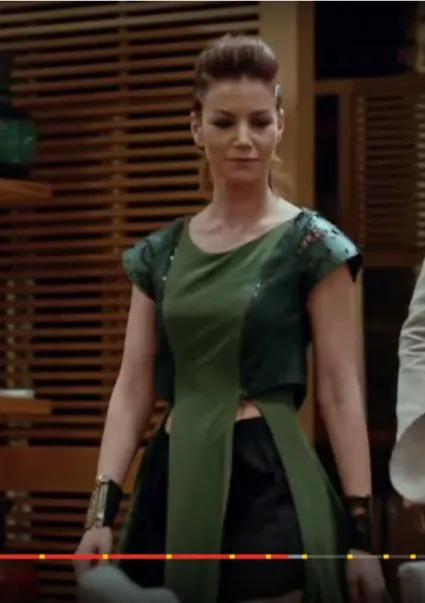
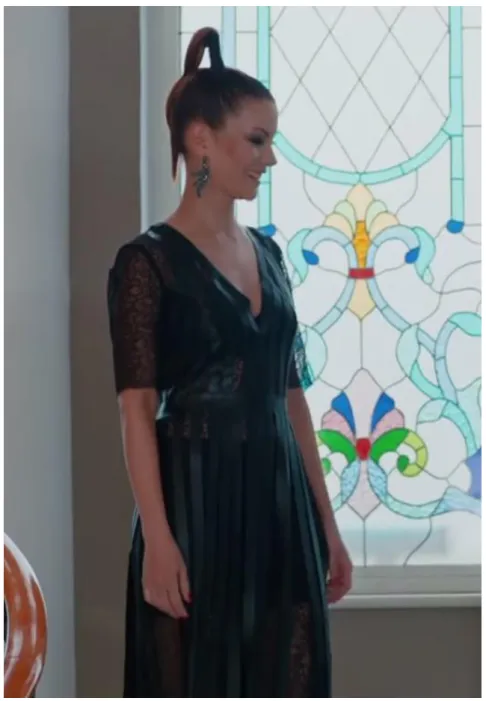
1. Fig. 1. A screenshot of Sedef Kaya, Medcezir episode 75 (a) ... 83 2. Fig. 2. A photograph of Sedef Kaya, Medcezir episode 55. Retrieved from
http://gayectukar.blogspot.com.tr/2015/03/Medcezir-sedef-kaya-stili.html... ... 83 3. Fig. 3. A screenshot of Sedef Kaya, Medcezir episode 75 (b) ... 84 4. Fig. 4. A photograph of Sedef Kaya, Medcezir episode 51. Retrieved from
http://nemarkabu.com/Files/Product/crop_taklit-kurk-ceket_65168562_thumb.jpg ... 85 5. Fig. 5. A screenshot of Sedef Kaya, Medcezir episode 75 (c) ... 85 6. Fig. 6. A photograph of Sedef Kaya, Medcezir episode 13. Retrieved from
http://bendeistiyom.com/wp-content/uploads/2015/02/Yesil_Beyaz_Elbise.jpg ... 86 7. Fig. 7. A photograph of Sedef Kaya, Medcezir episode 59. Retrieved from
http://bendeistiyom.com/urun-etiketi/sedef-kaya/ ... 86 8. Fig. 8. A screenshot of Sedef Kaya, Medcezir episode 64 ... 87
1
CHAPTER 1
INTRODUCTION
Television in Turkey experienced a drastic evolution within the last decade. The range of content provided to the audience expanded with locally produced originals, imported foreign shows or their adaptations with the same format. Turkey even became one of the biggest exporters of television content in the Middle East. However, one thing that has not changed is the primetime addiction of drama series. Primetime television series, mainly dramas, are the backbone of Turkish television. At the beginning of every season, which is approximately the first week of September every year, an average of seventy primetime series air and they are the most preferred programs, with nearly sixty three percent audience share. (The Wall Street Journal: Real Time Türkiye, August 26, 2014)
The content of these primetime series varies, and a considerable amount of these series are adaptations; either from a classic Turkish novel, a remake of a classic Turkish cinema film or adaptations of foreign projects. (Yıldırım, July 1, 2015) Among these successful adaptations, Doktorlar and Medcezir stand out as two of the highest rated series. These two examples are also adapted from television dramas that were first produced and aired in the United States.
Doktorlar is an adaptation of American Broadcasting Company’s Grey’s Anatomy
2
hospital in Seattle, Washington. Now in its twelfth season, Grey’s Anatomy is one of the most popular medical dramas on American television. Adapted in 2006,
Doktorlar started airing on Turkish television on Show TV, a national channel, and
to this date, it remains one of the most watched series with the most reruns to date. Doktorlar also centers on the lives of surgical interns in an İstanbul hospital.
Medcezir is an adaptation of Josh Schwartz’s The O.C. (2003- 2007), centering on
the lives of Newport Beach residents of Orange County, California. A decade later, Ay Yapım adapted The O.C. on Star TV as Medcezir (2013- 2015). The series tell the story of Altınkoy community, a fictional town in İstanbul, and how their lives change with the arrival of an outsider. Both with its first and its last episode,
Medcezir became a ratings hit and was praised for its production quality and its
plot. (Ranini.tv, June 12, 2015)
What Doktorlar and Medcezir have in common is that both of these projects that are adapted from the United States to Turkish television display certain characteristic approaches of cultural adjustments and industrial practices in Turkey. The way these projects handle their source texts and the process of adaptation as a transcultural and transnational adaptation comprise of the focus of this thesis. The main motivation behind this thesis research is to analyze in detail these two drama series and to present a case study of how adaptation process is realized in light of present cultural and industrial approaches. In doing so, this study aims to provide an understanding, specifically, of how these two American examples transform into Turkish television, bearing in mind the market-related, industrial and cultural differences between two countries. Additionally, one other aim of this thesis is to look closely at the examples as transnational/transcultural adaptations.
3
By looking at Doktorlar and Medcezir in detail, we can get a glimpse of the adaptation process of American content to Turkish primetime television is carried out, of the adjustments and the omissions made.
One thing I want to make clear is the reason why this study refers to its case studies as adaptations and not remakes. Remakes are generally seen as a production tactic that saves time and effort spent on each production. (Gürata, 2006: 243) Therefore remakes recreate their original texts either with the motivations of paying tribute or saving time and money by recycling an old production. There is no clear information regarding these Turkish series about these issues that can refer them as being remakes. To a certain scale, they do recreate their original texts and their prior success can play a role in their selection to be adapted; however their creative process involves more than recycling a previous idea. Firstly, the chances of Turkish viewers’ familiarity with the original texts depend heavily on their access to private networks, such as Digiturk. Therefore it would be misleading to suggest that a content that they are not generally familiar with can be recycled because it has not circulated before for this particular audience. Similarly, to allege that it is an homage to their source texts would also be misguiding. Consequently, even though they do share common characteristics with remakes such as adjustments that correspond with conventional moral codes and cultural values and they involve a cross-cultural interpretation process (Gürata, 2006: 244), because of the lack of motivations mentioned above, calling the case studies present in this research adaptations instead of remakes was preferred for its more encompassing stance. The methodology of this thesis is a basic close reading as well as a research of related dynamics, such as adaptations, globalization of television market, format
4
trade, and a brief history of these within the Turkish television context, by providing literary review. Doktorlar and Medcezir were chosen for their audience and market success on Turkish television; as well as because Grey’s Anatomy stands as one of the most successful recent U.S. medical dramas, and The O.C. is a canonical teen drama of 21st-century American television. Differences of formal tendencies, such as episode runtimes, use of music, main themes and cultural signifiers such as portrayal of sexuality, gender representations, as well as a focus of specific characters were used as criteria to analyze these series as American-to-Turkish transnational adaptations.
The second chapter offers a literary review of adaptations. The differing views on what adaptations are, their study in academia, a brief insight into adaptation theory and the reason behind adaptations’ appeal for both the audience and the market is mentioned. With its content, this chapter aims to lay the grounds for a viewpoint on adaptations: adaptations are a creative engagement process which can metamorphose both their subject matter and their audiences. They are not mere copies and they accommodate within themselves artistic, creative, cultural and even political relationships with their source texts and their own. Adaptation encourages variation, diversity and room for change. These findings will help answer part of the question as to why this thesis looks closely into its case studies.
While the lure of adaptations help understand one of the motivations behind this research, the third chapter deals closely with the remaining components of the case study at hand. The globalization of the television market, the origins and the boom of format trade, and how the debates of cultural homogenization emerged with these concepts are discussed. The central arguments of this chapter is how these debates
5
shifted into an understanding of transculturality and hybridity and how Doktorlar and Medcezir fall into the equation as cultural hybrids between the American and Turkish television markets and cultures. Later, a very brief history of the origins of television is presented, along with a summary of the first interactions between the United States and Turkish television. By way of detailing the origins of these concepts within the Turkish television content, the ground for culture-specific case study analysis is also laid out.
The fourth and final chapter inspects Doktorlar and Medcezir as the case studies of this thesis. A detailed analysis of industrial practices in Turkish television, such as episodial runtimes, music selection and cultural adjustments made in the portrayal of characters, events and themes are included in the analysis. In this manner, the goal is to identify Doktorlar and Medcezir as transcultural, specifically American-to-Turkish, adaptations which are hybrids between its source text/ culture and its Turkish local color. Additionally, with reference to Albert Moran’s metaphor in
Copycat TV: Globalisation, Program Formats, and Cultural Identity (1998), the
parallelism and the differentiations between these series’ American crust and their Turkish filling are demonstrated.
Lastly, the ultimate purpose of this thesis is to put Doktorlar and Medcezir on the map within contemporary television studies as a case study of adaptation, cultural studies, and television studies. This thesis aspires to contribute to the growing fields of American-Turkish cultural studies and media studies in Turkey focusing on Turkish television. The research process of this thesis also revealed to me that future television studies in Turkey have great potential, for many aspects remain
6
unexplained and overlooked. Hopefully, with this case study, this potential will be brought to light for further interest.
7
CHAPTER 2
ADAPTATIONS: A REVIEW
Adaptation is one of the most widely used approaches in media, ranging from performance arts to music, from literature to cinema. The resurrection of a song that was popular fifty years ago with a new version by a new artist; a novel or a comic book turning into a motion picture; a film turning into a television series; a theater play choreographed into a dance sequence; or even the recreation of a famous work in the same medium, elevated through certain modern dynamics such as technology, can sum up some of the features of the adaptation form.
The capabilities that adaptation endows to the process of creation have made it a popular choice in modern media. Adaptation has paved the way for media products to travel and settle in different forms, different geographies and cultures. It has changed the dynamics of many industries ranging from, but not limited to, cinema to literature, television to theatre. Adaptations are both a dynamic form of production and a dynamic subject of study for the academy; albeit still not entirely schematized or thoroughly depicted; raising new points of question and research every day, with its progression and renowned nature.
Nevertheless, adaptation studies have experienced multifaceted and continuous problems. Not only have scholars worked to explain adaptation studies as an academic approach, but they have also had to explain why its theory is difficult and
8
slow to progress. Additionally, they would have to justify adaptations as a worthy form, struggling with the stigma that labels adaptations as abominations, copies or derivations (Naremore, 2000; Hutcheon, 2006). Many adaptation studies have consequently dealt with what adaptations are not, as much as they dealt with what they are, such as A Theory of Adaptations by Linda Hutcheon, Adaptation Studies:
New Challenges, New Directions (2013) edited by Bruhn, Gjelsvik and Hanssen,
and many more.
2.1 What is Adaptation?
Adaptations as a form in media became a popular topic of study in the second half of the twentieth century. Despite their popularity, however, adaptations in film studies were considered to be an “abomination” by many critics in the first half of the twentieth century (Cartmell, Corrigan& Whelehan, 2008: 1). Consequently, besides working on defining adaptations, scholars also focused on breaking free from the narrow, limiting definitions of the genre that have accumulated so far. Even though the extent of adaptations goes far beyond the literature-to-film territory nowadays, the study of it started with the analyses of novel to film adaptations. Since adaptations were initially described as reworkings of literature into cinema, definitions tended to develop around this two-way diagram of literature and film. George Bluestone had written in Novels into Film: The Metamorphosis of Fiction
into Cinema that films “do not debase their literary sources” but they
“metamorphose them” into a medium that has “its own formal and narratological possibilities”. (Naremore, 2000: 6)
9
Still, adaptations, with time and in the hand of the scholars who studied to define it, started to break free from the perspectives that limited them to just literature-to-film reworkings; with the given that they depended on a pre-existing text for their own existence. Dudley Andrew wrote in 1984 that adaptation was the “appropriation of a meaning from a prior text.” (Andrew, 2000: 29) For Julie Sanders, adaptation “signals a relationship with an informing source text or original.” too (Sanders, 2006: 26). Both Andrew and Sanders, then, move on from the presumption that only literature is considered as source texts for adaptations, marking an important shift in adaptation studies.
James Naremore noted that “20 percent of the movies produced in 1997 had books as their sources. (...) Another 20 percent were derived from plays, sequels, remakes, television shows, and magazine or newspaper articles.” (2000: 10) With the proliferation of other media forms, such as television, published media, and cinema becoming more affordable by general public, the range and appeal of adaptations also started to expand. As Brian McFarlane noted, adaptations became a point of “convergence” for different art forms, making it possible for several different audiences to enjoy them. (1996: 10) Slowly moving away from 20th century perceptions and into the 21st century of adaptations, the approach now corresponds with as many art forms as one can think of; from literature to cinema, from cinema to television, from literature to stage performances of all kinds.
With growing popularity, however, came the growing scorn and negative attributes. Some of these views evaluated adaptations as unoriginal, unworthy copies, mere translations or imitations of their predecessors (Hutcheon, 2006). Consequently,
10
scholars who studied to define the parameters of adaptations, also felt the necessity to pay attention to unravel and dissolve these attributions.
Since its beginnings till today, adaptation studies struggled to change the stigma on adaptations: the stigma that labeled them as copies, imitations or derivations. Thomas Leitch wrote that “Ever since its inception half a century ago, adaptation studies has been haunted by concepts and premises it has repudiated in principle but continued to rely on in practice.” (2008: 1)
These “concepts and premises” Leitch wrote about were the dependency on literature, the limitation of literature-to-cinema as adaptations, and therefore the issues of originality and fidelity (2008). On a similar note, Linda Hutcheon had also stated:
In beginning to explore this wide range of theoretical issues surrounding adaptation, I have been struck by the unproductive nature of both that negative evaluation of popular cultural adaptations as derivative and secondary and that morally loaded rhetoric of fidelity and infidelity used in comparing adaptations to ‘source’ texts. (2006: 31)
Consequently, many of the concerns that adaptation studies dealt with touched upon these issues. Their originality, their fidelity to their precursor text, their artistic and creative role were discussed and therefore the corpus of adaptation studies mainly consisted of researches that aimed to shed light on these issues.
Linda Hutcheon is one of the scholars who defines adaptations by describing and eliminating what they in fact are not. In her A Theory of Adaptation, Hutcheon identifies adaptations as works of “repetition without replication.” (2006: 7) The text that is being adopted isn’t something “to be reproduced”; it is rather a text to be “interpreted and recreated, often in a new medium”. (2006: 84) She wrote that
11
“Adaptations remind us there’s no autonomous text (...) It is both an interpretive and creative act. It is storytelling as rereading and rerelating.” (2006: 111)
For Hutcheon, adapting is a process that involves a creative engagement with the original text. It is not simply a repeating act or a mere reproduction. Adaptation requires an intelligent and productive relation because it is a “process of making the adapted material one’s own.” (2006: 20) Therefore she hints at a new product that has its basis in an older, preceding work; yet the adapted work is not a simple retelling of it; but an inventive new product which benefits from its source through a certain subjective, selected style. In short, adapting a text is not “slavish copying.” (2006: 20) Hutcheon writes in her foreword:
One lesson is that to be second is not to be secondary or inferior; likewise, to be first is not to be originary or authoritative. Yet, as we shall see, disparaging opinions on adaptation as a secondary mode—belated and therefore negative—persist. (2006: 13)
Against these “disparaging” opinions that label adaptations as “secondary or inferior” and “derivative” because they stem from or get their inspiration from a prior text, Hutcheon writes that “multiple versions of a story in fact exists laterally, not vertically: adaptations are derived from, ripped off from, but are not derivative or second-rate.” (2006: 169)
To sum up, adaptations are not “secondary” or “derivative”, simple translations of their ancestors. They are not “inferior” or “copy” versions of their originals. (Hutcheon, 2006) Linda Hutcheon finalizes her description of adaptations as “an acknowledged transposition of a recognizable other work or works, a creative and an interpretive act of appropriation or salvaging, an extended intertextual engagement with the adapted work. (...) Therefore, an adaptation is a derivation that
12
is not derivative--- a work that is second without being secondary. It is its own palimpsestic thing.” (2006: 8)
Having dealt with the negative connotations about adaptations, scholars have also paid attention to broadening the extent of adaptations. Literary works, plays, films, performance arts and other media reworking each other have been beneficial in enlarging the horizon and theorization of the study of adaptations. Rather than defining them as reworkings of a prior text, scholars made an effort to establish that adaptations also produce their own process of engagement with their subject matter. This process can include artistic, creative, cultural, political and/or many other aspects.
It wasn’t until the late 1990s and the beginning of the 21st century that adaptation studies gained momentum; as it started to move on from the disputes mentioned above, though not abandoning them entirely, and continued with explaining what made adaptations this current, popular and appealing to audiences. In the study of adaptations, their reception, their audiences and their creative process became worthy of consideration as much as their content. For all these reasons, scholars agreed that a change in the way that adaptations are studied was necessary. James Naremore thought that, even though cinema made good use of “twenty centuries of literary culture”; it was “time for adaptation studies to take a sociological turn” and, in a sense, grow out of the already existing criteria. (2000: 35) Naremore also wrote that “what we need (instead) is a broader definition of adaptation and a sociology that takes into account the commercial apparatus, the audience and the academic culture industry” (2000: 10). Over time, newer definitions of adaptation studies emerged with the changing standpoints. Imelda Whelehan wrote:
13
Adaptation studies is now less about which is the better, the original or the adaptation, and more about engaging with the process and understanding the motivations for an adaptation – whether it be explanation, homage, revision, critique, pure exploitation or something else. Adaptation studies facilitates an understanding of social change, narrative form, cultural difference, commercial imperatives, power relationships and so much more. (2012)
The challenge that the theorization of adaptation posed to the process resulted in the amendment of scholars’ perspectives and paved the way for a larger and a more versatile, multi-directional evaluation of adaptations in media. With these new standpoints, James Naremore wrote, adaptation studies would finally move on from the constraints that existed in trying to theorize them. He formulated that:
The study of adaptations needs to be joined with the study of recycling, remaking, and every other form of retelling in the age of mechanical production and electronic communication. By this means, adaptation will become part of a general theory of repetition, and adaptation study will move from the margins to the center of contemporary media studies (2000: 15).
The differing opinions that had existed until this newer idea of adaptations had only been good for slowing down the understanding and evaluations of adaptations. Preexisting views had tended to dismiss or condemn each other and thus provided no progress. Yet with the new, open-minded angles into the subject; adaptation studies could now be utilized better into sociology as well as communication studies. The study of adaptations, the theorization process and their reception evolved in a manner that complimented their abundance. Following methods and perspectives in adaptation studies had to keep up with adaptations’ pace for any constructive improvements to be made in the field.
14 2.2 Adaptation Theory and Its Problems
In Being Adaptation: Resistance to Theory, Brett Westbrook wrote:
A grand unifying theory for adaptation studies is not, in fact, possible; the sheer volume of everything involved in a discussion of film adaptation is virtually immeasurable, which means that no single theory has the capacity to encompass every aspect of an adaptation (2010: 42).
The prevalence of adaptations, especially in film, has resulted in such evaluations as Westbrook’s. Despite its history of several decades, adaptation theory has made a rather slow progress and the reasons behind it are thought to be numerous. The abundance of adaptations, their reception by both scholars and audiences, their diverse connection with several art forms are some of these reasons. As a result, scholars who made an effort to theorize adaptations also worked to illuminate this slow progress of theorization.
In an interview with Alfred Hitchcock; François Truffaut said that “theoretically, a masterpiece is something that has already found its perfection of form, its definitive form.” (Naremore, 2000: 7) Perhaps, one of the reasons behind why adaptations were deemed an inferior form is because many of them derived highly from these “masterpieces” that had achieved their ideal form; therefore any repetitions or new takes on them were unwelcomed, unsatisfying and even displeasing.
Naremore wrote “all the ‘imitative’ types of film are in danger of being assigned a low status, or even of eliciting critical opprobrium, because they are copies of ‘culturally treasured’ originals.” (2000: 13) Moreover, both Linda Hutcheon and Dudley Andrew underline that it is a natural behavior for humans, therefore audiences, to look for similar patterns and seek “equivalences.” (Andrew, 2000: 33;
15
Hutcheon, 2000: 10) While Dudley Andrew spoke of the tendency of “matching” (Andrew, 2000: 33); borrowing from E.H. Gombrich, Linda Hutcheon wrote that “in adapting, the story-argument goes, ‘equivalences’ are sought in different sign systems for the various elements of the story: its themes, events, world, characters, motivations, points of view, consequences, contexts, symbols, imagery, and so on” (2000: 10). Similarly, Naremore wrote that “narrative codes (...) always function at the level of implication or connotation.” (2000: 34) He also mentioned binary oppositions and society’s tendency to deconstruct them puts adaptations in the position of copies as opposed to originals. (2000: 2) It seems, then, people’s tendency to compare, connote and associate the work they are experiencing is especially inevitable when the subject matter is adaptations; the genre that borrows from previous, associative material. Because of this given; the artistic, additional creative process that is intertwined with the process of adapting is overlooked or simply goes unacknowledged.
Thomas Leitch also addressed other factors that make up some of the problems in theorization of adaptations. For Leitch, some of these obstacles that presents are the expectation of fidelity to their precursor text, their low-status label because of their comparison to these texts and their canonicity; their narrow evaluation. (2008: 14) Linda Hutcheon also agrees, stating that in the evaluation of adaptations, “the rhetoric of comparison has most often been that of faithfulness and equivalence.” (2006: 16) Leitch additionally wrote:
The challenge for recent work in adaptation studies, then, has been to wrestle with the undead spirits that continue to haunt it however often they are repudiated: the defining context of literature, the will to taxonomize and the quest for ostensibly analytical methods and categories that will justify individual evaluations (2008: 3).
16
In an introduction published for Adaptation (2008), Deborah Cartmell, Timothy Carrigan and Imelda Whelehan explained, perhaps in the most spot-on way, the ultimate problems in theorization process. They came up with a ten-clause explanation as to why a journal on adaptation studies could finally be published after so many years of work in the field, accounting for the complications that its theoreticians have coped with. According to Cartmell, Corrigan and Whelehan, these ten problems were “the resentment of dependency of film on literature”, the perception of “film adaptations as abominations”, the “secondary status of film studies”, the understanding of “literature is better than film”, the insistence that “money and art cannot mix” where film does exactly this, “fetishization of individual genius” because films are a product of team work whereas literature praises personal effort, the narrow point of view that adaptations are “copy” works, the view of adaptations as “violation, betrayal, vulgarization” and so forth, the comparison of “bad adaptations versus good adaptations” and the fact that they are “based on a single ‘sourcetext’, resulting in the neglect of other factors in their creation process, such as cultural or social dynamics. (Cartmell, Corrigan& Whelehan, 2008)
In the process of theorizing adaptations, a change of approach was inevitable because the formerly dominant approaches, such as fidelity or the debates of originality, stalled the field’s progress. Therefore scholars have adopted a more embracing stance on the subject, taking into consideration more elements. In a sense, like Kamilla Elliott proposed, instead of trying to theorize adaptations, they adopted a more fruitful and responsive approach:
Adding historical, cultural, contextual, ideological, political and economic aspects of adaptation to semiotic, generic, textual and media aspects has
17
greatly expanded the scope of the field, as have the intertextual and intermedial theories that have replaced one-to-one translation models with longer representational genealogies and wider webs of intermediality. Adding audience reception and industrial practices to artistic practices has also enlarged the field. The democratization of representation has furthermore brought discredited older media and new media into adaptation studies; changing technologies have further expanded the materials that adaptation scholars must study. And to the impossibility of theorizing adaptations in the wake of all of these expansions, postmodern scholars add the undesirability of theorizing adaptations under any master system or narrative (2013: 30).
Elliott summarizes the new angle in adaptation studies and adaptation theory in perhaps the best, composite manner.
Since body of work dedicated specifically to television adaptations is very small, deriving from all of these findings can be useful. While there is a change of medium, television adaptations still go through a similar creative process. Television adaptations can still be compared to their original source texts and they can be criticized as adaptations in cinema do. Referring back to some of the ten points mentioned above, television adaptations can similarly be of secondary status compared to their source, its commercial foundations and quality of these productions as abominations can put them in a neglected position and their creative process can be overlooked. Therefore, limiting theory of adaptations to one medium or suggesting an exchange between two different mediums is restrictive and reduces its potential of comprehensiveness.
The step to be taken in order to provide a better analysis and understanding of adaptations was to expand the pre-existing perspectives and to embrace the many diverse dynamics of adaptations, their social and cultural value, their reception and their comprehensive range in all media forms. The theory and study of adaptations accommodate more than literature-to-film evaluations and the disputes of its
18
worthiness as a creative process. The deserted approaches of the past, the new dynamics of the process and the embracing of audience reception have all provided the field with a more positive stance. Rather than trying to schematize them, scholars finally handle adaptations in a way that is not constrained, and encircle all the other features that are relevant to the subject of adaptations.
2.3 Appeal of Adaptations
Despite the problems of theorization and the scorn they endure, adaptations are still one of the most popular forms in cinema, on television and in literature. Morris Beja noted that “since the inception of Academy Awards in 1927-8, more than three fourths of the awards for ‘best picture’ have gone to adaptations.” (1979: 78) and despite the time that has passed, adaptations continue to dominate Oscars. (Coffey, February 22, 2015) Thinking in a Turkish context, the same is also valid for “90% of the nearly 300 produced in 1972 were remakes, adaptations or spin-offs.” (Behlil, 2010: 2) For audiences, adaptations still have a very strong appeal. Studies of adaptation also pay attention to understand why they are this popular and alluring. In explaining the charm of adaptations, we can provide several reasons regarding both audiences and producers.
For producers of television, every new program carries with it the risk of failure. Since ratings can make or break a production, it is important to make a sound decision in choosing which programs to offer. In this process, choosing to make an adaptation can prove beneficial for a couple of reasons. Several producers believed that programs that have a “proven success” in their original countries is the “most effective way of guaranteeing audiences”. (Bell& Williams, 2009: 23) Similarly,
19
Janet McCabe and Kim Akass wrote that “prior success is key” because broadcasting material with evident success “offers some chance of duplicating past and existing successes.” (McCabe and Akass, 2013: 10) This “proven success” is “one of the most significant elements in the adaptation process.” (2013: 10)
Previous success also increases the potential of profit because it minimizes the risk of failure. In Novel to Film: An Introduction to the theory of Adaptation, Brian McFarlane pointed out the charm of adaptation is thus also financial:
No doubt there is the lure of a pre-sold title, the expectation that respectability or popularity achieved in one medium might infect the work created in another. The notion of a potentially lucrative 'property' has clearly been at least one major influence in the filming of novels, and perhaps film-makers, as Frederic Raphael scathingly claims, 'like known quantities (...) they would sooner buy the rights of an expensive book than develop an original subject' (1996: 5).
Even though McFarlane wrote about novel-to-film adaptations, his theory holds ground for television adaptations also. Adaptations attract audience response, potential of success based on previous acknowledgments of different viewers and it is an alluring choice of production; it is time-saving and less costly compared to the process of creating an original work because the basic outlines of the project comes prepared and ready to implement for its new production team. For the makers of television, adapting works that already exist elsewhere responds to the needs of effective, lucrative production and guarantees audience appeal. In other words, adaptations are a way of minimizing risk.
In evaluating adaptations and their appeal, it is also crucial to take account of another primary target: the audience. The magnetic effect of adaptations for the audience lies in the experience that adaptations offer to them. Viewers seek a point
20
of convergence, an angle with which they can identify in the story being portrayed. A successful adaptation caters to the needs of familiarity and an effect of surprise at the same time. In short, the audience needs a “hook” to lure them into the story; familiar yet curious enough to keep watching. Malgorzata Marciniak likens experiencing adaptations to “visiting an old friend”. (2007: 62)
Linda Hutcheon paid a great deal of attention to why audiences respond well to adaptations. To answer the reason behind such appeal, Hutcheon says:
Part of this pleasure, I want to argue, comes simply from repetition with variation, from the comfort of ritual combined with the piquancy of surprise. Recognition and remembrance are part of the pleasure (and risk) of experiencing an adaptation; so too is change (2006: 4).
Therefore the variation presented in the adaptation is the “hook” because, for Hutcheon, in experiencing an adaptation “we seem to desire the repetition as much as the change.” (2006: 9)
Through adaptations, the viewers’ need for pleasure, comfort and fulfillment is met. Repetition and familiarity provides comfort and pleasure; and with variation, the expectancy of surprise is realized. Hutcheon supportingly stated that “adaptations fulfill both desires at once”: the desire to return to the known pattern, and the desire to escape it by a new variation. (2006: 173) Hence, adaptations accommodate within themselves “the mixture of repetition and difference, of familiarity and novelty”; qualities which constitute the appeal of adaptations according to Linda Hutcheon. (2006: 114)
Being able to mobilize the feeling of the familiar, such as a memory or a widely known concept, is also another factor regarding why adaptations are this popular. Marking it as both a “pleasure” and “frustration”, Hutcheon says, “the familiarity
21
bred through repetition and memory” is another key point in experiencing adaptations. (2006: 21) This familiarity and memory is best addressed through localization of the given product according to target audiences. By achieving this localization, adaptations increase their local appeal as well. (McCabe& Akass, 2013: 9)
Having reviewed a brief history of and some of the problems in the evaluation of adaptations in both the academy and the market, one major cornerstone of this research project is partly covered: in order to look closely at television series that are adapted from the United States to Turkey and to provide an analysis of the examples at hand as transnational/ transcultural television adaptations, it is essentially important to grasp the charm of adaptations, and how they are studied. Yet this perspective constitutes only a part of the picture. Looking only at adaptations does not entirely account for the popularity and abundance of transnational television adaptations. Television industry is shaped by dynamics other than audiences, such as globalization of media and the new practices and perspectives that are borne along with it. These new dynamics form the rest of the picture for the present case studies, which are examined in the last chapter.
22
CHAPTER 3
GLOBALIZATION OF TELEVISION AND THE RISE OF
TRANSNATIONAL/TRANSCULTURAL ADAPTATIONS
Understanding transnational television adaptations depends on more than an understanding of why adaptations are popular. There are several other actors at play in this process that show how audience appeal becomes a functioning system that is both lucrative for the industry and popular for the consumers. Moreover, it is also crucial to underline that these concepts complement each other and they act as a unified system.
The reason behind adaptations’ popularity worldwide is also about how the world is becoming a globally borderless place with the emergence of communication that transcends physical borders and distances. It is what makes ideas circulate without being hindered and as it does, it helps form a common language between different cultures, peoples and places.
Format trade is the remaining important part of this equation. As ideas circulate and are adapted across the globe, from one place to another completely different place, adjustments are necessary. These adjustments are how ideas change, adapt and alter to fit in to their new environment and survive. Format trade, which will be discussed in detail in the second section of this chapter, acts as a template in organizing these adjustments and forms the language of this trade of ideas.
23
Turkey has adapted several American television series. Some of the most successful ones were Tatlı Hayat (2001-2004) as an adaptation of The Jeffersons (1975- 1985),
Dadı (2001-2002) as The Nanny (1993- 1999), Küçük Sırlar (2010- 2011) as Gossip Girl (2007- 2012), Kavak Yelleri (2007- 2011) as Dawson’s Creek (1998- 2003), Umutsuz Ev Kadınları (2011- 2014) as Desperate Housewives (2004- 2012), and Tatlı Küçük Yalancılar (2015- ) as Pretty Little Liars (2010- ) as the latest example. Doktorlar and Medcezir are some of the latest and highest-rated examples, and
since this thesis aims to analyze in detail the local flavor of these series, it is important to also understand what kind of factors play a role in their adaptation process. Therefore, globalization of television, how this globalization makes it possible for adaptations to travel freely as ideas and how format trade secures the legalization of this process are crucial phases to include in the study.
By way of touching upon the phases of media globalization and format trade in Turkish television, we can do a better case analysis; for it is important to include an understanding of how television market deals with the content that makes a journey across borders and cultures, and with the other developments that emerge in the process of adapting TV content for audiences that are nationally and culturally different. Adaptations require a working harmony between the television business, the targeted demographics, audiences and the local cultures. In this chapter the components of this harmony will be explained.
3.1 Globalization of Television Market
Globalization initially is shaped and molded by economic interests in the world market. The term is closely linked with concepts of market, economy, labor, and
24
global trade; yet it also refers to the “the growing level of connectedness between individuals, societies and nation states at a global level” and therefore also applies to cultures (Devereux, 2007: 30).
This level of ‘connectedness’ was made possible via improvements in the communications. Starting with the invention of telegraph in 1837 (Moran, 1998), globalization in media has further developed with the launch of satellites, proliferation of television and broadcast channels, and finally with internet and social media. This increased connectedness, however, eventually resulted in debates of cultural homogenization (Moran, 1998; Kraidy, 2002). Studies in globalization also asserted that standardization of content mainly promoted a dominantly white and highly American point of view, that it was a way of advertising and exporting American values and that it served the commercial interests of the United States; mainly because the country was the biggest exporter of television programs. (Moran, 1998) Particularly the world-wide influence of US cultural products with its enormous economic power was considered cultural imperialism. Thomas Guback argued that the European film market’s domination by the US, especially by Hollywood, led to a homogenization that blurred the lines between distinct cultures. This kind of globalization brought forth disputes of homogenization where more powerful cultures dominated other dependent cultures (Gürata, 2002). By making the same or similar content available on a global scale, therefore emerged an issue of standardization, which led to further debates about how this sameness threatens indigenous cultural diversity. The new globalized media scene was consequently connoted to be homogenizing; thus the term cultural homogenization. This resulted in a loss of individual local color, many scholars now defend that instead of this loss of cultural identity and color, what is happening is a
25
hybridization of these colors. Moreover, Ien Ang suggests that local cultures tend to reproduce themselves by appropriating global flows of mass-mediated forms and technologies. This allows new hybrid cultural forms to emerge all around the world. (Gürata, 2002)
In the face of this strong and influential presence of US culture called media imperialism or cultural imperialism, Ahmet Gürata writes that “there exists strong regional competitors in various parts of the world, such as India, Hong Kong, Mexico, Argentina, and Egypt. These powerful industries are not only successful in their respective countries, but are also distributed widely throughout the world.” (Gürata, 2002) It is possible to place Turkey among these competitors, especially lately, as now Turkish series air in more than 70 countries. Elest Ali, who also used the expression ‘cultural colonialism’ in her article referring to Turkey’s new presence, considers this effect more significant than that of all the Mexican
telenovelas and Egyptian musalsalat put together. (Ali, 2014)1
However, not all approaches to media globalization are similarly critical. For some researchers, as much as there is a dominating force and vested economic interests in the process, globalization in media doesn’t necessarily result in a loss of local, national traces. The present local and national differences in a specific geography not only interrupt a thorough homogenization; but they also pave the way for a different understanding of this shared, standard content by acting almost as a filter. Accordingly, more recent theories focus on what is termed cultural hybridization, a perspective on media globalization that endows more harmony between what is
1 For further information about Turkey’s new role in this issue, the documentary “Kismet: How
Soap Operas Changed the World” is recommended (and is available online at
http://www.aljazeera.com/programmes/witness/2013/11/kismet-how-soap-operas-changed-world-20131117152457476872.html)
26
local and what is imported. This hybridization prioritizes an “understanding of the interface of globalization and localization as a dynamic process and hybrid product of mixed traditions and cultural forms.” (Kraidy, 2002: 6). Carolina Matos wrote:
Cultural globalization theorists have thus underscored the need to recognise the blending of local cultures with global foreign influences, switching to an understanding of global culture as being grounded in a process of hybridization, and not homogenization or simply cultural diffusion of American values. (...) The hybridization argument thus contends that the impact of global culture does not lead to the extinction of the local. Hybrid styles are in essence a result of the combination of modern techniques or American influences with national and political traditions or regional identities. (Matos, 2012)
Matos also mentions another differing opinion presented by audience receptions researchers who simply rejected the view that audiences directly adopt what they watch without any critical input, simply acting as “cultural dopes”(2012). Matos notes:
They can negotiate dominant ideological messages and make readings that are empowering for their everyday lives. Studies in the audience research tradition have shown how diverse ethnic groups read and make sense of US television exported texts, from Dallas to The Simpsons and Sex and the City, differently, according to their own cultural preferences and socio-economic context. (2012)
Therefore, the viable alternative to the rather pessimistic views on how globalized media devalues the specific local colors is the perspective that provides an understanding of media globalization, which clarifies how the process both looks out for its industrial, economical priorities and also pays attention to making these exchanges appealing for the audiences.
Since the subject matter of this research is television adaptations that travel across geographies, it is important to understand how globalization and adaptation
27
cooperate in preserving the essence of these television projects, while also making this process profitable for the owners. Although globalized media corporations are owned by a number of people, audience is what makes their products a success or failure in the market. Silvio Waisbord said that “for global television companies, cultural difference is not an obstacle, but if incorporated properly, it could be a boon.” (2004: 378) It is exactly at this point that adaptations and the concept of globalization converges: adaptations make it possible for media corporations to achieve a sense of globalization, by preparing a legal base for the process and thus sparing them the accusations of cultural imperialism or homogenization. In return, media globalization paves the way for systems like format trade to develop and also presents the audience with an array of programs to select from.
It is for these reasons that globalization in the television market made adaptations across geographies this lucrative for media corporations and popular for the audiences. The success of globalization in media is evident in this aspect. Just as fashion, fads or trends, technological consumption etc. became global products, so did television productions. Once the success of a television production manifested success; it became the focus of attention for other countries’ media moguls to bring it to their home countries. By making a local product global, and eventually localizing it again for another culture/geography, adaptation form gained more mobility.
In McTV: Understanding the Global Popularity of Television Formats, Waisbord wrote that “in standardizing the structure of television, globalization encouraged the tendency toward imitation and reluctance to promote innovation that underlies commercial broadcasting. (2004: 364)
28
Observably, both globalization and adaptations suffer from the same connotation in this sense: being imitations and limiting creative input. The two, on the other hand, seem to complement each other rather fruitfully, judging by the fact that format trade “exploded and became a multi-billion dollar industry” in the late 1990s as the number of formats in circulation, number of countries they travelled to and the number of companies distributing and producing them rose rapidly. (Chalaby, 2015: 460)
It is a necessity for stories to evolve, adjust and be mobile in order to be retold and hence survive. Adaptations make possible just that. In studying adaptations, Linda Hutcheon derived remarkably from the studies of adaptation in Darwinian terms. As Darwin viewed adaptation as a necessity for survival of the living, Hutcheon appropriated her studies of adaptation in the same way and viewed adaptation as a survival method for narratives to survive in other geographies, societies and cultures. In doing so, alluding to the term natural selection; she used the term “cultural selection” and she wrote:
(...) perhaps traveling stories can be thought of in terms of cultural selection. Like evolutionary natural selection, cultural selection is a way to account for the adaptive organization, in this case, of narratives. Like living beings, stories that adapt better than others (through mutation) to an environment survive (2006: 167).
Hutcheon also said that adaptation was how stories evolved and mutated “to fit new times and different places.” She thought that “evolving by cultural selection, traveling stories adapt to local cultures, just as populations or organisms adapt to local environments” (2006: 177).
29
This is where globalization comes into the scene, by making a local product globally attainable to other environments, so it can travel and find new cultures and audiences to live on in, in other words; survive. In the process of making television content global, formats perhaps have been the most efficient survival tool.
Globalization is one of the many important factors in the process of adaptation, especially those that are cross-cultural and transnational. Globalized market favors adaptations instead of necessitating a constant flow of original ideas. The agent which links global television market and adaptations together is the format trade that is carried out successfully. Formats act as a converter, a modifier of ideas and by mapping out a legal process for the producers, it renders possible for these ideas to create its own variants in several diverse cultures, nations and geographies. In order to mobilize adaptations, television market has turned to format trade.
3.2 Formats: Television’s Popular Form
Formats act as a tool, a template for laying out the processes of programming and production of ideas, and they have become an indispensable system for exchanging ideas, or adapting them to fit to their new environments in an organized manner. This exchange has been a vibrant trade in television practices as the television market globalized. In other words, formats are the accomplished combinations of globalization and adaptations and their markets are interdependent; the adapted work can only be legally globalized through format trade. Therefore, format trade is nothing new to television market. Giselinde Kuipers explains format trade’s emergence in the market as follows:
30
Television import was born out of economic necessity. Producing television is expensive; especially in small countries, filling all airtime with domestic fare is too costly. Hence, shortly after the introduction of TV, European public networks began importing programs from larger countries, such as the United Kingdom, Germany, and the United States, where producers could earn back their investments in large domestic markets and sell their programs at reasonable prices abroad. Thus, smaller and poorer countries became dependent on larger producers, and a world television market emerged with one main center, Hollywood, and a number of regional centers of production on various continents (Straubhaar, 2007). (Kuipers, 2011: 6)
Format trade, up until today, has expanded to become an estimated 3.1 billion-euro industry. Less than a decade ago, in between the years of 2006 and 2008, 445 formats led to 1262 adaptations in fifty-seven territories(Chalaby, 2012: 37). Many of the popular television shows, Chalaby says, “are formatted and cover all TV genres from daytime cookery and decorating shows to primetime talent competition blockbusters.” (Chalaby, 2013: 54) Nevertheless, despite its origins in the 1940s and current acclaim, research of format trade became relatively distinctive in the 1990s; taking “almost twenty years and a booming trade before [finally attracting] broad academic attention” (Esser, 2013: xvii), especially with the work of Albert Moran in the field such as Understanding the Global TV Format (2006) and
Copycat TV: Globalisation, Program Formats, and Cultural Identity.
Formats act as a bridge in between what is global and what is local; hence making way for the glocal. According to Andrea Esser, one of the many reasons for format trade business’s success is the particular way they combine the local and the global (Esser, 2013). Also, by enabling program adaptations to secure a legal path, formats not only help the global television market; they additionally pave the way for a harmony in between cultures, nations and audiences. Formats, furthermore, are the ultimate risk-minimizing and cost-efficient medium in television business.
31
Formats are without a doubt one of the most essential tools in making the television market global. By making it possible for ideas to travel legally and for the benefit of the industry, format trade has proven lucrative for both producers and audiences. Format trade in the global scene provides the product with the necessary flexibility so it can survive in its new target geography without having to worry about factors like the specific cultural/national differences. In that sense, formats accommodate within themselves the qualities of timelessness and non-spatiality.
Formats are de-territorialized; they have no national home; they represent the disconnection between culture, geography, and social spaces that characterizes globalization. Signs of cultural territories are removed so domestic producers can incorporate local color and global audiences can paradoxically feel at home when watching them (Waisbord, 2004: 378).
This timelessness and the lack of geographical specificity, in a sense, paved the way for what Waisbord calls “the standardization of content.” (2004: 360), a standard that is designed to function regardless of cultural, national or geographical boundaries, for all audiences and producers. One downside in the process of such standardization, Waisbord observes, is that “globalization encouraged the tendency toward imitation and reluctance to promote innovation that underlies commercial broadcasting.” (2004: 364) This way, Waisbord also offers a critical approach to the ways of this market and writes:
Coping, imitation, and jumping on the bandwagon of whatever seems to work at the moment have been typical in the television industry since its origins and, arguably, have become even more common lately as conglomerization has increased pressures for higher profits in shorter periods of time. (2004: 363)
Nonetheless, the profitable nature of format trade for the market and the appeal it has for the audiences is evident and are two sides of the same coin. On the one hand
32
it satisfies whoever is making this trade by manifesting gainful, and on the other, it enables several different audiences with various experiences of watching television that they can choose from.
Jean K. Chalaby also defines formats as follows:
... [A] format works as a platform on which to generate drama. Formats may be international to the industry, but they are always local to the audience. Formats are successful internationally only if they resonate with an audience in each and every market in which they air (2013: 55).
What adaptations and formats have in common then, is the necessity of resonating with their audiences. Thus, one of the most important factors for a successful format adaptation is whether they appeal to their audience by making the correct adjustments in the process. A good example to this is Alexandra Beeden and Joost de Bruin’s analysis of the series The Office and how it failed as an American production after having been adapted from the British series of the same name. Since American production failed to provide this resonance with its audience, it was cancelled shortly after its initiation (Beeden and de Bruin, 2009). An effective implementation of the work that is being transported can make or break a production; in short, how well they “resonate” with their audiences is of utmost importance. Formats need to find the necessary balance by making their global concept accurately local as in the case of The Office. Only this way can formats become profitable and effective:
TV formats may be transnational in the sense that they travel and incorporate cross-border rules, but essentially, they apply these rules to create characters and fashion stories that resonate locally. In this sense, they make the local visible and the global invisible (Chalaby, 2013: 55).
33
In short, formats are “programming ideas that are adapted and produced domestically” (Waisbord, 2004: 359), they are the “ultimate risk-minimizing programming strategy” (2004: 365) and are “culturally specific but nationally neutral.” (2004: 368) They are “less prone to have specific references to the local and national, precisely because they are designed to “travel well” across national boundaries. (2004: 368) They also must follow a set of “rules that are applied across cultures” and “address cultural factors” so that they can “have a genuine local impact” and become internationally successful. “Applied to television industry, formats represent the global commercialization of an efficient and predictable program that can be tweaked according to local tastes.” (2004: 378)
Functions of format trade aren’t limited to just market and audience dimensions. According to Matos, formats make it possible for “national variations” of a program to exist and they provide “interconnectivity” among television industries worldwide. It legalizes the programs by adding to their exportability and help contribute to a sense of “cultural homogenization” or “hybridization”, to avoid recent disputes about the issue. This way, formats act according to the ideals of globalization, also moving in harmony with the mantra of global television industry: “think globally, program locally.” (2012)
The trade market for formats goes hand in hand with the process of adaptation. Format trade globalizes the subject matter and makes it possible through a legal process for the product to find various local colors in several different national markets. Perhaps eventually formats owe their popularity to this quality. With adaptations of formats into different markets, ideas become global, universal in a sense. For Waisbord, “the popularity of formats is largely the result of fundamental