Ankara Ecz. Fak. Derg. J- Fac. Pharm, Ankara
30(4)41-52,2001 30(4)41-52,2001
S T R U C T U R E - A C T I V I T Y R E L A T I O N S H I P S O F M E L A T O N I N A N A L O G U E S
M E L A T O N I N A N A L O G L A R I N I N YAPI-AKTİVİTE İLİŞKİLERİ
Zeynep ATEŞ-ALAGÖZ Sibel SÜZEN
Ankara Üniversitesi, Eczacılık Fakültesi, Farmasötik Kimya Anabilim Dalı, 06100 Tandoğan, Ankara
A B S T R A C T
This paper includes how melatonin and its related analogs interact with melatonin receptors with the hope of developing important tools and agents of significant clinical and scientific importance. The review provides currently published melatonergic ligands and their relative affinities for melatonin receptors and discusses the importance of developing reversible, high-affinity, and
subtype selective melatonin receptor antagonists. Further design, synthesis, and application of melatonergic ligands will lead us to a clearer understanding of the role that melatonin and its receptors play in humans.
Key words: Melatonin, melatonin analogues, melatonin receptor and melatonin ligands.
ÖZET
Bu makale klinik ve bilimsel önemi olan ajanların geliştirilmesi amacı ile, melatonin ve ilgili analoglarının melatonin reseptörleri ile etkileşimlerini içermektedir. Derleme son zamanlarda yayınlanan melatonerjik ligandlar ve onların ilgili melatonin reseptörlerine olan affinitelerini vermekte ve geri dönüşümlü, yüksek affiniteli ve seçici melatonin alt reseptörlerinin gelişimini tartışmaktadır. İleri tasarım, sentez ve melatonerjik ligandların kullanılması melatonin ve reseptörlerinin insanlardaki rolünü daha iyi anlamamıza olanak sağlıyacaktır.
Anahtar kelimeler: Melatonin, melatonin analogiarı, melatonin reseptörü ve melatonin ligandları
INTRODUCTION:
Melatonin (N-acetyl 5-methoxytryptamine) (Fig.l) is a neurohormone, first isolated by Lerner et al. (1) in 1958 from bovine pineal tissue, has a central role in the regulation of daily rhythms and seasonal cycles in vertebrates. Its potential usefulness to a number of therapeutic areas such as those related to the desynchronization of biological rhythms, such as jet-lag, disturbed sleep-wake cycles (2), seasonal disorders and depression are known (3). Melatonin may also play a role in the cardiovascular system (4). This is supported by recent findings which show that 2-[125I] iodomelatonin-binding sites are localized in both the caudal and cerebral arteries of the rat. In addition, melatonin binding has been reported at many other sites including the retina (propably related to resynchronization role) and peripheral tissues such as the spleen (related to a role immune system), gastrointestinal tract, blood platelets and the harderian gland (5). Furthermore antioxidant properties of melatonin have recently been proposed (6,7). Although the effects of melatonin in oncogenesis are unclear; majority of the studies conclude that the hormone has a protective role in the modulation of cancer or cancerous cells (8,9). Melatonin may also play a role in brain function (10) but the mechanisms underlying such functions are not known (11). Despite its potential involvement in the regulation in many possible physiological processes, two problems limit its the therapeutic use at present. The first is its very short biological half-life (15-30 min), due to its rapid catabolism to 6-hydroxymelatonin and N-acetylkynurenamines. The second problem is the lack of selectivity of melatonin at target sites. The development of novel analogues of provides a strategic approach to overcome both of these limitations (5).
Moleculer Biology of Melatonin Receptors
A high-affinity melatonin receptor was first cloned from frog dermal melanophores in 1994. Since then, 20 distinct full-length or partial melatonin receptor DNA sequences from a variety of species have been reported. Phylogenetic analyses of the predicted amino acid sequences of melatonin receptors support their division into three subtypes: mel1a, mellb and meli1c families. However, a fourth family, typified by a partial Xenopus laevis cDNA clone, may exist (12).
ML1-type receptor:
SAR studies on derivatives of melatonin have elucidated several key interactions between the ligand and the ML1-type receptor. Importantly, both the methoxy and the amide functional groups are critical to melatonin's affinity. N-acetyltryptamine possesses over a thousand-fold
Ankara Ecz. Fak. Derg., 30 (4) 41-52, 2001 43
FIGURE 3: Naphthalene, benzofuran, benzothiophene and benzimidazole derivatives lower affinity (Ki=730 nM) for the receptor in chicken brain compared to the melatonin (Ki=0.24 nM) while 5-methoxy tryptamine (Ki=2528 nM) exhibits no significant affinity for the ML1-type receptors (Fig.2) (13). Both the methoxy and the amide groups are therefore presumed to be involved in critical hydrogen bonds to the receptor recognition site. While the methoxy group is a major factor in binding melatonin to its receptor, it is not a necessary criteria for agonist activity as had been suggested previously (14).
N-acetyl tryptamine 5-methoxy tryptamine 6-chloromelatonin FIGURE 2: The chemical formula of N-acetyl tryptamine, 5-methoxy tryptamine and
6-chloromelatonin
Additional features of the ML1-type receptor include a small, hydrophobic pocket which can accommodate some increase in the size of group, R (alkyl), attached to the amide carbonyl. Increasing the length of R up to three carbons increases affinity for the receptor in ovine pars tuberalis but groups longer than three carbons, or those with branching, are not well-tolerated and result in a significant decrease in receptor affinity (15). Substituents on the indole ring are well-tolareted at both the 2- and 6- positions. 6-Chloromelatonin (Fig.2) demonstrates comparable affinity (KI=0.58 nM) to melatonin for the receptor in chicken brain (13). Substitution at the 2-position of the indole by halogen, methyl or phenyl groups enhances receptor affinity, either by influencing the conformation of the ethylamido side chain or accessing an auxiliary binding site (16).
The indole ring of melatonin appears to be a scaffold which is not critical for melatonin receptor recognition. The naphthalene derivative 6 possesses essentially equivalent affinity (K1=0.035 nM) to melatonin, for the receptor in ovine pars tuberalis (Fig.3) (17).
The indole ring of melatonin can also be replaced with a benzofuran (7) or benzothiophene (8) but these bio-isosteric replacements result in a slight loss in affinity. However, replacement of indole ring with the benzimidazole ring (9) dramatically attenuates activity (Fig.3) (5).
ML1-Antagonist:
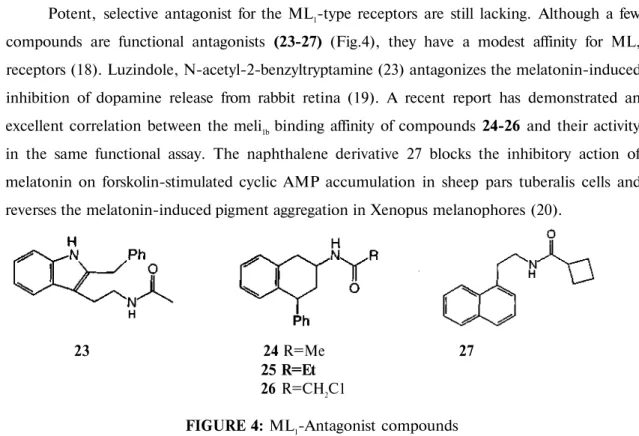
Potent, selective antagonist for the ML1-type receptors are still lacking. Although a few compounds are functional antagonists (23-27) (Fig.4), they have a modest affinity for ML, receptors (18). Luzindole, N-acetyl-2-benzyltryptamine (23) antagonizes the melatonin-induced inhibition of dopamine release from rabbit retina (19). A recent report has demonstrated an excellent correlation between the meli1b binding affinity of compounds 24-26 and their activity in the same functional assay. The naphthalene derivative 27 blocks the inhibitory action of melatonin on forskolin-stimulated cyclic AMP accumulation in sheep pars tuberalis cells and reverses the melatonin-induced pigment aggregation in Xenopus melanophores (20).
23 24 R=Me 27 25 R=Et
26 R=CH2C1
FIGURE 4: ML1-Antagonist compounds
ML2-binding site:
SAR data for the ML2-binding site is limited. In simple derivatives of melatonin, lengthening the group on the carbonyl increases affinity for the ML1 receptor, but decreases affinity for the ML2 site, thereby increasing selectivity for the ML1 site over the ML2 (20). Compounds which demonstrate good selectivity for the ML2 site include, 2-iodo-5-methoxycarbonylamino-N-acetyltryptamine 28, and a series of benzimidazoles 29 (Fig.5) (21).
Ankara Ecz. Fak. Derg., 30 (4) 41-52, 2001 45
28 29 FIGURE 5: Effective compounds for ML2 binding site
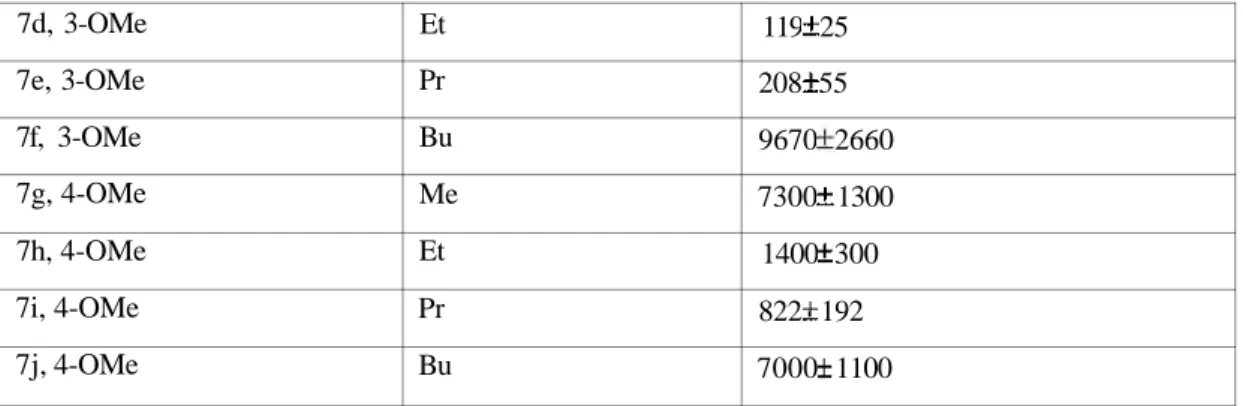
A series of 2-,3- and 4-substituted phenylalkyl amides were prepared as potential melatonin analogs in order to investigate the nature of the binding site of the melatonin receptor in chicken brain. The length of the alkyl chain-was systematically varied from n=l to 4, and methoxy substituents were incorporated into the phenyl ring at the 2-, 3-, and 4-positions. The maximum binding affinity was found to occur when n=3 and when the methoxy substituent was in the 3-position, the direct analog of the carbon framework of melatonin in which the first and second atoms of the indole ring have been removed. Whereas there was only a relatively small decrease in binding affinity for the corresponding 2-methoxy derivatives, 4-methoxy substitution led to a large decrease in binding affinity, suggesting that the binding sites for the side chain and methoxy group could not now be occupied at the same time. As in the indole analogs of melatonin, replacement of the methyl group of the amide by a longer alkyl chain led to an increase in binding affinity for ethyl and propyl with a subsequent decrease in binding affinity for butyl chains. Thus N-propanoyl-3-(3-methoxyphenyl)propanamide (6f) has a binding affinity of 5.6 nM, a remarkably high affinity for a simple compound in structure (22) (Table 1).
Compound Melatonin 3a 3b 3c 4a 4b 4c 5 a, 2-OMe 5b, 2-OMe 5c, 2-OMe 5d, 2-OMe 5e, 3-OMe 5f, 3-OMe 5g, 3-OMe 5h, 3-OMe 5i, 4-OMe 5j, 4-OMe 5k, 4-OMe 51, 4-OMe 6a, 2-OMe 6b, 2-OMe 6c, 2-OMe 6d, 2-OMe 6e, 3-OMe 6f, 3-OMe 6g, 3-OMe 6h, 4-OMe 6i, 4-OMe 6j, 4-OMe 7a, 2-OMe 7b, 2-OMe 7c, 2-OMe R1 Me Et Pr Me Et Pr Me Et Pr Bu Me Et Pr Bu Me Et Pr Bu Me Et Pr Bu Me Et Pr Me Et Pr Et Pr Bu rec. binding, Ki (nM) 0.59 0.06 57000 8100 22000±2500 13000 1500 870 130 130±21 59 9 573 68 420a 135 21789a 69±12 748a 16000 1600 958 108 581a253b 62: :7 40 6 741 63 > 100000 NE, a>1000b 19200 5100 17900 5200 70800 4100 1430 310 374 80 442 122 >100000 63 4 5.6 1.7 5.5±1.8 14000 1600 2900 800 860 210 339 54 116 29 9190 1260
Ankara Ecz. Fak. Derg., 30 (4) 41 -52, 2001 47 7d, 3-OMe 7e, 3-OMe 7f, 3-OMe 7g, 4-OMe 7h, 4-OMe 7i, 4-OMe 7j, 4-OMe Et Pr Bu Me Et Pr Bu 119 25 208 55 9670 2660 7300 1300 1400 300 822 192 7000 1100
TABLE 1. Binding affinity in chicken brain assay of (methoxyphenyl) alkyl amides (22)
A number of propyl amides 8 were prepared in which the 3-methoxyl group was replaced by halogen, compounds similar to the 5-halo-substituted tryptamides (23). The binding affinities for these compounds are shown in Table 2. In all cases there is a reduction of the binding affinity compared to the corresponding methoxy system, but nevertheless, some of these compounds show considerable affinity for the melatonin receptor. The 3-chloro derivatives have the highest binding affinities, and these again show the effect of changing the acylating group, butanoyl being the most effective, whereas in the 3-bromo series the propanoyl and the butanoyl show similar affinities. Unlike with the bromo and chloro derivatives, no maximum was observed in the 3-flouro series (22) (Table 2).
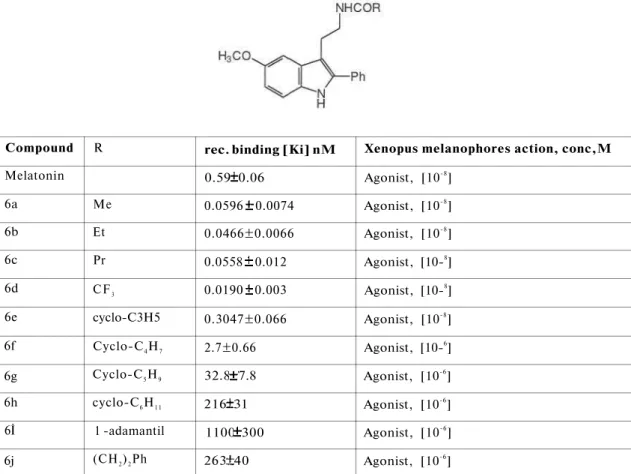
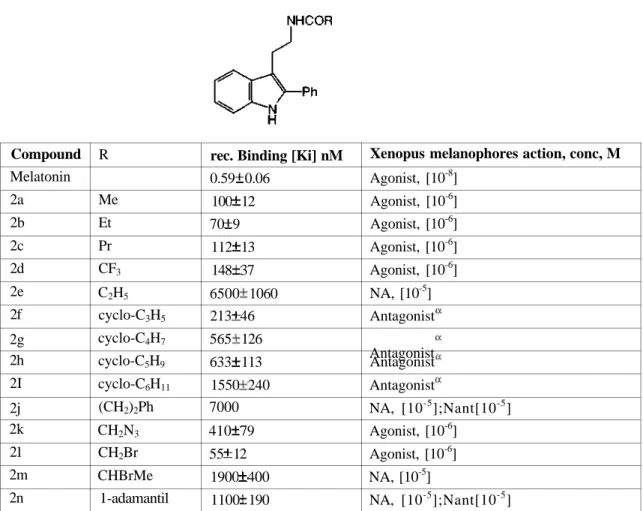
Two series of 2-phenyltryptamides were prepared as melatonin analogues to investigate the nature of the binding site of the melatonin receptor in chicken brain and in Xsenopus laevis melanophore cells. The 5-methoxy-2- phenyltryptamides (6a-j) (Table 3) have high binding affinities for the chicken brain receptor, in some cases (6a-d) greater than that for melatonin, confirming and extending the work of Spadoni et al. (16) and act as agonists in the Xsenopus melanophore assay. Analogues lacking the 5-methoxyl group (2a-n) had a considerably lower affinity for the chicken brain receptor. In the Xsenopus melanophore assay the compounds acylated on nitrogen by an alkyl group (2a-d) were agonist whereas the compounds acylated on nitrogen by an alicyclic group (2f-i) (Table 4) were antagonist (24).
Compound Melatonin 8a 8b 8c 8d 8e 8f 8g 8h 8İ X F F F CI CI CI Br Br Br R1 Me Et Pr Me Pr Bu Me Et Pr
rec. binding [Ki] nM
0.59±0.06 1920 330 740 110 434 66 636 134 113 33 15100 2700 852±93 318 30 354 74
TABLE 2. Binding affinity in chicken brain assay of 3-(3-halophenyl)propyl amides (22)
Compound Melatonin 6a 6b 6c 6d 6e 6f 6g 6h 6İ 6j R Me Et Pr CF3 cyclo-C3H5 Cyclo-C4H7 Cyclo-C5H9 cyclo-C6H11 1 -adamantil (CH2)2Ph
rec. binding [Ki] nM
0.59 0.06 0.0596 0.0074 0.0466±0.0066 0.0558 0.012 0.0190 0.003 0.3047±0.066 2.7±0.66 32.8 7.8 216 31 1100 300 263 40
Xenopus melanophores action, conc,M
Agonist, [10-8] Agonist, [10-8] Agonist, [10-8] Agonist, [10-8] Agonist, [10-8] Agonist, [10-8] Agonist, [10-6] Agonist, [10-6] Agonist, [10-6] Agonist, [10-6] Agonist, [10-6]
TABLE 3. Binding affinity in chicken brain assay and response of Xsenopus laevis melanophores to
Ankara Ecz. Fak. Derg., 30 (4) 41-52, 2001 49 Compound Melatonin 2a 2b 2c 2d 2e 2f 2g 2h 2I 2j 2k 21 2m 2n R Me Et Pr CF3 C2H5 cyclo-C3H5 cyclo-C4H7 cyclo-C5H9 cyclo-C6H11 (CH2)2Ph CH2N3 CH2Br CHBrMe 1-adamantil
rec. Binding [Ki] nM
0.59 0.06 100 12 70 9 112 13 148 37 6500 1060 213 46 565 126 633 113 1550 240 7000 410 79 55 12 1900 400 1100 190
Xenopus melanophores action, conc, M
Agonist, [10-8] Agonist, [10-6] Agonist, [10-6] Agonist, [10-6] Agonist, [10-6] NA, [10-5] Antagonist Antagonist Antagonist Antagonist NA, [10-5];Nant[10-5] Agonist, [10-6] Agonist, [10-6] NA, [10-5] NA, [10-5];Nant[10-5]
TABLE 4. Binding affinity in chicken brain assay and response of Xsenopus laevis melanophores to
2-phenyltryptamine derivatives (24).
A series of unsubstituted and methoxy-substituted 2-amidotetralins (4a-q) were prepared and evaluated for their ability to compete for 2-[125I] iodomelatonin binding to chicken retinal membranes and for their potency to inhibit the calcium-dependent release of [3H] dopamine from rabbit retina. The lead compound, 2-acetamido-8-methoxytetralin (4j), showed a moderate affinity (Ki=46 nM) and potency (IC50= 1.4 nM) at the melatonin receptor. The structural requirements necessary for optimal agonistic activity at the melatonin receptor are as follows. First, the amido group, which should have a small, nonbranched alkyl group, is essential for affinity, and second, the methoxy substituent at the 8-position of the 2-amidotetralin ring is essential for optimal agonistic activity at the melatonin receptor. The researchers concluded that this series of unsubstituted and methoxy-substituted 2-amidotetralins constitutes a class of nonindolic melatonin-like agents that can be used as pharmacological tools to further characterize melatonin receptors and to elucidate the mode of action of melatonin (25) (Table 5).
Compound Melatonin 4a 4b 4c 4d 4e 4f 4g 4h 4İ 4j 4k 41 4m 4n 4o 4p 4q Rı H H H H H H 5-OCH3 6-OCH3 7-OCH3 8-OCH3 8-OCH3 8-OCH3 8-OCH3 8-OCH3 8-OCH3 8-OCH3 8-OCH3 R2 Me Et n-Pr CH2C1 CH2Ph Ph Me Me Me Me Et n-Pr i-Pr C-C3H5 CH2C1 CH2Ph Ph Ki, nM b 0.57 665 145 44.4 95.1 NEh NE 1950 NE 121 46.3 7.40 3.60 312 141 3.75 NE 23100 Relative affinityc 1.00 1170 254 78 167 3420 212 81 13 6.3 547 247 6.6 40500 IC5 0, nMe 0.017 52 8.1 1.0 1.3 ND1 ND 6.5 ND 1.6 1.4 0.48 1.2 7.9 2.5 0.063 NE 22 relative potency 1.0 3060 476 59 76 382 94 82 28 71 465 147 3.7 1290 TABLE 5. Pharmacological evaluation of the amides 4a-q (25).
CONCLUSION
It has been demonstrated that the indole ring of melatonin is not an essential characteristic of the molecule for either its affinity for the melatonin receptor or for its biological activity, as it can be replaced by a naphthalene bioisostere. Whilst substitution of the nitrogen in the indolic ring by either S (benzothiophen) or O (benzofuran) can be tolerated, they both reduce binding affinities to some extent, and the later substitution elicits effects which cannot be presently explained. Homologous extension of the N-acetyl side chain of the naphthalenic analogue together with other modifications can increase the affinity of the compounds for the melatonin receptor over that of melatonin itself.
Ankara Ecz. Fak. Derg., 30 (4) 41-52, 2001 51
REFERENCES
1. Lerner, A.B., Case, J.D., Takahaski, Y., Lee, T.H. ve Mori, W. "Isolation of melatonin the
pineal gland factor that lightens melanocytes", J. Am. Chem. Soc, 80, 2587 (1958).
2. Arendt, J., Boberly, A.A., Franey, C, Wright, J. "The effects of chronic, small doses of
melatonin given in the late afternoon on fatigue in man", Neurosci Lett., 45, 317 (1984).
3. Guardiola-Lemaitre, B., "Development of melatonin analogues", Adv. Pineal Res., 351-353
(1991).
4. Seltzer, A., Viswanathan, M. and Sazwedra, J.M. "Melatonin-binding sites in brain and
caudal arteries of the female rat during the estrous cycle and after estrogen administration",
Endocrinology,130, 1890 (1992).
5. Depreux, P., Lesieur, D., Mansour, H.A., Morgan, P., Howell, H.E., Renard, P.., Caignard, D-H., Pfeiffer, B., Delagrange, P., Guardiola, B., Yous, S., Demarque, A., Adam, G. and Andrieux, J. "Synthesis and structure-activity relationships of novel
naphthalenic and bioisosteric related amidic derivatives as melatonin receptor ligans", J.
Med. Chem., 37, 3231 (1994).
6. Poeggler, B., Reiter, R.J., Tan, D.X., Chen, L.D. and Manchester, L.G. "Melatonin
hydroxy radical-mediated oxidative damage and aging: a hypothesis", J. Pineal Res.,14, 151 (1993).
7.Ates-Alagöz, Z., Süzen, S. "Oxidative damage in the central nervous system and protection
by melatonin",J. Faculty of Pharmacy of Ankara University, in press (2001).
8. Jones, M.P., Melan, M.A., Witt-Enderby, P.A. "Melatonin decreases cell proliferation and
transformation in a melatonin receptor-dependent manner", Cancer Lett., 151, 133 (2000).
9. Li, P.K., Witt-Enderby, P.A. "Melatonin receptors as potential targets for drug discovery",
Drugs of the Future, 25(9), 945 (2000).
10. Avery, D., Lenz, M. and Landis, C. "Guidelines for prescribing melatonin", Ann. Med.,
30, 122 (1998).
11. Witt-Enderby, P.A., Li, P.K. "Melatonin receptors and ligands", Vitam. Horm., 58, 321
(2000).
12. Shiu, S.Y.W., Ng, N. and Pang, S.F. "A molecular perspective of the genetic relationships
of G-protein coupled melatonin receptor subtypes", J. Pineal Res., 20, 198 (1996).
13. Sudgen, D., Chong, N.W.S. and Lewis, D.F.V. "Structural requirement at the melatonin
receptor", Br. J. Pharmacol., 114, 618 (1995).
14. Garratt, P.J., Jones, R., Rowe, S.R. and Sudgen, D. "Mapping the melatonin receptor. 1.
The methoxyl group of melatonin is not essential requirements for biological activity",
15. Sudgen, D. and Chong, N.W.S. "Pharmacological identity of 2-[125I]-iodomelatonin binding sites in chicken brain and sheep pars tuberalis", Brain Res., 539, 151 (1991). 16. Spadoni, g., Stankov, B., Duranti, A., Biella, G., Lucini, V., Salvatori, A. and
Franschini, F. "2-Substituted 5-methoxy-N-acyltryptamines: Synthesis, binding affinity for the melatonin receptor and evaluation of the biological activity", J. Med. Chem., 36, 4069 (1993).
17. Yous, S., Andrieux, J., Howell, H.E., Morgan, P.J., Renard, P., Preiffer, B., Lesieur, D. and Guardiola-Lemaitre, B. "Novel naphtalenic ligands with high affinity for the
melatonin receptor", J. Med. Chem., 36, 1484 (1992).
18. Dubocovich, M.L. "Melatonin receptors: Are there multiple subtypes", Trends Pharm.
Sci, 16,50(1995).
19. Krause, D.N. and Dubocovich, M.L. "Melatonin receptors", Annu. Rev. Pharmacol.
Toxicol, 31, 549 (1991).
20. Mahle, C.D., Takaki, K.S., Watson, A.J. "Melatonin receptor ligands and their potential clinical applications", Annu. Reports in Medicinal Chemistry, 32, 31 (1997).
21. Molinari, E.J., North, P.C. and Dubocovich, M.L. "2-[,25I]
Iodo-5-methoxycarbonylamino-N-acetyltryptamine: A selective radioligand for the characterization of melatonin ML2 binding sites", Eur. J. Pharmacol. 301, 159 (1996).
22. Garratt, P.J., Travard, S. and Vonhoff, S. "Mapping the melatonin receptor. 4.
comparison of the binding affinities of a series of substituted phenylalkyl amides", J. Med.
Chem., 39, 1797 (1996).
23. Kennaway, D.J., Hugel, H.M., Clarke, S., Tjandra, A., Johnson, D.W., Royles, P., Webb, H.A., Carbone, T., "Structure activity studies of melatonin analogues in prepubertal male rats", Aust. J. Biol. Sci, 41, 393 (1988).
24. Garratt, P.J., Jones, R. and Tocher, D.A. "Mapping the melatonin receptor. 3. design and synthesis of melatonin agonist and antagonist derived from 2-phenyltryptamines", J. Med.
Chem., 38, 1132(1995).
25. Copinga, S., Tepper, P.G., Grol, C.J., Horn, A.S., Dubocovich, M.L. "2-Amido-8-methoxytetralins: A series of nonindolic melatonin4ike agents", J. Med. Chem., 36, 2891 (1993).
Başvuru Tarihi: 03.07.2001 Kabul Tarihi: 11.09.2001