Examining the Effectiveness of Mindfulness Based Training
Program on Female Handball Players’ Psychological Skills
and Coping with Stress Strategies
Zeynep Ayça Terzioğlu
1A, Mustafa Yıldız
2B, S. Gülfem Çakır
3C1Antalya Bilim University, Psychological Counseling and Guidance Research and Application Center, Antalya, Turkey 2 Akdeniz University, Department of Recreation, Faculty of Sport Sciences, Antalya, Turkey
3 Akdeniz University, Department of Educational Sciences, Faculty of Education, Antalya, Turkey
* This study was presented at the 16 th International Sport Sciences Congress (31-03/10-11- 2018, (Antalya / Turkey).
Address Correspondence to Z.A., Terzioğlu e-mail:[email protected] (Received): 06.12.2019/ (Accepted): 31.03.2020
A:Orcid ID: 0000-0002-8849-9904- B: 0000-0002-9483-0341-C:0000-0003-0625-3802
Abstract
The aim of this study was to examine the effectiveness of a mindfulness-based training program on female handball athletes’ psychological skills and strategies to cope with stress in sport. In the study, as a quasi-experimental method, pre-test, and post-test models without a control group were used. The study group consists of 9 female handball players who play in the Antalya Muratpaşa Municipality Women's Handball Team. In the research, a personal information questionnaire, the Athletic Coping Skills Inventory and Coping Strategies in Sport Competition Inventory were used to collect data as pre-test before the program and as post-test at the end of the program. In the study, the Mindfulness-Based Training Program was implemented once a week as group training, consisting of 8 sessions lasted 60 minutes each. Wilcoxon Signed Rank Test was used to test the significance of the scope difference. As a result of the study, after the program, there was a significant difference in terms of ability to cope with adversity, coachability, concentration, goal setting and mental preparation, and being free from worries. Moreover, a significant difference between pre-test and post-test scores of the task-oriented coping dimension in Sport Competition Inventory was noted.
Key Words: Mindfulness, coping strategies with stress, psychological skills
INTRODUCTION
Increasing the performance of athletes has been one of the most significant fields of study in sports science. It is noted that performance in sport is largely affected by athletes' ability to be “mindful”. Being mindful for athletes means remaining in the present, and being centered and relaxed regardless of what happens during the competition (32). Recent studies conducted in the field reveal that mindfulness-based practices have become prominent as an effective method for increasing the performance of athletes (19, 21). In this sense, mindfulness interventions designed to assist athletes in increasing their performance are new practices.
Studies in sports psychology have shown that there is a relationship between mindfulness and sports performance (22) and also optimum performance in sports is linked to the present focus (33). Mindfulness interventions applied to improve performance in sports generally focus on psychological training techniques, attention and optimum performance (30).
Success and performance in sports are affected by stress factors, such as mental or physical mistakes, pain, disease, being cheated by opponents or seeing them succeed, being penalized by the referee and being challenged by the trainer (4). Stress consists of physiological, behavioral, http://dergipark.gov.tr/tsed
Year: 2020 - Volume: 22 - Issue: 1 - Pages: 30-37
DOI: 10.15314/tsed.656240
emotional and cognitive patterns of reactions against real or imagined stimulants that are perceived as putting the individual at risk or harm his/her well-being (23). On the other hand, mindfulness plays an important role in reinforcing the psychological and physiological well-being of the individuals (35). There are many definitions of mindfulness in literature. According to Bishop et al. (7), mindfulness is defined as the individual’s ability to self-regulate oneself regarding momentary mental states and mental processes. Linehan and Dimidjian (25) state that mindfulness includes, “the intentional process of observing, describing and participating in reality, nonjudgmentally, in the moment, and with effectiveness.” On the other hand, Kabat-Zinn (20) defines mindfulness as “paying attention in a particular way: on purpose, in the present moment, and non-judgmentally.”
Mindfulness teaches athletes to focus on the moment instead of dwelling on the mistakes of the past and potential consequences of those mistakes. By focusing on the moment, athletes can pay more attention to the cues about their performances, and they can more easily ignore the factors that distract them (36). Most of the traditional cognitive-behavioral strategies include techniques, such as thought-stopping, self-talk, goal setting and imagery (6, 10, 40). However, recent studies have shown that these techniques have limited impact on the athletes’ abilities to improve their performances (14). As a technique that helps athletes to focus on the moment (18), mindfulness makes it easier for them to improve their performance to the optimal level. Therefore, it has been found that mindfulness practices are effective for increasing performance in various branches of sports that require focusing, such as golf (5), marksmanship (19) and archery (21). While mindfulness practices have an important role as strategies to cope with stress, it has also been proven that they have a calming effect on the nervous system, helping to switch off the stress response and bring the individual back into balance. They also train individuals to become more aware of stress signals in the body, giving them the chance to respond more effectively (39). In addition, they provide significant information about the assessment of an athlete’s stress stories, life events, daily stress variables and previous stress stories (2). Another study has highlighted topics, such as referee decisions, contests, impact of trainers and teammates, managerial and administrative
decisions, social support, accommodation, travel, diet, education, and financial and time pressure as organizational stress sources (16). While it is common for athletes to be able to cope with stress, it often has major effects on their performance. The negative consequences of stress can be minimized with the help of mindfulness (32).
Competing at an elite level is a situation that requires the athlete to spend a great deal amount of time and intense effort. While doing this, it is normal for the athlete to experience stress and it is one of the most important factors affecting performance in sports. It can be said that mindfulness levels are also effective in improving the psychological skills of athletes and generating strategies to cope with stress. So, due to the absence of studies on mindfulness-based psycho-education programs on athletes in the Turkish literature, it is thought that examining the effectiveness on psychological skills of the mindfulness-based training program prepared within the scope of the research and the strategies to cope with stress in sports will contribute to the literature. Therefore, the main objective of this study is to assess whether mindfulness-based training programs improve the psychological abilities of women handball players and their strategies to cope with stress. Through the exercises incorporated in mindfulness-based programs, it is ensured that athletes focus on the moment and avoid judging their past, which is thought to increase their attention level and hence, reduce the stress level.
METHOD
This research is an experimental study that aims to analyze the effectiveness of an 8-week program, developed based on mindfulness-based stress reduction and mindfulness-based cognitive therapy approaches, on a female handball team’s psychological skills and their strategies to cope with stress. In the design of this research, a quasi-experimental design has been employed.
Research Group
The subjects of the study consist of the members of the female handball team of the Municipality of Muratpaşa, Antalya. The research group was determined using the convenient sampling method. The women athletes who volunteered (in line with the opinions of the trainer) constitute the experiment group of the study. The total number of participants is 9. The sportive experience of the participants varies between 7 and 14 years (mean = 9.78). The
participants are between the ages of 18 and 25, and the average age is 20.22 (ss= 2.64).
Data Collection Tools and Procedures
Moreover, Akdeniz University, Scientific Research and Publication Ethical Committee approved the study (decision number 60). Before first session of the psycho-education program, the pre-test was applied to participants to measure psychological skills and strategies to cope with stress. Post-test was applied at the end of the program to examine the impact of the prepared mindfulness-based training program.
The Athletic Coping Skills Inventory
The Athletic Coping Skills Inventory (ACSI-28), developed by Smith, Schutz, Smoll and Ptacek (1995), was adapted to the Turkish culture by Erhan, Bedir, Güler and Ağduman (15). The inventory is a self-assessment tool that was developed to assess the psychological skills of athletes. The Athletic Coping Skills Inventory, consisting of 28 items, has 7 sub-dimensions, which are coping with adversity, coachability, concentration, confidence and achievement motivation, goal setting and mental preparation, peaking under pressure and freedom from worry. The Cronbach’s Alpha coefficient, obtained in reliability studies, is .85. The Cronbach’s Alpha coefficients for the subscales of coping with adversity, coachability, concentration, confidence and achievement motivation, goal setting and mental preparation, peaking under pressure and freedom from worry are .62, .51, .59, .60, .62, .71 and .50, respectively.
Coping Strategies in Sport Competition Inventory
I’Invantaire des Stratégies de Coping enCompétition Sportive (ISCCS), developed by Gaudreau and Blondin (2002) in Canada, was adapted to the Turkish culture by Arsan (3). The inventory, developed to assess the athletes’ strategies to cope with stress during competitions, consists of 39 items. It has 10 subscales and is classified under three dimensions: Task-oriented coping (mental imagery, effort expenditure, thought-control, seeking support, relaxation, logical analysis), distraction-oriented coping (distancing, mental distraction) and disengagement-oriented coping (venting of unpleasant emotions, disengagement). The Cronbach’s Alpha coefficients for the subscales vary between .61 and .76.
Data Analysis
In the pre-test and post-test score comparisons of the study group, the Wilcoxon Signed Rank Test, which is a nonparametric statistical technique that is used to test the significance of the scope difference, was employed. Analysis of quantitative data was conducted with the use of the Statistical Package for Social Sciences (SPSS 20.0). Athletes who prefer to participate in the study voluntarily are included in the mindfulness- based training program. Thus, the control group could not be formed because the number of people in the study group was limited and only consists of inequivalent female handball players.
The Preparation of the Program
The mindfulness-based skills development program is a psycho-education program planned to be a 60-minute weekly session for 8 weeks to develop athletes' psychological skills and strategies to cope with stress. Mindfulness-based Stress Reduction (MBSR) and Mindfulness-based Cognitive Therapy Techniques (MBCT) were mainly used in the preparation of the Mindfulness-Based Skills Development Program. Researchers used many resources to develop the program (9, 11, 12, 13, 24, 31). The content of the program was prepared by taking relevant theoretical views into consideration. While creating the content of the group sessions, sequence in the session themes is predetermined based on MBCT and sequence in mindfulness practice is determined based on MBSR. The program started with the most basic mindfulness practices. Then, it is followed by meditation practices such as eating and walking meditations that athletes can practice in their daily lives and it is finished with the unconditional acceptance practice. The purpose of each session was prepared by determining the target thoughts, emotions and behaviors expected to be achieved by female handball players. In order to apply mindfulness in their daily lives, they were told to ask the question "Where am I now and what am I doing now?" Thus, it was stated that they can easily focus their attention on themselves and their current experiences while acting automatically without realizing what they are doing during the day. Moreover, Ch’an always includes being calm, well-balanced and disciplined (27). When Ch'an application is carried out regularly, it helps the
individual to respond more effectively to the situations that he encounters daily by providing the improvement of power, elegance and self-confidence in the individual (26). On the other hand, loving kindness meditation helps the individual to develop positive emotions by incorporating a strong friendship towards herself and others and it allows others to accept unconditionally with their all aspects. This practice allows the mind to relax from past and future pressures by helping the individual
to break his mental habits and his own judgements (8).
The homeworks to be assigned to participants at the end of groups sessions, and information and exercises to be provided to participants in each session were determined (Table 1).
Table 1. The content of the mindfulness-based skills development program
1stSession: Introduction to Mindfulness Concepts Introduction
Introduction of the Mindfulness-Based Skills Development Program
Setting group rules
A theoretical introduction to mindfulness
Explanation of daily mindfulness practices
Application of mindfulness exercises (9)
Informing about tasks and practices
Assignment of the breathing exercise as homework
2ndSession: Breath and Body Awareness
The significance of breathing and body awareness
Awareness of emotions, behaviors and thoughts.
Principles and benefits of awareness
The significance of being in the moment
Performance check list (9)
Mindful breathing (9, 11, 17, 24) and body-focus exercises (12)
Assignment of breathing exercises and body-focus exercises as homework
3rdSession: Ch’an Meditation
The significance of Ch’an meditation in stress reduction
Mindfulness Movement meditation
Ch’an meditation (34)
Application of Ch’an meditation and assignment of the Ch’an meditation as homework
4thSession: Let go of thoughts Thought tracking exercises
Imagination (River meditation) (13)
Sounds and Thoughts Meditation
Assignment of the Sounds and Thoughts meditation as homework (41)5thSession: Focusing
Application of mindfulness to daily life
Focusing on five senses (24, 39)
The Chocolate Meditation
Assignment of the Eating Meditation as homework6thSession: Walking Meditation and Thought Stopping
Formal walking meditation (8, 12)
“6 Things to Focus” Practice (12)
Thought stopping exercise
Assignment of the daily mindful walking exercise as homework7thSession: Loving Kindness Meditation
Information about the Loving Kindness Meditation
Loving Kindness Meditation (8)
Assignment of the Loving Kindness Meditation as homework8thSession: Wrapping up: Summary and Conclusion Assessment of the program
Integrating awareness methods in daily life (tooth-brushing, eating etc.) (24)
3-Minute Mindful Breathing Space Practice (28)
Sharing experience
Sharing the experience regarding all homework assigned in previous weeks
Receiving feedback
Application of the Program
The application of pre-test forms for the experiment group was completed in October, 2017; and the application of post-test forms was completed in December, 2017. The study started with 9 women handball players who attended all sessions of the program. The experiment group was given a group session on mindfulness-based skills development for 60 minutes a week. They were given a pre-test and a post-test to measure their
psychological skills and their strategies to cope with stress in sports to assess the effectiveness of the mindfulness-based skills development program.
FINDINGS
Pre-test and post-test means scores of psychological skills and the strategies to cope with stress are shown in Table 2.
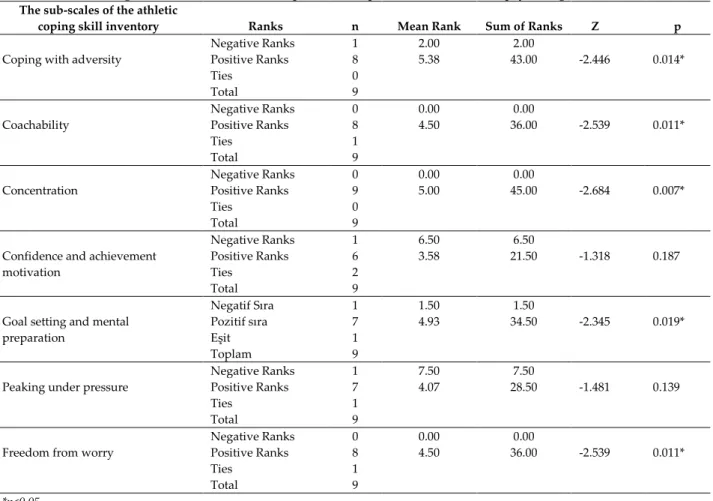
Wilcoxon signed rank test was used to compare pre-test and post-test values for the psychological skills. The analysis results as shown in Table 3.
Table 2. Pre-test and post-test values for psychological skills and the strategies to cope with stress.
Sub-scales
Pre-test Post-test
Mean Mean
Coping with adversity 9.22 11.89
Coachability 11.11 13.44
Concentration 9.56 12.67
Confidence and achievement motivation 12.89 13.44
Goal setting and mental preparation 10.33 11.89
Peaking under pressure 10.89 12.11
Freedom from worry 8.22 10.22
Task-oriented coping 81.78 98.22
Distraction-oriented coping 19.67 22.78
Disengagement-oriented coping 19.11 18.11
Table 3. Wilcoxon signed rank test results of the pre-test and post-test scores for the psychological skills.
The sub-scales of the athletic
coping skill inventory Ranks n Mean Rank Sum of Ranks Z p
Coping with adversity
Negative Ranks Positive Ranks Ties Total 1 8 0 9 2.00 5.38 2.00 43.00 -2.446 0.014* Coachability Negative Ranks Positive Ranks Ties Total 0 8 1 9 0.00 4.50 0.00 36.00 -2.539 0.011* Concentration Negative Ranks Positive Ranks Ties Total 0 9 0 9 0.00 5.00 0.00 45.00 -2.684 0.007*
Confidence and achievement motivation Negative Ranks Positive Ranks Ties Total 1 6 2 9 6.50 3.58 6.50 21.50 -1.318 0.187
Goal setting and mental preparation Negatif Sıra Pozitif sıra Eşit Toplam 1 7 1 9 1.50 4.93 1.50 34.50 -2.345 0.019*
Peaking under pressure
Negative Ranks Positive Ranks Ties Total 1 7 1 9 7.50 4.07 7.50 28.50 -1.481 0.139
Freedom from worry
Negative Ranks Positive Ranks Ties Total 0 8 1 9 0.00 4.50 0.00 36.00 -2.539 0.011* *p<0.05
According to the test results provided in Table 3, the results of the Wilcoxon Signed Rank Test applied for the Athletic Coping Skill Inventory of the experiment group revealed that there was a significant difference between the pre-test and post-test scores of the athletes in terms of coping with adversity, coachability, concentration, goal-setting and mental preparation and freedom from worry. When the rank sums of the variation scores are taken into consideration, the difference observed in positive ranks is in favor of the post-test scores.
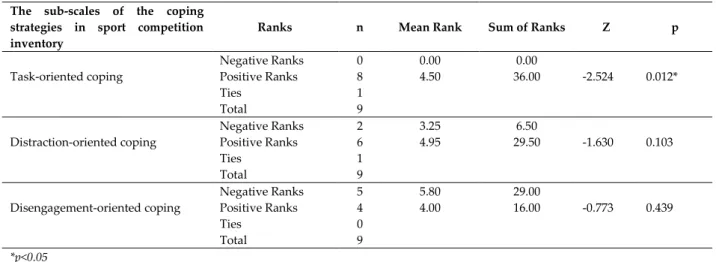
Wilcoxon signed rank test was used to compare pre-test and post-test values for the strategies to cope with stress. The analysis results as shown in Table 4.
According to the test results provided in Table 3, the results of the Wilcoxon Signed Rank Test applied for the Coping Strategies in Sport Competition Inventory of the experiment group reveal that there was a significant difference between the pre-test and post-test scores of the athletes in terms of task-oriented coping skills. When the rank sums of the variation scores are taken into consideration, the difference observed in positive ranks is in favor of the post-test score.
DISCUSSION
In this study, the aim was to assess whether there is a significant difference between the psychological skills assessment scores of the athletes in the experiment group before and after the application of the Mindfulness-Based Skills Development Program. It has been shown that there is a significant difference between the pre-test and post-test scores, obtained from the Athletic Coping Skills Inventory, in terms of coping with adversity, coachability, concentration, goal setting and mental preparation and freedom from worry. Bernier, Thienot, Cordon and Fournier (5), studied the effects of the psychological skills training, based on based acceptance and mindfulness-based cognitive therapies, on the performance of elite golfers, and the study showed that the mental skills of the athletes in the experiment group were improved. It was also found by other researchers that optimal performance is related to being present and now (22). This finding is consistent with the results of other studies. A study where the relationship between the optimal performance and the emotional state of the athletes was assessed after
the application of a mindfulness-based training program to the athletes of various branches (rugby, tennis, hockey, sprinter, hammer thrower), revealed that mindfulness training has a positive effect on the goal setting and emotional control skills of the athletes (1). These findings are consistent with the findings of the current study. Similarly, Kee and Wang (22) also found that as the mindfulness level increases, there is also an increase in the scores of mental skills such as attention control, emotional control, goal-setting and self-talk. Similarly, a study by Terzioğlu and Çakır (37), on the effects of a mindfulness-based training developed for elite archers, looking at the mental skills and mindfulness levels of these athletes, showed that after the application of the program, there was an improvement in the athletes’ levels of relaxation, activation, competition planning and refocusing dimensions of the mental skills test.
This study also examines whether there was a significant difference between the athletic coping skills of the athletes in the experiment group before and after the application of in the mindfulness-based training program. It was found that there was a significant difference between the (athletes’ pre-test and post-test scores of task-oriented coping skills in the favor of post-test scores. A study by John, Verma and Khanna (19) on the relationship between mindfulness meditation therapy and pre-competition anxiety for elite male archers shows that there is a significant decrease in the pre-competition anxiety in connection with the salivatory cortisol which is a physiological indicator of stress. Similarly, in a study where the effects of mindfulness-based performance enhancement on
Table 4. The wilcoxon signed rank test results of the pre-test and post-test scores for the strategies to cope with
stress.
The sub-scales of the coping strategies in sport competition inventory
Ranks n Mean Rank Sum of Ranks Z p
Task-oriented coping Negative Ranks Positive Ranks Ties Total 0 8 1 9 0.00 4.50 0.00 36.00 -2.524 0.012* Distraction-oriented coping Negative Ranks Positive Ranks Ties Total 2 6 1 9 3.25 4.95 6.50 29.50 -1.630 0.103 Disengagement-oriented coping Negative Ranks Positive Ranks Ties Total 5 4 0 9 5.80 4.00 29.00 16.00 -0.773 0.439 *p<0.05
the optimal performance and psychological properties of recreational archers and golfers were examined, it was found that there was a decrease in somatic anxiety levels of archers. It was also shown that there is a positive relationship between optimal performance and mindfulness levels (21). Another study by Thompson, Kaufman, De Petrillo, Glass and Arnkoff (38), where a mindfulness-based performance enhancement program was developed to improve the athletic performance and psychological aspects of athletes, it was found that there was a significant increase in the finish times and mindful behaviors of runners and that there was a decrease in their irrelevant thoughts and task-related concerns. These findings are consistent with the findings of this research. A study on 483 elite athletes in various branches of sports shows that there is a negative relationship between mindfulness and stress, and a positive relationship between mindfulness and achievement in sports (29). A study carried out by De Petrillo, Kaufman, Glass and Arnkoff (14), to determine the effect of a mindfulness-based performance enhancement program on long distance runners over a 4-week period, shows that there is a decrease in the sport-anxiety related worry level of the experiment group. A review of the literature shows that studies in the field of sports psychology generally focus on goal-setting, self-talk, imagination and physical relaxation, which are traditional psychological training techniques of athletes. Mindfulness-based practices are important for increasing the attention and self-control ability of the athletes. In this aspect, mindfulness in sports differs from traditional methods in terms of accepting negative thoughts and disturbing emotions without judging them and presents an alternative technique. Based on the findings in the literature, it can be suggested that through mindfulness-based practices, an increase in athletes’ focusing on the present moment and concentration skills, and a decrease in their stress level can be achieved. In fact, there has been increasing interest in mindfulness-based training programs; however, there is still a limited number of studies about the effects of mindfulness-based group programs on athletes in Turkey. In this sense, this study is the first one to focus on the effectiveness of a mindfulness-based training program on a women’s handball team in Turkey. Therefore, it is thought that the findings of this study will contribute to the
literature in the field. The results demonstrate that the Mindfulness-Based Training Program is effective for the athletes in terms of coping with adversity, coachability, concentration, goal setting and mental preparation, freedom from worry, and task-oriented coping skills as a way of coping with stress. While the current study presents some useful findings for the future, there are certain limitations that need to be considered when these findings are interpreted. First of all, this study includes only an experiment group. Since there is no control group, it is not clear whether the change is due to the time or application. Moreover, in this study, mindfulness-based training program was implemented during the training periods of athletes. It is also important the mention that the working group consists of only female. Lastly, the subscales on Coping Strategies in Sport Competition Inventory has reliability coefficient of .61 can be noted as another limitation of the study. Despite these limitations, there can be some recommendations for future studies. In light of the finding that mindfulness increases the ability of concentration and coping with adversity, mindfulness-based programs with different exercises can be prepared to improve the performance and focus skills of athletes. Therefore, it can be recommended to apply mindfulness-based interventions in individual and team sports that are professionally carried out starting from the infrastructures in the field of sports. In addition, it can be done in practice for coaches in coaching courses organized by federations. To the best of authors’ knowledge, studies about the effects of group programs prepared based on mindfulness on athletes have not been found in the literature in Turkey. Comparison can be made with this study by applying mindfulness based training program on different sports branches and male athletes. For future studies, it is strongly recommended that the effectiveness of the mindfulness based training program can be compared by taking follow up measurements.
REFERENCES
1. Aherne C, Moran AP, Lonsdale C. The effect of mindfulness training on athletes’ flow: An initial investigation. The Sport Psychologist, 2011; 25(2), 177-189.
2. Andersen MB, Williams JM. A model of stress and athletic injury: Prediction and prevention. Journal of Sport and Exercise Psychology, 1988; 10(3), 294-306.
3. Arsan N. Türkiye'de sporcuların stresle başa çıkma davranışlarının belirlenmesi. Unpublished master’s thesis. Ankara, Turkey: Hacettepe University, 2007.
4. Bahramizade H, Besharat MA. The impact of styles of coping with stress on sport achievement. Procedia-Social and Behavioral Sciences, 2010; 5, 764-769. doi: 10.1016/j.sbspro.2010.07.181
5. Bernier M, Thienot E, Cordon R, Fournier JF. Mindfulness and acceptance approaches in sport performance. Journal of Clinical Sport Psychology, 2009; 25(4), 320- 333.
6. Birrer D, Morgan G. Psychological skills training as a way to enhance an athlete’s performance in high-intensity sports. Scandinavian journal of medicine & science in sports, 2010; 20(2): 78-87.
7. Bishop SR, Lau M, Shapiro S, Carlson L, Anderson ND, Carmody J, Segal SV, Abbey S, Speca M, Velting D, Devins G. Mindfulness: A proposed operational definition. Clinical psychology: Science and practice, 2004; 11(3), 230-241. doi: 10.1093/clipsy/bph077
8. Brantley M, Hanauer T. The gift of loving kindness: 100 meditations on compassion, forgiveness and generosity. Oakland: New Harbinger, 2008.
9. Cohen, R. Sport psychology: The basics: Optimising human performance. New York: Bloomsbury Publishing, 2016. 10. Cox RH. Sport psychology: Concepts and applications. 7 ed.
New York: McGraw-Hill, 2014.
11. Çatak P, Ögel K. Farkındalık Çalışma Kitabı: Farkında nefes almak. Retrieved September 17, 2017, from www.ogelk.net/formlar/farkindalik/farkinda%20
nefes%20almak.pdf, 2009a.
12. Çatak P, Ögel K. Farkındalık çalışma kitabı: Şimdiye odaklanmak. Retrieved September 17, 2017, from www.ogelk.net/Dosyadepo//simdiye%20odaklanmak.pdf, 2009b.
13. Çatak P, Ögel K. Farkındalık çalışma kitabı: Düşüncelere mesafe koyabilmek. Retrieved September 17, 2017, from www.ogelk.net/formlar/farkindalik/dusunce.pdf, 2009c. 14. De Petrillo L, Kaufman K, Glass C, Arnkoff D. Mindfulness
for long-distance runners: An open trial using mindful sport performance enhancement (MSPE). Journal of Clinical Sports Psychology, 2009; 4, 357-376.
15. Erhan SE, Bedir D, Güler MŞ, Öztaşyonar Y. Psychological skills analysis of students studying at Ataturk University faculty of sports science. International Journal of Sport Studies, 2016; 6(11), 667-675.
16. Fletcher D, Hanton S. Sources of organizational stress in elite sports performers. The sport psychologist, 2003; 17(2), 175-195.
17. Forsyth JP, Eifert GH. The mindfulness and acceptance workbook for anxiety. Oakland: New Harbinger Publishing, 2007:145.
18. Hathaway C, Eiring K. Mindfulness and sports psychology for athletes: Consider awareness your most important mental tool. Madison: Lulu Press, 2012.
19. John S, Verma S, Khanna G. The effect of mindfulness meditation on HPA- Axis in pre-competition stress in sports performance of elite shooters. National Journal of Integrated Research in Medicine, 2011; 2(3), 15-21.
20. Kabat-Zinn J. Wherever you go, there you are. New York: Hyperion, 1994:4.
21. Kaufman KA, Glass CR, Arnkoff DB. Evaluation of mindful sport performance enhancement (MSPE): A new approach to promote flow in athletes. Journal of Clinical Sport Psychology, 2009; 25(4), 334-356.
22. Kee YH, Wang CJ. Relationships between mindfulness, flow dispositions and mental skills adoption: A cluster analytic
approach. Psychology of Sport and Exercise, 2008; 9(4): 393-411. doi: 10.1016/j.psychsport.2007.07.001.
23. Kremer J, Moran A, Walker G, Craig C. Key concepts in sport psychology. Thousand Oaks, CA: Sage, 2012.
24. Lehrhaupt L, Meibert P. Mindfulness-based stress reduction: The MBSR program for enhancing health and vitality. Novato, CA: New World Library, 2017.
25. Linehan MM, Dimidjian S. Mindfulness practice. In Cognitive behavior therapy: Applying empirically supported techniques in your practice ISBN: 0-471-23614-4 New York: Wiley (pp. 229–237), 2003.
26. Maezumi T, Glassman B. On zen practice: Body, breath, and mind. Boston: Wisdom Publications, 2002.
27. Mancini R. Zen, meditation & the art of shooting. Australia: Soul & Sense Publications, 2013.
28. Miklowitz DJ. The bipolar disorder survival guide: What you and your family need to know. New York: The Guilford Press, 2011:228.
29. Moen F, Federici RA, Abrahamsen F. Examining possible Relationships between mindfulness, stress, school-and sport performances and athlete burnout. International Journal of Coaching Science, 2015; 9(1), 3-19.
30. Moore ZE. Theoretical and emprical developments of the mindfulness-acceptance- commitment (MAC) approach to performance enhancement. Journal of Clinical Sport Psychology, 2009; 3, 291-302.
31. Morledge TJ, Allexandre D, Fox E, Fu AZ, Higashi MK, Kruzikas DT, Pham SV, Reese PR. Feasibility of an Online Mindfulness Program for Stress Management—A Randomized, Controlled Trial. Annals of Behavioral Medicine, 2013; 46(2), 137–148. doi.org/10.1007/s12160-013-9490-x.
32. Mumford G. The mindful athlete: Secrets to pure performance. California: Parallax Press, 2015.
33. Ravizza K. A philosophical construct: A framework for performance enhancement. International Journal of Sport Psychology, 2002; 33: 4–18.
34. Skinner JD. Practical zen: Meditation and beyond. London and Philadelphia: Singing Dragon, 2017.
35. Stahl B, Goldstein E. A mindfulness-based stress reduction workbook. Oakland, CA: New Harbinger Publications, 2010. 36. Stratton RK, Cusimano K, Hartman C, DeBoom N. Focus. In
Applying sport psychology: Four perspectives ISBN: 0-7360-4512-0 Champaign, IL: Human Kinetics (pp. 51-64), 2005. 37. Terzioğlu ZA, Çakır SG. Farkındalık temelli beceri geliştirme
programının elit okçuların mental becerileri ve farkındalık düzeyleri üzerindeki etkililiğinin incelenmesi. 15th International Sport Sciences Congress. Book of Abstract, 15th-18th November 2017, Antalya, 832-833.
38. Thompson RW, Kaufman KA, De Petrillo LA, Glass CR, Arnkoff DB. One year follow-up of mindful sport performance enhancement (MSPE) with archers, golfers, and runners. Journal of Clinical Sport Psychology, 2011; 5(2), 99-116.
39. Watt T. Mindfulness: Your step-by-step guide to a happier life. England: Icon Books, 2015.
40. Whelan JP, Mahoney MJ, Meyers AW. Performance enhancement in sport: A cognitive behavioral domain. Behavior Therapy, 1991; 22: 307-327.
41. Williams JM, Penman D. Farkındalık: Çılgın bir dünyada huzur bulmak. (E. Duru, Trans.) İstanbul: Pegasus. (Orginal work published 2011), 2015.