Chapter Nine
T he modern home, Western
fashion and feminine identities
in mid-twentieth-century Turkey
..
Meltem 0. GOrel
The trio of modern home, Western fashion and feminine identities offers productive opportunities to explore the politically charged sociocultural changes, as well as the continuity, that marked Turkish modernity. An abundance of idealized images and texts that exemplifies the trio and the way they were portrayed in popular media codify the convoluted concepts of 'modern' and 'Western' and frame an ideal contemporary citizen, defined with the founding of the Turkish Republic in 1923. At a discursive level, such images and written and oral expressions-as 'statements' , to use Michel Foucault's term contribute to the formation of common values and shared beliefs (in this case, around the meanings of terms such as modern, Western, progressive and civilized) and influence the way a person comes to know her- or himself as a member of a particular social group.1 Hence, they can be considered a technique of power that constructs and conveys certain ideas and ideals to a wide spectrum of society-and from the bottom up-and results in the significant internalization of these values. In part by constructing and in
part by causing an idealized woman to be internalized, such 'statements' contribute to the establishment of strong bonds between the style of women's clothing and the materiality of domestic space, assumed to be an extension of a woman's gendered identity. An analysis of visual and textual statements in popular media, hand in hand with an account of women's lived experiences, exposes how women assumed a leading role in performing modernity in mid-twentieth-century Turkey.2 Furthering this conceptualization, this chapter focuses on the 1950s, when images of postwar women had a global impact on capitalist societies defined by the outcome of World War II, and asks the following: How did the discourse around women engage with political ideology? How did fashion, as a cultural code, signify the contemporary woman? What was a woman's position in framing a concept of the modern domicile? How did this trio of woman, fashion, and home embody modernity?
In Turkey, a woman's appearance has been an important aspect of national identity since the founding of the Turkish Republic in
146
1923. How a woman dresses has signified a change and a civic stance. T,'1us, a woman's outfit has been an important ingredient in selling or representing political ideology. One can argue that whether identified by a headscarf tied in a certain style, which has increasingly occupied the political scene since the 1990s, or a secular appearance, the style of women's clothing has been centre stage in Turkish politics. For M. K. AtatOrk, the founder of the Republic, a certain clothing style for women and men symbolized progress and modernization. In 1925, he stated, 'We should be civilized people in all aspects. Our ideas, our mentality will be civilized from the top to the bottom. Civilized and international clothes are [secular] suitable clothes for our nation. We shall wear them.''.l His words signalled the changes to be initiated in clothing, moving away from the veiled woman and outlawing the fez and turban; men were to wear Western hats. These changes were among the republican reforms that included adopting the Latin alphabet and replacing Islamic law (sharia) with the Swiss civil code (1926), which radically changed society both in the private and public spheres while structuring the country as a secular and Western state.
The republican project of modernization revolutionized the family structure and altered women's status in society, significantly by banning polygamy and extending suffrage to women. In return, this status shift assisted the building of the new nation as a Western state:1 Women were important actors in representing the modern nation, which was dichotomous to the past Orientalist representational tropes of the Ottoman Empire. Images
Perionm:mc&, Fash1r.,r1 ar cJ the Modt:rn Interior
of educated contemporary women in the public domain as doctors, lawyers, teachers and even aviators were instrumental in establishing the new nation as secular and progressive.5 This was propagated through official publications as well as popular media, even though sociocultural prejudices against women working in public were still powerful.6 In contrast to the traditional Islamic image, these educated women were Western-looking. Men, with Western-style hats, suits and neckties, as well as children, were also idealized as Western citizens. But women's firm contrast in appearance more powerfully symbolized the new nation, as a visual confirmation of women's abrupt emancipation. The imported fashions that regularly appeared in the Turkish media not only helped redefine women's identities but also were politically significant because of the way in which they were construed by society. 7 Ranging from evening gowns for elite women to school uniforms for girls, clothing style played a significant role in idealizing women as Western and modern, reflecting the ideals of the new republic. Significantly, fashion had a great impact in forming a collective cultural expression and bonding women around ideas of modernity.
The modern style of clothing as connective tissue subversively portrayed the Islamic veil as a threat to secularity and traditional attire as rural.ll Both suggested the exclusion of women from modernity. A pair of dichotomous visuals that appeared in the popular magazine Resimli Hayat in 1954, for example, encapsulates the symbolic role of fashion in depicting the modern and its other in the streets of Istanbul (see Fig. 9.1 ). Contrasting
The modern home, Western fashion and feminine identities in mid-twentieth-century Turkey 147
women in contemporary dresses to a woman
in a veil, this visual pairing solidifies the binary
oppositions of republican/Ottoman, new/old,
modern/traditional, Western/Eastern, secular/
Islamic, urban/rural, educated/uneducated,
civilized/uncivilized, progressive/backward
and emancipation/captivity. At a discursive
level, such statements serve as instruments
that form and communicate norms around
women.
9Using images as instruments to construct
and influence certain ideals is pertinent to
the post-World War II era. During this time,
the idea of fashion as a visual declaration of
women's liberation and the desire to redefine
female identity were inevitably impinged
on by international relations in Turkey. The
country reinforced ties with the capitalist
West led by the United States. Located
strategically at the periphery of the Union
of Soviet Socialist Republics, Turkey was
included among the countries receiving
aid under the Marshall Plan-structured by
the US government to fight the spread of
communism in Eu
r
ope
-
although it did not
participate in the war.
10The aid extended
to the country largely supported agricultural
productivity and road development. As was
the case in many European locations, the
influx of foreign aid, and postwar cultural
._..
C,4
Fig. 9.1. Dichotomous Images: The pair, comparing a veiled woman to women In summer dresses. encapsulates the symbolic role of fashion In depicting the modern and its other in the streets of Istanbul. Res/ml/ Hayot, January 1954.
148
politics in general, cultivated approbation for the United States as the embodiment of modernity and democracy, influencing values, norms and beliefs about what cultural forms were considered contemporary, ranging from music to movies, fashion and architecture. Arguably, visuals of women as impeccably groomed feminine figures dressed in fashionable clothes, mediated through magazines, newspapers, posters, advertisements and the film and entertainment industries, were powerful tools in constructing and spreading American ideas and ideals.11 According to Fran9oise Giroud of Elle magazine, 'In those days, an American woman was someone whose hair was always freshly washed and combed'; she manifested hygienic confidence and an enthusiasm for frivolity and change in clothing. 12 In Turkey,
the conception of women wrought by World War II cultural politics can be vividly traced in the popular Hayat (1956- 1978, translated as Life) and its forerunner Resimli Hayat
(1952-1955, Life with Pictures), weekly magazines of current events, fashion, theatre, cinema, sports and art.13 These were Turkish versions
of the American magazine Life and depicted contemporary lifestyles, informed by Europe and the United States, before the advent of television in Turkey. With a circulation of more than that of the newspapers, they catered to a large female readership. M Similar magazines had existed previously; Yedigun, for example, was published from 1933 until 1951 . However, with the Hayat magazines the printing techniques and paper quality were much improved, and the readership increased. 15 Hayat was mainly promoted as a magazine of quality photography, and
Performance, Fashion and tt,e Modern Interior
its staff included famous photographers. 16 Arguably, this visual quality operated much like a television set in domestic space.
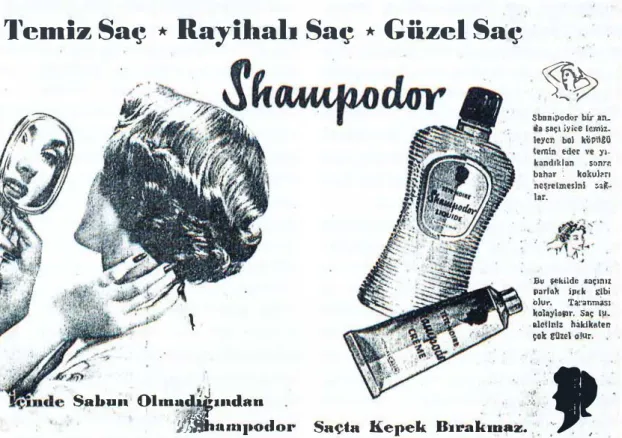
Hayat and Resimli Hayat were leading examples of media that served to frame and disseminate notions of how contemporary citizens should look. Their pages were packed with the latest vogue in clothing and advertisements for items such as nylon stockings and cosmetic products that promised beautiful skin and shining hair; advertised products included soap, lotion, shampoo and cologne-novelties in Turkey at that time (see Fig. 9.2). Articles, headlines and advertisements publicized an imported postwar expression of femininity, characterized by hygiene and fashion, symbolizing modernity. Such women as alluring citizens were conceptualized as national assets representing the country. For example, appearing on countless front covers and within the issues, GOnseli Ba9ar the Miss Turkey who won the European Beauty Pageant in 1952-was celebrated as a modern and Western face of Turkey. Her appearances matched the celebrity quality of royalty and Hollywood stars, further examples of glamorous Western imagery who were also widely portrayed in these magazines.17
Undoubtedly, Hollywood was (and still is) a powerful medium through which modes of fashion were propagated globally. ln the 1950s, for upper- and middle-class Turkish women living in urban contexts, Hollywood movies and their Turkish adaptations were the dominant means of entertainment and a source of inspiration in terms of contemporary looks. Many admired the fashions promoted in these movies and often saw them as a
The modern home, Western fashion and feminine identities in mid-twentieth-century Turkey 149
Temiz Sa�
*
Rayihah Sa�
*
Giizel Sa�
'
•iJ Sabun Obn�d.i,Landan
··�
1'l
'fn
•
DJUJ)Odor Sa�t.a Kepek.�
Sbnnipodor blr an_ da sa�1 lylce tcmit. leyen bol kopllRO temin cder ve y1. kand1klan sonrr. bahar . kokulu1 ne$retmeslnl �•it-. lar�•it-. • Bu f<)kildc sa�1n1t parlak lpek glbl blur. Taranma$, kolayloJir. Sa� tµ. olellnlt hiaklkaten �ok gUiel oJur ....
:
·
·,
.
.'t,, .,t
B:arak1naz. . . : , , Fig. 9.2. Advertisements for women's cosmetic producls depict the imported postwar expression of femininity, characterized by an enthusiasm for frivolity and hygienic confldence and symbolizing modernity. Hayat. 15 June 1956.
source for dress patterns. Reflecting the views of her generation of city-dwelling middle-class women, one interviewee commented that, 'Hollywood movies were a great source for dressing fashionably. If I liked a dress in a movie, I used to go and watch that movie again in order to precisely extract the pattern of that dress. I would take a piece of paper and pencil with me so that I could sketch the model and take notes as I watched the scenes with that dress in it. I made many dresses from movies.' 18 As another woman explained: 'My generation of women cared deeply about how they looked.
We weren't like today's youth, wearing jeans or wrinkled and saggy clothing in the name of fashion. We wore two-piece suits, sleek shirts, silk dresses ... we were chic.' 19
Fashion was an important preoccupation for the 1950s modern urban woman partly because it depicted the cultural and subjective experience of postwar capitalist society with which Turkey firmly identified in the Cold War years. Style of clothing was not only a visual representation of women's emancipation and a symbol of the republican reforms, but it also indicated a yearning for the new, as modernity does. Women's
150
..
.
engagement with fashion was a form of political take on liberation and announced an interest in embracing the new West, defined by the outcome of World War II. But what did the new West really offer in terms of women's liberation? What were some of the themes that engaged women with Cold War politics? What were the functions of individual and domestic appearances in playing out their (sociopolitical) role?
Eradicating certain elements of the past was an underlying theme of modernization. Abandoning the old suggested improving the present and bettering the future. Its replacement with new spatial and design elements in the city and at home, such as asphalt surfaces replacing dirt roads and modern bathroom and kitchen fixtures, plumbing, central heating and hot water and elevators, implied more comfortable and hygienic surroundings. In a homogenizing postwar world, modern would mean the same thing to people everywhere. 20 This was
the case behind the modernization efforts initiated by the Democrat Party and by Prime Minister Adnan Menderes, who came to power with the 1950 elections. Envisioning the country as 'little America', Menderes's urban renewal projects included building modern housing complexes and constructing new highway networks, which meant importing cars as well as technical and financial aid for building roads from the United States. New 'apartments instead of [old] houses [with inadequate equipment], asphalt instead of cobble stone, moreover a wide enough, beautiful road', as an article comparing the old and the new domestic architecture of Istanbul in Resimli Hayat proclaimed,
Performam;e, Fac;ltir;o anrJ the Modern lotE:rior
symbolized modern living and a desire to modernize major cities.21 Unfortunately, this involved clearing older buildings and demolishing the traditional urban fabric in the process of making room for the new. Modernization projects were widely rendered in the media. For example, Hayat magazines reported developments in architecture and urban planning in major Turkish cities and often showed large terrestrial and aerial photographs of urban development sites. The construction of new neighbourhoods, with modern homes and high-rise apartment buildings, wider boulevards and asphalted roads, public plazas and better-equipped or larger harbours, were celebrated as the building blocks of modern culture.22 Through portraying women in public life and public spaces, as well as in the home, popular magazines and major newspapers maintained the republican message that contemporary women, as liberated citizens, took pleasure in modern cities. A mass of photographs exhibiting stylish ladies in a la mode clothing at nightclubs, parties, balls, fashion shows, movie galas, beaches and, significantly, with cars (marking her mobility) was in line with the portrait of the ideal postwar woman painted in the United States. Also compatible with this ideal was the woman's assumed social role inside the house. Through images, texts and advertisements, the modern Turkish woman in the urban context was conceptualized as a (Western) homemaker and mother-in fact, no different from women in traditional and/ or rural settings, responsible for the order, hygiene and visual quality of the domestic domain. What was different from these settings, however, was that the modern
The modern home, Western fast,ion and feminine identities in mid-twentieth-century Turkey 151 Western woman was accompanied by men
in both the public and private domains. They socialized and entertained together. Famous men attending to household chores, such as preparing meals and serving drinks for guests, or pictures in the media of American husbands helping their wives in the kitchen, could be followed through the press. But any household task carried out by a husband for his wife beyond light assistance was not the norm. These examples, therefore, reinforced the conception of women as the primary custodians of the home (and men as their partial/insignificant/irregular helpers at best), rather than challenging their implicit social roles.23
Construction of gendered identities, as such, is rooted in assuming women as indiscretefrom thehouse.24 Because domestic space is often conceived as an inherent part of a woman's identity, the appearance of the home, its cleanliness and its physical qualities act as a reflection of her personality and expertise.25 Likewise, domestic space is
often conceived of as a paradigm expressing a woman's 'cultural capital' or (acquired) taste, which, according to Pierre Bourdieu, embodies the 'habitus' of the inhabitant.26 For Bourdieu, the ' determinant type of conditions of existence . . . (sexual division of labor, domestic morality, cares, strife, tastes, etc.), produce the structures of the "habitus", which become the basis of perception and appreciation of all subsequent experience'. 2' Hence, an individual's preferences depend on her or his habitus. As Bourdieu suggests: 'Every interior expresses, in its own language, the present and even the past state of its occupants, bespeaking the
elegant self-assurance of inherited wealth, the flashy arrogance of the nouveaux riches, the discreet shabbiness of the poor and the gilded shabbiness of "poor relations" striving
to live beyond their means. '28 The physical
conditions of the home embody layers of meaning through which class identity or group belonging is obtained. Accordingly, taste, as a socially and culturally formed and valued phenomenon manifested through spatial designs and objects, serves to indicate the ' distinction' of the residents.
The notion of distinction, suggesting being a member of a community in terms of social status, economic power, culture, civilization, civic identity, urbanity and modernity, constituted an important motivation for women in creating and maintaining the material quality of domestic space. This quality-embodied in the physical character of interior furnishings, fixtures, accessories and equipment-was a great cause of pride for women, and worked, as much as the style of clothing, to represent the gendered and modern identity of the individual as well as the sociocultural status and/or up-to-dateness of the family.29 One woman's memories
shed light on the power of distinction as a concept that suggests belonging by status: 'I gave away the old stuff that was left to me from my mother. Large copper pots and pans, rugs, chairs . . . Perhaps they would have been considered antiques today. But
I did not want them at the time because they were not considered modern. '30 The material culture of the domestic environment worked as a mechanism to define and establish a civic position-that is, being part of the Western/non-Western, urban/rural,
152
modern/traditional, new/old::::as related to the ideals of the nation. Middle- and upper middle-class Turkish women of the 1950s considered being a homemaker prestigious. This is not to say that these women did not pursue employment in the workplace, but the conception of modern women as Western-style housewives arguably mired their advancement in public life. On the other hand, it granted them a dynamic position in fashioning their environment and manipulated them into becoming amateur decorators, clients, users and consumers of and for the modern domicile.31
Advertisements for building materials, paint, window treatments, plastics and new synthetic flooring such as fiberboard and vinyl depicted homemakers as consumers in charge of domestic interiors during the mid twentieth century. These advertisements featuring drawings of stylish women holding paint rollers or glamorous ladies in nightgowns superimposed against American-system window blinds and American wallpapers with the motto, ·'Fabric adorns women, paper adorns wall[s]'-exemplify how women's gendered identities intertwined with notions of fashion, the modern home and consumerism (see Fig. 9.3).32 This social construction can
also be traced in Hayat, which published
decorating guides to creating contemporary and fashionable home interiors. The content in this and other media was often translated or adapted from Western sources since modern interiors were indexed to Western cultural capital. The substance reflects emerging trends in domestic design at the time; it also reveals how decoration is conceptualized as an important concern for
Performance, Fashion and the Modern Interior
women. For example, in an article entitled 'Simple Beauties inside the Home' -borrowed from Western sources-a 1952 issue of Resimli Hayat explains:
No matter how much we work outside the house, a big portion of our daily life is spent at home. Women especially attend to matters inside the home. That's why the better we arrange our houses, the more we decorate certain comers to please the eye, the more
delightful it becomes to us. 33
•
K U M A $
K A D I N I,
K A G
I T
D U V A R I
s i.i s I e r !
•
" WA R L A R "
Yeni in�aat ve Rufubefe kar�1 kullanilan Plastikli Mai halinde
•
<;imento
UNIVERSAL D•yoQlu, l•tlk161 C•ddul Y•nl H•n 320"324Fig. 9.3. Advenisements for building materials and finishes
exemplify how women's gendered Identities intenwined with nollons of fashion. femininity, the modern home and consumerism. Arlatakl, 193-4 (1948).
The modem home, Western fashion and feminine identities in mid-twentieth-century Turkey 153
In the same spirit, a decorating column that appeared regularly in 1958, entitled 'Practical Recommendations for Your Home', comprised drawings accompanied by instructions on how to modernize and improve the look of domestic spaces. The authoritative tone used in texts and captions such as 'You will change the upholstery of your furniture' and 'If you want to modernize your kitchen' recalls the manner of late nineteenth- and early-twentieth-century tastemakers and decorators in the United States and Europe.3'1 Suggesting how space should be manipulated and decorated through furniture arrangement. colour selection, window treatments, use of accessories and the like, they assumed the role of teaching desired notions of taste for modern lifestyles. Following the decorating column, a small section of the 1959 Hayat magazines entitled 'Beautiful Homes' displayed a shift in taste towards modern aesthetics expressed by unadorned designs. Towards the end of 1950s, mid-century modern emerged as a popular style in international architecture and interior design. Modernist planning precepts-most often characterized by open plans, flow of space, large glazed surfaces and interior-exterior continuity, as well as designs of sleek and undecorated furniture with slanted and/or thin metal or wooden legs, partitions, built-in closets, integrated storage units and indirect and cove lighting-made their mark in residential interiors. At this time, materials and finishes such as veneer, lacquer and plastic laminates such as Formica were used in furniture manufacturing. Although architectural journals of the time promoted modern designs as a way of mass-producing
inexpensive and functional furniture for everybody, in reality these designs were usually only available in upscale furniture stores. Thus, the demand for undecorated style was not because it was affordable, but because it was considered fashionable-a sign of being modern.35
Imported visuals promoted combined living and dining areas (referred to as salon salomanje, adapted from the French words of salon and sa//e a manger to Turkish). flowing spaces (for example study areas instead of study rooms, and airy or open kitchens), fireplaces and built-in furniture.36 One
commentary in Hayat stating that 'display sideboards are demode' also advised women to store their 'dishware and tea sets in closets' and was placed under a photograph of a chic woman in high heels pointing to dishware neatly organized inside a built-in closet.37 Such visuals and commentary exemplify how notions of fashion, femininity and domesticity were intertwined with concepts of contemporary interior design as signs of belonging to the capitalist West. This implicit assumption was embodied in the composition of that section of the magazine, which combined domestic interior design ideas with photographs of smiling women offering practical advice on household tasks, such as how to clean lamps and polish household metals (see Fig. 9.5). Codifying the contemporary woman in her relationship to domesticity, the photo composition in fact negotiates the gap between what it meant to be a modern or Western woman and a traditional or local woman, both of whom are tasked with managing the home. As these home sections and other combinations of
154
visuals suggest, towards the end of the 1950s many threads came together to represent the modern state in Turkey; these included the material culture of fashionable home interiors, architectural and urban renewal projects and a feminine culture depicting an image of the fashionable Western housewife.
Conceptualized as national assets represe nting the country, women played a critical role in spreading and normalizing state-led modernization and Westernization. Fashion as a cultural code helped transform women's
.... oa::
,
!:.&
.:.il
fjj -
1
-
:
: --�-: �-:-�-: :-::-.
-
:
-
.
'
_
-
�
-h
-
:
__ c .. '••••• ''* ' I t•ltot , - I J•• 11,•
•• "- \ J. I I,; \ I , t, a111 l M"' Iii ••
�" j! .. I,. IW••,h-1.on a..,a..-1�1� f Mlul ... .. , .. i,.J,. H f•\ tWI ..,.,.. ..
'' ••••• ,., \1,11 ....... o,kl,i.l,....,
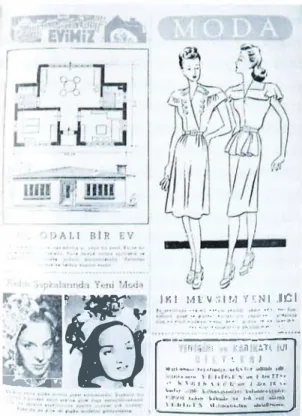
Fig. 9.4. A typical page layout of Yer.Jiytin pairing 'Our Home' and 'Fashion' sections. The former features new home plans that frame contemporary living, and the latter features Western fashions that frame modern women. Yll(Jjgtin, 25 September 1948.
Performance. Fashion anrJ the rllodem Interior
appearances and ideas around domestic interiors. While feeding political ideology, the trio of modern home, Western fashion and feminine identities reflected the collective cultural expression and women's acquired formation, embodying Turkish modernity. Identified with the contemporary home, women negotiated the difference between modern and traditional by simultaneously undoing the notion of captivity and enclosure associated with the Ottoman past and sustaining assumed gendered roles in the home and society at large.
This dual role is consolidated in the page layouts appearing first in YedigOn and later in Hayat magazines. YedigOn paired new house designs with Western fashions for the idealized woman (see Fig. 9.4). The style of clothing, purses, shoes and accessories implies how a modern Turkish woman dresses. To an extent, they depict women's preferences at a certain cultural formation and income level in urban areas but exclude most women living in traditional and/or rural settings. House plans, which had been included in the magazine since the 1930s, underscore the changes the Republic had already induced, namely eliminating gender segregation and emphasizing the nuclear family, conceptualized as the smallest unit of the state. House plans incorporate compact bathrooms with Western-style fixtures, new kitchen designs, and the equipment and furniture deemed necessary to acquire the idealized contemporary way of living. Houses are designed as extraverted structures, different from a typical Ottoman house with screens and high courtyard walls to keep the
The modern home, Western fashion and feminine identities in mid-twentieth-century Turkey 155
al-.nain
OLEKSIYONUNU T A K D 1 M EDER_
.. - -":-...____
...___
_
...
.
.
...
.
.
.
--
..
..-··--
...
.
__
...
---
...
..
-.�
_
.._
.. :-:._--: .=..::Fig. 9.5. A typical page layout of Haya/ pairing women·s fashion with the 'Beautiful Home' section. The composition reinforces and codifies the strong connection between women's clothing and domestic designs while framing contemporary looks. Hayat, 13 March 1959.
gaze of outsiders away from the household. The modern living rooms are given large windows, providing more sunlight and views than traditional ones. And unlike traditional layouts, rooms are assigned specific functions such as dining, sleeping, sitting and studying.38 Despite these changes, interior
space is usually compartmentalized partly to reflect sensitivity towards the still-prevalent sociocultural importance of privacy. Hayat's page composition echoes the changes in fashions, but the strong connection between women's clothing and home design
is still essential in framing and conveying sociocultural codes (see Fig. 9.5). Different from the 1930s and 1940s plans, designs reflect combined living and dining activities, which became a typical feature of architect designed residential schemes by the 1960s. There is more content on interior styles, furniture design, materials, finishes and accessories, and the general emphasis is on the cultural cliche of women as fashionable, skilful and proud homemakers. This cliche embodies various meanings. For one, it serves as a mechanism in solidifying a firm connection with the Western sphere. Second, it indicates a fallacy of women's liberation that the new West was offering through postwar politics in the early Cold War era. Further, the cliche structures a liminal position for women negotiating between traditional and modern identities in the local milieu. The simultaneous depiction of idealized women as liberal and domestic figures in popular media combined with lived experiences reveals how women were instrumental in playing out themes of being modern in 1950s Turkey.
Notes
1. M. Foucault, The Archaeology of Knowledge (Pantheon Books. 1972). See. in particular. 'The Discourse on Language', pp. 215-37.
2. From 2005 to 2007. I held in-depth interviews in an
informal life-history format with seventeen middle- and upper-middle-class women between 60 and 85 years old in lzmir, Istanbul and Ankara. The individuals lived in one of these major cities in the 1950s and 1960s and were consistent in terms of cultural background. For the most part, these Interviews and the research were a part of a larger study. See M. 6. Gi.irel , 'Domestic Space, Modernity,
156
and Identity: The Apartment in Mid-20th Century Turkey'. PhD dissertation, University of Illinois at Urbana-Champaign. 2007. p. 255.
3. H. Eroglu. Turk lnk,lap Tarihi [Turkish Revolution History] (Milli Egltim Basimevi, 1982). p. 324. Unless otherwise noted, all translations are my own.
4. Y. Arai. 'The Project of Modernity and Women in
Turkey', in S. Bozdogan and R. Kasaba, eds, Rethinking
Modernity and the National Identity in Turkey (University of
Washington Press. 1997), pp. 95-1 12.
5. Sabiha Gok9en (1913 - 2001) was the first Turkish
female aviator and military pi lot. She was also one or Ataturk's adopted daughters.
6. For more on this point and liberal representations
or women see S. Bozdogan. Modernism and Nation
Building: Turkish Architectural Culture in the Early Republic
(University of Washington Press. 2001), pp. 80-7. Arguably, this attitude was prevalent not onty In Turkey, but also in the majority of the West. However, Turkey had that much more of a hurdle to overcome because its change was so drastic.
7. For a similar argument see M. L. Roberts, 'Samson and Delilah Revisited: The Politics or Women's Fashion in 1920s France·. American Historical Review 98/3 (1993), p. 684.
8. I am inspired by the role or fashion as discussed in E. Wilson, Adorned in Dreams: Fashion and Modernity (Rutgers University Press. 2003), p. 12.
9. M. Foucault, The Archaeology of Knowledge. See in particular pp. 215-37.
10. As said by John Kenneth Galbraith, President J. F. Kennedy's aide on economics, 'It was accepted in the 1950s that ii the poor countries were not rescued rrom their poverty, the Communists would lake over.' J. K. Galbraith,
The Nature of Mass Poverty (Harvard University Press, 1979), pp. 3 1 - 2, quoted in M. H. Haefele. 'Walt Rostow·s Stages of Economic Growth: Ideas and Action', in D. C. Engerman, N. Gilman, M. H. Haefele and M. E. Latham, eds, Staging Growth: Modernization, Development and
the Global Cold War (University or Massachusetts Press, 2003), p. 84.
11. For this argument see M. 6. GOrel, 'Defining and Living Out lhe Interior: The "Modern" Apartment and the "Urban" Housewife in Turkey during the 1950s and 1g6os·, Gender. Place & Culture 16/6 (2009), pp. 703-22.
12. F. Giroud quoted in K. Ross, Fast Cars, Clean Bodies:
Decolonization and the Reordering of French Culture (MIT
Press, 1995), p. 79.
13. Haya/ was published by $evket Rado.
14. 6. Sage,. 'Ozan Sagd1c; ile Birlikte' [With Ozan Sagd1c;J,
Fotografya 10 (August 2001), hltp://64.233. 161.104/ search?q=cache:dmlvLXgo8koJ:www.fotografya.gen.
Performance, Fashion -ind the Modem Interior
tr/issue-1 0/cadi_kazani.lltml+hayat +mecmuasi&hl=tr, accessed 18 January 2006. All of the interviewees read Haya/ with great enthusiasm at the time and Identified it as a very popular magazine.
15. Yedigiin was published by Seclat Simavi.
16. Photograpt1ers included Ara Guler and Ozan Sagd19.
17. Among the most covered royal ligures were Grace
Kelly, Princess of Monaco; Queen Elizabeth and Princess Margaret of England; Princess Soraya (SOreyya), former wife of the late Reza Pahlavi; and the former empress Farah Pahlavl of Iran.
18. Interview with a middle-class housewife born in 1930,
conducted by the author in lzmir on 21 July 2007.
19. Interview with an upper-middle-class housewife born in
1927, conducted by the author in lzmir on 21 July 2007.
20. For debates on modernization see N. Gilman.
Mandarins of the Future: Modernization Theory in Cold War America (Johns Hopkins University Press, 2007).
21. 'Tezatlar memleketi Istanbul' [Country of Contrasts
Istanbul], Resimli Haya/ (January 1954), p. 31.
22. For some examples of urban development projects
published in Haya/ see 'Mustakbel Qehresi ile lzmir' [lzmir with Its Future Appearance], Haya/ (12 April 1957), pp. 10-1 10-1 ; 'Mersin Umani· [Mersin Harbor), Hayat (10-14 June 10-1957), pp. 16-17; 'Atatork Bulvan' [AtatOrk Boulevard). Hayat (21 November ·1958), p. 1; 'Yeni Qehresi ile Ankara' [Ankara with Its New Appearance], Hayat (5 December 1958), p. 1 2 -13; 'Alsancak Umani' [Alsancak Harbour], Hayat (10 October 1958) p. 1 2 -13; 'lzmir Limani tamamlarnyor' tlzmir Harbour Is Being CompleteclJ, Haya/ (6 June 1958).
23. As argued by Foucault. disagreements, abnormalities
and conflicts, more than unified ideas or opinions, contribute to the discursive formation of an object. M. Foucault, The
Archaeology of Knowledge, see in particular pp. 215-37.
24. My references related to this argument include.
A. Oakley, Housewife (Penguin Books, 1976); Q. Ka91t91ba$1, ed., Sex Roles, Family and Community in
Turkey (Indiana University Turkish Studies, 1982); M.
Wigley, 'Untitled: The Housing of Gender', in 8. Colomina, ed., Sexuality and Space (Princeton Architectural Press, 1991), pp. 326-90; L. Davidoff, J. t.:Esperance and H. Newby, 'Landscape with Figures: Home and Community in English Society', in L. Davidoff, Worlds Between: Historical
Perspectives on Gender and Class (Polity Press, 1995),
pp. 41- 7 2 ; F. 6zbay, 'Houses, Wives and Housewives·. in E. M. Komut, ed., Housing Question of the Others (Chamber
of Architects. 1996), pp. 49-59.
25. For elaboration on 11,is point with regard to the production of social identities through women's performativity In the context of apartment living in Turkey see GOrel, 'Defining and Living Out the Interior'. pp. 703-22.
The modern home, Western fashion and feminine Identities in mid- twentieth-century Turkey 157
26. This abstract concept refers to the conceptual world
of a person ancl includes experiences, upbringing, bel iefs and education. P. Bourdieu. Distinction: A Social Critique of the Judgement of Taste (Harvard University Press, 1984).
27. P. Bourdieu, Outllne of a Theory of Practice, tr. R. Nice (Cambridge University Press, 1977), p. 78.
28. Bourdieu, Distinction, p. 77.
29. See note 2.
30. Interview with an upper-middle-class housewife, conducted by the author in lzmir on 1 7 October 2005. Similar comments were made by a number of interviewees, all of whom were over the age of 70.
31. Gural , 'Defining and Living Out the Interior', p. 717. 32. Arkitekt ( 1946-1965). This was the first professional
architectural journal in Turkey, which started publication under the name Mimar in 1931 . The journal was renamed Arkitekt in 1933.
33. 'Evin i9inde basil guzellikler' [Simple Beauties inside
the Home], Resimli Hayat (August 1952), p. 37.
34. Seminal sources for such an authoritative tone include E. de Wolfe. The House in Good Taste (Century
Company, 1913); E. Wharton and 0. Cadman, The
Decoration of Houses (B. J. Batsford, 1898); C. Wheeler, Principles of Home Decoration: With Practical Examples
(Doubleday, Page & Company, 1903); H.J. Jennings,
Our Homes, and How to Beautify Them (Harrison &
Sons, 1902); L. A. Throop, Furnishing the Home of Good
Taste (New York, McBride, Nast & Company, 1912);
L. H. French, Homes and Their Decoration (Dodd, Mead
and Company, 1903).
35. M. 6. Gural , 'Consumption of Modern Furniture as a
Strategy of Distinction in Turkey', Journal of Design History 22/1 (2009), pp. 47-67.
36. See 'Guzel Yuva' [Beautiful Home]. Hayat (13 March 1959), p. 21; 'Guzel Yuva', Hayat (17 April 1959), p. 23; 'Guzel Yuva', Hayat (13 March 1959), p. 21; 'Guzel Yuva', Haya/ (6 March 1959), p. 21; 'Guzel Yuva', Hayat (24 April 1959), p. 25; 'Guzel Yuva', Hayat (20 March 1959), p. 23; 'Guzel Yuva', Hayat(15 May 1959), p. 21.
37. 'Guzel Yuva', Hayat (3 April 1959), p. 26.
38. A. Batur, '1925-1950 Doneminde TLJrkiye Mimarhg1 '
[furkish Architecture in the Period of 1925-1950], in Ydd1z Sey, ed., 75 Yllda Degi$en Kent ve Mimarlik (Tarih Vakf1,