549
Rojan Gümüş1, Mehmet Ufuk Aluçlu2, Seyfettin Sarıbaş3
Abstract
Objective: The aim of this study was to provide information on utilization of home health care services provided by government
and determine health status of children and young people who received this medical care.
Methods: Data for 576 patients who were followed and recorded by the health staff of the Ministry of Health between 2010 and
2015 were used in this study. Of these patients 234 (40.63 %) were female and 342 (59.37%) were male. The patients were divided into three age groups: 0-6 years of age: 93(16.15%), 7–14 years of age:219 (38.02%), and 15–22 years of age: 264 (45.83%).
Results: There was no significant difference in gender between the age groups (χ2=1.077, p>0.05). In 2015, there was an
increase in the prevalence of home care services across all age groups (χ2=38.734, p<0.01). Diyarbakir Children Hospital was more efficient than other hospitals (χ2=42.230, p<0.01) in providing this medical care. The most common diseases seen among these young patients were central nervous system diseases, neurodevelopmental diseases, and acquired brain injuries. In addition, epilepsy, SSPE, and cerebral palsy were also widely prevalent among this group of children and youth. The prevalence of cerebral palsy was larger in the 0–6 and 15–22 age groups (χ2=6.491, p<0.05). A prevalence of central nervous system diseases was seen most in the 0–6 age group (χ2=11.937, p<0.01). Apart from these, there were no other significance diseases observed by gender or age groups.
Conclusion: After favorable adjustments to public home care services, an increase was seen in the utilization of services in
recent years. As disabled patients need health care in their homes, this service has to be a primary goal for governments in order to provide them with a higher quality of life. Key words: Home care, children, youth, health status, Turkey 1 Dicle University, Atatürk Health Vocational School, Diyarbakır, Turkey 2 Dicle University, Department of Neurology, Diyarbakır, Turkey 3 Directorate of Public Health, Diyarbakır, Turkey Corresponding author: Rojan Gumus, Dicle University, Atatürk Health Vocational School, Diyarbakır, Turkey e-mail:[email protected]
Health Status of Disabled Children and Youth Receiving Public Home Care
Services Between 2010 and 2015 in Diyarbakir, Turkey
ORIGINAL ARTICLE
ÖzetAmaç: Bu çalışmanın amacı Diyarbakır ilinde son beş yılda Sağlık Bakanlığı hastaneleri tarafından verilen evde bakım
hizmetlerinden yararlanan çocuk ve gençlerin sağlık durumlarının araştırılmasıdır.
Yöntemler: Araştırmaya hastanelerin ilgili birimleri tarafından 2010-2015 yılları arasında izlenen ve kaydı tutulan 576 hasta dahil edildi. Bu hastaların 234’ü (%40.63) kız, 342’si (%59.37) erkektir. Çocuk ve gençler 93’ü (%16,15) 0-6 yaş, 219’u (%38,02) 7-14 yaş ve 364’ü (45.83) 15-22 yaş olmak üzere üç gruba ayrıldı.
Bulgular: Yaş grupları arasında kız ve erkek hastaların sayıları arasında bir fark bulunamadı (χ2=1.077, p>0.05). 2015’te tüm
yaş gruplarında evde bakım hizmetlerinden faydalanma açısından belirgin bir artış görüldü (χ2=38.734, p<0.01). Diyarbakır Çocuk hastanesi diğer hastanelerle kıyaslandığında diğer hastanelerden daha fazla hizmet sağladığı görüldü (χ2=42.230, p<0.01). İncelediğimiz hasta gruplarında en çok görülen hastalıklar merkezi sinir sistemi hastalıkları, nörogelişimsel bozukluklar, epilepsi, SSPE ve serebral palsidir. Serebral palsi hastalığı en çok 0-6 ve 15-22 yaş gruplarında görülürken (χ2=6.491, p<0.05), merkezi sinir sistemi hastalıkları 0-6 yaş grubunda daha fazla gözlendi (χ2=11.937, p<0.01). Diğer hastalıkların prevalansları incelendiğinde yaş grupları ve cinsiyet grupları arasında önemli başka bir fark bulunmadı.
Sonuçlar: Son yıllarda Türkiye’de devlet tarafından evde bakım hastalarına sağlanan sağlık hizmetlerindeki iyileştirmeler bu
hizmetten yararlanan hasta sayısını çok fazla arttırmıştır. Engelli ve evden çıkamayan hastaların bu hizmete ne kadar çok ihtiyaç duyduğu düşünüldüğünde, devlet kurumlarının bu dezavantajlı hasta gruplarına sağlık hizmeti sunmayı ilk hedeflerden biri olarak benimsemesi gerektiği açıktır. Anahtar kelimeler: Evde bakım, Çocuk, Genç, Sağlık Durumu, Türkiye Diyarbakır’da 2010-2015 Yılları Arasında Sağlık Bakanlığı Hastaneleri Tarafından Evde Bakılan Çocuk ve Gençlerin Sağlık Durumları Üzerine Bir Araştırma Received :31 Aug 2016; Revised:27 Sept 2016; Accepted :02 Oct 2016
43(4) 2016 www.diclemedj.org 550 INTRODUCTION
Disability in children is defined by the United Nations as “long term intellectual, mental, physical, or sensory impairments that can create barriers for children up to the age of 18 in living a complete and productive life as equals with other individuals of society” [1]. According to the World Report on Disability, over one billion people have some form of disability and approximately over one million of them are children between the ages of 0 to 18 years [2]. These children are the unluckiest members of the population as they face many difficulties attending school and accessing medical services. They are also at a higher risk of physical abuse.
Disabled children need additional support including rehabilitative care, surgical intervention, and basic medication. In developed countries, this support decreases morbidity and mortality rates among disabled children, but in low and middle-income countries there is a lack of healthcare services provided by public and healthcare institutions [3]. Many kinds of disabilities can be seen in the early ages of childhood. Some of the most common diseases are neurodevelopmental disorders (intellectual disability, autism spectrum disorders, genetic disorders such as fragile X syndrome, down’s syndrome and motor diseases such as developmental coordination disorder), central nervous system disorders (encephalitis, meningitis, multiple sclerosis, spinal cord disorders and spastic paraparesis), acquired brain injuries (caused by trauma to the head, falls, strokes, bleeding in the brain, oxygen deprivation, infections, exposure to toxic substances and brain tumors), and musculoskeletal disabilities (clubfoot, hip dysplasia, orthopedic trauma, fractures, muscular dystrophy, and scoliosis) [4–12].
Compared to normal children, children who have disabilities are two to three times more likely to be suffering from anxiety and depression, hyperactivity or inattention, and
emotional problems. Although disabled patients have to use more health care services than other people, the percentage of disabled patients who access health services is lower than those who are not disabled. Disability is associated with a reduced quality of life, lower socio-economic status, and large economic costs. Expenditures by disabled people for health services do not depend on age, but on how severe the disability is [5–6,8].
Being disabled greatly affects the child’s life and their health. In the last decade, there has been a rapid increase in chronic childhood conditions that has led to an increasing number of younger adults with disabilities and chronic illnesses, which in turn has made provisioning for the medical care of younger individuals a necessary goal of health care providers. Besides medical care given in hospitals and other institutions, this special care can be provided efficiently in the homes of disabled patients, which also mitigates the difficulties they have regarding transportation. Additionally, administration of in-home medication plays an important role in the rehabilitation of these patients [11–12].
A home care service includes a very comprehensive list of services such as medical social services, physical therapy, nursing care, and speech-language therapy [13]. It also covers a wide combination of different kinds of functions such as catheter care, administering injections, conducting psychological assessments, wound care, disease education, oxygen therapy, medication reminders, pain management, and nutritional evaluation. These services are conducted by skilled professionals such as medical practitioners, nurses, physical therapists, or home health aides who generally work for private home health care agencies, municipalities, and public institutions to help patients live with a greater degree of independence, assist the patient to continue to live at home, and improve the patient’s health [14–15]. Sometimes physicians propose this
43(4) 2016 www.diclemedj.org 551
care, but generally it is requested by family members or the patients themselves [13,16]. Home care services can save cost in addition to improving the comfort of patients. Since the 1990s, home-based health care has grown regularly in developed countries and has become very important. However, in Turkey, the issue was not seriously addressed by the government until 2010. In Turkey, all health services are provided by public and private sectors. Public health services are under the auspices of the Ministry of Health and implemented by the Social Security Institution (SSI). After the transformation of health programs, private sectors also began to provide home health services. As the Ministry of Health is the main provider of primary and secondary health care, it is responsible for health services and health policies in the country, including amendments for in-home medical care services. The most serious regulation was made by Law 2551 in March 2005 and published in the Official Newspaper [17]. This regulation provided the first official definition regarding the deliverance of in-home medical care services. Next came Directive 3895, “the Implementation of Health Care Services at Home” in February 2010 that detailed all kinds of home care services, responsible staff, necessary material, and tools as stated by the Ministry of Health [18].
After 2010, it was compulsory for public hospitals to provide hom care services which led to an expansion of utilization of home health care services by patients in need. In Diyarbakır, Turkey, between 2010 and 2013, these services were provided by the Diyarbakir Directorate of Health Services. Since 2013, the Secretary General of the Association of the Public Hospitals has been tasked with providing home health care services. The Coordination Center of Home Health Care Services was founded in the greater Diyarbakır Public Health Center in order to coordinate the services. Five hospitals in the city center and seven in other districts of Diyarbakır are
connected to this center. Six medical practitioners, one nurses, and twenty-seven other skilled staff work at this center. The subject of this study is home care services provided by the Diyarbakır Directorate of Health Service and the Secretary General of the Association of the Public Hospitals between 2010 and 2015. Data for children and youth receiving public home care services were followed and recorded by the health staff of the Ministry of Health during last five years. Ethics committee approval was obtained from the Dicle University Hospital upon request of the Ministry of Health.
METHODS
In this study, data was compiled on 576 children and young individuals aged between 0 and 22 who received home care in 2010–2015 at the city center or one of the seven districts of Diyarbakir. As all of children and young patients who utilized home care services were included in the study, any of sampling method was used. Children and young individuals in the three age groups were compared according to gender, most common diseases, hospitals, and years. Descriptive statistics and chi-square tests were performed using an SPSS 21 statistical package program. As the diseases recorded by the health staff were very diverse, it was necessary to classify them into several groups in order to obtain statistics.
When the data was analyzed, we found that all of the participants were either intellectually or physically disabled. In the literature, we investigated that various studies have classified common disability types in many different ways [4–5,8,10–12,19–21]. Diseases recorded by the health staff of the Ministry of Health were classified, and the seven most common groups were taken into account. These seven groups included the following diseases:
1.Epilepsy (neurological diseases characterized by epileptic seizures)
43(4) 2016 www.diclemedj.org 552
3.Musculoskeletal disabilities (clubfoot, hip dysplasia, orthopedic trauma, fractures, muscular dystrophy and scoliosis)
4.Cerebral palsy (hemiplegia, diplegia and athetoid and ataxic)
5. Acquired brain injury (caused by traumatic forces to the head, falls, stroke, bleeding in the brain, oxygen deprivation, infections, exposure to toxic substances and brain tumors)
6.Other neurodevelopmental disorders (intellectual disabilities, autism spectrum disorders, genetic disorders such as fragile X syndrome, down’s syndrome, and motor diseases such as developmental coordination disorder)
7.Other central nervous system disorders (encephalitis, meningitis, multiple sclerosis, spinal cord disorders and spastic paraparesis). Hospitals that provide home health care service at Diyarbakir city center are Gazi Yaşargil Education and Research Hospital, Selahaddin Eyyubi Public Hospital, Diyarbakir Obstetrics and Gynecology Hospital, and Diyarbakir Children Hospital. District services are provided by the Ergani Public Hospital, Bismil Public Hospital, Çermik Public Hospital, Çınar Public Hospital, and Dicle Public Hospital. When the hospitals were investigated, we discovered that the greatest number of child patients who used in-home medical care were receiving care from the Diyarbakır Children Hospital, so this led to the hospitals being classified as the Diyarbakir Child Hospital and the others.
RESULTS
Table 1 illustrates the frequencies and chi-square results for these 576 children and young patients by age groups, sex, years, and hospitals.
As can be seen from Table 1, there was no significant difference when age groups were compared by sex (χ2=1.077, p>0.05). When the prevalence of the most common diseases were compared according to age groups, a significant difference was found between the groups Table 1. Distribution of parameters by age groups 0-6 years n(%) 7-14 years n(%) 15-22 years n(%) χ2 P Sex Female 42 (45.2) 89(40.6) 103(39.0) 1.077 0.584 Male 51 (54.8) 130(59.4) 161(61.0) Total 93 (100) 219 (100) 264 (100) Diseases Epilepsy 8 (8.6) 35 (16.0) 31 (11.7) 34.394 0.001* SSPE 8 (8.6) 26 (11.9) 55 (20.8) Musculoskeletal disabilities 15 (16.1) 30 (13.7) 39 (14.8) Cerebral palsy 24 (25.8) 35 (16.0) 63 (23.9) Acquired Brain Injury 5 (5.4) 17 (7.8) 13 (4.9) Other neurodevelopmental disorders 15 (16.1) 54 (24.6) 45 (17.0) Other central nervous system disorders 18 (19.4) 22 (10.0) 18 (6.8) Total 93 (100) 219 (100) 264 (100) Years 2010-2013 8 (8.6) 21 (9.6) 52 (19.7) 38.734 0.001 2014 3 (3.2) 2 (0.9) 28 (10.6) 2015 82 (88.2) 196 (89.5) 184 (69.7) Total 93 (100) 219 (100) 264 (100) Hospitals Diyarbakir Children Hospital 59 (63.4) 150 (68.5) 106 (40.2) 42.230 0.001 Other hospitals 34 (36.6) 69 (31.5) 158 (59.8) Total 93 (100) 219 (100) 264 (100) (χ2=34.394, p<0.001). This difference was then analyzed and is illustrated in Table 2. Table 1 shows that in 2014 and 2015 there was a significant increase in the use of in-home medical care services by children and youth (χ2=38.734, p<0.001). There was a significant difference when age groups were compared by hospitals. The Diyarbakir Children Hospital was more efficient in utilization of home health care services for the 0–6 age group than the other hospitals (χ2=42.230, p<0.001). A statistical analysis was performed to investigate the differences between the prevalence of diseases
43(4) 2016 www.diclemedj.org 553
between the age groups. In Table 2, the frequencies and chi-square results can be seen. Table 2: Prevelance of diseases by age groups 0-6 years n(%) 7-14 years n(%) 15-22 years n(%) χ2 p Diseases Epilepsy Yes 8 (8.6) 35 (16.0) 31 (11.7) 3.706 0.157 No 85(91.4) 184(84.0) 233(88.3) SSPE Yes 8 (8.6) 26 (11.9) 55 (20.8) 0.799 0.671 No 85(91.4) 193(88.1) 209(79.2) Musculoskeletal disabilities Yes 15 (16.1) 30 (13.7) 39 (14.8) 0.324 0.851 No 78(83.9) 189(86.3) 225(85.2) Cerebral palsy Yes 24 (25.8) 35 (16.0) 63 (23.9) 6.491 0.039* No 69(74.2) 184(84.0) 201(76.1) Acquired Brain Injury Yes 5 (5.4) 17 (7.8) 13 (4.9) 1.785 0.410 No 88(94.6) 202(92.2) 251(95.1) Other neurodevelopmental disorders Yes 15 (16.1) 54 (24.6) 45 (17.0) 5.306 0.070 No 75(83.9) 165(75.4) 219(83.0) Other central nervous system disorders Yes 18 (19.4) 22 (10.0) 18 (6.8) 11.937 0.003** No 75(80.6) 197(90.0) 246(93.2) Total 93 (100) 219 (100) 264 (100)
Table 2 shows that there were no significant differences in the prevalence of epilepsy (χ2=3.706, p>0.05), SSPE (χ2=0.799, p>0.05), and musculoskeletal disabilities (χ2=0.324, p>0.05) and acquired brain injuries (χ2=1.785, p>0.05) between the age groups. The prevalence of cerebral palsy was larger in the 0–6 and 15–22 age groups (χ2=6.491, p<0.05). As seen in Table 2, there was a significant difference in the prevalence of other central nervous system disorders, seen more often in the youngest age group of 0–6 years (χ2=11.937, p<0.01).
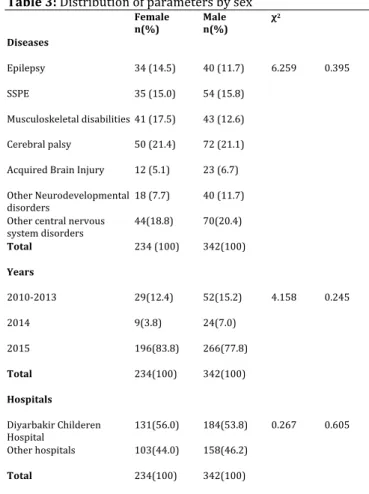
In Table 3, diseases, years, and hospitals were compared by sex. Table 3: Distribution of parameters by sex Female n(%) Male n(%) χ 2 Diseases Epilepsy 34 (14.5) 40 (11.7) 6.259 0.395 SSPE 35 (15.0) 54 (15.8) Musculoskeletal disabilities 41 (17.5) 43 (12.6) Cerebral palsy 50 (21.4) 72 (21.1) Acquired Brain Injury 12 (5.1) 23 (6.7) Other Neurodevelopmental disorders 18 (7.7) 40 (11.7) Other central nervous system disorders 44(18.8) 70(20.4) Total 234 (100) 342(100) Years 2010-2013 29(12.4) 52(15.2) 4.158 0.245 2014 9(3.8) 24(7.0) 2015 196(83.8) 266(77.8) Total 234(100) 342(100) Hospitals Diyarbakir Childeren Hospital 131(56.0) 184(53.8) 0.267 0.605 Other hospitals 103(44.0) 158(46.2) Total 234(100) 342(100)
When diseases were compared by gender, there was no significant difference (χ2=6.259, p>0.05). Also, we could not find any difference between years (χ2=4.158, p>0.05) and hospitals (χ2=0.267, p>0.05) by sex.
DISCUSSION
There was no significant difference between any of the age groups according to sex. This finding was in conflict with some other studies that have found greater disability prevalence in males [5–6,22–27]. However, the findings of the instant study were compatible with other studies [4,19,28]. When the most common diseases among disabled children and youth were compared, neurodevelopmental disorders (intellectual disability, autism spectrum disorders, genetic disorders such as fragile X syndrome, down syndrome and motor diseases
43(4) 2016 www.diclemedj.org 554
such as developmental coordination disorder) and central nervous system disorders (encephalitis, meningitis, multiple sclerosis, spinal cord disorder and spastic paraparesis) were common. Also, acquired brain injuries, cerebral palsy and musculoskeletal disorders were most common. These findings were compatible with many studies that found the same greater prevalence of these diseases [4– 12]. Also in some review and meta-analysis studies, these diseases were referred to as the most common diseases among disabled children and youth [19–20,29].
There was a significant difference when diseases were compared according to age groups. Cerebral palsy was seen more in the 0– 6 and 15–22 age groups. Other central nervous system disorders diseases (encephalitis, meningitis, multiple sclerosis, spinal cord disorder, spastic paraparesis) were more common in the 0–6 age group.
There was a significant difference between three periods, before 2014, 2014, and 2015 regarding home care for all age groups. As home care services began to become compulsory in all public hospitals in recent years, it has continued to become more widespread in the last two years. Districts hospitals began to provide these services only one year ago; hence, services in the city center hospitals are still more efficient.
There is also a significant difference in care for these age groups from hospitals in the city center because of the fact that most of these hospitals only provide care for adults. For these age groups, care is provided mostly by the children hospital.
CONCLUSION
Addressing disability among children and youth is a very important issue for medical health care providers. Although it is possible to prevent some disabilities in the early ages of life, improving the quality of medical care may change many more lives of children and young patients. Also these patients require special care, which makes it ideal, more economical,
and comfortable to make such services available in their homes. Home care services supplied by public or private health institutes has changed in the last decade as chronic illnesses have increased in every age group due to many factors including industrialization that has exposed more people to chemicals, changes in food consumption, and lack of physical activity.
In Turkey, since 2010, in-home medical care has been widely supported by the government. In the last five years, it has become compulsory for all public hospitals to have a distinct unit dedicated to providing home care. This study demonstrates that policy legislation for health care services to be provided in the home are generating successful results. In the last five years, this study is the only one to examine the utilization of home health services for disabled children and youth in Diyarbakir. We believe that it will be useful for researchers to continue to conduct studies in this field.
Declaration of Conflicting Interests: The
authors declare that they have no conflict of interest.
Financial Disclosure: No financial support
was received.
REFERENCES
1. United Nations , Convention on the Rights of the Child, G.A. Res. 44/25, U.N. GAOR, 44th Sess., Supp. No. 49, U.N. Doc. A/44/49, 1989 Available from:http://www.unicef.org/crc/ 2. World Health Organization, World Report on Disability.
Geneva: WHO/World Bank, 2011, Available from:
http://www.who.int/disabilities/world_report/2011/en/index .html
3. UNICEF, Children and Young people with disabilities:Fact Sheet, 2013 Available from: http:// www.unicef.org/ disabilities/files/Factsheet_A5__Web_NEW.pdf
4. Cornelius LR, Van der Klink JJL., De Boer M, et al. High prevalence of early onset mental disorders among long-term disability claimants. Disabil Rehabil 2016;38:520-27.
5. Etherington N, McDougall J, DeWit D, et al. Maternal factors and the emotional and behavioural functioning of adolescents with chronic health conditions. Disabil Rehabil 2015;37:1-11 . 6. Maart S, Jelsma J. Disability and access to health care a community based descriptive study, Disabil Rehabil 2014;36:1489-93.
7. Perrin JM, Bloom SR, Gortmaker SL. The increase of childhood chronic conditions in the United States. JAMA 2007;297:2755–59.
8. Andrews J, Falkmer M, Girdler S. Community participation interventions for children and adolescents with a
43(4) 2016 www.diclemedj.org 555
neurodevelopmental intellectual disability: a systematic review, Disabil Rehabil 2015;37:825-33.
9. McDougall J, Wright V, DeWit D, et al. Based functional components and contextual factors as correlates of perceived quality of life for youth with chronic conditions, Disabil Rehabil 2014;36:2143-51.
10. Sawyer SM, Drew, Yeo MS, et al. Adolescents with a chronic condition: Challenges living, challenges treating. Lancet 2007;369:1481–89.
11. Lightfoot J, Sloper M. Having a Say in Health: Involving Young People with a Chronic Illness or Physical Disability in Local Health Services Development. Children & Society 2003;4:277-90.
12. McColl MA, Shortt S, Gignac M, et al. Disentangling the effects of disability and age on health service utilisation, Disabil Rehabil 2011;33:1253-61.
13. Ellenbecker CH, Samia L, Cushman MJ, Alster K. Patient Safety and Quality in Home Health Care. 2008 [Internet]
Available from:
http://www.ncbi.nlm.nih.gov/books/NBK2631/ Accessed:
01.02.2006.
14. Önder T, Anuk T, Kahramanca Ş, et al. Evde bakım hizmetinden yararlanan hastaların sosyodemografik özellikleri ve tıbbi durumlarının değerlendirilmesi, Dicle Tıp Dergisi 2015;42:342-45.
15. Parkes J, McCullough N, Madden A. To What extent do children with cerebral palsy participate in everyday life situations? Health and Social Care in the Community 2010;18:304-15.
16. Hayles E, Jones A, Harvey D, et al. Delivering healthcare services to children with cerebral palsy and their families: a narrative review, Health and Social Care in the Community 2015;23:242–51.
17. General Directorate of Development of Legislation and Publication (2015) Implementation of Health Care Services at Home .Official Journal No: 25751, Ankara. Available at: http://www.mevzuat.gov.tr/Metin.Aspx?MevzuatKod=7.5.754 2&sourceXmlSearch=&MevzuatIliski=0 (accessed on 8 February 2016) .(In Turkish)
18. The Ministry of Health, Directive on procedures and applications of home health care services , Ankara, February, 2010 [Internet] Available from:
http://www.saglik.gov.tr/TR/dosya/1-
72726/h/son-yonerge.doc , Accessed: 06.02.2016. (In Turkish)
19. Anaby D, Hand C, Bradley L, et al The effect of the environment on participation of children and youth with disabilities: a scoping review, Disabil Rehabil 2013;35:1589-98. 20. Alford V, Ewen S, Webb G J, et al. The use of the International Classification of Functioning, Disability and Health to understand the health and functioning experiences of people with chronic conditions from the person perspective: a systematic review, Disabil Rehabil 2015;37:655-66.
21. McDowell BC, Duffy C, Parkes J. Service use and family-centred care in young people with severe cerebral palsy: a population-based, cross-sectional clinical survey, Disabil Rehabil 2015;37:2324-29.
22. Giallo R, Gavidia-Payne S. Child, parent and family factors as predictors of adjustment for siblings of children with a disability. Journal of Intellectual Disability Research 2006;50:937–48.
23. Amiet C, Gourfinkel-An I, Bouzamondo A, et al. Epilepsy in Autism is Associated with Intellectual Disability and Gender: Evidence from a Meta-Analysis, Biol Psychiatry 2008;64:577-82.
24. Sen E, Yurtsever S. Difficulties Experienced by Families With Disabled Children. Journal for Specialists in Pediatric Nursing 2007;12:238–52.
25. Maher CA, Toohey M, Ferguson M. Physical activity predicts quality of life and happiness in children and adolescents with cerebral palsy, Disabil Rehabil 2016;38:865-69.
26. Palisano RJ, Almarsi N, Chiarello F, et al. Family needs of parents of children and youth with cerebral palsy. Child: Care, Health and Development 2010;36:85–92. 27. Brereton A, Tonge B, Einfeld S, Psychopathology in Children and Adolescents with Autism Compared to Young People with Intellectual Disability,j Autism Dev Disord 2006;36:863-70. 28. Rezaee ME, Pollock M. Multiple Chronic Conditions Among Outpatient Pediatric Patients, Southeastern Michigan, 2008– 2013. Prev Chronic Dis 2015;12:140-49.
29. Oeseburg B, Dijkstra GJ, Groothoff JW, et al. Prevalence of Chronic Health Conditions in Children With Intellectual Disability: A Systematic Literature Review , Intellectual and Developmental Disabilities 2011;49:59-85.